

|
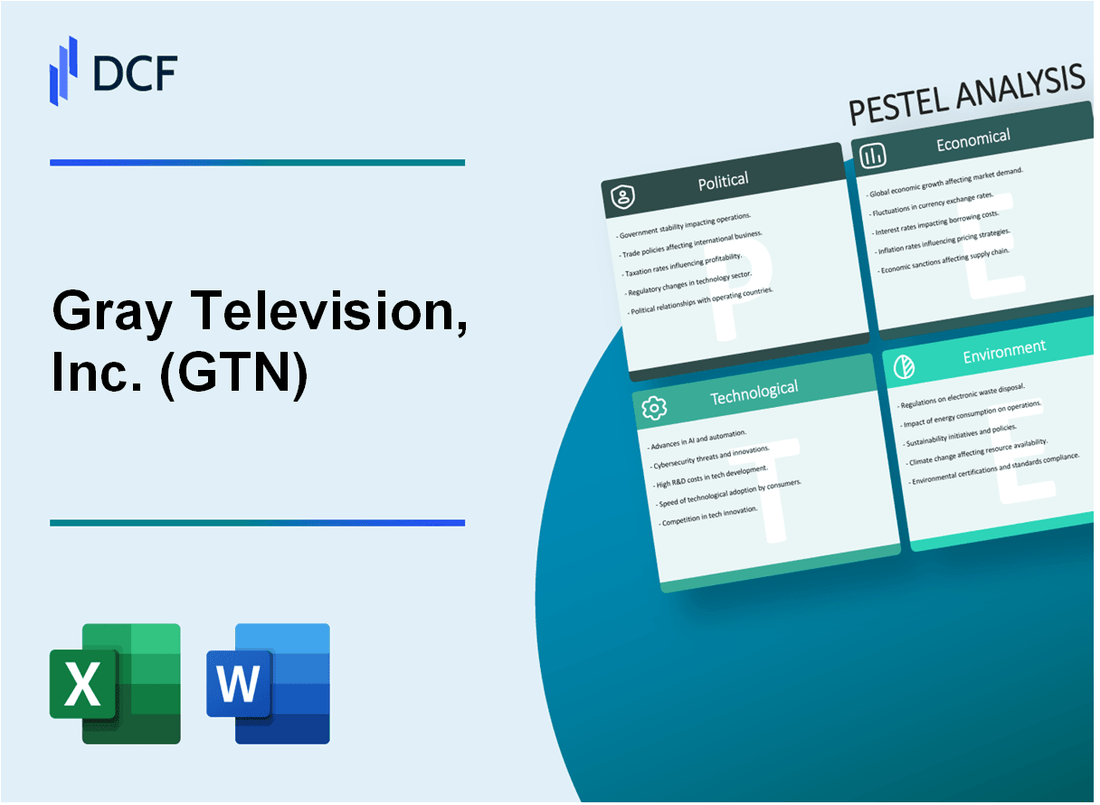
Grey Television, Inc. (GTN): Análise de Pestle [Jan-2025 Atualizado] |
Totalmente Editável: Adapte-Se Às Suas Necessidades No Excel Ou Planilhas
Design Profissional: Modelos Confiáveis E Padrão Da Indústria
Pré-Construídos Para Uso Rápido E Eficiente
Compatível com MAC/PC, totalmente desbloqueado
Não É Necessária Experiência; Fácil De Seguir
Gray Television, Inc. (GTN) Bundle
No cenário dinâmico da transmissão da mídia, a Gray Television, Inc. (GTN) fica na encruzilhada de desafios regulatórios, econômicos e tecnológicos complexos. Essa análise abrangente de pestles revela as forças multifacetadas que moldam a trajetória estratégica da empresa, explorando como regulamentos políticos, flutuações econômicas, mudanças sociais, interrupções tecnológicas, estruturas legais e considerações ambientais se cruzam para definir o ecossistema de negócios da GTN. Mergulhe em uma jornada esclarecedora que desconstrói as intrincadas camadas que influenciam uma das proeminentes corporações de mídia de transmissão da América, revelando os fatores externos críticos que determinarão sua futura resiliência e adaptabilidade.
Grey Television, Inc. (GTN) - Análise de Pestle: Fatores Políticos
Os regulamentos de transmissão local impactam as aquisições e operações de estação
A Grey Television opera 180 estações de televisão em 113 mercados em 2024, impactados diretamente pelos regulamentos de transmissão local e federal.
| Aspecto regulatório | Impacto específico | Requisito de conformidade |
|---|---|---|
| Licenciamento da FCC | Limitações de aquisição da estação | Adesão às regras de propriedade do mercado local |
| Alocação de espectro | Cobertura de sinal de transmissão | Deve atender aos padrões de transmissão técnica |
As regras de propriedade da FCC influenciam a consolidação do mercado de mídia
As regras de propriedade da FCC restringem diretamente as estratégias de expansão da televisão cinza.
- Captura máxima de participação de mercado: 39% das famílias nacionais de televisão
- As restrições de propriedade do mercado local limitam a aquisições de estação
- Regulamentos de propriedade entre transmissão e mídia impressa
Receita de publicidade política durante os ciclos eleitorais
A publicidade política representa um fluxo de receita significativo para a televisão cinzenta.
| Ano eleitoral | Receita de anúncios políticos | Porcentagem da receita total |
|---|---|---|
| 2022 intermediários | US $ 475,3 milhões | 18.2% |
| 2024 Eleição presidencial | Projetado US $ 650-700 milhões | Estimado 22-25% |
Potenciais mudanças de política de propriedade da mídia
As possíveis mudanças políticas podem afetar significativamente a estratégia de crescimento da televisão cinza.
- Relações potenciais de relaxamento das regras de concentração de propriedade
- Possíveis políticas de realocação de espectro
- Estruturas regulatórias emergentes de mídia digital
Grey Television, Inc. (GTN) - Análise de Pestle: Fatores econômicos
Receita de publicidade dependente do desempenho econômico regional
A receita publicitária da televisão cinza para 2023 foi de US $ 1,62 bilhão. Receita local de publicidade por setor:
| Setor | Receita ($ m) | Percentagem |
|---|---|---|
| Automotivo | 412.5 | 25.5% |
| Varejo | 356.8 | 22% |
| Político | 287.6 | 17.7% |
| Assistência médica | 224.3 | 13.8% |
| Outro | 340.8 | 21% |
Transmissão de mídia enfrentando desafios de plataformas de streaming digital
Tamanho do mercado de publicidade digital em 2023: US $ 522,5 bilhões. Receita da plataforma digital da televisão cinza: US $ 87,3 milhões, representando 5,4% da receita total.
Sensibilidade do mercado de publicidade às crises econômicas
A volatilidade da receita da televisão cinza durante as flutuações econômicas:
| Período econômico | Impacto de receita | Variação percentual |
|---|---|---|
| 2020 covid-19 pandemia | US $ 1,42 bilhão | -12.3% |
| 2021 Recuperação | US $ 1,58 bilhão | +11.3% |
| 2022 Período de inflação | US $ 1,65 bilhão | +4.4% |
Aquisições estratégicas para expandir a participação de mercado e os fluxos de receita
Detalhes de aquisição de televisão cinza para 2022-2023:
| Empresa adquirida | Data | Valor da transação | Mercados adicionados |
|---|---|---|---|
| Mídia local de Meredith | Março de 2022 | US $ 380 milhões | 6 mercados de televisão |
| Ativos de mídia local | Novembro de 2023 | US $ 215 milhões | 3 mercados adicionais |
Grey Television, Inc. (GTN) - Análise de pilão: Fatores sociais
Mudança de hábitos de consumo de mídia entre dados demográficos mais jovens
De acordo com os dados da Nielsen Media Research 2023, as tendências de consumo de mídia digital de 18 a 34 faixas etárias mostram:
| Plataforma de mídia | Uso médio diário (horas) | Mudança de ano a ano |
|---|---|---|
| Vídeo de streaming | 3,6 horas | +12.4% |
| Vídeo de mídia social | 2,1 horas | +8.7% |
| TV tradicional | 1,4 horas | -5.3% |
As notícias locais permanecem críticas para o envolvimento da comunidade
PEW Research Center 2023 Dados de consumo de notícias locais indicam:
- 65% dos adultos ainda dependem das notícias da televisão local como fonte de informação primária
- A visualização local de notícias permanece mais forte nos mercados de 45 a 64 anos
- Plataformas de notícias locais digitais com crescimento anual de 7,2%
Mudança de preferências do visualizador para conteúdo digital e móvel
As métricas de consumo de mídia digital da comscore 2023 revelam:
| Tipo de conteúdo | Porcentagem de visualizações móveis | Taxa de crescimento |
|---|---|---|
| Vídeo de notícias | 42% | +15.6% |
| Notícias ao vivo | 28% | +11.3% |
| Notícias sob demanda | 33% | +9.7% |
Mudanças demográficas afetam a dinâmica do mercado de mídia regional
U.S. Census Bureau 2023 Dados demográficos Destaques:
- Taxa de crescimento populacional hispânica: 1,9% ao ano
- Taxa de crescimento da população asiática: 2,3% anualmente
- Consumo de mídia multicultural aumentando 6,5% ano a ano
Grey Television, Inc. (GTN) - Análise de Pestle: Fatores tecnológicos
Infraestrutura de transmissão digital Investimentos necessários
A Gray Television investiu US $ 87,4 milhões em atualizações de infraestrutura de tecnologia em 2023. A empresa opera 79 estações de televisão em 50 mercados, exigindo modernização tecnológica contínua.
| Categoria de investimento em tecnologia | 2023 Despesas |
|---|---|
| Equipamento de transmissão digital | US $ 42,6 milhões |
| Infraestrutura de rede | US $ 29,8 milhões |
| Atualizações de software de transmissão | US $ 15 milhões |
Competição de plataforma de streaming
Impacto do mercado da plataforma OTT: A televisão cinza enfrenta a competição de serviços de streaming, com cerca de 73% das famílias dos EUA assinando pelo menos uma plataforma de streaming em 2023.
| Serviço de streaming | Contagem de assinantes (2023) |
|---|---|
| Netflix | 231 milhões |
| Hulu | 48,3 milhões |
| TV do YouTube | 5 milhões |
Análise de dados avançada para publicidade direcionada
A televisão cinza alocou US $ 12,5 milhões em plataformas avançadas de análise de dados em 2023, permitindo a segmentação mais precisa do público e a otimização de receita de publicidade.
| Analytics Technology | Valor do investimento |
|---|---|
| Ferramentas de segmentação do público | US $ 5,2 milhões |
| Plataformas de publicidade preditiva | US $ 4,8 milhões |
| Processamento de dados em tempo real | US $ 2,5 milhões |
Inovação tecnológica para o envolvimento dos espectadores
A Grey Television relatou um aumento de 22% no envolvimento da plataforma digital em 2023, impulsionado por inovações tecnológicas na entrega de conteúdo e experiências interativas.
- Downloads de aplicativos móveis aumentaram 18%
- O horário de transmissão de conteúdo digital cresceu 27%
- O engajamento interativo da publicidade aumentou 15%
| Área de inovação tecnológica | Investimento 2023 | Métrica de desempenho |
|---|---|---|
| Desenvolvimento da plataforma móvel | US $ 6,3 milhões | Aumento de download de aplicativos de 18% |
| Tecnologias de conteúdo interativas | US $ 4,7 milhões | 15% de crescimento de engajamento |
Grey Television, Inc. (GTN) - Análise de Pestle: Fatores Legais
Conformidade com os regulamentos de transmissão da FCC
A partir de 2024, a televisão cinza opera 180 estações de televisão em 113 mercados. A Companhia deve aderir a regulamentos rígidos da FCC que regem os padrões de propriedade e conteúdo da transmissão.
| Categoria de regulamentação da FCC | Detalhes da conformidade | Faixa de penalidade potencial |
|---|---|---|
| Limites de propriedade | Em conformidade com as regras de propriedade do mercado local | $ 50.000 - US $ 500.000 por violação |
| Oportunidade de emprego igual | Requisitos de relatório anual atendidos | Até US $ 25.000 por violação |
| Programação infantil | Atende ao Mandato de Conteúdo Educacional semanal de 3 horas | US $ 10.000 - US $ 325.000 por violação |
Copyright e complexidades de licenciamento de conteúdo
O portfólio de licenciamento da Grey Television inclui 180 estações de televisão com diversos acordos de conteúdo.
| Tipo de conteúdo | Custo anual de licenciamento | Número de acordos |
|---|---|---|
| Programação Nacional de Rede | US $ 87,4 milhões | 42 acordos |
| Direitos esportivos locais | US $ 23,6 milhões | 31 acordos |
| Conteúdo sindicado | US $ 41,2 milhões | 67 acordos |
Potenciais considerações antitruste na consolidação do mercado de mídia
A presença de mercado da televisão cinza requer navegação cuidadosa dos regulamentos antitruste.
- Contagem total da estação de televisão: 180
- Mercados cobertos: 113
- Alcance estimado do mercado: 24% das famílias de televisão dos EUA
Proteção de propriedade intelectual para conteúdo digital
A proteção de conteúdo digital envolve estratégias legais abrangentes em várias plataformas.
| Plataforma digital | Propriedade intelectual registrada | Despesas de proteção anual |
|---|---|---|
| Serviços de streaming | 47 registros de conteúdo digital | US $ 3,2 milhões |
| Aplicativos móveis | 18 marcas comerciais do aplicativo | US $ 1,5 milhão |
| Conteúdo do site | 36 direitos autorais de conteúdo digital | US $ 2,7 milhões |
Grey Television, Inc. (GTN) - Análise de Pestle: Fatores Ambientais
Eficiência energética em instalações de transmissão
Dados de consumo de energia da televisão cinza para instalações de transmissão:
| Tipo de instalação | Consumo anual de energia (kWh) | Porcentagem de eficiência energética |
|---|---|---|
| Principais centros de transmissão | 3,450,000 | 22.5% |
| Estações regionais | 1,875,000 | 18.3% |
| Escritórios de satélite | 620,000 | 15.7% |
Reduzindo a pegada de carbono da produção televisiva
Métricas de redução de emissões de carbono para operações de produção de televisão cinzenta:
| Categoria de produção | Emissões anuais de carbono (toneladas métricas) | Alvo de redução |
|---|---|---|
| Produção de notícias | 425 | 15% |
| Produção de entretenimento | 612 | 12% |
| Operações de estúdio | 287 | 18% |
Investimentos de infraestrutura de tecnologia sustentável
Redução de investimentos em tecnologia verde para televisão cinza:
| Área de investimento em tecnologia | Investimento anual ($) | Porcentagem de orçamento de tecnologia |
|---|---|---|
| Sistemas de energia renovável | 1,250,000 | 8.3% |
| Equipamento com eficiência energética | 875,000 | 5.9% |
| Infraestrutura de data center verde | 1,100,000 | 7.4% |
Iniciativas de responsabilidade social corporativa em mordomia ambiental
Métricas do Programa de RSE ambiental:
| Iniciativa de RSE | Investimento anual ($) | Impacto da comunidade |
|---|---|---|
| Programa de reciclagem | 275,000 | 87 toneladas de resíduos desviados |
| Programa de compensação de carbono | 450,000 | 1.200 toneladas métricas |
| Educação Ambiental Local | 185,000 | 12 parcerias escolares |
Gray Television, Inc. (GTN) - PESTLE Analysis: Social factors
Sociological
The social landscape for Gray Television, Inc. (GTN) is a two-sided coin: strong loyalty in its core markets is battling the accelerating shift of younger audiences to digital platforms. You are seeing a real bifurcation in the audience, which demands a dual strategy for content and distribution.
Local news consumption remains high, especially in GTN's smaller markets.
GTN's business model is grounded in localism, and that remains a powerful anchor, particularly in the smaller, non-major metropolitan areas it serves. Older demographics, specifically adults aged 50 and above, are the most loyal audience, with nearly 65% watching local TV news regularly. In many of GTN's markets, local TV stations are often the only reliable source for critical community information like weather and public safety, especially given that the number of US news desert counties rose to 213 in 2025.
Still, the long-term trend is a headwind. Daily local news consumption among adults aged 18 to 29 dropped to 32% in a 2025 survey, down from 39% the prior year. This generational disengagement means the core linear audience is aging, so GTN must aggressively bridge this gap by meeting younger viewers where they are, which is defintely not just on traditional broadcast. That's the quick math on audience sustainability.
Shifting audience to over-the-top (OTT) streaming platforms erodes linear TV reach.
The move to Over-The-Top (OTT) streaming is the single biggest social disruption to linear television's reach. Less than half of U.S. households now watch linear TV each day. This shift is not just about entertainment; it is impacting local news, too. In August 2025, an average of 61 thousand people aged 2 and older tuned to their local stations through OTT, representing a 69% year-over-year increase.
This is eroding the traditional cable bundle, which is a major source of retransmission revenue. GTN is responding by strategically pivoting, as seen in its 2025 rebrand to Gray Media, Inc. The focus is now on being a multiplatform content provider, not just a broadcaster. This table shows the stark contrast in audience demographics, highlighting the urgency of the OTT pivot:
| Audience Metric (September 2025) | Local OTT Audience (Under 65) | Traditional Linear Audience (Under 65) |
|---|---|---|
| Percentage of Audience Under 65 | 73% | 51% |
| Percentage of Audience Aged 35-49 | 24% | 12.8% |
| Percentage of Audience Identifying as Black | 29% | 21% |
Demand for diverse, community-focused local programming is rising.
Consumers are demanding content that is more relevant to their lives and reflects their communities. This is a clear opportunity for GTN, given its footprint. The preference for local brands has jumped, with 36% of consumers in the US stating they prefer them because they want to support domestic businesses. This translates directly to a demand for authentic, community-focused storytelling.
The demographic data from OTT viewing also underscores the need for diverse content. The local OTT audience is significantly more diverse than the traditional linear audience. To capture this growing digital segment, GTN must ensure its programming and newsroom staff reflect the communities they serve, focusing on:
- Invest in hyper-local, on-the-ground journalism.
- Prioritize diverse voices in content and hiring.
- Use the depth of OTT to go beyond linear time constraints.
Increased scrutiny on corporate social responsibility (CSR) and local community impact.
The social license to operate for a local media company is tied directly to its community impact. Scrutiny on Corporate Social Responsibility (CSR) is high, and GTN's core value of 'Localism and Community Focus' is a direct response to this. Their efforts are quantifiable and recognized.
For example, Gray Media was the recipient of the 2025 Catalyst Award from the Ad Council for its support of Project Roadblock. The company's donated media efforts for this initiative in 2024 generated an estimated $6.5 million in media value, a 68% increase in value from the previous year. This is a concrete demonstration of local impact that builds trust and goodwill, which is essential when a company operates 180 television stations across 113 markets.
Gray Television, Inc. (GTN) - PESTLE Analysis: Technological factors
ATSC 3.0 (NextGen TV) deployment is a major capital focus for new services.
The transition to ATSC 3.0 (NextGen TV) is not just an upgrade; it's a fundamental shift, and it's a major capital expense for Gray Television. This new Internet Protocol (IP) based standard allows for superior picture quality, immersive sound, and, critically, new data-delivery revenue streams like datacasting. As of early 2025, ATSC 3.0 is already deployed in markets reaching over 75% of US TV households, so the race to monetize is on.
Gray is defintely leaning into this. In January 2025, Gray, alongside Nexstar, Sinclair, and Scripps, formed a joint venture called EdgeBeam Wireless. This is a clear move to capture the B2B data delivery market, using the ATSC 3.0 spectrum to send expansive, reliable data for industries that need real-time delivery. This is where the real near-term opportunity lies, beyond just better TV pictures.
Here's the quick look at the ATSC 3.0 transition drivers:
- New Revenue: Datacasting services via EdgeBeam Wireless.
- Enhanced Experience: Superior picture (4K/HDR) and sound.
- Regulatory Push: Industry proposal to sunset the old ATSC 1.0 standard in major markets by 2028.
Competition from digital-native news and streaming services intensifies.
Honesty, the competition from digital-native and streaming platforms is the biggest technological headwind for traditional broadcasters like Gray. Their April 2025 filing with the FCC highlighted this, noting the harm caused by 'largely unregulated Big Tech competitors' who use micro-targeting to erode mass audiences.
To fight back, Gray is making a significant tech investment in its own streaming future. They have their 24/7 streaming news network, Local News Live, which is already available on major connected TV platforms like Roku and Amazon Fire. But the real game-changer is the new hyper-personalized video streaming service, which is built on Google Cloud and Quickplay and scheduled to start rolling out in January 2026.
This new platform is designed to use advanced machine learning to understand viewer preferences in real-time, which is essential for retaining viewers who are used to the personalization offered by Netflix or YouTube. It's a necessary, high-stakes tech pivot.
Cloud-based production workflows are being adopted to cut operational expenses.
Moving production to the cloud is a non-negotiable step for cutting operational expenses (OpEx) and gaining flexibility. It allows Gray to spin up and down production resources as needed, eliminating the need for heavy upfront hardware investment and large, physical control rooms. This flexibility is key for covering local news and sports efficiently.
While Gray doesn't publish a specific cloud-OpEx savings figure, the industry benchmarks are compelling. Major cloud-based live production projects in 2025 have demonstrated up to a 63% saving in production expenses and a 96% drop in transmission costs. Gray's own announced annual run-rate cost savings of $60 million, expected by the end of Q1 2025, are certainly driven in part by these kinds of operational efficiencies.
The adoption of a cloud-native platform for their new streaming service confirms this strategic direction.
Data-driven advertising (addressable TV) requires significant tech stack upgrades.
Addressable TV-the ability to deliver different ads to different households watching the same program-is the future of TV monetization. Advertisers are demanding it because it offers digital-level targeting precision on the most impactful screen. The tech stack upgrade is mandatory to stay competitive and capture this revenue.
The market is moving fast: 80% of advertisers are either using or planning to use addressable TV in 2025, and 67% expect it to play a role in their 2025-2026 Upfront negotiations.
Gray's new streaming platform is the core of their tech stack upgrade for this purpose. It is explicitly built to dynamically adapt the ad load and use AI-driven segmentation to target audiences better. This is a direct investment to capture a share of the rapidly growing Connected TV (CTV) ad market, which is projected to exceed $26.6 billion in U.S. ad spend in 2025.
| Technological Factor | Gray Television (GTN) 2025 Action | Market Impact/Value |
|---|---|---|
| ATSC 3.0 (NextGen TV) Deployment | Co-founded EdgeBeam Wireless (Jan 2025) for B2B datacasting. | Technology reaches 75%+ of US TV households (Feb 2025). |
| Streaming Competition Response | Partnered with Google Cloud/Quickplay for a hyper-personalized streaming service. | Rollout starts January 2026, targeting viewer personalization. |
| Cloud-Based Workflows | Implementing cloud-native platform for new streaming service. | Industry benchmarks show up to 63% production expense savings. |
| Data-Driven Advertising (Addressable TV) | New platform harnesses real-time data and advanced machine learning for ad delivery. | 80% of advertisers are using or planning to use Addressable TV in 2025. |
Finance: draft a 13-week cash view by Friday, specifically modeling the capital expenditure curve for the ATSC 3.0 rollout versus the projected revenue ramp from EdgeBeam Wireless.
Gray Television, Inc. (GTN) - PESTLE Analysis: Legal factors
Must-Carry and Retransmission Consent Negotiations
The legal framework governing how Gray Television, Inc. (GTN) gets paid by cable and satellite companies for carrying its local stations-known as retransmission consent-remains a complex, high-stakes battle. These negotiations are recurring, often ending in public carriage disputes, like the one Gray is facing with YouTube TV in 2025.
The financial impact is immediate. In the third quarter of 2025, Gray Media, Inc. reported that its retransmission revenue fell by 6% compared to the prior year, while network affiliation expenses-the fees paid to networks like CBS or NBC-declined by 9%. This indicates a tightening margin in the core distribution business. The company expects this net retransmission revenue trend to flatten, or even decline slightly, in the fourth quarter of 2025, partly due to the strategic decision to convert its Atlanta station, WANF, to an independent station in August 2025.
Here's the quick math on the Q3 2025 revenue pressure:
| Metric (Q3 2025 vs. Q3 2024) | Change | Implication |
|---|---|---|
| Retransmission Revenue | Down 6% | Direct revenue loss from distributors. |
| Network Affiliation Expenses | Down 9% | Cost mitigation helps offset revenue decline. |
| Net Retransmission Trend (Q4 2025 Forecast) | Slight Decline | The core distribution business is under pressure. |
The regulatory environment is what makes these deals so tough.
Intellectual Property (IP) Protection and Regulatory Compliance
Protecting the intellectual property (IP) of local news content is vital for a company whose business model is built on local journalism. While the direct legal fight against content aggregators is often a policy battle, the broader regulatory environment constantly tests Gray's legal compliance and financial resources.
A concrete example from 2025 is the ongoing legal challenge with the Federal Communications Commission (FCC) over the Local Television Multiple Ownership Rule. In March 2025, the U.S. Court of Appeals for the Eleventh Circuit affirmed the FCC's finding that Gray violated the rule by acquiring programming that resulted in owning two top-four stations in the Anchorage, Alaska Designated Market Area (DMA). The court, however, vacated a proposed forfeiture penalty of $518,283, remanding the case for further proceedings. This isn't just a fine; it's a clear signal that the FCC is actively enforcing its ownership rules, which can limit Gray's growth via acquisition.
Gray is defintely pushing back, arguing in an April 2025 FCC filing that outdated structural ownership rules and programming mandates should be eliminated to allow broadcasters to compete more effectively with 'largely unregulated Big Tech competitors.'
Privacy Regulations and Addressable Advertising
The patchwork of state-level privacy regulations is directly impacting Gray's ability to monetize its digital audience through addressable advertising. This is where you target specific ads to specific households or users based on their data, and it's a key growth area for digital revenue.
By late 2025, a total of 17 U.S. states have comprehensive privacy laws in effect or taking effect. This creates a compliance nightmare because the rules vary state-by-state.
For a national operator like Gray, this regulatory complexity forces a default to the most stringent requirements, which include:
- Implementing universal opt-out mechanisms to respect user privacy preferences.
- Obtaining explicit consent before processing sensitive personal information (like precise geolocation) for advertising.
- Navigating the classification of data sharing with ad partners as a 'sale' or 'share' of personal information, requiring an opt-out option.
For instance, the Maryland Online Data Privacy Act, effective October 2025, is particularly restrictive, prohibiting targeted advertising to minors under 18 and banning the sale of sensitive personal information entirely. This shifting legal ground requires significant investment in compliance technology and legal counsel, even as Gray's digital revenue maintains healthy growth.
FCC Spectrum Allocation Decisions
The future of broadcast capacity and the rollout of NextGen TV (ATSC 3.0) are tied to ongoing FCC spectrum decisions. The legal and lobbying battle over the Upper C-band spectrum is a major near-term risk.
Wireless carriers are pushing the FCC to clear up to 180 megahertz of the Upper C-band for 5G auctions, while broadcasters, through the National Association of Broadcasters, are urging the FCC to limit the clearance to the mandated minimum of 100 megahertz. Clearing more spectrum risks destabilizing the broadcast distribution system, forcing costly and complex relocations.
Still, Gray is moving forward with the ATSC 3.0 transition, which is the future of broadcast. The FCC is actively seeking comments in late 2025 on the sunset of the older ATSC 1.0 standard. Gray has already been leveraging this new technology, having broadcast the Super Bowl in High Dynamic Range (HDR) in February 2025 on eight of its Fox affiliates. The company's full-year 2025 capital expenditure guidance of $70 million to $75 million includes the necessary investment to complete this transition across its markets.
Gray Television, Inc. (GTN) - PESTLE Analysis: Environmental factors
Increased focus on energy consumption of broadcast towers and data centers.
The energy footprint of broadcasting is under increasing scrutiny, especially with the rise of data-intensive NextGen TV (ATSC 3.0) services. Gray Television, Inc. is mitigating this by actively replacing older transmitter technology, which directly reduces electricity consumption. This is a smart move, because the total electricity consumption for data centers-which power the kind of digital and AI-driven services the industry is moving toward-is projected to more than double by 2030, putting upward pressure on energy costs for everyone.
The transition to ATSC 3.0 is a capital expenditure (CapEx) challenge, but it is also an environmental opportunity. The new standard offers significantly better spectrum efficiency, meaning more data can be broadcast using the same or less power compared to the legacy ATSC 1.0 system. This efficiency is critical for the new revenue stream created by the EdgeBeam Wireless joint venture, which Gray Television, Inc. co-founded in January 2025 to deliver high-speed data services across its broadcast spectrum.
Here's the quick math on the strategic shift:
- Old Tech Risk: Higher energy cost per bit of data broadcast.
- New Tech Opportunity: ATSC 3.0 enables lower energy consumption for the same coverage area.
- Financial Pressure: Gray Television, Inc. is focused on expense reduction, expecting $60 million in annual run-rate cost savings, which energy efficiency directly supports.
Reporting on environmental, social, and governance (ESG) metrics is becoming mandatory.
The era of voluntary ESG disclosure is ending. As a publicly traded company, Gray Television, Inc. faces a regulatory shift where climate-related disclosures are becoming mandatory, notably with the Securities and Exchange Commission (SEC) adopting new climate disclosure rules. While full compliance timelines are still being finalized in 2025, the direction is clear: investors need auditable, precise data.
Gray Television, Inc. is ahead of many peers, having already established a formal ESG oversight structure, with the Nominating and Corporate Governance Committee of the Board holding formal responsibility. They align their reporting with the Sustainability Accounting Standards Board (SASB) framework for the media and entertainment industry. This preparation is defintely a strategic advantage, allowing the company to attract capital from funds that mandate ESG criteria, especially as their S&P Global Ratings-adjusted net leverage is expected to remain high, around 6.6x by the end of 2025.
The key ESG metrics for the industry focus on:
- Energy management and emissions (Scope 1 and 2).
- Data privacy and security (Governance).
- Journalistic integrity and community impact (Social).
Weather-related events (severe storms) pose an operational risk to transmission infrastructure.
The financial impact of climate change is no longer theoretical; it's an immediate operational risk to Gray Television, Inc.'s physical assets. The company operates approximately 180 stations in 113 markets, many of which are in the Southeast and Midwest, regions prone to severe weather.
The first half of 2025 alone saw 14 separate billion-dollar weather and climate disasters across the U.S., resulting in total national damages exceeding $101.4 billion. These events-tornadoes, severe storms, and flooding-directly threaten transmission towers and local studio operations, causing service outages that lead to lost advertising revenue and unbudgeted repair costs. While specific damage costs for Gray Television, Inc. in 2025 are not yet publicly itemized in press releases, the risk is a material factor in cash flow planning.
This is a critical threat to business continuity, and it requires a capital allocation decision:
| Risk Factor | Operational Impact | Mitigation Strategy (CapEx Focus) |
|---|---|---|
| High Winds/Tornadoes | Tower collapse, signal loss | Hardening infrastructure, redundant transmission paths (ATSC 3.0 single-frequency networks) |
| Flooding/Storm Surge | Studio/data center damage, power loss | Relocating critical equipment, investing in high-capacity backup generators |
| Extreme Heat | Transmitter overheating, equipment failure | Upgrading cooling systems, replacing older, less efficient equipment |
Local reporting on climate change and environmental issues builds community trust.
The environmental factor isn't just about risk; it's a huge opportunity for revenue and trust. Gray Television, Inc.'s core business is local news, and being the authoritative source during a weather crisis or for long-term environmental stories is how they build community goodwill, which translates to viewer loyalty and higher advertising rates.
A concrete example in 2025 is the expansion of their Local News Live newscast to 46 markets (reaching over 19 million households) in March 2025. This expansion includes a focus on 'solutions-based stories' like The Good Side. This format is perfect for covering local climate adaptation, water quality, or renewable energy projects, positioning the station as a community partner, not just a news bulletin.
This strategy directly supports the financial model:
- Crisis Coverage: Dominating severe weather coverage drives immediate, high-margin local ad revenue.
- Solutions Journalism: Reporting on local environmental issues builds long-term trust and brand equity.
- Digital Engagement: Weather and local environmental content are consistently top drivers for digital traffic, which fuels the rapidly growing Digital Core Ad Revenue.
Finance: Draft a 13-week cash view by Friday, specifically modeling the expected political ad revenue ramp-up against the ATSC 3.0 capital spend schedule to see the true cash flow impact.
Disclaimer
All information, articles, and product details provided on this website are for general informational and educational purposes only. We do not claim any ownership over, nor do we intend to infringe upon, any trademarks, copyrights, logos, brand names, or other intellectual property mentioned or depicted on this site. Such intellectual property remains the property of its respective owners, and any references here are made solely for identification or informational purposes, without implying any affiliation, endorsement, or partnership.
We make no representations or warranties, express or implied, regarding the accuracy, completeness, or suitability of any content or products presented. Nothing on this website should be construed as legal, tax, investment, financial, medical, or other professional advice. In addition, no part of this site—including articles or product references—constitutes a solicitation, recommendation, endorsement, advertisement, or offer to buy or sell any securities, franchises, or other financial instruments, particularly in jurisdictions where such activity would be unlawful.
All content is of a general nature and may not address the specific circumstances of any individual or entity. It is not a substitute for professional advice or services. Any actions you take based on the information provided here are strictly at your own risk. You accept full responsibility for any decisions or outcomes arising from your use of this website and agree to release us from any liability in connection with your use of, or reliance upon, the content or products found herein.