

|
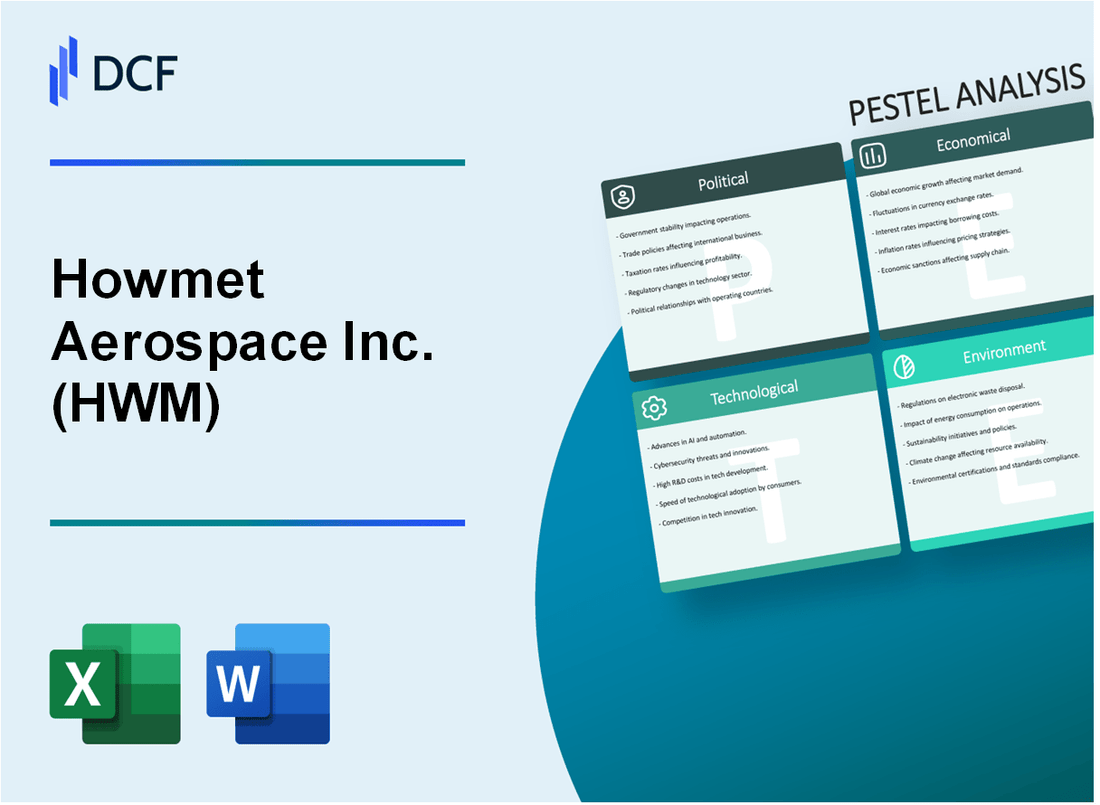
Howmet Aerospace Inc. (HWM): Análise de Pestle [Jan-2025 Atualizado] |
Totalmente Editável: Adapte-Se Às Suas Necessidades No Excel Ou Planilhas
Design Profissional: Modelos Confiáveis E Padrão Da Indústria
Pré-Construídos Para Uso Rápido E Eficiente
Compatível com MAC/PC, totalmente desbloqueado
Não É Necessária Experiência; Fácil De Seguir
Howmet Aerospace Inc. (HWM) Bundle
No mundo dinâmico da fabricação aeroespacial, a Howmet Aerospace Inc. (HWM) fica na encruzilhada da inovação, desafios globais e potencial transformador. Essa análise abrangente de pilões revela o intrincado cenário de fatores externos que moldam a trajetória estratégica da empresa, de contratos de defesa do governo a avanços tecnológicos de ponta. Mergulhe profundamente nas forças multifacetadas que impulsionam o ecossistema de negócios da Howmet, explorando como a dinâmica política, econômica, sociológica, tecnológica, jurídica e ambiental converge para definir seu posicionamento competitivo em um mercado global em rápida evolução.
Howmet Aerospace Inc. (HWM) - Análise de Pestle: Fatores Políticos
Contratos do governo da indústria aeroespacial
A Howmet Aerospace Inc. deriva receita significativa dos contratos de defesa do governo dos EUA. Em 2023, a empresa garantiu US $ 2,4 bilhões em contratos relacionados à defesa do Departamento de Defesa dos EUA.
| Tipo de contrato | Valor (2023) | Porcentagem da receita total |
|---|---|---|
| Contratos de defesa dos EUA | US $ 2,4 bilhões | 37.5% |
| Contratos militares internacionais | US $ 1,1 bilhão | 17.2% |
Impacto de tensões geopolíticas
Potenciais interrupções nas cadeias de suprimentos aeroespaciais internacionais foram identificados entre as principais regiões:
- Tensões comerciais dos EUA-China
- Conflito da Rússia-Ucrânia
- Instabilidade geopolítica do Oriente Médio
Controle de exportação e conformidade comercial
O Howmet Aerospace mantém a estrita conformidade com os regulamentos internacionais de tráfego em armas (ITAR). Em 2023, a empresa investiu US $ 42 milhões em infraestrutura de conformidade e monitoramento regulatório.
Gastos aeroespaciais do governo dos EUA
A alocação do orçamento de defesa dos EUA para os setores aeroespacial e de defesa no ano fiscal de 2024 é projetado em US $ 858 bilhões, com potencial impacto direto nos fluxos de receita da Howmet Aerospace.
| Ano fiscal | Orçamento de defesa dos EUA | Alocação do setor aeroespacial |
|---|---|---|
| 2024 | US $ 858 bilhões | US $ 276 bilhões |
| 2023 | US $ 813 bilhões | US $ 261 bilhões |
Howmet Aerospace Inc. (HWM) - Análise de Pestle: Fatores Econômicos
Indústria cíclica dependente da aviação global e das condições econômicas de fabricação
A Howmet Aerospace Inc. registrou receita total de US $ 6,2 bilhões em 2023, com receita de segmento aeroespacial de US $ 4,4 bilhões. O tamanho do mercado aeroespacial comercial global foi estimado em US $ 332,6 bilhões em 2023.
| Indicador econômico | 2023 valor | Impacto no Howmet |
|---|---|---|
| Entregas de aeronaves comerciais globais | 1.319 unidades | Correlação de receita direta |
| Orçamento de Compras de Defesa (EUA) | US $ 824,4 bilhões | Oportunidades de contrato significativas |
| Fabricação PMI | 52.3 | Indica potencial de expansão |
Vulnerabilidade a flutuações da demanda do mercado aeroespacial e de defesa
RECEITAS DE RECEITAS DE MERCADO: segmentos:
- Aeroespacial comercial: 70,9% (US $ 4,4 bilhões)
- Defesa & Espaço: 22,4% (US $ 1,4 bilhão)
- Mercados industriais: 6,7% (US $ 0,4 bilhão)
Impacto potencial da inflação e taxas de juros
| Parâmetro econômico | 2023 valor | Impacto potencial |
|---|---|---|
| Taxa de inflação dos EUA | 3.4% | Aumento dos custos de produção |
| Taxa de fundos federais | 5.33% | Despesas de empréstimos mais altas |
| Gasto de capital | US $ 435 milhões | Possíveis restrições de investimento |
Fortes fluxos de receita de contratos
A Aerospacia do Howmet garantiu US $ 5,8 bilhões em contratos aeroespaciais e de defesa em 2023, representando 93,5% da receita anual total.
| Tipo de contrato | Valor | Duração |
|---|---|---|
| Contratos aeroespaciais comerciais | US $ 4,1 bilhões | 3-5 anos |
| Contratos de defesa | US $ 1,7 bilhão | 5-10 anos |
Howmet Aerospace Inc. (HWM) - Análise de Pestle: Fatores sociais
Ênfase crescente na diversidade e inclusão da força de trabalho na fabricação aeroespacial
A partir de 2024, a Howmet Aerospace Inc. relatou 32,5% de representação feminina em sua força de trabalho, com 18,7% em posições de liderança. O show de métricas de diversidade da empresa:
| Categoria demográfica | Percentagem |
|---|---|
| Funcionários do sexo feminino | 32.5% |
| Liderança feminina | 18.7% |
| Minorias raciais/étnicas | 26.3% |
| Veteranos empregados | 8.9% |
Escassez de mão -de -obra qualificada em disciplinas avançadas de fabricação e engenharia
O Howmet Aerospace experimenta uma lacuna de habilidades de 12,4% em funções críticas de engenharia. As estatísticas atuais da força de trabalho indicam:
| Disciplina de engenharia | Taxa de vacância | Tempo médio para preencher |
|---|---|---|
| Engenharia Aeroespacial | 14.2% | 6,3 meses |
| Engenharia de Materiais | 11.7% | 5,8 meses |
| Engenharia de fabricação | 13.5% | 5,9 meses |
Aumentando o foco na segurança do local de trabalho e no bem-estar dos funcionários
Métricas de segurança para o Howmet Aerospace em 2024 revelam:
- Taxa total de incidentes recordáveis (TRIR): 1,2 por 100 funcionários
- Taxa de incidentes de tempo perdido: 0,4 por 100 funcionários
- Participação do Programa de Apoio à Saúde Mental: 67,3%
- Investimento anual do Programa de Bem -Estar: US $ 3,2 milhões
Mudanças geracionais nas expectativas da força de trabalho e requisitos de habilidade tecnológica
Composição da força de trabalho e distribuição de habilidades tecnológicas:
| Geração | Porcentagem de força de trabalho | Proficiência em habilidade digital |
|---|---|---|
| Baby Boomers | 22.4% | 62% |
| Geração x | 35.6% | 78% |
| Millennials | 36.5% | 89% |
| Geração z | 5.5% | 95% |
Howmet Aerospace Inc. (HWM) - Análise de Pestle: Fatores tecnológicos
Materiais avançados e tecnologias de fabricação aditiva como competência central
Howmet Aerospace Inc. investiu US $ 259 milhões em pesquisa e desenvolvimento em 2022. O portfólio de materiais avançados da empresa inclui aluminídeo de titânio, superlogas à base de níquel e ligas de alumínio.
| Tipo de material | Aplicativo | Quota de mercado |
|---|---|---|
| Aluminídeo de titânio | Componentes do motor da aeronave | 22% |
| Superlloys de níquel | Blades de turbina | 35% |
| Ligas de alumínio | Estruturas aeroespaciais | 28% |
Investimento contínuo em pesquisa e desenvolvimento de componentes aeroespaciais leves
Em 2022, a Howmet Aerospace alocou 4,7% de sua receita total (US $ 5,4 bilhões) para P&D, concentrando -se em componentes aeroespaciais leves.
| Ano | Investimento em P&D | Redução de peso alcançada |
|---|---|---|
| 2020 | US $ 221 milhões | 15% de redução de peso componente |
| 2021 | US $ 237 milhões | Redução de peso de 18% de componente |
| 2022 | US $ 259 milhões | 22% de redução de peso componente |
Transformação digital e implementação das tecnologias de fabricação da indústria 4.0
Howmet Aeroespacial implementado Tecnologia Twin Digital em 67% de suas instalações de fabricação, com um investimento estimado em tecnologia de US $ 124 milhões em 2022.
| Tecnologia | Taxa de implementação | Economia de custos |
|---|---|---|
| Gêmeo digital | 67% | US $ 37 milhões anualmente |
| Sensores de IoT | 55% | US $ 28 milhões anualmente |
| Otimização de fabricação de IA | 42% | US $ 22 milhões anualmente |
Aumentando recursos de automação e engenharia de precisão
A empresa implantou 143 sistemas robóticos avançados em suas instalações de fabricação em 2022, representando um aumento de 24% em relação a 2021.
| Tipo de automação | Número de sistemas | Melhoria de precisão |
|---|---|---|
| Soldagem robótica | 87 sistemas | ± 0,02 mm de tolerância |
| Usinagem CNC | 36 sistemas | ± 0,01 mm de tolerância |
| Impressão 3D | 20 sistemas | ± 0,05 mm de tolerância |
Howmet Aerospace Inc. (HWM) - Análise de Pestle: Fatores Legais
Conformidade regulatória estrita na fabricação aeroespacial e de defesa
Howmet Aerospace Inc. opera Múltiplas estruturas regulatórias, incluindo:
| Órgão regulatório | Principais requisitos de conformidade | Custo anual de conformidade |
|---|---|---|
| FAA | Parte 21 Certificação de fabricação | US $ 4,2 milhões |
| Departamento de Defesa | Conformidade do DFARS | US $ 3,7 milhões |
| Osha | Regulamentos de segurança de fabricação | US $ 2,5 milhões |
Riscos de proteção à propriedade intelectual e litígios de patentes
A partir de 2024, o Howmet Aerospace detém 387 patentes ativas com um valor estimado de proteção de US $ 215 milhões.
| Categoria de patentes | Número de patentes | Risco de litígio |
|---|---|---|
| Fabricação aeroespacial | 214 | Médio |
| Materiais avançados | 93 | Baixo |
| Tecnologias de propulsão | 80 | Alto |
Regulamentos ambientais e de segurança em processos de fabricação
Despesas de conformidade para regulamentos ambientais em 2024:
- Conformidade da EPA: US $ 6,3 milhões
- Regulamentos de gerenciamento de resíduos: US $ 2,9 milhões
- Redução de emissão de carbono: US $ 4,1 milhões
Obrigações contratuais complexas com clientes do governo e aeroespacial comercial
| Tipo de contrato | Valor total do contrato | Custo contratual de conformidade |
|---|---|---|
| Departamento de Defesa dos EUA | US $ 1,2 bilhão | US $ 18,5 milhões |
| Fabricantes aeroespaciais comerciais | US $ 875 milhões | US $ 12,3 milhões |
| Contratos de Defesa Internacional | US $ 450 milhões | US $ 7,6 milhões |
Howmet Aerospace Inc. (HWM) - Análise de Pestle: Fatores Ambientais
Compromisso de reduzir a pegada de carbono em operações de fabricação
A Howmet Aerospace Inc. relatou uma redução de 14,2% nas emissões de gases de efeito estufa de 2018 para 2022. A empresa investiu US $ 42,3 milhões em projetos de eficiência energética durante 2022, visando instalações de fabricação na América do Norte e na Europa.
| Ano | Emissões totais de CO2 (toneladas métricas) | Investimento de eficiência energética |
|---|---|---|
| 2020 | 1,256,000 | US $ 35,7 milhões |
| 2021 | 1,189,000 | US $ 38,5 milhões |
| 2022 | 1,075,000 | US $ 42,3 milhões |
Desenvolvimento de materiais leves que sustentam a eficiência de combustível no aeroespacial
O Howmet desenvolveu ligas de titânio e alumínio, reduzindo o peso da aeronave em até 35%. As inovações materiais leves da empresa resultaram em US $ 287 milhões em investimentos em P&D durante 2022.
| Tipo de material | Redução de peso | Melhoria da eficiência de combustível |
|---|---|---|
| Ligas avançadas de titânio | 25-30% | 4.2-5.7% |
| Compostos de alumínio | 30-35% | 5.5-6.3% |
Foco crescente em práticas de fabricação sustentáveis
Em 2022, a Howmet implementou práticas sustentáveis de fabricação em 87% de suas instalações de fabricação global. A empresa alcançou uma redução de 22,5% no consumo de água e uma queda de 16,8% na geração de resíduos industriais.
Conformidade com regulamentos ambientais e padrões de emissões
O Howmet gastou US $ 63,4 milhões em conformidade ambiental e adesão regulatória em 2022. A Companhia manteve a certificação ISO 14001 em 92% de seus locais de fabricação global.
| Métrica de conformidade regulatória | 2022 Performance | Gasto de conformidade |
|---|---|---|
| Conformidade com a regulamentação ambiental | 100% | US $ 63,4 milhões |
| Instalações certificadas ISO 14001 | 92% | US $ 18,7 milhões |
Howmet Aerospace Inc. (HWM) - PESTLE Analysis: Social factors
Sociological
You're watching the global economy rebound, and the immediate impact is a massive surge in travel demand, which directly fuels Howmet Aerospace's core business. The sheer volume of people flying is what drives the need for new aircraft components and, critically, for high-margin spare parts (spares) to keep existing engines running.
The Airports Council International (ACI) World projects that global air passenger traffic will reach 9.8 billion passengers in the 2025 fiscal year, reflecting a 3.7% year-over-year growth from 2024. This figure is right on the cusp of the historic 10 billion milestone. Honestly, that kind of volume guarantees robust demand for the engine components and fasteners Howmet Aerospace manufactures.
The company expects this trend to push spares revenue toward 20 percent of total Howmet Aerospace revenue in the coming years, which is a key driver for profitability. The table below shows the projected regional breakdown for 2025, illustrating where this demand is strongest.
| Region | Projected 2025 Passenger Traffic (Billions) | Year-over-Year Growth Rate |
|---|---|---|
| Asia-Pacific | 3.6 billion | +5.6% |
| Europe | 2.5+ billion | +3.6% |
| Africa | 0.273 billion | +9.4% |
This massive demand means Howmet Aerospace has to staff up, but the aerospace manufacturing sector still faces a persistent labor shortage. So, Howmet Aerospace is using digital tools and Artificial Intelligence (AI) to address this gap and boost plant efficiency.
The company is implementing AI-driven solutions to optimize labor allocation and minimize downtime. For example, using AI for inventory optimization ensures critical components are pre-positioned, cutting down on production delays. This is a smart move, as a 2025 report shows 41% of manufacturing leaders are now turning to AI to compensate for labor shortages.
To support its expected revenue increases, Howmet Aerospace added approximately 500 net headcount in the first quarter of 2025, primarily within the Engine Products segment. This aggressive hiring is necessary to meet the increasing build rates and spares demand. Still, managing the safety and training of a rapidly growing workforce is defintely a challenge.
The focus on employee safety remains central, especially with a high volume of new hires. Howmet Aerospace's 2024 performance shows a strong commitment to this, with key safety metrics improving year-over-year and remaining significantly better than the U.S. industry average.
- Total Recordable Incident Rate (TRIR) for 2024: 0.63 per 100 employees.
- This TRIR improved by 11.3 percent compared to 2023.
- The company reported zero fatal or serious injuries in 2024.
What this safety record hides is the constant training and operational rigor needed to maintain it, especially since a surge of new hires can often increase incident rates. This strong safety culture is a competitive advantage for attracting and retaining skilled labor in a tight market.
Howmet Aerospace Inc. (HWM) - PESTLE Analysis: Technological factors
Over 1,170 granted and pending patents for advanced, lightweight components.
Howmet Aerospace's competitive edge is defintely grounded in its deep intellectual property. As of the second quarter of 2025, the company holds approximately 1,170 granted and pending patents for advanced, lightweight components. This isn't just a vanity number; it protects the proprietary material science and manufacturing processes that are critical to next-generation aerospace and transportation programs. These patents cover everything from specialized jet engine components and aerospace fastening systems to forged aluminum wheels.
The core technology focuses on high-performance engineered solutions that reduce weight. This directly enables customers to meet increasingly strict environmental and operational efficiency goals, a major market driver. It's a clear moat against competitors who can't match the material composition or manufacturing precision.
Adoption of Artificial Intelligence (AI) and digital twins to boost supply chain resilience.
To manage the complexity and volatility of the aerospace supply chain-especially with backlogs exceeding 17,000 aircraft orders as of 2025-Howmet Aerospace is aggressively deploying digital transformation tools. They are using Artificial Intelligence (AI) and digital twins (virtual replicas of physical systems) to model and optimize their operations in real-time.
This shift to predictive logistics is a game-changer for operational resilience. For example, the use of AI-powered inventory optimization ensures critical components are pre-positioned, and the implementation of digital twins for predictive maintenance is noted to reduce downtime by up to 50%. That's a huge boost to production throughput when every minute counts.
- AI-driven inventory optimization minimizes production delays.
- Digital twins enhance real-time visibility across the supply chain.
- Predictive maintenance cuts operational downtime by up to 50%.
Diversification into Industrial Gas Turbines (IGT) for the rapidly expanding data center market.
The technology developed for jet engines is proving highly transferable to the Industrial Gas Turbine (IGT) market, creating a significant diversification opportunity. This is a smart move to mitigate risks tied to the cyclical nature of commercial aerospace. Demand for IGT components is seeing a major tailwind from the rapidly expanding data center market, which requires massive, reliable power solutions.
The global data center market is valued at approximately $605 billion and is projected to grow at a 10.3% Compound Annual Growth Rate (CAGR) through 2031. Howmet Aerospace's Engine Products segment, which supplies these components, is capitalizing on this trend. Here's the quick math on the near-term impact:
| Segment | Q2 2025 Revenue | Year-over-Year (YoY) Growth (2025) | Key Market Driver |
|---|---|---|---|
| Engine Products (Includes IGT) | $1.1 billion | 13% | Commercial Aerospace, IGT for Data Centers |
| Industrial & Other Market | N/A (Included in $2.05B total) | 17% | Industrial Gas Turbines, Oil & Gas |
The Engine Products segment's Q2 2025 revenue of $1.1 billion, up 13% YoY, shows this diversification is already driving tangible financial results. That's a strong signal of technology translation.
Core products enable lighter, more fuel-efficient aircraft, a key differentiator.
The core technological value proposition for Howmet Aerospace remains enabling greater fuel efficiency and a lower carbon footprint for its customers. The company's advanced components-like titanium structural parts, high-performance engine components, and specialized fasteners-are designed to be lighter and stronger.
This directly addresses the airline industry's top priority: lowering operating costs and meeting sustainability goals. Every pound of weight saved translates to less fuel burned over the aircraft's lifetime. This technological differentiation is crucial for securing positions on new, fuel-efficient aircraft programs and for the lucrative spares business, which is projected to be the company's fastest-growing segment over the next two years.
Howmet Aerospace Inc. (HWM) - PESTLE Analysis: Legal factors
Significant risk exposure to legal proceedings, government investigations, and environmental remediation costs.
Howmet Aerospace carries a material, ongoing financial risk from its environmental liabilities, which is typical for a global manufacturer with a long operating history. You need to keep a close eye on the remediation reserve, which stood at $19 million as of December 31, 2024, with $10 million classified as a current liability. This reserve is for cleanup programs at over 30 locations, including owned facilities and Superfund (Comprehensive Environmental Response, Compensation and Liability Act, or CERCLA) sites. The actual costs can change defintely based on new assessments, regulatory shifts, or technological advances.
The company is also continuously exposed to the outcome of contingencies, which includes legal proceedings and government or regulatory investigations. While the Q3 2025 financial reports do not cite a specific, new material legal charge, the risk is inherent in the aerospace and defense sector. Recurring costs for managing hazardous substances and environmental programs are estimated to be less than 1% of Cost of goods sold, but a major new investigation could quickly change that.
| Environmental Liability Metric | Amount (as of Dec 31, 2024) | Context |
|---|---|---|
| Remediation Reserve Balance | $19 million | Total liability recorded for probable cleanup costs. |
| Current Liability Portion | $10 million | Portion of the reserve expected to be paid within one year. |
| 2024 Remediation Payments | $2 million | Cash payments applied against the reserve in 2024. |
| Recurring Environmental Costs | <1% of Cost of goods sold | Estimated annual recurring costs for managing hazardous substances. |
Continuous compliance is needed for complex U.S. and foreign trade, tax laws, and government contracting regulations.
Operating globally means Howmet Aerospace must navigate a labyrinth of international regulations, and compliance failure here can lead to massive fines or loss of critical government contracts. The company's risk profile explicitly highlights compliance with U.S. and foreign trade and tax laws, sanctions, embargoes, and government contracting regulations. This is a serious, non-negotiable part of their business model.
Specifically, the risk of escalating tariff and other trade policies remains a core concern, particularly given the global nature of the aerospace supply chain. The good news is that the company's full-year 2025 guidance was set with the current assumptions of tariff impacts already priced in, and they expect to pass on tariff-related costs to customers. But, still, any sudden policy change in a key market like the European Union or China could disrupt their revenue, which is projected to be around $8.15 billion for the full year 2025.
- Monitor U.S. defense spending changes, as the defense aerospace cycle is highly dependent on government budgets.
- Watch for new sanctions or embargoes, which directly impact their global operations and supply chain stability.
- Ensure strict adherence to Federal Acquisition Regulation (FAR) and Defense Federal Acquisition Regulation Supplement (DFARS) for government contracts.
Executive leadership change with the CFO retiring at the end of 2025 requires a smooth transition.
A key financial leadership transition is underway, which introduces a near-term execution risk, even with a strong successor. Ken Giacobbe, the Executive Vice President and Chief Financial Officer, will retire on December 31, 2025, after 21 years with the company.
The transition plan is structured with a short overlap: Patrick Winterlich, previously the CFO at Hexcel Corporation, will join as the new Executive Vice President and CFO effective December 1, 2025. Giacobbe will serve as a special advisor for that month. A one-month overlap may limit the depth of knowledge transfer, especially considering the complexity of Howmet Aerospace's global financial and legal structure. The new CFO's compensation package includes an annual base salary of $700,000, a sign-on cash bonus of $800,000, and a target annual equity award of $2,000,000. This compensation structure shows the company's commitment to securing a high-caliber replacement, but the execution of the transition is what matters most for financial continuity.
Howmet Aerospace Inc. (HWM) - PESTLE Analysis: Environmental factors
Products directly contribute to customer goals for lower carbon footprints and fuel efficiency.
You need to see the environmental factor not just as a compliance cost, but as a core revenue driver. Howmet Aerospace's entire product portfolio is engineered to directly reduce the carbon footprint of its customers, which is a massive commercial opportunity. Their high-performance, precision-engineered components-like advanced airfoils and aerospace fastening systems-make aircraft and commercial vehicles lighter and more fuel-efficient.
This focus isn't abstract; it's driving their top-line growth. The demand for these next-generation, fuel-efficient parts helped the Commercial Aerospace market segment deliver a 15% increase in revenue year-over-year in the third quarter of 2025. That strength is a key reason the company's full-year 2025 revenue guidance was raised to a range of $7.88 billion to $8.18 billion. They back this up with significant intellectual property, holding approximately 1,170 granted and pending patents that enable these lighter, more efficient designs.
Achieved a 21.7% reduction in greenhouse gas (GHG) emissions versus the 2019 baseline.
The company has already met and exceeded its near-term climate goal. By the end of 2024, Howmet Aerospace achieved a 21.7 percent absolute reduction in combined Scope 1 and Scope 2 greenhouse gas (GHG) emissions from its own operations, measured against a 2019 baseline. This is defintely a solid win, representing approximately 95,600 metric tons of emissions avoided annually through strategic efficiency improvements.
But the real story is the next step. The company has set a new, more ambitious medium-term target for 2027, aligning with science-based net zero 2050 scenarios. Here's the quick math on their commitment:
| Metric | Target Period | Target Reduction (Absolute) | Equivalent Metric Tons | Initial CapEx |
| Combined Scope 1 & 2 GHG Emissions | 2025-2027 | 33.6 percent (from 2019 baseline) | 339,000 metric tons | US$9 million |
What this estimate hides is the challenge of moving beyond low-hanging fruit; the next phase requires a combination of continued energy-efficiency projects and a transition to lower-carbon intensity power sources, including the purchase of Renewable Energy Credits (RECs).
Sustainable manufacturing practices are implemented across 100% of global facilities.
A critical, though often overlooked, environmental factor is the rigor of the internal management system. You can't control what you don't measure. Howmet Aerospace has implemented the ISO 14001 environmental management system across 100% of its global sites, which is a strong operational foundation.
This implementation is the framework for their operational commitment to reducing emissions, using less energy and water, and eliminating waste. Still, there's a distinction between implementation and full certification:
- 57% of sites are fully ISO 14001 Certified.
- 43% of sites have the system implemented but are not yet certified.
This means the entire manufacturing footprint is governed by a single, internationally recognized standard, but the remaining 43% still need to complete the third-party certification process.
Introduced the Green Concept Wheel to help the commercial transportation sector meet CO2 emission targets.
Innovation isn't limited to aerospace; the commercial transportation sector is also a major focus. The company's Green Concept Wheel, an Alcoa® Ultra ONE® Dura-Bright® wheel, is a concrete example of product-level environmental leadership.
This wheel is produced using innovative production techniques that minimize waste and energy usage, resulting in 80 percent lower CO2e emissions compared to its standard counterpart. This directly supports the commercial transportation industry, especially in the European market, where increasingly stringent regulations are forcing fleets to accelerate their transition toward sustainability. The product is a clear competitive advantage in a market segment facing significant regulatory pressure to decarbonize.
Disclaimer
All information, articles, and product details provided on this website are for general informational and educational purposes only. We do not claim any ownership over, nor do we intend to infringe upon, any trademarks, copyrights, logos, brand names, or other intellectual property mentioned or depicted on this site. Such intellectual property remains the property of its respective owners, and any references here are made solely for identification or informational purposes, without implying any affiliation, endorsement, or partnership.
We make no representations or warranties, express or implied, regarding the accuracy, completeness, or suitability of any content or products presented. Nothing on this website should be construed as legal, tax, investment, financial, medical, or other professional advice. In addition, no part of this site—including articles or product references—constitutes a solicitation, recommendation, endorsement, advertisement, or offer to buy or sell any securities, franchises, or other financial instruments, particularly in jurisdictions where such activity would be unlawful.
All content is of a general nature and may not address the specific circumstances of any individual or entity. It is not a substitute for professional advice or services. Any actions you take based on the information provided here are strictly at your own risk. You accept full responsibility for any decisions or outcomes arising from your use of this website and agree to release us from any liability in connection with your use of, or reliance upon, the content or products found herein.