

|
ICICI Bank Limited (IBN): Análise de Pestle [Jan-2025 Atualizado] |
Totalmente Editável: Adapte-Se Às Suas Necessidades No Excel Ou Planilhas
Design Profissional: Modelos Confiáveis E Padrão Da Indústria
Pré-Construídos Para Uso Rápido E Eficiente
Compatível com MAC/PC, totalmente desbloqueado
Não É Necessária Experiência; Fácil De Seguir
ICICI Bank Limited (IBN) Bundle
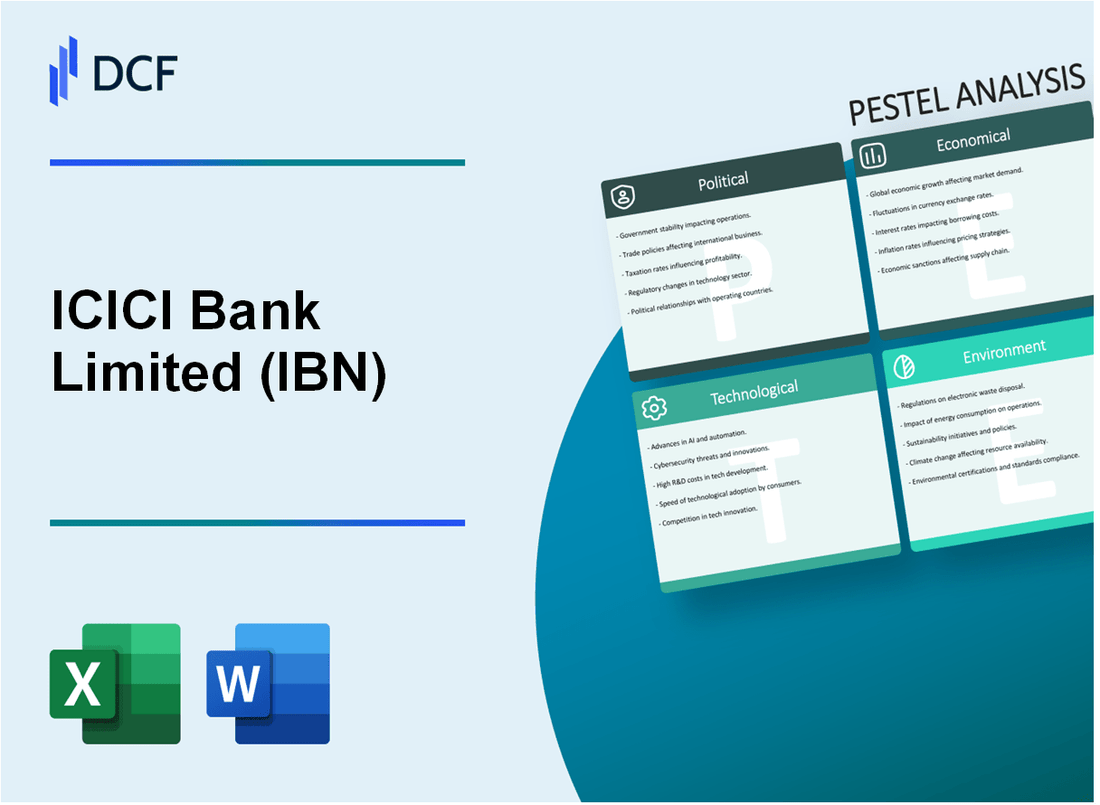
No cenário dinâmico do Bancário Indiano, o ICICI Bank Limited (IBN) permanece como uma instituição financeira fundamental que navega em uma complexa rede de desafios políticos, econômicos, sociológicos, tecnológicos, legais e ambientais. Essa análise abrangente de pestles revela os fatores intrincados que moldam as decisões estratégicas do banco, revelando como ela se adapta ao ecossistema financeiro em rápida evolução da Índia. De obstáculos regulatórios a inovações tecnológicas, o ICICI Bank demonstra uma abordagem notável de resiliência e visão de futuro em um setor bancário cada vez mais competitivo e transformador.
ICICI Bank Limited (IBN) - Análise de Pestle: Fatores Políticos
Ambiente bancário regulatório
O ICICI Bank opera sob a estrutura regulatória do Reserve Bank of India (RBI), que implementou 7 revisões de políticas monetárias em 2023. O banco está sujeito a Basileia III Normas de Adequação de Capital, com um requisito de taxa de adequação de capital de 11,5% em setembro de 2023.
| Aspecto regulatório | Detalhes da conformidade |
|---|---|
| Diretrizes do RBI | Conformidade total com 22 principais diretivas regulatórias |
| Regulamentos de investimento estrangeiro | IDE máximo permitido: 74% no setor bancário privado |
| Governança corporativa | 100% de adesão às normas de governança corporativa do SEBI |
Impacto da política do governo
O banco é significativamente influenciado pelas políticas econômicas da Índia, incluindo:
- Iniciativas bancárias digitais do governo da Índia
- Programa de inclusão financeira de Pradhan Mantri Jan Dhan Yojana
- Implementação de bens e serviços (GST)
- Reformas de código de insolvência e falência
Considerações de estabilidade política
As operações do ICICI Bank estão diretamente correlacionadas com o cenário político da Índia. A partir de 2024, a Índia mantém um ambiente político estável com a continuação do atual governo.
| Indicador político | Status atual |
|---|---|
| Índice de Estabilidade do Governo | 7.2/10 |
| Classificação de risco político | BB+ (estável) |
| Impacto do ciclo eleitoral | Interrupção mínima esperada em 2024 |
Monitoramento de mudanças regulatórias
O ICICI Bank se adapta continuamente às possíveis modificações regulatórias em serviços financeiros, com equipes de conformidade dedicadas rastreando 43 possíveis mudanças legislativas em 2024.
- Monitoramento contínuo de atualizações circulares do RBI
- Estratégia de conformidade proativa
- Ajustes de política interna regulares
ICICI Bank Limited (IBN) - Análise de Pestle: Fatores Econômicos
Exposto ao crescimento econômico da Índia e ao desempenho flutuante do PIB
A taxa de crescimento do PIB da Índia no terceiro trimestre de 2023 foi de 7,6%. O desempenho financeiro do ICICI Bank está diretamente correlacionado com os indicadores econômicos nacionais.
| Indicador econômico | 2023 valor | Impacto no Banco ICICI |
|---|---|---|
| Taxa de crescimento do PIB | 7.6% | Alta correlação positiva |
| Renda per capita | ₹1,75,406 | Aumento do potencial de crédito |
| Investimento direto estrangeiro | US $ 70,97 bilhões | Oportunidades bancárias aprimoradas |
Sensível às mudanças nas taxas de juros pelo Reserve Bank of India
A taxa de repositório do RBI em fevereiro de 2024 é de 6,50%. A margem de juros líquidos do ICICI Bank foi de 4,48% no terceiro trimestre de 2023.
| Parâmetro da taxa de juros | Taxa atual | Resposta do banco |
|---|---|---|
| Taxa de repositório do RBI | 6.50% | Ajustando as taxas de empréstimos |
| Margem de juros líquidos | 4.48% | Mantendo a lucratividade |
| Taxa de empréstimo base | 8.60% | Gerenciamento de riscos |
Opera no mercado bancário competitivo
O mercado de serviços financeiros digitais na Índia, avaliada em US $ 207,4 bilhões em 2023. As transações digitais do ICICI Bank aumentaram 35% ano a ano.
| Métrica bancária digital | 2023 valor | Porcentagem de crescimento |
|---|---|---|
| Volume de transação digital | ₹ 1,2 trilhão | 35% |
| Usuários bancários móveis | 25,6 milhões | 28% |
| Receita bancária digital | ₹ 12.456 crore | 22% |
Afetado pelas taxas de inflação e condições econômicas
A taxa de inflação da Índia em janeiro de 2024 foi de 5,1%. O Índice de Preços ao Consumidor (CPI) mostra pressões inflacionárias moderadas.
| Indicador de inflação | Janeiro de 2024 Valor | Impacto econômico |
|---|---|---|
| Taxa de inflação | 5.1% | Pressão econômica moderada |
| Índice de preços ao consumidor | 120.4 | Poder de compra estável |
| Índice de preços no atacado | 139.7 | Variações de custo de entrada |
ICICI Bank Limited (IBN) - Análise de Pestle: Fatores sociais
Serve diversos segmentos demográficos na Índia urbana e rural
A partir de 2024, o ICICI Bank atende 74,5 milhões de clientes em toda a Índia, com uma distribuição de base de clientes da seguinte forma:
| Segmento | Número de clientes | Percentagem |
|---|---|---|
| Áreas urbanas | 52,15 milhões | 70% |
| Áreas rurais | 22,35 milhões | 30% |
Adapta -se à mudança de preferências bancárias do consumidor e adoção digital
Penetração bancária digital para o ICICI Bank:
| Canal bancário digital | Base de usuários | Crescimento ano a ano |
|---|---|---|
| Mobile Banking | 31,6 milhões de usuários | 18.5% |
| Internet banking | 26,4 milhões de usuários | 15.3% |
| Transações UPI | 42,7 milhões de usuários | 27.9% |
Aborda a inclusão financeira para a população emergente de classe média
Métricas de inclusão financeira para o ICICI Bank:
| Categoria de inclusão | Número de contas | Saldo médio da conta |
|---|---|---|
| Jan Dhan contas | 12,3 milhões | ₹3,425 |
| Contas de pequenas empresas | 2,7 milhões | ₹8,750 |
Responde ao aumento da demanda por serviços bancários orientados para a tecnologia
Métricas de adoção de tecnologia:
| Serviço de Tecnologia | Volume de uso | Porcentagem do total de transações |
|---|---|---|
| Atendimento ao cliente movido a IA | 4,2 milhões de interações/mês | 37% |
| Vídeo Kyc | 890.000 verificações/trimestre | 22% |
| Interações Chatbot | 3,6 milhões/mês | 31% |
ICICI Bank Limited (IBN) - Análise de Pestle: Fatores tecnológicos
Implementa plataformas bancárias digitais avançadas e aplicativos móveis
A plataforma bancária digital do ICICI Bank relatou 8,5 milhões de usuários ativos de bancos móveis em março de 2023. O aplicativo de pagamento imobile do banco tem mais de 6,2 milhões de downloads com uma classificação de 4,5 estrelas. As transações bancárias digitais aumentaram 35,2% ano a ano no ano fiscal de 2023.
| Plataforma digital | Contagem de usuários | Volume de transação |
|---|---|---|
| Mobile Banking | 8,5 milhões | ₹ 42.650 crore |
| Internet banking | 6,3 milhões | ₹ 38.220 crore |
| Transações UPI | 5,7 milhões | ₹ 36.890 crore |
Investe fortemente em tecnologias de inteligência artificial e fintech
O ICICI Bank investiu ₹ 1.245 crore em infraestrutura de tecnologia durante o ano fiscal de 2023. A IA e os investimentos em aprendizado de máquina atingiram ₹ 320 crore, representando 25,7% do total de gastos com tecnologia.
| Categoria de tecnologia | Investimento (₹ crore) | Porcentagem de orçamento de tecnologia |
|---|---|---|
| Inteligência artificial | 320 | 25.7% |
| Infraestrutura em nuvem | 275 | 22.1% |
| Segurança cibernética | 210 | 16.9% |
Desenvolve infraestrutura robusta de segurança cibernética
O ICICI Bank relatou zero grandes violações de segurança cibernética em 2023. A equipe de segurança cibernética do banco compreende 285 profissionais especializados. Os gastos anuais de segurança cibernética atingiram ₹ 210 crore no ano fiscal de 2023.
Explora soluções de tecnologia financeira em blockchain e emergentes
O ICICI Bank implementou 12 soluções baseadas em blockchain nas finanças, remessas e serviços bancários corporativos. O banco processou 4.750 transações de blockchain em 2023, representando um aumento de 62% em relação ao ano anterior.
| Caso de uso de blockchain | Transações em 2023 | Crescimento ano a ano |
|---|---|---|
| Financiamento comercial | 2,340 | 45% |
| Remessa | 1,560 | 78% |
| Banco corporativo | 850 | 55% |
ICICI Bank Limited (IBN) - Análise de pilão: Fatores legais
Está em conformidade com regulamentos bancários rigorosos do Reserve Bank of India
O ICICI Bank mantém a taxa de adequação de capital regulatório de 19,56% em setembro de 2023, significativamente maior do que o RBI exigiu o mínimo de 11,5%. O índice de capital de nível 1 do banco é de 17,92%.
| Métrica regulatória | Conformidade do Banco ICICI | Requisito do RBI |
|---|---|---|
| Índice de adequação de capital | 19.56% | 11.5% |
| Índice de capital de camada 1 | 17.92% | 9.0% |
| Índice de ativos não-desempenho | 2.85% | <4.0% |
Adere as diretrizes de lavagem anti-dinheiro e conhecimentos de seu cliente
O ICICI Bank investiu ₹ 372 crore em tecnologias de conformidade e gerenciamento de riscos em 2023. O banco processou 14.267 relatórios de transações suspeitas no ano fiscal.
| Métrica de conformidade com LBA | 2023 dados |
|---|---|
| Investimento em tecnologia de conformidade | ₹ 372 crore |
| Relatórios de transação suspeitos | 14,267 |
| Taxa de verificação de KYC | 99.7% |
Gerencia riscos legais associados a operações bancárias corporativas e de varejo
As disposições legais do ICICI Bank em setembro de 2023 eram de ₹ 7.842 crore. O banco registrou 1.236 casos legais pendentes com responsabilidade contingente estimada de ₹ 2.563 crore.
| Métrica de risco legal | Quantia |
|---|---|
| Disposições legais | ₹ 7.842 crore |
| Casos legais pendentes | 1,236 |
| Responsabilidade contingente | ₹ 2.563 crore |
Navega relatórios financeiros complexos e padrões de governança corporativa
O conselho do ICICI Bank compreende 12 diretores, com 67% sendo diretores independentes. O Banco está em conformidade com as normas de governança corporativa de valores mobiliários e intercâmbio (SEBI).
| Métrica de Governança Corporativa | Detalhes |
|---|---|
| Total de membros do conselho | 12 |
| Diretores independentes | 8 (67%) |
| Reuniões do conselho em 2023 | 7 |
ICICI Bank Limited (IBN) - Análise de Pestle: Fatores Ambientais
Comprometer -se com práticas bancárias sustentáveis e iniciativas de financiamento verde
Em 2023, o ICICI Bank cometeu ₹ 15.000 crore em relação às iniciativas de financiamento verde. O portfólio financeiro sustentável do banco alcançou ₹ 50.000 crore Até dezembro de 2023.
| Categoria de finanças verdes | Valor do investimento (₹ crore) | Porcentagem de portfólio total |
|---|---|---|
| Projetos de energia renovável | 22,500 | 45% |
| Financiamento de veículos elétricos | 7,500 | 15% |
| Infraestrutura verde | 12,000 | 24% |
| Agricultura sustentável | 8,000 | 16% |
Reduz a pegada de carbono através da transformação bancária digital
O ICICI Bank reduziu suas emissões de carbono em 22% por meio de canais bancários digitais em 2023. As transações digitais aumentaram para 87% do total de transações bancárias.
| Canal digital | Volume de transação | Redução de emissão de carbono |
|---|---|---|
| Mobile Banking | 65% do total de transações | 12% de redução |
| Internet banking | 22% do total de transações | Redução de 7% |
| Transações ATM | 13% do total de transações | Redução de 3% |
Apoia projetos de energia renovável e de conservação ambiental
Em 2023, o ICICI Bank investiu ₹ 22.500 crore em projetos de energia renovável nos setores solar, eólica e hidrelétrica.
| Setor de energia renovável | Investimento (₹ crore) | Deslocamento de carbono projetado |
|---|---|---|
| Energia solar | 12,000 | 2,5 milhões de toneladas CO2 |
| Energia eólica | 7,500 | 1,8 milhão de toneladas CO2 |
| Projetos hidrelétricos | 3,000 | 0,7 milhão de toneladas CO2 |
Implementa práticas operacionais ecológicas em infraestrutura corporativa
O ICICI Bank implementou medidas abrangentes de sustentabilidade em sua infraestrutura corporativa, reduzindo o consumo de energia em 28% em 2023.
| Medida de sustentabilidade | Taxa de implementação | Economia de energia |
|---|---|---|
| Iluminação LED | 95% dos escritórios | 12% de redução |
| Instalações solares na cobertura | 45 locais corporativos | Redução de 8% |
| Equipamento com eficiência energética | 85% da infraestrutura | Redução de 8% |
ICICI Bank Limited (IBN) - PESTLE Analysis: Social factors
You're looking at ICICI Bank Limited's strategy and seeing a clear pivot toward the individual consumer and the emerging middle-class market. This isn't just about chasing volume; it's a structural shift reflecting India's demographic dividend and rising financial literacy. The bank is actively adapting its product mix and distribution to meet this massive, socially-driven demand, which is defintely a core strength.
Retail loans dominate the portfolio, accounting for over 52.4% of total loans in FY2025.
The consumer is king, and ICICI Bank's portfolio structure confirms it. As of March 31, 2025, the retail loan portfolio accounted for a commanding 52.4% of the total loan portfolio. This segment grew by a solid 8.9% year-on-year in Fiscal Year 2025 (FY2025). This focus is a conscious, risk-calibrated move away from the volatility of large corporate lending, favoring the granular, diversified nature of personal credit.
Here's the quick math: a higher share of retail loans, especially secured ones like home and vehicle loans, generally translates to a more stable net interest margin (NIM) and lower overall credit risk over the long term, even with short-term regulatory tightening in unsecured categories. The domestic loan portfolio overall grew by 13.9% year-on-year to ₹13,10,981 crore (approximately $153.4 billion) at the end of FY2025.
| Loan Segment | % of Total Loan Portfolio (Mar 31, 2025) | Year-on-Year Growth (FY2025) |
|---|---|---|
| Retail Loan Portfolio | 52.4% | 8.9% |
| Business Banking Portfolio | 19.6% (approx.) | 33.7% |
| Rural Portfolio | 5.8% (approx.) | 5.1% |
Focus on expanding services into Tier-2 and Tier-3 cities for deeper market penetration.
The next wave of growth isn't coming from Mumbai or Delhi; it's coming from the smaller, rapidly digitizing Tier-2 and Tier-3 cities. ICICI Bank is executing a clear horizontal growth strategy to capture this untapped market. This involves a physical presence coupled with digital enablement.
The bank expanded its physical reach significantly in FY2025, adding 460 new branches. This brought the total network to 6,983 business centers as of March 31, 2025. This network expansion, combined with a dedicated focus on the rural portfolio, which grew by 5.1% year-on-year to ₹783.40 billion at the end of FY2025, shows a commitment to financial inclusion and market deepening. This local expansion minimizes currency risks and taps directly into India's domestic consumption boom.
Digital platforms like iMobile Pay have over 10 million active non-ICICI Bank users.
Digital channels are the engine for social-scale reach. The iMobile Pay application, ICICI Bank's flagship digital platform, has successfully transcended its core customer base. The app has onboarded over 10 million non-ICICI Bank users since it became interoperable in December 2020. This is a crucial social metric: it shows the bank's digital interface is trusted and used by the broader public, not just its account holders.
The platform's high utility is evidenced by its transaction volume: it handled approximately 730 million UPI transactions in March 2025 alone. This digital ecosystem, which offers over 400 services, is the bank's primary tool for acquiring new-to-bank customers and cross-selling products like loans and investments without the high cost of a physical branch visit.
Upskilling employees in AI and Machine Learning (ML) is a core competency strategy.
The social factor here is the talent war and the need for a future-ready workforce. ICICI Bank is making a massive internal investment in human capital to support its digital-first strategy. In fiscal 2025, the bank delivered over 10 million learning hours, which averages out to about 10 learning days per employee.
A significant part of this effort is focused on Artificial Intelligence (AI) and Machine Learning (ML) technology, which the bank uses for everything from fraud detection to customized user experience. For instance, approximately 31,000 employees participated in risk and compliance workshops in 2025, which are integrated with the bank's risk framework, showing a focus on embedding data-driven decision-making across the organization.
- Delivered 10 million+ learning hours in FY2025.
- Averaged 10 learning days per employee.
- Trained 31,000 employees in risk and compliance.
This internal upskilling, combined with industry-academia collaborations, ensures the bank can leverage its vast data sets for credit underwriting and operational efficiency, which is a key competitive edge.
ICICI Bank Limited (IBN) - PESTLE Analysis: Technological factors
Digital Dominance and Transaction Volume
You need to see ICICI Bank Limited not just as a traditional lender, but as a technology company that happens to offer banking services. This is not corporate fluff; it's a strategic reality. The sheer volume of digital activity is staggering. In the broader Indian market, digital payments accounted for a massive 99.9% of the total volume of non-cash retail payments in FY2025, which tells you exactly where the industry is headed. ICICI Bank is a primary driver of this trend.
The bank's mobile application, iMobile, processed 558 million transactions in fiscal 2025, totaling a value of nearly ₹11,238 billion. That is a huge amount of capital moving through a single digital channel. This pivot to digital self-service is what drives efficiency and scalability.
Strategic Investment in Core Infrastructure
The bank's commitment to its digital backbone is clear in its spending. You can't run a massive digital operation on a shoestring budget, and ICICI Bank isn't. The annual Information and Communications Technology (ICT) spending was estimated at $1.1 billion in 2024. This investment is not discretionary; it's the cost of doing business in a hyper-digital environment.
Here's the quick math on how serious they are: their IT and cybersecurity expenditure as a share of aggregate operating expenses climbed to 9.4% in financial year 2023-24, up from 5.6% just a few years prior. This is a necessary, defensive investment to ensure system resilience and security, especially given the rising regulatory scrutiny on technology outages.
| Metric | Value (FY2025 unless noted) | Significance |
|---|---|---|
| iMobile Transactions (Volume) | 558 million | Scale of retail digital adoption |
| iMobile Transactions (Value) | ₹11,238 billion | High-value flow through mobile channel |
| ICT Spending (2024 Estimate) | $1.1 billion | Commitment to digital infrastructure |
| InstaBIZ Transaction Value Growth | 37% | Accelerated SME platform utility |
Platform-Centric Strategy: InstaBIZ and API Banking
For the Small and Medium Enterprise (SME) segment, the InstaBIZ platform is the key technological play. This is a one-stop app for business banking, and while the latest user count from 2023 was over 1.5 million active users, the real story is the platform's utility. The value of financial transactions on InstaBIZ grew by a sharp 37% in fiscal 2025. That growth rate shows businesses are deeply integrating the app into their daily operations.
This ecosystem approach is powered by Application Programming Interfaces (APIs)-the digital connectors that let different software talk to each other. The bank has a deep focus on what you could call API Banking 2.0, with over 4,600 APIs available to manage more than 160 million financial and non-financial transactions per day. This open architecture allows for rapid co-creation with partners, which is how you stay ahead of the fintech curve.
- Cloud computing is central to the strategy for scalability and cost efficiency.
- AI and Machine Learning (ML) are deployed for credit underwriting and risk management.
- AI-driven fraud prevention is a core focus, leveraging algorithms to detect unusual transaction patterns.
- The bank launched 'SmartLock,' an industry-first feature on the iMobile app, allowing customers to instantly lock or unlock internet banking, mobile banking, UPI, and their cards with a single click.
ICICI Bank Limited (IBN) - PESTLE Analysis: Legal factors
RBI Imposed a ₹75 Lakh Penalty in August 2025
You need to be acutely aware that regulatory compliance isn't a suggestion; it's a hard cost, and ICICI Bank Limited has seen this firsthand. In August 2025, the Reserve Bank of India (RBI) imposed a monetary penalty of ₹75.00 lakh on the bank. This fine was for non-compliance with specific directions concerning two key areas: the 'Valuation of Properties - Empanelment of Valuers' and the 'Opening of Current Accounts by Banks - Need for discipline.'
The core issue was the bank's failure to get property valuations from independent valuers for certain mortgage loans, a fundamental lapse in risk management protocol. This penalty, following a Statutory Inspection for Supervisory Evaluation (ISE 2024) with reference to the financial position as of March 31, 2024, is a clear signal: the RBI is serious about granular compliance.
RBI Dropped Proposed Restrictions on Overlapping Business with NBFC Subsidiaries
A significant potential risk was removed in October 2025, giving ICICI Bank's strategic model breathing room. The RBI withdrew its draft proposal that would have restricted a bank's group entities from carrying out similar business activities, which was a major overhang for banks with Non-Banking Financial Company (NBFC) subsidiaries. This is a huge relief, honestly, because it means ICICI Bank does not have to restructure or divest its stake in subsidiaries like ICICI Home Finance Co.
The decision leaves the strategic allocation of business streams-like different customer segments for affordable home loans or used cars-to the bank's board, preserving the operational flexibility of the bank-NBFC model. This is a direct competitive advantage, allowing the bank to maintain separate entities with lower operating costs and distinct customer targeting strategies.
Capital Adequacy Ratio is Well Above the RBI-Mandated Minimum
One of the most reassuring legal and prudential metrics for ICICI Bank is its robust Capital Adequacy Ratio (CAR), which is the bank's capital expressed as a percentage of its risk-weighted assets. The bank's total CAR on a standalone basis stood at a strong 17.00% as of September 30, 2025. This figure is comfortably above the RBI's minimum regulatory requirement of 11.70%, which includes the Capital Conservation Buffer (CCB).
For the full fiscal year 2025 (FY2025), the total CAR was 16.55% at March 31, 2025. This substantial buffer of over 530 basis points (17.00% minus 11.70%) provides a strong cushion against unforeseen credit or market shocks. Here's the quick math on the latest capital position:
| Ratio | Value (as of Sep 30, 2025) | RBI Minimum Requirement |
|---|---|---|
| Total Capital Adequacy Ratio (CAR) | 17.00% | 11.70% |
| Common Equity Tier 1 (CET-1) Ratio | 16.35% | 8.20% |
New Expected Credit Loss (ECL) Model Requires Earlier Stress Recognition
A significant regulatory shift is coming with the RBI's new Expected Credit Loss (ECL) framework, replacing the current incurred loss model. The RBI issued the draft directions in October 2025, with the new regime set for implementation on April 1, 2027. This is a forward-looking approach, forcing banks to recognize potential losses much earlier than the old system, which only recognized losses after a default occurred.
The new model requires a three-stage approach to provisioning, based on the assessment of a Significant Increase in Credit Risk (SICR):
- Stage 1: Recognize 12-month Expected Credit Loss for assets with no SICR.
- Stage 2: Recognize lifetime Expected Credit Loss for assets with a SICR but not yet credit-impaired.
- Stage 3: Recognize lifetime Expected Credit Loss for credit-impaired assets (Non-Performing Assets).
This mandate is defintely a challenge for modeling and data infrastructure, but it enhances the transparency of the balance sheet. Based on FY2025 numbers, the estimated one-time impact on the bank's capital adequacy from this transition is expected to be moderate, up to 30 basis points. The bank has until March 31, 2031, to adjust provisions on its existing loan book, giving management time to prepare.
ICICI Bank Limited (IBN) - PESTLE Analysis: Environmental factors
ESG Governance and Board-Level Oversight
As a seasoned analyst, I look for where the buck stops on major strategic risks, and for ICICI Bank, the Environmental, Social, and Governance (ESG) framework is defintely a top-down priority. The ultimate responsibility for ESG oversight rests with the Board of Directors. More specifically, the Risk Committee of the Board provides the strategic direction and crucial oversight on all ESG matters, including environmental sustainability and climate-related initiatives.
This isn't just a compliance exercise; it's embedded in the core strategy. The Risk Committee held seven meetings in fiscal 2025 to review the Bank's initiatives, which shows a serious time commitment from the top. They also introduced a new digital tool for better ESG data management, emissions calculation, and target monitoring.
Operational Efficiency and Resource Conservation
Digital transformation is an environmental lever, not just a cost-saver. ICICI Bank's push for paperless processes saved a massive amount of material in the last fiscal year. Here's the quick math on their digital impact:
- Paper saved in fiscal 2025: 29.7 million sheets.
- Trees saved as a result: 2,203.
- Water conservation: Installed Atmospheric Water Generators (AWGs) at five premises.
- Clean water generation potential: 8,000 litres per day.
That is a significant reduction in their operational footprint. Plus, they planted 1.2 million trees in fiscal 2025, demonstrating a clear commitment to forest conservation.
Integrating Environmental Risk into Lending
The biggest environmental risk for a bank is its loan book-financing high-carbon or environmentally sensitive projects. ICICI Bank is actively managing this with a dedicated ESG risk assessment tool. This is how they translate environmental sensitivity into credit decisions.
In fiscal 2025, they expanded the coverage of this tool to 20 sectors, up from 16 previously. This means a larger portion of their high-value lending proposals now undergo a formal environmental and social evaluation before approval. They even use 'go/no-go' criteria in some cases to avoid financing activities with high environmental risk.
The sectors under this enhanced scrutiny include:
- Construction, Real Estate, Iron and Steel.
- Power Generation, Petrochemicals, Oil and Gas.
- Automobiles, Wholesale and Retail Trade.
- Chemicals, Mining, Pharmaceuticals, and Textiles.
Sustainable Financing and Renewable Energy Adoption
The Bank is not just avoiding risk; it's actively pursuing green opportunities. Their sustainable lending portfolio, which covers areas like renewable energy and green certified real estate, is growing.
As of March 31, 2025, the total outstanding sustainable lending portfolio stood at ₹906.24 billion. Within that, their green financing portfolio accounted for 34.2%. That is a substantial capital allocation toward the energy transition.
On their own operations, they are making strides toward carbon neutrality for Scope 1 and Scope 2 emissions by fiscal 2032. This is a clear, long-term target. They are incorporating environmental sensitivity like using solar power, green tariffs, and International Renewable Energy Certificates (IRECs) for their energy needs.
| Environmental Metric (Fiscal 2025) | Amount/Value | Context |
|---|---|---|
| Sustainable Lending Portfolio (as of March 31, 2025) | ₹906.24 billion | Total outstanding loans for sustainable projects. |
| Green Financing Portfolio Share | 34.2% | Portion of sustainable lending focused on green activities. |
| Paper Saved from Digital Processes | 29.7 million sheets | Reduction in operational paper consumption. |
| ESG Risk Assessment Tool Coverage | 20 sectors | Number of high-value lending sectors subject to mandatory ESG review. |
| Total Green Energy Usage (Solar/Green Tariff/IRECs) | 92.13 units | Total energy from renewable sources (unit not specified, but reflects total green sourcing). |
Next step: Finance should model the impact of the new RBI Expected Credit Loss framework on provisioning by the end of the quarter.
Disclaimer
All information, articles, and product details provided on this website are for general informational and educational purposes only. We do not claim any ownership over, nor do we intend to infringe upon, any trademarks, copyrights, logos, brand names, or other intellectual property mentioned or depicted on this site. Such intellectual property remains the property of its respective owners, and any references here are made solely for identification or informational purposes, without implying any affiliation, endorsement, or partnership.
We make no representations or warranties, express or implied, regarding the accuracy, completeness, or suitability of any content or products presented. Nothing on this website should be construed as legal, tax, investment, financial, medical, or other professional advice. In addition, no part of this site—including articles or product references—constitutes a solicitation, recommendation, endorsement, advertisement, or offer to buy or sell any securities, franchises, or other financial instruments, particularly in jurisdictions where such activity would be unlawful.
All content is of a general nature and may not address the specific circumstances of any individual or entity. It is not a substitute for professional advice or services. Any actions you take based on the information provided here are strictly at your own risk. You accept full responsibility for any decisions or outcomes arising from your use of this website and agree to release us from any liability in connection with your use of, or reliance upon, the content or products found herein.