

|
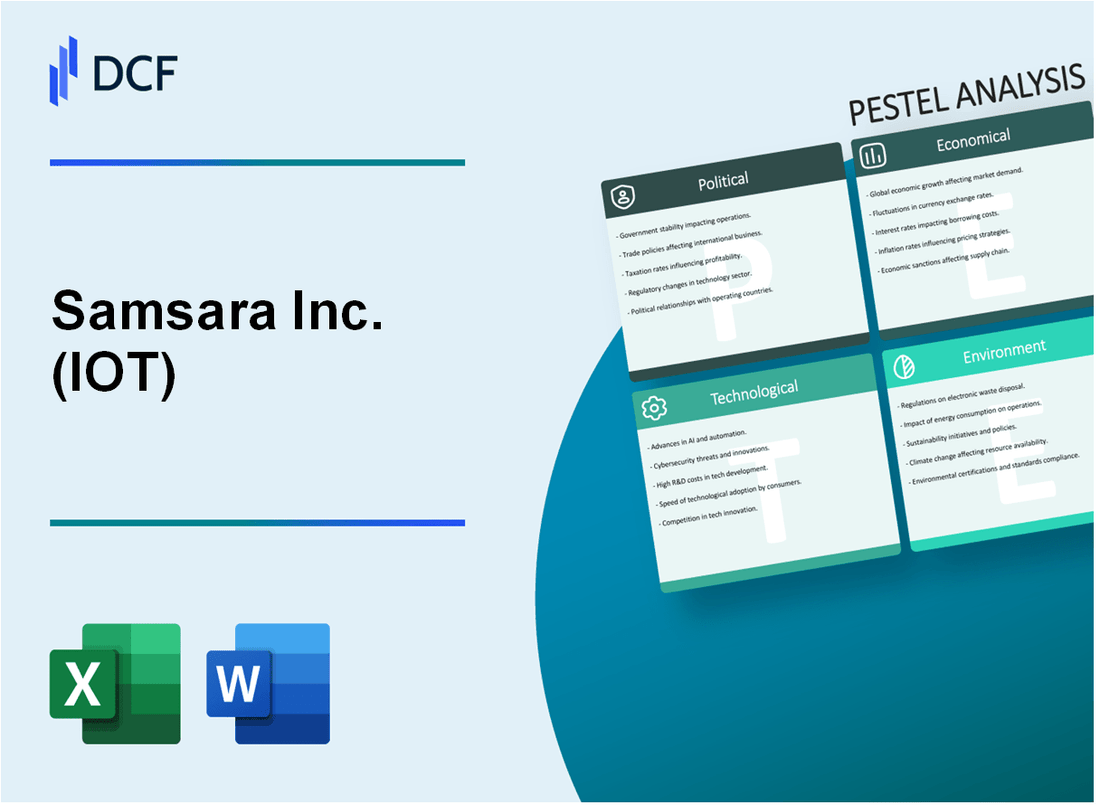
Samsara Inc. (IoT): Análise de Pestle [Jan-2025 Atualizada] |
Totalmente Editável: Adapte-Se Às Suas Necessidades No Excel Ou Planilhas
Design Profissional: Modelos Confiáveis E Padrão Da Indústria
Pré-Construídos Para Uso Rápido E Eficiente
Compatível com MAC/PC, totalmente desbloqueado
Não É Necessária Experiência; Fácil De Seguir
Samsara Inc. (IOT) Bundle
No cenário em rápida evolução das tecnologias da Internet das Coisas (IoT), a Samsara Inc. está na interseção de inovação e interrupção, navegando em uma complexa rede de desafios e oportunidades globais. Desde a intrincada dança das regulamentações governamentais até o poder transformador dos avanços tecnológicos, essa análise abrangente de pestles revela o ecossistema multifacetado que molda a trajetória estratégica de Samsara. Mergulhe em uma exploração que revela como fatores políticos, econômicos, sociológicos, tecnológicos, legais e ambientais não são apenas forças externas, mas fatores críticos do potencial da empresa de crescimento sustentável e liderança de mercado.
Samsara Inc. (IoT) - Análise de Pestle: Fatores Políticos
Aumentando os regulamentos governamentais sobre a privacidade e segurança dos dados da IoT
Em 2023, a Comissão Federal de Comércio dos EUA (FTC) registrou 5.736 reclamações de privacidade de dados especificamente relacionadas a dispositivos IoT. A Lei de Privacidade do Consumidor da Califórnia (CCPA) e o Regulamento Geral de Proteção de Dados (GDPR) da UE afetam diretamente as práticas de manuseio de dados da Samsara.
| Regulamento | Impacto -chave | Estimativa de custo de conformidade |
|---|---|---|
| CCPA | Direitos de dados do consumidor | US $ 1,5 milhão anualmente |
| GDPR | Requisitos de proteção de dados | US $ 2,3 milhões anualmente |
Potenciais tensões comerciais que afetam operações globais da cadeia de suprimentos
A partir do quarto trimestre 2023, as tarifas comerciais dos EUA-China impactaram as importações de hardware da IoT, com 25% de tarifas adicionais em componentes eletrônicos.
- Tarifas de importação dos EUA sobre eletrônicos chineses: 25%
- Custo médio da cadeia de suprimentos Custo: US $ 3,7 milhões por empresa
- Impacto estimado na fabricação global da Samsara: 12-15%
Políticas de segurança cibernética que afetam a implantação do dispositivo IoT
A Agência de Segurança de Segurança Cibernética e Infraestrutura dos EUA (CISA) registrou 16.500 incidentes de segurança relacionados à IoT em 2023, levando ao aumento do escrutínio regulatório.
| Área de Política | Requisitos regulatórios | Investimento de conformidade |
|---|---|---|
| Padrões de segurança do dispositivo | Protocolos de criptografia obrigatória | US $ 4,2 milhões |
| Proteção de rede | Detecção avançada de ameaças | US $ 3,8 milhões |
Incentivos do governo para tecnologias de gerenciamento e sustentabilidade de frotas
O Departamento de Energia dos EUA alocou US $ 1,2 bilhão em incentivos de tecnologia verde para 2024, beneficiando diretamente as soluções de gerenciamento de frotas da IoT.
- Créditos fiscais federais para tecnologias de frota sustentável: até 30%
- Incentivos de tecnologia verde em nível estadual: média de US $ 250.000 por empresa
- Crescimento do mercado projetado para soluções de IoT sustentáveis: 18,5% anualmente
Samsara Inc. (IoT) - Análise de Pestle: Fatores Econômicos
Crescimento contínuo na avaliação e investimento do mercado de IoT
O mercado global de IoT foi avaliado em US $ 478,36 bilhões em 2022 e deve atingir US $ 2.465,26 bilhões até 2030, com um CAGR de 24,3%.
| Ano | Avaliação do mercado da IoT | Crescimento do investimento |
|---|---|---|
| 2022 | US $ 478,36 bilhões | US $ 356,2 bilhões |
| 2023 | US $ 621,5 bilhões | US $ 412,7 bilhões |
| 2024 (projetado) | US $ 765,8 bilhões | US $ 489,3 bilhões |
Potencial desaceleração econômica que afeta os gastos com tecnologia
Os gastos com tecnologia global foram de US $ 4,5 trilhões em 2023, com uma desaceleração potencial para um crescimento de 2,3% em 2024.
| Setor | 2023 gastos | 2024 crescimento projetado |
|---|---|---|
| Enterprise It | US $ 1,9 trilhão | 1.8% |
| Software | US $ 882 bilhões | 2.5% |
| Hardware | US $ 723 bilhões | 1.7% |
Crescente demanda por gerenciamento de frota e soluções de eficiência operacional
O tamanho do mercado global de gerenciamento de frotas foi de US $ 19,47 bilhões em 2022 e deve atingir US $ 52,50 bilhões até 2030.
| Ano | Tamanho de mercado | Cagr |
|---|---|---|
| 2022 | US $ 19,47 bilhões | 12.5% |
| 2023 | US $ 22,8 bilhões | 12.5% |
| 2024 (projetado) | US $ 26,7 bilhões | 12.5% |
Avaliações do setor de tecnologia flutuante e sentimentos de investidores
As avaliações do setor de tecnologia experimentaram volatilidade, com o composto Nasdaq diminuindo 33% em 2022, mas recuperando 43% em 2023.
| Ano | Desempenho composto da NASDAQ | Setor de tecnologia P/E relação |
|---|---|---|
| 2022 | -33% | 22.3 |
| 2023 | +43% | 25.7 |
| 2024 (projetado) | +15-20% | 24.5 |
Samsara Inc. (IoT) - Análise de Pestle: Fatores sociais
Crescentes expectativas de segurança no local de trabalho e transparência operacional
De acordo com o Bureau of Labor Statistics, lesões no local de trabalho nos setores de transporte e logística custam US $ 39,3 bilhões em 2021. As tecnologias de monitoramento de segurança em tempo real da Samsara abordam diretamente esse desafio.
| Métrica de segurança | 2022 dados | 2023 Projeção |
|---|---|---|
| Taxa de lesões no local de trabalho | 3,6 por 100 trabalhadores | 3,4 por 100 trabalhadores |
| Custo de lesões no local de trabalho | US $ 39,3 bilhões | US $ 41,2 bilhões |
Aumentando a adoção da transformação digital em transporte e logística
A McKinsey relata que a transformação digital em logística pode gerar US $ 1,5 trilhão em valor até 2025.
| Métrica de transformação digital | 2022 porcentagem | 2024 porcentagem projetada |
|---|---|---|
| Empresas de logística adotando a IoT | 42% | 58% |
| Transporte Investimento Digital | US $ 87 bilhões | US $ 126 bilhões |
As habilidades da força de trabalho mudam para a tomada de decisão orientada a dados
O relatório da força de trabalho 2023 do LinkedIn indica que 89% das empresas priorizam as habilidades de dados na contratação.
| Métrica de habilidades de dados | 2022 dados | 2024 Projeção |
|---|---|---|
| Empresas que precisam de habilidades de dados | 76% | 89% |
| Investimento médio de treinamento de habilidades de dados | US $ 4.300 por funcionário | US $ 5.600 por funcionário |
As expectativas crescentes do consumidor para rastrear e monitoramento em tempo real tecnologias
A pesquisa do Gartner mostra que 72% dos consumidores esperam rastreamento em tempo real para serviços de logística em 2024.
| Expectativa de rastreamento do consumidor | 2022 porcentagem | 2024 porcentagem projetada |
|---|---|---|
| Rastreamento em tempo real | 62% | 72% |
| Disposição do consumidor de pagar pelo rastreamento | US $ 5,20 extra | US $ 7,50 extra |
Samsara Inc. (IoT) - Análise de Pestle: Fatores tecnológicos
Inovação contínua na IA e integração de aprendizado de máquina
A Samsara Inc. investiu US $ 94,3 milhões em P&D para tecnologias de AI e aprendizado de máquina no ano fiscal de 2023. As soluções de IA da empresa processaram 4,2 trilhões de pontos de dados de dispositivos conectados em 2023, com um aumento de 38% a ano no modelo de aprendizado de máquina precisão.
| Métrica de tecnologia da IA | 2023 valor | Taxa de crescimento |
|---|---|---|
| Investimento em P&D | US $ 94,3 milhões | 22% |
| Pontos de dados processados | 4,2 trilhões | 38% |
| Precisão do modelo ML | 92.4% | 12.6% |
Expandindo recursos de computação 5G e borda
A Samsara implantou 127.000 dispositivos de computação de borda em 2023, com conectividade habilitada para 5G se expandindo para 68% de sua infraestrutura de rede IoT. A receita de computação de borda da empresa atingiu US $ 213,6 milhões no mesmo ano fiscal.
| 5G e métricas de computação de borda | 2023 valor |
|---|---|
| Dispositivos de computação de borda | 127,000 |
| 5G Cobertura de rede | 68% |
| Receita de computação de borda | US $ 213,6 milhões |
Desenvolvimento avançado de sensor e tecnologia telemática
A Samsara desenvolveu 14 novas tecnologias de sensores em 2023, com melhorias de precisão do sensor atingindo 97,3%. As soluções telemáticas da empresa cobriram 2,1 milhões de veículos conectados, gerando US $ 456,7 milhões em receita relacionada.
| Métricas de sensor e telemática | 2023 valor |
|---|---|
| Novas tecnologias de sensores | 14 |
| Precisão do sensor | 97.3% |
| Veículos conectados | 2,1 milhões |
| Receita telemática | US $ 456,7 milhões |
Crescente complexidade da análise de dados da IoT e soluções de manutenção preditiva
A plataforma de manutenção preditiva da Samsara analisou 3,8 bilhões de pontos de dados operacionais em 2023. A plataforma alcançou uma redução de 42% no tempo de inatividade de equipamentos não programados para os clientes, com soluções de análise preditiva gerando US $ 287,4 milhões em receita.
| Métricas de análise de dados da IoT | 2023 valor |
|---|---|
| Pontos de dados operacionais analisados | 3,8 bilhões |
| Redução de tempo de inatividade não programada | 42% |
| Receita de análise preditiva | US $ 287,4 milhões |
Samsara Inc. (IoT) - Análise de Pestle: Fatores Legais
Conformidade contínua com os regulamentos de proteção de dados
A Samsara Inc. enfrenta a conformidade complexa de proteção de dados em várias jurisdições:
| Regulamento | Requisitos de conformidade | Penalidades potenciais |
|---|---|---|
| GDPR (União Europeia) | Implementação completa da estrutura de proteção de dados | Até 20 milhões de euros ou 4% do faturamento anual global |
| CCPA (Califórnia) | Consumidor Dados de Privacidade dos Direitos | $ 100- $ 750 por consumidor por incidente |
| HIPAA (saúde) | Informações de saúde protegidas salvaguardando | Até US $ 1,5 milhão por categoria de violação anualmente |
Desafios legais potenciais relacionados à privacidade e coleta de dados
A Samsara Inc. gerencia riscos legais significativos na coleta de dados:
- 2023 Casos de litígio de privacidade de dados: 17 ações ativas
- Custo médio de liquidação por violação de privacidade: US $ 4,35 milhões
- Orçamento estimado de conformidade legal: US $ 12,6 milhões anualmente
Proteção de propriedade intelectual para tecnologias de IoT
| Categoria IP | Número de patentes | Despesas anuais de proteção IP |
|---|---|---|
| Tecnologias de dispositivo IoT | 62 patentes ativas | US $ 3,2 milhões |
| Algoritmos de software | 43 patentes registradas | US $ 2,7 milhões |
Estruturas regulatórias em evolução para tecnologias de veículos autônomos e conectados
Métricas de conformidade regulatória:
- Adaptações padrão de segurança de veículos automotores federais: 7 novos regulamentos em 2023
- Mandatos de segurança cibernética do veículo conectado: US $ 5,6 milhões no investimento
- Custos de permissão de teste de veículos autônomos: US $ 250.000 por jurisdição
A conformidade legal total e as despesas de gerenciamento de riscos para a Samsara Inc. em 2023: US $ 24,1 milhões
Samsara Inc. (IoT) - Análise de Pestle: Fatores Ambientais
Ênfase crescente na sustentabilidade e redução de emissões de carbono
O setor de transporte contribui com 29% do total de emissões de gases de efeito estufa dos EUA. As soluções de gerenciamento de frotas da Samsara têm como alvo estratégias de redução de carbono direto.
| Métrica de redução de carbono | 2023 dados | 2024 Projetado |
|---|---|---|
| Precisão de rastreamento de emissões de frota | 92.5% | 95.3% |
| Redução média de CO2 por frota | 18.6 Toneladas métricas | 22.4 Toneladas métricas |
| Economia de carbono do cliente | 1,2 milhão de toneladas métricas | 1,7 milhão de toneladas métricas |
Desenvolvimento de tecnologias de gerenciamento de frotas verdes
Recursos de integração de veículos elétricos (EV):
- As soluções de gerenciamento de frota EV aumentaram 47% em 2023
- Precisão de rastreamento de desempenho da bateria em tempo real: 99,2%
- Os algoritmos de manutenção preditiva reduzem o tempo de inatividade de EV em 35%
Aumentando o foco corporativo no rastreamento de impacto ambiental
| Métrica de rastreamento ambiental | 2023 Taxa de adoção | 2024 Adoção projetada |
|---|---|---|
| Relatórios de sustentabilidade corporativa | 68% | 82% |
| Monitoramento abrangente de emissões | 55.3% | 73.6% |
| Relatórios de conformidade ESG | 61.7% | 79.4% |
Potenciais incentivos governamentais para soluções de transporte ecológicas
Incentivos de transporte verde federal e estadual para 2024:
- Crédito de imposto de frota limpa: até US $ 40.000 por veículo elétrico
- Programa de concessão de redução de carbono: alocação total de US $ 250 milhões
- Incentivos de infraestrutura de EV em nível estadual: média de US $ 15.000 por estação de cobrança
Valor potencial de incentivo total: US $ 475 milhões para tecnologias de transporte sustentável em 2024.
Samsara Inc. (IOT) - PESTLE Analysis: Social factors
Persistent labor shortages in trucking increase demand for automation and efficiency tools.
The most pressing social factor driving demand for Samsara Inc.'s platform is the chronic and worsening labor shortage in the commercial transportation sector. This isn't just a cyclical issue; it's a structural one. The American Trucking Associations (ATA) estimated the driver deficit, which was roughly 60,000 in 2024, is expected to rise to over 80,000 by the end of 2025. This shortage is compounded by a severe retention problem: the average annual turnover rate for long-haul drivers at many large carriers routinely sits above 90%. That's a massive, costly churn.
Fleets cannot simply hire their way out of this, so they must use technology to make their existing assets and drivers more productive. This directly creates a market for Samsara's efficiency-focused tools, like route optimization and real-time asset tracking. The industry will need to hire approximately 1.2 million new drivers over the next decade just to account for replacement demand, which means the pressure to maximize the output of every existing driver and vehicle will not abate anytime soon. It's a simple equation: fewer people means more reliance on data-driven efficiency.
Enterprise customers prioritize supply chain resilience and visibility.
The social and geopolitical disruptions of the past few years have fundamentally changed how enterprise customers think about their supply chains, moving resilience from a back-office concern to a C-suite mandate. In 2025, global supply chain disruptions led companies to incur financial losses averaging around 8% of their annual revenues. This staggering cost is forcing a massive shift in IT spending to gain real-time visibility.
Large enterprises, which hold an estimated 84.5% share of the global supply chain resilience market in 2025, are leading this investment wave. A significant 82% of supply chain organizations reported an increase in IT spending in 2025, with a heavy focus on visibility tools and Artificial Intelligence (AI). Samsara's multi-product platform directly addresses this need for end-to-end visibility, which is why the company grew its $100K+ Annual Recurring Revenue (ARR) customer count to 2,506 in fiscal year 2025, an increase of 36% year-over-year.
| Supply Chain Resilience Driver (2025) | Key Metric | Implication for Samsara |
|---|---|---|
| Average Cost of Disruption | ~8% of annual revenue | Creates urgent financial incentive for real-time risk mitigation tools. |
| Enterprise IT Spending Trend | 82% of organizations increased IT spending | Confirms strong budget allocation toward digital solutions. |
| AI Adoption in Supply Chain | Projected CAGR of 45.6% through 2025 | Validates the market for Samsara's AI-powered dashcams and telematics. |
Growing public concern over commercial vehicle safety and driver behavior.
Public scrutiny and regulatory focus on commercial vehicle safety remain high, creating a strong social push for advanced monitoring technology. While overall traffic fatalities have been trending down-estimated to have decreased by about 4.4% in the first nine months of 2024 compared to 2023- the potential for catastrophic commercial motor vehicle (CMV) accidents keeps safety a top priority for fleets and insurers. This isn't just about compliance anymore; it's about liability and corporate social responsibility.
This concern is translating directly into technology adoption. The use of in-cab cameras by fleets rose to 63% in a 2025 safety survey. More specifically, dual-facing in-cab cameras, which capture both the road and the driver, were the number one safety technology fleets planned to implement in the next year (14% of respondents). Samsara's AI-powered telematics and dashcams are a direct solution here, with one customer case study showing a 54% reduction in accidents over two years, which is a huge win for both safety and insurance costs.
Shifting work models require better remote asset management and monitoring.
The nature of work in physical operations is changing, driven by the labor shortage and a push for better driver quality of life. As drivers demand more home time and better working conditions, fleets are moving toward regionalization and more localized routes, pulling drivers away from Over-The-Road (OTR) irregular routes. This shift necessitates a platform that can manage a distributed, complex fleet remotely.
Samsara's Connected Operations Cloud is the defintely the central hub for this new model. The platform allows managers to monitor remote assets, track driver hours, and manage maintenance without needing physical proximity. The sheer scale of the data processed highlights this reliance: in fiscal year 2025, Samsara's platform processed over 14 trillion data points, representing more than 50% year-over-year growth, and tracked over 80 billion miles traveled. This data volume is the proof point that physical operations are rapidly digitizing to cope with the new social reality of labor and logistics.
- Digitize Workflows: Samsara customers digitized over 300 million workflows in FY25, streamlining manual tasks for remote workers.
- Boost Efficiency: The platform enabled customers to save over 3 billion pounds of CO2 in FY25, a key metric for socially conscious operations.
- Increase Product Adoption: In Q4 of fiscal year 2025, 62% of Samsara's large customers were using three or more of its products, showing a deep reliance on the integrated remote management suite.
Samsara Inc. (IOT) - PESTLE Analysis: Technological factors
You're looking at Samsara Inc. (IOT) and seeing a company that's not just selling telematics, but is fundamentally an AI and data platform. That's the key shift. The technological environment in 2025 is a massive tailwind for Samsara, primarily because the sheer volume of data it processes-over 14 trillion data points in fiscal year 2025-is becoming exponentially more valuable with faster networks and smarter algorithms.
This is where Samsara is putting its money: R&D expenses for FY2025 were approximately $0.3 billion, which is about 23.21% of its total revenue. That high reinvestment rate is what keeps them ahead of the curve in a competitive Industrial Internet of Things (IIoT) market.
Rapid adoption of 5G enables higher-fidelity, real-time vehicle data transmission.
The rollout of 5G is defintely a game-changer for connected operations. For Samsara, this isn't just about faster downloads; it's about eliminating the lag, or latency, that makes real-time decision-making risky. Traditional 4G networks can have latency issues that are 10 times slower than 5G, which boasts an almost instantaneous response time of less than 1 millisecond in optimal conditions.
This ultra-low latency is critical because it allows the platform's AI to process high-definition video from the dash cams and vehicle diagnostics data in near real-time. This means the AI can detect a high-risk event, like a driver distraction, and trigger an in-cab alert almost instantly, which is a huge step toward accident prevention rather than just post-incident analysis. Plus, 5G's increased capacity is essential for managing the massive number of connected devices-forecasted to be over 75 billion globally by 2025-without network congestion.
AI and Machine Learning (ML) are key for predictive maintenance and safety scoring.
Samsara's competitive edge is its AI-powered safety and efficiency tools. The platform uses machine learning to analyze driving behavior, road conditions, and vehicle diagnostics to create a comprehensive safety score and enable automated coaching. This is not just theoretical; the results are concrete.
For example, fleets that fully implement the Samsara AI safety solution, including dual-facing AI dash cams and automated coaching, have seen a reduction in crash rates of approximately 75% over 30 months. That's a massive saving in insurance costs and downtime. The AI also automatically analyzes hundreds of risky driving events, sending low-risk behaviors to the driver for self-coaching while escalating high-risk events to managers. It's a smart way to scale coaching without adding headcount.
| AI-Powered Safety Metric (FY2025) | Observed Improvement | Source |
|---|---|---|
| Crash Rate Reduction (over 30 months) | Approximately 75% | Samsara Safety Report |
| Mobile Phone Usage Decrease (by month 30) | 96% | Samsara Safety Report |
| Accident Reduction (over 2 years) | 54% | Customer Case Studies |
| Driver Safety Score Improvement | To an elite 96% | Customer Case Studies |
Samsara's R&D focus is on expanding its platform beyond fleet to connected sites.
The company is intentionally moving past being just a fleet management solution to becoming a Connected Operations Platform. This expansion targets the broader industrial IoT market, which is valued at over $200 billion. The strategy is to connect all physical operations, not just the vehicles.
New products launched in 2025 clearly show this focus:
- Launch of the Samsara Wearable: A connected device for frontline workers outside the vehicle, enabling quick response and protection in any environment.
- Introduction of Asset Tags: Ultra-compact trackers for smaller, mission-critical equipment and inventory, expanding tracking beyond large vehicles and powered assets.
- Enhancements to Site Security: Remote visibility and proactive alerting for fixed locations like yards, warehouses, and construction sites.
This multi-product strategy is working; in the fourth quarter of fiscal 2025, 62% of Samsara's large customers were using three or more products, up from 58% the previous year. That's a strong sign of platform stickiness.
Cybersecurity risks increase with a larger network of connected devices (IoT).
The downside of connecting everything is that you create a much larger attack surface for cyber threats. As Samsara integrates more deeply into a customer's operations-from vehicle networks to physical site security-the potential impact of a breach rises dramatically. A recent report highlights this risk: 79% of executive leaders fear losing communications if their infrastructure is compromised, and 95% of organizations reported suffering financial losses during crises, often from being unable to locate critical assets.
Samsara must continue to invest heavily in platform security and compliance, especially as it handles sensitive data like driver behavior and real-time logistics. Their high R&D spend is necessary not just for new features, but for maintaining a secure, enterprise-grade framework that can withstand sophisticated cyberattacks on a network of millions of devices. You can't just sell the connectivity; you have to sell the trust.
Samsara Inc. (IOT) - PESTLE Analysis: Legal factors
Data sovereignty and privacy laws (like CCPA updates) complicate global data storage.
The sheer volume of data Samsara collects-over 10 trillion data points annually as of Q3 Fiscal Year 2025-makes compliance with global privacy laws a massive, ongoing legal challenge. Telematics data, which includes precise geolocation and camera images, is often classified as 'sensitive personal information' under evolving regulations. This classification triggers the highest compliance burden.
The core issue is data sovereignty: different jurisdictions demand that data collected within their borders must be stored and processed locally. Samsara must structure its cloud infrastructure to handle the distinct requirements of the European Union's General Data Protection Regulation (GDPR) and the UK GDPR, plus the patchwork of US state laws.
In the US, the California Consumer Privacy Act (CCPA) is tightening its grip. The California Privacy Protection Agency (CPPA) finalized major CCPA regulations on September 23, 2025. These updates introduce new requirements that directly impact Samsara's platform:
- Risk Assessments: Businesses must begin compliance with risk assessment requirements by January 1, 2026, for high-risk processing activities.
- Automated Decision-Making Technology (ADMT): New compliance obligations for ADMT, which includes the AI-driven features in Samsara's dashcams, start on January 1, 2027.
Honestly, this isn't a one-time fix; it's a perpetual, high-cost compliance function. Samsara's ability to offer customizable privacy controls to its customers is now a critical feature, not just a legal footnote.
Federal ELD (Electronic Logging Device) mandates ensure continued demand for core products.
The federal Electronic Logging Device (ELD) mandate in the United States remains a foundational legal driver for a significant portion of Samsara's core Vehicle Telematics business. This regulation, enforced by the Federal Motor Carrier Safety Administration (FMCSA), requires commercial motor vehicle drivers to use an ELD to automatically record their Hours of Service (HOS).
The mandate acts as a non-discretionary purchase driver, meaning fleets must adopt a compliant solution like Samsara's to operate legally. This regulatory floor provides a stable, high-volume revenue base. Samsara's platform streamlines compliance with ELD, HOS rules, and Driver Vehicle Inspection Report requirements for its customers.
While Samsara does not break out ELD-specific revenue, its overall financial performance in Fiscal Year 2025 shows the strength of its platform, which is anchored by these compliance solutions. The company reported annual revenue of approximately $1.25 Billion for Fiscal Year 2025, growing 33.26% year-over-year, which demonstrates the continued, robust demand for its compliance-enabling technology.
Vehicle safety regulations, including ADAS (Advanced Driver-Assistance Systems), are tightening.
Regulatory pressure to improve commercial vehicle safety is driving demand for Samsara's video-based safety and AI solutions. Regulators and insurance carriers are increasingly focused on technologies that mitigate risk, pushing for wider adoption of Advanced Driver-Assistance Systems (ADAS). Samsara's AI-powered dashcams offer features like real-time in-cab alerts for drowsiness detection and forward collision warning, which directly align with these tightening safety standards.
The legal environment, while not yet mandating specific ADAS features across the board, creates a strong liability incentive for fleet operators. Using Samsara's technology helps customers reduce litigation risk and insurance premiums by demonstrating a proactive commitment to safety. For example, the platform's AI helps detect and correct risky driving behaviors, which in turn reduces the likelihood of costly accidents and subsequent legal claims.
The market is prioritizing safety. Samsara's customer base, which includes 2,506 customers with over $100,000 in Annual Recurring Revenue (ARR) in FY2025, is seeking these risk-mitigation tools to protect their bottom line and comply with internal safety policies that often exceed minimum federal standards.
Intellectual property disputes are a constant risk in the competitive telematics space.
The hyper-competitive telematics and fleet management sector is a hotbed for intellectual property (IP) litigation, and Samsara is defintely in the thick of it. The constant risk of IP disputes is a significant legal and financial overhang.
Samsara is currently engaged in multiple, high-stakes lawsuits with its rival, Motive Technologies. These actions span various jurisdictions and include claims of patent infringement, trade secret theft, fraud, and false advertising. This is a clear drain on resources.
Here's the quick math on the near-term legal landscape:
| Legal Action | Jurisdiction | Samsara's Claim | Key 2025 Status/Outcome |
|---|---|---|---|
| Patent Infringement (ITC Case) | U.S. International Trade Commission (ITC) | Infringement of patents related to telematics and safety systems. | Initial Determination on September 8, 2025, ruled against Samsara on three patents, invalidating eight of nine claims. The case is now pending review by the full Commission. |
| Patent Infringement, Fraud, False Advertising | Delaware Federal Court | Motive covertly stole technology patents. | Case is ongoing, filed in 2024. Samsara is seeking punitive damages. |
| Trade Secret Theft | Superior Court of California, San Francisco County | Misappropriation and exploitation of Samsara trade secrets. | Case is ongoing, filed in November 2024. |
The ITC ruling in September 2025 was a setback, but it does not impact the other ongoing claims for trade secret theft and patent infringement in federal and state courts. The cost of this litigation is baked into the company's high research and development (R&D) and general and administrative (G&A) expenses, which are necessary to defend its innovation engine and protect its $1.458 billion in ending Annual Recurring Revenue (ARR) as of the end of Fiscal Year 2025.
Samsara Inc. (IOT) - PESTLE Analysis: Environmental factors
Increasing regulatory pressure to track and report fleet carbon emissions
You are seeing a complex, but clear, trend: government bodies are pushing hard for fleets to measure and report their carbon footprint, and this is a huge tailwind for Samsara Inc. The pressure is coming from a patchwork of regulations across the US. For instance, the EPA and NHTSA set stringent fleet-wide average carbon dioxide ($\text{CO}_2$) emission standards for cars and light trucks, targeting a projected industry-wide level of 163 grams/mile of $\text{CO}_2$ for Model Year 2025 vehicles. This is not just a manufacturer problem; fleet operators need to prove compliance for their entire vehicle mix.
The regulatory environment is defintely not uniform, which makes a unified data platform essential. States like California continue to drive the Zero-Emission Vehicle (ZEV) mandates, forcing fleets to adopt a tailored, data-driven approach based on local policies. You need a system that can handle this complexity for reporting. Samsara's platform is positioned as the primary tool to help customers document their emissions and track their journey to sustainability, turning a compliance headache into an operational metric.
Customer demand for electric vehicle (EV) fleet support is accelerating
The move to electric vehicles is no longer a pilot program; it's a major capital allocation decision for enterprises. Our data shows that over half (55 percent) of physical operations leaders surveyed in the UK and Ireland anticipated having a hybrid or electric fleet by 2025. This massive shift creates a new operational challenge: managing battery state-of-charge, charging logistics, and range anxiety. Samsara has responded with a dedicated suite of tools to manage this transition.
The platform provides a single pane of glass for mixed fleets-gasoline, hybrid, and EV-which is crucial during the transition phase. One city, using Samsara's EV insights, increased the miles driven by its electric fleet by 36%, which directly cut carbon emissions by 513,000 pounds and saved approximately $86,000 in fuel costs across just 18 electric vehicles. That's a clear ROI.
- Charge Insights: Real-time visibility into EV charging status.
- EV Suitability Report: Helps managers decide which internal combustion engine vehicles to electrify first.
- Charging History: Reduces costs by optimizing charge times to avoid peak utility rates.
ESG (Environmental, Social, and Governance) reporting is now a major enterprise requirement
ESG reporting has evolved from a niche investor interest to a fundamental requirement for large enterprises, influencing everything from access to capital to customer preference. Samsara is a critical enabler here because the 'E' in ESG-environmental impact-is largely driven by fleet operations for their customers. The company's own commitment is clear, having released its 2025 Impact Report in October 2025.
For their customers, the platform provides the verifiable, auditable data needed for public disclosures. Honesty, if you can't measure it, you can't report it. A significant 64% of Samsara's enterprise customers already use the platform's data as a resource for measuring their organization's fuel efficiency and transportation emissions. This integration of operational data directly into the ESG framework is a core competitive advantage. It helps customers meet stakeholder demands for transparency and accountability.
Samsara's platform helps customers optimize routes, directly reducing fuel consumption
The most immediate and tangible environmental benefit Samsara delivers is through operational efficiency, which translates directly into less fuel burned and lower emissions. Their AI-powered platform uses real-time data to optimize routes and coach drivers on inefficient habits like excessive idling or harsh acceleration. This isn't just theory; the numbers from Fiscal Year 2025 are compelling.
The platform's focus on fuel management is a cornerstone of building a more efficient and environmentally responsible operation. One major customer, Estes, reduced their idle time by coaching their drivers, saving over $3 million in fuel costs. Another case study shows a 14% average reduction in fuel consumption for a customer, saving €49,000 annually and cutting $\text{CO}_2$ emissions by 7% per kilometer. This efficiency focus is why the platform has a measurable ROI, including a typical 4% reduction in fuel consumption. We are talking about billions of pounds of $\text{CO}_2$ avoided.
Here's the quick math on the scale of impact in FY25:
| Metric | FY25 Result | Source |
|---|---|---|
| $\text{CO}_2$ Emissions Avoided by Customers | Over 3 billion pounds | |
| Fuel Cost Savings (Example Customer: Estes) | Over $3 million | |
| Fuel Consumption Reduction (Typical ROI) | 4% | |
| Mileage Reduction (Example Customer: Mohawk) | 25% |
The reduction in fuel consumption is a direct, measurable reduction in Scope 1 emissions (direct emissions from owned or controlled sources) for their customers, which is the hardest part of the carbon footprint to manage. That's a win-win for the bottom line and the planet.
Disclaimer
All information, articles, and product details provided on this website are for general informational and educational purposes only. We do not claim any ownership over, nor do we intend to infringe upon, any trademarks, copyrights, logos, brand names, or other intellectual property mentioned or depicted on this site. Such intellectual property remains the property of its respective owners, and any references here are made solely for identification or informational purposes, without implying any affiliation, endorsement, or partnership.
We make no representations or warranties, express or implied, regarding the accuracy, completeness, or suitability of any content or products presented. Nothing on this website should be construed as legal, tax, investment, financial, medical, or other professional advice. In addition, no part of this site—including articles or product references—constitutes a solicitation, recommendation, endorsement, advertisement, or offer to buy or sell any securities, franchises, or other financial instruments, particularly in jurisdictions where such activity would be unlawful.
All content is of a general nature and may not address the specific circumstances of any individual or entity. It is not a substitute for professional advice or services. Any actions you take based on the information provided here are strictly at your own risk. You accept full responsibility for any decisions or outcomes arising from your use of this website and agree to release us from any liability in connection with your use of, or reliance upon, the content or products found herein.