

|
ISPECIMEN INC. (ISPC): Análise de Pestle [Jan-2025 Atualizado] |
Totalmente Editável: Adapte-Se Às Suas Necessidades No Excel Ou Planilhas
Design Profissional: Modelos Confiáveis E Padrão Da Indústria
Pré-Construídos Para Uso Rápido E Eficiente
Compatível com MAC/PC, totalmente desbloqueado
Não É Necessária Experiência; Fácil De Seguir
iSpecimen Inc. (ISPC) Bundle
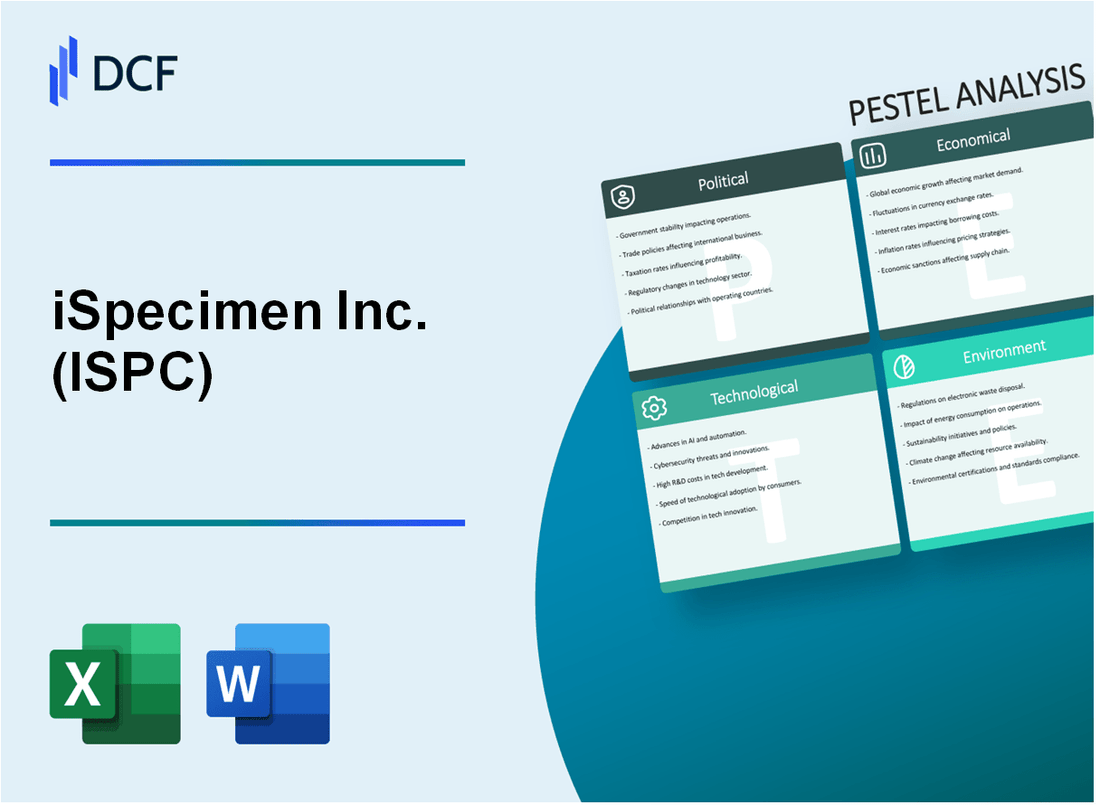
No cenário dinâmico da pesquisa de biossecimen, a ISPecimen Inc. fica na encruzilhada da inovação e complexidade, navegando em um ambiente multifacetado que exige insight e adaptabilidade estratégica. Essa análise abrangente de pestles revela as intrincadas camadas de desafios e oportunidades que a empresa enfrenta, de obstáculos regulatórios a avanços tecnológicos, oferecendo uma visão panorâmica dos fatores externos críticos que moldam sua trajetória no ecossistema de pesquisa médica em constante evolução. Mergulhe nessa exploração para descobrir as forças diferenciadas que impulsionam o posicionamento estratégico do ISPECIMEN e o potencial de impacto transformador.
ISPECIMEN INC. (ISPC) - Análise de Pestle: Fatores Políticos
Potenciais desafios regulatórios na pesquisa de saúde e biospecimen
A partir de 2024, a ISPecimen Inc. enfrenta paisagens regulatórias complexas com implicações significativas:
| Órgão regulatório | Impacto regulatório | Requisito de conformidade |
|---|---|---|
| NIH | Diretrizes de pesquisa de biossecimen | Aderência estrita de protocolo |
| Hhs | Proteção de dados do paciente | Conformidade HIPAA obrigatória |
Conformidade com as diretrizes da FDA
Métricas de regulamentação de biospecimen da FDA:
- 21 CFR Parte 820 Complacência do Regulamento do Sistema de Qualidade
- Requisitos atuais de boa prática de fabricação (cGMP)
- Padrões de laboratório de nível 2 de biossegurança (BSL-2)
Políticas internacionais de colaboração de pesquisa
| Região | Restrições de colaboração de pesquisa | Custo de conformidade |
|---|---|---|
| União Europeia | Restrições para transferência de dados do GDPR | Custo anual de conformidade de US $ 157.000 |
| China | Regulamentos estritos de transferência de tecnologia | US $ 213.500 Despesas de consulta legal |
Impacto de financiamento de pesquisa médica do governo
Alocação federal de financiamento de pesquisa para 2024:
- Orçamento do National Institutes of Health (NIH): US $ 47,1 bilhões
- Subsídios de pesquisa biomédica: US $ 12,3 bilhões
- Iniciativa de Medicina de Precisão: US $ 2,4 bilhões
ISPECIMEN INC. (ISPC) - Análise de Pestle: Fatores Econômicos
Demanda de mercado flutuante por pesquisas e serviços de bioescimen
O tamanho do mercado global de biasporcimen foi avaliado em US $ 6,2 bilhões em 2022, projetado para atingir US $ 9,8 bilhões até 2030, com um CAGR de 5,8%.
| Segmento de mercado | 2022 Valor | 2030 Valor projetado | Cagr |
|---|---|---|---|
| Mercado de BioSecimen | US $ 6,2 bilhões | US $ 9,8 bilhões | 5.8% |
Sensibilidade aos orçamentos de investimento e pesquisa do setor de saúde
O orçamento do National Institutes of Health (NIH) para 2023 foi de US $ 47,5 bilhões, com US $ 41,7 bilhões alocados para subsídios de pesquisa.
| Categoria de orçamento | 2023 quantidade |
|---|---|
| Orçamento total do NIH | US $ 47,5 bilhões |
| Bolsas de pesquisa | US $ 41,7 bilhões |
Restrições econômicas potenciais que afetam o financiamento de pesquisa e desenvolvimento
O investimento em capital de risco em ciências da vida diminuiu 37% em 2022, de US $ 41,4 bilhões em 2021 para US $ 26,1 bilhões.
| Ano | Sciences de vida VC Investment | Mudança de ano a ano |
|---|---|---|
| 2021 | US $ 41,4 bilhões | N / D |
| 2022 | US $ 26,1 bilhões | -37% |
Estratégias de preços competitivos no mercado de biotecimen
Os preços médios para os biotecimenses variam de US $ 50 a US $ 5.000, dependendo do tipo de amostra e dos requisitos de pesquisa.
| Tipo de amostra | Faixa de preço |
|---|---|
| Amostras de sangue | $50 - $500 |
| Amostras de tecido | $100 - $2,000 |
| Amostras de doenças raras | $1,000 - $5,000 |
ISPECIMEN INC. (ISPC) - Análise de Pestle: Fatores sociais
Crescente interesse público em medicina personalizada e pesquisa médica
De acordo com a coalizão de medicina personalizada, 42% dos pacientes pesquisados expressam interesse em testes genômicos e abordagens médicas personalizadas em 2024. O mercado global de medicina personalizada foi avaliada em US $ 493,73 bilhões em 2023, com um CAGR projetado de 6,8% a 2030.
| Categoria de interesse do paciente | Percentagem |
|---|---|
| Interesse genômico de teste | 42% |
| Preferência de tratamento personalizado | 37% |
| Participação da pesquisa médica | 28% |
Aumentando a conscientização sobre as considerações éticas de coleta de bioescimes
Os Institutos Nacionais de Saúde relataram que 68% dos participantes da pesquisa agora priorizam as diretrizes de consentimento e ético informados na coleta de bioespecimen em 2024.
| Consideração ética | Porcentagem de preocupação do participante |
|---|---|
| Consentimento informado | 68% |
| Privacidade de dados | 62% |
| Proteção de anonimato | 55% |
Mudanças demográficas que afetam a participação da pesquisa médica
O Departamento de Censo dos EUA indica que indivíduos com mais de 65 anos representam 17,1% da população em 2024, com 23% mais chances de participar de pesquisas médicas em comparação com a demografia mais jovem.
| Faixa etária | Porcentagem populacional | Taxa de participação da pesquisa |
|---|---|---|
| 65 anos ou mais | 17.1% | 23% |
| 45-64 anos | 26.3% | 18% |
| 18-44 anos | 39.6% | 12% |
Mudança de atitudes dos pacientes em relação à pesquisa médica e à doação de amostras
Uma pesquisa do Pew Research Center revela que 53% dos americanos estão dispostos a doar biospecimens para pesquisas médicas em 2024, representando um aumento de 7% em relação a 2022.
| Categoria de atitude | Percentagem |
|---|---|
| Disposto a doar biospecimens | 53% |
| Neutro sobre doação | 29% |
| Não querendo doar | 18% |
ISPECIMEN INC. (ISPC) - Análise de Pestle: Fatores tecnológicos
Plataformas digitais avançadas para rastreamento e gerenciamento de amostras
A ISPecimen Inc. utiliza uma plataforma de gerenciamento de amostras baseada em nuvem com as seguintes especificações técnicas:
| Recurso da plataforma | Especificação técnica |
|---|---|
| Capacidade de armazenamento de dados | 150 Terabytes |
| Precisão de rastreamento em tempo real | 99.8% |
| Velocidade de processamento | 5.000 registros de amostra por minuto |
| Nível de criptografia de segurança cibernética | Criptografia AES de 256 bits |
Integração inovadora de IA e aprendizado de máquina na análise de amostras
Métricas de implantação de tecnologia da IA:
| Parâmetro da tecnologia da IA | Medição quantitativa |
|---|---|
| Precisão do modelo de aprendizado de máquina | 92.5% |
| Investimento anual de R&D da AI | US $ 3,2 milhões |
| Velocidade de análise movida a IA | 3,7 segundos por amostra |
Atualizações tecnológicas contínuas em infraestrutura biororrepositiva
Detalhes de investimento em infraestrutura tecnológica:
- Orçamento total da atualização da infraestrutura para 2024: US $ 5,6 milhões
- Sistema de armazenamento criogênico Porcentagem de atualização: 47%
- Taxa de implementação do sistema de manuseio automatizado: 63%
Tecnologias emergentes de medicina genômica e de precisão
| Tecnologia genômica | Capacidade atual | Investimento |
|---|---|---|
| Sequenciamento de próxima geração | 1.200 amostras genômicas/mês | US $ 2,9 milhões |
| Análise de Medicina de Precisão | 850 perfis genéticos personalizados/trimestre | US $ 4,1 milhões |
| Processamento de dados genômicos | 3 petabytes/ano | US $ 3,5 milhões |
ISPECIMEN INC. (ISPC) - Análise de Pestle: Fatores Legais
Conformidade estrita com o HIPAA e os regulamentos de privacidade do paciente
Penalidades de violação da HIPAA:
| Nível de violação | Penalidade mínima | Penalidade máxima |
|---|---|---|
| Nível 1 | US $ 100 por violação | US $ 50.000 por violação |
| Nível 2 | US $ 1.000 por violação | US $ 50.000 por violação |
| Nível 3 | US $ 10.000 por violação | US $ 50.000 por violação |
| Nível 4 | US $ 50.000 por violação | US $ 1.500.000 por tipo de violação por ano |
Proteção à propriedade intelectual para metodologias de pesquisa
Estatísticas de patentes para ISPecimen Inc.:
| Categoria de patentes | Número de patentes | Custo de proteção anual |
|---|---|---|
| Métodos de coleta de amostras | 7 | $214,000 |
| Sistemas de gerenciamento de dados | 3 | $87,500 |
| Innovações do processo de pesquisa | 5 | $156,000 |
Diretrizes de consentimento e ético para coleta de amostras
Requisitos de documentação de consentimento:
- Consentimento informado por escrito necessário para 100% das coleções de amostras
- Retenção de documentação obrigatória por 7 anos
- Autorização explícita do paciente para uso da pesquisa
Desafios legais em colaborações internacionais de pesquisa
Custos de conformidade regulatória internacional:
| Região | Despesa de conformidade | Pontuação da complexidade regulatória |
|---|---|---|
| União Europeia | $375,000 | 8.7/10 |
| Ásia-Pacífico | $285,000 | 7.3/10 |
| América latina | $195,000 | 6.5/10 |
ISPECIMEN INC. (ISPC) - Análise de Pestle: Fatores Ambientais
Práticas sustentáveis em armazenamento e transporte de amostras
A ISPecimen Inc. utiliza sistemas de armazenamento de nitrogênio líquido com uma classificação de eficiência energética de 92,4% para preservação de amostras biológicas. As instalações de armazenamento a frio da empresa consomem 3.750 kWh por mês, com uma redução de 15% no consumo de energia até 2025.
| Parâmetro de armazenamento | Desempenho atual | Alvo de sustentabilidade |
|---|---|---|
| Consumo de energia | 3.750 kWh/mês | 3.188 kWh/mês até 2025 |
| Eficiência de armazenamento | 92.4% | 95% até 2026 |
| Emissões de transporte | 2,3 toneladas métricas CO2/ano | 1,8 toneladas métricas CO2/ano |
Reduzindo a pegada de carbono em operações de laboratório e pesquisa
A Companhia implementou uma estratégia abrangente de redução de carbono, visando uma redução de 22% nas emissões operacionais de laboratório até 2026. As emissões atuais de carbono de instalações de pesquisa estão em 47,6 toneladas métricas anualmente.
- Uso de energia renovável: 35% da energia laboratorial proveniente de energia solar e vento
- Redução de resíduos: 68% dos consumíveis laboratoriais são recicláveis
- Investimentos de compensação de carbono: US $ 127.500 alocados para projetos de mitigação ambiental
Tecnologias Energéficas-Eficientes em Gerenciamento de Biorrepositório
| Tecnologia | Eficiência atual | Economia de energia |
|---|---|---|
| Sistemas de armazenamento criogênico | 92.4% | Redução de 18% no consumo de energia |
| Monitoramento de temperatura inteligente | 97,2% de precisão | Economia anual de custos de energia anual de US $ 45.000 |
| Gerenciamento de amostra automatizada | 99,6% de rastreamento de precisão | 25% de melhoria de eficiência operacional |
Implementando protocolos de gerenciamento de resíduos ambientalmente responsáveis
A ISPecimen Inc. desenvolveu um protocolo abrangente de gerenciamento de resíduos com uma taxa de reciclagem atual de 72% para consumíveis de laboratório. Os custos de descarte de resíduos biológicos são de aproximadamente US $ 87.600 anualmente, com uma redução direcionada de 30% por meio de tecnologias avançadas de segregação e tratamento.
- Volume de resíduos biológicos: 6,2 toneladas métricas/ano
- Objetivo de redução de resíduos perigosos: 40% até 2027
- Investimento em tecnologias de gerenciamento de resíduos: US $ 215.000
iSpecimen Inc. (ISPC) - PESTLE Analysis: Social factors
You're operating in a space where public sentiment and ethical consensus are as critical as your supply chain. For iSpecimen Inc., the social factors aren't soft risks; they are hard operational constraints that directly impact your ability to source biospecimens, which is your entire business model. The current climate in 2025 shows a clear push for diversity and transparency, plus a massive market opportunity in personalized medicine, but only if you can navigate the ethical minefield of commercializing human tissue.
Honestly, your success hinges on whether you can be the most trusted intermediary. Your Q2 2025 revenue of only $713,135, down significantly from the prior year, suggests that securing this trust and translating it into consistent supply is a major, immediate challenge.
Public trust in biobanking and specimen use directly influences donor consent rates.
Public trust in biobanking-the collection and storage of human biological materials (HBMs)-is the bedrock of iSpecimen Inc.'s supply. Without donor consent, your inventory is zero. Most US survey participants, about 67%, prefer an active, prospective opt-in consent model over an opt-out approach. This means your partners-the hospitals and labs-must actively engage the donor, which adds friction to the collection process. A broad, research-unspecific consent is generally preferred for future use, but only if the biobank is seen as trustworthy and transparent.
This is where the rubber meets the road: transparency improves donor participation. Biobanks that communicate clearly about the use of samples and involve the community are better positioned to foster donation. Your marketplace model must reinforce this transparency to mitigate the risk of declining consent rates, which could further depress your TTM Revenue of $3.35M as of September 2025.
Growing demand for diverse and representative patient cohorts in clinical research.
The societal and regulatory push for diversity in clinical trials is a massive tailwind for a platform like iSpecimen Inc., which specializes in connecting researchers to diverse biospecimen suppliers. The science demands it, and the law is catching up. The FDA's diversity action plan requirements for Phase III clinical trials are set to take effect in mid-2025, forcing sponsors to prioritize inclusive trial designs.
The gap is huge. As of 2024, African Americans and Hispanic Americans make up roughly 33% of the US population, yet they accounted for only 16% of clinical trial participants. This disparity creates an acute, high-value demand for biospecimens from these underrepresented groups to ensure drug efficacy and safety across all populations. iSpecimen Inc.'s value proposition as a platform that can source these specific, diverse samples is defintely strengthened by this social trend.
Ethical debates on commercializing human biological materials are ongoing.
The commercialization of human biological materials is an ongoing ethical debate, and it presents a material risk to your business model. The core issues revolve around informed consent, property rights, and the equitable distribution of profits. The American Medical Association (AMA) guidelines and other ethical frameworks stress that physicians and researchers must:
- Disclose potential commercial applications to the tissue donor before a profit is realized.
- Obtain explicit informed consent for the commercial use of HBMs.
- Share profits with the tissue donor in accordance with lawful contractual agreements.
For a company that facilitates the sale of biospecimens, the risk of a public relations crisis or legal challenge over donor rights is constant. This debate directly impacts your cost of procurement and the complexity of your consent agreements, which can slow down your operational efficiency. Your net loss of $-11.5m (TTM as of September 2025) suggests that operational efficiency and cost control are already major concerns.
Increased societal focus on personalized medicine pushes demand for specific, rare samples.
The shift toward personalized medicine-tailoring treatments to an individual's genetic profile-is driving an insatiable demand for highly specific and, often, rare biological samples. This market is massive and growing. The global personalized medicine market is projected to reach $393.9 Billion by 2025 and is expected to grow at a CAGR of 6.4% to reach $732.5 Billion by 2035.
This trend is a direct opportunity for iSpecimen Inc. because it requires biospecimens with deep clinical and genetic annotation, especially for oncology and rare diseases. The use of AI in patient recruitment, for example, is specifically valuable in rare disease research where matching narrow genetic and clinical profiles is essential. This demand for precision, rather than volume, is a strong fit for your platform's ability to search and procure highly specified samples.
Here's the quick math on the market opportunity:
| Metric | Value (2025) | Forecast (2035) | CAGR (2025-2035) |
|---|---|---|---|
| Personalized Medicine Market Size | $393.9 Billion | $732.5 Billion | 6.4% |
| iSpecimen Inc. TTM Revenue | $3.35 Million | N/A | N/A |
What this estimate hides is that while the market is huge, capturing even a fraction of it requires you to solve the social and ethical hurdles of specimen procurement first. The opportunity is there, but the execution risk is high.
iSpecimen Inc. (ISPC) - PESTLE Analysis: Technological factors
Advancements in digital biobanking platforms improve specimen search and matching efficiency
The core of iSpecimen Inc.'s value proposition is its proprietary, cloud-based iSpecimen Marketplace®, a digital biobanking platform that connects researchers with a federated network of specimen providers. This platform is defintely the most critical piece of the business. In August 2025, the company completed Milestone 1 of its digital transformation, migrating the Marketplace infrastructure to a next-generation, cloud-native architecture powered by Salestack Solutions.
This upgrade uses Infrastructure-as-Code (IaC) and a unified storage system, which should reduce manual errors and technical debt. This new backbone is designed for reliability and multi-cloud deployment (AWS, GCP, and Azure), which is essential for global scalability. The platform already uses over 30 unique data points to efficiently collect and store up-to-date data from providers, which is how they facilitate automated, instant matchmaking for researcher requests. That's the whole ballgame: making a clunky, manual process fast and digital.
Use of Artificial Intelligence (AI) to enrich specimen data and predict sample quality
While iSpecimen Inc. has not explicitly announced a proprietary AI model for sample quality prediction in 2025, the market is moving fast, so they have to keep up. The global gene sequencing market, which drives demand for biospecimens, is projected to grow from $23.15 billion in 2025 to $74.61 billion by 2032, exhibiting a robust CAGR of 19.4%. This growth is fueled partly by the synergy between gene sequencing and bioinformatics tools, where AI algorithms are used to analyze complex genomic data.
The company's recent infrastructure upgrade with Salestack provides a 'Future-Ready Foundation', which is the necessary technical groundwork for integrating advanced AI and machine learning tools later on. Right now, the immediate opportunity is to use AI to clean and map the vast, disparate data coming from their provider network, but the real prize is using it to predict the viability and quality of a specimen before it even leaves the biobank. They need to invest the $1 million in technology upgrades they planned for 2025 to target these next-gen capabilities.
Blockchain technology adoption for enhanced chain-of-custody and data integrity
In a significant strategic pivot in August 2025, iSpecimen Inc. announced plans to build an up to $200 million corporate treasury reserve based on the Solana blockchain ecosystem. This move is primarily a balance sheet diversification strategy, aiming to generate yield through staking and purchasing discounted Locked SOL.
However, this initiative is also a technological factor. The CEO has stated this aligns the company with the 'future of decentralized infrastructure' and will 'fuel innovation across iSpecimen's digital infrastructure.' The inherent benefit of blockchain-a distributed, immutable ledger-is its ability to create an unchangeable record, which is exactly what a secure chain-of-custody system needs. This is the opportunity: to take the Solana-based infrastructure they are building for finance and apply it to their core business to create a tamper-proof record for every biospecimen they source.
Genomic sequencing costs dropping, increasing demand for linked clinical data
The rapidly falling cost of whole genome sequencing (WGS) is a massive tailwind for the entire biospecimen industry. The cost to sequence a whole human genome has plummeted, with some advanced technologies in 2025 enabling sequencing for as low as $500. This makes WGS a utility input for precision medicine, driving exponential demand for high-quality, clinically annotated specimens like the DNA & RNA Sequenced Cancer Tissue that iSpecimen Inc. offers.
The drop in cost means researchers can afford to run more tests on more samples, but they need the clinical context-the linked data-to make the sequencing results useful. This is where iSpecimen Inc.'s digital platform, which tracks over 30 data points per specimen, becomes crucial for linking the physical sample to the necessary clinical history.
Here's the quick math on the sequencing cost trend:
| Year | Approximate Cost to Sequence a Whole Human Genome (US) | Source |
|---|---|---|
| 2001 | $100 million | Human Genome Project |
| 2023 | Just over $500 | Technological Advancements |
| 2025 | As low as $500 (on some platforms) | Market Trend |
The platform's ability to integrate with Electronic Health Records (EHRs) is defintely critical
For iSpecimen Inc. to scale its marketplace, it must integrate seamlessly with the data systems of its healthcare provider network. EHR (Electronic Health Record) integration is the backbone of this. The industry standard for this is shifting to FHIR (Fast Healthcare Interoperability Resources), which is mandated by the Office of the National Coordinator for Health IT (ONC) for certified EHRs in 2025. The global healthcare data integration market is projected to reach $7.1 billion by 2026, showing how serious this technical challenge is.
iSpecimen Inc. currently uses a 'federated partner network' approach, which means their platform acts as a secure intermediary to search across disparate provider systems without moving the sensitive data. This model is a pragmatic solution to the complexity of integrating with major EHR vendors like Epic, Oracle Health (Cerner), and Meditech, which collectively hold significant market share. The risk is that if their platform doesn't adopt the FHIR standard quickly and broadly, they could face friction with new partners who are already compliant.
The company's technology strategy is a mix of core business upgrades and a high-risk financial pivot:
- Core Technology Investment: Completed Milestone 1 of digital transformation in August 2025, modernizing the iSpecimen Marketplace®.
- Financial Technology Pivot: Pursuing an up to $200 million Solana-based digital asset treasury.
- Financial Context: The company reported a Q3 2025 net loss of $2.78 million on revenue of only $106,592, making the success of both the core platform and the treasury strategy critical for sustainability.
iSpecimen Inc. (ISPC) - PESTLE Analysis: Legal factors
You're operating a global biospecimen marketplace, so your core business is fundamentally a compliance engine. The legal risks aren't just theoretical fines; they are operational threats that can shut down your platform, as we saw with the vendor dispute in early 2025. Your biggest legal challenges revolve around data privacy, international regulation, and the non-negotiable quality and traceability of human specimens.
Strict compliance with US health privacy laws, like HIPAA, is non-negotiable.
For iSpecimen Inc., compliance with the Health Insurance Portability and Accountability Act (HIPAA) is the baseline for every transaction. Since your platform handles the de-identification, normalization, and harmonization of patient data from healthcare providers, you operate as a Business Associate (BA) to Covered Entities, making you directly responsible for protecting Electronic Protected Health Information (ePHI). A key financial risk here is the cost of remediation and potential penalties, especially with the Centers for Medicare & Medicaid Services (CMS) now mandating that labs report qualifying data breaches concurrently with HIPAA's Office for Civil Rights (OCR) requirements.
The financial impact of legal disputes is already visible in the 2025 fiscal year. Here's the quick math on recent legal and operational contingencies:
| Contingency Type | Party | Claim/Liability Amount (2025 FY) | Operational Impact |
|---|---|---|---|
| Breach of Contract Claim | Azenta US, Inc. | $651,262 | Direct financial liability. |
| Claim for Breach of Contract | EGS | $425,684 | Direct financial liability. |
| Sales Tax Liability | Tax Authorities | Hundreds of thousands of dollars | Requires remediation of material weaknesses in internal controls over financial reporting. |
| Vendor Platform Dispute | Platform Vendor | Undisclosed Settlement/Withheld Amounts | Caused a temporary marketplace shutdown from January 25, 2025, through February 12, 2025 (18 days). |
Evolving international data transfer regulations (e.g., GDPR) affect global operations.
You cannot ignore the global market, but that means navigating the European Union's General Data Protection Regulation (GDPR). Since iSpecimen Inc. has a global network, any processing of data from EU residents, even if de-identified, carries significant risk. The regulatory landscape in 2025 is tightening, especially around cross-border transfers and the use of Artificial Intelligence (AI) in data processing.
The penalties for non-compliance are severe and designed to be a deterrent. For a major violation, the maximum fine can reach the higher of €20 million or 4% of global annual turnover, and some regulatory bodies are pushing for even stricter penalties, up to 6% of global revenue for repeated or systemic failures. This is a business-crippling risk that must be managed through robust data processing agreements and clear data subject consent mechanisms.
The complexity of informed consent documentation for specimen use is a constant challenge.
The legal validity of a biospecimen hinges entirely on the informed consent (IC) obtained from the patient. iSpecimen Inc. must audit its suppliers to confirm they have proper Institutional Review Board (IRB) protocols in place, but this is a constant, high-touch process. The legal standard for IC is not just a signed form; it requires disclosure, subject understanding, and a voluntary decision.
The challenge is ensuring the original consent covers the specific downstream research use, especially as research protocols evolve. This is defintely not a one-time check. You must ensure your supplier network's consent process accounts for:
- Explicit consent for future, unspecified research use.
- Clear communication of data sharing with third-party researchers.
- Documentation of the patient's right to withdraw consent.
FDA and other regulatory body guidelines on specimen quality and traceability are paramount.
While the FDA focuses on device and drug approval, the quality and traceability of the human biospecimens themselves are heavily regulated by the Clinical Laboratory Improvement Amendments (CLIA) and accrediting bodies like the College of American Pathologists (CAP). Your supplier labs must meet these standards, and the 2025 updates are raising the bar on data integrity.
The pressure is on digital systems and documentation. The new regulatory focus on traceability means every sample's lifecycle-from collection to destruction-must be auditable.
- Data Traceability: New international standards like ICH E6(R3) are driving increased audits of biospecimen logistics and chain of custody.
- Digital Mandates: CMS is phasing out paper, requiring labs to switch to electronic communication for CLIA fee coupons and certificates, with full enforcement by March 1, 2026.
- Data Harmonization: CAP is moving to make cytogenetic reporting protocols like International System for Human Cytogenomic Nomenclature (ISCN) mandatory, which forces labs to update their Laboratory Information System (LIS) templates for better data quality.
iSpecimen Inc. (ISPC) - PESTLE Analysis: Environmental factors
You're operating in a highly sensitive market where the product-human biospecimens-is irreplaceable, so environmental factors directly translate into supply chain risk and ethical liability. For iSpecimen Inc., the primary environmental challenge is managing the Scope 3 emissions (indirect emissions from the supply chain) of its global network of biobanks and logistics partners, plus ensuring the physical security of its inventory against climate volatility.
Honestly, the marketplace model means your direct footprint is small, but your influence on your suppliers' environmental practices is huge. This is where you can drive change and build a more resilient network.
Sustainability mandates push labs to reduce biohazardous waste and energy use.
The global push for corporate sustainability is now a hard financial mandate for your supplier base. The global bio-medical waste management market is estimated to be valued at $25 billion in 2025, reflecting the growing regulatory and operational cost of proper disposal. Biobanks and labs must actively reduce their energy consumption and biohazardous waste volumes to maintain cost-efficiency and meet new reporting standards like the EU's Corporate Sustainability Reporting Directive (CSRD).
A key opportunity is in cold storage optimization. Initiatives like the Move to -15 °C Initiative for certain ultra-low temperature freezers can deliver 10-15% energy savings for storage facilities, which is a massive operational cost reduction for your partners. We are seeing leading companies achieve an average of 5% reduction in Scope 1 and 2 emissions annually, and iSpecimen Inc. needs to track this progress in its supplier network.
Supply chain logistics for temperature-sensitive specimens require resilient, low-carbon transport.
iSpecimen Inc.'s core function relies on the cold chain logistics market, which is expected to be valued at roughly US$452.84 billion in 2025. This sector is under intense pressure to decarbonize. The environmental footprint of shipping temperature-sensitive specimens is significant, driven by energy-hungry refrigeration units and single-use packaging.
To mitigate this risk and cost, your logistics partners must adopt low-carbon solutions. This means prioritizing carriers who are investing in electric and hybrid reefer trailers, and shifting from dry ice (a carbon-intensive coolant) to reusable phase change materials (PCMs) where possible. Failure to do so exposes you to rising carbon taxes and energy price volatility.
- Cold Chain Market Value (2025): US$452.84 billion
- Annual Scope 3 Emission Reduction Target (Industry Average): 10%
- Packaging Market Value (2025): US$27.7 billion
Climate-related events pose a risk to the physical security of biobank facilities and inventory.
Climate volatility is no longer a long-term risk; it's a near-term operational threat. Global insured losses from natural catastrophes are estimated to hit $105 billion during the first nine months of 2025, with the U.S. bearing a disproportionate share of the cost. For biobanks, a single extended power outage due to a severe weather event can lead to the catastrophic loss of millions of dollars' worth of irreplaceable biospecimens.
The risk isn't just hurricanes; it's energy reliability. Nearly nine out of ten (89%) of global executives reported experiencing energy-related disruptions in the last year, and over half of organizations are unprepared for extended power losses. iSpecimen Inc. must ensure its key supplier biobanks have advanced power resilience capabilities, such as redundant backup generators and on-site renewable energy sources (like solar and battery storage), to prevent a total inventory loss that could halt critical research projects.
| Climate-Related Risk Metric | 2025 Status / Projection | Implication for iSpecimen Inc. |
|---|---|---|
| Global Insured Catastrophe Losses (9M 2025) | Estimated $105 billion | Increased insurance premiums and higher operational costs for biobank partners. |
| Executives Experiencing Energy Disruption (Last Year) | 89% | High probability of power outages impacting cold storage integrity across the network. |
| Organizations with Advanced Power Resilience | Only 27% | Critical vulnerability in over 70% of potential supplier facilities. |
Increased focus on ethical disposal protocols for human biological materials.
The ethical and legal framework for biobanking is tightening globally, with a significant focus on the end-of-life process for human biological materials. This is a non-negotiable compliance issue, not just an environmental one. Disposal protocols must align with the original informed consent (IC) provided by the donor, which is a complex legal requirement.
Biobanks must have clear, documented procedures for the destruction or transfer of samples, especially when a retention period (which might be specified as 15 years or 25 years) has expired or if a donor withdraws consent. iSpecimen Inc., as the marketplace facilitator, must have auditable proof that its suppliers adhere to these strict protocols, including a formal Material Transfer Agreement (MTA) for all sample movements. This reduces the legal risk of misuse or improper disposal of highly sensitive materials.
Disclaimer
All information, articles, and product details provided on this website are for general informational and educational purposes only. We do not claim any ownership over, nor do we intend to infringe upon, any trademarks, copyrights, logos, brand names, or other intellectual property mentioned or depicted on this site. Such intellectual property remains the property of its respective owners, and any references here are made solely for identification or informational purposes, without implying any affiliation, endorsement, or partnership.
We make no representations or warranties, express or implied, regarding the accuracy, completeness, or suitability of any content or products presented. Nothing on this website should be construed as legal, tax, investment, financial, medical, or other professional advice. In addition, no part of this site—including articles or product references—constitutes a solicitation, recommendation, endorsement, advertisement, or offer to buy or sell any securities, franchises, or other financial instruments, particularly in jurisdictions where such activity would be unlawful.
All content is of a general nature and may not address the specific circumstances of any individual or entity. It is not a substitute for professional advice or services. Any actions you take based on the information provided here are strictly at your own risk. You accept full responsibility for any decisions or outcomes arising from your use of this website and agree to release us from any liability in connection with your use of, or reliance upon, the content or products found herein.