

|
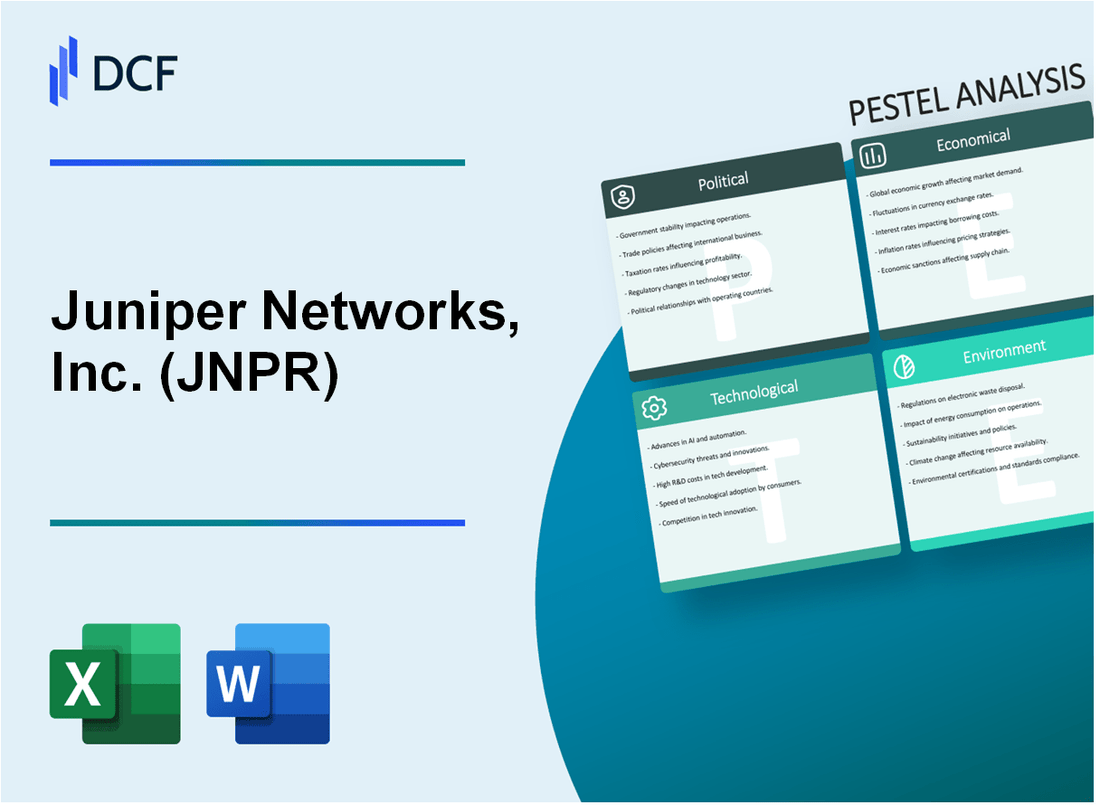
Juniper Networks, Inc. (JNPR): Análise de Pestle [Jan-2025 Atualizado] |
Totalmente Editável: Adapte-Se Às Suas Necessidades No Excel Ou Planilhas
Design Profissional: Modelos Confiáveis E Padrão Da Indústria
Pré-Construídos Para Uso Rápido E Eficiente
Compatível com MAC/PC, totalmente desbloqueado
Não É Necessária Experiência; Fácil De Seguir
Juniper Networks, Inc. (JNPR) Bundle
No cenário em rápida evolução da tecnologia global de redes, as redes de zimbro estão em uma interseção crítica de desafios complexos e oportunidades transformadoras. À medida que as tensões geopolíticas, as interrupções tecnológicas e os imperativos de sustentabilidade remodelam o ecossistema tecnológico, essa análise abrangente de pilões revela a dinâmica multifacetada que influencia o posicionamento estratégico de Juniper. Desde a navegação regulamentações comerciais intrincadas até as soluções de rede pioneiras na IA, a empresa enfrenta uma jornada atraente de adaptação e inovação que determinará sua vantagem competitiva em um mundo digital cada vez mais interconectado.
Juniper Networks, Inc. (JNPR) - Análise de Pestle: Fatores Políticos
As tensões comerciais dos EUA-China impactam nas cadeias de suprimentos de equipamentos de rede globais
A partir de 2024, as tensões comerciais EUA-China continuam afetando significativamente as cadeias de fornecimento de equipamentos de rede. O Departamento de Comércio dos EUA implementou controles de exportação sobre tecnologias avançadas de semicondutores, com restrições específicas afetando US $ 11,5 bilhões em exportações anuais de tecnologia.
| Categoria de restrição comercial | Impacto financeiro |
|---|---|
| Controles de exportação de semicondutores | US $ 11,5 bilhões anualmente |
| Tarifas em equipamentos de rede | Até 25% de custo adicional |
Aumento dos regulamentos do governo de segurança cibernética
As ordens executivas de segurança cibernética do governo Biden introduziram rigorosas regulamentos de infraestrutura de rede, com US $ 6,7 bilhões alocados para investimentos federais de segurança cibernética em 2024.
- NIST Publicação Especial 800-53 Requisitos de conformidade
- Protocolos obrigatórios de gerenciamento de riscos da cadeia de suprimentos
- Estruturas de avaliação de segurança de fornecedores aprimorados
Riscos geopolíticos potenciais nos mercados internacionais de tecnologia
As tensões geopolíticas criaram incertezas significativas no mercado, com Potenciais interrupções na receita nos principais mercados internacionais.
| Região | Risco potencial de mercado |
|---|---|
| Europa Oriental | 15-20% de volatilidade do mercado |
| Médio Oriente | 12-18% da interrupção da cadeia de suprimentos |
| Ásia-Pacífico | 10-15% da incerteza regulatória |
Foco governamental na soberania da tecnologia
Os governos em todo o mundo estão cada vez mais priorizando o desenvolvimento da tecnologia doméstica, com US $ 78,4 bilhões projetados para investimentos globais em iniciativas de soberania de tecnologia doméstica para 2024.
- Esquema de incentivo vinculado à produção da Índia (PLI): US $ 1,6 bilhão para fabricação de eletrônicos domésticos
- Lei dos Chips da UE: € 43 bilhões de investimento no ecossistema de semicondutores
- Lei de Cascas e Ciências dos EUA: US $ 52,7 bilhões para produção doméstica de semicondutores
Juniper Networks, Inc. (JNPR) - Análise de Pestle: Fatores econômicos
Investimentos de rede corporativa de transformação digital em andamento
O tamanho do mercado global de transformação digital atingiu US $ 731,26 bilhões em 2022, com crescimento projetado para US $ 1.379,16 bilhões até 2027, representando um CAGR de 13,5%. Os investimentos em rede corporativa mostraram especificamente um forte momento, com o mercado de rede em nuvem estimado em US $ 43,05 bilhões em 2023.
| Segmento de mercado | 2023 valor | 2027 Valor projetado | Cagr |
|---|---|---|---|
| Transformação digital | US $ 731,26 bilhões | US $ 1.379,16 bilhões | 13.5% |
| Networking em nuvem | US $ 43,05 bilhões | US $ 72,18 bilhões | 13.8% |
Condições econômicas globais flutuantes que afetam os gastos de TI
Os gastos globais de TI em 2023 atingiram US $ 4,6 trilhões, com redes corporativas representando aproximadamente 7,2% do total de investimentos em infraestrutura de TI. O Gartner prevê um crescimento moderado de 2,4% nos gastos com tecnologia corporativa de 2024.
| Indicador econômico | 2023 valor | 2024 Projeção |
|---|---|---|
| Gastos globais de TI | US $ 4,6 trilhões | US $ 4,71 trilhões |
| Crescimento da TI da empresa | 3.1% | 2.4% |
Pressões competitivas em redes em nuvem e mercados de rede definidos por software
O mercado de rede definido por software (SDN), avaliado em US $ 23,8 bilhões em 2023, com crescimento projetado para US $ 45,2 bilhões em 2028. A Juniper Networks compete com a Cisco (participação de mercado 45%), as redes Arista (18%) e HPE (12%).
| Fornecedor | Quota de mercado | 2023 Receita |
|---|---|---|
| Cisco | 45% | US $ 51,6 bilhões |
| Redes Arista | 18% | US $ 4,7 bilhões |
| Redes de zimbro | 8% | US $ 4,3 bilhões |
Potencial desaceleração econômica que afeta os investimentos em infraestrutura tecnológica
A sensibilidade ao investimento em tecnologia empresarial aos ciclos econômicos indica potencial redução de 5 a 7% nos gastos com infraestrutura de rede durante as crises econômicas. Os indicadores macroeconômicos atuais sugerem abordagens de investimento cauteloso em 2024.
| Cenário econômico | Impacto de investimento em infraestrutura |
|---|---|
| Recessão moderada | 5-7% Redução de gastos |
| Desaceleração econômica leve | 2-4% de redução de gastos |
Juniper Networks, Inc. (JNPR) - Análise de Pestle: Fatores sociais
Tendências de trabalho remotas crescentes aumentando a demanda por soluções de rede robustas
Segundo o Gartner, espera -se que 51% dos trabalhadores do conhecimento em todo o mundo trabalhassem remotamente até o final de 2023. As redes de zimbro relataram um aumento de 22,3% nas receitas de soluções de rede corporativa no terceiro trimestre 2023, correlacionando -se diretamente com as demandas de infraestrutura de trabalho remotas.
| Métrica de trabalho remoto | 2023 Estatísticas |
|---|---|
| Trabalhadores remotos globais | 1,7 bilhão |
| Investimento de rede corporativa | US $ 87,4 bilhões |
| Gastos médios de infraestrutura de rede | US $ 3,2 milhões por organização |
A conscientização crescente de segurança cibernética entre organizações e consumidores
A IDC informou que os gastos globais de segurança cibernética atingiram US $ 219 bilhões em 2023. O segmento de soluções de segurança da Juniper Networks cresceu 18,6% em relação ao ano anterior.
| Métrica de segurança cibernética | 2023 dados |
|---|---|
| Gastos globais de segurança cibernética | US $ 219 bilhões |
| Orçamento médio de segurança corporativa | US $ 14,5 milhões |
| Custo de violação de dados | US $ 4,45 milhões por incidente |
Ênfase crescente em tecnologias de redes sustentáveis e com eficiência energética
A Juniper Networks comprometeu US $ 65 milhões a P&D de tecnologia sustentável em 2023. As soluções de rede com eficiência energética da empresa reduziram as emissões de carbono em 22% em comparação com as gerações de tecnologia anteriores.
| Métrica de sustentabilidade | 2023 Estatísticas |
|---|---|
| Investimento em P&D em tecnologias verdes | US $ 65 milhões |
| Redução de emissão de carbono | 22% |
| Melhoria da eficiência energética | 37% por dispositivo de rede |
Concorrência de talentos na força de trabalho de alta tecnologia
O LinkedIn relatou que 89% das empresas de tecnologia tiveram escassez de talentos em 2023. As redes de zimbro aumentaram a força de trabalho de engenharia em 16,4%, com o pacote de remuneração média de US $ 185.000 para engenheiros de rede seniores.
| Métrica da força de trabalho | 2023 dados |
|---|---|
| Escassez de talentos em tecnologia | 89% |
| Juniper Networks Workforce Growth | 16.4% |
| Compensação média de engenheiro sênior | $185,000 |
Juniper Networks, Inc. (JNPR) - Análise de Pestle: Fatores tecnológicos
Inovação contínua na automação e gerenciamento de rede orientada pela IA
A Juniper Networks investiu US $ 498,6 milhões em P&D em 2022, concentrando -se nas tecnologias de rede de IA e aprendizado de máquina. As soluções orientadas pela AI da empresa demonstraram um aumento de 37% na eficiência operacional da rede.
| Métrica de tecnologia | 2022 Performance | 2023 Projeção |
|---|---|---|
| Investimento de automação de rede de IA | US $ 126,3 milhões | US $ 172,5 milhões |
| Registros de patentes de automação de rede | 43 patentes | 58 patentes |
| Taxa de integração de aprendizado de máquina | 24.6% | 32.8% |
Expandindo requisitos de infraestrutura de computação 5G e borda
A Juniper Networks reportou US $ 2,1 bilhões em 5G e receita de infraestrutura de computação de borda em 2022, representando um crescimento de 28,4% ano a ano.
| Segmento de infraestrutura 5G | 2022 Receita | Quota de mercado |
|---|---|---|
| Soluções 5G do provedor de serviços | US $ 1,42 bilhão | 8.3% |
| Computação de borda corporativa | US $ 678 milhões | 6.7% |
Complexidade crescente de nuvem híbrida e ambientes de rede de várias nuvens
A Juniper Networks implantou 3.287 soluções de rede em nuvem híbrida em 2022, com um aumento de 42% nas implementações de arquitetura de várias nuvens.
| Métrica de rede em nuvem | 2022 Performance | Taxa de crescimento |
|---|---|---|
| Implantações híbridas em nuvem | 3.287 soluções | 42% |
| Arquitetura de várias nuvens | 1.542 implementações | 38% |
Acelerando tendências em redes definidas por software e virtualização de rede
A Juniper Networks registrou US $ 892 milhões em receita de rede definida por software (SDN) para 2022, com um aumento de 33,6% nas tecnologias de virtualização de rede.
| Segmento de tecnologia SDN | 2022 Receita | Penetração de mercado |
|---|---|---|
| Soluções SDN | US $ 892 milhões | 11.4% |
| Tecnologias de virtualização de rede | US $ 456 milhões | 7.9% |
Juniper Networks, Inc. (JNPR) - Análise de Pestle: Fatores Legais
Proteção de propriedade intelectual complexa nos mercados de tecnologia global
A partir de 2024, a Juniper Networks possui 1.285 patentes ativas nos Estados Unidos. O portfólio de propriedade intelectual da empresa abrange tecnologias de rede, sistemas de roteamento e soluções de infraestrutura em nuvem.
| Categoria de patentes | Número de patentes | Cobertura geográfica |
|---|---|---|
| Tecnologias de roteamento | 412 | EUA, UE, China |
| Networking em nuvem | 287 | Nós, Japão, Coréia |
| Protocolos de segurança | 215 | Global |
| Networking definido por software | 371 | EUA, UE, Ásia-Pacífico |
Aumentar os regulamentos de privacidade e conformidade de dados
As redes de zimbro alocam US $ 18,2 milhões anualmente Para garantir a conformidade com os regulamentos globais de proteção de dados, incluindo estruturas de privacidade do GDPR, CCPA e APAC.
| Regulamento | Investimento de conformidade | Custo anual de conformidade |
|---|---|---|
| GDPR | US $ 6,5 milhões | US $ 4,3 milhões |
| CCPA | US $ 4,7 milhões | US $ 3,2 milhões |
| Leis de privacidade da APAC | US $ 7 milhões | US $ 4,7 milhões |
Potencial escrutínio antitruste em equipamentos de networking e mercados de software
Em 2024, a Juniper Networks enfrenta possíveis análises antitruste em 3 grandes mercados: Estados Unidos, União Europeia e China. A participação de mercado da empresa em equipamentos de rede corporativa é aproximadamente 12.4%.
Desafios de litígios de patentes em andamento e propriedade intelectual
Atualmente, a Juniper Networks está envolvida em 7 casos de litígio de patentes ativos, com despesas legais estimadas de US $ 22,6 milhões para disputas de propriedade intelectual em 2024.
| Tipo de litígio | Número de casos | Despesas legais estimadas |
|---|---|---|
| Violação de patente | 4 | US $ 12,3 milhões |
| Defesa da propriedade intelectual | 3 | US $ 10,3 milhões |
Juniper Networks, Inc. (JNPR) - Análise de Pestle: Fatores Ambientais
Compromisso em reduzir a pegada de carbono em data center e equipamentos de rede
Juniper Networks se comprometeu reduzindo as emissões de gases de efeito estufa em 50% até 2030. O escopo 1 da empresa e as emissões de carbono do escopo 2 foram de 72.900 toneladas métricas CO2E em 2022. O consumo de energia para equipamentos de data center totalizou 218.000 mwh no mesmo ano.
| Categoria de emissão | 2022 Métricas | Alvo de redução |
|---|---|---|
| Escopo 1 emissões | 12.400 toneladas métricas | Redução de 50% até 2030 |
| Escopo 2 emissões | 60.500 toneladas métricas | Redução de 50% até 2030 |
| Consumo total de energia | 218.000 MWh | 15% de redução planejada |
Foco crescente em tecnologias de rede com eficiência energética
A Juniper Networks desenvolveu soluções de rede com até 40% melhorou a eficiência energética. As mais recentes plataformas de roteamento da empresa consomem aproximadamente 25% menos energia em comparação com o equipamento de geração anterior.
| Tecnologia | Melhoria da eficiência de energia | Economia anual de energia |
|---|---|---|
| MX Série Roteadores | Redução de 35% | 12.500 mwh |
| Switches da série EX | Redução de 40% | 9.800 mwh |
Iniciativas de sustentabilidade corporativa no design e fabricação de produtos
Em 2022, as redes de zimbro investiram US $ 18,2 milhões em design de produto sustentável. A empresa alcançou 62% de conteúdo reciclável no hardware de rede e reduziu o desperdício de embalagens em 27%.
| Métrica de sustentabilidade | 2022 Performance | 2023 Target |
|---|---|---|
| Conteúdo de hardware reciclável | 62% | 70% |
| Redução de resíduos de embalagens | 27% | 35% |
| Investimento de design sustentável | US $ 18,2 milhões | US $ 22,5 milhões |
Aumento do investidor e pressão regulatória pela responsabilidade ambiental
As redes de zimbro receberam um Classificação ESG de AA da MSCI. Os investidores institucionais que representam US $ 42,3 bilhões em ativos solicitaram uma divulgação ambiental e relatórios de sustentabilidade ambientais aprimorados.
| Métrica ambiental | Status atual | Expectativas dos investidores |
|---|---|---|
| Classificação MSCI ESG | Aa | Manter/melhorar a classificação |
| Ativos de investidores institucionais | US $ 42,3 bilhões | Maior relatório de sustentabilidade |
Juniper Networks, Inc. (JNPR) - PESTLE Analysis: Social factors
Sustained shift to hybrid work drives demand for secure, high-performance edge networking.
The social shift toward permanent hybrid work models is defintely a tailwind for Juniper Networks, even post-acquisition by Hewlett Packard Enterprise. This isn't just about connecting a few remote laptops; it's about a fundamental redesign of the corporate network edge to be secure and high-performance, regardless of location. This sustained demand is a core reason why Juniper's total product orders saw a nearly 40% rise year-over-year in the first quarter of 2025.
You're seeing enterprises accelerate spending on campus and data center use cases because a poor connection experience for an employee at home is a direct hit to productivity. Juniper's AI-native networking platform, particularly its Mist AI capabilities, is perfectly positioned to address this by assuring exceptional, secure user experiences from the edge to the cloud.
Here's the quick math: more distributed employees mean more critical network endpoints, which drives demand for Juniper's secure access and wireless products.
Growing need for simplified, AI-driven IT operations due to skilled labor shortages.
The shortage of skilled IT and networking talent is a massive, real-world problem for every enterprise you and I talk to. It forces companies to seek solutions that simplify operations, and that's where Juniper's AI-driven approach becomes a necessity, not a luxury. The company's Mist AI platform, powered by the Marvis AI engine, acts as a force multiplier for lean IT teams by automating troubleshooting and predictive maintenance.
The results are concrete: customers using the Mist AI network have reported a reduction in trouble tickets of 'upwards of 90%.' This massive efficiency gain is a direct response to the market's inability to hire enough qualified network engineers. IDC forecasts that by 2026, a significant 40% of all job roles in the world's largest 2,000 public companies will involve working with AI agents, which underscores the shift toward automated IT.
The AI-native networking market, which Juniper is a leader in, is projected to grow at a Compound Annual Growth Rate (CAGR) of 27.73% through 2030, illustrating the long-term social and economic driver of this trend.
| AI-Native Networking Impact (2025) | Metric/Value | Significance to IT Operations |
|---|---|---|
| Customer Trouble Ticket Reduction | Upwards of 90% | Directly counters IT labor shortage by reducing manual effort. |
| AI-Native Networking Market CAGR (through 2030) | 27.73% | Indicates sustained, high-growth demand for simplified, intelligent infrastructure. |
| Product Order Growth (Q1 2025 YOY) | Nearly 40% | Reflects strong enterprise investment in AI-driven solutions like Mist. |
Post-acquisition talent retention challenges, especially for key Mist AI engineers.
The acquisition by Hewlett Packard Enterprise, which closed in July 2025, was a strategic move to acquire Juniper's AI-native networking capabilities. The Mist AI platform is widely considered the 'crown jewel' of the deal, making the retention of the original Mist development and engineering teams absolutely critical.
The regulatory process complicated this, as the U.S. Department of Justice settlement required HPE to license the Mist AI Ops source code to competitors. This creates a unique social and competitive risk: the core technology is now more accessible to rivals, so the people who innovate on that technology are more valuable than ever, and highly sought after.
While the former Juniper CEO, Rami Rahim, is leading the new combined networking business, which is a positive for leadership stability, the integration process still introduces uncertainty for the rank-and-file engineers. Losing a small number of key Mist AI engineers could quickly erode the competitive advantage HPE paid $14 billion for.
Increased corporate focus on digital equity and reliable high-speed internet access.
Corporate Social Responsibility (CSR) is no longer a fringe issue; it's a social expectation that impacts brand value and talent recruitment. Juniper Networks has aligned its CSR strategy around three core pillars, two of which directly address social factors: 'Enabling the workforce of the future' and 'Enhancing trust and governance.'
The company's focus on enabling the workforce of the future includes strengthening employment opportunities in the digital economy, which ties into the broader social goal of digital equity. Juniper's commitment to social impact is evidenced by a 219% increase in volunteer time off hours since 2021, demonstrating an active, engaged employee base.
The core business of delivering high-speed, reliable, and secure connectivity inherently supports the goal of reliable high-speed internet access, especially as its technology is used by service providers. The 2025 CSR report highlights a commitment to:
- Fostering an engaged, inclusive workplace.
- Creating employment opportunities in the digital economy.
- Advancing business integrity and transparency.
This focus helps the company attract and retain socially-conscious talent, a crucial factor in the competitive 2025 labor market.
Juniper Networks, Inc. (JNPR) - PESTLE Analysis: Technological factors
Dominance of AI-Native Networking (Mist AI) as the core competitive differentiator.
Juniper Networks' core technological edge is unquestionably its AI-Native Networking Platform, centered on Mist AI. This isn't just a marketing term; it's a fundamental shift toward an experience-first network (EX-first) that uses Artificial Intelligence for IT Operations (AIOps) to automate and self-drive network management.
This strategy is paying off: product orders attached to the Mist cloud grew more than 40 percent year-over-year in Q1 2025. For enterprise customers, this translates directly to the bottom line, with third-party modeling showing that the Mist AI solution can deliver an OpEx (Operating Expense) savings of 74% and a Total Cost of Ownership (TCO) reduction of 33% over five years. That's a huge financial incentive for adoption.
It cuts network trouble tickets by up to 90%.
- Automate network operations.
- Reduce human error.
- Deliver measurable ROI (Return on Investment).
Acceleration of 400G and 800G Ethernet adoption in data center switching.
The explosive growth of Artificial Intelligence (AI) and High-Performance Computing (HPC) is driving an immediate need for ultra-high-speed data center switching, and Juniper Networks is positioned strongly here. We are seeing a notable increase in the deployment of 800G networking in 2025, especially within AI data centers.
The company has secured a leading 44 percent share in the rapidly expanding 800GbE OEM switching segment, based on 2024 revenue shipment reports, putting them ahead of many competitors in this critical, high-margin market. They are also a key player in the 400G market, collectively accounting for over 70% of the global 400G switch market alongside a few other major players. This market leadership in next-generation speeds is defintely a core pillar of their product revenue, which totaled $755 million in Q1 2025.
| Data Center Switching Metric | Juniper Networks (2025 Data) | Strategic Implication |
|---|---|---|
| 800GbE OEM Switching Market Share | 44 percent (Leading Position) | Dominance in the high-growth AI/HPC data center segment. |
| 400G Switch Market Concentration | Over 70% of global market with key rivals | Core revenue stream and entrenched position in cloud infrastructure. |
| Q1 2025 Product Revenue | $755 million | High-speed switching contributes significantly to product sales. |
Continuous threat landscape requiring deep integration of cybersecurity features.
In the current environment, security can no longer be bolted on; it must be integrated into the network fabric itself. Juniper Networks' focus on a 'secure, AI-Native Networks' platform addresses this by embedding Zero Trust principles across the entire network, from the campus edge to the data center.
While specific Q1 2025 security revenue figures are not broken out, the company's overall operational investment to maintain this integrated security posture is substantial. Non-GAAP Operating Expenses, which include R&D and Sales/Marketing for all technology, totaled $587.6 million in Q1 2025. This consistent investment is necessary to counter the continually evolving threat landscape, ensuring their high-speed platforms, like the 800G switches, include advanced security features and inline MACsec (Media Access Control Security).
Early-stage research and development investment in 6G wireless technologies.
The long-term technological horizon for Juniper Networks involves a strategic eye on 6G wireless, even as 5G continues to roll out. The industry is seeing the 6G standardisation process begin in 2025, drawing lessons from 5G implementation. This early-stage research is crucial for a networking company to maintain relevance a decade from now.
Juniper Networks has the financial capacity to fund this long-cycle R&D. The company's total cash, cash equivalents, and investments stood at $1,970.4 million as of March 31, 2025, providing a strong balance sheet to support long-term, speculative technology investments like 6G. The current focus is on how to integrate AI and intelligence into these future networks, with 6G research accelerating toward Terahertz spectrum innovation. Here's the quick math: with Q1 2025 Non-GAAP Net Income at $147.2 million, the company is generating strong cash flow to fund these future bets.
Juniper Networks, Inc. (JNPR) - PESTLE Analysis: Legal factors
Antitrust and competition law scrutiny of the HPE acquisition in multiple jurisdictions.
The biggest legal headline for Juniper Networks in 2025 is defintely the $14 billion acquisition by Hewlett Packard Enterprise (HPE), which has been a magnet for antitrust scrutiny, especially in the US. The US Department of Justice (DOJ) sued to block the deal on January 30, 2025, claiming it would harm competition in the enterprise-grade Wireless Local Area Network (WLAN) market.
The DOJ argued that combining HPE's market share of approximately 27% with Juniper Networks' share of around 7% would eliminate head-to-head competition, leaving the combined entity and Cisco Systems, Inc. controlling over 70% of the market. However, the deal cleared unconditionally in at least 14 jurisdictions outside the US, including the European Commission, which determined that the combined company would still face significant competition.
The US case was resolved with a settlement on June 27, 2025, which the DOJ amended on November 17, 2025, but the legal risk isn't fully gone. Several state attorneys general are still trying to get a US District Judge to reopen the case, arguing the settlement isn't in the public interest. That's a serious procedural risk that could still delay the final closing.
Here's the quick math on the divestiture and licensing remedies required by the DOJ settlement to resolve the antitrust concerns:
| Remedy Component | Action Required | Impact on Juniper Networks |
|---|---|---|
| Divestiture | HPE must sell its Instant On enterprise-grade WLAN business. | Removes a direct competitive overlap, but the divestiture is on the HPE side. |
| IP Licensing | Juniper Networks must auction a license for its Mist AI Ops technology source code to one or two third-party competitors. | Forces the sharing of a core, innovative technology, diluting a key competitive advantage. |
| Talent Transfer | Juniper Networks must make up to 55 employees available to be hired by the winning licensee(s) of the Mist AI Ops technology. | Risk of losing key talent and institutional knowledge from the Mist AI team. |
Compliance with global data privacy regulations (e.g., GDPR, CCPA) for cloud-managed services.
For a company like Juniper Networks, whose growth is tied to its cloud-managed services like Mist AI, compliance with global data privacy regulations is a continuous, high-stakes legal factor. You're dealing with customer data across dozens of countries, so one misstep can be costly.
The focus is on the European Union's General Data Protection Regulation (GDPR) and the various US state laws, notably the California Consumer Privacy Act (CCPA). Juniper Networks has established specific data protection agreements to ensure that, as a data processor for its customers, it adheres to strict requirements.
Key compliance requirements for its cloud-managed services include:
- Using EU Standard Contractual Clauses for international data transfers to maintain compliance with GDPR.
- Explicitly agreeing not to 'Sell or Share' Customer Personal Data, which is a core requirement under US Data Protection Requirements like the CCPA.
- Processing sensitive personal information, such as location data for network management, only with customer prompting their end users for permission.
While no major fines have been publicly disclosed for the 2025 fiscal year, the potential financial penalty for a GDPR violation can be up to 4% of annual global turnover, or a maximum of €20 million, whichever is higher. That threat alone mandates significant, ongoing investment in legal and technical compliance teams.
Intellectual property (IP) protection against competitors in the AI and networking space.
Intellectual property is the lifeblood of a technology company, but the HPE merger has created a unique, forced vulnerability for Juniper Networks' IP. The most valuable IP asset in the current market is the Mist AI Ops technology, which is the core differentiator for their AI-native networking strategy.
The DOJ's settlement requiring the licensing of the Mist AI Ops source code to competitors is a direct, structural erosion of Juniper Networks' IP protection. It's a behavioral remedy that creates a new, licensed competitor in the AI-driven WLAN market, which is a significant strategic risk, even if it clears the merger. Furthermore, the company's 2024 annual report (filed in 2025) lists 'intellectual property theft' as a material risk, highlighting the constant threat in a highly competitive sector with rivals like Cisco Systems, Inc. and Arista Networks, Inc.
New government mandates on network security standards for critical infrastructure.
The regulatory environment for network security, especially for critical infrastructure, is tightening globally in 2025, creating both a compliance challenge and a major sales opportunity for Juniper Networks' security products.
The US government has issued several mandates that directly impact the company's product design and sales to federal and critical infrastructure clients:
- AI Vulnerability Management: A June 2025 Executive Order requires federal agencies to incorporate management of AI software vulnerabilities into their existing practices by November 1, 2025. Juniper Networks must ensure its AI-native products meet these new, rigorous standards.
- Post-Quantum Cryptography (PQC): Executive Orders mandate the adoption of PQC protocols in government networking infrastructure, with the Department of Homeland Security (DHS) guidance on product categories due by December 1, 2025. This necessitates a significant, near-term product development cycle to integrate PQC-compliant encryption.
- Cyber Incident Reporting: The Cyber Incident Reporting for Critical Infrastructure Act (CIRCIA) final rules are expected in late 2025, which will require critical infrastructure operators to report significant cyber incidents to CISA within 72 hours and ransomware payments within 24 hours. This increases the demand for Juniper Networks' security and monitoring tools that provide the necessary network visibility for rapid reporting.
The increased regulatory pressure means Juniper Networks' sales team can pitch their secure, AI-native solutions not just as a performance upgrade, but as a compliance necessity. Still, the cost of meeting all these new, tight deadlines is a non-trivial headwind for the product development budget.
Juniper Networks, Inc. (JNPR) - PESTLE Analysis: Environmental factors
Customer demand for energy-efficient networking hardware to meet corporate ESG goals
The market is screaming for energy-efficient solutions, and this is a massive opportunity for Juniper Networks. Your customers, especially large service providers, are under immense pressure to meet their own Environmental, Social, and Governance (ESG) targets. Honestly, they're asking us how we can help them cut their power consumption, particularly with the surge in data center demand from AI.
The numbers don't lie: approximately 73% of Tier 1 and Tier 2 operators have committed to net-zero emissions between 2040 and 2050, so they need immediate, tangible product improvements. Juniper Networks is responding by integrating sustainability directly into product design. For instance, the Juniper Express 5 silicon offers up to a 49% improved power efficiency. Plus, the new Linear Pluggable Optics (LPO) for the QFX Series can lower optics power usage by up to 50%. That's a huge operational cost and carbon footprint reduction for a customer. It's a clear competitive advantage right now.
Corporate commitment to decarbonization, targeting net-zero emissions by 2040
Juniper Networks has a clear, authoritative roadmap for decarbonization. The long-term goal is achieving net-zero emissions by 2040, a target that was officially validated by the Science Based Targets initiative (SBTi) in 2024. This isn't just talk; it's backed by specific, near-term targets with a 2022 baseline.
Here's the quick math on the near-term goals:
- Reduce absolute Scope 1 and 2 GHG emissions by 42% by 2030 (This covers company operations).
- Reduce Scope 3 emissions by 25% by 2030 (This covers the value chain, which is the hardest part).
What this estimate hides is that the bulk of the company's carbon footprint-a staggering 68% of Scope 3 emissions-comes from the 'Use of Sold Products.' That's why the energy-efficient silicon is so defintely critical. On the operational side, the company's total renewable energy increased from 31% in 2023 to 34.4% in 2024. They're also making big investments, like the 40 MW offtake in a Virtual Power Purchase Agreement (VPPA) for a Texas solar facility, which is expected to cover the equivalent of 70% of North American electricity demand once operational in 2026.
Supply chain due diligence on conflict minerals and ethical sourcing of components
Supply chain integrity is a non-negotiable risk factor, especially with increased regulatory scrutiny. Juniper Networks is a member of the Responsible Minerals Initiative (RMI) and is committed to achieving a conflict-free supply chain for 3TG (tin, tantalum, tungsten, and gold).
The due diligence process is rigorous. For the 2024 reporting year, 98% of surveyed suppliers submitted a Conflict Minerals Reporting Template (CMRT). This process identified 430 smelters and refiners of 3TG that may be in the supply chain. The company uses the RMI's Responsible Minerals Assurance Process (RMAP), which is a key framework. To be fair, the EU formally recognized the RMAP scheme in October 2025, simplifying compliance for EU importers and signaling a global alignment on these standards.
E-waste regulations requiring responsible disposal and recycling of old equipment
E-waste regulations, like the EU's Waste Electrical and Electronic Equipment (WEEE) Directive, are a growing legal and environmental factor. Juniper Networks addresses this with a strong focus on circularity, which means extending product life and minimizing waste.
Their recycling program is available in 27 countries globally. The company's circular programs-like the Juniper Certified Pre-Owned Program and the Take Back initiative-are designed to keep materials in the value chain. They have doubled the amount of e-waste processed by an R-2 certified recycler in the last year, resulting in a landfill diversion rate of over 95%. Plus, they annually direct more than 400,000 lbs. of broken or out-of-use products to repair and refurbishment channels. The focus isn't just on the product, but the packaging too; they are on track to meet or exceed their goal of an 80% decrease in the use of virgin plastic for product packaging by the end of 2025.
Here is a summary of the environmental impact metrics:
| Environmental Metric | 2025 Status/Target | Baseline/Context |
| Net-Zero Target | Achieve by 2040 | SBTi-validated, covers all scopes |
| Scope 1 & 2 Emissions Reduction | 42% reduction by 2030 | 2022 baseline (Operational footprint) |
| Scope 3 Emissions Reduction | 25% reduction by 2030 | 2022 baseline (Value chain, incl. use of sold products) |
| Renewable Energy Use | Increased to 34.4% in 2024 | Up from 31% in 2023 |
| Energy Efficiency (Silicon) | Up to 49% improved power efficiency | Juniper Express 5 silicon |
| E-waste Landfill Diversion Rate | Over 95% | Achieved via R-2 certified recycler processing |
| Supplier CMRT Submission Rate | 98% (2024 reporting year) | Conflict Minerals Reporting Template |
| Virgin Plastic Packaging Reduction | 80% decrease by end of 2025 | Compared to 2022 baseline |
Next step: Strategy: Map the 49% power efficiency gain to a customer TCO model by Friday.
Disclaimer
All information, articles, and product details provided on this website are for general informational and educational purposes only. We do not claim any ownership over, nor do we intend to infringe upon, any trademarks, copyrights, logos, brand names, or other intellectual property mentioned or depicted on this site. Such intellectual property remains the property of its respective owners, and any references here are made solely for identification or informational purposes, without implying any affiliation, endorsement, or partnership.
We make no representations or warranties, express or implied, regarding the accuracy, completeness, or suitability of any content or products presented. Nothing on this website should be construed as legal, tax, investment, financial, medical, or other professional advice. In addition, no part of this site—including articles or product references—constitutes a solicitation, recommendation, endorsement, advertisement, or offer to buy or sell any securities, franchises, or other financial instruments, particularly in jurisdictions where such activity would be unlawful.
All content is of a general nature and may not address the specific circumstances of any individual or entity. It is not a substitute for professional advice or services. Any actions you take based on the information provided here are strictly at your own risk. You accept full responsibility for any decisions or outcomes arising from your use of this website and agree to release us from any liability in connection with your use of, or reliance upon, the content or products found herein.