
|
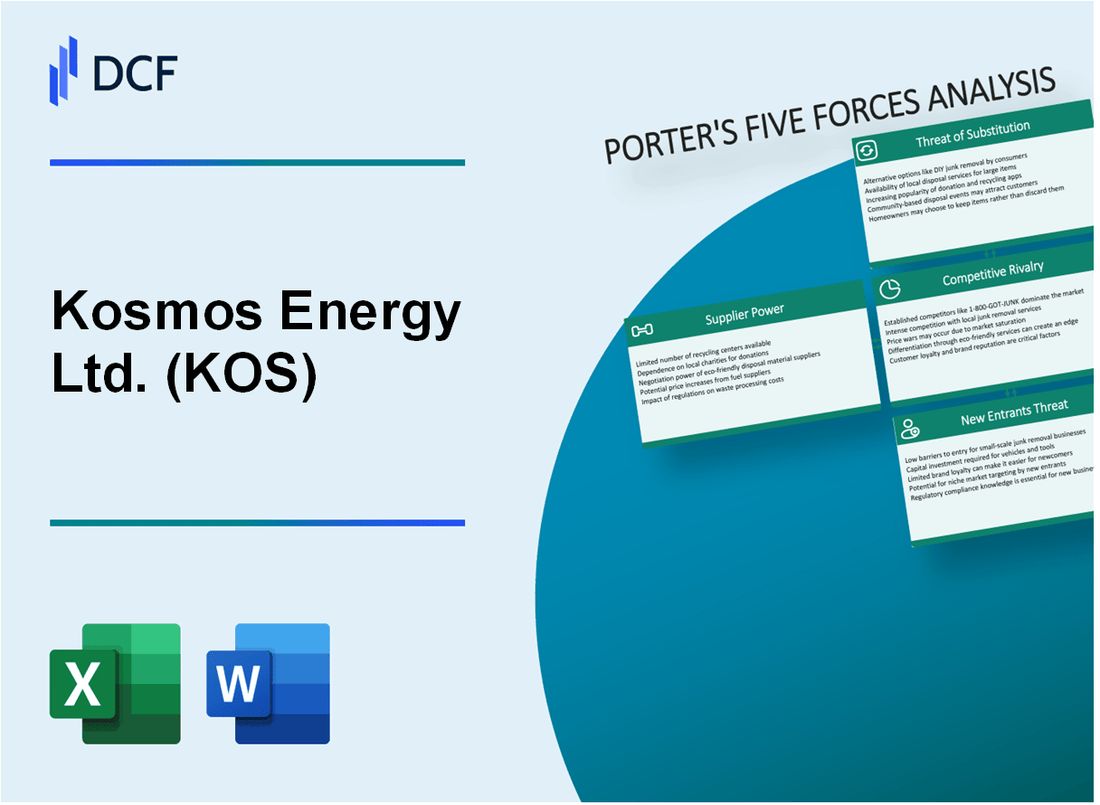
Kosmos Energy Ltd. (KOS): 5 forças Análise [Jan-2025 Atualizada] |
Totalmente Editável: Adapte-Se Às Suas Necessidades No Excel Ou Planilhas
Design Profissional: Modelos Confiáveis E Padrão Da Indústria
Pré-Construídos Para Uso Rápido E Eficiente
Compatível com MAC/PC, totalmente desbloqueado
Não É Necessária Experiência; Fácil De Seguir
Kosmos Energy Ltd. (KOS) Bundle
No mundo de alto risco de exploração de energia offshore, a Kosmos Energy Ltd. (KOS) navega em um cenário complexo de desafios estratégicos e dinâmica competitiva. À medida que os mercados globais de energia evoluem e as inovações tecnológicas reformulam a indústria, entender as forças complexas que impulsionam os negócios de Kosmos se torna crucial. Através das lentes estratégicas de Michael Porter, dissecaremos os fatores críticos que influenciam a posição competitiva da empresa, revelando o delicado equilíbrio de poder entre fornecedores, clientes, rivais, substitutos em potencial e novos participantes do mercado que definem o campo de batalha estratégico da Kosmos Energy em 2024.
KOSMOS Energy Ltd. (KOS) - As cinco forças de Porter: poder de barganha dos fornecedores
Provedores especializados de equipamentos de perfuração offshore
A partir de 2024, o mercado de equipamentos de perfuração offshore é dominado por um número limitado de fornecedores -chave:
| Fornecedor | Quota de mercado (%) | Receita anual ($) |
|---|---|---|
| Schlumberger | 23.5 | 43,2 bilhões |
| Halliburton | 18.7 | 37,6 bilhões |
| Baker Hughes | 16.3 | 32,9 bilhões |
Requisitos de investimento de capital
Custos de investimento em tecnologia de exploração de águas profundas:
- Rata de perfuração avançada: US $ 650-750 milhões
- Equipamento submarino: US $ 200-300 milhões
- Sistemas de tecnologia de exploração: US $ 150-250 milhões
Concentração do mercado de fornecedores
Métricas de concentração do mercado de equipamentos de petróleo e gás offshore:
- CR4 (taxa de concentração de quatro empresas): 68,5%
- Herfindahl-Hirschman Index (HHI): 1.850 pontos
- Número de principais fornecedores globais: 5-7
Requisitos de especialização tecnológica
Indicadores de complexidade tecnológica para exploração offshore:
| Fator de complexidade tecnológica | Nível de especialização necessário |
|---|---|
| Perfuração de águas profundas | Extremamente alto |
| Robótica submarina | Alto |
| Imagem geofísica | Muito alto |
Kosmos Energy Ltd. (KOS) - Five Forces de Porter: Power de barganha dos clientes
Base de clientes concentrados
A partir de 2024, a base de clientes da Kosmos Energy inclui:
| Tipo de cliente | Porcentagem de vendas |
|---|---|
| Empresas de petróleo internacionais | 62.3% |
| Empresas nacionais de energia | 37.7% |
Principais características do cliente
- Os três principais clientes representam 45,6% da receita total
- Duração média do contrato: 7,2 anos
- Mecanismos contratuais de ajuste de preço: 89% dos acordos de longo prazo
Impacto global do preço do petróleo
2024 Métricas de volatilidade do preço do petróleo:
| Faixa de preço | Impacto nas decisões dos clientes |
|---|---|
| $ 70- $ 80 por barril | Estabilidade moderada de compra |
| US $ 80 a US $ 90 por barril | Alta probabilidade de negociação |
Características do contrato do cliente
- Valor do contrato de longo prazo: US $ 2,3 bilhões
- Comprimento médio do contrato: 6,8 anos
- Frequência de renegociação: a cada 2,4 anos
Acordos de exploração e produção
| Tipo de contrato | Número de acordos | Valor total |
|---|---|---|
| Exploração personalizada | 14 | US $ 1,7 bilhão |
| Compartilhamento de produção | 8 | US $ 1,2 bilhão |
Kosmos Energy Ltd. (KOS) - As cinco forças de Porter: rivalidade competitiva
Cenário competitivo de mercado
A partir de 2024, a Kosmos Energy Ltd. opera em um mercado de exploração e produção offshore altamente competitivo em águas profundas com dinâmica competitiva específica:
- Número total de concorrentes diretos na exploração offshore africana: 7
- Principais concorrentes internacionais com presença significativa no mercado: Chevron, ExxonMobil, Shell, Totalenergies
- Taxa estimada de concentração de mercado: 65,4%
Comparação de capacidades competitivas
| Concorrente | Cap de mercado ($ B) | Blocos de exploração offshore | Produção anual (barris) |
|---|---|---|---|
| Kosmos Energy | 2.1 | 12 | 54,000 |
| Chevron | 304.7 | 26 | 1,900,000 |
| ExxonMobil | 446.5 | 35 | 2,300,000 |
Barreiras de entrada
Os requisitos de capital para exploração e produção offshore criam desafios significativos de entrada no mercado:
- Investimento médio de exploração inicial: US $ 150 a US $ 250 milhões
- Requisito de conhecimento técnico: habilidades geológicas e de engenharia especializadas
- Custos de conformidade regulatória: aproximadamente US $ 50 a US $ 75 milhões anualmente
Métricas de intensidade competitiva
| Métrica | Valor |
|---|---|
| Número de concorrentes significativos | 4-6 |
| Taxa de crescimento do mercado | 3.2% |
| Margens médias de lucro | 12.5% |
Kosmos Energy Ltd. (KOS) - Five Forces de Porter: ameaça de substitutos
Crescer tecnologias de energia renovável que desafia a exploração tradicional de petróleo
A capacidade de energia renovável global atingiu 3.372 GW em 2022, representando um aumento de 9,6% em relação a 2021. As instalações fotovoltaicas solares foram responsáveis por 339 GW em 2022, com energia eólica atingindo 837 GW globalmente.
| Tipo de energia renovável | Capacidade global 2022 (GW) | Crescimento ano a ano |
|---|---|---|
| Solar PV | 339 | 26% |
| Energia eólica | 837 | 11% |
| Hidrelétrica | 1,230 | 2.4% |
Aumentando o foco global em fontes de energia alternativas
O investimento em energia renovável atingiu US $ 495 bilhões em 2022, com US $ 366 bilhões direcionados às tecnologias solares e eólicas.
- A China investiu US $ 164 bilhões em energia renovável em 2022
- Os Estados Unidos investiram US $ 110 bilhões em energia renovável em 2022
- União Europeia investiu US $ 89 bilhões em energia renovável em 2022
Adoção de veículos elétricos potencialmente reduzindo a demanda de petróleo a longo prazo
As vendas globais de veículos elétricos atingiram 10,5 milhões de unidades em 2022, representando um aumento de 55% em relação a 2021. Os veículos elétricos da bateria compreendiam 13% das vendas globais de veículos de passageiros em 2022.
| Região | Vendas de EV 2022 | Quota de mercado |
|---|---|---|
| China | 6,0 milhões | 25% |
| Europa | 2,6 milhões | 20% |
| Estados Unidos | 807,180 | 5.8% |
Tecnologias emergentes de hidrogênio e energia solar como substitutos em potencial
A capacidade global de produção de hidrogênio deve atingir 320 milhões de toneladas métricas até 2030, com um investimento estimado de US $ 150 bilhões em tecnologias de hidrogênio.
- Os custos de produção de hidrogênio verde que devem cair para US $ 2/kg até 2030
- Custo de eletricidade nivelado por energia solar: US $ 0,037/kWh em 2022
- Capacidade de energia solar projetada para atingir 1.500 GW até 2025
Kosmos Energy Ltd. (KOS) - Five Forces de Porter: Ameaça de novos participantes
Requisitos de capital substanciais para exploração e produção offshore
A exploração e produção offshore da Kosmos Energy requerem investimento significativo de capital. Em 2024, as despesas de capital estimadas em projetos de águas profundas variam entre US $ 500 milhões e US $ 1,2 bilhão por projeto.
| Categoria de requisito de capital | Faixa de custo estimada |
|---|---|
| Equipamento de perfuração offshore | US $ 250-450 milhões |
| Infraestrutura de exploração | US $ 150-300 milhões |
| Sistemas tecnológicos avançados | US $ 100-250 milhões |
Ambientes regulatórios complexos em regiões de exploração
Custos de conformidade regulatória Para a exploração offshore de petróleo e gás, pode ser substancial, criando barreiras significativas à entrada.
- Custos de licença ambiental: US $ 50-100 milhões
- Despesas de documentação de conformidade: US $ 10-25 milhões
- Processos de revisão regulatória: 18-36 meses de duração
Capacidades tecnológicas avançadas para operações de águas profundas
A exploração de águas profundas requer infraestrutura tecnológica sofisticada. O investimento tecnológico para um único projeto de águas profundas pode exceder US $ 300 milhões.
| Componente tecnológico | Investimento estimado |
|---|---|
| Tecnologia de imagem sísmica | US $ 75-125 milhões |
| Sistemas de robótica submarina | US $ 50-100 milhões |
| Tecnologias avançadas de perfuração | US $ 100-200 milhões |
Alto investimento inicial e experiência técnica
As barreiras de entrada são reforçadas pela necessidade de experiência técnica especializada e recursos financeiros substanciais.
- Tamanho mínimo da equipe técnica: 50-100 profissionais especializados
- Custos anuais de treinamento e desenvolvimento: US $ 5 a 10 milhões
- Reservas financeiras mínimas necessárias: US $ 500 milhões-US $ 1 bilhão
Kosmos Energy Ltd. (KOS) - Porter's Five Forces: Competitive rivalry
Competition in the deepwater exploration and production space where Kosmos Energy Ltd. operates is definitely fierce. You're facing off against the integrated majors, like BP and TotalEnergies, who bring massive balance sheets and established infrastructure to the table. Then you have large independents, such as APA, who are also vying for the same premium barrels. This rivalry isn't just about who can drill the best well; it's about who can manage the entire lifecycle cost-effectively.
Rivals are constantly competing for the same finite deepwater exploration licenses across West Africa and the Gulf of Mexico. For instance, in the Gulf of Mexico, we see major projects like the Tiber Floating Production Unit (FPU) being developed by BP, which is designed with a production capacity of 80,000 barrels of crude oil per day in water depths around 4,100ft. This scale of development highlights the prize and the level of investment required to secure and develop these resources. Kosmos Energy Ltd.'s Q3 2025 net production stood at ~65,500 barrels of oil equivalent per day (boepd), showing the scale difference against the supermajors' potential output from single, large developments.
Kosmos Energy Ltd.'s strategy is a direct response to this intense rivalry, focusing on lower-risk, infrastructure-led exploration (ILX) tiebacks to existing hubs. The goal here is simple: find it, and hook it up fast to existing facilities to generate cash flow sooner. The Greater Tortue Ahmeyim (GTA) LNG project, where Kosmos holds an interest and BP operates, is a prime example; it achieved Commercial Operations Date (COD) early in 2025, and by Q3 2025, it had already lifted 6.8 gross LNG cargos. Also, the Jubilee drilling campaign in Ghana brought a new producer well online contributing around 10,000 bopd gross in Q3 2025, leveraging existing infrastructure.
To give you a clearer picture of where Kosmos Energy Ltd. stands against some key players in this competitive arena, look at these comparative figures based on recent 2025 data. Remember, Kosmos Energy Ltd. reported a net loss of $124 million in Q3 2025 on revenues of $311.2 million, while APA, a large independent, showed a positive net margin of 10.53% compared to Kosmos Energy Ltd.'s net margin of -10.74% in a recent comparison.
| Metric (As of Late 2025 Data) | Kosmos Energy Ltd. (KOS) | Major Peer (e.g., BP/TotalEnergies Scale) | Large Independent Peer (e.g., APA) |
|---|---|---|---|
| Q3 2025 Net Production | ~65,500 boepd | Significantly higher (Supermajor scale) | Not explicitly available for Q3 2025 |
| Full Year 2025 Capex Guidance (Revised) | Less than $350 million | Multi-billion dollar range | Not explicitly available |
| Q3 2025 Net Income | Net Loss of $124 million | Typically large positive net income | Positive Net Margin of 10.53% |
| Key Asset Strategy Example | ILX tiebacks (Jubilee, GTA) | Large-scale greenfield developments (e.g., Tiber FPU) | Deepwater/Unconventional focus |
The rivalry is sustained by high exit barriers, which keep incumbents locked in. Building specialized deepwater infrastructure-like the Floating LNG (FLNG) vessel for GTA or the massive subsea tiebacks in the GoM-requires enormous upfront capital, often running into the hundreds of millions or billions of dollars. If you have to sell an asset, finding a buyer who can absorb that sunk cost and integrate the specialized hardware is tough. Plus, Kosmos Energy Ltd. has worked to secure its own financial footing, completing the re-determination of its Reserve-Based Lending (RBL) facility, which remained in excess of the $1.35 billion facility size, showing the quality of assets underpinning their operations.
- Competition includes majors like BP, TotalEnergies, and ExxonMobil.
- Large independents like APA and Hess Corporation are direct rivals.
- Focus areas include West Africa and the Gulf of America basins.
- Kosmos Energy Ltd. is targeting overhead reduction of $25 million by year-end 2025.
- Hedging for 2026 production aims for 50% coverage with a floor of $66 per barrel.
Kosmos Energy Ltd. (KOS) - Porter's Five Forces: Threat of substitutes
You're looking at how external energy shifts could replace the core products of Kosmos Energy Ltd. (KOS), which are primarily crude oil and natural gas from its West African assets. The threat of substitution for crude oil is definitely a long-term structural issue, driven by the global push toward electrification.
Globally, the energy transition is underway, though unevenly. For instance, in 2024, solar power alone accounted for over three-quarters of renewable additions, with a record 452 GW added. However, Africa's contribution to this shift remains small; Africa added only 4.2 GW (or 0.7%) of new renewable capacity in 2024. This disparity shows that while the technology for substitution exists, its deployment pace in KOS's core operational regions lags behind global leaders like China, the US, and the EU, which together accounted for 83.6% of new capacity in 2024.
Natural gas, particularly the liquefied natural gas (LNG) from the Greater Tortue Ahmeyim (GTA) project, is positioned as a cleaner transitional fuel for African power generation. Kosmos Energy Ltd.'s GTA Phase 1 production ramped up during Q3 2025, averaging approximately 11,400 boepd net. The global LNG market itself is expected to expand significantly, with projections showing growth from around 560 bcm in 2024 to 880 bcm in 2035. Furthermore, final investment decisions for new LNG projects surged in 2025, with operations for about 300 bcm of new annual export capacity set to start by 2030, marking a 50 per cent increase in available supply. This suggests a near-to-medium term role for gas as a replacement for dirtier fuels like coal in power generation.
Renewables like solar are becoming increasingly cost-competitive, though financing remains a hurdle in developing markets. Globally, the fixed-axis utility-scale solar Levelized Cost of Electricity (LCOE) was forecast to decline 2% year-over-year in 2025, moving from $36 per MWh to $35 per MWh. The International Energy Agency (IEA) previously predicted that solar LCOE in Africa could drop to between $0.018/kWh and $0.049/kWh by 2030, making it cheaper than wind or gas. Still, in many developing countries, wind and solar projects often cost more to finance than coal or gas due to higher perceived risk and less established financial mechanisms.
The near-term threat of substitution for KOS's oil and gas production is low. This is largely due to persistent global energy security needs and the sheer long lead time required for infrastructure change. As of late November 2025, geopolitical tensions continue to inject volatility, keeping energy security a primary concern. The IEA's World Energy Outlook 2025 noted that traditional oil and gas security risks are compounded by vulnerabilities in critical mineral supply chains, which are essential for the very technologies meant to substitute fossil fuels. Also, KOS itself is hedging its near-term oil output: they have 2.5 million barrels of remaining 2025 production hedged with a floor of about $62/barrel, and 8.5 million barrels for 2026 with a floor of $66/barrel. This hedging strategy implies management does not anticipate a sudden collapse in oil demand or price due to substitution in the immediate future.
Here's a quick look at Kosmos Energy Ltd.'s recent performance metrics versus the broader energy context:
| Metric | Kosmos Energy Ltd. (KOS) Q3 2025 Data | Contextual Energy Data (Late 2025) |
|---|---|---|
| Net Production | ~65,500 boepd | Global oil supply estimated at 106.3 million bpd in 2025 |
| GTA LNG Throughput (Net) | Averaged ~11,400 boepd net | Global LNG market projected to reach 880 bcm by 2035 from 560 bcm in 2024 |
| Oil Hedging Floor (2026) | $66/barrel for 8.5 million barrels | Brent crude forecast averages $55/bbl for full year 2026 (EIA) |
| Solar LCOE (Global Forecast) | N/A | Fixed-axis utility solar LCOE expected to be $35/MWh in 2025 |
The pace of renewable buildout in KOS's key operational geography highlights the slow nature of substitution there:
- Africa's wind power capacity expected to reach 15,877 MW by end-2025.
- This is more than double the capacity from the end of 2021, which was 7,177 MW.
- North and Southern Africa hold 86% of the continent's total operating wind capacity.
- By 2027, almost 30% of Africa's electricity is projected to be generated using natural gas.
Kosmos Energy Ltd. (KOS) - Porter's Five Forces: Threat of new entrants
You're looking at the barriers that keep new players from jumping into the deepwater exploration and production (E&P) game where Kosmos Energy Ltd. (KOS) operates. Honestly, the threat of new entrants here is structurally low, which is a huge advantage for established players like Kosmos Energy Ltd. The sheer scale of commitment required acts as a massive moat.
Deepwater E&P requires massive capital investment; Kosmos Energy Ltd.'s 2025 CapEx is still near \$350 million, which is the company's target for the full year. That figure, while reduced from prior years, represents just the spending for one established operator on its existing portfolio, not the multi-billion dollar outlay needed to start from scratch with a major discovery and development. New entrants must secure financing for exploration, appraisal, and then the multi-year development cycle before seeing a single dollar of revenue. Here's the quick math: a single ultra-deepwater development can easily run into the billions, making it a game for the well-capitalized only.
Significant technical expertise is needed for ultra-deepwater projects; look no further than Kosmos Energy Ltd.'s Greater Tortue Ahmeyim (GTA) project, which taps reservoirs situated in water depths up to 2,850 meters. Operating at these depths means dealing with extreme pressures and temperatures, demanding proprietary or highly specialized subsea engineering and floating production infrastructure that takes years to master and deploy. What this estimate hides is the learning curve; even with capital, a new entrant lacks the decade-plus of operational experience major players have built in these harsh environments.
Host government relationships and securing high-quality, large-scale licenses are substantial barriers. While some producer countries are actively lowering entry requirements and offering fiscal incentives to attract upstream dollars, the best acreage is often already tied up. Securing a world-class, large-scale block requires navigating complex international and local regulatory frameworks, which are often rigorous and expensive to comply with, especially concerning environmental standards. This process favors entities with proven track records and strong diplomatic ties.
New entrants are often smaller, focused on niche areas, or state-backed National Oil Companies (NOCs) with preferential access. The deepwater sector is dominated by fewer than ten energy companies accounting for the majority of exploration, showing a clear concentration of expertise and resources. Smaller, specialized entrants might target niche areas like near-shore fields or specific service niches, but they typically avoid the frontier, ultra-deepwater plays that define Kosmos Energy Ltd.'s long-term growth profile.
The financial and technical hurdles can be summarized by comparing the investment required versus the established operational base:
| Barrier Component | Metric/Context | Relevance to New Entrants |
|---|---|---|
| Capital Requirement (Annualized) | Kosmos Energy Ltd. 2025 CapEx Target: \$350 million | Sets the baseline for ongoing operational spend; new developments require multiples of this. |
| Technical Complexity | GTA Water Depth: Up to 2,850 meters | Requires specialized, high-pressure, high-temperature (HPHT) rated equipment and subsea technology. |
| Regulatory Compliance Cost | Rigorous environmental and maritime regulations (e.g., MARPOL standards) | Adds significant, non-productive capital expenditure for compliance, favoring large balance sheets. |
| Market Concentration | Fewer than ten energy companies dominate deepwater exploration | Indicates a high barrier due to established resource ownership and operational dominance. |
To be fair, the industry sees some shifts, with governments in places like Argentina, Brazil, and Angola introducing fiscal incentives in 2024 to reactivate E&P sectors. Still, these incentives often target proven basins or smaller projects, not necessarily the frontier deepwater plays that require the most significant upfront commitment.
- Deepwater exploration is capital-intensive and laborious.
- Proprietary technology creates an immediate operating disadvantage for newcomers.
- High fixed operating costs deter speculative entry attempts.
- Securing prime acreage involves navigating complex government licensing.
Finance: review the Q4 2025 budget against the \$350 million target by next Tuesday.
Disclaimer
All information, articles, and product details provided on this website are for general informational and educational purposes only. We do not claim any ownership over, nor do we intend to infringe upon, any trademarks, copyrights, logos, brand names, or other intellectual property mentioned or depicted on this site. Such intellectual property remains the property of its respective owners, and any references here are made solely for identification or informational purposes, without implying any affiliation, endorsement, or partnership.
We make no representations or warranties, express or implied, regarding the accuracy, completeness, or suitability of any content or products presented. Nothing on this website should be construed as legal, tax, investment, financial, medical, or other professional advice. In addition, no part of this site—including articles or product references—constitutes a solicitation, recommendation, endorsement, advertisement, or offer to buy or sell any securities, franchises, or other financial instruments, particularly in jurisdictions where such activity would be unlawful.
All content is of a general nature and may not address the specific circumstances of any individual or entity. It is not a substitute for professional advice or services. Any actions you take based on the information provided here are strictly at your own risk. You accept full responsibility for any decisions or outcomes arising from your use of this website and agree to release us from any liability in connection with your use of, or reliance upon, the content or products found herein.