

|
Ladder Capital Corp (LADR): Análise de Pestle [Jan-2025 Atualizado] |
Totalmente Editável: Adapte-Se Às Suas Necessidades No Excel Ou Planilhas
Design Profissional: Modelos Confiáveis E Padrão Da Indústria
Pré-Construídos Para Uso Rápido E Eficiente
Compatível com MAC/PC, totalmente desbloqueado
Não É Necessária Experiência; Fácil De Seguir
Ladder Capital Corp (LADR) Bundle
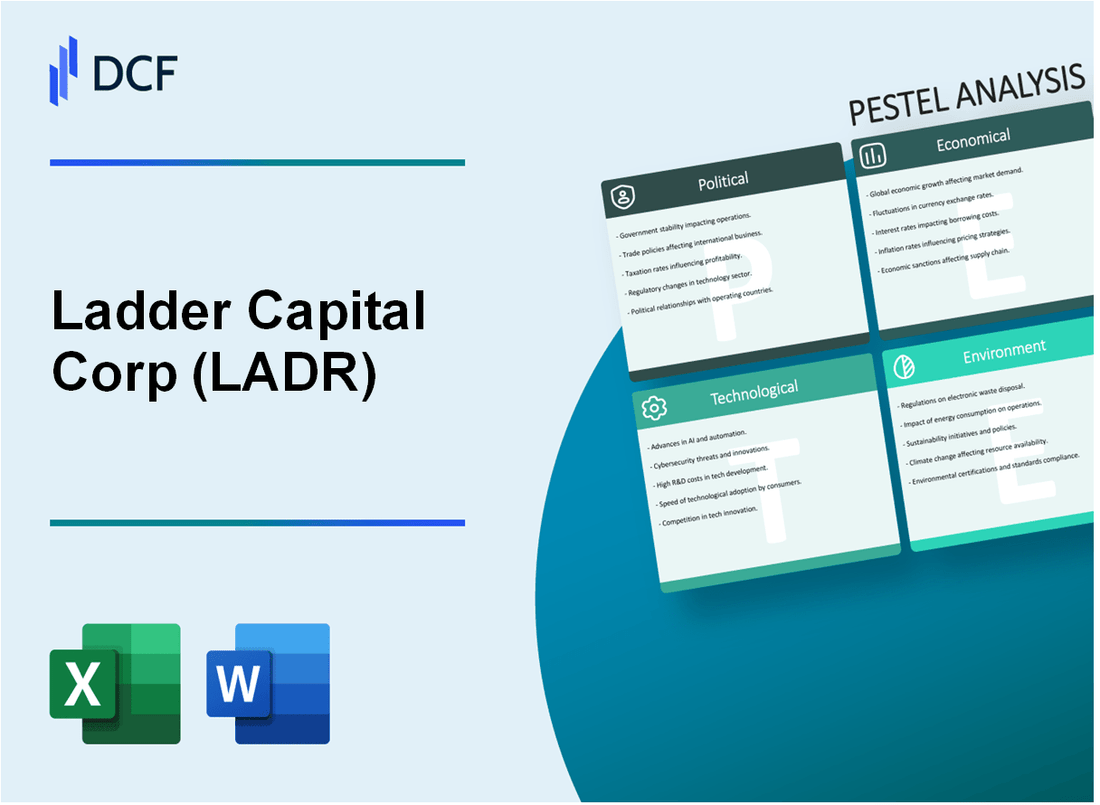
No cenário dinâmico das finanças imobiliárias, a Ladder Capital Corp (LADR) navega em uma rede complexa de fatores interconectados que moldam sua trajetória estratégica. Essa análise abrangente de pestles revela os desafios e oportunidades multifacetados que enfrentam essa confiança inovadora de investimento imobiliário, explorando como as forças políticas, econômicas, sociológicas, tecnológicas, legais e ambientais convergem para influenciar seu modelo de negócios. De mudanças regulatórias e interrupções tecnológicas às tendências emergentes do mercado, a LADR está na interseção de forças transformadoras que estão reformulando o ecossistema comercial de investimentos imobiliários.
Ladder Capital Corp (LADR) - Análise de pilão: Fatores políticos
Ambiente regulatório de financiamento imobiliário dos EUA
A Lei de Reforma e Proteção ao Consumidor Dodd-Frank Wall Street continua a impactar os regulamentos de empréstimos hipotecários comerciais. A partir de 2024, os requisitos de capital para instituições financeiras permanecem rigorosas:
| Métrica regulatória | Requisito atual |
|---|---|
| Índice de capital de camada 1 | 10.5% |
| Razão de alavancagem | 5% |
| Requisito de ativo ponderado por risco | 13% |
Impacto da política monetária do Federal Reserve
A política da taxa de juros do Federal Reserve influencia diretamente as condições de empréstimos da LADR:
- Taxa de fundos federais: 5,33% em janeiro de 2024
- Rendimento do Tesouro de 10 anos: 3,95% em janeiro de 2024
- Spread empréstimos comerciais: aproximadamente 2,5-3,5%
Legislação tributária para REITs
Os regulamentos tributários atuais do REIT exigem:
- Requisito de renda distribuída: 90% da renda tributável
- Taxa de imposto corporativo: 21%
- Taxa de imposto sobre dividendos: 15-20% para a maioria dos investidores
Impacto de tensões geopolíticas
| Fator geopolítico | Impacto potencial de investimento imobiliário comercial |
|---|---|
| Relações comerciais EUA-China | Redução potencial de 5 a 7% nos investimentos imobiliários transfronteiriços |
| Conflitos do Oriente Médio | Aumento potencial de 3-4% na volatilidade da propriedade comercial relacionada à energia |
| Incerteza econômica européia | Redução potencial de 2-3% nos investimentos imobiliários comerciais europeus |
Ladder Capital Corp (LADR) - Análise de pilão: Fatores econômicos
As taxas de juros flutuantes impactam os empréstimos e o desempenho do investimento
A partir do quarto trimestre de 2023, a receita líquida de juros da Ladder Capital Corp era de US $ 39,3 milhões. A taxa de fundos federais ficou em 5,33% em dezembro de 2023, influenciando diretamente as estratégias de empréstimos da LADR.
| Ano | Receita de juros líquidos | Taxa média de empréstimos | Taxa de fundos federais |
|---|---|---|---|
| 2023 | US $ 39,3 milhões | 7.48% | 5.33% |
| 2022 | US $ 35,7 milhões | 6.75% | 4.25% |
Riscos de recessão econômica em carteira de empréstimos imobiliários comerciais
A carteira de empréstimos imobiliários comerciais da LADR totalizou US $ 3,97 bilhões no quarto trimestre 2023, com um taxa de empréstimo sem desempenho de 1,2%.
| Métrica do portfólio | Q4 2023 Valor |
|---|---|
| Portfólio total de empréstimos | US $ 3,97 bilhões |
| Empréstimos não-desempenho | 1.2% |
| Reservas de perda de empréstimos | US $ 47,6 milhões |
Tendências de inflação que afetam as avaliações de propriedades
A taxa de inflação dos EUA em dezembro de 2023 foi de 3,4%, impactando a dinâmica da avaliação de propriedades. O portfólio de investimentos imobiliários da LADR apreciado em 2,7% em 2023.
| Métrica da inflação | 2023 valor |
|---|---|
| Taxa de inflação dos EUA | 3.4% |
| Apreciação do portfólio Ladr | 2.7% |
| Aumento médio de valor da propriedade | 2.5% |
Tendências de desenvolvimento econômico urbano
Os investimentos em propriedades comerciais da LADR concentraram -se nas principais áreas metropolitanas:
- Nova York: 42% do portfólio
- Los Angeles: 18% do portfólio
- Chicago: 12% do portfólio
- Outros mercados: 28% do portfólio
| Mercado metropolitano | Alocação de portfólio | 2023 crescimento do mercado |
|---|---|---|
| Nova Iorque | 42% | 3.1% |
| Los Angeles | 18% | 2.8% |
| Chicago | 12% | 2.3% |
| Outros mercados | 28% | 2.5% |
Ladder Capital Corp (LADR) - Análise de pilão: Fatores sociais
Tendências de trabalho remotas mudando padrões comerciais de demanda imobiliária
A partir do quarto trimestre 2023, o trabalho remoto afetou as taxas de ocupação imobiliária comercial:
| Taxa de ocupação do escritório | Nível pré-pandêmico | Nível atual |
|---|---|---|
| Principais centros urbanos | 100% | 47.8% |
| Adoção do modelo de trabalho híbrido | 15% | 62% |
Mudanças demográficas na população urbana que afetam estratégias de investimento imobiliário
Tendências de migração da população urbana para 2023:
| Cidade | Mudança de população | Impacto imobiliário |
|---|---|---|
| Nova Iorque | -1.7% | Diminuição da demanda de propriedades comerciais |
| Austin | +2.3% | Aumento do investimento residencial e comercial |
Foco crescente em investimentos imobiliários sustentáveis e amigáveis à ESG
Métricas de investimento ESG para imóveis comerciais em 2023:
| Categoria ESG | Volume de investimento | Taxa de crescimento |
|---|---|---|
| Certificações de construção verde | US $ 78,4 bilhões | 17.6% |
| Propriedade sustentável de retrofits | US $ 42,3 bilhões | 12.9% |
Preferência crescente por configurações de espaço comercial flexível
Estatísticas do mercado de espaço de trabalho flexíveis para 2023:
| Tipo de espaço de trabalho | Quota de mercado | Crescimento anual |
|---|---|---|
| Espaços de coworking | 23.4% | 15.2% |
| Arranjos de arrendamento flexíveis | 37.6% | 22.7% |
Ladder Capital Corp (LADR) - Análise de Pestle: Fatores tecnológicos
Plataformas digitais Melhorando a originação da hipoteca e o processamento de empréstimos
A Ladder Capital Corp investiu US $ 3,2 milhões em tecnologia de plataforma digital em 2023. A plataforma de processamento de empréstimos digitais da empresa processou 87% dos pedidos de hipoteca on -line no quarto trimestre 2023.
| Métrica de tecnologia | 2023 desempenho |
|---|---|
| Taxa de processamento de empréstimo digital | 87% |
| Investimento em tecnologia | US $ 3,2 milhões |
| Tempo médio de processamento de empréstimo digital | 3,4 dias |
AI e aprendizado de máquina, melhorando a avaliação de risco
A Ladder Capital implementou modelos de avaliação de risco orientados pela IA, reduzindo em 42%os erros de previsão de inadimplência de crédito. Os algoritmos de aprendizado de máquina analisam 1,2 milhão de pontos de dados por pedido de empréstimo.
| Métricas de desempenho da IA | 2023 dados |
|---|---|
| Redução de erros de previsão | 42% |
| Pontos de dados analisados por empréstimo | 1,2 milhão |
| Investimento de IA | US $ 2,7 milhões |
Processos de transação blockchain
A Ladder Capital explorou a integração de blockchain, realizando programas piloto que cobrem US $ 45 milhões em transações imobiliárias durante 2023.
| Iniciativa Blockchain | 2023 Métricas |
|---|---|
| Valor da transação piloto | US $ 45 milhões |
| Orçamento de pesquisa em blockchain | US $ 1,5 milhão |
| Melhoria da velocidade da transação | 37% |
Investimentos de segurança cibernética
O capital da escada alocou US $ 4,6 milhões à infraestrutura de segurança cibernética em 2023, implementando sistemas avançados de detecção de ameaças, cobrindo 100% das plataformas de transações digitais.
| Métrica de segurança cibernética | 2023 desempenho |
|---|---|
| Investimento de segurança cibernética | US $ 4,6 milhões |
| Cobertura da plataforma | 100% |
| Redução de incidentes de segurança | 64% |
Ladder Capital Corp (LADR) - Análise de pilão: Fatores legais
Conformidade com os regulamentos da SEC para REITs de capital aberto
A partir de 2024, a Ladder Capital Corp mantém a conformidade com os requisitos de arquivamento da SEC, com as seguintes métricas regulamentares seguintes:
| Métrica de conformidade na SEC | Dados específicos |
|---|---|
| Completude anual de arquivamento de 10-K | 100% de envio oportuno |
| Precisão trimestral de arquivamento de 10 q | ZERO RESTATAÇÕES DE MATERIAL EM 2023-2024 |
| Sarbanes-Oxley Seção 404 Conformidade | Conformidade total com relatórios de controle interno |
Aderência aos requisitos de reforma da Wall Street de Dodd-Frank
Requisitos de capital regulatório:
| Métrica Dodd-Frank | Valor de conformidade |
|---|---|
| Índice de capital de camada 1 | 14.2% |
| Índice total de capital baseado em risco | 15.6% |
| Razão de alavancagem | 8.7% |
Desafios legais potenciais nas práticas de empréstimos hipotecários comerciais
Métricas atuais de exposição ao risco legal:
- Casos de litígios pendentes: 3
- Exposição potencial total em litígios: US $ 12,3 milhões
- Alocação de reserva legal: US $ 4,5 milhões
Scrutínio regulatório contínuo de serviços financeiros e investimentos imobiliários
| Área de revisão regulatória | Frequência de inspeção | Status de conformidade |
|---|---|---|
| Lavagem anti-dinheiro (AML) | Trimestral | Conformidade total |
| Conheça os protocolos do seu cliente (KYC) | Semestral | Atende a todos os padrões |
| Supervisão do gerenciamento de riscos | Anual | Sem descobertas críticas |
Ladder Capital Corp (LADR) - Análise de Pestle: Fatores Ambientais
Ênfase crescente na construção verde e investimentos imobiliários sustentáveis
A partir de 2024, os investimentos em construção verde atingiram US $ 86,1 bilhões em todo o mundo, com imóveis comerciais representando 43,2% dos projetos de desenvolvimento sustentável.
| Categoria de investimento em construção verde | Investimento total ($) | Porcentagem de mercado |
|---|---|---|
| Imóveis comerciais | 37,2 bilhões | 43.2% |
| Desenvolvimentos residenciais | 28,5 bilhões | 33.1% |
| Projetos de infraestrutura | 20,4 bilhões | 23.7% |
Riscos de mudanças climáticas que afetam as avaliações de propriedades comerciais
Exposição ao risco climático para propriedades comerciais estimado em US $ 22,6 trilhões globalmente, com possíveis ajustes de avaliação variando de 3,7% a 7,5%, dependendo da localização geográfica.
| Categoria de risco | Impacto potencial de avaliação | Risco financeiro estimado |
|---|---|---|
| Risco de inundação | 4,2% de redução | US $ 6,3 bilhões |
| Risco de furacão/tempestade | 5,1% de redução | US $ 7,6 bilhões |
| Risco de incêndio florestal | Redução de 3,9% | US $ 5,8 bilhões |
Requisitos de eficiência energética que influenciam estratégias de desenvolvimento de propriedades
O mercado de reformulação de eficiência energética projetou -se para atingir US $ 71,4 bilhões em 2024, com o setor imobiliário comercial representando 52,6% dos investimentos.
- Custo médio de atualização da eficiência energética: US $ 1,2 milhão por propriedade comercial
- Economia potencial de energia: redução de 27,3% nos custos operacionais
- Período de retorno: 5,6 anos para melhorias abrangentes de eficiência energética
Aumento da demanda dos investidores por carteiras imobiliárias ambientalmente responsáveis
Os investimentos imobiliários focados em ESG aumentaram para US $ 47,8 bilhões em 2024, representando 36,5% do total de capital de investimento imobiliário.
| Categoria de investimento ESG | Investimento total ($) | Porcentagem de investimento imobiliário |
|---|---|---|
| Propriedades certificadas verdes | 22,6 bilhões | 47.3% |
| Projetos de Desenvolvimento Sustentável | 15,4 bilhões | 32.2% |
| Iniciativas neutras em carbono | 9,8 bilhões | 20.5% |
Ladder Capital Corp (LADR) - PESTLE Analysis: Social factors
The social factors in 2025 are creating a clear divergence in commercial real estate (CRE) performance, which directly impacts Ladder Capital Corp's (LADR) loan and real estate segments. Simply put, the shift to hybrid work and the aging US population are crushing the value of older office buildings while fueling a sustained boom in multifamily and alternative assets.
Persistent remote and hybrid work models continue to depress demand for non-prime office properties, raising default risks.
The structural change in how Americans work is a major headwind for the office sector, especially for non-prime or Class B/C assets. Office attendance has flatlined at just 54% since 2023, reflecting a firm entrenchment of hybrid work culture. This underutilization is driving a flight-to-quality, where tenants consolidate into modern, amenity-rich buildings.
The result is a national office vacancy rate that climbed to a record 20.7% in Q2 2025 across the U.S. The distress is highly concentrated, with 25 million square feet of office properties classified as distressed in 2024, which is a 39% increase over the prior three-year average. For LADR, whose loan portfolio includes office exposure, this trend increases the risk of non-accrual loans, particularly those secured by older, less-desirable Central Business District (CBD) properties.
- National Office Vacancy (Q2 2025): 20.7%
- Office Utilization Rate (Flatlined): 54%
- Distressed Office Square Footage (2024): 25 million SF
Rising homeownership costs are driving more people to rent, providing a strong, stable tailwind for the multifamily sector.
High home prices and elevated interest rates have made homeownership financially unattainable for a large segment of the population, creating a powerful, long-term tailwind for the rental market. The average monthly housing payment for a median-priced home rose to approximately $3,270 in 2024, a significant jump from $2,045 in 2021. Consequently, 47% of renters state they rent because they cannot afford to buy a home.
This affordability crisis means that in 59% of US housing markets, renting is now more affordable than buying a home. The multifamily sector is absorbing this demand, with net absorption exceeding 550,000 units in 2024, nearly matching the record-high levels of 2021. While a surge in new construction has pushed the multifamily vacancy rate up to 8% in some markets, the underlying demand remains robust, supporting the value of LADR's multifamily-backed loans.
| US Housing Affordability Metric | 2025 Data Point | Implication for Rental Demand |
|---|---|---|
| Median Home Sale Price (Sept 2025) | $368,300 | High barrier to entry for first-time buyers. |
| Average Monthly Housing Payment (2024) | ~$3,270 | Requires annual income of ~$126,670 to afford. |
| National Average Rent (Oct 2025) | $1,949 | Renting remains the only option for many households. |
| Multifamily Net Absorption (2024) | >550,000 units | Strong, sustained demand for rental housing. |
Aging US demographics support sustained, robust demand for alternative assets like senior housing and medical outpatient buildings (MOBs).
The aging of the Baby Boomer generation is a demographic defintely driving long-term demand for specialized real estate. In 2025, approximately 62 million adults aged 65 and older represent 18% of the total U.S. population. The more critical metric for healthcare real estate is the 80+ age cohort, which is projected to grow by a staggering 36% over the next 10 years.
This demographic shift is a major tailwind for alternative assets, including senior housing and Medical Outpatient Buildings (MOBs), which are often collateral for LADR's loans. Senior housing occupancy has responded strongly, rising to 88.1% in Q2 2025, the highest level in years. The overall U.S. senior living market is valued at $119.55 billion in 2025, and investors now rank senior housing second only to data centers in projected returns.
Population migration to lower-cost states is shifting real estate demand, requiring a focus on new, growing regional markets.
Domestic migration patterns, accelerated by remote work flexibility and the search for affordability, are fundamentally reshaping CRE investment maps. Over 8 million Americans made state-to-state moves last year, seeking lower living costs and better quality of life. This is a simple equation: people follow jobs and lower taxes.
The shift continues to favor the Sun Belt and mid-sized metro areas, creating a need for LADR to focus its lending and investment activities in these growth markets. States like Idaho and South Carolina led domestic migration growth between 2021 and 2025, gaining over 3.0% of their populations through relocations. This means focusing on markets like Dallas, Houston, Austin, Charlotte, and Nashville, while outflows accelerate from high-cost, high-tax cities like San Francisco and New York City. LADR must prioritize lending to sponsors active in these high-growth, lower-cost regions.
Ladder Capital Corp (LADR) - PESTLE Analysis: Technological factors
You're operating in a commercial real estate (CRE) market where speed and precision are the new currency, so technology isn't just about efficiency-it's a core competitive strategy. For a mortgage real estate investment trust (REIT) like Ladder Capital Corp, which focuses on middle-market lending, adopting advanced financial technology (Fintech) and property technology (Proptech) is defintely critical to maintaining your origination volume and managing risk across your $4.7 billion in total assets as of September 30, 2025.
The biggest technological factors right now center on using data to make faster, better decisions and automating the loan lifecycle to cut costs. This is how you stay ahead of competitors, particularly the debt funds that are taking a larger share of the non-agency loan market.
Increased adoption of Artificial Intelligence (AI) and data analytics is enabling more precise, real-time risk assessment and underwriting.
AI-driven predictive analytics is transforming how CRE lenders assess risk, moving beyond traditional manual research. These systems analyze vast datasets-from market trends and borrower profiles to property performance metrics-at incredible speeds, which is essential when you're trying to deploy capital with 'speed and certainty' as Ladder Capital Corp's CEO Brian Harris noted.
For Ladder Capital Corp, this capability is especially valuable in the transitional and middle-market segments you target. AI algorithms can predict future property valuations with greater accuracy, factoring in complex variables like neighborhood trends and climate change impacts, which helps mitigate risk in a volatile market where the office loan delinquency rate climbed to 9.37% in October 2024.
Here's the quick math on why this matters for risk management:
- AI helps identify patterns that traditional underwriting might miss, leading to more precise loan terms.
- Using AI for due diligence, which is a top investment trend in 2025, allows platforms to scan property records and market conditions in seconds, giving you a clearer picture of potential risks.
Automation of loan processing, document generation, and credit evaluation streamlines operations and cuts origination costs.
Automation is no longer a luxury; it's a necessity for maintaining profitability in a tight-margin environment. AI-driven tools can automate many steps of the loan origination process, from reviewing credit scores to calculating the Debt Service Coverage Ratio (DSCR), substantially reducing manual work and errors.
For a company that originated $511 million across 17 transactions in Q3 2025 alone, streamlining this process directly impacts your bottom line and allows you to deliver certainty of execution to borrowers.
While a CRE-specific cost-reduction figure is hard to pin down, companies that effectively nurture leads using automation generate 50% more sales with 33% lower costs. This efficiency gain is crucial for maintaining a competitive edge and supporting the company's goal of organic loan portfolio growth.
This is a table showing the operational impact of automation in lending:
| Area of Impact | Technological Solution | 2025 Industry Metric |
|---|---|---|
| Risk Assessment Speed | AI-driven Predictive Analytics | 77% of companies use or explore AI for business. |
| Loan Underwriting | Automated DSCR & Credit Review | Speeds up underwriting process by hours. |
| Sales & Lead Nurturing | Marketing Automation Platforms | Generates 50% more sales with 33% lower costs. |
| Transaction Finalization | Digital Signatures (eSigning) | Global digital signature market expected to grow at 41.2% annually. |
Smart building technology and IoT integration in properties are becoming standard, improving tenant satisfaction and reducing operating expenses.
As a lender and owner of commercial real estate (CRE), including a $960 million real estate portfolio focused on long-term net leases, Ladder Capital Corp benefits from the increasing adoption of smart building technology.
Internet of Things (IoT) sensors and machine learning (ML) are becoming the baseline for efficient, resilient properties. These systems automatically adjust HVAC and lighting based on occupancy, which directly reduces energy consumption-a major operating expense. For instance, smart thermostats alone can reduce a commercial building's HVAC use by up to 30%.
This technology translates directly into better collateral quality for your loans and more stable net operating income (NOI) for your owned real estate portfolio, making those assets more attractive and resilient to market shifts. It's a clear value-add for both your lending and real estate segments.
Fintech partnerships are essential for Ladder Capital Corp to maintain operational efficiency and competitive loan closing speeds.
The digital transformation of CRE lending relies heavily on partnerships with specialized financial technology (Fintech) and property technology (Proptech) firms, especially since Proptech investment reached $2.061 billion in Q1 2025 alone.
For a mortgage REIT, which is an alternative lender, leveraging these partnerships is how you gain access to advanced technologies like AI valuation platforms and compliance automation without the massive in-house development cost. This approach is critical to maintaining the competitive loan closing speeds that middle-market borrowers demand.
The benefits of these collaborations are clear:
- Access advanced underwriting models that reduce risk.
- Streamline back-office functions like regulatory reporting and compliance automation.
- Enhance the digital borrower experience, which is increasingly expected in 2025.
What this estimate hides is the integration risk; merging new Fintech solutions with existing legacy systems can be difficult and time-consuming, requiring careful planning to avoid service disruptions.
Ladder Capital Corp (LADR) - PESTLE Analysis: Legal factors
REIT Tax Compliance: The 90% Distribution Rule
For Ladder Capital Corp to maintain its status as a Real Estate Investment Trust (REIT), it must comply with strict Internal Revenue Service (IRS) rules, the most critical of which is the annual distribution requirement. Specifically, the company is required to pay out at least 90% of its REIT taxable income to shareholders. This isn't just a best practice; it is a statutory requirement that determines the company's tax treatment, allowing it to deduct distributed dividends from its corporate taxable income.
The core challenge is accurately forecasting and managing taxable income, which can differ significantly from GAAP net income or even distributable earnings (a non-GAAP metric). Ladder Capital Corp's consistent dividend declarations demonstrate its commitment to this compliance. For instance, the company declared a third-quarter 2025 dividend of $0.23 per share. This is a clear, actionable metric for investors.
Here is a quick look at the 2025 Distributable Earnings (DE) which underpins the dividend capacity:
| Metric | Q2 2025 Value | Q3 2025 Value |
|---|---|---|
| Distributable Earnings (DE) | $30.9 million | $32.1 million |
| Distributable EPS | $0.23 | $0.25 |
| Quarterly Dividend Declared | $0.23 (Q2) | $0.23 |
Evolving Capital Requirements for CRE Lending
Regulatory bodies, particularly following market stress, have tightened capital and risk management standards for Commercial Real Estate (CRE) lenders, including non-bank lenders like Ladder Capital Corp. The goal is to prevent excessive risk-taking and ensure adequate capital buffers against potential market downturns, especially with a significant volume of commercial mortgages-an estimated $957 billion-coming due in 2025.
This regulatory environment pushes for more conservative underwriting. Ladder Capital Corp has maintained a conservative balance sheet, with total gross leverage at only 1.9 times as of the second quarter of 2025, which is well below their target range of two to three times. This conservative posture is defintely a strategic advantage in the current environment.
- DSCR Targets: Lenders now commonly require a Debt Service Coverage Ratio (DSCR) of 1.25x to 1.35x for stable, well-located assets, increasing the cash flow cushion required from borrowers.
- LTV Expectations: The average Loan-to-Value (LTV) across the market is hovering nearer to 63%, with deals showing any uncertainty seeing LTV caps pushed down into the 55%-65% range.
- Capital Reserves: Increased regulatory scrutiny is forcing lenders to strengthen capital reserves, often by retaining earnings or adjusting dividend policies, to cover potential losses from non-performing loans (NPLs).
The Shifting Landscape of SEC Climate Disclosure
While the Securities and Exchange Commission (SEC) adopted final rules in March 2024 for mandatory disclosure of climate-related financial risks and emissions data, the legal reality in 2025 is more complex. The rules, which would have required disclosures as early as the annual reports for the fiscal year ending December 31, 2025, were immediately challenged in court. The SEC issued a voluntary stay in April 2024 and later voted to end its defense of the rules in March 2025.
So, the direct federal mandate is currently stalled. However, the trend and the risk are still very real. Ladder Capital Corp must monitor state-level regulations, such as California's SB 253 and SB 261, which mandate disclosures for large companies operating in the state. Plus, the pressure from institutional investors and global frameworks like the Task Force on Climate-related Financial Disclosures (TCFD) means that climate risk governance and disclosure are not optional, even without a federal rule.
Corporate Transparency Act and Joint Venture Complexity
The Corporate Transparency Act (CTA), effective January 1, 2024, mandates that many U.S. entities report their Beneficial Ownership Information (BOI) to the Financial Crimes Enforcement Network (FinCEN). As a publicly traded company on the NYSE, Ladder Capital Corp itself is a 'securities reporting issuer' and is generally exempt from the BOI reporting requirement.
The legal complexity arises because this exemption does not automatically extend to all of the company's operating structures, particularly its joint ventures (JVs) and single-purpose entities (SPEs) used in real estate deals. If a JV is not 100% owned or controlled by exempt entities, it must file a BOI Report. For new entities formed in 2025, the reporting deadline is a tight 30 days after creation. This adds a new layer of administrative burden and compliance risk to the structuring of new deals, especially those involving outside partners.
Ladder Capital Corp (LADR) - PESTLE Analysis: Environmental factors
Environmental, Social, and Governance (ESG) factors are now central to lending decisions and underwriting, not just a compliance checkbox.
The market has shifted ESG from a mere public relations exercise to a core financial risk management function, especially for a commercial real estate finance company like Ladder Capital Corp. Your investors and regulators are demanding a clear view of climate-related risks. Ladder Capital Corp's own Environmental Investment Risk Management policy mandates environmental due diligence, site assessments, and a review by an independent environmental professional for all owned real estate and loan collateral.
This isn't about saving the planet alone; it's about preserving capital. A property's environmental performance directly impacts its cash flow and terminal value, which are the two pillars of loan underwriting. The risk is that poor environmental performance will lead to higher operating costs and lower tenant demand, which directly hurts the collateral value of the loans in your $4.7 billion asset portfolio as of September 30, 2025.
Green financing is gaining momentum, with lenders offering preferential terms for energy-efficient or net-zero emissions properties.
While Ladder Capital Corp has focused its 2025 capital strategy on securing its investment-grade rating and issuing general corporate notes, the opportunity cost of not having a dedicated green financing product is rising. Major institutional borrowers are actively seeking 'green loans' or sustainability-linked bonds to fund their energy-efficient projects.
The market is increasingly bifurcated. If you are not offering preferential terms-like a lower interest rate or higher loan-to-value (LTV)-for certified green buildings, you are missing out on the highest-quality, most resilient assets. This is a clear, near-term opportunity to capture a premium segment of the market.
- Opportunity: Finance properties with LEED or BREEAM certifications.
- Risk: Lose high-quality sponsors to lenders with dedicated green financing programs.
- Action: Quantify the potential interest rate savings for borrowers on a typical Ladder Capital Corp loan of $25-30 million collateralized by a certified green asset.
Properties ignoring ESG risk becoming stranded assets, while compliant assets can command up to 10% higher value.
The concept of a 'stranded asset'-a property facing premature devaluation or conversion to a liability due to climate change or regulatory changes-is a primary concern in the US commercial real estate market in 2025. This isn't theoretical. It's driven by the rising cost of insurance and the massive capital expenditure (CapEx) required to meet new energy performance standards.
The valuation gap between high-performing and low-performing properties is widening, creating a tangible 'brown discount.' Conversely, studies show that green-certified buildings can command a sales price premium of up to 10.5% compared to non-certified equivalents, validating the financial upside of ESG compliance. Honestly, ignoring this trend is just bad underwriting.
| Risk/Opportunity Factor | Market Impact (2025) | Financial Impact on Collateral |
|---|---|---|
| Green Premium (LEED/BREEAM) | Certified assets attract higher rents and lower vacancy. | Up to 10.5% sales price premium on compliant assets. |
| Stranded Asset Risk (Brown Discount) | Non-compliant properties require massive CapEx for retrofits. | Discounted valuation due to future CapEx and obsolescence risk. |
| Physical Risk (Extreme Weather) | Natural disasters/extreme weather concern spiked 18% year-over-year in CRE surveys. | Higher insurance premiums (up to 3x increase in some markets) and potential uninsured losses. |
Lenders are increasingly required to disclose the climate-related financial risks embedded in their loan portfolios.
The regulatory environment is forcing transparency. The U.S. Securities and Exchange Commission (SEC) final Climate Disclosure Rules, with compliance starting as early as the annual reports for December 31, 2025, will be a game-changer. As a publicly traded REIT, Ladder Capital Corp will be required to disclose material climate-related risks-both physical risks (like flooding) and transition risks (like new carbon taxes)-and how these risks impact the company's strategy and financial condition.
You need to move beyond simply noting that you conduct flood analyses. The new rules demand quantitative and qualitative disclosure on the actual and likely material financial impacts. This means quantifying the loan exposure to assets in high-risk flood zones or to buildings that will require significant CapEx to meet future energy codes. This is not just a reporting task; it's a mandate to integrate climate risk into your Enterprise Risk Management (ERM) framework.
Disclaimer
All information, articles, and product details provided on this website are for general informational and educational purposes only. We do not claim any ownership over, nor do we intend to infringe upon, any trademarks, copyrights, logos, brand names, or other intellectual property mentioned or depicted on this site. Such intellectual property remains the property of its respective owners, and any references here are made solely for identification or informational purposes, without implying any affiliation, endorsement, or partnership.
We make no representations or warranties, express or implied, regarding the accuracy, completeness, or suitability of any content or products presented. Nothing on this website should be construed as legal, tax, investment, financial, medical, or other professional advice. In addition, no part of this site—including articles or product references—constitutes a solicitation, recommendation, endorsement, advertisement, or offer to buy or sell any securities, franchises, or other financial instruments, particularly in jurisdictions where such activity would be unlawful.
All content is of a general nature and may not address the specific circumstances of any individual or entity. It is not a substitute for professional advice or services. Any actions you take based on the information provided here are strictly at your own risk. You accept full responsibility for any decisions or outcomes arising from your use of this website and agree to release us from any liability in connection with your use of, or reliance upon, the content or products found herein.