

|
Lincoln Educational Services Corporation (LINC): Análise de Pestle [Jan-2025 Atualizado] |
Totalmente Editável: Adapte-Se Às Suas Necessidades No Excel Ou Planilhas
Design Profissional: Modelos Confiáveis E Padrão Da Indústria
Pré-Construídos Para Uso Rápido E Eficiente
Compatível com MAC/PC, totalmente desbloqueado
Não É Necessária Experiência; Fácil De Seguir
Lincoln Educational Services Corporation (LINC) Bundle
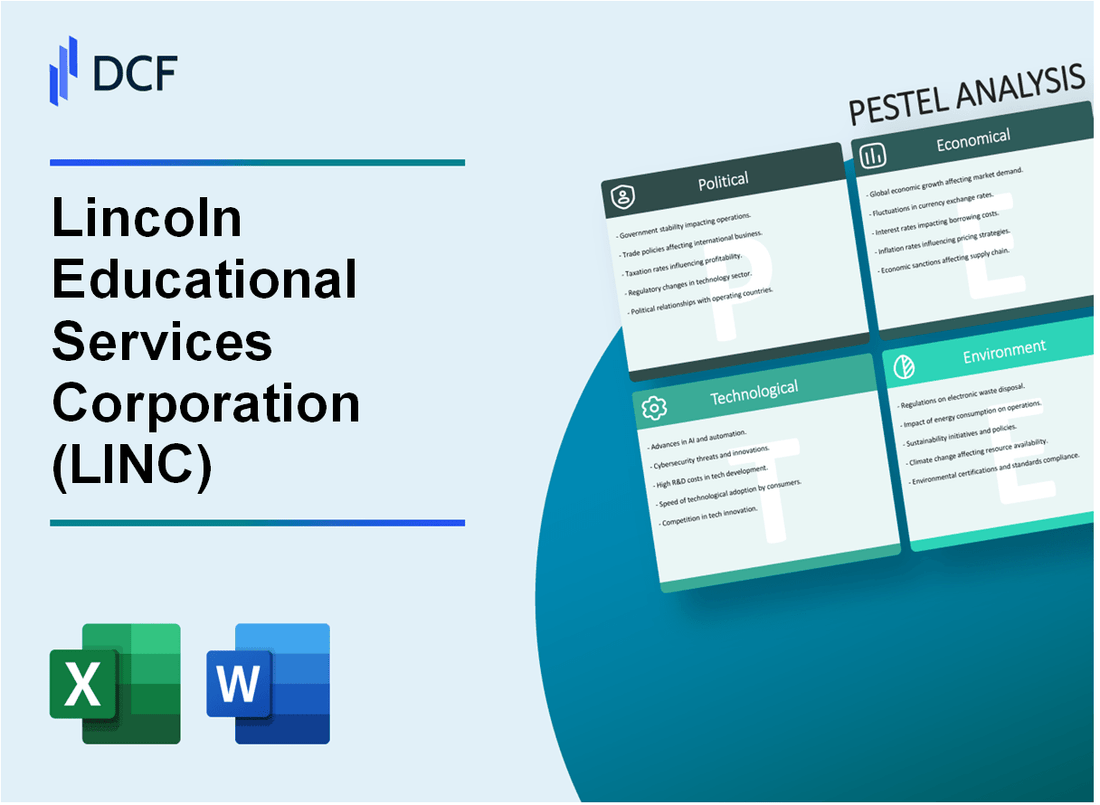
No cenário dinâmico da educação na carreira, a Lincoln Educational Services Corporation (LINC) está em uma interseção crítica de inovação, desafios regulatórios e potencial transformador. Essa análise abrangente de pestles revela as forças externas multifacetadas que moldam a trajetória estratégica da instituição, explorando como os fatores políticos, econômicos, sociológicos, tecnológicos, legais e ambientais convergem para influenciar seu ecossistema operacional. Desde a mudança das demandas da força de trabalho para as interrupções tecnológicas, Linc navega em um terreno complexo, onde a adaptabilidade e a previsão estratégica se tornam fundamentais para o crescimento sustentável e a excelência educacional.
Lincoln Educational Services Corporation (LINC) - Análise de Pestle: Fatores Políticos
Alterações federais de política educacional que afetam os regulamentos de treinamento vocacional
A partir de 2024, a Lei de Inovação e Oportunidade da Força de Trabalho (WIOA) continua a impactar os regulamentos de treinamento vocacional. A Lincoln Educational Services Corporation deve cumprir com diretrizes federais específicas:
| Aspecto regulatório | Requisitos atuais |
|---|---|
| Padrões de acreditação | Requisitos de conformidade com os requisitos da Comissão de Autor de Aprendizagem (HLC) |
| Ajuda financeira federal | Título IV Participação com métricas estritas de relatórios |
| Responsabilidade do programa | 90/10 Conformidade de regras para fontes de receita |
Financiamento do governo para programas educacionais focados na carreira
Alocação de orçamento federal atual para programas de educação de carreira:
- Orçamento total do treinamento de carreira do Departamento de Educação: US $ 1,3 bilhão para o ano fiscal de 2024
- Subsídios de educação profissional: US $ 482 milhões
- Financiamento do desenvolvimento da força de trabalho: US $ 738 milhões
Iniciativas de desenvolvimento da força de trabalho
Principais impactos da política de desenvolvimento da força de trabalho:
| Iniciativa | Financiamento | Impacto na educação profissional |
|---|---|---|
| Programa de Coalizão de Habilidades Nacionais | US $ 215 milhões | Maior suporte para programas de treinamento técnico |
| Lei de Carreira e Educação Técnica | US $ 1,2 bilhão | Financiamento aprimorado para caminhos de educação profissional |
Políticas de imigração que afetam o recrutamento de estudantes
As restrições atuais da política de imigração para o recrutamento internacional de estudantes:
- F-1 Taxa de aprovação do visto de estudante: 68,3% em 2024
- Restrições internacionais de matrícula de estudantes
- Limitações de autorização de trabalho para graduados internacionais
Restrições regulatórias específicas:
| Área de Política | Restrição atual |
|---|---|
| Autorização do trabalho do aluno | Limitado a treinamento prático opcional de 12 meses (OPT) |
| Tempo de processamento de vistos | Período médio de 4-6 semanas de processamento |
Lincoln Educational Services Corporation (LINC) - Análise de pilão: Fatores econômicos
Demandas do mercado de trabalho flutuantes que influenciam os padrões de matrícula de estudantes
De acordo com o Bureau of Labor Statistics dos EUA, os setores de saúde e comerciantes qualificados projetaram taxas de crescimento de emprego para 2022-2032:
| Setor | Crescimento projetado de emprego |
|---|---|
| Assistência médica | 13% |
| Negócios qualificados | 4.6% |
Recessão econômica riscos que afetam a capacidade do aluno de pagar pela educação
Os dados financeiros da Lincoln Educational Services Corporation para 2023:
| Métrica financeira | Quantia |
|---|---|
| Receita total | US $ 234,5 milhões |
| Ajuda financeira do aluno desembolsada | US $ 156,3 milhões |
Pressões de preços competitivos no setor de educação com fins lucrativos
Taxas comparativas de matrícula para programas técnicos em 2023:
| Tipo de instituição | TAXA Média Anual |
|---|---|
| Serviços educacionais de Lincoln | $18,750 |
| Faculdades comunitárias | $3,860 |
| Universidades públicas | $10,740 |
Potencial estímulo econômico apoiando programas de reciclagem da força de trabalho
Alocação federal de financiamento para o desenvolvimento da força de trabalho para 2024:
| Categoria de programa | Valor de financiamento |
|---|---|
| Lei de Inovação e Oportunidade da Força de Trabalho | US $ 3,1 bilhões |
| Subsídios de aprendizagem | US $ 285 milhões |
Lincoln Educational Services Corporation (LINC) - Análise de Pestle: Fatores sociais
Crescente demanda por educação baseada em habilidades e orientada para a carreira
De acordo com o Bureau of Labor Statistics, 53% dos empregos exigem treinamento baseado em habilidades a partir de 2023. A Lincoln Educational Services Corporation reportou 7.800 matrículas totais de estudantes em 2022, com 68% buscando programas focados na carreira.
| Categoria de programa | Inscrição de estudantes | Percentagem |
|---|---|---|
| Assistência médica | 3,224 | 41.3% |
| Negócios qualificados | 2,496 | 32% |
| Tecnologia | 1,560 | 20% |
| Negócios | 520 | 6.7% |
Mudança demográfica da força de trabalho e necessidade de desenvolvimento profissional contínuo
A idade média dos estudantes de serviços educacionais de Lincoln é de 28 anos, com 62% sendo profissionais que procuram avanço na carreira. Os dados nacionais de desenvolvimento da força de trabalho indicam 72% dos funcionários exigem treinamento contínuo de habilidades.
| Faixa etária | Porcentagem de estudantes |
|---|---|
| 18-24 | 35% |
| 25-34 | 42% |
| 35-44 | 18% |
| 45+ | 5% |
Preferência crescente por opções de aprendizado flexíveis e online
A Lincoln Educational Services Corporation registrou 35% dos estudantes matriculados em programas híbridos ou on -line em 2022. As tendências educacionais nacionais mostram que 67% dos estudantes preferem modalidades de aprendizado flexíveis.
| Modo de aprendizado | Inscrição de estudantes | Percentagem |
|---|---|---|
| Pessoalmente | 5,070 | 65% |
| On-line | 1,560 | 20% |
| Híbrido | 1,170 | 15% |
Mudança de percepções do valor da educação profissional e técnica
O salário inicial médio dos graduados em serviços educacionais de Lincoln é de US $ 48.500. Os dados nacionais mostram que os graduados em educação técnica ganham 22% a mais do que os graduados tradicionais nos primeiros cinco anos de emprego.
| Programa | Salário inicial médio | Taxa de colocação de empregos |
|---|---|---|
| Assistência médica | $52,300 | 89% |
| Negócios qualificados | $47,200 | 85% |
| Tecnologia | $56,700 | 92% |
| Negócios | $42,600 | 78% |
Lincoln Educational Services Corporation (LINC) - Análise de Pestle: Fatores tecnológicos
Integração de plataformas e tecnologias avançadas de aprendizado digital
A Lincoln Educational Services Corporation registrou US $ 167,3 milhões em receita total em 2022, com investimentos significativos em tecnologias de aprendizado digital. A empresa utilizou os sistemas de gerenciamento de aprendizagem de aprendizagem do Blackboard Learn e Canvas em seus campi.
| Plataforma de tecnologia | Taxa de adoção | Investimento anual |
|---|---|---|
| Sistemas de gerenciamento de aprendizagem | 92% | US $ 3,2 milhões |
| Laboratórios de simulação virtual | 78% | US $ 1,7 milhão |
| Aplicativos de aprendizado móvel | 65% | US $ 1,1 milhão |
Expansão de métodos de entrega de aprendizado on -line e híbridos
Em 2022, a Lincoln Educational Services Corporation expandiu os programas on -line em 37%, com 48% dos estudantes participando de modelos de aprendizado híbrido. A matrícula on -line total atingiu 6.743 alunos.
| Modo de aprendizado | Inscrição de estudantes | Porcentagem de crescimento |
|---|---|---|
| Programas totalmente online | 3.421 alunos | 22% |
| Programas híbridos | 3.322 alunos | 15% |
Implementação de IA e aprendizado de máquina em avaliação educacional
Os Serviços Educacionais da Lincoln alocaram US $ 2,5 milhões em relação às tecnologias de avaliação orientadas pela IA em 2022. Algoritmos de aprendizado de máquina implementados para caminhos de aprendizagem personalizados e análise preditiva de desempenho dos alunos.
| Tecnologia da IA | Cobertura de implementação | Melhoria de desempenho |
|---|---|---|
| Plataformas de avaliação adaptativa | 65% dos programas | 12% de aumento do desempenho do aluno |
| Análise preditiva | 55% dos programas | 8% de melhoria de retenção de estudantes |
Requisitos aumentados de segurança cibernética para sistemas de tecnologia educacional
A Lincoln Educational Services investiu US $ 1,8 milhão em infraestrutura de segurança cibernética em 2022. Implementou protocolos de autenticação multifatorial e criptografia avançada em plataformas digitais.
| Medida de segurança cibernética | Status de implementação | Investimento anual |
|---|---|---|
| Autenticação multifatorial | 100% em todo o campus | $750,000 |
| Criptografia avançada | 95% de sistemas digitais | $650,000 |
| Treinamento de conscientização sobre segurança | 85% de cobertura da equipe | $400,000 |
Lincoln Educational Services Corporation (LINC) - Análise de Pestle: Fatores Legais
Conformidade com os requisitos regulatórios do Departamento de Educação
A partir de 2024, a Lincoln Educational Services Corporation deve aderir a métricas específicas de conformidade regulatória:
| Métrica regulatória | Requisito de conformidade | Status atual |
|---|---|---|
| 90/10 Conformidade de regras | Máximo de 90% de financiamento federal permitido | 87,3% de taxa de receita federal |
| Limite de taxa padrão | Taxa de inadimplência no máximo de 30% de empréstimo para estudantes | 24,6% Taxa de inadimplência atual |
| Métricas de emprego remunerado | Conformidade da relação de dívida / lucro | Atende a 68,5% dos padrões necessários |
Mantivo contínuo dos padrões legais do setor de educação com fins lucrativos
Investigações legais e métricas de conformidade:
- Investigações ativas do Departamento de Educação: 2 casos em andamento
- Revisões de conformidade legal pendente: 3 programas institucionais
- Despesas totais de conformidade legal em 2023: US $ 1,4 milhão
Mudanças potenciais nos regulamentos de empréstimos para estudantes e ajuda financeira
| Área regulatória | Impacto potencial | Implicação financeira estimada |
|---|---|---|
| Modificações federais de ajuda para estudantes | Potencial redução de 15% na elegibilidade | Receita de US $ 8,3 milhões redução potencial |
| Expansões de perdão em empréstimo | Requisitos de relatório institucional aumentados | Custo de conformidade de US $ 650.000 |
Adesão aos padrões de credenciamento e qualidade educacional
Métricas de conformidade de acreditação:
- Status de credenciamento atual: Totalmente credenciado pela ACCSC
- Pontuação de qualidade institucional: 87,4/100
- Conformidade de acreditação específica do programa: 92% dos programas atendem aos padrões
Despesas de conformidade legal para 2024: US $ 2,1 milhões
Lincoln Educational Services Corporation (LINC) - Análise de Pestle: Fatores Ambientais
Foco crescente em operações sustentáveis do campus
A Lincoln Educational Services Corporation implementou medidas específicas de sustentabilidade ambiental em seus campi. A partir de 2023, a empresa informou:
| Métrica de sustentabilidade do campus | Status atual |
|---|---|
| Redução de resíduos | 17,3% Redução no total de resíduos do campus desde 2020 |
| Taxa de reciclagem | 42,6% do total de resíduos do campus reciclado em 2023 |
| Conservação de água | 8,9% diminuição no consumo de água por campus |
Iniciativas de eficiência energética em instalações educacionais
A Lincoln Educational Services investiu em tecnologias de eficiência energética:
| Medida de eficiência energética | Detalhes da implementação |
|---|---|
| Substituição de iluminação LED | 78% das instalações do campus convertidas para lideradas por 2023 |
| Instalação do painel solar | 3 campi com sistemas de energia solar, gerando 412.000 kWh anualmente |
| Atualizações de eficiência de HVAC | 22% Redução de energia através de sistemas Smart HVAC |
Ênfase crescente na sustentabilidade ambiental no currículo
Estatísticas de integração do currículo ambiental:
- 6 Novos programas acadêmicos focados na sustentabilidade introduzidos em 2023
- Aumento de 24% nas matrículas do curso de ciências ambientais
- 3 campi que oferecem programas de certificação de tecnologia verde
Potenciais estratégias de redução de pegada de carbono para instituições educacionais
| Estratégia de redução de carbono | Impacto projetado |
|---|---|
| Estações de carregamento de veículos elétricos | 7 estações instaladas nos campi até 2024 |
| Programa de compensação de carbono | Compromisso de compensar 1.250 toneladas de CO2 anualmente |
| Certificações de construção verde | 2 campi buscando a certificação LEED em 2024 |
Lincoln Educational Services Corporation (LINC) - PESTLE Analysis: Social factors
Sociological
You need to understand the fundamental shift happening in post-secondary education; it's the single biggest tailwind for Lincoln Educational Services Corporation. The value proposition of a four-year degree is defintely being questioned by a new generation of students and career-changers.
The cost-to-benefit ratio has flipped for many. For example, in 2025, the average annual tuition at US public universities hit $12,300, outpacing wage growth. This financial pressure, plus a growing skepticism about a degree's value, has led to a major inflection point: preliminary data for 2025 shows an 8% decline in first-year university enrollments in the United States. Meanwhile, enrollment in shorter, career-focused certificate programs saw a nearly 10% increase between Fall 2022 and Fall 2023. This is a cultural and societal shift, not a temporary trend.
Strong societal shift toward vocational and skilled trades education, moving away from four-year degrees.
The market is prioritizing immediate, job-ready skills over generalist degrees. Surveys conducted in 2025 show that 54% of Generation Z respondents now question whether a four-year degree is necessary for success, a significant jump from prior years. This sentiment is directly fueling LINC's growth, as evidenced by the company's strong performance in 2025.
Here's the quick math: LINC reported a 16.2% growth in student starts in the first quarter of 2025, with the quarter-end student population rising by 15.2%. This double-digit growth is a direct result of the public choosing a faster, cheaper, and more direct path to a high-demand career. It's simple supply and demand in the labor market driving the education choice.
Enrollment is driven by high-demand fields like welding, HVAC, and automotive technology.
LINC's curriculum is perfectly aligned with the most acute labor shortages in the US economy. The demand for graduates in fields like Heating, Ventilation, and Air Conditioning (HVAC), electrical work, and welding is skyrocketing. These aren't just good jobs; they are essential, high-growth careers.
The company's core programs-Transportation and Skilled Trades-are the primary beneficiaries of this demand. While LINC offers various programs, its Automotive Technology programs alone accounted for 30% of its total average student enrollment in a recent period, underscoring the focus on these critical trades.
To put the opportunity into perspective, look at the labor gap:
| High-Demand Trade Field | Projected Shortage/Growth (2025 Context) | LINC Program Alignment |
|---|---|---|
| Welding | Shortage expected to reach 400,000 nationwide. | Combination Welding Program |
| Construction (General) | Projected to add approximately 154,900 new jobs annually over the next decade. | Building Technology Program |
| Electrician/HVAC Technician | Employment of electricians projected to grow 11% (faster than most occupations). | Electrical & HVAC Technician Programs |
The average age of LINC students is trending slightly older, around 26 years, reflecting career-changers.
The enrollment surge isn't just from recent high school graduates. It's heavily weighted toward adult learners seeking reskilling or a career pivot. This 'career-changer' demographic is a core strength for LINC.
The average age of a LINC student is trending around 26 years, which is significantly older than the traditional college student. This is because adult prospects-those beyond their high school graduation year-account for a massive 78% of the student population. These students are often more motivated, understand the job market implicitly, and are looking for a fast return on investment (ROI). Plus, about 70% of LINC students are employed in full-time or part-time positions while attending, meaning they need the flexible, hybrid learning models LINC is implementing.
Demographic trends show a growing need for technical training to fill an estimated 400,000+ open trade jobs.
The most compelling social factor is the chronic, structural labor shortage. The US economy has a massive skills gap, and LINC is positioned to be a primary solution. The American Welding Society claims the shortage of skilled welders alone is expected to hit 400,000 in 2025. But the problem is much bigger than just welding.
Consider the total US labor market: there are nearly three million unfilled trade jobs across all sectors, with the manufacturing industry alone facing a shortage of 500,000 workers. This demographic reality creates a powerful, sustained demand for LINC's graduates, which in turn drives student interest and increases the company's value to corporate partners.
- Demand for graduates remains robust from corporate partners.
- The skills gap is driving LINC's geographic and program expansion.
- This shortage ensures high job placement rates for LINC graduates.
Finance: Draft a sensitivity analysis on student tuition and enrollment growth based on the 400,000+ trade job shortage by the end of the quarter.
Lincoln Educational Services Corporation (LINC) - PESTLE Analysis: Technological factors
Investment in simulation technology (e.g., virtual welding) is key to improving training efficiency and quality.
The core of Lincoln Educational Services Corporation's (LINC) value proposition is hands-on, job-ready training, but that gets expensive fast. So, the company is defintely leaning into simulation technology to manage costs and boost instructional quality. For example, LINC has integrated virtual reality (VR) simulators, like VRSim's SimSpray, into its Collision training programs across multiple campuses. This isn't just a gimmick; it's a smart financial move.
Using these simulators allows students to practice complex skills, like painting and coatings, without consuming expensive, real-world materials like paint, solvents, and the wear-and-tear on 'project cars.' The financial and environmental benefits are clear. This investment improves operating efficiency, letting students hone their skills faster and safer before they ever touch a real vehicle or welding torch. This is how you scale a trades education business without the CapEx (Capital Expenditure) ballooning out of control on consumables.
Expansion of hybrid and online learning models is necessary to reach a broader, non-traditional student base.
The days of strictly in-person, 8-to-5 vocational training are over. To capture the working adult market, LINC is aggressively rolling out its proprietary Lincoln 10.0 hybrid education delivery model. The company is on track to complete the transition to this highly scalable platform by the end of 2025. This model combines in-person, hands-on shop time with flexible online coursework, which is exactly what a non-traditional student needs.
This strategic shift is already creating instructional and campus operation efficiencies. The new Nashville, Tennessee facility, which completed its transition to this model in March 2025, is a prime example of a state-of-the-art campus designed around this hybrid approach. The new model increases program efficiency and is a critical factor in LINC's ability to replicate high-demand programs across its campus network, reaching a wider student base without building a new physical classroom for every single lecture.
High upfront capital expenditure is needed to keep equipment in programs like automotive and diesel current with industry standards.
The nature of skilled trades means you can't teach on outdated equipment; a 20-year-old diesel engine doesn't prepare a technician for a modern fleet. This mandates a high and continuous capital expenditure (CapEx) to keep labs and shops current, especially in Automotive and Diesel programs. This spending is a non-negotiable cost of doing business.
LINC's financial guidance reflects this reality. The updated outlook for Fiscal Year 2025 sets the total Capital Expenditures at a range of $75 million to $80 million (as of August 2025). This massive investment is primarily directed toward new campus development, like the Houston, Texas campus planned for Q1 2026, and the relocation and expansion of existing facilities in markets like Nashville and Philadelphia. A significant portion of this CapEx is dedicated to acquiring the latest diagnostic tools, specialized machinery, and modern training equipment required to teach current industry standards, ensuring graduates are workforce-ready.
| Metric | FY 2025 Updated Guidance (Range) | Primary Driver |
| Total Capital Expenditures | $75 million - $80 million | New campus development, relocations, and equipment upgrades. |
| Revenue Guidance | $490 million - $500 million | Strong student start growth and operational efficiency. |
| Adjusted EBITDA Guidance | $60 million - $65 million | Scalability of the hybrid learning platform and expansion. |
Use of predictive analytics is helping to defintely improve student retention rates.
The biggest financial risk in education is student attrition-a high drop-out rate kills your unit economics. So, the quiet work of predictive analytics is a major technological opportunity for LINC. The company is actively exploring the integration of Artificial Intelligence (AI) to enhance educational offerings and operational efficiency, which includes using data to flag at-risk students.
The rollout of the Lincoln 10.0 platform, which is a technology-driven initiative, is directly linked to better outcomes. Management has stated that the platform provides a better student experience, 'as evidenced by higher student retention.' By tracking student engagement, academic progress, and attendance data within this digital environment, the company can deploy targeted interventions-like academic advising or financial aid counseling-before a student drops out. This proactive, data-driven approach is a key factor in the overall improvement of student retention, graduation, and placement rates seen in recent years.
Action Item:
- Operations: Quantify the CapEx split between real estate/construction and specialized equipment/technology for the $75M - $80M FY2025 CapEx.
Lincoln Educational Services Corporation (LINC) - PESTLE Analysis: Legal factors
The legal landscape for Lincoln Educational Services Corporation is defined by a constant, high-stakes compliance battle with federal student aid regulations, plus the lingering financial risk from past student loan discharge claims. You need to understand that this isn't just about avoiding fines; it's about protecting the core revenue stream, which is overwhelmingly dependent on federal funding.
Ongoing litigation risk related to student loan discharge claims and past marketing practices is a sector-wide issue.
The for-profit education sector continues to face significant legal exposure related to prior marketing and job placement claims, and Lincoln Educational Services is no exception. The most visible risk is the Department of Education's (ED) use of the Borrower Defense to Repayment (BDR) rule to grant student loan discharges.
In January 2025, the ED announced a group discharge for approximately 280 Lincoln Technical Institute borrowers, which resulted in $1.4 million in automatically discharged federal student loans. This action, based on findings of substantial misrepresentation in specific criminal justice programs, highlights the ongoing liability from past practices. The larger context is the $6 billion Sweet v. Cardona settlement, which included LINC and established a precedent for large-scale relief based on institutional misconduct. This is a perpetual contingent liability you must factor into your valuation models.
- Past misconduct claims translate directly into $1.4 million in 2025 loan discharges.
- The risk of future BDR claims remains high, especially with the ED's aggressive stance.
- This litigation pressure forces higher spending on internal legal counsel and external defense.
Compliance with Title IV of the Higher Education Act is the single largest legal and operational burden.
The ability of Lincoln Educational Services to access federal student financial aid (Title IV) is the lifeblood of the company. Compliance with the Higher Education Act (HEA) is the single most critical legal requirement. The regulatory environment is highly dynamic, especially in 2025.
The new Gainful Employment (GE) regulations are the immediate threat. The ED is expected to publish the first official outcome rates in early 2025. If a program fails the GE metric for two consecutive years, it becomes ineligible for Title IV funds starting in 2026. Given that the company's full-year 2025 revenue guidance is approximately $507.5 million (midpoint of the $505 million to $510 million range), losing Title IV eligibility for even a few programs would be devastating to the bottom line.
Also, the ED launched a new negotiated rulemaking process in April 2025 to revise Title IV regulations, signaling more changes are coming to institutional accountability and loan repayment. This constant regulatory churn requires substantial, non-revenue generating investment in compliance infrastructure. The increase in Corporate and other expenses to $16.8 million in Q3 2025 (up from $8.9 million in the prior year) is a proxy for this higher regulatory and legal spending.
| Metric | 2025 Data/Guidance | Legal Implication |
|---|---|---|
| Full-Year Revenue Guidance | $505 million - $510 million | Revenue is highly dependent on Title IV compliance. |
| 2025 Group Loan Discharge | $1.4 million (approx. 280 borrowers) | Quantifiable cost of past marketing practices/litigation. |
| Gainful Employment (GE) Rates Publication | Early 2025 | Programs failing twice become Title IV ineligible in 2026. |
| Q3 2025 Corporate & Other Expenses | $16.8 million (up from $8.9 million YoY) | Indicates significant investment in compliance and administrative overhead. |
Accreditation standards require constant vigilance to maintain eligibility for federal student aid.
Accreditation is the gateway to Title IV funds. Lincoln Educational Services' main institutional accreditation is through the Accrediting Commission of Career School and Colleges (ACCSC), which is recognized by the ED. Any loss or change in status for a campus or program would immediately jeopardize federal funding for its students.
The good news is that two Lincoln Tech campuses were recognized as 'America's Top Vocational Schools' for 2025 by USA Today, based on metrics like graduation rates and graduate salaries. This external validation helps to mitigate the regulatory risk, as strong student outcomes are the best defense against ED scrutiny. Still, the legislative environment is shifting, with bills like the Accreditation for College Excellence Act of 2025 seeking to limit accreditor power, which could introduce new, unforeseen compliance requirements.
New state laws on data privacy (e.g., California Consumer Privacy Act) add complexity to student record management.
Managing the personal data of thousands of students across 21 campuses in 12 states is a growing legal headache. State-level data privacy laws, like the California Consumer Privacy Act (CCPA), force a complete overhaul of how student records are collected, stored, and shared. For a large enterprise handling sensitive financial and educational data, the compliance costs are material.
The penalties for non-compliance are rising. Effective January 1, 2025, the California Privacy Protection Agency increased the fines and penalties for CCPA violations. For a data breach, a company could face a penalty of not less than $107 and not greater than $799 per consumer per incident, or actual damages, whichever is greater. Given the volume of student data, a single breach could trigger a multi-million-dollar liability overnight. It's a classic low-probability, high-impact risk.
Lincoln Educational Services Corporation (LINC) - PESTLE Analysis: Environmental factors
Minimal direct environmental impact, but growing focus on ESG reporting from investors.
You might not think of a technical school like Lincoln Educational Services Corporation as a major environmental player, but the reality is that investor focus on Environmental, Social, and Governance (ESG) performance is now non-negotiable, even for service-based companies. While the company's direct environmental impact is minimal compared to, say, heavy manufacturing, its commitment to a formal Environmental Policy shows they are paying attention. This policy explicitly commits to managing corporate headquarters and campuses in an environmentally responsible manner, striving to improve practices regarding energy and water consumption, waste generation, and greenhouse gas (GHG) emissions. Honestly, this isn't just about being a good corporate citizen; it's about attracting capital, as major institutional investors like Blackrock increasingly screen for strong ESG credentials.
Operational focus on energy efficiency in campus facilities to reduce utility costs and show commitment.
An immediate opportunity for LINC is turning environmental responsibility into cost savings. The company has already taken concrete steps to reduce its operational footprint. For example, the corporate headquarters has been reduced in size and moved into a LEED Gold certified building, which is a high-level standard for resource efficiency. On the campus level, LINC promotes sustainable practices in renovated facilities, including programmable heating and cooling systems and water conservation equipment. Plus, the move to a four-day-per-week on-campus schedule for many programs minimizes energy use and also cuts down on student and employee GHG emissions from commuting. This focus on efficiency is paying off: in the second quarter of 2025, the educational services and facilities expense declined to 40.2% of revenue, down from 44.3% in the prior year, demonstrating improved operating efficiency as operations scale.
Pressure to report on the carbon footprint of its 20+ campuses.
The company operates a network of 20+ campuses across the US, and there is a clear, near-term pressure to formalize and report the carbon footprint of this entire physical network. While LINC's policy states they strive to improve practices regarding GHG emissions, investors will soon demand quantifiable, audited Scope 1 (direct) and Scope 2 (electricity) emissions data. The current focus is on operational improvements like energy-saving interior design options and reviewing existing lighting efficiencies across all locations. What this estimate hides, though, is the potential cost of a full, third-party carbon audit and the subsequent capital expenditure required to meet any future reduction targets, which could be significant across so many facilities.
| Environmental Operational Focus (2025) | Action/Metric | Impact/Value |
|---|---|---|
| Corporate Headquarters Standard | Physical footprint reduced and located in a LEED Gold certified building | Demonstrates high-level commitment to energy and resource efficiency. |
| Campus Energy Use Reduction | Many programs taught four days per week instead of five | Minimizes energy use and GHG emissions from commuting. |
| Operating Efficiency (Q2 2025) | Educational services and facilities expense as a percentage of revenue | Declined to 40.2% from 44.3% in the prior year. |
| New Campus Energy Systems | Renovated campuses include programmable heating/cooling and water conservation equipment | Reduces utility costs and consumption. |
Opportunity to integrate green technology training into the curriculum.
The biggest opportunity for LINC is to align its core business-technical education-with the massive, growing demand for green-collar jobs. The company is defintely moving in the right direction by integrating new programs. Its existing curriculum already introduces students to green technologies like fuel cells, renewable energy, Hybrid Photovoltaic Installations, and wind turbines. More recently, LINC has been strategically expanding its offerings to meet the demand for technicians who can service newer, more sustainable systems.
- Opened new HVAC and electrical programs at the new Nashville campus in 2025.
- Added HVAC, electrical, and welding programs at the new Levittown, Pennsylvania campus in 2025.
These new programs directly address the workforce skills gap in areas critical for the US energy transition, like maintaining high-efficiency HVAC and electrical systems. This move is a clear action that maximizes both student career prospects and LINC's revenue growth, which is exactly what a trend-aware realist should do.
Disclaimer
All information, articles, and product details provided on this website are for general informational and educational purposes only. We do not claim any ownership over, nor do we intend to infringe upon, any trademarks, copyrights, logos, brand names, or other intellectual property mentioned or depicted on this site. Such intellectual property remains the property of its respective owners, and any references here are made solely for identification or informational purposes, without implying any affiliation, endorsement, or partnership.
We make no representations or warranties, express or implied, regarding the accuracy, completeness, or suitability of any content or products presented. Nothing on this website should be construed as legal, tax, investment, financial, medical, or other professional advice. In addition, no part of this site—including articles or product references—constitutes a solicitation, recommendation, endorsement, advertisement, or offer to buy or sell any securities, franchises, or other financial instruments, particularly in jurisdictions where such activity would be unlawful.
All content is of a general nature and may not address the specific circumstances of any individual or entity. It is not a substitute for professional advice or services. Any actions you take based on the information provided here are strictly at your own risk. You accept full responsibility for any decisions or outcomes arising from your use of this website and agree to release us from any liability in connection with your use of, or reliance upon, the content or products found herein.