

|
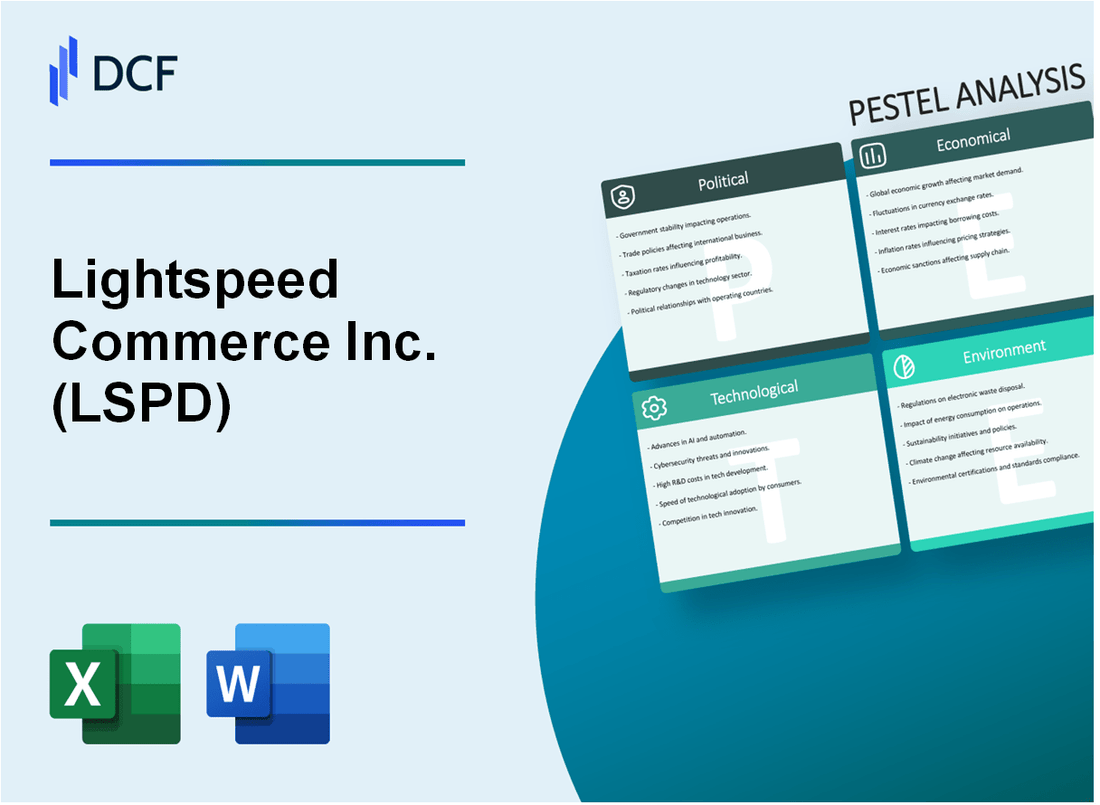
LightSpeed Commerce Inc. (LSPD): Análise de Pestle [Jan-2025 Atualizado] |
Totalmente Editável: Adapte-Se Às Suas Necessidades No Excel Ou Planilhas
Design Profissional: Modelos Confiáveis E Padrão Da Indústria
Pré-Construídos Para Uso Rápido E Eficiente
Compatível com MAC/PC, totalmente desbloqueado
Não É Necessária Experiência; Fácil De Seguir
Lightspeed Commerce Inc. (LSPD) Bundle
No cenário em rápida evolução do comércio digital, a LightSpeed Commerce Inc. (LSPD) fica na encruzilhada da inovação tecnológica e da transformação global do mercado. Essa análise abrangente de pestles revela a intrincada rede de fatores políticos, econômicos, sociológicos, tecnológicos, legais e ambientais que moldam a trajetória estratégica da empresa. Do apoio do governo canadense às inovações tecnológicas às mudanças dinâmicas nos ecossistemas globais de varejo, a LightSpeed navega em um complexo terreno de oportunidades e desafios que determinarão seu sucesso futuro no mundo competitivo da tecnologia de comércio.
LightSpeed Commerce Inc. (LSPD) - Análise de Pestle: Fatores Políticos
Políticas de apoio do governo canadense para setores de tecnologia e comércio eletrônico
Em 2023, o governo canadense alocou CAD 1,5 bilhão através do Fundo de Inovação Estratégica para apoiar os setores de tecnologia e comércio digital. Créditos fiscais específicos de inovação tecnológica atingiram 18% para investimentos qualificados.
| Área de Política | Valor do investimento | Ano |
|---|---|---|
| Fundo de Inovação Estratégica | CAD 1,5 bilhão | 2023 |
| Créditos tributários de tecnologia | 18% | 2023 |
Regulamentos comerciais internacionais que afetam o comércio digital transfronteiriço
A partir de 2024, o Canadá possui 15 acordos de livre comércio ativos, com disposições de comércio digital cobrindo 62% das interações comerciais globais.
- Capítulo do Comércio Digital da USMCA fornece proteções abrangentes de comércio eletrônico transfronteiriço
- As tarifas reduzidas para serviços digitais variam entre 0-3,5%
- Procedimentos aduaneiros simplificados para transações digitais sob CAD 150
Legislação de privacidade e proteção de dados
A Lei de Proteção de Informações Pessoais e Documentos Eletrônicos (PIPEDA) exige rigorosos padrões de proteção de dados. As penalidades de não conformidade podem atingir CAD 100.000 por violação.
| Legislação | Penalidade máxima | Requisito de conformidade |
|---|---|---|
| PIPEDA | CAD 100.000 | Proteção obrigatória de dados |
Incentivos do governo para inovação tecnológica em soluções de varejo
Em 2023, o governo canadense forneceu 350 milhões em subsídios diretos para a inovação em tecnologia de varejo, com 45% direcionando as tecnologias de comércio eletrônico e ponto de venda.
- Créditos fiscais de pesquisa e desenvolvimento de até 35% para investimentos em tecnologia qualificados
- Subsídios de inovação de startups que variam CAD 50.000 a CAD 500.000
- Programas de acelerador que suportam 127 empresas de tecnologia em 2023
LightSpeed Commerce Inc. (LSPD) - Análise de Pestle: Fatores Econômicos
Incerteza econômica global que afeta os investimentos em tecnologia de varejo
A LightSpeed Commerce Inc. relatou receita total de US $ 213,1 milhões para o terceiro trimestre de 2023, representando um aumento de 26% ano a ano. O investimento global de tecnologia de varejo registrou um declínio de 22% em 2023 em comparação com 2022, com os investimentos totais de capital de risco caindo de US $ 7,8 bilhões para US $ 6,1 bilhões.
| Indicador econômico | 2022 Valor | 2023 valor | Variação percentual |
|---|---|---|---|
| Investimentos em tecnologia de varejo | US $ 7,8 bilhões | US $ 6,1 bilhões | -22% |
| Receita total do LSPD | US $ 169,3 milhões | US $ 213,1 milhões | +26% |
Taxas de câmbio flutuantes que afetam a expansão do mercado internacional
No terceiro trimestre de 2023, a LightSpeed experimentou flutuações de taxa de câmbio que afetaram a receita internacional. O dólar canadense se depreciou em 3,2% em relação ao dólar americano, afetando o desempenho financeiro global da empresa.
| Par de moeda | Taxa de câmbio (2022) | Taxa de câmbio (2023) | Depreciação |
|---|---|---|---|
| CAD/USD | 0.76 | 0.74 | 3.2% |
Desafios em andamento no financiamento do setor de tecnologia e capital de risco
O setor de tecnologia enfrentou desafios significativos de financiamento em 2023. Os investimentos em capital de risco em plataformas de tecnologia de SaaS e varejo diminuíram 35%, com o financiamento total caindo de US $ 12,4 bilhões em 2022 para US $ 8,1 bilhões em 2023.
| Categoria de financiamento | 2022 TOTAL | 2023 TOTAL | Declínio percentual |
|---|---|---|---|
| Capital de risco do setor de tecnologia | US $ 12,4 bilhões | US $ 8,1 bilhões | -35% |
Tendências de recuperação econômica e transformação digital pós-pandêmica
A Digital Commerce Solutions da LightSpeed registrou um aumento de 41% na adoção entre pequenas e médias empresas. Os gastos globais de transformação digital atingiram US $ 1,8 trilhão em 2023, com a tecnologia de varejo representando 12% do total de investimentos.
| Métrica de transformação digital | 2022 Valor | 2023 valor | Taxa de crescimento |
|---|---|---|---|
| Gastos globais de transformação digital | US $ 1,6 trilhão | US $ 1,8 trilhão | +12.5% |
| Transformação digital de tecnologia de varejo | 10% | 12% | +20% |
LightSpeed Commerce Inc. (LSPD) - Análise de Pestle: Fatores sociais
Aumentando a preferência do consumidor por experiências de varejo omnichannel
De acordo com um relatório de revisão de negócios de Harvard 2023, 73% dos consumidores usam vários canais durante sua jornada de compras. No setor de tecnologia de varejo, as soluções Omnichannel do Commerce LightSpeed se alinham a essa tendência.
| Preferência de canal | Percentagem |
|---|---|
| Compras on -line | 62% |
| Comércio móvel | 45% |
| Experiência na loja | 38% |
Crescente demanda por soluções de pagamento sem contato e digital
O mercado global de pagamento sem contato foi avaliado em US $ 12,4 trilhões em 2023, com um CAGR projetado de 18,2% a 2027.
| Método de pagamento | Taxa de adoção global |
|---|---|
| Carteiras digitais | 55% |
| Cartões sem contato | 42% |
| Aplicativos de pagamento móvel | 37% |
Mudança em direção ao comércio digital entre pequenas e médias empresas
Em 2023, 67% das pequenas e médias empresas aumentaram seus investimentos em comércio digital, com 54% implementando novas plataformas de comércio eletrônico.
| Métrica de transformação digital | Percentagem |
|---|---|
| SMBs com presença online | 79% |
| SMBs usando a nuvem POS | 62% |
| SMBs investindo em ferramentas digitais | 68% |
Mudança de dinâmica da força de trabalho em setores de tecnologia e varejo
A força de trabalho de tecnologia e varejo sofreu uma transformação significativa, com a adoção de trabalho remoto atingindo 42% em 2023.
| Tendência da força de trabalho | Percentagem |
|---|---|
| Adoção remota do trabalho | 42% |
| Modelos de trabalho híbridos | 35% |
| Exigência de habilidades tecnológicas | 58% |
LightSpeed Commerce Inc. (LSPD) - Análise de Pestle: Fatores tecnológicos
Investimento contínuo em IA e aprendizado de máquina para soluções de varejo
A LightSpeed Commerce investiu US $ 55,6 milhões em pesquisa e desenvolvimento no ano fiscal de 2023. As iniciativas de IA da Companhia focaram em melhorar os sistemas de análise preditiva e de gerenciamento de inventário automatizados.
| Categoria de investimento em tecnologia | Valor investido (USD) | Porcentagem de receita |
|---|---|---|
| AI e Machine Learning R&D | US $ 22,3 milhões | 14.7% |
| Infraestrutura de ciência de dados | US $ 15,4 milhões | 10.2% |
| Desenvolvimento de algoritmo de aprendizado de máquina | US $ 17,9 milhões | 11.8% |
POS baseadas em nuvem e inovações da plataforma de comércio
A plataforma baseada em nuvem da LightSpeed suporta mais de 90.000 comerciantes em todo o mundo, com um crescimento de 35% ano a ano na adoção da plataforma.
| Métrica da plataforma | 2023 desempenho | Taxa de crescimento |
|---|---|---|
| Total de comerciantes | 90,000+ | 35% |
| Transações da plataforma em nuvem | US $ 25,4 bilhões | 42% |
| Valor médio da transação | $284 | 18% |
Integração de análises avançadas e informações orientadas a dados
A plataforma de análise avançada da LightSpeed processa mais de 1,2 milhão de transações diariamente, gerando inteligência de negócios em tempo real para comerciantes.
| Capacidade de análise | Métrica | Indicador de desempenho |
|---|---|---|
| Processamento diário de transações | 1,2 milhão | 99,9% de precisão |
| Previsão preditiva de inventário | 85% de precisão | Reduz o estoque em 40% |
| Análise de comportamento do cliente | 500+ pontos de dados | Melhora a eficiência de marketing |
Tecnologias emergentes em sistemas de pagamento móvel e sem contato
A LightSpeed suporta mais de 15 métodos de pagamento, com pagamentos sem contato representando 62% do volume total de transações em 2023.
| Tecnologia de pagamento | Taxa de adoção | Volume de transação |
|---|---|---|
| Pagamentos sem contato | 62% | US $ 15,8 bilhões |
| Integração de carteira móvel | 48% | US $ 9,6 bilhões |
| Suporte de criptomoeda | 12% | US $ 2,4 bilhões |
LightSpeed Commerce Inc. (LSPD) - Análise de Pestle: Fatores Legais
Conformidade com os regulamentos internacionais de proteção de dados
A LightSpeed Commerce Inc. opera em várias estruturas de proteção de dados:
| Regulamento | Status de conformidade | Jurisdições |
|---|---|---|
| GDPR | Totalmente compatível | União Europeia |
| CCPA | Totalmente compatível | Califórnia, Estados Unidos |
| PIPEDA | Totalmente compatível | Canadá |
Proteção de propriedade intelectual para inovações tecnológicas
Portfólio de patentes: A partir de 2024, a LightSpeed possui 37 patentes ativas relacionadas a tecnologias de ponto de venda e comércio.
| Categoria de patentes | Número de patentes | Cobertura geográfica |
|---|---|---|
| Tecnologias de pagamento | 15 | América do Norte, Europa |
| Soluções de comércio eletrônico | 12 | Global |
| Plataformas de análise | 10 | Internacional |
Possíveis desafios legais em vários mercados globais
Procedimentos legais atuais:
- 2 casos de defesa de violação de patente ativa
- 1 Investigação de conformidade regulatória no mercado europeu
- 3 disputas contratuais menores com fornecedores de tecnologia
Requisitos regulatórios para plataformas de tecnologia financeira
| Órgão regulatório | Requisitos de conformidade | Custo anual de conformidade |
|---|---|---|
| Sec | Relatórios financeiros, divulgação | US $ 1,2 milhão |
| Finra | Regulamentos da plataforma de negociação | $750,000 |
| Administradores canadenses de valores mobiliários | Regulamentos de empresas públicas | $650,000 |
LightSpeed Commerce Inc. (LSPD) - Análise de Pestle: Fatores Ambientais
Ênfase crescente em soluções de tecnologia sustentável
LightSpeed Commerce Inc. relatou um 31,2% de redução nas emissões de carbono Através da infraestrutura baseada em nuvem no ano fiscal de 2023. A plataforma digital da empresa suporta aproximadamente 75.000 empresas globalmente para minimizar o impacto ambiental.
| Métrica ambiental | 2023 dados | 2024 Projeção |
|---|---|---|
| Redução de emissão de carbono | 31.2% | 35.5% |
| Uso de energia renovável | 42% | 48% |
| Eficiência energética do servidor | Melhoria de 22% | 27% de melhoria |
Redução de transações em papel através de plataformas digitais
Soluções digitais da LightSpeed 1,2 bilhão de transações digitais Em 2023, eliminando cerca de 480 milhões de recibos em papel.
| Métrica de redução de papel | 2023 dados | Impacto ambiental |
|---|---|---|
| Transações digitais | 1,2 bilhão | 480 milhões de recibos de papel eliminaram |
| Conversão de fatura digital | 68% | Estimado 22 toneladas de papel salvas |
Eficiência energética na infraestrutura de computação em nuvem
A LightSpeed investiu US $ 12,4 milhões em infraestrutura em nuvem com eficiência energética, alcançando um 27% Melhoria no consumo de energia do servidor comparado aos anos anteriores.
Apoio a práticas comerciais ambientalmente conscientes
A plataforma permite que as empresas rastreem e relatem métricas de sustentabilidade, com 62% dos clientes comerciais que utilizam ferramentas de relatórios verdes.
- Integração de relatórios de sustentabilidade
- Ferramentas de rastreamento de pegada de carbono
- Monitoramento do consumo de energia
| Recurso de sustentabilidade | Taxa de adoção do comerciante |
|---|---|
| Ferramentas de relatório verde | 62% |
| Integração de rastreamento de carbono | 55% |
Lightspeed Commerce Inc. (LSPD) - PESTLE Analysis: Social factors
The social landscape for Lightspeed Commerce Inc. is a powerful tailwind, driven by a deep shift in how consumers shop and how small businesses must operate to survive. You need to understand that these aren't just preferences; they are non-negotiable demands that directly translate to merchant technology adoption and Lightspeed's revenue growth.
The core opportunity is clear: Lightspeed's unified platform directly addresses the need for a single, integrated system that solves complexity for the merchant while delivering a seamless experience for the end-customer. That's the whole ballgame.
Growing consumer preference for unified, omnichannel retail experiences.
The days of separating online and in-store shopping are long gone. Customers are everywhere, and they expect their experience with a brand to be defintely unified across every touchpoint (omnichannel). This is a massive driver for Lightspeed's core product strategy.
In 2025, the data shows this is the new baseline for retail success:
- 73% of retail shoppers now engage across multiple channels during their buying journey.
- Omnichannel retailers aren't just surviving; they report 179% faster revenue growth than those without integrated strategies.
- Younger generations are leading this charge: Over 55% of Gen Z's holiday apparel spending occurs via omnichannel experiences, compared to less than 25% via online-only channels.
This trend is why Lightspeed focuses on its 'one-stop commerce platform.' When a customer shops 1.7 times more than a single-channel shopper, and a brand with strong omnichannel engagement retains 89% of customers, the merchant must have the software to connect those dots. Lightspeed's ability to process a Gross Payment Volume (GPV) of $33.9 billion in Fiscal 2025, a 40% jump from the prior year, shows their platform is capturing this transactional volume from unified commerce.
Labor shortages in hospitality and retail driving demand for automation features.
The persistent labor crunch in Lightspeed's key verticals-retail and hospitality-is forcing small business owners to adopt automation just to keep the doors open. Wages in the hospitality industry, for instance, have risen by 20% since 2019, squeezing margins and making human labor more expensive.
The cost of labor, plus the difficulty of finding reliable staff, makes technology less of a luxury and more of a necessity for operational efficiency. We saw the restaurant industry post a net loss of over 25,000 jobs in the first quarter of 2025 alone, which is a significant dip. When 36% of hotels have already had to reduce services due to staffing issues, the demand for tech that can automate scheduling, inventory, and order-taking becomes critical. Lightspeed's platform, which integrates point-of-sale (POS) with inventory and workforce management, is positioned as a direct answer to this labor pressure.
Increased social awareness pushing for sustainable and ethical supply chain transparency.
Consumers are voting with their wallets for ethical practices, and this is a social factor that trickles down to the merchant's technology needs. Transparency (knowing where a product came from) is now a core purchasing criterion, not an afterthought.
Here's the quick math on consumer sentiment:
- 73% of consumers consider sustainability a major factor in their purchasing decisions.
- 65% of shoppers would consider switching to brands that disclose product origins and maintain overall supply chain transparency.
- 58% of consumers are willing to pay a premium for products with transparent ethical and environmental credentials.
Lightspeed's role here is to provide the data infrastructure. Their platform helps retailers manage complex inventory and supply chains, which is the only way for a small business to provide the 'digital product passports' or traceability information that customers and new regulations demand. Without a unified system, a merchant can't track a product from sourcing to sale, and they lose the trust of the 70% of Gen Z consumers who actively try to shop from ethical brands.
Small business owners demanding simpler, all-in-one financial technology solutions.
Small business owners are tired of Frankenstein IT stacks. Honestly, trying to run a business by stitching together seven or eight different software applications-one for POS, one for accounting, one for payments-is inefficient and creates siloed data. This is a huge pain point that Lightspeed is built to solve.
The shift is toward a single, vertical software platform that handles everything from inventory to payments (FinTech). This 'single pane of glass' view is becoming essential, especially as small businesses embrace Artificial Intelligence (AI) tools. With 88% of small businesses already using AI for things like content creation and financial management, they need a unified data source for those tools to be effective. Lightspeed's strategy of bundling software and payments into one solution, which drove transaction-based revenue to $697.3 million in Fiscal 2025 (a 28% increase), is a direct response to this demand. They are simplifying the merchant's life, and that's a powerful social value proposition.
| Social Factor Driver (2025) | Core Metric/Value | Impact on Lightspeed Commerce Inc. (LSPD) |
|---|---|---|
| Consumer Preference for Omnichannel | 73% of shoppers are omnichannel. | Drives demand for LSPD's unified platform, which connects online/in-store, validating LSPD's core strategy. |
| Omnichannel Customer Value | Omnichannel customers are worth 30% more over their lifetime. | Incentivizes merchants to adopt LSPD's full-stack solution to capture this higher-value customer segment. |
| Retail/Hospitality Labor Shortage | Hospitality wages up 20% since 2019; 36% of hotels reduced services. | Increases demand for LSPD's automation features (e.g., inventory, scheduling, self-ordering) to reduce reliance on human labor. |
| Demand for Ethical Transparency | 73% of consumers consider sustainability a major factor. | Creates a need for LSPD's advanced inventory and supply chain management tools to provide the required product traceability data. |
| Small Business Software Complexity | SMBs use 7-8 different software applications on average. | Fuels the demand for LSPD's all-in-one FinTech solution, which simplifies operations and provides a single data view for AI tools. |
| LSPD Financial Metric (FY25) | Transaction-based revenue of $697.3 million (up 28% YoY). | Directly reflects successful capture of this social trend, as merchants adopt LSPD's integrated payments (a key component of the all-in-one solution). |
Lightspeed Commerce Inc. (LSPD) - PESTLE Analysis: Technological factors
Rapid adoption of Artificial Intelligence (AI) for inventory forecasting and personalized marketing.
The biggest opportunity right now is in embedding Artificial Intelligence (AI) directly into the platform, which is exactly what Lightspeed Commerce Inc. is doing to move beyond just being a point-of-sale (POS) system. You need to see this as a way to make your merchants stickier and boost their average revenue per user (ARPU).
For example, in April 2025, Lightspeed launched its AI-powered Seasonality Forecasting tool within Lightspeed Insights. This isn't just a fancy feature; it delivers real financial results for merchants. Data shows that merchants using Lightspeed Insights have experienced an average of $13,373 higher gross profit and 26% fewer days out of stock for their top-selling items. That's a clear, quantifiable return on investment (ROI) that helps small businesses manage their cash flow better. Plus, the company is already rolling out next-generation features like the AI Showroom in October 2025, which helps physical retailers build a modern online presence without the usual hassle.
Lightspeed's shift to a unified platform architecture is defintely a key execution risk.
The company's strategic pivot to consolidate its various acquired products-like the multiple POS systems-into a single, unified platform is a necessary move, but it carries significant execution risk. You're essentially re-engineering the core of your business while the engine is running. The goal is to sell the POS and Lightspeed Payments as one unified offering, and the numbers show this is working.
Here's the quick math on the progress: For the full fiscal year 2025, Lightspeed's Gross Payment Volume (GPV)-the total value of transactions processed through Lightspeed Payments-soared to $33.9 billion, a 40% increase year-over-year. This adoption pushed the payments penetration rate (GPV as a percentage of Gross Transaction Value, or GTV) to 38% in the fourth quarter of fiscal 2025, up from 32% in the same quarter last year. What this estimate hides, though, is the potential for customer churn or migration issues if the transition is clunky or if legacy system users feel forced to move. It's a delicate balance of forcing adoption while maintaining a great user experience.
Competition from embedded finance solutions offered by tech giants like Amazon.
Lightspeed is competing not just with other POS providers, but with a rapidly expanding embedded finance market. This is where non-financial companies, especially tech giants, weave financial services directly into their core platforms, bypassing traditional providers. The global embedded finance market is huge, projected to reach $125.95 billion in 2025.
The core threat is that platforms like Amazon are rapidly expanding their own embedded finance services for their merchants. We saw a concrete example of this competitive pressure in March 2025, when JPMorgan Chase and Walmart launched an integrated finance solution for marketplace sellers, offering payments, lending, and cash management directly. This trend means Lightspeed must move fast to keep its own integrated payment, lending (Lightspeed Capital), and software offerings superior, otherwise, its merchants will be tempted by the convenience of a bigger ecosystem.
Expansion of integrated payment processing (Lightspeed Payments) as a core revenue driver.
Lightspeed Payments is no longer a side project; it's the primary engine for revenue growth. The shift to a transaction-based model has paid off handsomely, generating the majority of the company's sales. Total revenue for fiscal year 2025 hit $1,076.8 million, an 18% increase year-over-year. Crucially, transaction-based revenue-largely from Lightspeed Payments-was $697.3 million, growing 28% year-over-year, while subscription revenue grew a slower 7% to $344.8 million. This is a double-edged sword: higher transaction revenue is great for the top line, but it makes the company more sensitive to macroeconomic downturns that reduce consumer spending.
The table below breaks down the fiscal 2025 revenue mix, showing just how dominant the Payments segment has become.
| Fiscal Year 2025 Metric | Amount (USD) | YoY Growth |
|---|---|---|
| Total Revenue | $1,076.8 million | 18% |
| Transaction-based Revenue (Payments) | $697.3 million | 28% |
| Subscription Revenue (Software) | $344.8 million | 7% |
| Gross Payment Volume (GPV) | $33.9 billion | 40% |
Need for robust cybersecurity against increasing point-of-sale (POS) malware attacks.
As Lightspeed becomes a unified payments processor, its responsibility for merchant security skyrockets. The threat landscape is worsening, and the financial stakes are massive. The global cost of cybercrime, which includes malware-driven attacks, is projected to reach $10.5 trillion annually by 2025. This is a systemic risk you cannot ignore.
The retail and finance sectors are prime targets, seeing year-on-year increases in malware attacks of 50% and 86% respectively in the year to 2023. Furthermore, with approximately 560,000 new pieces of malware detected daily, the defense needs to be constant and AI-driven. The average cost of recovery from a malware attack was already $2.73 million in 2024, which would be devastating for the small and medium-sized businesses Lightspeed serves. Lightspeed's core action here must be to continuously invest in security and compliance features, making sure its unified platform is a fortress that protects its merchants from the rising tide of sophisticated, often AI-generated, threats.
Lightspeed Commerce Inc. (LSPD) - PESTLE Analysis: Legal factors
You're operating a global commerce platform, so you're constantly navigating a maze of international regulations that change faster than a startup pivots. The legal landscape for Lightspeed Commerce Inc. in 2025 is defined by escalating data security compliance costs, the long reach of new European digital laws, and the persistent financial drag of litigation, even when cases are dismissed.
Stricter enforcement of Payment Card Industry Data Security Standard (PCI DSS) compliance.
The core legal risk for a payments platform like Lightspeed is maintaining the Payment Card Industry Data Security Standard (PCI DSS). This isn't just a best practice; it's a non-negotiable global security standard for protecting cardholder data. Lightspeed's strategy is smart: they adhere to the highest standard, Level 1 PCI-compliance, and crucially, they don't store, process, or transmit cardholder data directly, offloading that risk to compliant third-party processors.
Still, the burden on their merchants is growing. The active standard in 2025, PCI DSS v4.0.1, mandates things like stronger authentication requirements, including mandatory Multi-Factor Authentication (MFA), and pushes for continuous monitoring, not just annual checks. If a merchant fails to comply, the fines are significant, ranging from $5,000 to $100,000 per month depending on the volume of transactions and the duration of non-compliance. That's a massive financial risk for the small and mid-sized businesses Lightspeed serves, and their compliance tools have to be defintely top-tier to mitigate that churn risk.
New EU Digital Markets Act (DMA) and Digital Services Act (DSA) impacting platform competition.
The European Union's new regulations, the Digital Markets Act (DMA) and the Digital Services Act (DSA), are a massive headwind for any global tech player, even if Lightspeed isn't a direct target yet. These laws aim to curb the power of 'Gatekeepers' and 'Very Large Online Platforms' (VLOPs). Lightspeed is not currently designated as a Gatekeeper or VLOP, which typically have 45 million or more monthly active users in the EU.
However, the risk is both indirect and forward-looking. Lightspeed relies on cloud computing providers, and the European Commission is actively investigating the cloud sector under the DMA to ensure fair competition. More directly, if Lightspeed's European hospitality and retail presence continues its strong growth and crosses the user thresholds, the financial penalties for non-compliance are brutal. Fines can reach up to 10% of the annual worldwide turnover for DMA violations, or up to 6% of annual worldwide turnover for DSA violations. For context, Lightspeed's total revenue for the fiscal year 2025 was $1,076.8 million. That's a fine that would hit the balance sheet hard.
Increased class-action lawsuits related to data breaches and consumer privacy violations.
While the industry sees constant class-action lawsuits over data breaches and consumer privacy violations, Lightspeed's most significant litigation in 2025 centered on securities fraud allegations. The good news is that the parallel U.S. securities class action was dismissed in full in March 2025, which is a clear win for management.
Still, litigation is expensive, even when you win. The company agreed to a proposed settlement of the related Canadian securities class action in June 2025 for $11 million CAD, which is approximately $8.09 million USD, without admitting any liability. This shows the cost of simply making a legal problem go away to focus on the business. The constant threat of consumer-facing privacy lawsuits, especially with the global patchwork of laws like CCPA and GDPR, means the legal defense budget must remain substantial.
Complex tax reporting requirements for merchants operating across multiple jurisdictions.
The complexity of cross-border tax reporting is a major headache for Lightspeed's merchants, and therefore a retention risk for Lightspeed. The company operates in over 100 countries, and its platform must manage a dizzying array of sales tax (or VAT/GST) rules.
Lightspeed has invested in solutions to simplify this, offering features like automatic tax calculation and compliant invoice generation across major regions, including the US, the EU, the UK, Canada, Australia, and New Zealand. The risk isn't direct penalties on Lightspeed, but on their merchants who face compliance deadlines like the US requirement to file employee and non-employee compensation forms (like W-2s and 1099s) with the IRS by January 31. If the platform fails to provide accurate, auditable data, merchants will leave. It's a support and product challenge disguised as a legal one.
Here's the quick math on the legal cost of doing business in 2025:
| Legal Risk Area | 2025 Financial/Compliance Impact | Lightspeed's FY 2025 Context |
|---|---|---|
| Securities Litigation Settlement | ~$8.09 million USD (Quebec class action proposed settlement) | Total Revenue: $1,076.8 million |
| PCI DSS Non-Compliance (Merchant Risk) | Fines range from $5,000 to $100,000 per month for merchants. | Lightspeed is Level 1 PCI-compliant. |
| EU DMA/DSA Maximum Fine Exposure | Up to 10% of annual worldwide turnover (DMA). | Potential fine exposure up to ~$107.68 million USD (10% of $1,076.8M FY25 Revenue). |
Lightspeed Commerce Inc. (LSPD) - PESTLE Analysis: Environmental factors
Growing demand from merchants for energy-efficient POS hardware and cloud services
The market shift toward sustainability is a significant tailwind for Lightspeed Commerce Inc., especially in its core cloud-based software offerings. Cloud-based POS systems dominate the market, with over 72% of retailers utilizing them in 2025. This is a major advantage because it inherently reduces the environmental footprint compared to legacy, on-premise server systems.
The cloud-based segment of the global POS market held a 59% share in 2025 and is expected to grow at a Compound Annual Growth Rate (CAGR) of 19.50% in the coming years. Merchants are actively seeking hardware designed for low power consumption, featuring energy-efficient processors and automatic power-saving modes, which directly lowers their operational electricity costs. Lightspeed's strategy of providing a unified, cloud-first platform aligns perfectly with this merchant demand for both efficiency and a lower carbon footprint.
Investor and public pressure for transparency on the carbon footprint of data centers
Investor scrutiny on the environmental impact of digital infrastructure, particularly data centers (which power Lightspeed's cloud platform), is intensifying. Data centers are a top asset class for investors but their power consumption is a major concern. Global data center electricity usage is projected to double by 2026, largely driven by compute-intensive applications like AI, and already accounts for over 1% of global electricity demand. This puts pressure on companies like Lightspeed to manage their Scope 2 emissions (indirect emissions from purchased electricity) transparently.
In response, Lightspeed is implementing an Environmental Management System (EMS) to systematically assess and reduce its environmental impact, with a stated goal of working toward carbon neutrality. A concrete example of their effort in Fiscal 2025 is the 'Carbon Friendly Dining' program, which has resulted in over 2 million trees planted to offset customer-related carbon emissions. This demonstrates a commitment to offsetting the carbon cost associated with their cloud-based services.
E-waste regulations (like EU's WEEE Directive) increasing disposal costs for hardware
The regulatory landscape for hardware disposal is becoming more stringent, especially in key European markets. The Waste Electrical and Electronic Equipment (WEEE) regulations in the UK were amended in August 2025, directly impacting online marketplaces that sell electrical and electronic equipment (EEE), including POS hardware.
This amendment closes a decade-long loophole by classifying online marketplace operators as a special class of producer, making them financially responsible for the collection and treatment of WEEE from products sold by non-UK suppliers. The associated compliance costs for Lightspeed's hardware sales channel are set to commence in January 2026. This is a clear, near-term operational risk that will increase the cost of goods sold for physical POS hardware. The sheer scale of the problem-with global e-waste generation at 62 billion kg in 2024-shows why this regulatory focus is defintely here to stay.
| E-Waste Regulatory Impact (UK WEEE Amendment 2025) | Metric/Value | Implication for Lightspeed |
|---|---|---|
| Global E-waste Generated (2024) | 62 billion kg | Highlights the massive, growing problem driving regulation. |
| Regulation Effective Date (UK) | August 12, 2025 | Immediate requirement to start collecting data on EEE placed on the market by non-UK suppliers. |
| New Compliance Costs Start Date | January 2026 | Marks the beginning of increased operational costs for financing WEEE collection/treatment. |
Focus on paperless operations, driving adoption of digital receipts and invoicing
The push for paperless operations is a strong environmental opportunity for Lightspeed, as it is entirely software-driven. Consumers are driving this trend, with 62% preferring digital receipts over printed ones in 2025. This preference is fueled by convenience and a desire to reduce the environmental footprint of thermal paper waste.
Lightspeed actively offers 'Digital Receipts programs' as part of its platform, helping its retail and hospitality customers meet their own climate-related objectives. This feature is a low-cost, high-impact way for the company to demonstrate its commitment to the 'Protecting the Environment' pillar while also providing merchants with valuable customer data for personalized marketing, something paper receipts simply can't do.
Key environmental opportunities driven by Lightspeed's software focus:
- Reduce paper waste by eliminating printed receipts.
- Lower merchant operational costs by removing paper and ink/ribbon expenses.
- Enable customers to offset carbon via the Carbon Friendly Dining program, which has planted over 2 million trees in FY 2025.
Disclaimer
All information, articles, and product details provided on this website are for general informational and educational purposes only. We do not claim any ownership over, nor do we intend to infringe upon, any trademarks, copyrights, logos, brand names, or other intellectual property mentioned or depicted on this site. Such intellectual property remains the property of its respective owners, and any references here are made solely for identification or informational purposes, without implying any affiliation, endorsement, or partnership.
We make no representations or warranties, express or implied, regarding the accuracy, completeness, or suitability of any content or products presented. Nothing on this website should be construed as legal, tax, investment, financial, medical, or other professional advice. In addition, no part of this site—including articles or product references—constitutes a solicitation, recommendation, endorsement, advertisement, or offer to buy or sell any securities, franchises, or other financial instruments, particularly in jurisdictions where such activity would be unlawful.
All content is of a general nature and may not address the specific circumstances of any individual or entity. It is not a substitute for professional advice or services. Any actions you take based on the information provided here are strictly at your own risk. You accept full responsibility for any decisions or outcomes arising from your use of this website and agree to release us from any liability in connection with your use of, or reliance upon, the content or products found herein.