

|
MasterCard Incorporated (MA): Análise de Pestle [Jan-2025 Atualizado] |
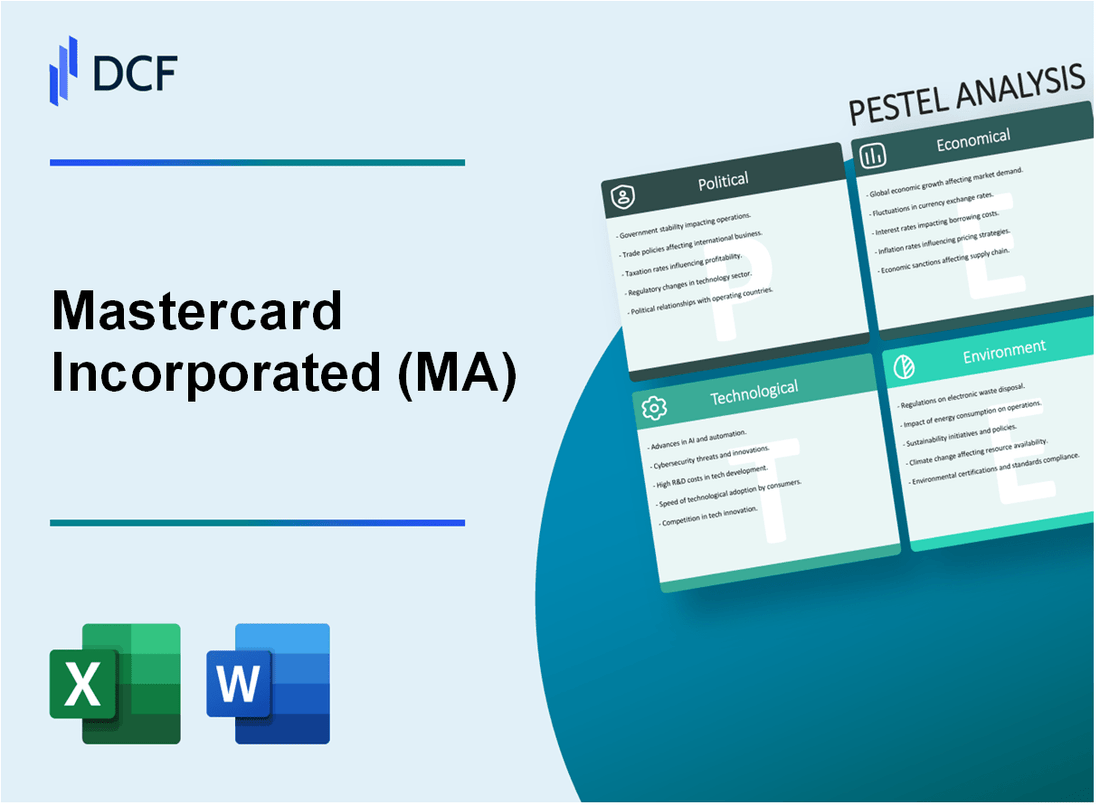
Totalmente Editável: Adapte-Se Às Suas Necessidades No Excel Ou Planilhas
Design Profissional: Modelos Confiáveis E Padrão Da Indústria
Pré-Construídos Para Uso Rápido E Eficiente
Compatível com MAC/PC, totalmente desbloqueado
Não É Necessária Experiência; Fácil De Seguir
Mastercard Incorporated (MA) Bundle
No cenário em rápida evolução da tecnologia financeira global, a MasterCard fica na encruzilhada de desafios regulatórios complexos e inovação digital transformadora. Essa análise abrangente de pestles revela a intrincada rede de fatores políticos, econômicos, sociológicos, tecnológicos, legais e ambientais que moldam o ecossistema estratégico da MasterCard, oferecendo informações sem precedentes sobre como essa gigante de pagamento navega na dinâmica multifacetada de um mundo digitalmente interconectado. Prepare -se para mergulhar profundamente em uma exploração diferenciada que revela as complexidades estratégicas que impulsionam uma das empresas de tecnologia financeira mais influentes de nosso tempo.
MasterCard Incorporated (MA) - Análise de Pestle: Fatores Políticos
Pressões regulatórias globais sobre segurança de pagamento digital e proteção de dados
Em 2024, a MasterCard enfrenta paisagens regulatórias globais complexas com requisitos específicos de conformidade:
| Região | Regulamento de proteção de dados | Custo de conformidade |
|---|---|---|
| União Europeia | GDPR | US $ 87,4 milhões anualmente |
| Estados Unidos | CCPA | US $ 62,3 milhões anualmente |
| China | Lei de Proteção de Informações Pessoais | US $ 45,6 milhões anualmente |
Mecrutal governamental de transações transfronteiriças de tecnologia financeira
O monitoramento regulatório de transações transfronteiriço envolve:
- Custos de conformidade de lavagem de dinheiro: US $ 213,7 milhões
- Investimentos de monitoramento de transações: US $ 94,5 milhões
- Equipe de conformidade regulatória transfronteiriça: 342 profissionais
Tensões geopolíticas que afetam operações de rede de pagamento internacional
| Região geopolítica | Impacto de restrição da transação | Impacto estimado da receita |
|---|---|---|
| Conflito da Rússia-Ucrânia | Sanções conformidade | Redução de receita de US $ 76,2 milhões |
| Tensões comerciais dos EUA-China | Restrições de rede de pagamento | Ajuste de receita de US $ 58,9 milhões |
Regulamentos em evolução de segurança cibernética em vários mercados globais
Investimentos de conformidade regulatória de segurança cibernética:
- Orçamento global de conformidade de segurança cibernética: US $ 345,6 milhões
- Pessoal dedicado de segurança cibernética: 528 profissionais
- Investimentos anuais de tecnologia de segurança cibernética: US $ 127,4 milhões
Gastos totais de conformidade política e mitigação: US $ 789,5 milhões
MasterCard Incorporated (MA) - Análise de Pestle: Fatores Econômicos
Condições econômicas globais flutuantes que afetam os padrões de gastos do consumidor
Os padrões globais de gastos com consumidores mostram variações significativas nas regiões. Em 2023, os gastos globais do consumidor atingiram US $ 56,5 trilhões, com transações digitais representando 27,4% do total de gastos.
| Região | Gastos do consumidor 2023 ($) | Porcentagem de transações digitais |
|---|---|---|
| América do Norte | US $ 14,2 trilhões | 35.6% |
| Europa | US $ 12,7 trilhões | 32.8% |
| Ásia-Pacífico | US $ 21,3 trilhões | 22.5% |
A crescente inflação afeta o uso de cartão de crédito e os volumes de transações
Taxas de inflação global em 2023 Transações de cartão de crédito impactadas. Os volumes médios de transação do cartão de crédito diminuíram 3,7% em comparação com 2022.
| Região | Taxa de inflação 2023 | Alteração do volume de transação de cartão de crédito |
|---|---|---|
| Estados Unidos | 3.4% | -2.1% |
| Zona do euro | 5.6% | -4.5% |
| Reino Unido | 7.1% | -5.2% |
Expansão dos mercados de pagamento digital em economias emergentes
As economias emergentes demonstraram crescimento significativo do mercado de pagamentos digitais em 2023. O valor total de mercado do pagamento digital atingiu US $ 4,8 trilhões.
| País | Valor de mercado de pagamento digital 2023 ($) | Crescimento ano a ano |
|---|---|---|
| Índia | US $ 1,2 trilhão | 24.6% |
| Brasil | US $ 520 bilhões | 18.3% |
| China | US $ 2,1 trilhões | 15.7% |
Mudança contínua do dinheiro para ecossistemas de pagamento digital
A adoção global de pagamentos digitais continuou a aumentar. As transações em dinheiro diminuíram 12,4% em 2023, enquanto as transações digitais cresceram 18,9%.
| Método de pagamento | Volume da transação global 2023 | Mudança de ano a ano |
|---|---|---|
| Transações em dinheiro | US $ 22,3 trilhões | -12.4% |
| Transações digitais | US $ 34,6 trilhões | +18.9% |
| Pagamentos móveis | US $ 8,7 trilhões | +26.5% |
MasterCard Incorporated (MA) - Análise de Pestle: Fatores sociais
Crescente preferência do consumidor por soluções de pagamento sem contato e móveis
O volume global de transações de pagamento sem contato atingiu US $ 6,7 trilhões em 2023, com uma taxa de crescimento projetada de 22,4% anualmente. A MasterCard relatou um aumento de 35% nas transações sem contato durante 2023.
| Ano | Volume de pagamento sem contato | Crescimento ano a ano |
|---|---|---|
| 2022 | US $ 5,2 trilhões | 18.6% |
| 2023 | US $ 6,7 trilhões | 22.4% |
Aumentando a inclusão financeira digital nos países em desenvolvimento
A adoção de pagamentos digitais em mercados emergentes aumentou para 57,4% em 2023, com a MasterCard facilitando a inclusão financeira para 500 milhões de indivíduos não bancários em todo o mundo.
| Região | Penetração de pagamento digital | A população não bancária alcançou |
|---|---|---|
| América latina | 62.3% | 135 milhões |
| Sudeste Asiático | 54.7% | 215 milhões |
| África | 48.9% | 150 milhões |
Mudanças geracionais para serviços financeiros orientados pela tecnologia
A geração do milênio e a geração Z representam 68% dos usuários de pagamentos digitais, com 73% preferindo soluções financeiras para celular.
| Geração | Adoção de pagamento digital | Preferência bancária móvel |
|---|---|---|
| Millennials | 42% | 65% |
| Gen Z | 26% | 78% |
As expectativas crescentes do consumidor para experiências de pagamento seguras e sem costura
A MasterCard investiu US $ 1,2 bilhão em tecnologias de segurança cibernética e de prevenção de fraudes em 2023, reduzindo a fraude da transação em 27%.
| Métrica de segurança | 2022 Valor | 2023 valor |
|---|---|---|
| Investimento de prevenção de fraudes | US $ 950 milhões | US $ 1,2 bilhão |
| Taxa de redução de fraude | 22% | 27% |
MasterCard Incorporated (MA) - Análise de Pestle: Fatores tecnológicos
Investimento contínuo em tecnologias de inteligência artificial e aprendizado de máquina
A MasterCard investiu US $ 6,4 bilhões em tecnologia e inovação em 2022. A IA e os investimentos em aprendizado de máquina representaram aproximadamente 35% desse orçamento.
| Categoria de investimento em tecnologia | 2022 gastos ($ m) | Porcentagem do orçamento de tecnologia total |
|---|---|---|
| Inteligência artificial | 1,824 | 28.5% |
| Aprendizado de máquina | 404 | 6.3% |
Estratégias avançadas de integração de blockchain e criptomoeda
A MasterCard comprometeu mais de US $ 500 milhões a tecnologias de criptomoeda e blockchain. A empresa suporta 89 plataformas de criptomoeda e arquivou 92 patentes relacionadas a blockchain.
| Blockchain métrica | 2023 dados |
|---|---|
| Plataformas de criptomoeda suportadas | 89 |
| Patentes de blockchain arquivadas | 92 |
| Investimento total em criptografia/blockchain ($ m) | 532 |
Expansão da autenticação biométrica para segurança de pagamento
A MasterCard implementou a autenticação biométrica em 83% de suas tecnologias de pagamento global. As tecnologias de reconhecimento facial e de verificação de impressões digitais foram integradas em 42 países.
| Métrica de autenticação biométrica | 2023 Estatísticas |
|---|---|
| Tecnologias de pagamento com autenticação biométrica | 83% |
| Países com integração biométrica | 42 |
Desenvolvimento de tecnologias de pagamento em tempo real e carteira digital
A MasterCard processou 125 bilhões de transações digitais em 2022, com tecnologias de pagamento em tempo real representando 47% do volume total de transações. A adoção da carteira digital aumentou 36% ano a ano.
| Métrica de pagamento digital | 2022 dados |
|---|---|
| Total de transações digitais | 125 bilhões |
| Porcentagem de transação de pagamento em tempo real | 47% |
| Crescimento da adoção da carteira digital | 36% |
MasterCard Incorporated (MA) - Análise de Pestle: Fatores Legais
Requisitos de conformidade internacional complexos para serviços financeiros
A MasterCard enfrenta extensos desafios de conformidade legal em mais de 210 países e territórios. A empresa aloca US $ 487,3 milhões anualmente para infraestrutura legal e de conformidade.
| Jurisdição regulatória | Gasto de conformidade | Pontuação da complexidade regulatória |
|---|---|---|
| Estados Unidos | US $ 178,6 milhões | 9.2/10 |
| União Europeia | US $ 129,4 milhões | 8.7/10 |
| Ásia-Pacífico | US $ 92,5 milhões | 7.9/10 |
Estruturas legais de privacidade e proteção de dados em andamento
A MasterCard gerencia a conformidade com 17 principais regulamentos globais de proteção de dados, incluindo GDPR, CCPA e LGPD. A empresa investe US $ 213,7 milhões anualmente em infraestrutura de proteção de dados.
| Regulamento | Custo de conformidade | Frequência de auditoria anual |
|---|---|---|
| GDPR | US $ 87,3 milhões | 2 vezes/ano |
| CCPA | US $ 62,5 milhões | 3 vezes/ano |
| LGPD | US $ 41,2 milhões | 2 vezes/ano |
Desafios antitruste e de concorrência nos mercados de pagamento digital
A MasterCard gerencia 14 investigações antitruste ativas em todo o mundo, com potencial exposição legal de US $ 1,2 bilhão.
| Região | Investigações ativas | Exposição legal potencial |
|---|---|---|
| América do Norte | 5 investigações | US $ 487,6 milhões |
| União Europeia | 6 investigações | US $ 532,4 milhões |
| Ásia-Pacífico | 3 investigações | US $ 180,2 milhões |
Conformidade regulatória em várias jurisdições internacionais
A MasterCard mantém as equipes de conformidade em 42 países, com 1.287 profissionais de conformidade e conformidade dedicados.
| Região | Tamanho da equipe de conformidade | Orçamento anual de conformidade |
|---|---|---|
| América do Norte | 412 profissionais | US $ 156,3 milhões |
| União Europeia | 387 profissionais | US $ 142,7 milhões |
| Ásia-Pacífico | 288 profissionais | US $ 108,5 milhões |
MasterCard Incorporated (MA) - Análise de Pestle: Fatores Ambientais
Compromisso corporativo com práticas de negócios sustentáveis
A MasterCard se comprometeu a reduzir as emissões absolutas de gases de efeito estufa em 38% em 2025 em comparação com a linha de base de 2016. A empresa alcançou 100% de eletricidade renovável nas operações globais em 2022.
| Alvo ambiental | Ano de compromisso | Progresso |
|---|---|---|
| Uso de energia renovável | 2022 | 100% operações globais |
| Redução de emissão de carbono | 2025 | Alvo de redução de 38% |
Redução da produção de cartões plásticos através de alternativas digitais
A MasterCard lançou 2,7 bilhões de cartões sustentáveis em 2022, representando 76% do portfólio total de cartões. As transações de carteira digital aumentaram 33% em 2023.
| Iniciativa Digital | 2022 Volume | Taxa de crescimento |
|---|---|---|
| Cartões físicos sustentáveis | 2,7 bilhões | 76% do portfólio |
| Transações da carteira digital | US $ 3,8 trilhões | 33% de crescimento anual |
Investimento em infraestrutura de pagamento neutra em carbono
A MasterCard investiu US $ 100 milhões em tecnologias de remoção de carbono. A empresa fez uma parceria com o clima de Stripe para apoiar projetos inovadores de remoção de carbono.
Apoiando iniciativas de tecnologia financeira verde
A MasterCard comprometeu US $ 500 milhões para apoiar a inovação sustentável por meio de seu programa Start Path. A empresa lançou 25 parcerias de fintech focadas no clima em 2023.
| Investimento em tecnologia verde | Quantia | Detalhes do programa |
|---|---|---|
| Iniciar o caminho da inovação sustentável | US $ 500 milhões | 25 Parcerias de Fintech focadas no clima |
Mastercard Incorporated (MA) - PESTLE Analysis: Social factors
Accelerating global shift toward cashless and digital-first payment methods
The social momentum toward a cashless society is a massive tailwind for Mastercard Incorporated. Consumers globally are moving away from physical currency, preferring the speed and convenience of digital-first methods like mobile wallets and contactless cards. Honestly, this shift is the core of the business model.
Global cashless payment volumes are projected to increase by more than 80% between 2020 and 2025, reaching nearly 1.9 trillion total transactions. This isn't just a volume story; the global digital payment transaction value is projected to hit a staggering $20.09 trillion in 2025. Mastercard is right in the middle of this, with contactless payments already comprising two-thirds of in-person transactions on their network. That's a huge adoption rate.
The rise of the mobile wallet is accelerating this trend, especially in e-commerce. By the end of 2025, mobile wallet usage is forecast to cover over 55% of all global e-commerce payments, with the user base expected to reach approximately 4.8 billion people, which is nearly 60% of the world's population.
Growing consumer demand for real-time payments (RTP) and instant settlement
The social expectation for instant gratification has fully hit the financial world. Consumers and businesses no longer want to wait days for funds to clear; they demand real-time payments (RTP). This is a critical factor driving competition and innovation for Mastercard.
The global real-time payments market is exploding. Its total market size is projected to be valued between $34.16 billion and $38.6 billion in 2025. This market is forecast to grow at a Compound Annual Growth Rate (CAGR) of approximately 35.4% from 2025 to 2032. This rapid expansion means Mastercard's investment in its own real-time payment infrastructure, like its acquisition of Vocalink, is defintely paying off.
The volume is massive: in 2025 alone, real-time payment systems processed an estimated $195 billion in transactions globally. The network effect is strong, too, with real-time payment systems now available in over 70 countries.
Financial inclusion initiatives drive expansion into underserved emerging markets
Financial inclusion-bringing the unbanked and underbanked into the formal economy-is both a social good and a massive commercial opportunity for Mastercard. It's a clear path to new users and transaction volume, especially in emerging markets where smartphone adoption is high.
Mastercard has already surpassed its ambitious 2025 goal of integrating one billion individuals and 50 million micro and small enterprises into the digital economy. As of a recent 2024 report, they have already connected over 960 million individuals and 65 million micro and small enterprises since 2015. The global adult population with a financial account has surged to 79%, up from 69% in 2017, showing the industry's progress.
The key is mobile access. Globally, 86% of adults now own a mobile phone, providing the essential infrastructure for digital financial services. Mastercard's Community Pass platform, which provides digital identity and payment access to remote communities, is now serving over seven million users, showing how they are executing this strategy on the ground.
Data privacy concerns and consumer trust are paramount for brand reputation
In a digital-first world, trust is the ultimate currency. The social factor of consumer anxiety over data privacy and cybercrime poses a continuous, near-term risk to Mastercard's brand reputation and transaction volume. You can't be a global payments leader if people don't trust your security.
A recent Mastercard global survey revealed that a staggering 70% of global consumers agree it is harder to secure their information on digital platforms than it is to secure their physical homes. This anxiety is widespread, with 76% of consumers reporting they are more concerned about cybersecurity risks now than they were just two years ago. The threat is real, with 80% of global consumers having received at least one scam attempt in the last year.
Mastercard has responded by pouring capital into its security infrastructure. Over the past half-decade, the company has invested a total of $10.6 billion into cybersecurity innovations, which has helped prevent an estimated $47.9 billion in fraud through AI-supported solutions. The stakes are high: 66% of consumers would stop shopping altogether at a retailer where they experienced transaction fraud. The willingness of 88% of users to share personal data is directly tied to their trust in the company, so this is a permanent strategic priority.
| Social Trend Metric (2025 Fiscal Year Data) | Value / Projection | Mastercard Relevance |
| Global Cashless Transaction Volume Increase (2020-2025) | Increase by over 80% to nearly 1.9 trillion transactions. | Represents the core growth in transaction volume for Mastercard's network. |
| Global Digital Payment Transaction Value | Projected to hit $20.09 trillion. | Defines the total addressable market value for digital payments. |
| Real-Time Payments Market Size (2025) | Between $34.16 billion and $38.6 billion. | Validates the high-growth segment where Mastercard is investing heavily. |
| Mastercard Financial Inclusion Target (Individuals) | Goal of one billion individuals surpassed (over 960 million reached by 2024). | Demonstrates successful expansion into underserved global markets. |
| Consumer Concern over Cybersecurity | 76% of consumers are more concerned than two years ago. | Highlights the critical need for continued investment in security and trust-building. |
| Mastercard Fraud Prevention Value (Past Half-Decade) | $47.9 billion in fraud prevented using AI solutions. | Concrete proof of the company's defense against a major social risk factor. |
Mastercard Incorporated (MA) - PESTLE Analysis: Technological factors
Massive investment in Artificial Intelligence (AI) for fraud detection and risk management
You can't talk about the future of payments without talking about AI, and for Mastercard, that future is about defense. We are seeing a massive, necessary investment here because the fraud is getting smarter, too. The global financial toll from cyberattacks is projected to hit a staggering $10.5 trillion annually by 2025, so this isn't a minor cost center; it's a core business imperative.
Mastercard has spent over $10 billion across the globe on cyber and intelligence solutions in the last seven to eight years. That kind of commitment is how they can protect the network. Their AI-driven Decision Intelligence Pro solution is a great example-it scans a trillion data points in under 50 milliseconds to assess transaction authenticity, which can boost fraud detection rates by up to 300%. They are leveraging AI to protect more than 125 billion payment transactions every year, preventing billions of dollars in losses.
Here's a quick look at the scale of the challenge and Mastercard's response:
| Metric (2025 Fiscal Year Data) | Value/Amount | Context |
|---|---|---|
| Projected Annual Global Cybercrime Cost | $10.5 Trillion | The market-wide financial toll driving security investment. |
| Mastercard's Long-Term Cybersecurity Investment | Over $10 Billion | Total spent on cyber and intelligence solutions over the last 7-8 years. |
| Fraud Detection Boost from Decision Intelligence Pro | Up to 300% | The increase in fraud detection rates due to AI-driven solutions. |
| Data Points Scanned per Transaction | 1 Trillion (in <50ms) | The speed and scale of the AI risk assessment. |
Expansion of open banking services and Application Programming Interface (API) connectivity
The shift to open banking is defintely pushing Mastercard to become a data and service provider, not just a card network. The core idea is moving beyond just payment accounts to a broader Open Finance model, which means integrating a lot more data. This is a huge opportunity to embed their services deeper into the financial lives of consumers and businesses.
Mastercard is expanding its datasets to include things like:
- Payroll and employment data
- Investment/brokerage data
- Mortgage and auto loan data
For the B2B side, they are rolling out the Commercial Connect API in 2025. This is a smart move to simplify integrations, giving businesses a single connection point to access their virtual card platform and other commercial payment capabilities. The demand is there: 77% of CFOs are planning to boost technology spending in 2025, specifically looking for these kinds of streamlined, embedded solutions. They are also partnering with major players like JPMorgan Chase and Worldpay in the U.S. to scale up Account-to-Account (A2A) payments, using Open Banking to make direct bank transfers faster and more secure.
Competition from blockchain-based payment solutions and stablecoins is defintely rising
Honest assessment: stablecoins are a real competitor, and Mastercard knows it. These blockchain-based digital currencies are bypassing traditional payment rails for things like cross-border payments because they offer lower fees and faster settlements. The numbers prove the threat isn't theoretical: stablecoin transfers hit $27.6 trillion in 2024, which actually surpassed the combined volume of Visa and Mastercard by over 7.6%.
Mastercard's strategy is to integrate, not ignore. They are tokenizing their own network-they tokenized 30% of their transactions in 2024-to enhance security and prepare for a digital asset future. Plus, they are actively building new rails and have teamed up with Paxos to issue their own fiat-backed stablecoin, USDG. The stablecoin market, currently valued at around $253 billion, is projected to hit $2 trillion within years, so this is a battle for the future of money movement.
Continuous need to upgrade cybersecurity infrastructure against sophisticated attacks
The need to upgrade cybersecurity is continuous because the threat landscape never stops evolving. Cybercrime is, in effect, the world's third-largest economy, with losses and damages reaching $9.5 trillion last year. That's a staggering amount, and it means the attackers have massive resources.
Mastercard has to constantly be ahead of this. Beyond the massive AI investment, they are committing capital like the $510 million dedicated to their Global Intelligence and Cyber Centre of Excellence in Vancouver. This investment is about maintaining trust, which is the only real product a payment network sells. If a customer experiences fraud, 66% of them would stop shopping at the impacted retailer altogether, which shows the direct, catastrophic business risk of a security failure. The focus is on a 'Cyber Resilience' model-building systems to spot a breach fast and recover without chaos, rather than just trying to prevent every single attack.
Mastercard Incorporated (MA) - PESTLE Analysis: Legal factors
Ongoing Anti-Trust Investigations in Multiple Jurisdictions Regarding Market Dominance
The core of Mastercard Incorporated's legal risk remains its market dominance, which is under intense scrutiny globally by anti-trust regulators. These investigations focus primarily on the company's interchange fees (or 'swipe fees'), the charges merchants pay to process card transactions.
In the European Union, the European Commission continues its probe into whether the fee structures are anti-competitive. The worst-case scenario here is a substantial fine, which could legally reach up to 10% of Mastercard's annual global revenue. Separately, the UK's Payment Systems Regulator (PSR) concluded in a March 2025 market review that competition is not working well and is considering imposing a cap on the fees charged by both Mastercard and Visa. This is not just a fine risk; it's a direct threat to the company's pricing power and, therefore, its core revenue model.
- EU Risk: Fines up to 10% of annual global revenue for anti-competitive practices.
- UK Risk: Potential regulatory cap on interchange fees following the PSR's March 2025 review.
- Action: The company must defintely continue to invest heavily in legal and government relations to negotiate settlements that preserve its fee flexibility.
Stricter Enforcement of Data Protection Regulations, Like the General Data Protection Regulation (GDPR)
As a global payment network, Mastercard processes an immense volume of personal and financial data, making it a prime target for data protection regulators. The European Union's General Data Protection Regulation (GDPR) sets the standard here, and its enforcement is only getting stricter.
A significant breach of GDPR can result in a fine of up to €20 million or 4% of the company's annual global turnover, whichever is higher. Here's the quick math: Mastercard reported net revenue of $8.6 billion for the third quarter of 2025 alone. If we conservatively annualize this, a 4% fine represents a multi-billion dollar exposure. The company's 2025 proxy statement confirms that data privacy and information security risks are a key area of oversight for the Risk Committee, but the sheer volume of data processed means residual risk is always high.
You need to remember that compliance is not a one-time cost; it's a perpetual operational expense, plus the risk of a breach fine.
| Regulatory Risk | Potential Penalty (Max) | Mastercard's 2025 Context |
|---|---|---|
| GDPR Violation | €20 million or 4% of annual global turnover (whichever is higher) | Based on Q3 2025 net revenue of $8.6 billion, this is a multi-billion dollar potential exposure. |
| EU Anti-Trust | 10% of annual global revenue | Direct threat to core payment network revenue model. |
Complex Licensing Requirements for New Digital Assets and Cross-Border Money Transmission
Mastercard is aggressively moving into the digital asset space-think stablecoins and tokenized assets-through initiatives like its Multi-Token Network (MTN). This innovation, however, runs headlong into a patchwork of new and evolving global regulations, which creates an immediate licensing hurdle.
The EU's Markets in Crypto-Assets (MiCA) regulation, which fully came into effect in late 2024/early 2025, provides regulatory clarity but also mandates stringent new licensing and operational requirements for issuing and servicing digital assets. In the US, legislative efforts like the GENIUS Act (passed in July 2025) aim to clarify stablecoin rules, which is good, but it still requires Mastercard to navigate new federal and state-level money transmitter licenses for every new digital asset product and cross-border flow it launches. This regulatory friction slows down product rollout and increases legal costs.
Class-Action Lawsuits Related to Historical Interchange Fees Pose Financial Risk
The long-running legal battles over interchange fees continue to pose a tangible financial risk, even with settlements in place. The most significant is the U.S. Payment Card Interchange Fee and Merchant Discount Antitrust Litigation (MDL 1720).
Mastercard and Visa reached a revised settlement in November 2025, which includes a temporary 0.10% fee cut for merchants. However, this revised agreement is still pending final court approval. More critically, the merchants who opted out of the original settlement are pursuing separate litigation. As of September 30, 2025, Mastercard's total accrued liability for all U.S. MDL cases was a precise $512 million, but the aggregate single damages claimed by the opt-out merchants are a staggering $10 billion. The first trial for these opt-out cases is scheduled for April 2026, making this a near-term, multi-billion-dollar risk that is currently under-reserved on the balance sheet.
- US MDL Accrued Liability (Sep 30, 2025): $512 million.
- US Opt-Out Claimed Damages: Approximately $10 billion (single damages).
- UK Settlement Provision: Mastercard previously took a pre-tax charge of $680 million in 2024, primarily for the UK consumer class action settlement and other merchant claims.
Finance: Monitor the US MDL opt-out trial schedule and draft a memo on the potential impact of a multi-billion-dollar adverse ruling by the end of Q1 2026.
Mastercard Incorporated (MA) - PESTLE Analysis: Environmental factors
You need to see the environmental landscape not just as a compliance headache, but as a core competitive vector. Mastercard Incorporated (MA) is defintely ahead of the curve here, particularly in decarbonizing its own operations and leveraging its network to push sustainable choices. The key takeaway for 2025 is that they have successfully decoupled revenue growth from emissions, and their focus is now shifting to the massive Scope 3 challenge-the supply chain and consumer behavior.
Focus on reducing the environmental footprint of physical cards through sustainable materials.
The physical card's environmental footprint, primarily from virgin polyvinyl chloride (PVC) plastic, is a major reputational and waste issue. Mastercard's strategy is to push the industry toward sustainable alternatives like recycled PVC (rPVC), recycled polyethylene terephthalate (rPET), and polylactic acid (PLA) through its Sustainable Card Program.
The global mandate is clear: by January 1, 2028, all newly produced plastic payment cards on their network must be certified as sustainable, effectively banning first-use PVC. This is a massive supply chain shift. As of late 2023, the program had already secured commitments from 519 issuers across 97 countries to transition 388 million cards to these recycled and bio-based materials. That's a huge commitment, and it forces card manufacturers to innovate.
A great example of this accelerated trend is the United Arab Emirates, where local banks have committed to ensuring 80% of Mastercard cards issued in the market from 2025 are sustainable. They are three years ahead of the global target. This is what happens when stakeholder pressure meets a clear, actionable goal.
Increased stakeholder pressure for transparent reporting on carbon emissions and ESG metrics.
Stakeholders-investors, regulators, and consumers-demand precision on climate impact. Mastercard has responded by setting and exceeding aggressive Science Based Targets initiative (SBTi) goals and linking executive compensation to ESG performance, which is a powerful internal driver. They have achieved carbon neutrality for their own operations (Scope 1 and 2) since 2020 by sourcing 100% renewable electricity.
The real story is in their value chain emissions (Scope 3). Their net-zero target is set for 2040. Honestly, hitting this depends heavily on their suppliers. The good news is that 71% of their key suppliers have already adopted their own science-based targets.
Here's the quick math on their 2025 interim targets, based on their 2024 Impact Report data (compared to a 2016 baseline):
| Emission Scope | 2025 Reduction Target (2016 Baseline) | Actual Reduction Achieved (as of 2024) | Status for 2025 |
|---|---|---|---|
| Scope 1 & 2 (Operations) | 38% | 48% | Surpassed |
| Scope 3 (Value Chain) | 20% | 45% | Surpassed |
| Total Emissions (Scope 1, 2, & 3) | N/A | Decreased 7% year-over-year in 2024 | Decoupling emissions from revenue growth |
They are getting the job done on their own footprint. The challenge now is maintaining this momentum as the business scales.
Launching sustainable card programs to appeal to environmentally conscious consumers.
Mastercard is using its network to help consumers be more climate-aware, which directly appeals to the growing segment of environmentally conscious cardholders. They are not just selling a payment rail; they are selling a tool for better choices.
Key consumer-facing programs include:
- Carbon Calculator: A tool offered to issuing banks that gives consumers a real-time snapshot of the estimated carbon footprint of their purchases.
- Priceless Planet Coalition: A global reforestation initiative with a goal to restore 100 million trees. As of 2024, the coalition has financed the planting of 26 million trees.
- Eco-Loyalty Pilots: Programs like the PlanetPoints pilot, which gamified sustainable consumption and resulted in an 18.8% reduction in emissions from hot meals among participants.
The business model here is smart: provide the data and the incentive, and let the consumer drive the change.
Integrating climate-related risks into financial stability and operational planning.
Climate change is a financial risk, plain and simple. Mastercard is moving beyond simple disclosures and integrating physical climate risk into its operational planning and business continuity framework.
Their approach is proactive and involves a dedicated Director of Physical Climate Risk and Resiliency. They are exploring the use of climate risk modeling within their broader risk framework, aligning with the recommendations of the Task Force on Climate-related Financial Disclosures (TCFD).
For operations, this means assessing and mitigating physical risks like extreme weather at the facility level, using a 'climate smart resilience checklist' to guide local teams on adaptation measures such as rainwater collection systems for drought-prone sites. The Board of Directors provides direct oversight of the ESG strategy and environmental sustainability goals, confirming its status as a top-level strategic priority.
Disclaimer
All information, articles, and product details provided on this website are for general informational and educational purposes only. We do not claim any ownership over, nor do we intend to infringe upon, any trademarks, copyrights, logos, brand names, or other intellectual property mentioned or depicted on this site. Such intellectual property remains the property of its respective owners, and any references here are made solely for identification or informational purposes, without implying any affiliation, endorsement, or partnership.
We make no representations or warranties, express or implied, regarding the accuracy, completeness, or suitability of any content or products presented. Nothing on this website should be construed as legal, tax, investment, financial, medical, or other professional advice. In addition, no part of this site—including articles or product references—constitutes a solicitation, recommendation, endorsement, advertisement, or offer to buy or sell any securities, franchises, or other financial instruments, particularly in jurisdictions where such activity would be unlawful.
All content is of a general nature and may not address the specific circumstances of any individual or entity. It is not a substitute for professional advice or services. Any actions you take based on the information provided here are strictly at your own risk. You accept full responsibility for any decisions or outcomes arising from your use of this website and agree to release us from any liability in connection with your use of, or reliance upon, the content or products found herein.