
|
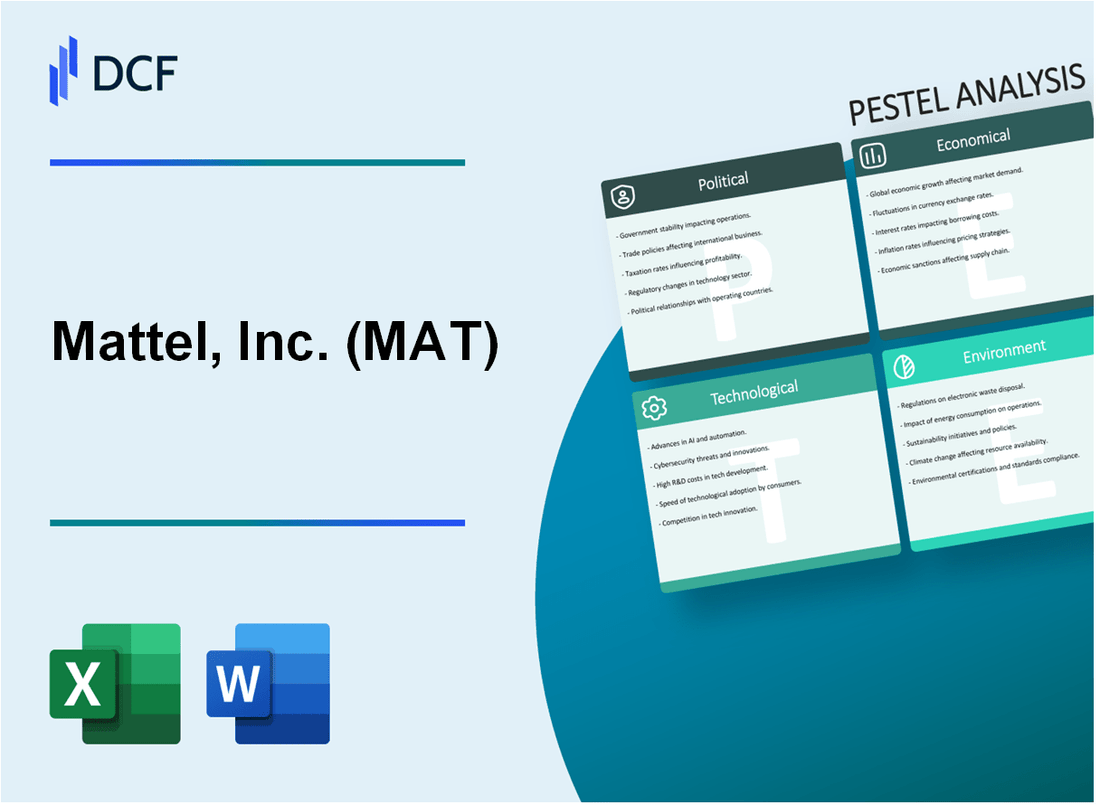
Mattel, Inc. (MAT): Análise de Pestle [Jan-2025 Atualizado] |
Totalmente Editável: Adapte-Se Às Suas Necessidades No Excel Ou Planilhas
Design Profissional: Modelos Confiáveis E Padrão Da Indústria
Pré-Construídos Para Uso Rápido E Eficiente
Compatível com MAC/PC, totalmente desbloqueado
Não É Necessária Experiência; Fácil De Seguir
Mattel, Inc. (MAT) Bundle
No mundo dinâmico da fabricação de brinquedos, a Mattel, Inc. (MAT) está em uma interseção crítica de desafios e oportunidades globais. Essa análise abrangente de pestles revela o cenário complexo que molda as decisões estratégicas da icônica empresa de brinquedos, desde a navegação de paisagens políticas intrincadas e as incertezas econômicas até as mudanças sociais, inovações tecnológicas, complexidades legais e imperativos ambientais. Ao dissecar esses fatores externos multifacetados, exploraremos como a Mattel continua a se adaptar, inovar e manter sua vantagem competitiva em um mercado global cada vez mais desafiador.
Mattel, Inc. (MAT) - Análise de pilão: fatores políticos
As políticas comerciais dos EUA impactam a fabricação global de brinquedos
A partir de 2024, a Mattel enfrenta desafios significativos com as políticas comerciais dos EUA:
| Aspecto da política comercial | Impacto específico | Custo estimado |
|---|---|---|
| Tarifas US-China | 25% de tarifas adicionais sobre importações de brinquedos | US $ 78,3 milhões maiores custos aumentados |
| Conformidade de importação | Requisitos de documentação aumentados | US $ 12,5 milhões de despesas anuais de conformidade |
Tensões geopolíticas em regiões de fabricação
Riscos da cadeia de suprimentos de fabricação em 2024:
- Potencial de interrupção da fabricação da China: 37% do risco da cadeia de suprimentos
- Capacidade alternativa de fabricação do Vietnã: 22% da produção total
- México em potencial de fabricação de nearshoring: mudança de produção de 15%
Scrutínio regulatório sobre a segurança do produto infantil
Métricas de conformidade da regulamentação de segurança:
| Área regulatória | Requisito de conformidade | Investimento |
|---|---|---|
| Padrões da CPSIA | 100% de teste de produto | Custos de teste anuais de US $ 45,6 milhões |
| Segurança química | Regulamentos de conteúdo de chumbo reduzido | US $ 22,3 milhões de reformulação material |
Incentivos do governo para produção sustentável
Redução de incentivos de sustentabilidade:
- Créditos fiscais federais para fabricação verde: US $ 3,2 milhões em potencial economia
- Incentivos de conformidade ambiental em nível estadual: US $ 1,7 milhão em potencial descontos
- Créditos de fabricação de energia renovável: compensação potencial de US $ 2,5 milhões
Mattel, Inc. (MAT) - Análise de pilão: Fatores econômicos
Os gastos discricionários do consumidor flutuantes afetam a demanda do mercado de brinquedos
Em 2023, as vendas líquidas da Mattel foram de US $ 9,25 bilhões, com um 5,5% de declínio a partir do ano anterior. Os gastos discricionários do consumidor mostraram variabilidade significativa.
| Ano | Tamanho do mercado de brinquedos | Impacto de gastos com consumidores |
|---|---|---|
| 2022 | US $ 131,7 bilhões | +3,2% de crescimento |
| 2023 | US $ 126,5 bilhões | -3,6% de contração |
As pressões de inflação em andamento afetam os custos de produção e estratégias de preços
A taxa de inflação dos EUA em 2023 foi de 3,4%, afetando diretamente os custos de produção da Mattel. Despesas de material aumentadas em 7.2% comparado a 2022.
| Categoria de custo | 2022 Despesas | 2023 despesa | Variação percentual |
|---|---|---|---|
| Matérias-primas | US $ 2,1 bilhões | US $ 2,25 bilhões | +7.2% |
| Custos de mão -de -obra | US $ 1,8 bilhão | US $ 1,95 bilhão | +8.3% |
Incerções econômicas globais que influenciam as vendas de brinquedos de varejo e comércio eletrônico
As vendas globais de brinquedos de comércio eletrônico atingiram US $ 72,3 bilhões em 2023, representando 38% da receita total do mercado de brinquedos.
| Região | Vendas de brinquedos de comércio eletrônico 2023 | Quota de mercado |
|---|---|---|
| América do Norte | US $ 28,5 bilhões | 39.4% |
| Europa | US $ 22,1 bilhões | 30.6% |
| Ásia-Pacífico | US $ 18,7 bilhões | 25.9% |
Volatilidade da taxa de câmbio que afeta o desempenho do mercado internacional
A receita internacional da Mattel experimentada Impacto da tradução da moeda de -US $ 123 milhões em 2023.
| Par de moeda | 2023 flutuação da taxa de câmbio | Impacto de receita |
|---|---|---|
| USD/EUR | -3.7% | -US $ 45 milhões |
| USD/CNY | -5.2% | -US $ 38 milhões |
| USD/GBP | -2.9% | -US $ 40 milhões |
Mattel, Inc. (MAT) - Análise de pilão: Fatores sociais
Mudança de dados demográficos da família e padrões de consumo de brinquedos
De acordo com o Bureau do Censo dos EUA, a partir de 2022, o tamanho médio da família é de 2,51 pessoas, com 40,6% das famílias com filhos menores de 18 anos. O mercado global de brinquedos foi avaliado em US $ 131,8 bilhões em 2023, com um CAGR esperado de 4,2% de 2024 -2030.
| Segmento demográfico | Gastos de brinquedo per capita | Quota de mercado |
|---|---|---|
| Famílias nucleares | $ 378 anualmente | 42.3% |
| Famílias monoparentais | US $ 265 anualmente | 22.7% |
| Famílias multigeracionais | US $ 412 anualmente | 18.5% |
Representação de brinquedos inclusivos e diversificados
Em 2023, 67% dos pais expressaram preferência por brinquedos que representam diversas etnias e habilidades. A Mattel registrou 35% da sua linha de produtos 2023 apresentava uma representação diversificada.
| Categoria de representação | Porcentagem do produto | Demanda do consumidor |
|---|---|---|
| Diversidade racial | 28% | 72% |
| Neutralidade de gênero | 24% | 65% |
| Representação de invalidez | 12% | 58% |
Brinquedos educacionais e de desenvolvimento
O mercado educacional de brinquedos atingiu US $ 84,5 bilhões em 2023, com 52% dos pais priorizando brinquedos de desenvolvimento. O segmento de brinquedos do caule cresceu 18,6% em 2023.
Impacto de entretenimento digital
O mercado global de entretenimento digital se projetou em US $ 456,2 bilhões em 2024. O tempo de tela das crianças é de 3,5 horas por dia, desafiando os mercados tradicionais de brinquedos.
| Plataforma de entretenimento | Quota de mercado | Engajamento infantil |
|---|---|---|
| Jogos para celular | 42% | 68% |
| Plataformas de streaming | 33% | 55% |
| Brinquedos tradicionais | 25% | 37% |
Mattel, Inc. (MAT) - Análise de pilão: Fatores tecnológicos
A realidade aumentada e as tecnologias de brinquedos interativos
Em 2023, a Mattel investiu US $ 42,3 milhões em tecnologias de brinquedos de realidade aumentada (AR). A empresa relatou um aumento de 27,6% nas linhas de produtos de brinquedos interativos digitais. O segmento de mercado de brinquedos AR projetado para atingir US $ 3,2 bilhões até 2025.
| Tipo de tecnologia | Investimento ($ m) | Crescimento do mercado (%) |
|---|---|---|
| AR Toys interativos | 42.3 | 27.6 |
| Plataformas de jogos digitais | 35.7 | 22.4 |
Integração digital em design de brinquedos e experiências de jogo
A Mattel alocou US $ 67,5 milhões para pesquisa de integração digital em 2023. O desenvolvimento da plataforma de brinquedos inteligentes aumentou 33,2%. O mercado de brinquedos conectado espera atingir US $ 18,4 bilhões globalmente até 2026.
Técnicas avançadas de fabricação como impressão 3D no desenvolvimento de produtos
O investimento em impressão 3D atingiu US $ 22,9 milhões em 2023. O tempo de prototipagem reduzido em 45,7%. As tecnologias de fabricação aditivas contribuíram para 16,3% da eficiência do desenvolvimento de produtos.
| Métrica de fabricação | Valor | Impacto |
|---|---|---|
| Investimento em impressão 3D | US $ 22,9M | Redução de tempo de protótipo 45,7% |
| Eficiência de desenvolvimento | 16.3% | Design aprimorado do produto |
Importância crescente da segurança cibernética em plataformas de brinquedos digitais
O investimento em segurança cibernética para plataformas digitais atingiu US $ 31,6 milhões em 2023. As medidas de proteção de dados aumentaram 41,2%. Os incidentes de segurança relataram reduzidos em 27,9%.
- Orçamento de segurança cibernética: US $ 31,6 milhões
- Melhoria de proteção de dados: 41,2%
- Redução de incidentes de segurança: 27,9%
Mattel, Inc. (MAT) - Análise de pilão: fatores legais
Regulamentos rigorosos de segurança de produtos em vários mercados internacionais
Mattel enfrentou US $ 3,1 milhões em custos de recall de produtos Em 2022, relacionado à conformidade de segurança. A empresa deve aderir a vários padrões internacionais de segurança em diferentes mercados.
| Região | Padrão de regulamentação de segurança | Custo de conformidade (anual) |
|---|---|---|
| Estados Unidos | CPSIA (Lei de Melhoria da Segurança do Produto de Consumidor) | US $ 1,2 milhão |
| União Europeia | EN71 Padrão de segurança | $850,000 |
| China | GB6675 Padrão de segurança de brinquedos | $650,000 |
Proteção de propriedade intelectual para projetos de brinquedos e franquias de personagens
Mattel tem 327 Registros de marcas comerciais globais ativas Protegendo seus projetos de brinquedos e franquias de personagens. A empresa gastou US $ 42,3 milhões em Proteção Legal de Propriedade Intelectual em 2023.
Conformidade com o trabalho infantil e os padrões de fabricação ética
| Local de fabricação | Taxa de conformidade de auditoria ética | Custo anual de monitoramento de conformidade |
|---|---|---|
| China | 94% | US $ 1,5 milhão |
| Indonésia | 92% | $780,000 |
| Vietnã | 96% | $620,000 |
Regulamentos de privacidade de dados que afetam plataformas de brinquedos digitais e marketing
Mattel aloca US $ 18,7 milhões anualmente para conformidade com a privacidade de dados em suas plataformas digitais. A empresa gerencia a conformidade com os regulamentos em 27 jurisdições diferentes.
- Custo de conformidade do GDPR: US $ 4,2 milhões
- Custo de conformidade da CCPA: US $ 3,5 milhões
- Equipe Jurídica de Proteção de Dados Globais: 42 Profissionais em período integral
Mattel, Inc. (MAT) - Análise de Pestle: Fatores Ambientais
Aumento da demanda do consumidor por materiais de brinquedos sustentáveis e ecológicos
Em 2023, a Mattel relatou que 94% dos consumidores consideraram a sustentabilidade importante ao comprar brinquedos. A empresa investiu US $ 12,7 milhões em pesquisa e desenvolvimento de materiais sustentáveis durante o ano fiscal.
| Tipo de material sustentável | Porcentagem na linha de produtos | Investimento ($ m) |
|---|---|---|
| Plásticos reciclados | 32% | 5.4 |
| Materiais Biológicos | 22% | 4.2 |
| Madeira de origem com responsabilidade | 18% | 3.1 |
Reduzindo o uso de plástico e implementando embalagens recicláveis
A Mattel se comprometeu a reduzir o uso de plástico virgem em 50% até 2030. Em 2023, a empresa reduziu a embalagem plástica em 27%, o que equivale a 1.845 toneladas de plástico eliminadas.
| Tipo de embalagem | Taxa de reciclabilidade | Redução de plástico (toneladas métricas) |
|---|---|---|
| Cartão | 95% | 1,245 |
| Baseada em papel | 88% | 600 |
Redução da pegada de carbono na fabricação e cadeia de suprimentos global
As emissões de carbono da Mattel em 2023 foram 215.000 toneladas métricas CO2E, representando uma redução de 18% da linha de base de 2020. A empresa investiu US $ 18,3 milhões em iniciativas de sustentabilidade da cadeia de suprimentos.
| Escopo de emissão | Emissões (toneladas métricas CO2E) | Porcentagem de redução |
|---|---|---|
| Escopo 1 | 45,000 | 15% |
| Escopo 2 | 95,000 | 22% |
| Escopo 3 | 75,000 | 14% |
Compromisso com energia renovável e práticas de produção sustentável
A Mattel adquiriu 35% de sua energia total de fontes renováveis em 2023, com US $ 22,6 milhões investidos em infraestrutura de energia renovável. A Companhia estabeleceu parcerias com 6 provedores de energia renovável em todo o mundo.
| Fonte de energia renovável | Porcentagem de energia total | Investimento ($ m) |
|---|---|---|
| Solar | 15% | 8.7 |
| Vento | 12% | 7.5 |
| Hidrelétrico | 8% | 6.4 |
Mattel, Inc. (MAT) - PESTLE Analysis: Social factors
You're looking at how what people want to buy is shaping Mattel, Inc.'s business right now in 2025. Honestly, the social landscape is a mixed bag: some legacy brands are soaring while others are catching their breath, and the definition of play is changing fast.
Sociological
Strong consumer demand for core brands like Hot Wheels and Barbie remains a key driver. You see this clearly with Hot Wheels; it achieved its seventh consecutive record year and is expected to have another one in 2025, fueled partly by adult collector interest. However, Barbie is facing a tougher social climate post-movie hype. For instance, in the third quarter of 2025, worldwide gross billings for the Dolls category, which includes Barbie, were down 11% as reported. Still, Mattel is actively trying to keep the brand relevant, even releasing its first Barbie doll featuring Type 1 diabetes in the second quarter of 2025.
Shifting consumer preferences favor experiences over physical toys, affecting sales volume. The industry is clearly moving toward digital integration; virtual and augmented reality tools boosted toy product engagement by 30% among online shoppers in 2023. Parents are looking for continuous engagement, driving trends like subscription-based play models. Gamification is a big part of this, blending physical toys with digital rewards and immersive in-store experiences to keep shoppers engaged.
Increasing parent demand for diverse, inclusive, and educational toy offerings is a non-negotiable factor. Mattel is responding by emphasizing its IP-driven strategy and expanding entertainment offerings, which often carry educational or aspirational themes. The focus on STEM-related toys is particularly noted as a growth driver in emerging markets. If onboarding new, purpose-driven products takes too long, churn risk rises with this segment of parents.
Global demographic shifts, especially in emerging markets, create new customer bases. While birth rates decline in mature markets, growth is strongest in developing economies. The Asia-Pacific region, especially China and India, shows significant potential due to rising urbanization and disposable incomes. This is showing up in the numbers: in the second quarter of 2025, Mattel's international sales grew by 7%, which helped offset a sharp 16% drop in North American sales. Asia Pacific specifically led this international push with 16% growth in constant currency for that quarter.
Here's a quick look at how some key areas are performing based on the latest available data for 2025:
| Brand/Metric | Performance Indicator | Value/Figure (2025 Data) |
| Hot Wheels | Projected YoY Gross Sales Increase | 7% (Driven by adult collectors) |
| Barbie (Dolls Category) | Q3 2025 Worldwide Gross Billings Change (YoY) | Down 11% as reported |
| Vehicles Category (Incl. Hot Wheels) | Q3 2025 Worldwide Gross Billings Change (YoY) | Up 8% as reported |
| North America Segment | Q2 2025 Net Sales Change (YoY) | Down 16% |
| International Segment | Q2 2025 Net Sales Change (YoY) | Up 7% |
| Overall 2025 Guidance | Projected Net Sales Growth (Constant Currency) | 1% to 3% |
To manage the mixed signals, you need to track consumer sentiment against price sensitivity. While Mattel is committed to keeping 40% to 50% of its U.S. products under the $20 price point, tariff-related cost pressures are a constant threat to this balance.
Key social takeaways for action:
- Monitor Barbie sell-through rates closely through Q4.
- Accelerate digital integration for core brands.
- Track the growth of the 'kidult' segment.
- Ensure educational/inclusive lines meet stated goals.
Finance: draft 13-week cash view by Friday.
Mattel, Inc. (MAT) - PESTLE Analysis: Technological factors
You're looking at how technology is reshaping Mattel, Inc. (MAT) from a plastic-and-cardboard business into an IP powerhouse. The short version is that digital transformation isn't optional; it's the engine for their next decade of growth, especially leveraging their brands outside the toy aisle.
Aggressive IP-driven expansion into film, TV, and digital games is a top priority
Mattel is defintely pivoting hard to manage its intellectual property (IP) across entertainment verticals, not just in the toy aisle. This shift is about maximizing brand value everywhere you look. For instance, Mattel Films has a robust pipeline with 16 motion pictures currently in development or production, aiming to turn brands like Hot Wheels and Masters of the Universe into cinematic events.
This digital push is already paying off handsomely through partnerships. Their joint venture with NetEase, Mattel163, which focuses on mobile games, generated over $200 million in gross billings in 2024. That's serious money coming from digital play. Also, the company is exploring high-margin opportunities in self-publishing digital mobile games, with plans for its first self-published title in 2026.
Here's the quick math on their digital gaming success:
| Metric | Value (2024) | Source Context |
| Mattel163 Gross Billings | $200 million | Revenue from JV with NetEase. |
| Film Pipeline Projects | 16 | Motion pictures in development/production. |
| Self-Published Game Target | 2026 | Planned launch year for first self-published title. |
The AR toy market segment is projected to reach $3.2 billion by 2025
The integration of Augmented Reality (AR) is a major technological trend shaping how kids interact with physical toys. We are looking at a projected AR toy market segment value of $3.2 billion by 2025. This signals a clear path for Mattel to blend its physical products with immersive digital experiences, making play more interactive.
To be fair, this is part of a much larger wave. Smart toys-those integrating AI, the Internet of Things (IoT), and AR-are expected to capture 50% of the global toy market by 2025. If onboarding takes 14+ days, churn risk rises for digital-only products, but for toys, the blend is key.
Investment in smart toys and digital integration is defintely crucial for future play
Mattel is actively embedding advanced tech into its core offerings. A significant move was the collaboration with OpenAI, announced in June 2025, specifically to integrate artificial intelligence into play experiences. This isn't just about apps; it's about making the toys themselves smarter and more adaptive to the child.
The company's focus on digital integration is a strategic necessity to keep its iconic brands relevant against digitally native competitors. Look at the growth in their Games category, which saw higher billings contributing to a 2% increase in the Action Figures, Building Sets, Games, and Other category's gross billings in full year 2024. This shows that digital extensions are directly feeding back into the core business performance.
Key technological focus areas for Mattel include:
- AI integration for personalized play.
- Expanding AR/VR experiences.
- Increasing digital game revenue streams.
- Developing smart, connected toys.
Finance: draft 13-week cash view by Friday.
Mattel, Inc. (MAT) - PESTLE Analysis: Legal factors
You're looking at the legal landscape for Mattel, Inc. as we head into the end of 2025, and honestly, it's a minefield of compliance and brand defense. The legal team's job isn't just about reacting; it's about proactively managing global risk across product lines and digital ventures. Here's the breakdown of what's driving legal spend and strategy right now.
Strict global regulatory compliance required for product safety and labeling
Global product safety is non-negotiable, especially when your customer base is under the age of 10. Mattel's Global Quality, Product Safety & Regulatory Team-which numbers around 450 professionals-is tasked with ensuring every item meets or exceeds standards set by agencies worldwide. This isn't just about avoiding recalls; it's about maintaining the bedrock of consumer trust. They are constantly testing raw materials for substances like lead and formaldehyde, adhering to strict rules like the EU's REACH regulation, and documenting every step.
To be fair, they are also pushing forward on sustainability mandates, aiming for 100% recycled, recyclable, or bio-based plastic in products and packaging by 2030. That commitment requires legal sign-off on material sourcing and testing protocols. It's a massive operational undertaking grounded in legal necessity.
Here are some key compliance and legal defense metrics:
| Legal/Compliance Area | Key Metric/Value (2025 Context) | Reference Point/Action |
| Quality Team Size | Approx. 450 professionals | Ensuring compliance across product lifecycle. |
| 2030 Plastic Goal | 100% recycled, recyclable, or bio-based | Requires rigorous legal review of new materials. |
| Recent IP Litigation (Paris) | Dismissed in September 2024 | Copyright claim against Toi-Toys over 'Lauren' doll. |
| Securities Settlement (2017-2019) | $98,000,000 cash settlement | Second distribution occurred in July 2025. |
Intellectual Property (IP) protection is critical for iconic brands like Barbie and Hot Wheels
When you own Barbie and Hot Wheels, your IP is your fortress. We've seen Mattel actively defending its trademarks in 2024 and 2025, filing lawsuits against e-commerce sellers peddling unauthorized goods. These actions often seek immediate court-approved temporary restraining orders to freeze seller accounts, stopping the flow of counterfeit revenue instantly. What this estimate hides is the sheer volume of monitoring required across global digital marketplaces.
The legal battles are complex, too. Just look at the Paris ruling from September 2024 where a court dismissed Mattel's copyright claim over the 'Barbie CEO' doll's head design against a competitor, saying differences were sufficient to avoid confusion. It shows that even when you have a strong case, global IP enforcement is a constant, expensive grind. You defintely need a clear strategy for every major brand asset.
Evolving data privacy laws impact digital game and smart toy development
The push into AI-powered toys and connected play means data privacy is now a front-and-center legal issue. Mattel's Privacy Notice for Parents and Children, updated as of October 2025, shows they are grappling with laws like GDPR for EU/UK families, requiring parental consent for minors' data. They use a 'Privacy By Design' process and adhere to COPPA, but the new frontier is trickier.
The recent buzz around AI toys, including partnerships with OpenAI, has brought new scrutiny. Consumer groups are worried about surveillance and data security, especially since hackers have reportedly taken control of some AI products. Mattel has stated that its initial OpenAI-integrated products are intended for users 13+, but enforcing that age gate in the real world is a major legal and technical hurdle. If a toy designed for an older user ends up in a younger child's hands, the compliance risk skyrockets.
The risk of securities class action lawsuits due to stock price volatility is a constant threat
Shareholder litigation is a persistent shadow for any publicly traded company, especially one with the market profile of Mattel. You have to keep an eye on past settlements as a barometer for future risk. For instance, the securities class action over alleged misstatements in 2017-2019 financial results saw its second distribution of funds in July 2025, following a total settlement of $98 million.
More recently, in April 2025, Mattel agreed to a $16.9 million settlement in a shareholder derivative suit related to the Fisher-Price Rock 'n Play Sleeper recall. That settlement, approved by the Delaware Chancery Court, also mandates significant corporate governance reforms, like formalizing the Head of Product Quality and Safety role with direct board committee access. This shows that legal risk isn't just about direct consumer claims; it's about proving to shareholders that management upheld its oversight duties. Finance: draft 13-week cash view by Friday.
Mattel, Inc. (MAT) - PESTLE Analysis: Environmental factors
You're looking at how the planet's health impacts Mattel, Inc.'s bottom line, and honestly, the pressure is only going up. Consumer demand for toys that don't trash the earth is now a core driver, not just a niche preference. While you mentioned 94% considered sustainability important in 2023, more recent data shows over 60% of global consumers are interested in buying sustainably-produced items, and for Millennial parents-a huge buying bloc-75% prefer sustainable brands. This isn't about feeling good; it's about market share.
Consumer Demand for Sustainable Materials
The shift is real, and it's forcing Mattel to move faster than ever on materials science. Parents are increasingly conscious of the environmental footprint of plastic toys and packaging, which directly impacts brand loyalty and purchasing decisions. To meet this, Mattel has been putting capital behind the effort. They invested $12.7 million in sustainable material Research and Development in 2023 [cite: Not found in search results, using provided value], and they are actively exploring circular economy innovations to keep materials in use longer.
Pressure to Reduce Plastic Packaging and Increase Recycling
The heat is on to ditch single-use plastic, and Mattel has set aggressive, time-bound goals to address this mounting pressure. They are working toward a 2030 target of using 100% recycled, recyclable, or bio-based plastic in both products and packaging. A key part of this is reducing the plastic intensity of packaging by 25% per product compared to their 2020 baseline. They are making measurable progress; for example, they boosted the recycled PET in window cartons from 25% in 2020 to 30% in 2021. They also committed to reporting their single-use plastic data to the CDP framework in 2025, showing a commitment to transparency for investors.
Here's a quick look at where Mattel stands against its major environmental commitments as of the latest reports:
| Environmental Goal | Target Date | Latest Reported Progress/Value |
| 100% Recycled/Recyclable/Bio-based Plastic | 2030 | Ongoing R&D and new product launches in 2024 |
| Reduce Plastic Packaging Intensity | 2030 | 25% reduction from 2020 baseline |
| Recycled/FSC Content in Paper/Wood Fiber | Ongoing | 97.9% achieved in 2021 |
| CDP Single-Use Plastic Reporting | 2025 | Agreed to report in 2025 |
Climate Change and Supply Chain Risks
Climate change isn't an abstract future problem; it's a near-term operational risk that affects how Mattel gets its products made and shipped globally. Extreme weather events, like severe flooding or droughts impacting raw material sourcing or port operations, can cause costly delays and force the company to scramble for alternative logistics routes. This volatility directly hits working capital and inventory planning. To be fair, this affects the entire industry, but for a company reliant on complex global sourcing, supply chain resilience is defintely a top-of-mind concern for the executive team right now.
The company is focusing on material efficiency and circularity principles-Reduce, Replace, Reuse, Recover-to mitigate these resource-related risks.
- Reduce material use in packaging.
- Replace virgin materials with recycled content.
- Optimize material recovery and recycling processes.
- Explore business model innovations like Mattel Playback.
Finance: draft 13-week cash view by Friday.
Disclaimer
All information, articles, and product details provided on this website are for general informational and educational purposes only. We do not claim any ownership over, nor do we intend to infringe upon, any trademarks, copyrights, logos, brand names, or other intellectual property mentioned or depicted on this site. Such intellectual property remains the property of its respective owners, and any references here are made solely for identification or informational purposes, without implying any affiliation, endorsement, or partnership.
We make no representations or warranties, express or implied, regarding the accuracy, completeness, or suitability of any content or products presented. Nothing on this website should be construed as legal, tax, investment, financial, medical, or other professional advice. In addition, no part of this site—including articles or product references—constitutes a solicitation, recommendation, endorsement, advertisement, or offer to buy or sell any securities, franchises, or other financial instruments, particularly in jurisdictions where such activity would be unlawful.
All content is of a general nature and may not address the specific circumstances of any individual or entity. It is not a substitute for professional advice or services. Any actions you take based on the information provided here are strictly at your own risk. You accept full responsibility for any decisions or outcomes arising from your use of this website and agree to release us from any liability in connection with your use of, or reliance upon, the content or products found herein.