

|
Meta plataformas, Inc. (Meta): Modelo de Negócios Canvas [Jan-2025 Atualizado] |
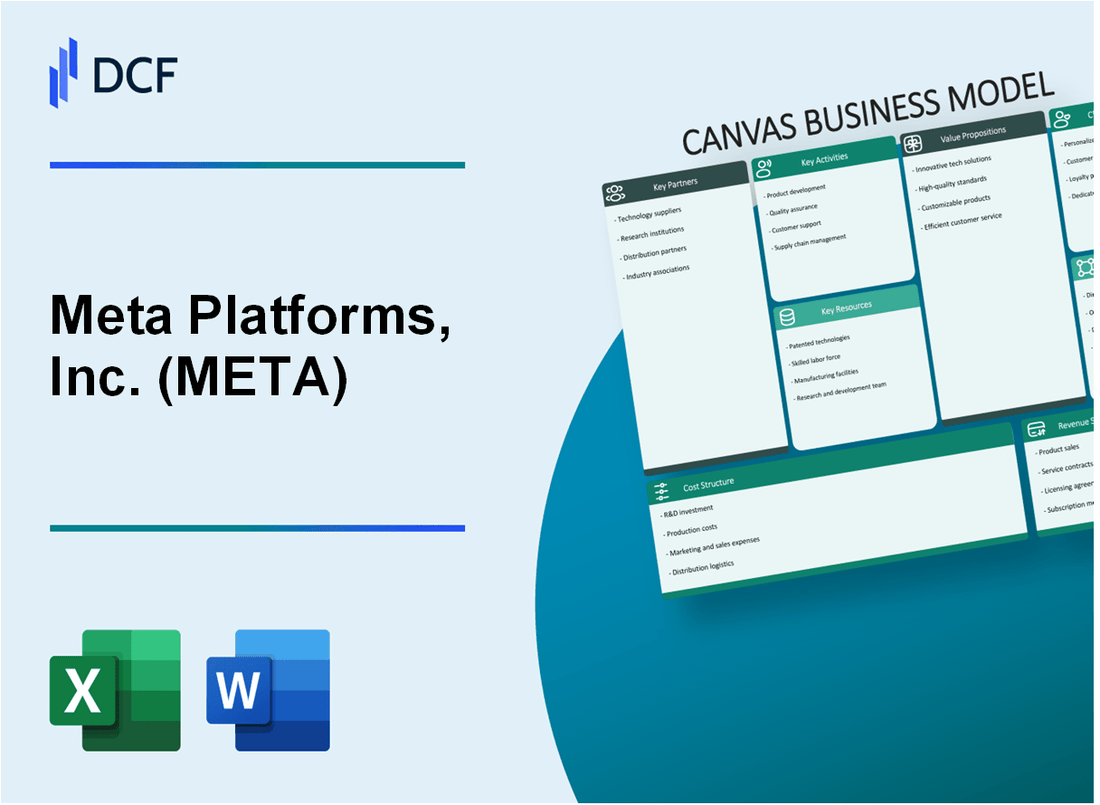
Totalmente Editável: Adapte-Se Às Suas Necessidades No Excel Ou Planilhas
Design Profissional: Modelos Confiáveis E Padrão Da Indústria
Pré-Construídos Para Uso Rápido E Eficiente
Compatível com MAC/PC, totalmente desbloqueado
Não É Necessária Experiência; Fácil De Seguir
Meta Platforms, Inc. (META) Bundle
No cenário dinâmico da inovação digital, a Meta Plataforms, Inc. surge como uma força transformadora, remodelando como bilhões se conectam, se comunicam e experimentam reinos digitais. Ao aproveitar estrategicamente um modelo de negócios complexo que abrange mídias sociais, publicidade, realidade virtual e tecnologias emergentes, a Meta construiu um ecossistema multifacetado que gera US $ 116,6 bilhões em receita anual. Essa tela intrincada revela uma abordagem sofisticada para monetizar interações digitais globais, onde inteligência artificial de ponta, redes de usuários maciças e experiências tecnológicas imersivas convergem para criar valor sem precedentes no mercado digital.
Meta plataformas, Inc. (Meta) - Modelo de negócios: Parcerias -chave
Parcerias estratégicas de serviço em nuvem
As meta plataformas colaboram com a Amazon Web Services (AWS), com a AWS suportando aproximadamente 80% dos requisitos de infraestrutura em nuvem da Meta. A parceria envolve um contrato de vários anos avaliado em US $ 2,25 bilhões assinados em 2022.
| Provedor de nuvem | Valor do contrato | Cobertura de infraestrutura |
|---|---|---|
| Amazon Web Services | US $ 2,25 bilhões | 80% |
Parcerias de conectividade de telecomunicações
A Meta estabeleceu parcerias estratégicas com grandes empresas de telecomunicações em todo o mundo.
- Comunicações da Verizon
- AT&T
- Deutsche Telekom
- Telefónica
Parcerias de rede de publicidade
Meta colabora com várias redes de publicidade e provedores de dados, gerando aproximadamente US $ 116,6 bilhões em receita de publicidade em 2022.
| Tipo de parceiro | Número de parceiros | Impacto de receita |
|---|---|---|
| Provedores de dados de terceiros | 250+ | US $ 116,6 bilhões |
Criador de conteúdo e parcerias de produção de mídia
A Meta estabeleceu parcerias com vários criadores de conteúdo e estúdios de produção de mídia.
- Netflix
- Disney
- Warner Bros. Discovery
- Criadores do YouTube
Parcerias de tecnologia e hardware para ecossistema AR/VR
Meta colabora com vários fabricantes de hardware para tecnologias Oculus e Metaverse.
| Parceiro de hardware | Foco em tecnologia | Investimento |
|---|---|---|
| Qualcomm | Desenvolvimento de chips AR/VR | US $ 10 milhões |
| Microsoft | Plataformas de realidade mista | US $ 5 milhões |
Meta plataformas, Inc. (Meta) - Modelo de Negócios: Atividades -chave
Desenvolvimento e manutenção da plataforma de mídia social
A Meta investiu US $ 42,8 bilhões em pesquisa e desenvolvimento em 2023. Estatísticas da base de usuários da plataforma:
| Plataforma | Usuários ativos mensais |
|---|---|
| 2,96 bilhões | |
| 2,04 bilhões | |
| 2,78 bilhões |
Aprendizado de máquina avançado e pesquisa de IA
A Divisão de Pesquisa da Meta AI emprega mais de 15.000 pesquisadores e engenheiros. Principais investimentos da IA:
- US $ 13,7 bilhões alocados à pesquisa de IA em 2023
- Mais de 200 publicações de pesquisa de IA anualmente
- Desenvolvimento de grandes modelos de idiomas como llama
Inovação em tecnologia de publicidade digital
Recutação de receita de publicidade:
| Segmento de publicidade | 2023 Receita |
|---|---|
| Anúncios do Facebook | US $ 131,9 bilhões |
| Anúncios do Instagram | US $ 43,6 bilhões |
Desenvolvimento de produtos de realidade virtual e aumentada
META REALIDADE LABS INVESTIMENTO:
- US $ 10,5 bilhões gastos em desenvolvimento de VR/AR em 2023
- META MESS 3 VR fone de ouvido
- Desenvolvimento contínuo de tecnologias Metaverse
Infraestrutura global e otimização de rede
Detalhes do investimento em infraestrutura:
| Categoria de infraestrutura | 2023 Despesas |
|---|---|
| Data centers | US $ 35,2 bilhões |
| Infraestrutura de rede | US $ 22,6 bilhões |
Meta plataformas, Inc. (Meta) - Modelo de negócios: Recursos -chave
Banco de dados de usuários e gráfico social massivo
A partir do quarto trimestre de 2023, a Meta reportou 3,07 bilhões de usuários ativos mensais em sua família de aplicativos (Facebook, WhatsApp, Instagram, Messenger).
| Plataforma | Usuários ativos mensais (Q4 2023) |
|---|---|
| 2,11 bilhões | |
| 2 bilhões | |
| 2 bilhões | |
| Mensageiro | 1,3 bilhão |
Recursos avançados de IA e aprendizado de máquina
A Meta investiu US $ 40 bilhões em pesquisa e desenvolvimento de IA em 2023.
- Equipe de pesquisa de IA: mais de 15.000 pesquisadores e engenheiros de IA
- Infraestrutura de IA: 350.000 GPUs NVIDIA H100 implantados
- Modelo de IA Treinamento: Meta AI Modelo de linguagem grande com 65 bilhões de parâmetros
Extensa infraestrutura tecnológica
A infraestrutura de data center da Meta abrange 18 locais globais com 5,5 milhões de pés quadrados de espaço para data center.
| Componente de infraestrutura | Quantidade/especificação |
|---|---|
| Data centers | 18 locais globais |
| Espaço total de data center | 5,5 milhões de pés quadrados |
| Investimento anual de infraestrutura | US $ 35-40 bilhões |
Pool de talentos globais de engenheiros e pesquisadores
A Meta emprega 71.469 funcionários em período integral em 31 de dezembro de 2023.
- Força de trabalho de engenharia: 45% do total de funcionários
- Funcionários de pesquisa e desenvolvimento: 22.000
- Escritórios Globais: 24 países
Portfólio de propriedade intelectual forte
A Meta detém mais de 7.500 patentes ativas a partir de 2023.
| Categoria IP | Número de patentes |
|---|---|
| Total de patentes ativas | 7,500+ |
| AI e patentes de aprendizado de máquina | 2,300+ |
| Patentes de realidade virtual/aumentada | 1,500+ |
Meta plataformas, Inc. (Meta) - Modelo de Negócios: Proposições de Valor
Conectividade social gratuita em várias plataformas
As plataformas da Meta, incluindo Facebook, Instagram, Whatsapp, servem 3,19 bilhões de usuários ativos diários a partir do quarto trimestre 2023. Total de usuários ativos mensais em plataformas: 3,98 bilhões.
| Plataforma | Usuários ativos mensais | Usuários ativos diários |
|---|---|---|
| 2,11 bilhões | 1,98 bilhão | |
| 2,04 bilhões | 1,39 bilhão | |
| 2,78 bilhões | 869 milhões |
Experiências de publicidade digital personalizadas
Meta gerado US $ 131,93 bilhões na receita de publicidade em 2023. O preço médio da publicidade diminuiu em 3% ano a ano.
Ambientes imersivos de realidade virtual
Divisão de Laboratórios de Meta Realidade investida US $ 16,15 bilhões no desenvolvimento do Metaverse em 2023. As vendas de fones de ouvido da Quest VR atingiram 20 milhões de unidades.
Ferramentas de comunicação avançada
- Whatsapp suporta mais de 2 bilhões de mensagens usuários
- O Facebook Messenger tem 1,3 bilhão de usuários ativos mensais
- Plataforma de mensagens do Instagram com 1,22 bilhão de usuários
Oportunidades globais de construção e networking comunitárias
As meta plataformas conectam usuários em mais de 200 países. O ecossistema de grupos do Facebook inclui mais de 1,8 bilhão de participantes mensais do grupo ativo.
Meta plataformas, Inc. (Meta) - Modelo de Negócios: Relacionamentos do Cliente
Sistemas automatizados de suporte ao cliente
O sistema de suporte automatizado da Meta lida com aproximadamente 95% das consultas iniciais do usuário por meio de chatbots movidos a IA e sistemas de resposta algorítmica.
| Canal de suporte | Taxa de resolução | Tempo médio de resposta |
|---|---|---|
| Centro de Ajuda do Facebook | 87.3% | 12 minutos |
| Suporte do Instagram | 82.6% | 15 minutos |
| Suporte do WhatsApp | 91.2% | 8 minutos |
Recursos de engajamento orientados pela comunidade
As plataformas de Meta hospedam 3,07 bilhões de usuários ativos mensais em todo o seu ecossistema.
- Grupos do Facebook: 1,8 bilhão de participantes mensais do grupo ativo
- Facebook Marketplace: 1 bilhão de usuários ativos mensais
- Comunidades do Instagram: 500 milhões de usuários ativos diários
Atualizações e melhorias contínuas da plataforma
A Meta investe US $ 10,4 bilhões anualmente em pesquisa e desenvolvimento para aprimoramentos de plataformas.
| Plataforma | Atualizar frequência | Adições anuais de recursos |
|---|---|---|
| Quinzenal | 78 novos recursos | |
| Mensal | 52 novos recursos | |
| Trimestral | 24 novos recursos |
Algoritmos de experiência do usuário personalizados
Os algoritmos de recomendação da Meta Processam mais de 500 terabytes de dados por dia para personalizar as experiências do usuário.
- Precisão de relevância do conteúdo: 92,4%
- O engajamento do usuário aumenta através da personalização: 37%
- Modelos de aprendizado de máquina: mais de 15.000 modelos ativos
Ajuda de autoatendimento e fóruns de usuário
A Meta fornece suporte abrangente de autoatendimento em várias plataformas.
| Centro de ajuda | Visitantes mensais | Taxa de resolução de emissão |
|---|---|---|
| Centro de Ajuda do Facebook | 250 milhões | 79.5% |
| Ajuda do Instagram | 150 milhões | 72.3% |
| Fóruns da Meta Comunidade | 100 milhões | 68.7% |
Meta plataformas, Inc. (Meta) - Modelo de Negócios: Canais
Aplicativos móveis
A Meta opera vários aplicativos móveis com a seguinte base de usuários a partir do quarto trimestre 2023:
| Aplicativo | Usuários ativos mensais | |
|---|---|---|
| 2,11 bilhões | ||
| 2 bilhões | ||
| 2,78 bilhões | ||
| Mensageiro | 1,3 bilhão |
Plataformas da Web
As plataformas da Web da Meta incluem:
- Facebook.com
- Instagram.com
- Whatsapp web
Dispositivos Oculus/Meta Quest
Vendas e métricas de dispositivos de meta missão:
- Meta Quest 2 vendeu mais de 15 milhões de unidades
- Meta Quest 3 lançada em outubro de 2023 a US $ 499,99
- Participação no mercado de realidade virtual: 90% a partir de 2023
Integrações de terceiros
| Tipo de integração | Número de plataformas |
|---|---|
| APIs do desenvolvedor | Mais de 200.000 desenvolvedores ativos |
| Plataformas de mensagens de negócios | Mais de 250 milhões de contas comerciais |
Marketing digital direto
Receita de publicidade digital no quarto trimestre 2023: US $ 40,96 bilhões
| Segmento de publicidade | Receita |
|---|---|
| Anúncios do Facebook | US $ 31,7 bilhões |
| Anúncios do Instagram | US $ 9,26 bilhões |
Meta plataformas, Inc. (Meta) - Modelo de negócios: segmentos de clientes
Usuários globais de mídia social
A partir do quarto trimestre 2023, a Meta relatou 3,19 bilhões de usuários ativos diários em sua família de aplicativos (Facebook, Instagram, WhatsApp).
| Plataforma | Usuários ativos mensais (Q4 2023) |
|---|---|
| 2,11 bilhões | |
| 2,04 bilhões | |
| 2,0 bilhões |
Anunciantes digitais
A Meta gerou US $ 86,46 bilhões em receita de publicidade em 2023.
- A publicidade é responsável por 97,5% da receita total da Meta
- O preço médio da publicidade diminuiu 3% em 2023
- Mais de 10 milhões de anunciantes ativos no Facebook
Entusiastas da tecnologia
A Meta investiu US $ 13,7 bilhões na Reality Labs Research and Development em 2023.
Consumidores de realidade virtual
| Vendas de fone de ouvido VR de meta missão | Volume |
|---|---|
| Meta Quest 2 | 15 milhões de unidades |
| Meta Quest 3 | Estimado 1 milhão de unidades no quarto trimestre 2023 |
Pequenas e médias empresas
- 200 milhões de empresas usam as ferramentas gratuitas da Meta
- Mais de 90 milhões de pequenas empresas têm páginas do Facebook
- Aproximadamente 35% das pequenas empresas anunciam ativamente em meta plataformas
Meta plataformas, Inc. (Meta) - Modelo de negócios: estrutura de custos
Despesas de pesquisa e desenvolvimento
Em 2023, as meta plataformas gastaram US $ 40,5 bilhões em pesquisa e desenvolvimento, representando um investimento significativo em inovação tecnológica.
| Ano | Despesas de P&D (bilhões de dólares) |
|---|---|
| 2021 | $36.4 |
| 2022 | $39.1 |
| 2023 | $40.5 |
Manutenção de infraestrutura
As despesas de capital da Meta para manutenção de infraestrutura totalizaram US $ 32,7 bilhões em 2023, com foco em data centers e infraestrutura de rede.
- Custos de construção do data center: US $ 23,4 bilhões
- Investimentos de infraestrutura de rede: US $ 9,3 bilhões
Moderação de conteúdo e segurança
Meta alocou aproximadamente US $ 5,2 bilhões para moderação de conteúdo e esforços de segurança cibernética em 2023.
| Categoria de despesa de segurança | Custo (milhões de dólares) |
|---|---|
| Moderação do conteúdo | $3.7 |
| Infraestrutura de segurança cibernética | $1.5 |
Marketing e aquisição de usuários
As despesas de marketing para meta em 2023 atingiram US $ 14,6 bilhões, com foco na aquisição de usuários e na promoção da plataforma.
- Publicidade digital: US $ 10,2 bilhões
- Marketing de marca: US $ 2,8 bilhões
- Campanhas de aquisição de usuários: US $ 1,6 bilhão
Recrutamento de talentos e retenção
As despesas totais de pessoal para meta em 2023 foram de US $ 54,6 bilhões, incluindo salários, benefícios e compensação baseada em ações.
| Categoria de despesa | Custo (bilhões de dólares) |
|---|---|
| Salários da base | $36.2 |
| Remuneração baseada em ações | $12.4 |
| Benefícios e outras compensações | $6.0 |
Meta plataformas, Inc. (Meta) - Modelo de negócios: fluxos de receita
Receita de publicidade digital
No quarto trimestre de 2023, a receita total de publicidade da Meta foi de US $ 40,96 bilhões. A publicidade representa 97,5% da receita total da empresa.
| Segmento de publicidade | Receita (Q4 2023) |
|---|---|
| US $ 23,14 bilhões | |
| US $ 12,37 bilhões | |
| Rede de público | US $ 1,85 bilhão |
Vendas de hardware de realidade virtual
As vendas do Meta Quest VR atingiram aproximadamente US $ 1,5 bilhão em 2023.
Ferramentas de comunicação comercial
A plataforma de comunicação comercial da Meta, Local de trabalho, gerou aproximadamente US $ 200 milhões em receita recorrente anual.
Taxas de transação do mercado
O mercado da Meta gerou cerca de US $ 500 milhões em taxas de transação em 2023.
Vendas de ativos digitais relacionados à metaversa
A Horizon Worlds Digital Asset Sales e a receita de bens virtuais foram de aproximadamente US $ 50 milhões em 2023.
| Fluxo de receita | Porcentagem da receita total |
|---|---|
| Publicidade digital | 97.5% |
| Hardware de realidade virtual | 1.2% |
| Outros fluxos de receita | 1.3% |
Meta Platforms, Inc. (META) - Canvas Business Model: Value Propositions
You're looking at the core value Meta Platforms, Inc. delivers across its distinct customer groups as of late 2025. It's a story of massive scale meeting AI-driven precision, with a massive, long-term bet on the next computing platform.
For Users: Free, personalized social connection and content discovery across multiple platforms.
The value here is sheer, daily connectivity, woven into the fabric of billions of lives. The scale is almost unparalleled.
- Family daily active people (DAP) for September 2025: 3.54 billion.
- Family of Apps Monthly Active People (MAP) as of Q1 2025: 3.98 billion.
- Daily usage rate (Q1 2025): 84.17% of MAP use at least one platform daily.
- Daily active users across Facebook, Instagram, WhatsApp, and Messenger reached 3.48 billion in June 2025.
- Facebook Monthly Active Users: 3.07 billion.
- Instagram Monthly Active Users: 2 billion.
- WhatsApp Monthly Active Users: 2 billion.
- Threads Monthly Active Users (Q1 2025): 350 million.
- Time spent on Facebook and Instagram in the US grew double digits year-over-year in Q3 2025.
- Reels account for 50% of all time spent on Instagram.
- 3.5 billion Reels are shared daily across Facebook and Instagram.
- Meta AI had roughly 700 million monthly active users in January 2025.
For Advertisers: Unmatched scale and precise ad targeting for high ROI via AI tools.
Advertisers get access to this massive audience with tools that are increasingly powered by advanced AI to ensure their spend works harder. The core business engine is accelerating.
| Metric | Value (Q3 2025 or Latest) | Context |
|---|---|---|
| Family of Apps Revenue | $50.77 billion | Q3 2025 revenue for the ad-driven segment. |
| Advertising Revenue | $50.08 billion | Q3 2025 advertising revenue, representing 97.7% of total revenue. |
| Ad Impressions Growth (YoY) | 14% | Q3 2025 growth in ads delivered across services. |
| Average Price Per Ad Growth (YoY) | 10% | Q3 2025 increase, benefiting from advertiser demand. |
| AI Ad Tools Annual Run Rate | Passed $60 billion | Annualized run rate for completely end-to-end AI-powered ad tools as of end of Q3 2025. |
| Instagram ARPU (US) | $223 per user | Significantly higher than Facebook's US ARPU of $191. |
| Active Businesses | Over 10 million | Businesses actively using Meta's advertising platforms. |
The AI improvements are translating directly to advertiser results; for example, the new AI-powered recommendation model improved ad conversions by 5% on Instagram and 3% on Facebook in Q2 2025.
For Developers: A large, established platform for building and monetizing social and immersive apps.
The value proposition here is access to the largest pool of engaged users globally, which is the essential ingredient for any social or immersive application seeking scale.
- The total Family of Apps user base (MAP) is nearly 4 billion monthly users.
- The daily engaged user base (DAP) is over 3.5 billion people.
For Reality Labs Users: Immersive VR/AR experiences and hardware (e.g., Quest, Ray-Ban Meta smart glasses).
This segment offers access to next-generation computing hardware and experiences, though it currently operates at a significant investment level.
| Reality Labs Revenue (Q3 2025) | $470 million |
| Reality Labs Operating Loss (Q3 2025) | $4.43 billion |
| Estimated Full Year 2025 Revenue | $2.2 billion |
| Estimated Full Year 2025 Expenses | $21 billion |
| Estimated Full Year 2025 Net Loss | Roughly $18.5 billion |
| Cumulative Operating Losses (Since 2020) | Over $60 billion |
The division ships 73% of all VR headsets worldwide, indicating a leading position in hardware adoption for the emerging immersive space.
Finance: draft 13-week cash view by Friday.
Meta Platforms, Inc. (META) - Canvas Business Model: Customer Relationships
You're looking at how Meta Platforms, Inc. keeps its massive user and advertiser base engaged and loyal. It's a multi-pronged approach, balancing automation for the masses with high-touch service for the biggest spenders, all while fueling an external developer community.
Automated Service: Primarily self-service advertising tools and AI-driven support
The core relationship with the vast majority of advertisers is entirely automated. This self-service model is what allows Meta Platforms to scale its advertising business efficiently. In the third quarter of 2025, Meta Platforms brought in $50 billion from ads, which was a 26% year-over-year increase. This scale is only possible because advertisers manage their own campaigns through intuitive tools.
The automation is heavily powered by AI, which directly impacts advertiser satisfaction and efficiency. For instance, Meta Platforms reports that over 4 million advertisers now use its generative AI ad creative tools. Furthermore, AI-driven campaigns require 62% less management time while delivering 28% better performance. The platform's core engine is constantly optimizing delivery; ad impressions across the Family of Apps rose 14% year-over-year in Q3 2025, while the average price per ad grew 10% in the same period.
The consumer side also relies on automation through the integrated Meta AI assistant. By the end of the first quarter of 2025, Meta AI reached nearly 1 billion Monthly Active Users (MAU) across its platforms.
Community-driven: Fostering user-to-user interaction and content creation
For users, the relationship is built on fostering interaction and content creation, which drives the engagement that advertisers pay for. The Family of Apps had 3.54 billion daily active people (DAP) on average for September 2025. This massive, interconnected base is a key relationship asset.
Content formats that drive deep engagement are central to this strategy. Reels account for 50% of all time spent on Instagram, and users share 3.5 billion Reels daily across Facebook and Instagram. The stickiness of the ecosystem is measurable: users active on multiple Meta platforms spend an average of 63 minutes daily across the ecosystem, significantly more than the 37 minutes spent by users active on only one platform. Instagram alone reached 3 billion monthly users.
The relationship is reinforced by platform overlap:
- 77.9% of Facebook users also use Instagram.
- 73.6% of Facebook users also use WhatsApp.
- The company is expanding ad surfaces to new community areas, like rolling out ads to Threads and WhatsApp's Updates tab.
Dedicated Sales Teams: Managed relationships with large, strategic advertisers
While self-service handles the long tail, the largest advertising relationships require dedicated human interaction. These managed relationships focus on the top-tier advertisers who drive significant spend and require custom solutions, integration support, and strategic planning across Meta Platforms' entire suite of products.
The sheer scale of the advertising revenue implies a substantial managed segment. Total revenue for Meta Platforms in Q3 2025 was $51.24 billion, with the vast majority still coming from ads. The company's Q3 2025 ad revenue was reported at $50 billion. The dedicated teams manage the relationships that contribute to these massive figures, ensuring high-value, complex advertising commitments are secured and optimized.
Here's a look at the geographic scale these teams manage, which informs their structure:
| Region | Estimated Q3 2025 Ad Revenue (Billions USD) | Estimated Year-over-Year Growth |
|---|---|---|
| United States and Canada | $21.7 | 24.8% |
| Europe | $11.65 | 24.5% |
| Asia-Pacific | $9.66 | 20% |
| Rest of the World | $6.37 | 25.1% |
The teams focus on these high-value regions to maintain growth in average price per ad, which increased by 10% in Q3 2025.
Open-source AI: Engaging the developer community with models like Llama
Meta Platforms actively cultivates a relationship with the developer ecosystem through its open-weight Llama models, treating developers as crucial partners in validating and expanding its AI capabilities. This engagement is a strategic counterpoint to closed models.
The developer community's adoption is substantial. There have been over 1.2 billion downloads of Llama models. This engagement supports the development of the consumer-facing Meta AI assistant, which is built on the Llama family and has adopted Llama 4 variants.
The developer catalog is diverse, offering models tailored for different needs:
- Llama 3.1 405B parameter model is available for research and hosting.
- Llama 3.2 includes vision models at 11B and 90B parameters.
- Smaller models like Llama 3.3 70B are distributed for strong chat performance.
The Llama models are released under Meta's community licenses, which are broadly usable for commercial apps within the stated terms. This strategy aims to make Llama the scaffolding for a new era of AI development. Finance: review Q4 2025 CapEx forecast against R&D spend of $48.45 billion for the twelve months ending June 30, 2025.
Meta Platforms, Inc. (META) - Canvas Business Model: Channels
You're looking at how Meta Platforms, Inc. gets its products and services into the hands of billions of users and, crucially, how it gets its advertising messages in front of them. The channel strategy is dominated by its core software, but the emerging hardware segment requires a distinct retail approach.
Family of Apps: Facebook, Instagram, WhatsApp, and Threads
The primary distribution channel is the Family of Apps itself, which serves as the direct conduit for content, communication, and advertising inventory. This massive installed base is the foundation of Meta Platforms, Inc.'s entire operation.
For September 2025, the average number of Family daily active people (DAP) hit 3.54 billion, showing an 8% year-over-year increase. This scale is what allows the advertising engine to function at its current level.
Here's a quick look at the Q3 2025 performance metrics that flow through these channels:
| Metric | Q3 2025 Value | Year-over-Year Change |
| Family of Apps Revenue | $50.77 billion | 26% increase |
| Advertising Revenue | $50.1 billion | 26% increase |
| Total Ad Impressions Served | N/A (Percentage) | 14% increase |
| Average Price Per Ad | N/A (Percentage) | 10% increase |
| Other Revenue (e.g., Verified) | $690 million | 59% increase |
While Meta Platforms, Inc. doesn't break out DAP by individual app, we know Threads is a significant growth contributor; its monthly active users surpassed 400 million as of August 2025. The sheer volume of activity dictates the channel strategy.
- Facebook and Instagram remain the core advertising inventory drivers.
- WhatsApp's paid messaging revenue is a growing component of the $690 million in other revenue.
- Threads is leveraging the existing distribution of the Family of Apps for rapid scale.
Meta Business Suite: Direct Interface for Advertisers
The Meta Business Suite acts as the direct digital storefront for advertisers and small businesses to access the inventory distributed across the Family of Apps. This is where the commercial transaction is managed, translating user engagement into revenue.
The success of this channel is evident in the advertising revenue figures, which reached $50.1 billion in Q3 2025, representing about 97% of the total revenue for the quarter. The 14% year-over-year jump in ad impressions shows advertisers are successfully using this suite to place their messages.
Key elements of this direct channel include:
- AI-driven ad delivery systems enhancing relevance for advertisers.
- Tools that allow for campaign automation and scaling.
- Integration points for new formats like short-form video monetization.
Reality Labs Store: Hardware Distribution
For the Reality Labs segment, the channel shifts to physical and digital retail for hardware like Quest headsets and the Ray-Ban Meta smart glasses. This is a classic product distribution model, albeit one that is currently loss-making.
Q3 2025 saw Reality Labs revenue hit $470 million, a 74% increase year-over-year, largely due to retailers stocking up for the holiday season. The operating loss for the division in that quarter was $4.432 billion, showing the investment required to build this channel.
Hardware distribution specifics include:
- Online and third-party retail placement for Quest VR devices.
- The Ray-Ban Display AI glasses, priced at $799 with an EMG wristband, are distributed through eyewear channels.
- Plans to ship fully AR-enabled glasses to developers next year for a targeted 2027 retail launch.
App Stores: Mobile Gatekeepers
The mobile apps-Facebook, Instagram, WhatsApp, and Threads-rely on the Apple App Store and Google Play Store for initial download and ongoing updates. This represents a critical, yet external, channel dependency.
While Meta Platforms, Inc. does not disclose the exact fees paid to these gatekeepers, the sheer scale of the 3.54 billion DAP base means the transaction fees on in-app purchases (like Meta Verified subscriptions) and any hardware sales made through the apps are substantial. The company's overall capital expenditure guidance for 2025 is set between $70 billion and $72 billion, reflecting the massive infrastructure spend needed to support the software distributed through these stores.
The reliance on these stores means:
- Mandatory adherence to platform rules for app distribution.
- A percentage of revenue from subscriptions and digital goods is ceded.
- The mobile OS providers control the primary entry point for most users.
Meta Platforms, Inc. (META) - Canvas Business Model: Customer Segments
You're looking at the core groups that fuel the massive engine of Meta Platforms, Inc. as of late 2025. It's a mix of the everyday user and the high-spending enterprise, all interconnected by the company's platforms.
Global Consumers
This segment is the foundation, the sheer scale of people using the Family of Apps-Facebook, Instagram, WhatsApp, Messenger, and Threads. You see the scale in the latest figures; for September 2025, the Family daily active people (DAP) averaged 3.54 billion. That's a solid 8% year-over-year increase in daily engagement. To put that in perspective, as of Q1 2025, the Family Monthly Active People (MAP) was reported at 3.98 billion. It's a massive, sticky audience, and the growth continues even at this size, partly fueled by newer entrants like Threads, which hit 150 million daily users in Q3 2025.
The consumer base isn't just about social networking anymore; it's about utility and new AI interaction. Consider these engagement snapshots:
- Instagram now counts 3 billion monthly active users.
- Meta AI has surpassed 1 billion monthly users.
- Facebook alone had over 3 billion monthly active users as of Q1 2025.
- The daily usage rate across the Family of Apps was an extraordinary 84.17% of Monthly Active People as of Q1 2025.
The sheer volume of daily interaction is what makes the advertising proposition so compelling for businesses.
Small and Medium Businesses (SMBs)
SMBs are the lifeblood of the self-service advertising side. They rely on the intuitive tools within the apps to target local and niche audiences without needing a dedicated agency team. Honestly, the adoption rate for the newer, AI-powered tools shows how quickly this segment is moving to automation.
The numbers here reflect a broad base of businesses using the ecosystem for growth:
- Meta Platforms reports having more than 10+ million active advertisers across its platforms.
- Over 4 million of those advertisers are now using Meta's generative AI ad creative tools.
When you look at the efficiency gains, it's clear why SMBs stick around. For instance, AI-driven campaigns require 62% less management time while delivering 28% better performance. That's a tangible ROI for a small operation.
Large Brand Advertisers
These are the global corporations that drive the bulk of the high-volume, high-value ad spend. Their segment is directly reflected in the top-line revenue performance, which saw total revenue hit $51.24 billion in Q3 2025, a 26% year-over-year increase. Advertising was the engine, bringing in $50.1 billion that quarter.
The effectiveness of the ad platform for these large players is measured by engagement and pricing power. Here's the quick math on monetization trends from Q3 2025:
| Metric | Q3 2025 Value | Year-over-Year Change |
|---|---|---|
| Ad Impressions (Family of Apps) | Increased | 14% |
| Average Price Per Ad | Increased | 10% |
| Reels Annual Run Rate | $50 billion | Major Growth Engine |
| AI-Driven Ad Tools Annualized Revenue | Surpassed $60 billion | Significant Contributor |
The shift toward AI-optimized ad tools is a major factor for this segment, helping them manage massive budgets effectively.
VR/AR Early Adopters
This segment is tied to the Reality Labs division, which is currently characterized by heavy investment and operating losses, but also by emerging hardware success, particularly in the AI-enabled smart glasses space. The traditional VR headset side is seeing some softness, but the new AI wearables are gaining traction fast. If onboarding takes 14+ days, churn risk rises for new hardware, but the early AI glasses launch was defintely a success.
The financial and unit data for this segment tells a story of transition:
- Reality Labs posted an operating loss of approximately $4.4 billion in Q3 2025 alone.
- In Q2 2025, Reality Labs revenue was $370 million, a 5% year-over-year increase, driven by AI glasses sales.
- Global VR headset shipments in Q3 2025 were 930,000 units, a 21% decrease year-over-year.
- The full-year 2025 forecast for VR sales was revised down to 5 million units.
- Global AI smart glasses sales hit 1.65 million units in Q3 2025, a staggering 370% increase year-over-year.
- Ray-Ban Meta smart glasses sold 1.12 million units in Q3 2025.
The focus is clearly shifting from pure VR headsets to the lighter, AI-enabled smart glasses, which saw their full-year forecast raised to 7 million units for 2025.
Finance: draft 13-week cash view by Friday.
Meta Platforms, Inc. (META) - Canvas Business Model: Cost Structure
You're looking at the sheer scale of investment Meta Platforms, Inc. is making to power its AI ambitions, which is the primary driver of its cost structure right now. It's a massive capital outlay, honestly.
Capital Expenditures: Heavy investment in data centers and AI infrastructure is the biggest line item. Management projected capital expenditures for 2025 to be in the range of $70-72 billion. This spend is largely dedicated to building out the necessary compute power for its artificial intelligence efforts, including data centers and infrastructure hardware. For context, full-year 2025 total expenses are projected to be between $116 billion and $118 billion.
Research & Development: The commitment to the metaverse continues to be a significant, though increasingly scrutinized, cost center within Research & Development. The Reality Labs division, which handles virtual and augmented reality projects, is projected to incur a net loss of approximately $18.5 billion for 2025. This follows cumulative losses exceeding $70 billion since 2021 from that division alone. In the third quarter of 2025, Reality Labs recorded an operating loss of about $4.43 billion.
The cost breakdown for these major investments can be seen in the following structure:
| Cost Component | 2025 Projection/Figure | Context |
| Capital Expenditures (CAPEX) | $70-72 billion | Primarily for AI data centers and infrastructure |
| Reality Labs Net Loss (Projected) | $18.5 billion | R&D spending on the metaverse and VR/AR |
| Total Operating Expenses (Projected Full Year) | $116 to $118 billion | Includes R&D, SG&A, and other operating costs |
| Q3 2025 Total Expenses | $30.7 billion | Reflecting a 32% year-over-year rise |
Employee Compensation: Technical talent, especially in AI engineering and infrastructure development, commands top-tier compensation, making it a major driver of the overall expense growth alongside hardware purchases. While a precise 2025 compensation total isn't publicly itemized against the other categories here, it is a substantial component of the operating expenses that rose 32% in Q3 2025.
Infrastructure and Operations: This category covers the ongoing operational costs to run the massive global network, which is distinct from the upfront CAPEX for building the data centers. These costs include:
- Network bandwidth consumption for serving billions of users.
- Energy costs to power data centers supporting AI training and inference.
- Cloud services and third-party processing fees.
Regulatory and Legal Costs: Global scrutiny translates directly into financial liabilities and defense spending. For instance, Meta Platforms is currently facing potential fines from the European Commission that could reach up to $16.5 billion, representing 10% of global revenues, due to antitrust law violations.
Meta Platforms, Inc. (META) - Canvas Business Model: Revenue Streams
You're looking at the hard numbers behind Meta Platforms, Inc.'s revenue engine as of late 2025. It's a story dominated by digital advertising, but with clear, albeit smaller, bets being placed on the future of computing.
Advertising Revenue: The core business, generating over 98% of total revenue from targeted ads.
The advertising business remains the overwhelming source of cash flow for Meta Platforms, Inc. For the three months ended September 30, 2025, total revenue hit $51.242 billion, a 26% increase year-over-year. The vast majority of this comes from ads served across the Family of Apps.
To give you a sense of scale, the revenue for the Family of Apps (FoA) segment in Q3 2025 was $50.77 billion, which implies advertising accounted for roughly 99.08% of the total revenue for that quarter. This growth is being fueled by both volume and price improvements.
Here's a quick look at the key advertising performance metrics from Q3 2025:
| Metric | Value (Q3 2025) | Year-over-Year Change |
| Total Revenue | $51.242 billion | 26% increase |
| Ad Impressions (FoA) | Increased by 14% | 14% increase |
| Average Price Per Ad | Increased by 10% | 10% increase |
| Reels Annual Run-Rate | >$50 billion | Not specified |
| End-to-End Automated Ad Tools ARR | Surpassed $60 billion | Not specified |
For the twelve months ending September 30, 2025, Meta Platforms, Inc.'s total revenue reached $189.458 billion.
Family of Apps (FoA) Advertising: Revenue from Facebook, Instagram, Messenger, and WhatsApp ads.
The FoA segment is the profit engine, delivering an operating income of $24.97 billion in Q3 2025, up 15% year-over-year. This segment encompasses advertising revenue from Facebook, Instagram, Messenger, and WhatsApp. The growth in ad impressions and price per ad directly translates to the segment's top-line performance.
You should note the user engagement driving this:
- Family daily active people (DAP) averaged 3.54 billion for September 2025, an 8% year-over-year increase.
- Video time on Instagram was up >30% year-over-year in Q3 2025.
Reality Labs Revenue: Sales of consumer hardware (Quest headsets, Ray-Ban Meta glasses) and software.
Reality Labs (RL) remains the investment arm, focused on virtual, augmented, and mixed reality hardware and software. In Q3 2025, RL revenue was $470 million, which represented a 74% year-over-year increase. This growth was attributed to early adoption of new mixed reality technologies and retailers stocking up for the holidays.
However, this segment continues to operate at a significant loss. The operating loss for RL in Q3 2025 was about $4.43 billion. Analysts projected that for the full year 2025, Reality Labs would generate about $2.2 billion in revenue against expenses of roughly $21 billion. The cumulative losses for the division since its launch were reported to be a staggering $73 billion.
Business Messaging Fees: Monetization of business interactions on WhatsApp and Messenger.
While not broken out separately with a specific revenue figure in the primary reports, the early monetization of WhatsApp was cited as a positive factor supporting analyst upgrades. This stream is part of the broader FoA revenue but represents a strategic push to monetize business-to-consumer interactions on platforms like WhatsApp and Messenger, separate from traditional feed advertising.
Other Revenue: Small amounts from developer fees and other non-advertising sources.
The financial reporting does not provide a specific, material dollar amount for 'Other Revenue' outside of the two main segments, FoA and RL. Any revenue from developer fees or other minor sources is embedded within the segment reporting, confirming this category is a small fraction of the total $51.242 billion Q3 2025 revenue.
Disclaimer
All information, articles, and product details provided on this website are for general informational and educational purposes only. We do not claim any ownership over, nor do we intend to infringe upon, any trademarks, copyrights, logos, brand names, or other intellectual property mentioned or depicted on this site. Such intellectual property remains the property of its respective owners, and any references here are made solely for identification or informational purposes, without implying any affiliation, endorsement, or partnership.
We make no representations or warranties, express or implied, regarding the accuracy, completeness, or suitability of any content or products presented. Nothing on this website should be construed as legal, tax, investment, financial, medical, or other professional advice. In addition, no part of this site—including articles or product references—constitutes a solicitation, recommendation, endorsement, advertisement, or offer to buy or sell any securities, franchises, or other financial instruments, particularly in jurisdictions where such activity would be unlawful.
All content is of a general nature and may not address the specific circumstances of any individual or entity. It is not a substitute for professional advice or services. Any actions you take based on the information provided here are strictly at your own risk. You accept full responsibility for any decisions or outcomes arising from your use of this website and agree to release us from any liability in connection with your use of, or reliance upon, the content or products found herein.