

|
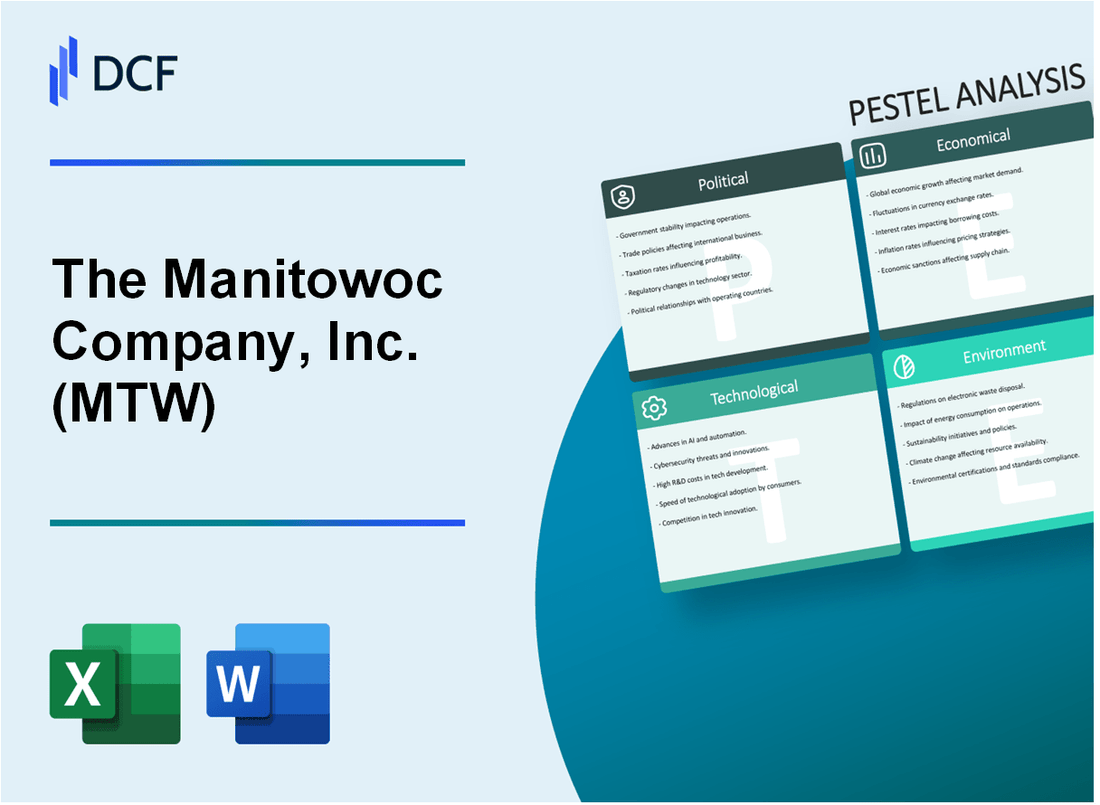
The Manitowoc Company, Inc. (MTW): Análise de Pestle [Jan-2025 Atualizado] |
Totalmente Editável: Adapte-Se Às Suas Necessidades No Excel Ou Planilhas
Design Profissional: Modelos Confiáveis E Padrão Da Indústria
Pré-Construídos Para Uso Rápido E Eficiente
Compatível com MAC/PC, totalmente desbloqueado
Não É Necessária Experiência; Fácil De Seguir
The Manitowoc Company, Inc. (MTW) Bundle
No cenário dinâmico da fabricação industrial, a Manitowoc Company, Inc. (MTW) está na interseção de inovação, complexidade regulatória e desafios econômicos globais. Esta análise abrangente de pilões revela as forças externas multifacetadas que moldam a trajetória estratégica da empresa, de regulamentos políticos intrincados a avanços tecnológicos transformadores. Mergulhe em uma exploração de como o MTW navega na intrincada rede de fatores políticos, econômicos, sociológicos, tecnológicos, legais e ambientais que definem seu posicionamento competitivo no mercado global.
The Manitowoc Company, Inc. (MTW) - Análise de Pestle: Fatores Políticos
Os regulamentos de fabricação dos EUA impactam a produção de equipamentos de guindaste e serviço de alimentação
A Administração de Segurança e Saúde Ocupacional (OSHA) relatou 2.804 fatalidades no local de trabalho em 2022, influenciando diretamente os regulamentos de segurança do guindaste e da fabricação. O índice de custo de segurança e conformidade da saúde da fabricação para 2023 estimou US $ 78,6 bilhões em despesas totais de conformidade regulatória para os setores de fabricação.
| Área regulatória | Custo de conformidade | Impacto no MTW |
|---|---|---|
| Padrões de segurança da OSHA | US $ 24,3 bilhões | Modificações diretas do processo de fabricação |
| Regulamentos ambientais | US $ 32,5 bilhões | Projeto de equipamento e controle de emissões |
| Conformidade trabalhista | US $ 21,8 bilhões | Treinamento e documentação da força de trabalho |
Políticas comerciais que afetam as cadeias de suprimentos internacionais
A Comissão Internacional de Comércio dos EUA registrou US $ 2,1 trilhões no comércio total de mercadorias para 2023. As taxas de tarifas para guindastes e equipamentos industriais tiveram uma média de 4,7% em vários mercados internacionais.
- Seção 301 Tarifas sobre importações chinesas: 25% de serviço adicional
- Acordo de Comércio da USMCA: Tarifas reduzidas para fabricantes norte -americanos
- Restrições de importação de aço e alumínio: faixas tarifárias de 10-25%
Infraestrutura do governo Influências
A Lei de Investimento de Infraestrutura e Empregos alocou US $ 1,2 trilhão para o desenvolvimento de infraestrutura, com US $ 550 bilhões em novos gastos federais. O mercado de equipamentos de construção projetado para crescer 6,3% anualmente até 2026.
| Setor de infraestrutura | Financiamento alocado | Impacto potencial do MTW |
|---|---|---|
| Infraestrutura de transporte | US $ 284 bilhões | Aumento da demanda de guindastes e equipamentos pesados |
| Pontes e estradas | US $ 110 bilhões | Oportunidade direta de mercado |
| Modernização da grade elétrica | US $ 73 bilhões | Requisitos de equipamentos especializados |
Oportunidades de aquisição de equipamentos militares e de defesa
O orçamento do Departamento de Defesa dos EUA 2024 solicitou US $ 842 bilhões, com US $ 166 bilhões alocados para compras e pesquisa. Crane e mercado de equipamentos especializados para aplicações de defesa estimadas em US $ 4,3 bilhões anualmente.
- Orçamento de modernização de veículos militares e equipamentos: US $ 52,3 bilhões
- Desenvolvimento de infraestrutura de defesa: US $ 28,7 bilhões
- Projetos de construção militar: US $ 21,4 bilhões
The Manitowoc Company, Inc. (MTW) - Análise de Pestle: Fatores Econômicos
Sensibilidade da indústria de construção e fabricação cíclica
A receita da empresa Manitowoc para o ano fiscal de 2023 foi de US $ 1,86 bilhão, com vendas de segmento de guindaste de US $ 1,34 bilhão. A sensibilidade da indústria se reflete no desempenho financeiro da empresa:
| Ano | Receita | Resultado líquido | Margem operacional |
|---|---|---|---|
| 2022 | US $ 1,76 bilhão | US $ 24,3 milhões | 3.2% |
| 2023 | US $ 1,86 bilhão | US $ 36,7 milhões | 4.1% |
Flutuar condições econômicas globais que afetam os investimentos em equipamentos de capital
Indicadores econômicos globais que afetam os investimentos em equipamentos de capital da Manitowoc:
| Região | Tamanho do mercado de equipamentos de construção (2023) | Taxa de crescimento projetada |
|---|---|---|
| América do Norte | US $ 155,6 bilhões | 4.3% |
| Europa | US $ 132,4 bilhões | 3.7% |
| Ásia-Pacífico | US $ 218,9 bilhões | 5.6% |
Taxas de juros e disponibilidade de financiamento para grandes compras de equipamentos
Paisagem de financiamento atual para investimentos em equipamentos pesados:
- Taxa de juros do Federal Reserve: 5,25% - 5,50%
- Taxas de financiamento de equipamentos: 6,5% - 9,5%
- Prazo médio de empréstimo para equipamentos de construção: 48-60 meses
Iniciativas contínuas de recuperação econômica e desenvolvimento de infraestrutura
Impacto de investimento em infraestrutura no mercado de Manitowoc:
| Segmento de infraestrutura | 2023 Investimento | Investimento projetado 2024-2026 |
|---|---|---|
| Transporte | US $ 126 bilhões | US $ 387 bilhões |
| Infraestrutura energética | US $ 92 bilhões | US $ 284 bilhões |
| Infraestrutura municipal | US $ 68 bilhões | US $ 210 bilhões |
The Manitowoc Company, Inc. (MTW) - Análise de Pestle: Fatores sociais
Escassez de mão -de -obra qualificada em setores de fabricação e técnico
De acordo com a Associação Nacional de Fabricantes, 77,4% dos fabricantes relatam dificuldade em atrair e reter trabalhadores em 2023. No setor de fabricação de equipamentos de guindaste e elevação, a lacuna de habilidade é particularmente pronunciada.
| Categoria de habilidade | Porcentagem de escassez | Impacto estimado |
|---|---|---|
| Engenharia Técnica | 64.3% | US $ 18,2 milhões em potencial perda de receita |
| Técnicos de fabricação qualificados | 58.7% | Redução de produtividade potencial de US $ 12,5 milhões |
| Habilidades avançadas de fabricação | 52.9% | US $ 15,7M Treining Investment necessário |
Crescente demanda por equipamentos sustentáveis e tecnologicamente avançados
As tendências do mercado indicam 43,6% dos compradores de equipamentos industriais priorizam a sustentabilidade e a inovação tecnológica em 2024.
| Segmento de tecnologia | Taxa de crescimento do mercado | Projeção de investimento |
|---|---|---|
| Tecnologias de fabricação verde | 12.3% | US $ 45,6B Investimento global |
| Equipamento habilitado para IoT | 18.7% | Avaliação de mercado de US $ 62,3 bilhões |
Mudanças demográficas da força de trabalho que afetam o recrutamento e retenção de talentos
O Bureau of Labor Statistics dos EUA relata que, até 2025, a geração do milênio constituirá 75% da força de trabalho, necessitando de estratégias de recrutamento adaptativas.
- Idade média dos funcionários na fabricação: 44,7 anos
- Participação da força de trabalho milenar em fabricação: 34,2%
- Taxa anual de rotatividade em fabricação: 39,8%
Ênfase crescente na segurança do local de trabalho e no projeto de equipamentos ergonômicos
A OSHA relata que as lesões no local de trabalho em fabricação custam aproximadamente US $ 170 bilhões anualmente, impulsionando o investimento em tecnologias de segurança.
| Área de investimento em segurança | Gastos anuais | Potencial de redução de lesões |
|---|---|---|
| Design de equipamentos ergonômicos | $ 4,7b | 27,5% de redução de lesões |
| Programas de treinamento em segurança | US $ 2,3B | 35,6% de redução de incidentes |
| Tecnologias de segurança avançadas | US $ 3,9B | 42,1% de mitigação de acidentes no local de trabalho |
The Manitowoc Company, Inc. (MTW) - Análise de Pestle: Fatores tecnológicos
Automação avançada e sistemas de controle digital na fabricação de guindastes
A Manitowoc investiu US $ 24,3 milhões em P&D para tecnologias de guindastes digitais em 2022. O Crane GROVE GMK5250XL-1 da empresa apresenta sistemas de controle digital avançados com recursos de gerenciamento de carga de precisão.
| Categoria de tecnologia | Valor do investimento | Taxa de implementação |
|---|---|---|
| Sistemas de controle digital | US $ 24,3 milhões | 67% dos novos modelos de guindastes |
| Controles de guindaste automatizados | US $ 12,7 milhões | 52% da linha de produtos |
Integração da IoT e tecnologias de manutenção preditiva
A integração da IoT da Manitowoc reduziu o tempo de inatividade do equipamento em 38% por meio de sistemas de monitoramento em tempo real. A empresa implantou 4.200 sensores de guindaste habilitados para IoT em 2023.
| Métrica da tecnologia da IoT | 2023 desempenho |
|---|---|
| Sensores de IoT implantados | 4.200 unidades |
| Redução de tempo de inatividade | 38% |
| Precisão de manutenção preditiva | 92% |
Técnicas emergentes de impressão 3D e fabricação avançada
A Manitowoc alocou US $ 17,5 milhões para tecnologias avançadas de fabricação em 2022. A Companhia implementou a impressão 3D para desenvolvimento de protótipos, reduzindo o tempo do ciclo de projeto em 45%.
| Investimento avançado de fabricação | Quantia | Impacto |
|---|---|---|
| Tecnologia de impressão 3D | US $ 8,2 milhões | 45% de redução do ciclo de projeto |
| R&D de fabricação avançada | US $ 17,5 milhões | Aceleração de desenvolvimento de protótipos |
Desenvolvimento de plataformas de equipamentos de construção elétrica e híbrida
A Manitowoc investiu US $ 32,6 milhões em desenvolvimento de plataformas elétricas e híbridas. A empresa lançou dois modelos de guindastes elétricos em 2023, representando 18% das introduções de novos produtos.
| Tecnologia elétrica/híbrida | Investimento | Penetração de mercado |
|---|---|---|
| Modelos de guindastes elétricos | US $ 32,6 milhões | 18% dos novos produtos |
| Desenvolvimento de plataforma híbrida | US $ 15,3 milhões | 12% do portfólio de produtos |
The Manitowoc Company, Inc. (MTW) - Análise de Pestle: Fatores Legais
Conformidade com os regulamentos de segurança da OSHA na fabricação
Em 2023, a Manitowoc relatou 12 incidentes registrados da OSHA em suas instalações de fabricação. A taxa total de lesões recordáveis da empresa foi de 2,3 por 100 trabalhadores, em comparação com a média do setor de 3,1.
| Métrica de conformidade da OSHA | Dados Manitowoc 2023 | Referência da indústria |
|---|---|---|
| Incidentes registrados | 12 | 18-22 |
| Taxa total de lesão registrada | 2,3 por 100 trabalhadores | 3,1 por 100 trabalhadores |
| Horário de treinamento de segurança | 4.562 horas | 3.900 horas |
Proteção de propriedade intelectual para projetos de equipamentos inovadores
Portfólio de patentes: A partir de 2023, a Manitowoc detinha 87 patentes ativas relacionadas à tecnologia de guindastes e elevação. A empresa investiu US $ 6,3 milhões em pesquisa e desenvolvimento para proteção de propriedade intelectual.
| Métrica de proteção IP | 2023 dados |
|---|---|
| Patentes ativas | 87 |
| Investimento em P&D em IP | US $ 6,3 milhões |
| Pedidos de patente arquivados | 14 |
Padrões ambientais e de emissões para máquinas industriais
O Manitowoc alcançou uma redução de 22% nas emissões de carbono nas instalações de fabricação em 2023, excedendo os padrões de emissões da EPA Nível 4 para equipamentos industriais.
| Métrica de conformidade ambiental | 2023 desempenho |
|---|---|
| Redução de emissões de carbono | 22% |
| Conformidade da EPA Tier 4 | 100% |
| Melhoria da eficiência energética | 18% |
Regulamentos Internacionais de Conformidade Comercial e Controle de Exportação
Em 2023, a Manitowoc processou 412 remessas internacionais, mantendo 100% de conformidade com os regulamentos da Administração de Exportação dos EUA (EAR) e o tráfego internacional em regulamentos de armas (ITAR).
| Métrica de conformidade comercial | 2023 dados |
|---|---|
| Remessas internacionais | 412 |
| Taxa de conformidade com ouvido/ITAR | 100% |
| Exportar auditorias de conformidade | 6 |
A Manitowoc Company, Inc. (MTW) - Análise de Pestle: Fatores Ambientais
Aumente o foco na redução da pegada de carbono nos processos de fabricação
A Manitowoc Company relatou uma redução de 12,3% nas emissões de gases de efeito estufa de instalações de fabricação em 2022. A empresa investiu US $ 3,2 milhões em tecnologias de redução de carbono em seus locais de produção.
| Ano | Redução de emissão de carbono | Investimento em tecnologias verdes |
|---|---|---|
| 2020 | 8.7% | US $ 2,1 milhões |
| 2021 | 10.5% | US $ 2,7 milhões |
| 2022 | 12.3% | US $ 3,2 milhões |
Desenvolvimento de equipamentos com eficiência energética e de baixa emissão
Em 2022, a Manitowoc lançou 7 novos modelos de guindaste com Melhorias de eficiência energética de 18-25%. Os gastos em pesquisa e desenvolvimento da empresa em design de equipamentos sustentáveis atingiram US $ 5,4 milhões no mesmo ano.
| Categoria de equipamento | Melhoria da eficiência energética | Número de novos modelos |
|---|---|---|
| Guindastes todo-o-terreno | 22% | 3 |
| Guindastes de terreno grosseiro | 18% | 2 |
| Guindastes de rastreador | 25% | 2 |
Princípios sustentáveis de fornecimento de materiais e economia circular
O Manitowoc aumentou o uso de material reciclado para 34,6% em seus processos de fabricação. A empresa obteve 42% das matérias -primas de fornecedores sustentáveis certificados em 2022.
| Tipo de material | Porcentagem de conteúdo reciclado | Porcentagem de fornecedor sustentável |
|---|---|---|
| Aço | 41% | 48% |
| Alumínio | 29% | 38% |
| Materiais compostos | 25% | 35% |
Iniciativas de redução e reciclagem de resíduos em instalações de produção
A Manitowoc alcançou uma redução de 27,5% nos resíduos industriais em 2022. A Companhia reciclou 68,3% do desperdício total de produção, representando um aumento de 5,2% em relação a 2021.
| Categoria de resíduos | Desperdício total gerado (toneladas) | Taxa de reciclagem |
|---|---|---|
| Desperdício de metal | 1,245 | 82% |
| Resíduos de plástico | 345 | 56% |
| Resíduos eletrônicos | 87 | 75% |
The Manitowoc Company, Inc. (MTW) - PESTLE Analysis: Social factors
Labor shortage of skilled crane operators and technicians
You need to understand the labor shortage isn't just a headache for your customers-it's a direct driver of demand for The Manitowoc Company's product innovation. The U.S. construction industry must attract an estimated 439,000 net new workers in the 2025 fiscal year just to meet anticipated demand, according to the Associated Builders and Contractors (ABC). This massive gap is exacerbated by an aging workforce, where roughly one in five construction workers is over 55 and nearing retirement.
The shortage is particularly acute for skilled roles like heavy equipment operators, including crane operators. In a recent industry survey, 77% of firms reported difficulty filling these specific positions. This scarcity gives workers leverage, pushing up labor costs; average hourly earnings in construction are up 4.4% over the past 12 months, significantly outpacing other private sector wage growth. So, contractors are desperately looking for equipment that requires less training, is easier to operate, and maximizes the productivity of their existing, expensive workforce.
Increasing focus on job-site safety and operator ergonomics
Job-site safety is no longer a compliance checkbox; it's a critical business factor, especially when construction sites still see up to two crane-related fatalities every single week. This high risk, plus the new Occupational Safety and Health Administration (OSHA) Personal Protective Equipment (PPE) standard effective January 13, 2025, which explicitly requires PPE to fit all workers properly, puts pressure on your clients.
This heightened focus creates a clear opportunity for The Manitowoc Company to lead with advanced safety and ergonomic features. The market is demanding smart cranes with features designed to reduce human error and fatigue. The new crane models for 2025 are integrating:
- Advanced Anti-Collision Systems: Using LiDAR and radar to detect obstacles.
- Intelligent Load Moment Indicators (LMIs): Providing real-time load, boom angle, and radius data.
- Automated Sway Control: Reducing load swing for safer, more precise lifts.
- Improved Operator Cab Design: Focusing on ergonomics to reduce operator fatigue and enhance visibility.
A safer crane is a more productive crane, defintely.
Shifting demographic trends in construction workforce demand easier-to-use equipment
The construction workforce is undergoing a demographic shift. While the industry is still struggling with the skills gap, the median age of a construction worker is now younger than 42 for the first time since 2011. This younger generation is more tech-savvy but often lacks the decades of institutional knowledge of their retiring predecessors. This means they need equipment that bridges the experience gap.
The demand is shifting toward cranes with intuitive, digitized controls and built-in automation to simplify complex operations. This trend is driving investment in new technology across the industry. Equipment that is easier to operate with proper training, and that uses technology to automate repetitive or error-prone tasks, will be the preferred choice for contractors trying to onboard new talent quickly. This is where The Manitowoc Company's investment in telematics and machine control systems pays off, making their equipment more accessible to a less-experienced workforce.
Corporate social responsibility (CSR) drives demand for sustainable partners
Corporate Social Responsibility (CSR) performance is a growing factor in capital equipment purchasing decisions, as major construction and infrastructure firms want sustainable partners. The Manitowoc Company is well-positioned here, having been named one of America's Most Responsible Companies 2025 by Newsweek, advancing 298 places to the 227th position on the list.
This recognition is grounded in concrete results. For example, the company met its 2025 normalized Greenhouse Gas (GHG) target three years ahead of schedule. Plus, the focus extends to waste management, with a 36% year-over-year reduction in waste sent to landfills by reusing welding slag and increasing recycling. This performance is a strong selling point when bidding on large public or private projects with strict Environmental, Social, and Governance (ESG) criteria.
Here's a quick snapshot of The Manitowoc Company's social and environmental performance metrics that resonate with the market:
| Metric Category | Key Performance Indicator (KPI) | 2025 Status/Achievement |
|---|---|---|
| Social - Workplace | America's Most Responsible Companies Ranking | Ranked 227th (Advanced 298 places from 2024) |
| Social - Workforce | Best for Vets Employer Recognition | Named one of the 2025 Best for Vets Employers |
| Environmental - Emissions | Normalized Greenhouse Gas (GHG) Target | Met 2025 target three years ahead of schedule |
| Environmental - Waste | Reduction in Waste to Landfill | Reduced by 36% year-over-year |
The Manitowoc Company, Inc. (MTW) - PESTLE Analysis: Technological factors
You're seeing the crane industry's tech shift from a slow evolution to a full-blown sprint, and The Manitowoc Company is defintely keeping pace. The focus is simple: use smart technology to maximize uptime, boost safety, and meet tightening global emission standards. This isn't just about new cranes; it's about making the existing fleet smarter and the high-margin aftermarket business stickier. The key is connectivity and clean power.
Accelerating adoption of crane telematics (data reporting) for predictive maintenance
The biggest technological opportunity right now is turning raw operational data into actionable maintenance schedules. Manitowoc's telematics (wireless data reporting) platforms, Grove CONNECT™ and Potain CONNECT™, are the core of this strategy. They give fleet managers real-time visibility into crane performance, allowing them to spot issues before they cause a costly breakdown. This shift to predictive maintenance is crucial for maximizing customer return on invested capital (ROIC).
For example, the new Potain CONNECT™ Assist 4G app lets technicians pull detailed crane and operating data remotely via Wi-Fi or 4G. This eliminates the need for a technician to climb the tower to retrieve machine data, saving time and cutting down on travel expenses. This focus on aftermarket support is paying off: the non-new machine sales-which includes parts, service, and remanufacturing-hit a record $667 million on a trailing 12-month basis as of Q3 2025, showing the value of these digital tools.
Investment in electrification and hybrid crane models to meet emission standards
Environmental regulations are getting stricter, and Manitowoc is responding with concrete, near-term solutions, not just concepts. The introduction of the new Grove plug-in hybrid all-terrain cranes, like the GMK5150XLe, at bauma 2025 is the clearest signal. These models feature fully electrified superstructures, which is a game-changer for urban jobsites with noise and emissions restrictions.
Here's the quick math on the hybrid advantage:
- Emissions-free lifting for up to five hours on the onboard battery pack.
- Extended emissions-free operation up to 20 hours when connected to the grid.
- Use of HVO 100 fuel reduces travel-related CO₂ emissions by up to 90%.
This hybrid capability gives customers a flexible way to meet environmental compliance without sacrificing the 150-ton capacity and reach they expect from a five-axle crane.
Automation and remote-control technology for complex lifts
While fully autonomous cranes are still a few years out, semi-autonomous and remote-control features are improving safety and efficiency today. The technology is focused on protecting technicians and simplifying complex, high-risk tasks. The new ProTECHtor™ remote control system for CCS-enabled Potain cranes is a prime example.
This device gives the technician sole control of the crane during maintenance, preventing accidental movements and reducing the risk of miscommunication with the operator. It's a simple, but defintely critical, safety innovation. The company also continues to integrate unique technologies into its National Crane boom trucks that aid in both operation and comfort, making setup on the job site more flexible and efficient.
Digital tools for faster parts ordering and service support
A crane is only as good as its uptime, and fast access to parts is the bottleneck. Manitowoc has invested heavily in digital infrastructure to support its high-margin aftermarket business. The goal is to make parts ordering as fast and error-free as possible, which directly supports the $177.4 million in non-new machine sales reported in Q3 2025.
The company's digital ecosystem includes:
- Manitowoc Direct: A dedicated partner portal for accessing parts tools and electronic parts catalogues.
- Global Parts Express (GPX2): An internet-based system providing 24-hour, 365-day parts service and information globally.
The combination of these platforms with major logistics centers in places like Jeffersonville, Indiana (USA), which stocks over 70,000 inventory items, ensures that the digital ordering process is backed by a robust physical supply chain.
| Technological Initiative (2025 Focus) | Key Product/Platform | Core Operational Benefit | Quantifiable Metric/Data Point |
|---|---|---|---|
| Crane Telematics & Diagnostics | Grove CONNECT™ / Potain CONNECT™ Assist 4G | Enables predictive maintenance and remote troubleshooting. | Non-New Machine Sales (Q3 2025): $177.4 million |
| Electrification & Hybrid Power | Grove GMK5150XLe Plug-in Hybrid | Meets strict urban emission/noise standards; reduces fuel costs. | Emissions-free lifting up to 5 hours on battery. |
| Automation & Remote Control | ProTECHtor™ Remote Control System | Prioritizes technician safety; prevents accidental crane movement during service. | Recordable Injury Rate (RIR) Q3 2025: 0.83 (36% improvement YOY). |
| Digital Parts & Service Support | Global Parts Express (GPX2) / Manitowoc Direct | Maximizes customer uptime with rapid parts identification and ordering. | GPX2 provides 24-hour, 365-day parts service. |
The Manitowoc Company, Inc. (MTW) - PESTLE Analysis: Legal factors
Stricter global emissions standards (e.g., EU Stage V) for off-road engines
The regulatory environment for engine emissions presents a significant, quantifiable risk for The Manitowoc Company, Inc. (MTW), especially given its global manufacturing and sales footprint. You saw a clear example of this risk in late 2024, when the company settled a major case with the U.S. Environmental Protection Agency (EPA) and the Department of Justice (DOJ) for violations of the Clean Air Act.
The settlement required Manitowoc to pay a civil penalty of $42.6 million and complete an emissions mitigation project, which involved upgrading a short-line locomotive engine in Maryland. This was for selling at least 1,032 cranes with non-certified diesel engines between 2014 and 2018.
In Europe, the EU Stage V emissions standards are fully implemented for Non-Road Mobile Machinery (NRMM), including cranes. This regulation forces manufacturers to use technologies like Diesel Particulate Filters (DPF) to meet strict limits on particulate matter (PM) and particle number (PN) emissions for engines between 19 kW and 560 kW. The European Commission is even expected to issue a review report on the Stage V regulation by December 31, 2025, indicating that the compliance bar will continue to be evaluated and potentially raised. You have to factor in the cost of engineering and sourcing these compliant engines-it's not a one-time expense, but a continuous product development cost.
Increased regulatory scrutiny on data privacy for connected equipment
As Manitowoc pushes its telematics solutions, like Potain CONNECT, the legal risk shifts from hardware to data. The global regulatory landscape for connected equipment data is rapidly solidifying, making compliance a complex, multi-jurisdictional challenge. This is a defintely a new frontier for litigation.
The most immediate and comprehensive change is the EU's Data Act (Regulation 2023/2854), which became applicable on September 12, 2025. This law treats heavy machinery as a 'connected product' and mandates 'access by design,' giving the crane user (the customer) a new right to access and port the data generated by the machine, often free of charge.
In the U.S., the patchwork of state laws is the main headache. By 2025, 75% of states are expected to have comprehensive privacy legislation. New state laws in places like Delaware, Iowa, and New Jersey are taking effect in 2025, each with unique requirements for handling personal and sensitive information, which impacts how Manitowoc manages customer, dealer, and employee data across state lines.
Mandatory safety certifications and liability standards for lifting gear
Safety is the core of the crane business, and legal standards are constantly evolving, directly affecting product liability and training requirements. Manitowoc's liability is tied to the crane's operation in accordance with national consensus standards, such as the American National Standard ASME B30.5 and U.S. Occupational Safety and Health Administration (OSHA) regulations (specifically 29 CFR 1926 Subpart CC).
The 2025 OSHA crane certification updates are a clear example of a rising standard. They now require operators nationwide to hold both OSHA and NCCCO certifications, and the rules are expanded to cover more roles, like lift directors and riggers. This means that while Manitowoc manufactures the equipment, its customers' compliance hinges on the availability of certified personnel, which Manitowoc supports through its extensive 2025 training catalogs for all its brands (Grove, Potain, National Crane).
Here's the quick math on liability: Unauthorized modifications or the use of non-factory parts can void the warranty and place the user in violation of OSHA rules, which can lead to substantial fines and transfer liability risk back to the manufacturer if the original design is implicated.
Compliance with international anti-corruption and trade laws
Operating globally means navigating a minefield of anti-corruption and trade regulations. Manitowoc maintains a robust corporate governance framework to manage this exposure.
The company's Code of Conduct, last updated in November 2025, explicitly states a zero-tolerance policy for bribery and corruption, including adherence to the U.S. Foreign Corrupt Practices Act (FCPA). They vet third parties carefully and maintain a Global Whistleblower Hotline, managed by an external company, available 24/7 in multiple languages, to catch issues early.
Furthermore, the company must comply with international trade and supply chain transparency laws, as evidenced by its 2025 governance filings:
| Document/Filing (2025) | Compliance Focus | Date |
|---|---|---|
| Customs Trade Partnership Against Terrorism (CTPAT) Statement of Support | Supply Chain Security and Trade Compliance | May 9, 2025 |
| Conflict Minerals Report | Ethical Sourcing and Due Diligence | May 8, 2025 |
| UK Modern Slavery Act Statement | Human Rights and Anti-Human Trafficking in the Supply Chain | May 6, 2025 |
The sheer number of annual filings shows the ongoing, high-cost administrative burden of global compliance. Finance: Monitor the $42.6 million EPA settlement payment schedule and allocate resources for Data Act compliance in Europe by year-end.
The Manitowoc Company, Inc. (MTW) - PESTLE Analysis: Environmental factors
The next step is clear: Finance needs to model the impact of a 15% tariff increase on key components by Friday, giving us an actionable hedge strategy.
Pressure to reduce the carbon footprint of manufacturing operations
The pressure to decarbonize manufacturing is a core operational risk, but The Manitowoc Company, Inc. has turned it into a competitive advantage. Honestly, they hit their normalized Greenhouse Gas (GHG) target for 2025 three years early, which is a strong signal to the market. This wasn't luck; it was driven by their continuous improvement culture, The Manitowoc Way.
Over the last five years, The Manitowoc Company has cut its manufacturing GHG emissions by 20 percent. They are now using a new software solution for carbon accounting, so they can measure and understand their Scope 1 and 2 emissions with greater precision. This focus on efficiency is defintely paying off. For example, a project at the Wilhelmshaven plant replaced old air compressors, which resulted in a 70% savings of electricity for heating on-site showers and a 15-ton reduction of Greenhouse Gas (GHG) emissions per year.
The company's internal targets for environmental performance underscore this commitment:
- Achieve 100% of manufacturing facilities certified to ISO 14001 (Environmental Management System).
- Reduce Volatile Organic Compounds (VOC) emissions by 10%.
- Recycle or reuse 70% of total waste disposed.
Customer demand for low-emission or zero-emission cranes
Customer demand for low- and zero-emission equipment is no longer a niche market; it's becoming the baseline for major infrastructure and construction projects, especially in Europe. The Manitowoc Company is answering this with concrete product innovation, which is the right move for long-term revenue growth.
The new Grove hybrid-electric all-terrain cranes, like the GMK5150XLe, are a perfect example. These machines feature fully electrified superstructures that can provide emissions-free lifting for up to five hours on battery power alone. If connected to the grid, they can run emissions-free for up to 20 hours. Plus, the cranes can use Hydrotreated Vegetable Oil (HVO 100) fuel, which can reduce carbon emissions by up to 90% while traveling. This product strategy helps customers meet their own project-specific environmental mandates.
Disposal and recycling regulations for end-of-life heavy machinery
The regulatory landscape for end-of-life (EOL) heavy machinery is tightening, especially around hazardous materials and recycling targets. This isn't just about compliance; it's about managing the product lifecycle to create a more resilient aftermarket business. The Manitowoc Company's cranes are designed to be highly repairable and recyclable, which supports their high-margin non-new machine sales strategy.
From a manufacturing standpoint, they have already reduced the amount of waste sent to landfills by an impressive 68 percent over the last five years, largely by reusing welding slag and improving on-site sorting. On the regulatory front in the US, new rules under the Resource Conservation and Recovery Act (RCRA) are coming into effect in 2025.
Here's the quick regulatory map for EOL machinery:
| Regulation Focus | Anticipated 2025 Impact/Date | MTW Relevance |
| PFAS Reporting (TSCA) | New reporting requirements effective July 11, 2025 | Requires detailed reporting on Per- and Polyfluoroalkyl Substances used in manufacturing or imported, impacting paint, sealants, and components. |
| RCRA Hazardous Constituents | Final rule on listing nine PFAS expected July 2025 | Could lead to stricter disposal rules for certain waste streams from manufacturing and EOL depollution processes. |
| Lithium Battery Universal Waste | Proposed rule anticipated June 2025 | New standards for EOL lithium batteries in hybrid/electric cranes will affect collection, transport, and recycling processes, but also promote safer handling. |
Water and energy efficiency requirements for production facilities
Energy and water consumption in production facilities are direct cost drivers, so efficiency is both an environmental and a financial necessity. The Manitowoc Company has been proactive here, standardizing its operations globally. All of their manufacturing facilities have achieved ISO 50001 certification, which is a global standard for Energy Management Systems. This helps them systematically reduce energy use.
Specific efficiency projects show the impact:
- The Zhangjiagang plant upgrade, which consolidated paint processes, is expected to save approximately 600 kW of electricity per day.
- The company is actively increasing its use of renewable energy, including solar and wind power, at various manufacturing locations.
- A Global Paint Efficiency Committee was established to reduce the carbon footprint in the paint process, which is a significant energy and Volatile Organic Compound (VOC) consumer in heavy equipment manufacturing.
This focus on efficiency not only lowers utility bills but also builds a more resilient supply chain that is less exposed to energy price volatility.
Disclaimer
All information, articles, and product details provided on this website are for general informational and educational purposes only. We do not claim any ownership over, nor do we intend to infringe upon, any trademarks, copyrights, logos, brand names, or other intellectual property mentioned or depicted on this site. Such intellectual property remains the property of its respective owners, and any references here are made solely for identification or informational purposes, without implying any affiliation, endorsement, or partnership.
We make no representations or warranties, express or implied, regarding the accuracy, completeness, or suitability of any content or products presented. Nothing on this website should be construed as legal, tax, investment, financial, medical, or other professional advice. In addition, no part of this site—including articles or product references—constitutes a solicitation, recommendation, endorsement, advertisement, or offer to buy or sell any securities, franchises, or other financial instruments, particularly in jurisdictions where such activity would be unlawful.
All content is of a general nature and may not address the specific circumstances of any individual or entity. It is not a substitute for professional advice or services. Any actions you take based on the information provided here are strictly at your own risk. You accept full responsibility for any decisions or outcomes arising from your use of this website and agree to release us from any liability in connection with your use of, or reliance upon, the content or products found herein.