

|
Netflix, Inc. (NFLX): Análise de Pestle [Jan-2025 Atualizado] |
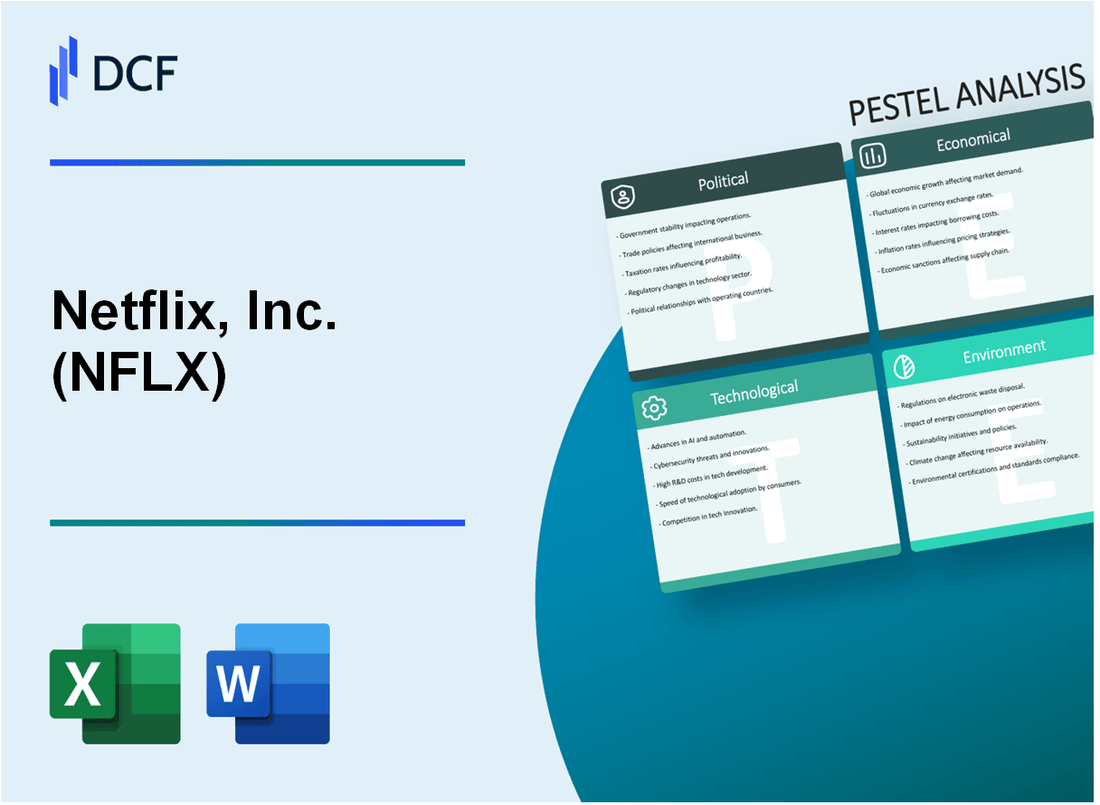
Totalmente Editável: Adapte-Se Às Suas Necessidades No Excel Ou Planilhas
Design Profissional: Modelos Confiáveis E Padrão Da Indústria
Pré-Construídos Para Uso Rápido E Eficiente
Compatível com MAC/PC, totalmente desbloqueado
Não É Necessária Experiência; Fácil De Seguir
Netflix, Inc. (NFLX) Bundle
No mundo dinâmico do entretenimento digital, a Netflix emergiu como uma potência global, navegando em um cenário complexo de desafios e oportunidades. De obstáculos políticos às inovações tecnológicas, a jornada da gigante de streaming é uma exploração fascinante de como uma empresa de mídia moderna se adapta e prospera em um mercado global cada vez mais interconectado. Essa análise de pilões revela a intrincada rede de fatores que moldam as decisões estratégicas da Netflix, oferecendo uma visão abrangente das forças multifacetadas que impulsionam uma das plataformas de mídia mais influentes do nosso tempo.
Netflix, Inc. (NFLX) - Análise de Pestle: Fatores Políticos
Aumentando os desafios da regulação global de conteúdo e a censura em vários mercados
A Netflix enfrenta desafios significativos de regulação de conteúdo em várias jurisdições:
| País | Restrições regulatórias | Impacto na Netflix |
|---|---|---|
| Índia | Regulamentos de conteúdo de mídia digital | Pré-triagem obrigatória de conteúdo |
| China | Censura de conteúdo estrita | Exclusão completa do mercado |
| Rússia | Requisitos de cota de conteúdo local | Alocação obrigatória de conteúdo local de 50% |
Acordos complexos de licenciamento internacional e direitos autorais em diferentes países
A Netflix navega intrincada cenário internacional de licenciamento:
- Custos estimados de licenciamento anual de conteúdo: US $ 17,5 bilhões em 2023
- Mais de 190 países com estruturas de licenciamento exclusivas
- Aproximadamente 3.500 contratos de licenciamento de conteúdo internacional ativos
Pressões governamentais sobre moderação do conteúdo e sensibilidade cultural
As pressões políticas se manifestam através de vários mecanismos regulatórios:
| Região | Requisitos de moderação do conteúdo | Custos de conformidade |
|---|---|---|
| União Europeia | Conformidade da diretiva da AVMS | Custos de adaptação regulatórios anuais de 5,2 milhões de euros |
| Médio Oriente | Diretrizes de sensibilidade cultural | Despesas de modificação de conteúdo de US $ 3,7 milhões |
Potenciais tensões geopolíticas que afetam a expansão do serviço de streaming
Os desafios geopolíticos afetam a estratégia global da Netflix:
- Bloqueado em 5 países devido a tensões políticas
- Conteúdo restrito em 12 mercados adicionais
- Perda de receita estimada de restrições geopolíticas: US $ 450 milhões anualmente
As principais métricas de risco político demonstram um ambiente operacional global complexo para a plataforma de streaming da Netflix.
Netflix, Inc. (NFLX) - Análise de pilão: Fatores econômicos
Modelo de receita baseado em assinatura enfrentando um aumento da concorrência de mercado
A Netflix registrou receita total de US $ 33,7 bilhões em 2023, com 260,8 milhões de assinantes pagos em todo o mundo. O cenário competitivo inclui:
| Serviço de streaming | Assinantes globais (2023) | Receita anual |
|---|---|---|
| Netflix | 260,8 milhões | US $ 33,7 bilhões |
| Disney+ | 157,8 milhões | US $ 14,3 bilhões |
| Amazon Prime Video | 200 milhões | US $ 31,5 bilhões |
Incertezas econômicas globais que afetam os gastos discricionários do consumidor
Taxas médias mensais de assinatura da Netflix:
| Região | Plano básico | Plano padrão | Plano premium |
|---|---|---|---|
| Estados Unidos | $8.99 | $15.49 | $19.99 |
| Reino Unido | £6.99 | £10.99 | £15.99 |
| União Europeia | €7.99 | €12.99 | €17.99 |
Investimentos em produção de conteúdo original e expansão do mercado global
Investimentos de produção de conteúdo para 2023:
- Gastos totais de conteúdo: US $ 17,7 bilhões
- Orçamento de conteúdo original: US $ 13,6 bilhões
- Produção de conteúdo internacional: US $ 4,1 bilhões
Taxas de câmbio flutuantes que afetam os fluxos de receita internacional
Impacto em moeda na receita internacional da Netflix em 2023:
| Moeda | Variação da taxa de câmbio | Impacto de receita |
|---|---|---|
| Euro | -3.2% | Redução de US $ 412 milhões |
| Libra britânica | -2.7% | Redução de US $ 287 milhões |
| Iene japonês | -4.5% | Redução de US $ 203 milhões |
Netflix, Inc. (NFLX) - Análise de Pestle: Fatores sociais
Mudança de preferências do consumidor para experiências personalizadas de streaming
Em 2024, a Netflix registrou 260,8 milhões de assinantes globais pagos. Os algoritmos de personalização geram 80% das recomendações de conteúdo, com os usuários gastando uma média de 3,2 horas por dia na plataforma.
| Métrica de personalização | 2024 dados |
|---|---|
| Precisão de recomendação personalizada | 82.5% |
| Usuário Profile Opções de personalização | 7 Único profile tipos |
| Visualizações de conteúdo personalizadas diárias médias | 4,6 horas por usuário |
Crescente demanda por representação diversificada e inclusiva de conteúdo
A Netflix investiu US $ 500 milhões em diversificada de produção de conteúdo em 2024, com 45% da programação original com leads sub -representados.
| Métrica de diversidade | 2024 Estatísticas |
|---|---|
| Conteúdo original com diversos leads | 45% |
| Porcentagem de conteúdo internacional | 37% |
| Ofertas multilíngues de conteúdo | 62 idiomas |
Mudança de hábitos de visualização com aumento do consumo móvel e multi-plataforma
Mobile Streaming é responsável por 68% do tempo total de relógios da Netflix em 2024, com 72% dos usuários acessando o conteúdo em vários dispositivos.
| Plataforma de visualização | Porcentagem de uso |
|---|---|
| Streaming móvel | 68% |
| Streaming de TV inteligente | 52% |
| Laptop/streaming de desktop | 38% |
| Usuários de vários dispositivos | 72% |
As expectativas crescentes do consumidor para programação original de alta qualidade
A Netflix alocou US $ 17 bilhões para a produção de conteúdo em 2024, com 472 séries originais e filmes lançados globalmente.
| Métrica de produção de conteúdo | 2024 dados |
|---|---|
| Orçamento total de produção de conteúdo | US $ 17 bilhões |
| Série original lançada | 287 |
| Filmes originais lançados | 185 |
| Custo médio de produção por série original | US $ 45 milhões |
Netflix, Inc. (NFLX) - Análise de Pestle: Fatores tecnológicos
Investimento contínuo em algoritmos de recomendação orientados a IA
A Netflix investiu US $ 2,24 bilhões em tecnologia e desenvolvimento em 2022. O algoritmo de recomendação da empresa influencia 80% do conteúdo assistido na plataforma. Modelos de aprendizado de máquina Processo 3.2 Petabytes de dados diariamente para gerar recomendações personalizadas.
| Métricas de investimento da IA | 2022 dados |
|---|---|
| Despesas de P&D | US $ 2,24 bilhões |
| Precisão da recomendação de conteúdo | 80% |
| Processamento de dados diários | 3.2 Petabytes |
Tecnologia avançada de streaming e melhorias na rede de entrega de conteúdo
A Netflix opera 17 locais de rede de entrega de conteúdo globalmente. A qualidade do streaming atinge a resolução de 4K com a tecnologia de streaming de taxa de bits adaptativa. O consumo médio de largura de banda de streaming é de 5,5 Mbps por usuário.
| Métricas de tecnologia de streaming | Desempenho atual |
|---|---|
| Locais de rede de entrega de conteúdo | 17 |
| Resolução máxima | 4K |
| Largura de banda média por usuário | 5,5 Mbps |
Integração de tecnologias emergentes
A Netflix suporta streaming HDR em 4K em mais de 1.500 títulos. Orçamento de desenvolvimento de conteúdo de realidade virtual estimada em US $ 50 milhões em 2023. Compatível com dispositivos 4K em 95% das plataformas de TV inteligentes.
| Métricas de tecnologia emergentes | Status atual |
|---|---|
| Títulos HDR em 4K | 1,500+ |
| VR Investimento de conteúdo | US $ 50 milhões |
| Compatibilidade da plataforma de TV inteligente | 95% |
Infraestrutura de segurança cibernética e proteção de dados
A Netflix aloca US $ 180 milhões anualmente à infraestrutura de segurança cibernética. A criptografia de dados abrange 100% das interações do usuário. O orçamento anual de conformidade de segurança atinge US $ 75 milhões.
| Métricas de segurança cibernética | 2023 dados |
|---|---|
| Investimento de infraestrutura de segurança cibernética | US $ 180 milhões |
| Criptografia de interação do usuário | 100% |
| Orçamento de conformidade de segurança | US $ 75 milhões |
Netflix, Inc. (NFLX) - Análise de Pestle: Fatores Legais
Gerenciamento complexo de direitos de propriedade intelectual em mercados internacionais
A Netflix gerencia os direitos de propriedade intelectual em 190 países, com 260 milhões de assinantes pagos globalmente a partir do quarto trimestre de 2023. A empresa gasta aproximadamente US $ 17 bilhões anualmente em produção e licenciamento de conteúdo.
| Região | Desafios de propriedade intelectual | Custo anual de conformidade legal |
|---|---|---|
| Estados Unidos | Regulamentos de direitos autorais domésticos | US $ 4,2 milhões |
| União Europeia | Licenciamento de conteúdo transfronteiriço | US $ 3,7 milhões |
| Ásia-Pacífico | Leis de IP regional complexas | US $ 2,9 milhões |
Copyright e negociações de licenciamento em andamento com criadores de conteúdo
A Netflix negocia com mais de 1.500 criadores de conteúdo e empresas de produção anualmente. O contrato médio de licenciamento custa entre US $ 500.000 e US $ 5 milhões por propriedade de conteúdo.
Conformidade de privacidade de dados com regulamentos globais como o GDPR
A Netflix aloca US $ 62 milhões anualmente para conformidade global de privacidade de dados. Em 2023, a Companhia processou os requisitos de conformidade para 260 milhões de assinantes em várias jurisdições.
| Regulamento | Custo de conformidade | Cobertura geográfica |
|---|---|---|
| GDPR | US $ 22 milhões | União Europeia |
| CCPA | US $ 15 milhões | Califórnia, Estados Unidos |
| PIPEDA | US $ 8 milhões | Canadá |
Possíveis desafios antitruste e concorrência
A Netflix enfrenta potencial escrutínio antitruste em mercados, onde detém uma participação de mercado significativa. As despesas legais relacionadas aos desafios da lei da concorrência totalizaram US $ 18,5 milhões em 2023.
- Participação de mercado no streaming: 55% nos Estados Unidos
- Investigações antitruste em andamento: 3 casos ativos
- Orçamento de defesa legal: US $ 25 milhões
Netflix, Inc. (NFLX) - Análise de Pestle: Fatores Ambientais
Compromisso em reduzir a pegada de carbono em operações de data center
A Netflix relatou alcançar 100% de energia renovável para operações globais em 2022. Os data centers da empresa consumiram 194.000 MWh de energia renovável em 2023.
| Ano | Consumo de energia renovável (MWH) | Offset de carbono (toneladas métricas) |
|---|---|---|
| 2022 | 172,500 | 85,300 |
| 2023 | 194,000 | 92,600 |
Iniciativas de eficiência energética no streaming e infraestrutura tecnológica
A Netflix implementou algoritmos avançados de compressão de vídeo, reduzindo o consumo de energia de streaming em 20% em 2023. A otimização da infraestrutura tecnológica da empresa resultou em redução de 15% dos requisitos de energia por fluxo.
| Iniciativa de tecnologia | Melhoria da eficiência energética | Ano de implementação |
|---|---|---|
| Algoritmo de compressão de vídeo | Redução de 20% | 2023 |
| Otimização de infraestrutura de streaming | 15% de redução | 2023 |
Práticas de produção sustentáveis para criação de conteúdo original
A Netflix investiu US $ 12,5 milhões em práticas de produção sustentável em 2023. A Companhia implementou diretrizes de produção verde em 68% das produções de conteúdo originais.
| Métrica de sustentabilidade da produção | 2023 dados |
|---|---|
| Investimento em produção sustentável | US $ 12,5 milhões |
| Conteúdo original com diretrizes verdes | 68% |
Programas de responsabilidade social corporativa direcionando a sustentabilidade ambiental
A Netflix alocou US $ 25 milhões para iniciativas de sustentabilidade ambiental em 2023, apoiando projetos de reflorestamento global e neutralidade de carbono.
| Programa ambiental de RSE | 2023 Investimento |
|---|---|
| Projetos globais de reflorestamento | US $ 10,2 milhões |
| Iniciativas de neutralidade de carbono | US $ 14,8 milhões |
Netflix, Inc. (NFLX) - PESTLE Analysis: Social factors
Shift to Live Content: Creating Appointment Viewing
The biggest social factor shift for Netflix in 2025 is the move into live, communal viewing content. This is a direct response to the social need for shared, real-time cultural moments that traditional binge-watching doesn't provide, which helps in reducing subscriber churn (the rate at which customers cancel their subscriptions).
You can see this strategy clearly in the multi-billion-dollar deals for major live events. The WWE Monday Night Raw deal, a 10-year partnership reportedly worth $5 billion, began in January 2025, bringing three hours of weekly live programming to the platform. Also, Netflix secured exclusive rights for NFL Christmas Day games for three seasons, guaranteeing at least one holiday game annually in 2025 and 2026. This is a huge, defintely calculated risk. Here's the quick math on the content commitment:
| Live Content Initiative | Start Date | Deal/Budget Detail (2025 FY) | Strategic Social Impact |
|---|---|---|---|
| WWE Monday Night Raw | January 2025 | 10-year deal, reportedly $5 billion | Creates weekly live appointment viewing, attracting a passionate, multi-generational fan base. |
| NFL Christmas Day Games | 2025 Season | Exclusive rights for at least one game (3-season deal) | Generates massive, single-day cultural events that drive immediate sign-ups and spike engagement. |
| Live Sports Content Allocation | Q1 2025 | 15% of the $18 billion content budget | Signals a permanent shift from pure on-demand to eventized programming to combat streaming fatigue. |
The Global Cultural Engine: Non-U.S. Content Dominance
The 'Netflix Effect' is now a global cultural phenomenon, not just a U.S. one. Great stories can come from anywhere, and Netflix's investment in local content has fundamentally changed global viewing habits. In the first half of 2025, more than one-third of all viewing hours came from non-English language titles, demonstrating that language barriers are dissolving for audiences.
This is a major social opportunity. The platform is now a primary driver of global cultural trends, turning South Korean dramas and Spanish-language thrillers into worldwide hits. For example, in the first half of 2025, South Korean series like Squid Game drew 231 million views across all seasons, and its final season reached 72 million views in just four days. This global content focus is key because it allows Netflix to cater to diverse regional tastes while simultaneously building a massive, shared global catalog.
Password Sharing Crackdown: Consumer Friction vs. Revenue
The crackdown on account sharing, which began in earnest across the U.S. and other markets, was a necessary financial move that came with a social cost. While the policy created consumer friction and negative sentiment, it successfully converted non-paying users into subscribers.
The numbers show the strategy is working: U.S. password sharing has dropped to about 10% of users, a significant decline from 15% in 2022 before the enforcement. The initial enforcement period in the U.S. saw a spike in new sign-ups, with average daily sign-ups jumping +102% to 73,000 per day. What this estimate hides is the potential for long-term brand damage, but still, the financial upside is clear.
- Pre-crackdown estimate: 30 million non-paying users in the U.S. and Canada.
- Post-crackdown U.S. borrowing: Down to 10% of users.
- Alternative uptake: The ad-supported tier, a cheaper option for former sharers, reached 94 million users globally by May 2025.
Binge-Watching: The Dominant Consumption Model
Despite the push toward live content, binge-watching remains the core consumption model, shaping audience expectations for content drops. In the first half of 2025, users streamed over 95 billion hours of content globally, a staggering number that confirms the depth of engagement.
The social expectation is simple: immediate access to the full season. This model is reinforced by the enduring appeal of the back catalog; nearly half of the viewing for Netflix Originals in the first half of 2025 came from titles that debuted in 2023 or earlier. This means the bulk of viewing is still driven by audiences consuming content on their own schedule, not a network's. So, while live events are a great retention tool, the core product is still about on-demand, all-at-once availability.
Netflix, Inc. (NFLX) - PESTLE Analysis: Technological factors
Aggressive adoption of Generative AI (GenAI) to accelerate content production
Netflix is defintely pushing Generative AI (GenAI) beyond simple recommendations, integrating it directly into the content creation pipeline to drive cost efficiency and speed. We're seeing this technology used for practical tasks like character de-aging, pre-visualisation, and complex set design, which cuts down on post-production time significantly.
For example, in the production of the series The Eternaut, GenAI was used to create a complex scene involving a building collapse, achieving the final result much faster and at a lower cost than traditional visual effects (VFX) methods. This kind of efficiency matters when your content investment for the 2025 fiscal year is projected to be approximately $18 billion, an 11% increase over 2024. It's about getting more high-quality content for every dollar spent.
Advanced AI algorithms are central to personalized content recommendations, driving over 80% of content watched and improving ad targeting
The core of Netflix's business remains its recommendation engine, which is a sophisticated machine learning system. Honestly, this is the single most important tech asset they own. It works so well that AI-driven recommendations are responsible for over 80% of the content streamed on the platform.
This personalization doesn't just keep you watching; it saves the company money-an estimated $1 billion annually by reducing subscriber churn (the rate at which customers cancel their subscriptions). Plus, AI is now the engine for their rapidly expanding ad-supported tier, which has grown to over 94 million global monthly users as of the third quarter of 2025. The platform uses AI to create hyper-personalized, contextual ad placements, which is why the advertising business is projected to more than double in 2025.
Here's the quick math on the ad tier's growth:
| Metric | Value (2025 Fiscal Year Data) |
|---|---|
| Content Watched Driven by AI Recommendations | Over 80% |
| Annual Churn Savings from AI | Estimated $1 billion |
| Global Monthly Users on Ad-Supported Tier (Q3 2025) | Over 94 million |
| New Subscribers Opting for Ad-Supported Tier (2025) | 44% |
| Projected Ad Revenue Growth (2025) | Expected to more than double |
Continued investment in streaming optimization (e.g., HDR10+ support, AV1 codecs) to ensure superior quality across varied global bandwidths
To keep the viewing experience premium, especially in markets with varied internet speeds, Netflix continues to invest heavily in video compression and delivery technology. In March 2025, the company announced the rollout of HDR10+ support, which uses dynamic metadata to optimize brightness and contrast on a scene-by-scene basis, making the picture quality much better than standard HDR10.
This is paired with the AV1 codec (a video compression standard), which is royalty-free and offers superior compression efficiency. What this means for you is that you get a stunning 4K picture at lower bitrates, reducing buffering and improving stream consistency. This upgrade covers over 11,000+ hours of HDR titles, and already, AV1-HDR10+ content accounts for 50% of eligible watch time, though you need the Premium plan, which costs $22.99/month, to access it.
Expansion into cloud gaming and interactive content to increase engagement and diversify the entertainment offering beyond linear video
Netflix is pivoting its gaming strategy from a mobile-only experiment to a full-fledged engagement pillar. By late 2025, the gaming catalog had grown to more than 100 mobile and cloud titles, all bundled free with the subscription. The big strategic shift, announced in Q3 2025, is bringing gaming to the living room.
They are rolling out TV-based party games-like Lego Party! and Boggle-where your smartphone acts as the controller. This removes the friction of needing a separate console, making it super accessible. This focus on 'interactivity broadly' also extends to live content, with tests underway for real-time voting features in shows like Dinner Time Live With David Chang. The goal here is simple: make the service stickier by giving you more reasons to open the app besides just watching a new series.
- Gaming Catalog Size (Late 2025): Over 100 titles (mobile and cloud).
- New Strategy: TV-based party games using phones as controllers.
- Engagement Goal: Increase time spent in-app and reduce churn.
Netflix, Inc. (NFLX) - PESTLE Analysis: Legal factors
The legal landscape for a global streaming giant like Netflix is a complex, multi-jurisdictional web that is rapidly tightening. You need to stop thinking of this as a single market; it's a mosaic of over 190 countries, each introducing new laws that directly impact content strategy, data governance, and operational costs. The near-term focus is on navigating the European Union's Digital Services Act (DSA), the global scramble over Generative AI (GenAI) copyright, and the rising cost of local content quotas.
Compliance with the European Union's Digital Services Act (DSA) mandates more rigorous age verification and transparency on algorithmic recommendations
The European Union's Digital Services Act (DSA) is a major regulatory hurdle for Very Large Online Platforms (VLOPs) like Netflix, especially concerning user safety and transparency. The compliance deadline for new age verification and assurance standards is July 25, 2025, a critical date for your European operations. This isn't just about a simple checkbox; it requires implementing effective, privacy-respecting systems to prevent minors from accessing harmful content.
Plus, the DSA demands greater transparency on the recommendation engine, which is the core of the Netflix service. Users in the EU must now have the option to use a non-personalized feed, which means content is not based on the proprietary algorithm's suggestions. This forces a trade-off: compliance versus the personalized user experience that drives retention. Non-compliance with the DSA carries a heavy financial risk, with potential fines reaching up to 6% of the company's global annual turnover.
Increasing legal complexity around copyright and intellectual property (IP) due to the use of GenAI in content creation
The rise of Generative AI (GenAI) in production-for everything from VFX to script ideation-has created a massive, unsettled legal risk around copyright and intellectual property (IP). To manage this, Netflix unveiled formal guidelines for its production partners in August 2025. This is a smart, proactive move, but it adds a layer of legal friction to the creative process.
The core legal principle you must enforce is that AI outputs cannot replicate or substantially recreate identifiable characteristics of unowned or copyrighted material. Here's the quick math on the risk: one major copyright infringement lawsuit involving AI-generated content could easily cost tens of millions in damages and legal fees, not to mention the reputational damage. Production partners now must share their AI implementation plans, and any output that includes final deliverables, talent likeness, personal data, or third-party IP requires written legal approval before proceeding. This defintely slows down the pipeline.
Varying international data privacy laws (like GDPR and CCPA updates) require complex, localized data governance frameworks
Data privacy is a global compliance headache, and the rules are constantly evolving. The California Consumer Privacy Act (CCPA) continues to be the most restrictive state law in the US, and its rulemaking in 2025 is focused on Automated Decision-Making Technology (ADMT) and the explicit prohibition of 'dark patterns'-deceptive user interfaces to trick users into giving consent.
For a company that relies heavily on user data for its recommendation algorithm, these updates are not trivial. Netflix has to ensure its privacy policy, which was last updated on April 17, 2025, clearly addresses these new categories of data processing. Furthermore, streaming services are under scrutiny from older laws like the Video Privacy Protection Act (VPPA), which requires explicit consent before sharing a consumer's video viewing habits.
- Risk Assessments: New CCPA regulations in 2025 require businesses to conduct and document risk assessments for high-risk data processing activities.
- Consent: Opt-out mechanisms must be as simple and prominent as opt-in processes, eliminating deceptive design.
- ADMT Rights: Consumers gain the right to access information about how ADMT affects them and to opt out of its use for significant decisions.
Adherence to local content quotas and investment requirements imposed by regulators in countries like France and Canada
Governments worldwide are increasingly mandating that global streamers contribute directly to local creative economies, transforming a content cost into a legal obligation. This is a non-negotiable cost of doing business in key international markets.
In the EU, the Audiovisual Media Services (AVMS) Directive requires at least 30% of the catalogue to be European content. Individual nations have gone further, turning revenue into a mandatory investment. France, for example, requires streamers to invest 20% of their French revenues into domestic and European productions.
In Canada, the federal government's Bill C-11 (the Online Streaming Act) gives the regulator power to impose fees and control how content is displayed to promote Canadian content. Quebec is also pushing for a specific quota for French-language content.
Here is a snapshot of the mandatory investment landscape as of the 2025 fiscal year:
| Jurisdiction | Legal Mandate Type | Minimum Obligation (2025) |
|---|---|---|
| European Union (EU) | Content Quota (AVMSD) | 30% of catalogue must be European content |
| France | Investment Obligation (SMAD Decree) | 20% of French revenues invested in domestic/European production |
| Canada (Federal) | Financial/Display Obligation (Bill C-11) | Regulator can levy fees and mandate content discoverability |
| Italy | Investment Obligation | 16% of revenues invested in local productions |
These obligations force a shift in capital allocation, moving money from discretionary global content budgets to legally required local productions. The total investment by major US platforms (including Netflix) into French production alone reached €866 million between mid-2021 and 2023. This number is expected to rise in the 2025 figures.
Netflix, Inc. (NFLX) - PESTLE Analysis: Environmental factors
Commitment to Net-Zero and Absolute Carbon Reduction
Netflix has set a clear, science-based target to align its business with the 1.5°C global warming goal, which is a critical factor for institutional investors. This isn't just a vague goal; it's a hard number. The company is committed to achieving net-zero greenhouse gas (GHG) emissions annually from 2022 onward, which they accomplish through a reduction strategy paired with high-quality carbon offsets.
The core of their plan is absolute carbon reduction. Specifically, Netflix's Science Based Targets initiative (SBTi)-validated goal is to achieve a 46.2% absolute reduction in Scope 1 and Scope 2 emissions by 2030, using a 2019 baseline. They are moving fast, having already reduced their Scope 1 and Scope 2 emissions by 46% by 2024. Plus, they are tackling the tougher Scope 3-value chain and user-side emissions-with a target to reduce this intensity by 55% per million USD of value added by 2030. That's a defintely ambitious target for a content company whose footprint is largely outside its direct control.
| GHG Emissions Scope | 2030 Reduction Target (vs. 2019 Baseline) | 2024 Progress on Scope 1 & 2 |
|---|---|---|
| Scope 1 & 2 (Direct Operations) | 46.2% Absolute Reduction | 46% Reduction Achieved |
| Scope 3 (Value Chain & Streaming) | 55% Intensity Reduction (per $M Value Added) | Showing steady but slower reductions (approx. 12% over five years) |
Focus on Sustainable Production Practices
A huge chunk of Netflix's carbon footprint comes from the physical production of films and series-think about the energy needed for a massive location shoot. To address this, they've implemented mandatory low-carbon guidelines across all original content. This involves a fundamental shift in how they build sets, power the lights, and move people around.
The results are starting to show up in the numbers. For instance, the average production emissions for a major Netflix Original film in 2024 were around 1,200 metric tons CO2e, which is a solid drop from the 1,800 metric tons reported in 2019. They are actively replacing diesel with cleaner alternatives, avoiding over 200,000 gallons of conventional fuel use in 2024 alone by integrating electric and low-carbon vehicles and clean mobile power on sets. That's real progress, not just talk.
- Mandate electric generators and hybrid vehicles on set.
- Use renewable diesel and natural gas: 200,000 gallons of renewable diesel used in 2024.
- Implement sustainable set design to reduce waste.
- Require a dedicated sustainability coordinator for each production.
Digital Carbon Footprint of Data Centers and Streaming
The biggest long-term environmental challenge is the digital carbon footprint, which is largely invisible to the end-user. Even though Netflix has powered its corporate offices and productions with 100% renewable energy since 2022, the vast data centers and the energy consumed by user devices remain a major hurdle.
The sheer scale of streaming is the problem. A recent 2025 study noted that watching one hour of HD video on a platform like Netflix consumes about 0.12 kWh of electricity, producing an average of 42 grams of CO₂. When you have over 270 million global subscribers, that adds up quickly. Total global Netflix streaming emissions were estimated at approximately 5.17 million metric tons of CO2e in 2024. What's often missed is that end-user devices, especially large 4K screens, account for a whopping 89% of streaming-related emissions. Netflix is fighting this with technology, using AI-optimized content encoding to reduce data transmission energy usage by 17% between 2021 and 2024.
Stronger ESG Reporting is a Growing Investor Expectation
The pressure for transparent, high-quality Environmental, Social, and Governance (ESG) reporting is intensifying, especially from massive institutional investors like BlackRock. They are not just checking a box; they are incorporating climate risk into their stewardship, which impacts their voting on corporate boards.
As of June 30, 2025, BlackRock's program applying its Climate and Decarbonization Stewardship Guidelines represents $203 billion of client Assets Under Management (AUM). This is a concrete financial force demanding accountability. For example, during the 2025 proxy season, BlackRock rejected 74 director nominations at 62 companies due to concerns over inadequate climate-related risk disclosure or board oversight. That's a clear signal: if your climate reporting is weak or your board oversight is questionable, you risk a direct challenge from your largest shareholders.
Disclaimer
All information, articles, and product details provided on this website are for general informational and educational purposes only. We do not claim any ownership over, nor do we intend to infringe upon, any trademarks, copyrights, logos, brand names, or other intellectual property mentioned or depicted on this site. Such intellectual property remains the property of its respective owners, and any references here are made solely for identification or informational purposes, without implying any affiliation, endorsement, or partnership.
We make no representations or warranties, express or implied, regarding the accuracy, completeness, or suitability of any content or products presented. Nothing on this website should be construed as legal, tax, investment, financial, medical, or other professional advice. In addition, no part of this site—including articles or product references—constitutes a solicitation, recommendation, endorsement, advertisement, or offer to buy or sell any securities, franchises, or other financial instruments, particularly in jurisdictions where such activity would be unlawful.
All content is of a general nature and may not address the specific circumstances of any individual or entity. It is not a substitute for professional advice or services. Any actions you take based on the information provided here are strictly at your own risk. You accept full responsibility for any decisions or outcomes arising from your use of this website and agree to release us from any liability in connection with your use of, or reliance upon, the content or products found herein.