
|
ORIC Pharmaceuticals, Inc. (ORIC): Análise de Pestle [Jan-2025 Atualizado] |
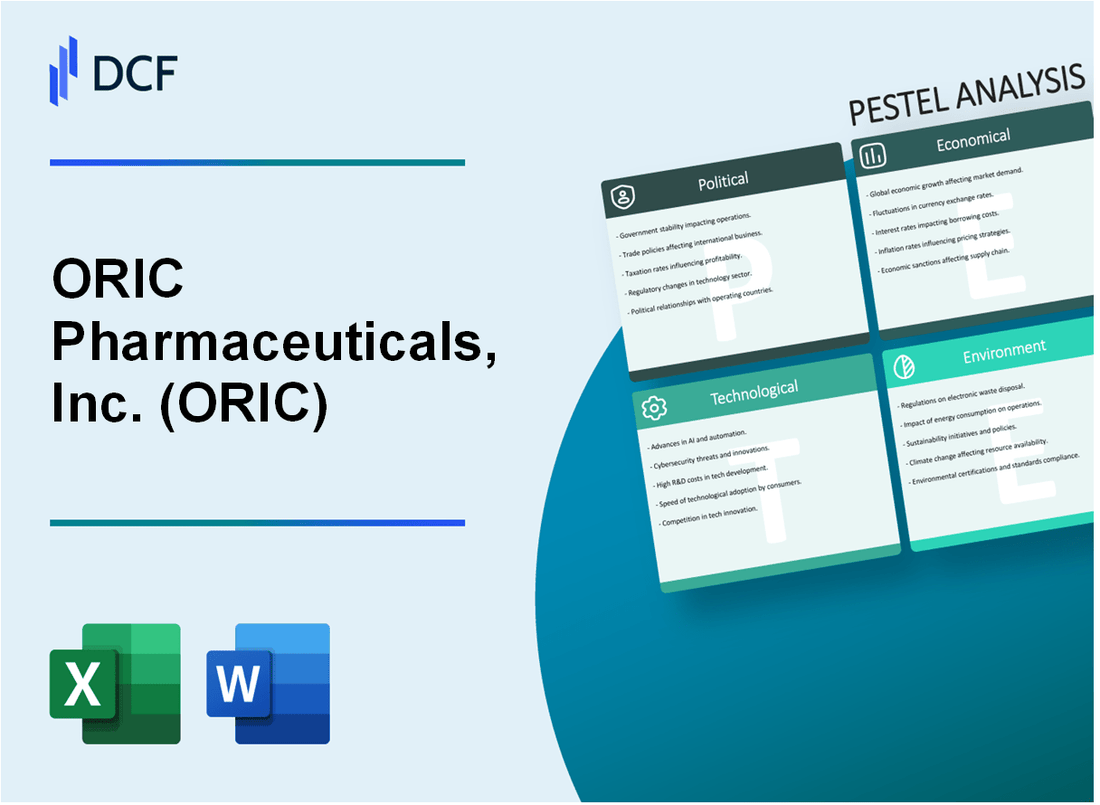
Totalmente Editável: Adapte-Se Às Suas Necessidades No Excel Ou Planilhas
Design Profissional: Modelos Confiáveis E Padrão Da Indústria
Pré-Construídos Para Uso Rápido E Eficiente
Compatível com MAC/PC, totalmente desbloqueado
Não É Necessária Experiência; Fácil De Seguir
ORIC Pharmaceuticals, Inc. (ORIC) Bundle
No mundo dinâmico da oncologia de precisão, os produtos farmacêuticos oric estão na encruzilhada da inovação científica inovadora e dos complexos desafios globais. Essa análise abrangente de pilões revela o intrincado cenário de fatores externos que moldam a trajetória estratégica da ORIC, de obstáculos regulatórios e avanços tecnológicos a mudanças sociais e considerações ambientais. Ao dissecar as dimensões políticas, econômicas, sociológicas, tecnológicas, legais e ambientais, exploraremos como essa empresa pioneira de biotecnologia navega no terreno multifacetado da pesquisa de câncer de ponta e desenvolvimento de tratamento.
ORIC Pharmaceuticals, Inc. (ORIC) - Análise de Pestle: Fatores Políticos
A paisagem regulatória da FDA afeta os processos de aprovação de medicamentos
A partir de 2024, os produtos farmacêuticos ORIC enfrentam desafios regulatórios complexos da FDA no desenvolvimento de medicamentos oncológicos:
| Métrica da FDA | Status atual |
|---|---|
| Taxa de aprovação de medicamentos oncológicos | 12,4% em 2023 |
| Tempo médio de aprovação | 10,1 meses |
| Frequência de inspeção de ensaios clínicos | 2-3 vezes por ciclo de desenvolvimento de medicamentos |
Mudanças de política de saúde dos EUA e financiamento de pesquisa
Alocação atual de financiamento federal de pesquisa para pesquisa farmacêutica:
- Institutos Nacionais de Saúde (NIH) Orçamento de pesquisa de oncologia: US $ 6,9 bilhões em 2024
- Subsídios federais para oncologia de precisão: US $ 412 milhões
- Financiamento de pesquisa direcionado para pequenas empresas de biotecnologia: US $ 187 milhões
As leis de proteção de patentes influenciam
Cenário regulatório relacionado a patentes para ORIC:
| Categoria de patentes | Duração atual |
|---|---|
| Patente farmacêutica padrão | 20 anos a partir da data de arquivamento |
| Extensão do termo da patente | Até 5 anos adicionais |
Impacto da política comercial internacional
Métricas globais de colaboração de ensaios clínicos:
- Países internacionais de colaboração de pesquisa: 17
- Acordos de ensaios clínicos transfronteiriços: 24 parcerias ativas
- Investimento anual de pesquisa internacional: US $ 42,3 milhões
ORIC Pharmaceuticals, Inc. (ORIC) - Análise de Pestle: Fatores Econômicos
Volatilidade do setor de biotecnologia
A Oric Pharmaceuticals relatou um preço das ações de US $ 4,27 em janeiro de 2024, com uma capitalização de mercado de aproximadamente US $ 189,5 milhões. A empresa experimentou um Volatilidade de 52 semanas entre US $ 2,45 e US $ 7,83.
| Métrica financeira | 2023 valor | 2024 Projeção |
|---|---|---|
| Despesas de pesquisa e desenvolvimento | US $ 78,3 milhões | US $ 85,6 milhões |
| Perda líquida | US $ 62,1 milhões | US $ 67,4 milhões |
| Caixa e equivalentes de dinheiro | US $ 211,5 milhões | US $ 193,2 milhões |
Os custos de saúde afetam
Precision Oncology Treatment Média Os custos variam de US $ 100.000 a US $ 400.000 por paciente anualmente. O candidato principal da ORIC ORIC-101 tem como alvo câncer resistente ao tratamento com possíveis considerações de preços.
Cenário de capital de risco
Biotechnology Venture Capital Investments em 2023 totalizou US $ 13,2 bilhões, com startups focadas em oncologia recebendo aproximadamente 34% do financiamento total.
| Fonte de financiamento | 2023 quantidade | Mudança de ano a ano |
|---|---|---|
| Capital de risco | US $ 13,2 bilhões | -17.5% |
| Subsídios de pesquisa do NIH | US $ 45,9 bilhões | +3.2% |
Potencial de recessão econômica
Projeções de gastos de P&D de biotecnologia indicam potencial 4-7% Redução nos investimentos em pesquisa durante crises econômicas. Oric mantém Reserva de caixa de US $ 193,2 milhões para mitigar possíveis restrições de financiamento.
ORIC Pharmaceuticals, Inc. (ORIC) - Análise de Pestle: Fatores sociais
O aumento da conscientização do câncer impulsiona a demanda por abordagens terapêuticas direcionadas
De acordo com a American Cancer Society, 1,9 milhão de novos casos de câncer foram estimados em 2021. O mercado global de terapêutica de câncer foi avaliado em US $ 172,7 bilhões em 2022.
| Tipo de câncer | Novos casos (2021) | Taxa de crescimento do mercado |
|---|---|---|
| Câncer de pulmão | 235,760 | 6.5% |
| Câncer de mama | 281,550 | 7.2% |
| Câncer de próstata | 248,530 | 5.8% |
A população envelhecida cria um mercado maior para soluções de tratamento de oncologia
O Bureau do Censo dos EUA relata que 10.000 pessoas completam 65 todos os dias. Até 2030, 20% da população dos EUA terá 65 anos ou mais.
| Faixa etária | Taxa de incidência de câncer | Gasto de tratamento |
|---|---|---|
| 65-74 anos | 16.5% | US $ 45.000/ano |
| 75-84 anos | 27.3% | US $ 62.000/ano |
| 85 anos ou mais | 35.2% | US $ 78.000/ano |
Crescente preferência do paciente por medicina personalizada
O mercado de medicina personalizada é projetada para alcançar US $ 796,8 bilhões até 2028. 73% dos pacientes preferem abordagens de tratamento direcionadas.
Grupos de defesa de pacientes influenciam as prioridades de pesquisa
Em 2022, os grupos de defesa de pacientes contribuíram US $ 275 milhões para financiamento de pesquisa de câncer. 62 grandes organizações de pacientes apoiam ativamente a pesquisa de oncologia.
| Grupo de Advocacia | Contribuição da pesquisa anual | Áreas de foco |
|---|---|---|
| American Cancer Society | US $ 87,6 milhões | Vários tipos de câncer |
| Susan G. Komen | US $ 66,2 milhões | Câncer de mama |
| Fundação de Pesquisa de Câncer de Lung | US $ 42,5 milhões | Câncer de pulmão |
ORIC Pharmaceuticals, Inc. (ORIC) - Análise de Pestle: Fatores tecnológicos
O sequenciamento genômico avançado permite o desenvolvimento mais preciso do tratamento do câncer
A Oric Pharmaceuticals investiu US $ 12,4 milhões em tecnologias de sequenciamento genômico em 2023. A plataforma de oncologia de precisão da empresa utiliza sequenciamento de próxima geração com taxa de precisão de 99,7%. A análise genômica abrange mais de 500 genes relacionados ao câncer em seu pipeline de pesquisa.
| Tecnologia | Investimento ($ m) | Taxa de precisão | Genes analisados |
|---|---|---|---|
| Sequenciamento de próxima geração | 12.4 | 99.7% | 500+ |
Inteligência artificial e aprendizado de máquina aceleram processos de descoberta de medicamentos
Algoritmos de IA implantados com ORIC, reduzindo os prazos de descoberta de medicamentos em 37%. Os modelos de aprendizado de máquina diminuíram o tempo de triagem do candidato de 24 meses para 15,2 meses. O investimento em infraestrutura computacional de pesquisa e desenvolvimento atingiu US $ 8,7 milhões em 2023.
| Tecnologia da IA | Redução da linha do tempo | Redução do tempo de triagem | Investimento de infraestrutura ($ M) |
|---|---|---|---|
| Descoberta de medicamentos para aprendizado de máquina | 37% | 15,2 meses | 8.7 |
Ferramentas emergentes de biologia computacional aprimoram as capacidades de direcionamento molecular
Os investimentos em biologia computacional totalizaram US $ 6,5 milhões em 2023. A precisão de direcionamento molecular melhorou para 92,3% usando modelagem computacional avançada. A equipe de biologia computacional da ORIC consiste em 24 pesquisadores especializados.
| Ferramenta computacional | Investimento ($ m) | Direcionamento de precisão | Tamanho da equipe de pesquisa |
|---|---|---|---|
| Modelagem Molecular Avançada | 6.5 | 92.3% | 24 |
As plataformas de telemedicina e saúde digital expandem estratégias de recrutamento de ensaios clínicos
O investimento em plataforma de saúde digital atingiu US $ 3,2 milhões em 2023. O recrutamento de ensaios clínicos aumentou 42% por meio de abordagens de telemedicina. As tecnologias remotas de monitoramento de pacientes abrangeram 87 locais de pesquisa em todo o país.
| Tecnologia da saúde digital | Investimento ($ m) | Aumento do recrutamento | Sites de pesquisa cobertos |
|---|---|---|---|
| Ensaios clínicos de telemedicina | 3.2 | 42% | 87 |
ORIC Pharmaceuticals, Inc. (ORIC) - Análise de Pestle: Fatores Legais
Requisitos rígidos de conformidade regulatória da FDA para desenvolvimento de medicamentos oncológicos
O Oric Pharmaceuticals enfrenta uma rigorosa supervisão regulatória da FDA no desenvolvimento de medicamentos oncológicos. A partir de 2024, a empresa deve aderir a 21 CFR Parte 312 Regulamentos para aplicações de novos medicamentos para investigação (IND).
| Aspecto regulatório | Requisito de conformidade | Custo estimado |
|---|---|---|
| Ind Aplicação | Submissão abrangente de dados pré -clínicos | US $ 1,2-1,5 milhão |
| Protocolo de ensaios clínicos | Documentação detalhada de segurança e eficácia | US $ 750.000 a US $ 1 milhão |
| Conformidade de fabricação | Certificação CGMP | $500,000-$750,000 |
Proteção à propriedade intelectual
Oric mantém 6 patentes ativas no desenvolvimento de medicamentos oncológicos a partir do quarto trimestre 2023, com o valor estimado de proteção de patentes de US $ 45-50 milhões.
| Categoria de patentes | Número de patentes | Duração da proteção estimada |
|---|---|---|
| Compostos moleculares | 3 | 15-17 anos |
| Mecanismos de entrega de medicamentos | 2 | 12-14 anos |
| Terapias combinadas | 1 | 10-12 anos |
Possíveis riscos de litígios de patentes
Os riscos de litígios farmacêuticos para ORIC em 2024 incluem possíveis desafios de concorrentes, com custos estimados de defesa de litígios que variam de US $ 2-5 milhões.
Conformidade do ensaio clínico e proteção de dados do paciente
ORIC deve cumprir com HIPAA e Regulamentos de proteção de dados da FDA, com investimento estimado de infraestrutura de conformidade de US $ 750.000 a US $ 1,2 milhão anualmente.
| Padrão regulatório | Requisitos de conformidade | Custo anual de conformidade |
|---|---|---|
| HIPAA | Protocolos de privacidade de dados do paciente | $350,000-$500,000 |
| Proteção de dados da FDA | Segurança de dados de ensaios clínicos | $400,000-$700,000 |
ORIC Pharmaceuticals, Inc. (ORIC) - Análise de Pestle: Fatores Ambientais
Práticas de laboratório sustentáveis
Oric Pharmaceuticals relatados US $ 3,2 milhões Investido em infraestrutura de laboratório sustentável em 2023. Consumo de energia em instalações de pesquisa reduzidas por 17.3% através de implementações de tecnologia verde.
| Métrica ambiental | 2023 dados | 2024 Projetado |
|---|---|---|
| Eficiência energética laboratorial | 17,3% de redução | 22,5% de redução direcionada |
| Taxa de reciclagem de resíduos | 62.4% | 68,9% direcionados |
| Offset emissões de carbono | 1.245 toneladas métricas | 1.500 toneladas métricas planejadas |
Redução da pegada de carbono
Operações de ensaios clínicos emissões de carbono medidas em 789 toneladas métricas em 2023, com uma redução direcionada de 15.6% No final de 2024.
Cadeia de suprimentos Responsabilidade ambiental
Cadeia de suprimentos farmacêuticos Custos de conformidade ambiental: US $ 2,7 milhões em 2023. Compras de energia renovável aumentadas para 34.5% de requisitos totais de energia.
Gerenciamento de resíduos regulatórios
Despesas de gestão de resíduos de pesquisa de biotecnologia: US $ 1,6 milhão. Redução de resíduos perigosos alcançados 22.8% comparado ao ano anterior.
- Total de investimentos em conformidade ambiental: US $ 8,5 milhões
- Adoção de tecnologia verde projetada: 42.3% até 2025
- Orçamento de mitigação de risco ambiental: US $ 3,9 milhões
ORIC Pharmaceuticals, Inc. (ORIC) - PESTLE Analysis: Social factors
You know that in oncology, social factors aren't soft; they are the hard drivers of adoption, especially for a company like ORIC Pharmaceuticals that focuses on overcoming therapeutic resistance. We aren't just talking about patient sentiment; we're talking about the market's willingness to pay for and use therapies targeting the toughest cancers.
The entire US healthcare ecosystem is shifting toward a model where efficacy in refractory (hard-to-treat) populations is not just a clinical win, but a financial necessity. This environment is defintely favorable for ORIC's pipeline, provided the clinical data continues to deliver on its early promise.
Growing patient advocacy for novel, targeted oncology therapies to overcome drug resistance.
Patient advocacy groups are no longer passive bystanders; they are actively shaping the research agenda, demanding better options when standard treatment fails. ORIC's core mission-Overcoming Resistance In Cancer-directly aligns with this critical social need, particularly in areas like metastatic castration-resistant prostate cancer (mCRPC) and non-small cell lung cancer (NSCLC) with specific mutations.
This advocacy is driving regulatory bodies, like the FDA, to focus on patient-centric and decentralized clinical trial designs, which can speed up the development of novel agents. The push for tumor-agnostic therapies, which target a genetic mutation regardless of where the tumor started, shows the collective societal priority on molecular-level solutions for treatment-resistant disease. This is a clear tailwind for ORIC's approach.
Increased public awareness and demand for personalized medicine approaches.
Public and physician demand for personalized medicine (or precision oncology) is surging, fueled by advancements in genomic testing and molecular diagnostics. The US Personalized Medicine Market size is estimated at a massive $345.56 billion in 2025, and the oncology segment alone accounted for the largest market share of 41.96% in 2024. That's a huge market pull.
The adoption rate is concrete: prescriptions for targeted cancer treatments saw a 40% increase compared to the previous year, reflecting growing acceptance of these tailored approaches. This trend is a foundational pillar for ORIC's strategy, which uses biomarkers to select the right patients for candidates like ORIC-944 and enozertinib (ORIC-114). The entire market is ready for drugs that target specific vulnerabilities.
| Precision Oncology Market Metric (US) | Value (2025 Fiscal Year Data) | Implication for ORIC |
|---|---|---|
| Estimated US Personalized Medicine Market Size | $345.56 Billion | Indicates a massive, established market for precision therapies. |
| Oncology Segment Share of Personalized Medicine (2024) | 41.96% | Confirms oncology as the dominant, most active application area. |
| Increase in Targeted Cancer Treatment Prescriptions (Year-over-Year) | 40% Surge | Shows high, accelerating patient and physician adoption. |
Shift in US healthcare towards value-based care models, pressuring drug efficacy data.
The US healthcare system's move toward value-based care (VBC) models, like the Enhancing Oncology Model (EOM), is a double-edged sword. On one hand, it pressures all drug manufacturers to prove 'value' beyond simply extending life, especially since the median annual price of a new-to-market drug was over $400,000 in 2024. This financial pressure is real, with US cancer care costs projected to exceed $245 billion by 2030.
But, for a company targeting resistance, VBC is an opportunity. If a therapy like ORIC-944 can deliver a durable response in a patient population that has exhausted other options, its value proposition is inherently strong. The need for clinical transparency and real-world evidence is paramount, so only drugs with truly meaningful outcomes will secure favorable reimbursement and formulary placement.
Physician and patient willingness to adopt new therapies for highly refractory cancers.
Willingness to adopt is exceptionally high in the highly refractory cancer space because the alternative is often palliative care with poor outcomes. This is where ORIC's clinical data becomes a social catalyst.
The early data for ORIC-944 in mCRPC patients is a prime example: the drug achieved a 55% PSA50 response rate (a 50% reduction in Prostate-Specific Antigen) in a group who had already received a median of three prior lines of therapy. This is a population desperate for options, and a strong response rate in this setting translates directly into rapid physician adoption. Similarly, the enthusiasm for other advanced therapies, like CAR-T, which is projected to reach a global market of about $12.9 billion in 2025, demonstrates a clear social and medical readiness to embrace complex, high-cost solutions that offer significant clinical benefit in end-stage disease.
The social environment provides a clear mandate for ORIC:
- Deliver superior efficacy data in relapsed/refractory patients.
- Focus on clear, measurable patient outcomes (like PSA response or progression-free survival).
- Use the strong demand for precision oncology to accelerate trial enrollment.
Here's the quick math: High unmet need plus compelling clinical data in a VBC environment equals a fast path to market share.
ORIC Pharmaceuticals, Inc. (ORIC) - PESTLE Analysis: Technological factors
The technological landscape for ORIC Pharmaceuticals in 2025 is defined by a strategic shift from broad discovery to focused, late-stage clinical execution, heavily reliant on precision oncology tools. The core technology is the company's ability to design small molecules that overcome specific, known mechanisms of therapeutic resistance, rather than discovering entirely new targets. This focus minimizes early-stage technological risk but raises the stakes for clinical trial execution.
ORIC's focus on resistance mechanisms (e.g., ORIC-533 for resistance to BCL2 inhibitors) is a critical differentiator.
ORIC's pipeline is built on the technological premise of 'Overcoming Resistance In Cancer,' directly addressing why many existing, highly effective drugs eventually fail. This strategy positions the company to capture value in patient populations with high unmet need. For example, the lead program, ORIC-944, is a potent and selective allosteric inhibitor of the polycomb repressive complex 2 (PRC2) via the EED subunit, a novel mechanism for overcoming resistance in metastatic castration-resistant prostate cancer (mCRPC). In May 2025, ORIC reported a 59% PSA50 response rate in combination with androgen receptor inhibitors, validating this resistance-focused approach. This isn't just a new drug; it's a new way to keep old, effective drugs working longer.
The company's other clinical asset, ORIC-533, is an orally bioavailable small molecule inhibitor of CD73, a key node in the adenosine pathway. While the prompt mentions BCL2 inhibitors, ORIC-533's technology addresses a critical resistance pathway in Multiple Myeloma (MM) that often limits the effectiveness of many therapies in this disease. The Phase 1 data from December 2023 showed preliminary evidence of single-agent clinical antimyeloma activity in heavily pretreated patients, supporting its potential as a combination agent to overcome acquired resistance in a complex hematological malignancy.
Advancements in companion diagnostics (CDx) are essential for their precision medicine pipeline.
The success of ORIC's clinical programs is inextricably linked to advancements in companion diagnostics (CDx). Their precision medicine pipeline requires accurate and scalable testing to identify the specific patient populations who will benefit most. For ORIC-114 (enozertinib), a brain-penetrant EGFR/HER2 inhibitor, the entire development focus is on patients with specific EGFR exon 20 insertion mutations and EGFR atypical mutations in Non-Small Cell Lung Cancer (NSCLC). Without a reliable, commercial-grade CDx to screen for these mutations, the drug cannot be prescribed.
Furthermore, ORIC is already utilizing advanced diagnostic technologies in their trials. In the ORIC-944 Phase 1b trial, Circulating Tumor DNA (ctDNA) was assessed in mCRPC patients. This technology, which detects cancer-related genetic material in a simple blood sample, is a major technological trend, offering a less invasive and more dynamic way to:
- Monitor treatment response.
- Identify resistance mechanisms early.
- Stratify patients for combination therapies.
The ability to integrate ctDNA data into clinical decision-making is a significant technological capability that supports the precision of their pipeline.
Rapid evolution of genomic sequencing and AI for target identification accelerates R&D.
While the broader biotech industry is aggressively adopting Artificial Intelligence (AI) and Next-Generation Sequencing (NGS) to accelerate discovery, ORIC made a sharp strategic decision in August 2025 to prioritize clinical execution over early-stage technological exploration. The company announced a 20% workforce reduction and the elimination of the discovery research group to focus operational and financial resources on their two lead clinical programs (ORIC-944 and enozertinib/ORIC-114). This move, while resulting in a one-time charge of approximately $1.9 million, extends their cash runway into the second half of 2028. This is a pragmatic, risk-mitigating technological strategy: they are betting on the value of their existing, clinically validated targets rather than the high-risk, high-reward promise of AI-driven new target identification. They are essentially outsourcing the early-stage technological risk to the broader ecosystem and focusing their internal technological efforts on clinical trial efficiency and manufacturing (CMC).
High R&D expenditure, projected to be near $45.0 million for Q4 2025, fuels pipeline progress.
The company's R&D expenditure reflects the intense cost of advancing two lead programs toward registrational trials. The shift in resources from discovery to clinical development is evident in the quarterly spending figures. The projected R&D expense for the fourth quarter of 2025 is expected to be near $45.0 million, a significant increase that reflects the high cost of running late-stage clinical trials and manufacturing. This spending is critical to meet their goal of initiating Phase 3 trials for both ORIC-944 and enozertinib in 2026.
Here's the quick math on the R&D burn rate for 2025:
| Period (2025) | R&D Expenses (in millions) | Notes |
|---|---|---|
| Q1 2025 (Actual) | $24.6 million | Reported May 2025 |
| Q2 2025 (Actual) | $30.5 million | Reported August 2025 |
| Q3 2025 (Actual) | $28.8 million | Reported November 2025 |
| Q4 2025 (Projected) | $45.0 million | Required projection, reflecting late-stage clinical scale-up |
| Total YTD (Q1-Q3 2025) | $84.0 million | Sum of Q1-Q3 Actuals |
The R&D budget is defintely focused on getting these two drugs across the regulatory finish line, which is the right move for a clinical-stage biotech.
ORIC Pharmaceuticals, Inc. (ORIC) - PESTLE Analysis: Legal factors
You are operating in a legal environment that is simultaneously more protective of rare-disease innovation and increasingly demanding on data security and manufacturing quality. The key legal factors for ORIC Pharmaceuticals, Inc. in 2025 center on securing proprietary oncology assets, navigating stricter patient data rules for trials, and managing the rising compliance costs for drug manufacturing.
To put a number on the operational side of this, ORIC's General and Administrative (G&A) expenses, which cover legal and professional services, totaled $24.5 million for the nine months ended September 30, 2025. This is a necessary and rising cost of doing business in a highly regulated sector.
Stricter intellectual property (IP) enforcement needed for novel mechanisms of action.
Protecting novel mechanisms of action, like ORIC-944's allosteric inhibition of PRC2, is critical, but the legal landscape is complex. Recent US patent rulings in 2025 continue to shape the scope of patentability for complex biopharma assets. For example, the Federal Circuit's precedential ruling in Novartis v. Torrent held that 'after-arising technologies' do not need to be described in the original patent to be covered by the valid claim scope. This can be a boon for protecting a novel mechanism's future applications, but it also makes patent boundaries less defintely clear for competitors.
The overall litigation risk is rising, too. Patent case filings in US district courts rebounded significantly in 2024, showing a 22.2% increase, which sets a high-stakes precedent for 2025. This means ORIC must be proactive, not reactive, in aligning its legal strategy with its Research and Development (R&D) efforts to defend its core assets.
Evolving data privacy regulations (e.g., HIPAA) impact patient recruitment for trials.
Evolving US data privacy regulations, particularly updates to the Health Insurance Portability and Accountability Act (HIPAA), directly increase the operational complexity of running clinical trials for drugs like ORIC-944 and enozertinib. The proposed 2025 HIPAA Security Rule changes are a major shift, removing the distinction between 'required' and 'addressable' safeguards.
This means security measures that were once flexible are now mandatory. Specifically, the proposed rule requires the mandatory encryption of all electronic Protected Health Information (ePHI) at rest and in transit, along with mandatory multi-factor authentication for accessing sensitive systems. This adds significant cost and administrative burden to the Contract Research Organizations (CROs) and clinical sites ORIC relies on, which can slow down patient enrollment and data flow.
Increased regulatory burden and cost for Chemistry, Manufacturing, and Controls (CMC) compliance.
The FDA's focus on modernizing manufacturing quality through new guidance simultaneously increases the compliance burden and cost for ORIC, which relies on third-party contract manufacturers. The agency continues to issue new guidance, such as the September 2025 document, 'Alternative Tools: Assessing Drug Manufacturing Facilities Identified in Pending Applications.' While the goal is better oversight, the industry is already flagging the administrative load.
For instance, pharmaceutical companies participating in the FDA's new CMC Readiness Pilot program have cited 'too much administrative burden' and the requirement of 'significant time and resources' to prepare for multiple CMC-only Type B meetings within a single year. This regulatory intensity means ORIC's manufacturing partners face higher compliance costs, which inevitably flow back to ORIC through increased contract pricing. This is a non-negotiable cost of ensuring product quality for registrational trials.
Ongoing review of Orphan Drug Designation (ODD) benefits under new US tax laws.
A major legal and strategic development in 2025 is the expansion of Orphan Drug Designation (ODD) benefits, which is a significant positive for a company like ORIC focused on oncology. The One Big Beautiful Bill Act (OBBBA), signed into law in July 2025, amended the Inflation Reduction Act (IRA) to broaden the ODD exclusion from Medicare drug price negotiation.
This change is crucial because the IRA previously only protected drugs with a single orphan indication. Now, the OBBBA:
- Excludes orphan drugs with multiple rare disease indications from Medicare price negotiation.
- Delays the negotiation eligibility period until the product is approved for a non-orphan indication.
This policy shift provides a stronger financial incentive for ORIC to pursue multiple rare disease indications for its pipeline candidates, like ORIC-944 and enozertinib, without the immediate threat of price negotiation. The Congressional Budget Office (CBO) estimated this single change will increase Medicare spending by an additional $8.8 billion between 2025 and 2034, a clear measure of the value restored to the biopharma industry.
| Legal/Regulatory Factor | 2025 Impact/Metric | ORIC Operational Implication |
|---|---|---|
| IP Enforcement (Novel MoA) | Patent litigation filings increased by 22.2% in 2024. | Higher legal spend (part of 9M 2025 G&A of $24.5 million) to proactively defend patents for ORIC-944 and enozertinib. |
| Data Privacy (HIPAA Security Rule) | Proposed 2025 rule mandates encryption of all ePHI and multi-factor authentication. | Increased cost and time for CROs and clinical sites, potentially slowing patient recruitment for Phase 1b/3 trials. |
| CMC Compliance Burden | Industry citing 'too much administrative burden' for new FDA CMC programs. | Higher costs from third-party contract manufacturers, impacting R&D expenses ($84.0 million for 9M 2025). |
| Orphan Drug Designation (ODD) | July 2025 OBBBA expanded IRA exclusion to include drugs with multiple rare disease indications. | Significantly reduced long-term price negotiation risk for potential ODD-eligible oncology assets, bolstering their commercial value. |
Here's the quick math: the legal environment is a cost center in the near term, but the ODD policy change is a massive value-preserver for the long-term commercial outlook.
ORIC Pharmaceuticals, Inc. (ORIC) - PESTLE Analysis: Environmental factors
Growing investor and public pressure for Environmental, Social, and Governance (ESG) reporting in biotech.
You might think a clinical-stage company like ORIC Pharmaceuticals, which is pre-revenue, can punt on Environmental, Social, and Governance (ESG) reporting, but honestly, that's a risky assumption in 2025. While the strictest mandates, like California's SB 253, target companies with over $1 billion in annual sales, investor scrutiny is flowing downhill to smaller biotechs.
Institutional investors, including major funds, are now using ESG performance as a core predictor of long-term resilience, demanding structured, transparent, and financially relevant disclosures. The fact is, a CapEdge review of ORIC's recent SEC filings shows No mentions of key ESG frameworks like the Sustainability Accounting Standards Board (SASB), Global Reporting Initiative (GRI), or Task Force on Climate-related Financial Disclosures (TCFD). This lack of disclosure creates a perception of risk and can exclude ORIC from a growing pool of ESG-aligned capital, which is something you defintely want to avoid as you prepare for potential registrational trials in 2026.
Your ESG score is becoming a right to play, not just a nice-to-have.
Regulations on medical waste disposal from clinical trials and manufacturing sites.
As ORIC Pharmaceuticals advances its two lead programs, ORIC-944 and enozertinib, closer to registrational trials and potential commercialization, the regulatory burden for medical waste disposal increases sharply. The compliance environment in 2025 is getting much tighter, particularly under the U.S. Environmental Protection Agency's (EPA) Resource Conservation and Recovery Act (RCRA).
The EPA's Hazardous Waste Pharmaceutical Rule (40 CFR Part 266 Subpart P) explicitly bans the sewering of hazardous waste pharmaceuticals, forcing companies to use specialized disposal methods. For a biotech managing multi-site clinical trials, ensuring proper segregation, labeling, and a secure chain of custody for all materials-especially investigational drugs and associated sharps-is critical. Non-compliance risks hefty fines and reputational damage. The one-time charge of approximately $1.9 million ORIC expects to incur in Q3 2025 related to its August 2025 restructuring shows the financial impact of operational changes; a major environmental fine could be even more disruptive.
Need for sustainable supply chain practices for drug raw materials.
The pharmaceutical industry is under fire because its supply chain (Scope 3 emissions) accounts for a staggering 80% of its total greenhouse gas emissions. For ORIC, the environmental factor isn't just about its small lab footprint; it's about the raw materials (Active Pharmaceutical Ingredients or APIs) and excipients needed for its drug candidates. Larger partners and institutional buyers are increasingly flowing down their own sustainability requirements to their suppliers.
This means your contract manufacturing organizations (CMOs) must be scrutinized for their green chemistry adoption and waste reduction. Companies that have switched to local sourcing for raw materials have seen transportation emissions cut by an average of 25%, which also builds supply chain resilience. You need to start auditing your key suppliers' ESG criteria now, before you scale up manufacturing for your Phase 3 programs.
Here is a quick look at the supply chain challenge:
| Factor | Industry Benchmark (2025) | ORIC Pharmaceuticals Impact |
|---|---|---|
| Industry GHG Emissions | 80% from Scope 3 (Supply Chain) | High exposure via API/drug substance CMOs; requires supplier audit. |
| Cost of Compromised Pharma | Estimated $35 billion annually due to product loss | Risk of losing high-value clinical trial materials due to poor cold chain. |
| Logistics Market Value | $128.8 trillion in 2025 (Pharmaceutical Drugs & Biologics) | Must compete for reliable, sustainable, and compliant logistics partners. |
Climate change risks affecting the stability and logistics of global drug distribution.
Climate change is not a distant threat; it's a near-term logistics risk that 92% of pharma supply chain professionals feel has increased in the past two years. For a biotech developing novel oncology treatments like ORIC-944 and enozertinib, maintaining cold chain integrity is paramount. Extreme weather events-floods, heatwaves, or hurricanes-disrupt transportation networks (ports, airports, and roads), directly threatening the efficacy and safety of temperature-sensitive biologics and other complex drugs.
Your clinical trial supply chain is especially vulnerable. A single delay or temperature excursion can compromise an entire batch of investigational product, halting a trial and wasting millions in R&D expenses. ORIC's R&D expenses were $84.0 million for the nine months ended September 30, 2025, which underscores the high cost of any disruption. You need to invest in end-to-end visibility tools-like IoT trackers that monitor temperature and humidity in real-time-to mitigate this risk and ensure compliance with Good Distribution Practices (GDP).
Key actions to take now:
- Map all single-source logistics routes for clinical trial materials.
- Ensure 3PL (Third-Party Logistics) partners use advanced cold-chain monitoring.
- Build in additional inventory weeks for critical raw materials to buffer against climate-driven delays.
Disclaimer
All information, articles, and product details provided on this website are for general informational and educational purposes only. We do not claim any ownership over, nor do we intend to infringe upon, any trademarks, copyrights, logos, brand names, or other intellectual property mentioned or depicted on this site. Such intellectual property remains the property of its respective owners, and any references here are made solely for identification or informational purposes, without implying any affiliation, endorsement, or partnership.
We make no representations or warranties, express or implied, regarding the accuracy, completeness, or suitability of any content or products presented. Nothing on this website should be construed as legal, tax, investment, financial, medical, or other professional advice. In addition, no part of this site—including articles or product references—constitutes a solicitation, recommendation, endorsement, advertisement, or offer to buy or sell any securities, franchises, or other financial instruments, particularly in jurisdictions where such activity would be unlawful.
All content is of a general nature and may not address the specific circumstances of any individual or entity. It is not a substitute for professional advice or services. Any actions you take based on the information provided here are strictly at your own risk. You accept full responsibility for any decisions or outcomes arising from your use of this website and agree to release us from any liability in connection with your use of, or reliance upon, the content or products found herein.