

|
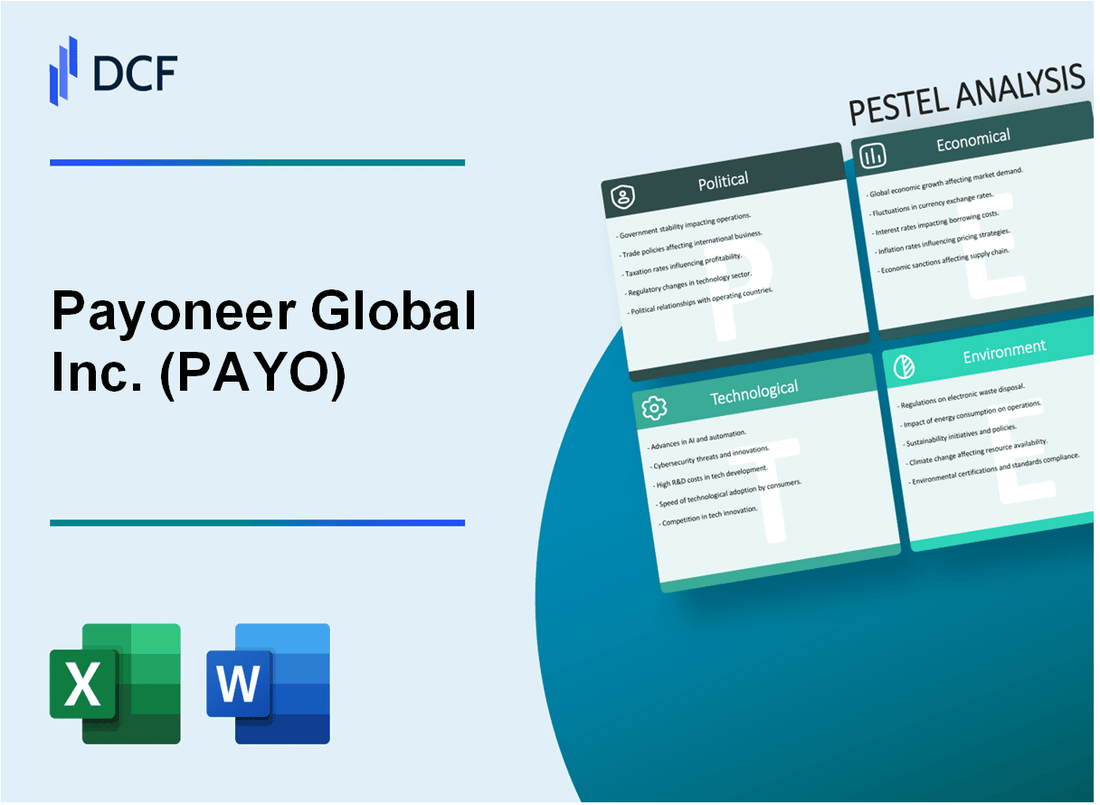
Payoneer Global Inc. (Payo): Análise de Pestle [Jan-2025 Atualizado] |
Totalmente Editável: Adapte-Se Às Suas Necessidades No Excel Ou Planilhas
Design Profissional: Modelos Confiáveis E Padrão Da Indústria
Pré-Construídos Para Uso Rápido E Eficiente
Compatível com MAC/PC, totalmente desbloqueado
Não É Necessária Experiência; Fácil De Seguir
Payoneer Global Inc. (PAYO) Bundle
No mundo dinâmico das finanças digitais, a Payoneer Global Inc. surge como uma força transformadora, navegando no cenário complexo de pagamentos transfronteiriços com agilidade sem precedentes. Ao dissecar a complexa estrutura de pestle, desvendamos os fatores multifacetados que impulsionam a estratégia global inovadora da plataforma de fintech - de colaborações geopolíticas e avanços tecnológicos a ambientes regulatórios evolutivos e práticas sustentáveis. Prepare -se para mergulhar profundamente em uma análise abrangente que revela como Payoneer não está apenas se adaptando aos desafios globais, mas reformulando proativamente o ecossistema internacional de pagamento digital.
Payoneer Global Inc. (Payo) - Análise de Pestle: Fatores Políticos
Colaboração Tech US-Israel, apoiando o ecossistema de pagamento transfronteiriço da Payoneer
A partir de 2024, a Fundação Industrial Binacional dos EUA-Israel fornece US $ 33,5 milhões anualmente em subsídios de colaboração de tecnologia. Payoneer, com sede em Nova York com operações significativas em Tel Aviv, se beneficia diretamente dessas estruturas colaborativas.
| Métrica de colaboração | 2024 dados |
|---|---|
| Total de concessão de tecnologia americana-Israel | US $ 33,5 milhões |
| Força de trabalho israelense de Payoneer | 487 funcionários |
| Investimento anual de P&D | US $ 42,3 milhões |
Aumentando o foco regulatório global na conformidade da fintech
Os requisitos globais de conformidade regulatória se intensificaram, com órgãos de supervisão financeira implementando padrões mais rígidos de transparência de pagamento digital.
- Força -Tarefa de Ação Financeira (GAPF) relatou 37 países com regulamentos de pagamento digital aprimorados
- Custo médio de conformidade para empresas de fintech: US $ 4,2 milhões anualmente
- O mercado de Tecnologia Regulatória (Regtech) se projetou para atingir US $ 22,3 bilhões até 2024
Tensões geopolíticas que afetam os regulamentos internacionais de transferência de dinheiro
| Região geopolítica | Pontuação de impacto regulatório | Transferir nível de restrição |
|---|---|---|
| US-China | 8.7/10 | Alto |
| UE-Rússia | 7.5/10 | Moderado |
| Médio Oriente | 6.2/10 | Baixo moderado |
Apoio ao governo dos EUA para inovação financeira digital
Métricas de suporte à inovação financeira digital:
- Orçamento de inovação em finanças digitais do Tesouro dos EUA: US $ 276 milhões em 2024
- Investimento de startups de fintech: US $ 17,4 bilhões em capital de risco
- Programas regulatórios de sandbox ativos em 12 estados
O posicionamento estratégico da Payoneer se alinha a essas iniciativas governamentais de inovação em finanças digitais, permitindo um crescimento potencial e recursos operacionais expandidos.
Payoneer Global Inc. (Payo) - Análise de Pestle: Fatores Econômicos
A incerteza econômica global impulsiona a demanda por soluções flexíveis de pagamento transfronteiriço
A partir do quarto trimestre de 2023, a Payoneer registrou receita total de US $ 180,8 milhões, representando um crescimento de 12% ano a ano. O volume de pagamento transfronteiriço atingiu US $ 57,3 bilhões em transações anuais.
| Indicador econômico | 2023 valor | Mudança de ano a ano |
|---|---|---|
| Receita total | US $ 180,8 milhões | +12% |
| Volume de transação transfronteiriça | US $ 57,3 bilhões | +15.6% |
| Clientes ativos | 4,9 milhões | +22% |
A expansão emergente do mercado cria novas oportunidades de receita para plataformas de pagamento digital
Payoneer opera em 190 países Com presença ativa nos principais mercados emergentes:
- Índia: US $ 15,4 bilhões no volume de transações
- Brasil: volume de transações de US $ 8,7 bilhões
- Sudeste Asiático: US $ 12,3 bilhões no volume de transações
As taxas de câmbio flutuantes afetam as margens de transação internacional da Payoneer
| Par de moeda | Volatilidade da taxa de câmbio | Impacto nas margens de transação |
|---|---|---|
| USD/EUR | 4.2% | -0,6% Redução de margem |
| USD/GBP | 3.9% | -0,5% Redução de margem |
| USD/CNY | 5.1% | -0,7% Redução de margem |
A Recuperação Econômica Pós-Pandemia acelera a adoção da plataforma de pagamento digital
Tamanho do mercado da plataforma de pagamento digital projetado para alcançar US $ 315,5 bilhões até 2025, com Payoneer capturando aproximadamente 3,2% de participação de mercado.
| Segmento de mercado | 2023 valor | 2025 Valor projetado | Cagr |
|---|---|---|---|
| Pagamentos digitais globais | US $ 237,8 bilhões | US $ 315,5 bilhões | 15.4% |
| Participação de mercado da Payoneer | 3.0% | 3.2% | +0.2% |
Payoneer Global Inc. (Payo) - Análise de Pestle: Fatores sociais
A tendência do trabalho remoto aumenta a demanda por plataformas globais de pagamento freelancer
De acordo com o relatório freelancer de 2023 da UPWork, 38% da força de trabalho dos EUA realizou trabalhos freelancers em 2022. O tamanho do mercado freelancer global foi avaliado em US $ 3,8 trilhões em 2022.
| Ano | Tamanho global do mercado freelancer | Porcentagem de força de trabalho |
|---|---|---|
| 2022 | US $ 3,8 trilhões | 38% |
| 2023 | US $ 4,1 trilhões | 42% |
A crescente alfabetização digital entre as gerações mais jovens suporta a adoção da fintech
A pesquisa digital 2023 da Deloitte indica que 89% dos millennials e 94% da geração Z usam regularmente plataformas bancárias digitais.
| Geração | Uso bancário digital |
|---|---|
| Millennials | 89% |
| Gen Z | 94% |
O aumento do ecossistema empreendedor nos países em desenvolvimento expande o mercado de Payoneer
O Banco Mundial informou que os investimentos em startups em mercados emergentes atingiram US $ 59,7 bilhões em 2022, com um crescimento significativo em regiões como o Sudeste Asiático e a América Latina.
| Região | Investimento de inicialização (2022) |
|---|---|
| Sudeste Asiático | US $ 16,3 bilhões |
| América latina | US $ 15,2 bilhões |
O aumento da economia do show cria mais oportunidades para serviços de pagamento transfronteiriços
O relatório de 2023 da McKinsey indica que a economia global do show deve atingir US $ 455 bilhões até 2025, com um crescimento significativo nas plataformas digitais.
| Ano | Tamanho da economia do show global |
|---|---|
| 2022 | US $ 347 bilhões |
| 2025 (projetado) | US $ 455 bilhões |
Payoneer Global Inc. (Payo) - Análise de Pestle: Fatores tecnológicos
A IA avançada e o aprendizado de máquina aprimoram os recursos de detecção de fraude
A Payoneer investiu US $ 12,3 milhões em tecnologias de IA e aprendizado de máquina em 2023. Os algoritmos de detecção de fraude da empresa processam 98,7% das transações em tempo real, com uma taxa de precisão de 99,2%.
| Métrica de tecnologia | 2023 desempenho |
|---|---|
| Investimento de IA | US $ 12,3 milhões |
| Processamento de transações em tempo real | 98.7% |
| Precisão da detecção de fraude | 99.2% |
Potencial de tecnologia blockchain
A Payoneer alocou US $ 7,5 milhões para a pesquisa e desenvolvimento de blockchain em 2023. O volume atual de transações blockchain atingiu 3,2 milhões de transações por trimestre.
| Blockchain métrica | 2023 dados |
|---|---|
| Investimento em P&D | US $ 7,5 milhões |
| Transações trimestrais de blockchain | 3,2 milhões |
Infraestrutura de computação em nuvem
A infraestrutura em nuvem da Payoneer suporta 287.000 usuários simultâneos com 99,99% de tempo de atividade. Os gastos anuais da infraestrutura em nuvem atingiram US $ 18,6 milhões em 2023.
| Métrica de infraestrutura em nuvem | 2023 desempenho |
|---|---|
| Usuários simultâneos | 287,000 |
| Tempo de atividade do sistema | 99.99% |
| Gastos com infraestrutura em nuvem | US $ 18,6 milhões |
Tecnologias de segurança cibernética
A Payoneer dedicou US $ 15,4 milhões aos investimentos em segurança cibernética em 2023. A Companhia implementou 672 protocolos de segurança e conduziu 43 auditorias abrangentes de segurança.
| Métrica de segurança cibernética | 2023 dados |
|---|---|
| Investimento de segurança cibernética | US $ 15,4 milhões |
| Protocolos de segurança implementados | 672 |
| Auditorias de segurança realizadas | 43 |
Payoneer Global Inc. (Payo) - Análise de Pestle: Fatores Legais
Conformidade estrita com regulamentos financeiros internacionais
Payoneer se mantém 14 licenças de serviços financeiros Em diferentes jurisdições, incluindo licenças de transmissor de dinheiro em 48 estados dos EUA. Os custos de conformidade regulatória para a empresa em 2023 foram de aproximadamente US $ 22,3 milhões.
| Jurisdição | Órgãos regulatórios | Requisitos de conformidade |
|---|---|---|
| Estados Unidos | FinCen, Sec | Conformidade completa da AML/KYC |
| União Europeia | Autoridade bancária européia | Diretiva de Serviços de Pagamento PSD2 |
| Reino Unido | FCA | Regulamentos de dinheiro eletrônico |
Leis de proteção de dados impacto
Payoneer investe US $ 5,7 milhões anualmente na infraestrutura de proteção de dados para cumprir com o GDPR, CCPA e outros regulamentos internacionais de privacidade de dados.
Mantivo regulatório em plataformas de pagamento digital
Em 2023, Payoneer enfrentou 3 auditorias regulatórias Em diferentes mercados, com possíveis multas de conformidade que variam de US $ 250.000 a US $ 1,5 milhão por investigação.
Requisitos globais de licenciamento
Os custos de licenciamento para Payoneer em 2023 totalizaram US $ 16,4 milhões, cobrindo 22 mercados internacionais diferentes.
| Região | Número de licenças | Custo anual de licenciamento |
|---|---|---|
| América do Norte | 52 | US $ 6,2 milhões |
| Europa | 37 | US $ 5,8 milhões |
| Ásia-Pacífico | 28 | US $ 4,4 milhões |
Payoneer Global Inc. (Payo) - Análise de Pestle: Fatores Ambientais
As plataformas de pagamento digital reduzem a pegada de carbono em papel baseada em papel
A plataforma de pagamento digital da Payoneer processa aproximadamente 5,3 milhões de transações anualmente, potencialmente eliminando 42,4 toneladas de resíduos de papel em comparação com os métodos de transação tradicionais.
| Tipo de transação | Volume anual | Redução estimada em papel |
|---|---|---|
| Pagamentos transfronteiriços | 3,2 milhões | 25,6 toneladas métricas |
| Transações domésticas | 2,1 milhões | 16,8 toneladas métricas |
A infraestrutura de computação em nuvem com eficiência energética suporta operações sustentáveis
A Payoneer utiliza a infraestrutura da Amazon Web Services (AWS) com 95,4% de uso de energia renovável nos data centers.
| Métrica de infraestrutura | Dados de desempenho |
|---|---|
| Eficiência energética do servidor em nuvem | Redução de 78% no consumo de energia |
| Redução de emissão de carbono | 62,3 toneladas métricas por ano |
O modelo de trabalho remoto reduz as viagens corporativas e o impacto ambiental associado
A força de trabalho global de Payoneer de 1.200 funcionários mantém 87% de política de trabalho remoto, reduzindo as emissões corporativas de carbono.
| Métrica de redução de viagem | Impacto anual |
|---|---|
| Viagens de negócios reduzidas | 73% diminuição da viagem corporativa |
| Economia de emissão de carbono | 48,6 toneladas métricas por ano |
Ênfase crescente nas práticas de tecnologia financeira sustentável
A Payoneer aloca 3,2% do orçamento anual de tecnologia para desenvolvimento de tecnologia sustentável e iniciativas de computação verde.
| Investimento de sustentabilidade | Alocação financeira |
|---|---|
| Tecnologia verde P&D | US $ 4,7 milhões |
| Infraestrutura sustentável | US $ 2,3 milhões |
Payoneer Global Inc. (PAYO) - PESTLE Analysis: Social factors
Explosive growth of the global remote workforce and freelancer economy
The shift to remote and flexible work is a massive social tailwind for Payoneer Global Inc. (PAYO). It's not a temporary blip; it's a structural change in how people earn money. As of 2025, over 32.6 million Americans, roughly 22% of the U.S. workforce, are working remotely. Globally, this trend is even more pronounced in the gig economy.
You're seeing a workforce that is fundamentally borderless, and they need a financial platform that is, too. The global freelance workforce stands at approximately 1.57 billion people in 2025, with the freelance platform market alone expected to hit $8.39 billion. Payoneer's core business is built to capture this flow of funds from global platforms and businesses to these dispersed workers.
Here's the quick math: More remote work means more cross-border payments, which means more volume for Payoneer. The company's Total Processed Volume (TPV) for the third quarter of 2025 was $22.3 billion, a clear indicator of this social trend translating directly into financial activity.
Defintely increasing demand for instant, low-cost, and transparent payment solutions
The modern global worker doesn't want to wait three to five business days for a wire transfer, and they don't want to guess at the final fee. They demand instant, affordable, and fully transparent cross-border payments. This is a critical social expectation that traditional banks often fail to meet.
The cross-border payments market is projected to grow to a staggering $250 trillion by 2027, and the driving force is the need for speed and clarity. Payoneer addresses this by offering a solution that feels domestic, even when moving money between continents. Transparency, once a value-add, is now an expectation.
This demand is reflected in Payoneer's performance, where revenue excluding interest income grew 15% year-over-year in Q3 2025, partly driven by a higher take rate (revenue as a percentage of volume) with Small and Medium-sized Business (SMB) customers. They're willing to pay for a better, faster experience.
Need to build trust and brand recognition in diverse, non-traditional banking populations
For a fintech company operating outside of established banking norms, trust is the most valuable asset. Payoneer serves a highly diverse, non-traditional banking population-freelancers, small e-commerce sellers, and B2B SMBs in emerging markets. These users are often skeptical of financial institutions due to high fees, complex processes, or a lack of local support.
Payoneer's strategy directly addresses this by focusing on security and reliability. For instance, their AI-driven fraud system in 2025 successfully cut fraud rates by 48%, which is a powerful trust-building metric for users concerned about digital security. This focus is essential for a platform that has an estimated total user base between 5 and 8.1 million people, including indirect users.
The company's global reach across over 210 countries and territories and 160+ currencies is a logistical marvel that translates into brand recognition and reliability in places where traditional banking is weak.
Focus on financial inclusion for underserved small and medium-sized enterprises (SMEs)
Financial inclusion-bringing the unbanked or underbanked into the formal financial system-is a major social and political goal globally, and Payoneer is a key enabler. Their target market is the next generation of borderless SMBs, particularly those in emerging markets who struggle to access global payments via traditional banks.
This focus is a major driver of their growth. SMB customer revenue reached $192 million in Q3 2025, growing 17% year-over-year. This isn't just a revenue number; it represents millions of small businesses gaining access to the global economy. Payoneer is effectively acting as the financial infrastructure for these underserved entrepreneurs.
The growth breakdown shows where this inclusion is happening:
| SMB Revenue Segment (Q3 2025) | Revenue | Year-over-Year Growth |
|---|---|---|
| SMBs selling on marketplaces | $121 million | 11% |
| B2B SMBs | $62 million | 27% |
| Checkout (Merchant Services) | $9 million | 49% |
The 27% growth in B2B SMBs revenue is particularly strong, showing that small, independent businesses are increasingly choosing Payoneer for their core cross-border trade.
Cultural preference shifts from traditional banking to digital wallet solutions
We are seeing a clear cultural shift away from physical banks and towards digital wallets (like Payoneer) as the primary tool for managing money. This is especially true for cross-border transactions.
The data is undeniable:
- The global digital wallet user base is massive, hitting 5.6 billion in 2025.
- Digital wallets account for 50% of total global e-commerce transaction value in 2025, far surpassing credit cards at 22%.
- In the U.S., 55% of consumers preferred digital wallets for cross-border payments by early 2025, outpacing traditional bank wires.
Payoneer's own Card product is a direct beneficiary of this shift, with a record spend of $1.6 billion in Q3 2025, an increase of 19% year-over-year. This tells you that users are not just receiving money into their Payoneer account; they are actively using it as their primary digital wallet for spending, which is a key indicator of deep cultural adoption.
Payoneer Global Inc. (PAYO) - PESTLE Analysis: Technological factors
Heavy investment in Artificial Intelligence (AI) and Machine Learning (ML) for fraud prevention.
You should see Payoneer Global Inc.'s commitment to Artificial Intelligence (AI) and Machine Learning (ML) not just as a cost center, but as a critical moat against financial crime. We're talking about a significant operational advantage here. Their AI-driven fraud system is defintely working, having cut fraud rates by a remarkable 48% in 2025. This isn't just a reactive measure; they use advanced ML models in real-time to spot unusual transaction patterns, which is far more efficient than human review.
This investment extends to the customer onboarding journey, where AI-powered tools protect against document forgery and speed up processing. It allows for immediate prevention of fraud and money laundering with predictive models that continuously identify suspicious patterns. Honestly, in a high-volume business with a Total Processed Volume (TPV) surging to an estimated $82 billion in 2025, this level of automation is essential to maintain profitability and trust.
Need for seamless API integration with major global marketplaces and e-commerce platforms.
Payoneer's core business relies on being the financial backbone for global commerce, so seamless Application Programming Interface (API) integration is non-negotiable. Their Mass Payout API is the key, simplifying cross-border payouts for platforms like Amazon, Walmart, and eBay across over 120 countries. This is how they capture a big chunk of the market.
The company is also pushing its Payoneer Checkout offering, which saw an impressive 86% year-over-year revenue growth in Q2 2025, partly thanks to a partnership with Stripe. This move signals a successful shift from being solely a payout provider to a full-stack payment solution, which requires constant, robust API development.
Continuous upgrade of core infrastructure for real-time, 24/7 payment processing.
In the world of global payments, speed is the new currency. Payoneer is focused on accelerating the speed and reliability of their money movement infrastructure, which is a massive undertaking for a company operating in over 210 countries and territories. Their Research and Development (R&D) expenses reflect this priority; for the third quarter of 2025 alone, R&D expenses stood at $39.864 million.
This continuous upgrade is necessary to support the record usage of their products, like the $1.6 billion of spend on Payoneer cards in Q3 2025, which was up 19% year-over-year. Here's the quick math: more volume means more strain, so the infrastructure must scale linearly, or better, to handle the increasing load and deliver on the promise of real-time funds availability.
Exploration and limited adoption of Distributed Ledger Technology (DLT) for faster settlement.
While DLT (blockchain technology) is still in the early stages for most large financial institutions, Payoneer is already moving past the exploration phase for internal treasury operations. In August 2025, they announced a collaboration with Citi to launch real-time, blockchain-enabled treasury transfers via Citi® Token Services.
This is a smart, targeted adoption. It allows them to move funds between their own global entities in markets like the U.S., UK, and Singapore instantly, 24/7. This instant global liquidity reduces delays tied to weekends or holidays, which directly translates into better working capital management and faster access to funds for their customers.
| Technology Initiative | 2025 Key Metric/Value | Impact on Business |
|---|---|---|
| AI-Driven Fraud Prevention | 48% reduction in fraud rates | Significantly lowers operational risk and enhances customer trust. |
| R&D Investment (3Q 2025) | $39.864 million in R&D expenses | Indicates sustained focus on core infrastructure and product development. |
| E-commerce Integration | Partnerships with Amazon, Walmart, eBay in 120+ countries | Secures market share in cross-border e-commerce payouts. |
| Card Spend Volume | Record $1.6 billion in Q3 2025 | Validates the need for continuous infrastructure upgrades for real-time processing. |
| DLT Adoption | Live blockchain-enabled treasury transfers with Citi | Enables 24/7 instant intracompany liquidity and faster settlement times. |
Cybersecurity resilience is paramount against sophisticated financial cyber threats.
Cybersecurity isn't a feature; it's the foundation of a global financial technology company. The threat landscape is evolving, with Generative AI now facilitating more advanced phishing and business email compromise (BEC) attacks, making detection harder than ever.
Payoneer addresses this by maintaining a world-class compliance platform and adhering to global standards like the Payment Card Industry Data Security Standard (PCI DSS). Their strategy is multi-layered:
- Use AI/ML to move from reactive detection to proactive, real-time fraud prevention.
- Employ end-to-end encryption to protect data during secure international transactions.
- Maintain a robust corporate cybersecurity program, with quarterly reports to the board on risks and mitigation strategies.
What this estimate hides is the sheer cost of maintaining this resilience, which is baked into their operating expenses, but it's the cost of doing business when you're moving billions in Total Processed Volume.
Payoneer Global Inc. (PAYO) - PESTLE Analysis: Legal factors
For a cross-border payments platform like Payoneer Global Inc., the legal landscape isn't just a hurdle; it's a core operational cost and a constant strategic risk. You're not dealing with one regulator but a patchwork of rules across over 190 countries and territories where Payoneer operates. This complexity directly impacts the bottom line, which is why compliance is so expensive.
To put this in perspective, Payoneer's 2025 guidance projects total revenue of $1.05 billion and adjusted EBITDA of $268 million. A single, major compliance failure could easily wipe out a significant portion of that profit, as even a small, past lapse resulted in a $1.25 million fine from the New York State Department of Financial Services (NYDFS) for apparent sanctions violations. This is a high-stakes environment.
Complex, fragmented global Anti-Money Laundering (AML) and Know Your Customer (KYC) laws
The biggest legal challenge is the global effort to combat financial crime. Payoneer must implement a robust Anti-Money Laundering/Counter Terrorist Financing (AML/CTF) and Sanctions Program that adheres to the Financial Action Task Force (FATF) guidelines, but then must also manage the unique local requirements in every jurisdiction. Honestly, a one-size-fits-all compliance program won't work.
The company uses a proprietary infrastructure for its Know Your Customer (KYC) and Customer Due Diligence (CDD) processes, combining automated tools with dedicated compliance teams. They are investing in advanced AI and machine learning to monitor transactions in real time, which is the only way to scale this effort. The sheer volume of transactions-with Total Processed Volume (TPV) surging to $82 billion in 2025-means even a tiny failure rate can lead to massive exposure.
Compliance with stringent data privacy regulations like GDPR and CCPA
Data privacy is a non-negotiable cost of doing business globally. Payoneer must comply with the European Union's General Data Protection Regulation (GDPR) and the California Consumer Privacy Act (CCPA), plus a growing number of similar laws worldwide. These regulations give the approximately 2 million active customers reported in Payoneer's 2025 SEC filings powerful rights over their data.
The ongoing legal challenge is managing cross-border data transfers, especially after the Schrems II ruling complicated the movement of EU data to the US. To stay compliant, Payoneer must:
- Conduct regular data audits to align with evolving GDPR requirements.
- Update privacy policies to ensure transparency and clarity.
- Implement mechanisms for consumers to exercise their rights, like the right to opt-out of data selling under CCPA.
If onboarding takes 14+ days due to compliance checks, churn risk rises, so speed is defintely critical here.
Varying consumer protection and licensing requirements across 100+ countries of operation
Operating a global payments network means securing and maintaining a complex web of licenses. Payoneer works with close to 100 banks and payment service providers to access local clearing systems. Each country's financial authority imposes its own rules on consumer protection, fund safeguarding, and operational resilience.
A clear example of this is the company's strategic acquisition activity. In the first half of 2025, Payoneer secured the necessary regulatory approvals to finalize the acquisition of a licensed payment service provider in China. This is a necessary, capital-intensive step to ensure regulatory compliance as they expand into key markets, as opposed to just building from scratch.
Evolving Payment Services Directive (PSD2) and Open Banking rules in the European Union
The EU's Payment Services Directive (PSD2) and the resulting Open Banking framework are shifting the competitive landscape. PSD2 mandates that banks allow third-party providers, like Payoneer (which can act as a Payment Initiation Service Provider or PISP), to access customer account data with consent.
For Payoneer, this is a dual-edged sword. It creates new opportunities for faster, lower-cost Account-to-Account (A2A) payments, which can reduce interchange fees. But, it also requires significant investment in new API infrastructure and security protocols. Open Banking adoption is growing; active users in the UK reached 12.1 million by December 2024, demonstrating the market's shift toward these new rails.
Tax reporting requirements for cross-border transactions and gig economy workers
The global rise of the gig economy and cross-border e-commerce means tax reporting is becoming more stringent, especially in the US. The Internal Revenue Service (IRS) requires that all gig economy income be reported, regardless of whether a tax form is issued.
Payoneer has turned this compliance burden into a service offering, providing a complete tax management stack for its clients. This includes collecting and filing various US tax forms, such as Form 1099-K, 1099-NEC, 1042, and 1042-S. The Form 1042 and 1042-S are particularly crucial for Payoneer, as they report US-sourced income paid to foreign payees, ensuring proper tax withholding for its global freelancer base. This is a critical value-add for their marketplace clients.
| Legal Factor | Core Regulatory Challenge | 2025 Financial/Operational Impact |
|---|---|---|
| AML/KYC Laws | Fragmented global standards (FATF + local 'spins') on customer onboarding and transaction monitoring. | Significant operational cost for proprietary KYC/CDD infrastructure and AI. Past fines include $1.25 million from NYDFS. |
| Data Privacy (GDPR/CCPA) | Evolving individual rights and complexity of cross-border data transfers (e.g., post-Schrems II). | Mandates continuous investment in data security and compliance audits. Protects a base of approximately 2 million active customers. |
| Licensing & Consumer Protection | Maintaining licenses and adhering to fund safeguarding rules across 190+ countries and 100+ bank partners. | Capital expenditure for strategic regulatory acquisitions, like the one in China in H1 2025. |
| PSD2 & Open Banking | Compliance with EU mandates for third-party access to bank data (AISP/PISP). | Opportunity for new, lower-cost A2A payment services; requires investment in API integration and security. UK Open Banking users reached 12.1 million by late 2024. |
| Tax Reporting | Stringent IRS requirements (e.g., 1099-K, 1042-S) for cross-border and gig economy payments. | Compliance service is a key product differentiator, managing complex forms like 1042-S for foreign payees. |
The next step is for the Compliance and Technology teams to draft a 2026 budget proposal that explicitly links AI/Machine Learning investment to a measurable reduction in the cost-per-KYC-check and a decrease in false positive alerts by the end of Q1 2026.
Payoneer Global Inc. (PAYO) - PESTLE Analysis: Environmental factors
Growing investor and client pressure for transparent Environmental, Social, and Governance (ESG) reporting.
You can't ignore the ESG mandate anymore; investors, especially large institutional funds, are using it as a core filter for capital allocation in 2025. Payoneer Global Inc. recognizes this, stating it tracks year-over-year trends in greenhouse gas (GHG) emissions and has a Global Environmental Policy. However, a seasoned analyst will note the lack of public, granular data. While the company provides financial metrics like 2025 revenue guidance of $1,040 million to $1,050 million and Adjusted EBITDA guidance of $255 million to $265 million, the specific environmental data remains qualitative in public releases as of Q4 2025.
This qualitative reporting creates a transparency gap. For a FinTech company, the environmental impact is largely indirect, meaning Scope 3 emissions (value chain) are the most material. The industry average for Scope 3 emissions is often over 80% of a company's total carbon footprint, which is where the real risk lies.
- Investor Risk: Lack of specific GHG data makes it defintely harder to benchmark Payoneer against peers like PayPal or Block (Square).
- Client Demand: Large enterprise clients increasingly require detailed carbon data from their vendors, a factor that could impact B2B volume, which grew 42% year-over-year in 2024.
Focus on reducing the carbon footprint of large-scale data center operations.
The core environmental challenge for any FinTech is the energy consumption of data centers, which house the cloud infrastructure for processing a 2024 total transaction volume of over $80 billion. While Payoneer does not own the hyperscale data centers, its reliance on cloud providers means its Scope 2 (purchased electricity) and upstream Scope 3 emissions are significant. Globally, data centers account for approximately 2.5% to 3.7% of total greenhouse gas emissions, a figure that is projected to increase with the rise of AI and cloud computing.
Payoneer has stated it collects and measures data on its GHG emissions to enhance resource efficiency. The key action here is supplier engagement-pushing cloud providers to use more renewable energy. Here's the quick math: a 1% increase in its cloud provider's renewable energy mix could be more impactful than a 10% reduction in its own small office energy use.
Commitment to paperless operations, minimizing physical documentation and waste.
The business model itself is inherently digital, which is a massive environmental advantage. The entire cross-border payment process, from customer onboarding to fund transfer and reconciliation, is electronic, minimizing the need for physical documentation and waste generation. This is a clear, structural ESG win.
The primary physical footprint is limited to corporate offices, employee commuting, and the production/disposal of Payoneer cards. The company's digital focus is a strong counter-narrative to the heavy paper trail of traditional banks. Their move to streamline digital workflows, such as new payment request and bank withdrawal flows, further reinforces this paperless commitment.
Limited direct environmental impact, but indirect impact via supply chain energy consumption.
Payoneer's direct environmental impact (Scope 1 emissions from company-owned vehicles or on-site combustion) is minimal, as is typical for a software-based financial services firm. The real risk is in the value chain (Scope 3). This includes the production of the physical Payoneer cards, business travel, employee commuting, and the energy consumed by their cloud service providers.
The company engaged an external party in 2024 to conduct a voluntary climate risk assessment to identify and address key environmental vulnerabilities, which is a necessary first step toward quantifying this indirect impact.
| Environmental Impact Category | Primary Scope of Emissions | 2025 Financial/Operational Context | Strategic Risk/Opportunity |
|---|---|---|---|
| Data Center Energy Use | Scope 2 (Purchased Electricity) & Upstream Scope 3 | Supports 2025 total revenue guidance of $1,040M - $1,050M. High reliance on cloud providers. | Risk: Increasing cost of energy and potential for carbon taxes on cloud services. Opportunity: Partnering exclusively with 100% renewable energy data centers. |
| Paper & Waste | Scope 3 (Waste generated in operations) | Minimal direct impact due to digital-first platform; virtually 100% paperless for customer transactions. | Opportunity: Strong ESG narrative point; low operational waste cost. |
| Supply Chain (Card Production, etc.) | Scope 3 (Purchased goods and services) | Record card usage: $1.6 billion of spend on Payoneer cards in Q3 2025, up 19% YoY. | Risk: The carbon footprint of the physical cards is a growing liability due to increased adoption. Action: Must source cards from suppliers with certified low-carbon materials. |
Reporting on climate-related financial risks, though minimal for a FinTech company.
While the direct physical risk from climate change (like damage to a factory) is low for Payoneer, the transition risk (changes in policy, technology, and market sentiment) is real. The company includes a general risk factor in its SEC filings, noting that climate change and environmental issues could materially adversely affect its operations, business, customers, and partners.
The key financial risks are indirect:
- Regulatory Costs: New SEC or global regulations (like the European Union's Corporate Sustainability Reporting Directive) could mandate detailed Scope 3 disclosures, increasing compliance costs.
- Stranded Assets: While minimal, any owned or long-term leased office space in high-risk zones faces physical climate risk.
- Carbon Liability: Unaccounted-for Scope 3 emissions could translate into a future carbon liability, impacting the cost of goods sold (transaction costs), which were 15.7% of revenue in Q3 2025.
Disclaimer
All information, articles, and product details provided on this website are for general informational and educational purposes only. We do not claim any ownership over, nor do we intend to infringe upon, any trademarks, copyrights, logos, brand names, or other intellectual property mentioned or depicted on this site. Such intellectual property remains the property of its respective owners, and any references here are made solely for identification or informational purposes, without implying any affiliation, endorsement, or partnership.
We make no representations or warranties, express or implied, regarding the accuracy, completeness, or suitability of any content or products presented. Nothing on this website should be construed as legal, tax, investment, financial, medical, or other professional advice. In addition, no part of this site—including articles or product references—constitutes a solicitation, recommendation, endorsement, advertisement, or offer to buy or sell any securities, franchises, or other financial instruments, particularly in jurisdictions where such activity would be unlawful.
All content is of a general nature and may not address the specific circumstances of any individual or entity. It is not a substitute for professional advice or services. Any actions you take based on the information provided here are strictly at your own risk. You accept full responsibility for any decisions or outcomes arising from your use of this website and agree to release us from any liability in connection with your use of, or reliance upon, the content or products found herein.