

|
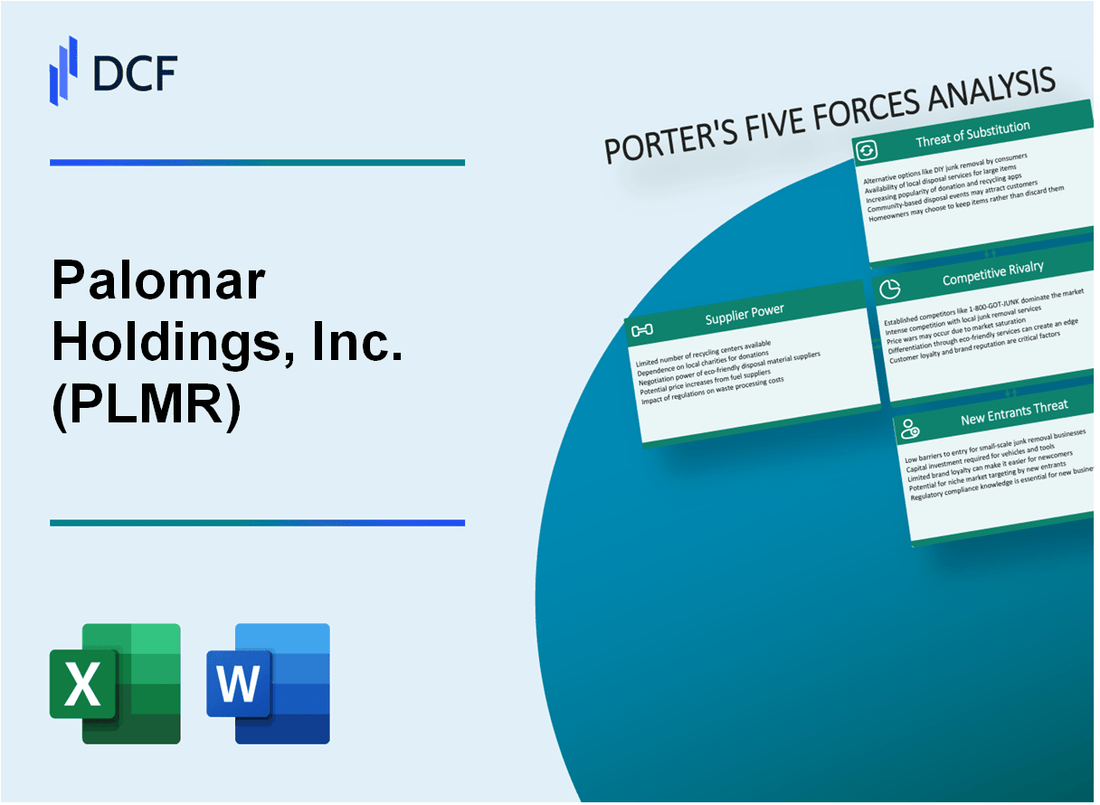
Palomar Holdings, Inc. (PLMR): 5 forças Análise [Jan-2025 Atualizada] |
Totalmente Editável: Adapte-Se Às Suas Necessidades No Excel Ou Planilhas
Design Profissional: Modelos Confiáveis E Padrão Da Indústria
Pré-Construídos Para Uso Rápido E Eficiente
Compatível com MAC/PC, totalmente desbloqueado
Não É Necessária Experiência; Fácil De Seguir
Palomar Holdings, Inc. (PLMR) Bundle
No cenário em rápida evolução da tecnologia de seguros, a Palomar Holdings, Inc. (PLMR) navega em um complexo ecossistema de forças competitivas que moldam seu posicionamento estratégico. Como a InsurTech continua a transformar o gerenciamento tradicional de riscos, compreendendo a intrincada dinâmica do poder do fornecedor, demandas de clientes, rivalidade de mercado, substitutos em potencial e barreiras à entrada se torna crucial para investidores e observadores do setor. Este mergulho profundo na estrutura das cinco forças de Porter revela os desafios e oportunidades estratégicas que definem o cenário competitivo da PLMR em 2024, oferecendo informações sobre como a empresa mantém sua vantagem em um mercado altamente dinâmico.
Palomar Holdings, Inc. (PLMR) - As cinco forças de Porter: poder de barganha dos fornecedores
Número limitado de fornecedores especializados de tecnologia de seguros e dados
A partir do quarto trimestre 2023, a Palomar Holdings identificou aproximadamente 7 principais provedores de tecnologia de seguros do mercado, com software Guidewire, Duck Creek Technologies e sistemas aplicados que dominam 68% do mercado de infraestrutura de tecnologia de seguros.
| Provedor | Quota de mercado | Receita anual |
|---|---|---|
| Software Guidewire | 37% | US $ 1,2 bilhão |
| Duck Creek Technologies | 22% | US $ 685 milhões |
| Sistemas aplicados | 9% | US $ 450 milhões |
Altos custos de comutação para os principais sistemas de infraestrutura de seguros
Os custos de migração de tecnologia para plataformas de seguro variam entre US $ 3,5 milhões e US $ 7,2 milhões, com cronogramas de implementação de 12 a 24 meses.
- Custo médio de implementação: US $ 5,4 milhões
- Tempo médio de implementação: 18 meses
- Perda de produtividade estimada durante a transição: 22-35%
Dependência de tecnologias -chave e fornecedores de dados
A Palomar Holdings depende de três fornecedores de tecnologia primária para infraestrutura crítica, com cerca de 65% dos sistemas operacionais dependentes desses fornecedores.
| Categoria de fornecedor | Nome do fornecedor | Valor do contrato |
|---|---|---|
| Plataforma de seguro principal | Seguro de fio -guia | US $ 2,1 milhões anualmente |
| Análise de dados | Verisk Insurance Solutions | US $ 1,3 milhão anualmente |
| Infraestrutura em nuvem | Amazon Web Services | US $ 1,7 milhão anualmente |
Potencial para parcerias estratégicas com fornecedores selecionados
Em 2023, a Palomar Holdings estabeleceu 2 parcerias estratégicas de tecnologia, representando um aumento de 40% em relação ao ano anterior.
- Parceria com o Software Guidewire para Integração Analítica Avançada
- Colaboração com Verisk para recursos aprimorados de modelagem de risco
- Potencial Parceria Investimento: US $ 4,5 milhões
Palomar Holdings, Inc. (PLMR) - As cinco forças de Porter: poder de barganha dos clientes
Mercado concentrado de seguro de propriedade e compradores de seguros especializados
Em 2023, a concentração do mercado de seguros imobiliários mostrou a seguinte quebra:
| Principais compradores de seguros | Quota de mercado (%) |
|---|---|
| Seguradoras de propriedade comercial | 42.6% |
| Seguradoras de propriedades residenciais | 35.4% |
| Segmento de seguro especializado | 22% |
Sensibilidade ao preço nos mercados de seguros comerciais e residenciais
Métricas de sensibilidade a preços para Palomar Holdings revelaram:
- Elasticidade do preço do seguro comercial: 0,7
- Elasticidade do preço do seguro residencial: 0,9
- Sensibilidade média do prêmio: 15,3%
Crescente demanda por soluções de seguro personalizadas
Tendências do mercado de personalização em 2023:
| Tipo de personalização de seguro | Penetração de mercado (%) |
|---|---|
| Seguro paramétrico | 18.2% |
| Políticas micro-algas | 22.7% |
| Seguro baseado em uso | 14.5% |
Aumentando as expectativas do cliente para plataformas de seguro digital
Taxas de adoção de plataforma digital no seguro:
- Uso do aplicativo móvel: 67,3%
- Solicitações de cotação on -line: 59,8%
- Processamento de reivindicações digitais: 45,6%
Palomar Holdings, Inc. (PLMR) - As cinco forças de Porter: rivalidade competitiva
Cenário competitivo Overview
A partir de 2024, a Palomar Holdings opera em um setor competitivo de tecnologia de seguros especializados com as seguintes métricas competitivas seguintes:
| Concorrente | Quota de mercado | Receita anual | Investimento em tecnologia |
|---|---|---|---|
| Seguro raiz | 3.2% | US $ 413,6 milhões | US $ 87,3 milhões |
| MetroMile | 2.7% | US $ 256,4 milhões | US $ 62,9 milhões |
| Palomar Holdings | 4.5% | US $ 542,1 milhões | US $ 105,6 milhões |
Dinâmica competitiva -chave
A intensidade competitiva no setor de insurtech demonstra concorrência tecnológica significativa:
- Número de concorrentes diretos: 8-12 empresas de insurtech especializadas
- Gastos médios de P&D: US $ 65-95 milhões anualmente
- Ciclo de inovação tecnológica: 12-18 meses
Comparação de investimento em tecnologia
| Empresa | Porcentagem de gastos em P&D | Aplicações de patentes |
|---|---|---|
| Palomar Holdings | 19.5% | 37 |
| Seguro raiz | 16.3% | 24 |
| MetroMile | 14.7% | 18 |
Métricas de concentração de mercado
Indicadores de rivalidade competitiva:
- Herfindahl-Hirschman Index (HHI): 1.250 pontos
- Taxa de concentração de mercado (CR4): 62,3%
- Taxa média de troca de clientes: 14,6% anualmente
Palomar Holdings, Inc. (PLMR) - As cinco forças de Porter: ameaça de substitutos
Mecanismos alternativos de transferência de risco emergentes
O tamanho do mercado alternativo de transferência de risco (ART) atingiu US $ 71,2 bilhões em 2022, com um CAGR projetado de 5,6% a 2027. As formações de seguro em cativeiro aumentaram 7,3% em 2023, indicando estratégias crescentes de gerenciamento de riscos corporativos.
| Mecanismo de transferência de risco alternativo | Penetração de mercado 2023 | Taxa de crescimento anual |
|---|---|---|
| Seguro paramétrico | 12.4% | 8.2% |
| Títulos de catástrofe | 6.7% | 6.5% |
| Seguro cativo | 18.3% | 7.3% |
Crescendo plataformas de seguro ponto a ponto
O mercado global de seguros ponto a ponto, avaliado em US $ 4,2 bilhões em 2022, que deve atingir US $ 11,6 bilhões até 2027. A Lemonade Inc. registrou 1,4 milhão de clientes ativos em 2023, representando 31% de crescimento ano a ano.
- Mercado Global de Seguros P2P CAGR: 22,3%
- Economia premium média para os consumidores: 15-25%
- Número de plataformas de seguro P2P ativas globalmente: 47
Aumentando o uso de estratégias de auto-seguro
Os empregadores auto-segurados representaram 64,3% dos trabalhadores do setor privado em 2022. Tamanho total do mercado de auto-seguro estimado em US $ 1,3 trilhão.
| Setor da indústria | Penetração de auto-seguro | Economia média anual |
|---|---|---|
| Assistência médica | 73.2% | US $ 2,4 milhões |
| Tecnologia | 61.5% | US $ 1,8 milhão |
| Fabricação | 58.7% | US $ 1,5 milhão |
Análise preditiva avançada, reduzindo a dependência tradicional de seguro
A análise preditiva no mercado de seguros atingiu US $ 10,5 bilhões em 2022, com crescimento projetado para US $ 26,8 bilhões até 2027. Os modelos de aprendizado de máquina demonstram melhoria de 35% na precisão da avaliação de risco.
- Taxa de adoção de análise preditiva: 68% entre as principais seguradoras
- Redução de custos médios por meio de modelos preditivos: 22%
- Melhoria da eficiência do processamento de reivindicações: 40%
Palomar Holdings, Inc. (PLMR) - As cinco forças de Porter: ameaça de novos participantes
Altos requisitos de capital inicial para tecnologia de seguro
A Palomar Holdings requer aproximadamente US $ 50 milhões a US $ 75 milhões em investimento inicial de capital para infraestrutura e desenvolvimento de tecnologia de seguros.
| Categoria de requisito de capital | Custo estimado |
|---|---|
| Infraestrutura de tecnologia | US $ 25-35 milhões |
| Desenvolvimento de software | US $ 15-20 milhões |
| Sistemas de segurança cibernética | US $ 5 a 10 milhões |
Barreiras complexas de conformidade regulatória
A conformidade regulatória de tecnologia de seguros envolve investimentos financeiros substanciais e requisitos complexos.
- Custos de licenciamento em vários estados: US $ 500.000 - US $ 2 milhões
- Despesas anuais de auditoria de conformidade: US $ 250.000 - US $ 750.000
- Taxas de consultoria legal e regulatória: US $ 300.000 - US $ 600.000
Investimento de infraestrutura de tecnologia
A infraestrutura tecnológica da Palomar Holdings requer investimentos contínuos significativos.
| Componente de infraestrutura | Investimento anual |
|---|---|
| Computação em nuvem | US $ 5-8 milhões |
| Plataformas de análise de dados | US $ 3-5 milhões |
| Atualizações de segurança cibernética | US $ 2-4 milhões |
Reputação da marca e desafios de confiança do cliente
Os novos participantes enfrentam barreiras significativas no estabelecimento de credibilidade do mercado.
- Custo médio de aquisição de clientes: US $ 500 - US $ 1.500 por cliente
- Hora de estabelecer reputação de mercado: 3-5 anos
- Taxa de retenção de clientes para empresas de insurtech estabelecidas: 85-92%
Palomar Holdings, Inc. (PLMR) - Porter's Five Forces: Competitive rivalry
You're assessing the competitive landscape for Palomar Holdings, Inc. (PLMR) right now, late in 2025. The rivalry force is definitely elevated, driven by growth in specialty lines and the commoditized aspects of certain Property & Casualty (P&C) products. Palomar Holdings competes directly with large, established, diversified carriers such as Everest Group and Kinsale Capital Group in these specialty areas.
To give you a sense of scale, as of mid-October 2025, Everest Group, Ltd. held a market capitalization of approximately $14.3 billion, and it boasts a Very Strong Growth Score of 91, compared to Kinsale Capital Group, Inc.'s Strong Growth Score of 70. Palomar Holdings is navigating this environment while executing its growth strategy.
The US property insurance market itself is transitioning into a more competitive phase, which inherently pressures rates. After years of sharp increases, the environment is softening for many. For instance, property renewals in the first half of 2025 showed rate reductions between 5% and 30% for accounts with favorable risk profiles, thanks to new capacity from London and Bermuda markets. Still, the backdrop of catastrophe losses remains a significant factor; total CAT losses for 2025 could push toward $200 billion depending on the hurricane season, reinforcing the need for strong underwriting.
Palomar Holdings' strategy to mitigate direct rivalry centers on diversification away from its core earthquake product. The company is scaling up its Crop and Surety segments, which lessens reliance on any single line. Management's confidence in this strategy is clear, as evidenced by the raised full-year 2025 adjusted net income guidance, now set at $210 million to $215 million, showing strong execution against peers.
Here's a quick look at how Palomar Holdings' recent performance underpins its competitive standing:
| Metric | Palomar Holdings (Q3 2025) | Market Context (Property Insurance) |
| Adjusted Net Income Growth (YoY) | 70% | US P&C Market Premium Growth Forecast: 5% |
| Adjusted Combined Ratio | 75% | Rate Trend: Flat to slightly decreased for property |
| Adjusted Return on Equity (ROE) | 25.6% | Industry Earnings (2024): Nearly doubled to $171 billion |
| Gross Written Premium Growth (YoY) | 44% | Wildfire Acres Burned (YTD 2025): Over 1 million acres |
The competitive dynamics are complex, balancing rate moderation with persistent peril risk. You should watch these key competitive pressures:
- Increased competition from new capacity, especially Managing General Agents (MGAs).
- Rate decreases of up to 30% seen on some property renewals in H1 2025.
- Sustained scrutiny and tighter capacity management for wildfire-exposed properties.
- The need to maintain underwriting discipline despite improving investment income.
The growth in Palomar Holdings' specialty lines is substantial; for example, the Crop premium guidance for 2025 increased to $230 million. Furthermore, the announced acquisition of Gray Casualty and Surety Company for $300 million signals an aggressive move to bolster the Surety platform, directly addressing diversification goals and carving out market share in that specialty niche.
Palomar Holdings, Inc. (PLMR) - Porter's Five Forces: Threat of substitutes
You're looking at the substitutes for Palomar Holdings, Inc. (PLMR) business, which is heavily concentrated in specialty property and catastrophe risk. The threat here isn't a single product replacing all of Palomar Holdings, Inc.'s offerings; it's about alternative ways policyholders or reinsurers manage their exposure. Honestly, the landscape is shifting, which is why your analysis needs to be sharp.
Parametric insurance solutions offer rapid, predefined payouts, acting as a direct substitute for traditional property claims processing. While Palomar Holdings, Inc. focuses on specialty P&C, the broader market is seeing this alternative gain traction; for instance, NormanMax Insurance Holdings acquired FloodFlash, a parametric technology company, in May 2025 to scale its rapid flood coverage platform. Parametric policies bypass the loss adjustment process entirely, which is a key value proposition against slow indemnity claims.
Standard insurance carriers exiting high-risk regions, like California, actually reduces the threat of substitution from generalist policies for Palomar Holdings, Inc. When primary carriers pull back due to climate volatility, the market need for specialty carriers like Palomar Holdings, Inc. increases. Industry analysis for late 2025 confirms that insurers are 'increasingly pull[ing] back or raise[ing] rates in high-catastrophe zones,' which creates a capacity void that Palomar Holdings, Inc. is positioned to fill with its specialized underwriting. This dynamic means fewer generalist policies are available to substitute for Palomar Holdings, Inc.'s targeted coverage.
Policyholders may self-insure or use government-backed programs for certain high-severity risks like flood. The National Flood Insurance Program (NFIP) remains a dominant substitute in that specific peril space. As of 2025, the NFIP has about 4.7 million active policies in force, providing over $1.3 trillion in total coverage, yet it only covers roughly 3.3% of U.S. households. The NFIP is losing money, reporting an annual loss of $600 million and carrying $20.5 billion in debt to the Treasury as of early 2025. This financial strain on the government program suggests its long-term viability as a perfect substitute is questionable, especially compared to Palomar Holdings, Inc.'s focus on achieving an adjusted return on equity of 26% in Q3 2025.
Here's a quick comparison of the flood insurance landscape, showing the scale of the government-backed substitute:
| Metric | National Flood Insurance Program (NFIP) | Private Flood Insurance (Estimate) |
|---|---|---|
| Market Share (US, 2024) | 58.3% | ~42% (Growing) |
| Active Policies (US, 2025) | ~4.7 million | Not specified, but growing |
| Average Annual Premium (2025) | ~$899 | $600 to $2,800 |
| Max Building Coverage Cap | $250,000 | $1 million or more |
Alternative risk transfer mechanisms, like Cat Bonds, are substitutes for reinsurance, not the primary insurance product sold to homeowners or businesses. This is a key distinction; Palomar Holdings, Inc. uses these instruments to manage its own risk transfer needs. The capital markets appetite for this risk is strong, which helps Palomar Holdings, Inc. secure its own capacity. For example, the total outstanding catastrophe bond market size climbed to $57.86 billion by November 2025, up $8.384 billion since the end of 2024. Palomar Holdings, Inc. successfully executed its own ILS strategy, raising $525 million in earthquake coverage through its Torrey Pines Re catastrophe bond, exceeding its $425 million target.
The use of ILS by Palomar Holdings, Inc. itself demonstrates how this mechanism is integrated into their strategy, rather than being a direct threat to their policyholders:
- Palomar Holdings, Inc. raised $525 million via Torrey Pines Re VI.
- Risk-adjusted pricing on Palomar Holdings, Inc.'s cat bonds was down approximately 15%.
- Gross Written Premium (GWP) grew 44% year-over-year in Q3 2025.
- The company raised its full-year 2025 adjusted net income guidance to $210 million to $215 million.
The market is definitely segmenting, and for Palomar Holdings, Inc., the threat of substitution from generalists is lower, but the threat from sophisticated capital market alternatives for reinsurance remains a constant strategic consideration.
Palomar Holdings, Inc. (PLMR) - Porter's Five Forces: Threat of new entrants
You're looking at the barriers to entry for Palomar Holdings, Inc. (PLMR) in the specialty insurance space. Honestly, the hurdles are substantial, but the growth of alternative capital models means you can't ignore the evolving landscape.
High capital and regulatory requirements for specialty insurance carriers create a significant barrier to entry. Starting a new carrier demands substantial initial capital and navigating a complex, state-by-state regulatory maze. For instance, in California, a key market for Palomar Holdings, Inc., statutory minimum paid-in capital can range from $1 million to $2.6 million, with minimum surplus requirements between $1 million to $2.8 million for Property and Casualty (P&C) lines. Furthermore, the global regulatory environment is tightening; the adoption of the Insurance Capital Standard (ICS) is a strategic theme for 2025, which could mean increased supervision for insurers with private equity links, raising the compliance cost for any new entrant.
Palomar Holdings, Inc.'s proprietary data analytics and underwriting technology are difficult for new players to replicate quickly. This technological moat is a key differentiator. Palomar uses its PRISM platform to price and select risks with granular precision, which helps maintain a low combined ratio. For personal lines, this technology enables automated underwriting that can process applications within minutes, a speed advantage that new, less technologically advanced entrants will struggle to match.
The need for a sophisticated, multi-billion dollar reinsurance tower is a major capital barrier. Palomar Holdings, Inc. recently extended its top-of-tower protection to $3.53 billion for earthquake events following its June 2025 renewal, up from $3.06 billion the prior year. Building and maintaining this level of risk transfer capacity requires deep relationships and significant capital commitments from the global reinsurance market. To put that scale in perspective, Palomar raised its full-year 2025 adjusted net income guidance to a range of $195 million to $205 million, showing the scale of premium volume this tower supports.
Here's a quick look at how Palomar's risk transfer strategy compares to the general market structure:
| Metric | Palomar Holdings, Inc. (PLMR) Data (2025) | Contextual Market Data |
|---|---|---|
| Total Earthquake Reinsurance Tower Limit | $3.53 billion | N/A |
| Catastrophe Bond Contribution to Tower | $1.15 billion (approx. 33%) | Latest Cat Bond issuance size: $525 million |
| U.S. P&C Industry Written Premiums (2024) | N/A | Over $965 billion in 2023 |
| MGA Direct Premiums Written (2024) | N/A | Estimated $114.1 billion |
Still, the growth of managing general agents (MGAs) and algorithmic syndicates suggests new, asset-light models are entering the market. These entities often bypass the capital-intensive process of building a full carrier balance sheet by using fronting carriers. The U.S. MGA market demonstrated robust expansion in 2024, with direct premiums written rising 16% year-over-year to an estimated $114.1 billion. MGA direct written premiums have more than doubled over the last decade, with the marketplace writing between $95bn and $100bn in 2024. Fronting companies, which are crucial partners for these asset-light models, supported more than $18 billion in MGA premium in 2024, marking a 26% increase over the prior year.
New entrants are heightening competition, particularly in the Excess and Surplus (E&S) lines where Palomar Holdings, Inc. operates. The influx of business into the E&S market is attracting these new competitors aggressively vying for market share. This increased competition is a direct result of the MGA growth and the general flow of risk away from standard carriers. You see this pressure manifesting in market dynamics:
- MGA growth has led to fierce competition in various lines of business.
- The E&S market growth rate, while strong, is expected to slow to 12-15% in 2025 from 32% in 2021.
- New, technology-driven MGAs are raising the bar for speed to market.
- Some industry executives question the quality of expansion, citing a potential misalignment of interest between originators and carriers of risk.
The barrier is high for traditional carriers, but the asset-light MGA model lowers the initial capital hurdle for new competitors, making the E&S segment more contested.
Disclaimer
All information, articles, and product details provided on this website are for general informational and educational purposes only. We do not claim any ownership over, nor do we intend to infringe upon, any trademarks, copyrights, logos, brand names, or other intellectual property mentioned or depicted on this site. Such intellectual property remains the property of its respective owners, and any references here are made solely for identification or informational purposes, without implying any affiliation, endorsement, or partnership.
We make no representations or warranties, express or implied, regarding the accuracy, completeness, or suitability of any content or products presented. Nothing on this website should be construed as legal, tax, investment, financial, medical, or other professional advice. In addition, no part of this site—including articles or product references—constitutes a solicitation, recommendation, endorsement, advertisement, or offer to buy or sell any securities, franchises, or other financial instruments, particularly in jurisdictions where such activity would be unlawful.
All content is of a general nature and may not address the specific circumstances of any individual or entity. It is not a substitute for professional advice or services. Any actions you take based on the information provided here are strictly at your own risk. You accept full responsibility for any decisions or outcomes arising from your use of this website and agree to release us from any liability in connection with your use of, or reliance upon, the content or products found herein.