

|
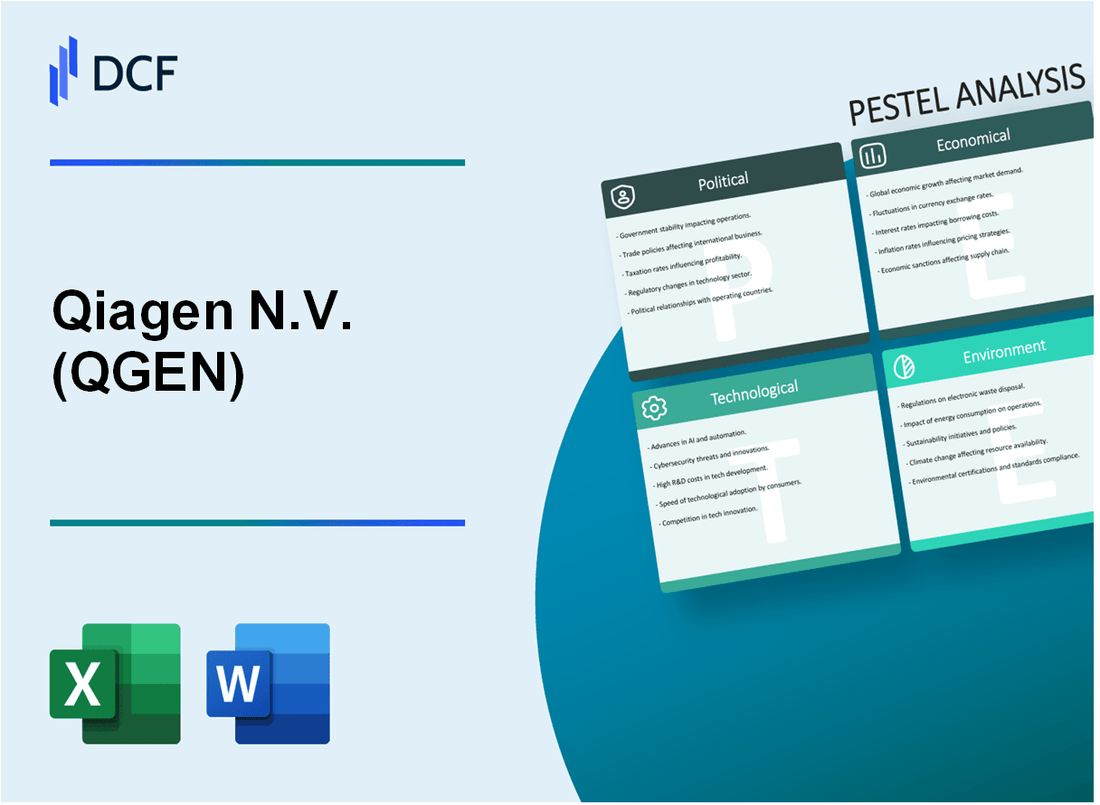
Qiagen N.V. (QGEN): Análise de Pestle [Jan-2025 Atualizado] |
Totalmente Editável: Adapte-Se Às Suas Necessidades No Excel Ou Planilhas
Design Profissional: Modelos Confiáveis E Padrão Da Indústria
Pré-Construídos Para Uso Rápido E Eficiente
Compatível com MAC/PC, totalmente desbloqueado
Não É Necessária Experiência; Fácil De Seguir
Qiagen N.V. (QGEN) Bundle
No cenário dinâmico de diagnósticos globais e ciências da vida, a Qiagen N.V. (QGEN) fica na interseção de inovação de ponta e forças de mercado complexas. Essa análise abrangente de pestles revela a intrincada rede de fatores políticos, econômicos, sociológicos, tecnológicos, legais e ambientais que moldam a trajetória estratégica da empresa. Desde a navegação nos desafios regulatórios internacionais até a aproveitamento das tecnologias genômicas inovadoras, a jornada de Qiagen reflete as profundas complexidades de um ecossistema científico em rápida evolução que toca as próprias fronteiras da saúde humana e do avanço tecnológico.
Qiagen N.V. (QGEN) - Análise de pilão: Fatores políticos
Variações regulatórias internacionais
A Qiagen opera em vários ambientes regulatórios com variações significativas:
| Região | Órgão regulatório | Requisitos de conformidade |
|---|---|---|
| Estados Unidos | FDA | 510 (k) depuração obrigatória para dispositivos de diagnóstico |
| União Europeia | Ema | Certificação de marca CE necessária para diagnóstico médico |
| China | NMPA | Classe II Registro de dispositivos médicos obrigatório |
Políticas comerciais dos EUA-UE
As restrições de pesquisa transfronteiriça afetam as operações da Qiagen:
- Taxas tarifárias em equipamentos científicos: 4,2-7,5%
- Regulamentos de controle de exportação limitam a transferência de tecnologia
- Distribuição de produtos de biotecnologia sujeita a estrita conformidade de importação/exportação
Financiamento do governo para pesquisa
| País | Financiamento anual de pesquisa genômica | Impacto potencial no qiagen |
|---|---|---|
| Estados Unidos | US $ 41,7 bilhões (2023) | Oportunidades de concessão de pesquisa direta |
| Alemanha | € 3,5 bilhões (2023) | Suporte de desenvolvimento de mercado local |
| China | US $ 12,6 bilhões (2023) | Potencial de expansão do mercado emergente |
Considerações geopolíticas da cadeia de suprimentos
Riscos críticos de interrupção da cadeia de suprimentos:
- As tensões comerciais americanas-China impactam 12,4% da cadeia de suprimentos global da Qiagen
- As restrições de exportação de semicondutores afetam a aquisição de equipamentos científicos
- A pandemia covid-19 revelou 37% de vulnerabilidade em redes de logística global
Qiagen N.V. (QGEN) - Análise de pilão: Fatores econômicos
Tendências globais de gastos com saúde afetando diretamente a demanda do mercado de tecnologia de diagnóstico
Os gastos globais em saúde atingiram US $ 9,4 trilhões em 2022, com o mercado de diagnóstico molecular avaliado em US $ 24,5 bilhões. A taxa de crescimento do mercado projetada é de 6,8% anualmente até 2030.
| Ano | Gastos globais em saúde | Valor de mercado de diagnóstico molecular | Taxa de crescimento do mercado |
|---|---|---|---|
| 2022 | US $ 9,4 trilhões | US $ 24,5 bilhões | 6.8% |
| 2023 | US $ 9,8 trilhões | US $ 26,1 bilhões | 6.9% |
As flutuações da taxa de câmbio afetam os fluxos de receita internacional da Qiagen
Receita de 2022 da Qiagen: US $ 2,67 bilhões. Distribuição de receita internacional:
| Região | Porcentagem de receita | Impacto em moeda |
|---|---|---|
| Europa | 38% | €/flutuação de USD: ± 3,2% |
| Américas | 42% | Estabilidade do USD |
| Ásia-Pacífico | 20% | Variação de CNY/USD: ± 2,7% |
Covid-19 Pandemic Aftermath Remodelando Economia de Mercado de Testes Moleculares
CoVID-19 Testando o valor de mercado em 2022: US $ 87,4 bilhões. Declínio projetado para US $ 42,6 bilhões até 2025.
| Ano | Valor de mercado de testes covid-19 | Segmento de mercado |
|---|---|---|
| 2022 | US $ 87,4 bilhões | Testes de pico de pandemia |
| 2025 | US $ 42,6 bilhões | Projeção pós-panorâmica |
Investimento de pesquisa e desenvolvimento para posicionamento competitivo de mercado
As despesas de P&D da Qiagen em 2022: US $ 442,3 milhões, representando 16,6% da receita total.
| Ano | Despesas de P&D | Porcentagem de receita | Novos lançamentos de produtos |
|---|---|---|---|
| 2022 | US $ 442,3 milhões | 16.6% | 7 novas plataformas de diagnóstico |
| 2023 | US $ 468 milhões | 17.2% | Projetado 9 novas plataformas |
Qiagen N.V. (QGEN) - Análise de pilão: Fatores sociais
O crescente interesse público em medicina personalizada impulsiona a demanda por testes genéticos avançados
Tamanho do mercado global de medicina personalizada: US $ 539,21 bilhões até 2028, com um CAGR de 6,8% de 2021 a 2028.
| Segmento de mercado | 2024 Valor projetado | Taxa de crescimento |
|---|---|---|
| Medicina personalizada | US $ 402,5 bilhões | 7.2% |
| Mercado de testes genéticos | US $ 23,89 bilhões | 11.5% |
O envelhecimento da população global aumenta os requisitos de diagnóstico de saúde e medicina de precisão
População global de 65 anos e mais: 9,3% em 2020, espera -se que atinja 16% até 2050.
| Região | 65+ porcentagem populacional (2024) | Gastos com saúde per capita |
|---|---|---|
| América do Norte | 16.9% | $12,914 |
| Europa | 19.7% | $4,621 |
| Ásia-Pacífico | 8.4% | $1,059 |
O aumento da conscientização da saúde acelera a triagem genética e a adoção de diagnóstico molecular
Tamanho do mercado de diagnóstico molecular em 2024: US $ 86,45 bilhões
| Categoria de diagnóstico | 2024 participação de mercado | Taxa de crescimento anual |
|---|---|---|
| Teste de doenças infecciosas | 35.6% | 8.3% |
| Teste de oncologia | 28.4% | 9.1% |
| Triagem genética | 22.5% | 11.2% |
As necessidades em evolução da comunidade acadêmica e de pesquisa moldam estratégias de desenvolvimento de produtos
Pesquisa global e gastos acadêmicos em diagnóstico molecular: US $ 24,3 bilhões em 2024.
| Área de pesquisa | Investimento anual | Porcentagem de gastos totais |
|---|---|---|
| Pesquisa genômica | US $ 8,7 bilhões | 35.8% |
| Medicina de Precisão | US $ 6,5 bilhões | 26.7% |
| Diagnóstico molecular | US $ 5,2 bilhões | 21.4% |
Qiagen N.V. (QGEN) - Análise de pilão: Fatores tecnológicos
O avanço contínuo em tecnologias de sequenciamento genômico impulsiona a inovação do produto
A Qiagen investiu US $ 245,4 milhões em despesas de P&D em 2022, representando 13,4% da receita total. As tecnologias de sequenciamento de próxima geração da empresa (NGS) demonstraram um crescimento de 22% ano a ano no segmento de diagnóstico molecular.
| Tecnologia | Investimento ($ m) | Crescimento do mercado (%) |
|---|---|---|
| Plataformas NGS | 78.3 | 22 |
| PCR digital | 45.6 | 17.5 |
| Ferramentas de pesquisa genômica | 56.2 | 15.8 |
Inteligência artificial e integração de aprendizado de máquina em plataformas de diagnóstico
A Qiagen desenvolveu 7 algoritmos de diagnóstico aprimorados em 2022, com um investimento de US $ 34,2 milhões direcionando especificamente as tecnologias de aprendizado de máquina.
| Aplicação da IA | Custo de desenvolvimento ($ m) | Impacto potencial |
|---|---|---|
| IA diagnóstico de câncer | 12.5 | Oncologia de precisão |
| Doença infecciosa ML | 9.7 | Detecção de patógenos |
| Análise da variante genética | 12.0 | Medicina personalizada |
Aumento da transformação digital em diagnóstico molecular e automação de laboratório
A Qiagen lançou 5 novas plataformas digitais em 2022, com investimentos totais de transformação digital atingindo US $ 62,8 milhões. As tecnologias de automação laboratorial aumentaram a eficiência em 34% nos fluxos de trabalho de teste.
O rápido desenvolvimento de tecnologias de teste CoVID-19 demonstra adaptabilidade tecnológica
Durante 2020-2022, a Qiagen produziu 350 milhões de kits de teste Covid-19, gerando US $ 1,2 bilhão em receita relacionada à pandemia. A empresa desenvolveu 12 diferentes soluções de teste molecular SARS-CoV-2.
| Tecnologia de teste Covid-19 | Kits de teste produzidos | Receita gerada ($ m) |
|---|---|---|
| Testes de RT-PCR | 180 milhões | 620 |
| Testes de antígeno | 95 milhões | 340 |
| Testes de anticorpos | 75 milhões | 240 |
Qiagen N.V. (QGEN) - Análise de pilão: Fatores legais
Requisitos rigorosos de conformidade regulatória FDA e EMA para tecnologias de diagnóstico
A Qiagen N.V. deve aderir a rigorosos padrões regulatórios nas tecnologias de diagnóstico:
| Órgão regulatório | Requisitos de conformidade | Frequência de inspeção anual |
|---|---|---|
| FDA | 510 (k) Notificação de pré -mercado | 2 vezes por ano |
| Ema | Certificação de marca CE | 1 tempo por ano |
| ISO | ISO 13485: 2016 Dispositivos médicos | 1 tempo por ano |
Proteção de propriedade intelectual para soluções de diagnóstico molecular
Patente portfólio Redução:
| Categoria de patentes | Número de patentes ativas | Valor estimado |
|---|---|---|
| Diagnóstico molecular | 87 | US $ 156 milhões |
| Tecnologias de amostra | 42 | US $ 78 milhões |
| Métodos de teste genético | 53 | US $ 94 milhões |
Os regulamentos de privacidade de dados impactam no teste genético
Despesas de conformidade:
- Investimento de conformidade com GDPR: US $ 3,2 milhões anualmente
- Conformidade regulatória da HIPAA: US $ 2,7 milhões anualmente
- Infraestrutura de proteção de dados: US $ 4,5 milhões anualmente
Dispositivos médicos internacionais e regulamentos de diagnóstico
| Região | Estrutura regulatória | Custo de conformidade |
|---|---|---|
| União Europeia | Regulação de dispositivos médicos (MDR) | US $ 5,6 milhões |
| Estados Unidos | Regulamento do sistema de qualidade da FDA | US $ 4,9 milhões |
| Japão | Agência de produtos farmacêuticos e de dispositivos médicos | US $ 3,2 milhões |
Qiagen N.V. (QGEN) - Análise de pilão: Fatores ambientais
Equipamentos de laboratório sustentáveis e produção de reagentes
A Qiagen relatou uma redução de 22,3% nas emissões de carbono dos processos de produção em 2022. A Companhia investiu US $ 14,7 milhões em tecnologias de fabricação sustentável durante o ano fiscal.
| Métrica de sustentabilidade | 2022 Valor | 2023 Target |
|---|---|---|
| Redução de emissão de carbono | 22.3% | 25.5% |
| Investimento sustentável | US $ 14,7 milhões | US $ 18,2 milhões |
| Uso de energia renovável | 37.6% | 45% |
Redução de resíduos plásticos em consumíveis diagnósticos
Iniciativas de redução de resíduos de plástico:
- Redução de 37% no volume de embalagens plásticas em 2022
- Implementou embalagens bio-degradáveis para 28% das linhas de produtos
- Programa de reciclagem para consumíveis diagnósticos com 42% de taxa de participação
Processos de fabricação com eficiência energética
A Qiagen alcançou 43,2% de melhoria da eficiência energética na fabricação de instrumentos científicos. O consumo total de energia reduziu de 68,5 milhões de kWh em 2021 para 51,3 milhões de kWh em 2022.
| Métrica de eficiência energética | 2021 Valor | 2022 Valor | Variação percentual |
|---|---|---|---|
| Consumo total de energia | 68,5 milhões de kWh | 51,3 milhões de kWh | -25.1% |
| Fabricação de eficiência energética | 32.1% | 43.2% | +34.6% |
Práticas de pesquisa e produção ambientalmente responsáveis
A Qiagen alocou US $ 22,3 milhões para a pesquisa e implementação de sustentabilidade ambiental em 2022. Atingiu a certificação ISO 14001 de gestão ambiental em 89% das instalações de fabricação global.
- Orçamento de conformidade ambiental: US $ 22,3 milhões
- Instalações certificadas ISO 14001: 89%
- Alvo de redução de resíduos: 50% até 2025
Qiagen N.V. (QGEN) - PESTLE Analysis: Social factors
The social landscape for Qiagen N.V. is defined by a powerful demographic shift and a growing public insistence on faster, more personalized, and environmentally conscious healthcare. This isn't just about new products; it's about fundamentally changing where, how, and for whom diagnostics are delivered. Your strategic focus must be on meeting the demand for molecular insights outside of centralized labs, especially as the population ages and chronic diseases become more prevalent.
Rising global demand for personalized medicine (theranostics) and companion diagnostics
The social acceptance of personalized medicine (precision medicine) has moved from a niche concept to a core expectation, fundamentally driving the diagnostics market. This shift is a massive opportunity for Qiagen N.V. The global Precision Medicine Market is estimated to be valued at nearly USD 110.68 billion in 2025 and is projected to grow at a robust Compound Annual Growth Rate (CAGR) of 14.03% through 2030. The diagnostics segment, which is Qiagen N.V.'s wheelhouse, is the primary enabler of this trend. Specifically, the Companion Diagnostics (CDx) market, which links a specific diagnostic test to a targeted drug, is expected to reach a revenue of USD 6,059.1 million in 2025.
The core of this demand is oncology, which accounts for approximately 44.23% of the precision medicine application market. This means that co-developing CDx tests with pharmaceutical partners-like the company's focus on Minimal Residual Disease (MRD) testing using the QIAcuity digital PCR system-is defintely a high-leverage move. Molecular diagnostics, the segment where Qiagen N.V. is a leader, holds the largest share of the CDx market at 49.1% in 2025, due to its precision in identifying the genetic mutations that guide targeted treatment. It's a clear signal: the future of cancer care is molecular, and it's individualized.
Increased public awareness and demand for decentralized (Point-of-Care) testing
The public's experience with rapid, decentralized testing (Point-of-Care or PoC) during the recent pandemic has permanently changed expectations. People now demand faster results closer to home. The global PoC Diagnostics Market is estimated at approximately USD 53.63 billion in 2025, with a projected CAGR of 9.63% through 2030. This growth is fueled by the need for immediate clinical decision-making, especially in managing infectious diseases, which hold the largest PoC market share at 25.9% in 2025.
This social factor presents a direct opportunity for Qiagen N.V.'s integrated systems, like the QIAsymphony and QIAcuity, to be adapted for decentralized settings or to provide the high-quality sample preparation needed for subsequent PoC molecular analysis. The fastest-growing platform segment within PoC is Molecular Diagnostics, forecast to post an 11.8% CAGR through 2030, which validates the company's core technology focus. You need to make your complex molecular workflows simple enough for the doctor's office or even home use.
Growing aging population driving demand for chronic disease and oncology testing
The demographic reality of an aging global population is the single most predictable driver of diagnostics demand. Older adults face a higher risk of chronic conditions, particularly cancer. The global next-generation cancer diagnostics market, which includes the advanced testing Qiagen N.V. provides, is valued at USD 19.16 billion in 2025. The U.S. market alone is calculated at USD 5.50 billion in 2025.
Here's the quick math on why this matters: as the cohort of older patients expands, the demand for early screening and therapeutic monitoring rises dramatically. For instance, the colorectal cancer screening market is expected to reach $16.6 billion in 2025, directly driven by the aging demographic. This trend not only increases the volume of testing but also necessitates more complex, multi-biomarker genetic testing, which saw a 10% increase in utilization in 2024.
| Market Segment (2025 Data) | Estimated Market Value (USD) | Primary Driver | Qiagen N.V. Relevance |
|---|---|---|---|
| Precision Medicine Market | $110.68 billion | Oncology applications (44.23% share) | Companion Diagnostics (CDx) co-development and NGS sample prep. |
| Companion Diagnostics (CDx) Market | $6,059.1 million | Molecular Diagnostics (49.1% segment share) | QIAcuity digital PCR for MRD testing in oncology. |
| Point-of-Care (PoC) Diagnostics Market | $53.63 billion | Demand for rapid infectious disease and chronic disease testing. | Decentralized testing platforms and rapid assay kits. |
| Next-Generation Cancer Diagnostics Market | $19.16 billion | Aging population and need for early detection. | Genetic analysis and biomarker development. |
Shift in R&D focus toward sustainable, less resource-intensive lab practices
Societal pressure is increasingly forcing life science companies to account for their environmental footprint, especially the high use of plastics and energy in labs. This is a critical social factor that translates directly into operational risk and opportunity. Qiagen N.V. has responded with clear, quantifiable commitments validated by the Science Based Targets initiative (SBTi).
The company commits to a 42% reduction in Scope 1 and 2 emissions by 2030, and a 25% reduction in Scope 3 emissions (which includes the use and end-of-life treatment of sold products) by 2030. This commitment means R&D must prioritize the design of new kits and instruments that use less plastic and energy. This is not a soft goal; it's tied to compensation, as ESG objectives now account for 20% of annual variable compensation for the global workforce. That's a strong incentive.
Key actions driven by this social pressure include:
- Reducing plastic in transportation packaging by 9.6% compared to 2020.
- Developing less resource-intensive workflows in new instruments.
- Integrating ESG goals into 20% of global employee variable compensation.
This focus on sustainability is now a prerequisite for retaining talent and securing long-term institutional investment. You must continue to prioritize R&D that makes your products smaller, faster, and greener.
Qiagen N.V. (QGEN) - PESTLE Analysis: Technological factors
Rapid adoption of Next-Generation Sequencing (NGS) and digital PCR platforms.
You need to watch the shift in molecular testing, as it directly impacts Qiagen N.V.'s core business. While the company is a leader in sample preparation, the platforms that run the final analysis are changing fast. In Q1 2025, the company's PCR/Nucleic acid amplification revenues were strong, growing by 13%. This shows the continued strength of their traditional quantitative PCR (qPCR) and newer digital PCR (dPCR) platforms, like QIAcuity, which delivered high-single-digit constant exchange rate (CER) gains in Q1 2025.
Still, the Genomics/Next-Generation Sequencing (NGS) segment saw a revenue decrease of 3% in Q1 2025, which is a clear headwind. NGS is the future of high-throughput genetic analysis, so this dip is a concern. Qiagen N.V. is addressing this by expanding its NGS-related portfolio, especially in the high-growth minimal residual disease (MRD) testing space, often using their QIAseq targeted gene panels on third-party NGS systems. This is a critical area for them to gain traction in, defintely.
AI and Machine Learning integration for data analysis and diagnostic accuracy.
The biggest near-term opportunity for Qiagen N.V. is in bioinformatics (using computer science to understand biological data), specifically by integrating Artificial Intelligence (AI) and Machine Learning (ML). This is where the value is moving-from generating data to interpreting it. The company is making concrete moves here. They acquired Genoox in May 2025 with an upfront cash payment of $70 million, plus up to $10 million in milestone payments.
This acquisition is small relative to their overall business-it is expected to add only $5 million in sales in 2025-but it is strategically important, bringing the AI-powered Franklin software into their Qiagen Digital Insights (QDI) portfolio. They also acquired Parse Biosciences in Q3 2025, expanding into the single-cell market, which is a fast-growing area that relies heavily on AI for data processing. This is how they future-proof their data interpretation tools.
Other recent launches that show this focus include:
- QIAGEN Biomedical KB-AI: A generative AI-driven knowledge base launched in early 2024.
- Ingenuity Pathway Analysis (IPA) Interpret: An AI-extension launched in late 2024 to simplify complex biological data interpretation.
Continued investment in the QIAstat-Dx syndromic testing platform expansion.
The QIAstat-Dx syndromic testing platform is a major internal growth engine and a core part of their Diagnostic Solutions segment. This platform provides rapid, multiplexed detection of multiple pathogens from a single sample. The growth numbers here are exceptional: Diagnostic solutions sales grew +11% CER in Q2 2025, driven by QIAstat-Dx, which saw an impressive +41% CER growth in the same quarter. Q3 2025 core sales growth remained strong at +11% CER.
To support this, the company is investing heavily in capacity and portfolio expansion. In March 2025, they received U.S. FDA clearance for a second QIAstat-Dx mini gastrointestinal panel. They are also planning to launch the QIAstat-Dx Rise, a higher-capacity instrument submitted for U.S. regulatory clearance, designed to process up to 160 tests per day. This is a clear move to capture more market share in high-volume hospital labs.
Competition from faster, cheaper gene-editing technologies like CRISPR.
The rise of gene-editing technologies, particularly CRISPR (Clustered Regularly Interspaced Short Palindromic Repeats), represents a long-term competitive threat to many traditional molecular biology tools. CRISPR is much faster and cheaper for precise gene modification, which could eventually reduce the need for certain types of complex, multi-step molecular analysis that Qiagen N.V. specializes in. The global CRISPR gene editing market is projected to reach a valuation of $4.10 billion in 2025.
This market is expanding at a Compound Annual Growth Rate (CAGR) of 13.01% from 2025 to 2034, which is significantly faster than Qiagen N.V.'s projected full-year 2025 net sales growth of 4-5% CER. Key players like Thermo Fisher Scientific Inc. and Merck KGaA are major competitors in the CRISPR product space. Qiagen N.V. does participate in this market by providing sample preparation and analysis tools, but the core gene-editing technology itself is a disruptive force that could shift R&D focus and funding away from their traditional research products.
| Technological Factor | 2025 Data / Financial Impact | Strategic Implication |
|---|---|---|
| QIAstat-Dx Platform Growth | Q2 2025 sales growth of +41% CER; Q3 2025 core sales growth of +11% CER. | Opportunity: Major near-term revenue driver; justifies investment in high-capacity QIAstat-Dx Rise (up to 160 tests per day). |
| AI/ML Integration (Genoox Acquisition) | Upfront cash payment of $70 million in May 2025; expected to add $5 million in 2025 sales. | Action: Critical strategic move to capture value in data interpretation and clinical decision support. |
| CRISPR Market Expansion | Global market projected to reach $4.10 billion in 2025, with a CAGR of 13.01% (2025-2034). | Risk: Faster growth rate than QGEN's core sales; represents a long-term disruptive threat to traditional molecular tools. |
| NGS Revenue Trend | Genomics/NGS revenues decreased 3% in Q1 2025. | Challenge: Indicates weakness in a key future technology area; necessitates aggressive portfolio expansion (e.g., MRD testing). |
Qiagen N.V. (QGEN) - PESTLE Analysis: Legal factors
Compliance with the EU's stricter In Vitro Diagnostic Regulation (IVDR) deadline.
The European Union's In Vitro Diagnostic Regulation (IVDR) represents a significant legal and operational challenge, requiring extensive re-certification for legacy products. For a major diagnostics player like Qiagen N.V., this is not a theoretical risk; it is a massive, near-term compliance cost. Successfully navigating this regulatory shift is crucial for maintaining market access in the EU, which is one of the company's core markets.
The good news is that Qiagen has shown concrete progress in 2025. In September 2025, the company secured the European CE-IVDR Certification for its full QIAstat-Dx portfolio. This is a critical milestone, as the QIAstat-Dx system is a key growth driver, with its sales increasing by 41% at constant exchange rates (CER) in Q2 2025. Failure to achieve IVDR compliance would have meant pulling these high-growth products from the EU market, so this certification effectively de-risks a significant portion of their diagnostics revenue.
Here's the quick math: protecting a key product line with 41% CER growth is a huge win. The risk of non-compliance is simply too high to ignore.
Intellectual property (IP) litigation risks in the highly competitive molecular diagnostics space.
In the molecular diagnostics space, intellectual property (IP) is the core currency, and Qiagen is both a frequent plaintiff and defendant. The risk here is two-fold: defending its own extensive patent portfolio and managing infringement claims against its products. Litigation is a constant, expensive reality in this industry, but it also protects future revenue streams.
In 2025, the company has been actively involved in several high-stakes cases, demonstrating its commitment to vigorously defending its IP. For instance, in March 2025, the German Federal Patent Court ruled in Qiagen's favor against SD Biosensor, upholding the validity of a key patent protecting innovations in its QuantiFERON technology. The QuantiFERON franchise alone is protected by a group of more than 120 patents globally. Conversely, in August 2025, the Federal Circuit in the U.S. reversed a jury verdict against Qiagen in a patent case involving Mass General (now LabCorp), setting aside a willful-infringement verdict that had included an award of about $5 million in damages. This reversal saved the company a substantial financial hit and affirmed their non-infringement position on the patents in question.
The table below summarizes recent IP activity, highlighting the competitive pressure:
| Date (2025) | Action/Outcome | Opposing Party | Technology/Product |
| March | Patent Upheld (Favorable Ruling) | SD Biosensor | QuantiFERON-TB (Tuberculosis Detection) |
| August | Jury Verdict Reversed (Favorable Ruling) | LabCorp (Mass General Patents) | DNA Sample Prep/Sequencing Enrichment |
| 2025 (Ongoing) | Patent Lawsuit Filed | bioMérieux | Tuberculosis Test Patent (QuantiFERON) |
Data privacy laws (e.g., GDPR, CCPA) requiring stringent data handling protocols.
As a global entity with over 5,700 employees and operations in more than 35 locations as of September 30, 2025, Qiagen must comply with a patchwork of global data privacy laws, including the EU's General Data Protection Regulation (GDPR) and the California Consumer Privacy Act (CCPA). This is defintely a high-risk area, especially given the sensitive nature of molecular diagnostics data.
Non-compliance carries massive financial penalties. A single GDPR violation can result in fines of up to €20 million or 4% of global annual revenue, whichever is higher. In the U.S., CCPA violations can cost up to $7,500 per incident. For a mid-to-large company, the initial cost of establishing a GDPR-compliant framework averages around $1.3 million, not including the ongoing operational costs of handling Data Subject Access Requests (DSARs), which average $1,500 per request.
Qiagen's Compliance Program explicitly covers data protection laws, but the sheer volume of data and the increasing stringency of regulations mean the operational expense for data mapping, security upgrades, and response protocols is a material, recurring cost. You cannot afford a data breach in this business.
Anti-kickback and anti-bribery laws in international markets requiring robust compliance.
Operating in the global healthcare and life sciences sectors exposes Qiagen to severe risks under anti-corruption statutes like the U.S. Foreign Corrupt Practices Act (FCPA) and the U.K. Bribery Act 2010 (UKBA). These laws prohibit offering anything of value to foreign officials to gain a business advantage, which is a constant challenge when dealing with government-run healthcare systems in international markets.
The regulatory environment became even more focused in 2025, particularly in high-growth markets like China. The State Administration for Market Regulation (SAMR) in China published Compliance Guidelines for Healthcare Companies in January 2025, and a May 2025 notice from 14 Chinese government agencies highlighted continued enforcement focus on the sale and distribution of medical products. This increased scrutiny targets high-risk areas like genetic testing and patient information protection, which are central to Qiagen's business model.
To mitigate this, Qiagen maintains a comprehensive Compliance Program, overseen by the Audit Committee of the Supervisory Board, and has a specific Anti-Corruption Policy. The key compliance actions include:
- Mandatory acceptance of a Supplier Code of Conduct by 100% of its global supplier network, which includes over 5,900 suppliers in more than 60 countries.
- Regular, mandatory compliance and anti-corruption training for employees, including a whistleblower system (QIAintegrity Line) for reporting misconduct.
- Strict policies governing business courtesies, prohibiting cash gifts and requiring advance approval for non-cash gifts and hospitality.
The cost of this compliance-training, audits, internal controls-is a necessary operating expense to avoid a potentially catastrophic fine that could reach hundreds of millions of dollars under the FCPA.
Qiagen N.V. (QGEN) - PESTLE Analysis: Environmental factors
Growing pressure from investors and regulators on Scope 1 and 2 carbon emissions.
The pressure to decarbonize is a critical external factor, driven by both institutional investors and increasingly stringent global regulations like the EU's Corporate Sustainability Reporting Directive (CSRD). Qiagen N.V. has responded by setting ambitious, Science Based Targets initiative (SBTi) validated goals. The company is committed to a 42% absolute reduction in Scope 1 and 2 emissions by 2030, using a 2020 base year, with a long-term goal of net-zero by 2050 for these operational emissions.
In the near term, the results are already visible. The company's Scope 1 and 2 market-based emissions saw a significant decrease of 14% in 2024 compared to 2023, representing a reduction of 2,466 tCO₂e. This reduction is not just a paper exercise; it's the result of concrete operational changes, such as decommissioning the combined heat and power (CHP) plant at its Hilden facility and increasing the procurement of green energy, which accounted for 84% of global electricity usage in 2023.
Here's the quick math on recent progress:
| Metric | 2023 Performance | 2024 Performance | Target |
|---|---|---|---|
| Scope 1 & 2 Emissions Reduction (YoY) | 15% reduction over 2022 | 14% reduction over 2023 | 42% reduction by 2030 (from 2020 base) |
| Green Energy Share of Global Electricity | 84% | N/A (Focus on absolute reduction) | Transitioning to renewable energy |
Need to reduce plastic waste from single-use diagnostic consumables.
The life sciences and diagnostics sector relies heavily on single-use plastics for sterility and workflow efficiency, creating a major environmental challenge. Qiagen N.V. is tackling this head-on with a reduce-reuse-recycle strategy. In 2024, the company reduced its plastic use by 25 tons, which notably exceeded its internal goal of 20 tons for the year.
This is a defintely material issue for the industry, so the focus is on product redesign and material substitution. The QIAwave product line, for instance, is a concrete example of a sustainable product innovation, with each kit using 62% less plastic and 58% less cardboard than its predecessors. Furthermore, the company introduced bio-based plastics into a key diagnostic product in 2024, signaling a shift away from fossil-based materials in their consumables.
Key actions to reduce plastic waste include:
- Introducing bio-based plastics for product components.
- Achieving a 9.6% plastic reduction in transportation packaging since 2020.
- Setting a goal to further decrease the plastic footprint by an additional 20 tons in the upcoming year.
Developing sustainable packaging and logistics for global product distribution.
Global distribution, particularly for temperature-sensitive molecular diagnostic kits (cold chain), is a major source of Scope 3 emissions and packaging waste. Qiagen N.V. is actively replacing high-impact materials and optimizing its logistics network. The company has rolled out eco-friendly transport boxes across the U.S. and EMEA regions, replacing the traditional, high-polluting Expanded Polystyrene (EPS) foam boxes.
These new transport boxes are a huge improvement, consuming 50 times less energy during their production compared to the Styrofoam alternatives. The focus extends beyond the box itself; the company invested in new winding equipment for pallet wrapping in its distribution hubs, which drastically reduced the amount of stretch foil used in logistics. This kind of supply chain optimization is where you find real, measurable impact.
Increased focus on ESG (Environmental, Social, and Governance) reporting transparency.
Transparency in ESG reporting is no longer optional; it's a prerequisite for capital access and stakeholder trust. Qiagen N.V. has demonstrated a high level of commitment here, voluntarily preparing and publishing its 2024 Sustainability Statement in accordance with the rigorous EU Corporate Sustainability Reporting Directive (CSRD) and the European Sustainability Reporting Standards (ESRS). This voluntary early adoption, even before the directive was fully implemented in Dutch law, shows proactive risk management.
The company's reporting is externally validated, with its 2024 Sustainability Statement subject to limited assurance by KPMG Accountants N.V. This level of scrutiny builds confidence for investors. The market is recognizing these efforts, reflected in top-tier ESG ratings as of 2025:
- MSCI ESG Rating: AAA Leader
- Sustainalytics Risk Rating: 13.5 (Low risk)
- S&P Global ESG Score: 48 (as of July 31, 2025)
- CDP Climate Score: B Management Level
Also, the company has started linking executive compensation to climate-related goals, specifically including a plastics reduction goal in the 2024 Team Goals for variable remuneration. That's how you drive accountability.
Disclaimer
All information, articles, and product details provided on this website are for general informational and educational purposes only. We do not claim any ownership over, nor do we intend to infringe upon, any trademarks, copyrights, logos, brand names, or other intellectual property mentioned or depicted on this site. Such intellectual property remains the property of its respective owners, and any references here are made solely for identification or informational purposes, without implying any affiliation, endorsement, or partnership.
We make no representations or warranties, express or implied, regarding the accuracy, completeness, or suitability of any content or products presented. Nothing on this website should be construed as legal, tax, investment, financial, medical, or other professional advice. In addition, no part of this site—including articles or product references—constitutes a solicitation, recommendation, endorsement, advertisement, or offer to buy or sell any securities, franchises, or other financial instruments, particularly in jurisdictions where such activity would be unlawful.
All content is of a general nature and may not address the specific circumstances of any individual or entity. It is not a substitute for professional advice or services. Any actions you take based on the information provided here are strictly at your own risk. You accept full responsibility for any decisions or outcomes arising from your use of this website and agree to release us from any liability in connection with your use of, or reliance upon, the content or products found herein.