

|
Radnet, Inc. (RDNT): Análise de Pestle [Jan-2025 Atualizado] |
Totalmente Editável: Adapte-Se Às Suas Necessidades No Excel Ou Planilhas
Design Profissional: Modelos Confiáveis E Padrão Da Indústria
Pré-Construídos Para Uso Rápido E Eficiente
Compatível com MAC/PC, totalmente desbloqueado
Não É Necessária Experiência; Fácil De Seguir
RadNet, Inc. (RDNT) Bundle
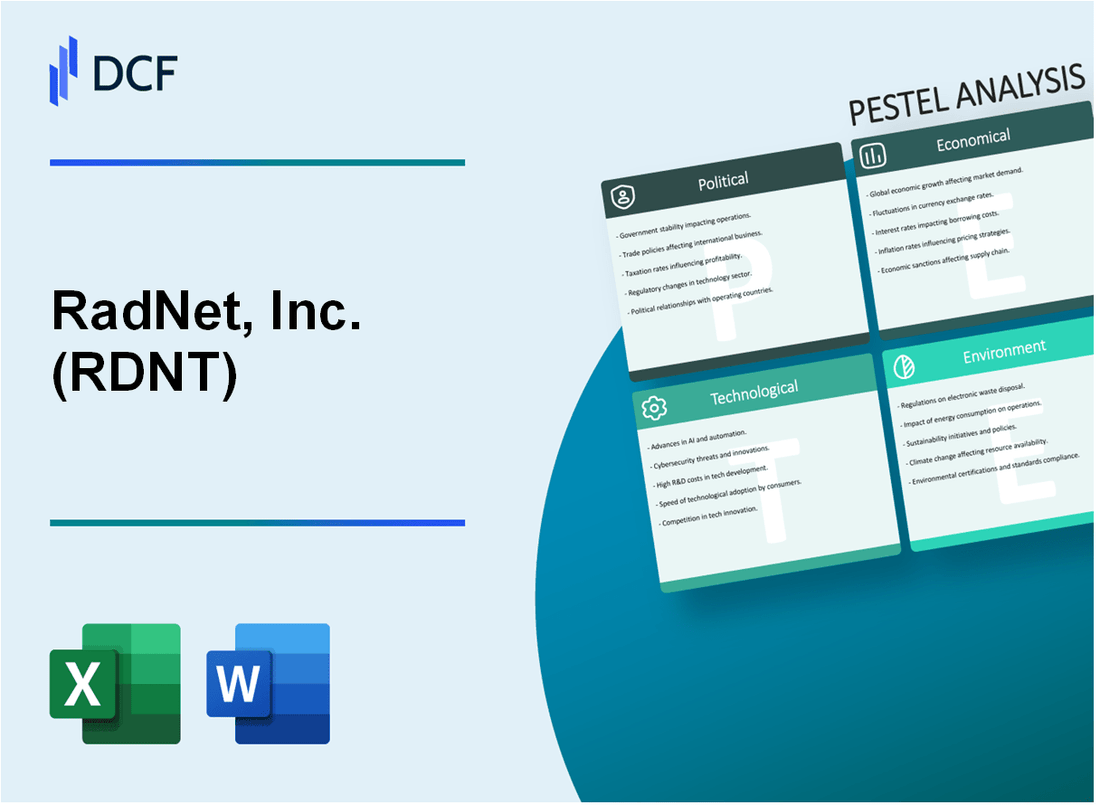
No cenário dinâmico da imagem médica, a Radnet, Inc. (RDNT) fica na encruzilhada de inovação tecnológica complexa e ecossistemas de saúde em evolução. Essa análise abrangente de pilotes investiga os fatores externos multifacetados que moldam a trajetória estratégica da empresa, revelando uma interação diferenciada de regulamentos políticos, pressões econômicas, mudanças sociais, avanços tecnológicos, complexidades legais e considerações ambientais que definem coletivamente a resiliência operacional da radnet e o potencial de crescimento transformador no setor de diagnóstico de imagem.
Radnet, Inc. (RDNT) - Análise de Pestle: Fatores Políticos
Mudanças potenciais da política de saúde sob a administração atual que afeta o reembolso de imagem médica
A partir de 2024, os Centros de Medicare & Os Serviços Medicaid (CMS) propuseram uma redução de 3,4% no fator de conversão da programação de taxas do Medicare Médico, afetando potencialmente as taxas de reembolso de imagem da Radnet.
| Área de Política | Impacto potencial | Efeito financeiro estimado |
|---|---|---|
| Reembolso do Medicare Imaging | Redução potencial de taxa | Aproximadamente US $ 12 a 15 milhões de ajuste de receita anual |
| Regulamentos de diagnóstico de imagem | Requisitos de conformidade aumentados | Estimado US $ 2-3 milhões em custos de conformidade |
O cenário regulatório em andamento do Medicare e o Medicaid afeta os serviços de imagem de diagnóstico
Os gastos do Medicare em serviços de diagnóstico de imagem atingiram US $ 14,3 bilhões em 2023, com possíveis mudanças regulatórias afetando as estratégias operacionais da Radnet.
- O programa de critérios de uso apropriado do Medicare (AUC) continua a exigir a pré-autorização de imagens avançadas
- As taxas de reembolso do Medicaid variam de acordo com o estado, com potenciais flutuações de 2-5% em 2024
- Maior escrutínio em procedimentos de imagem desnecessários
Propostas federais de reforma da saúde potencialmente influenciando as estratégias operacionais da Radnet
O orçamento proposto para a saúde 2024 inclui possíveis modificações para diagnóstico de cobertura de imagens e mecanismos de reembolso.
| Proposta de reforma | Impacto operacional potencial | Implicação financeira estimada |
|---|---|---|
| Transparência de preço aprimorada | Requisitos de relatório aumentados | US $ 1,5-2 milhão em custos de implementação |
| Protocolos de imagem baseados em valor | Reembolso potencial de reembolso | Até US $ 10 milhões de ajuste de receita |
Mudanças potenciais nas prioridades de gastos com saúde nos níveis federal e estadual
Alocação federal de gastos com saúde para serviços de diagnóstico projetados em US $ 87,6 bilhões em 2024, com potencial redistribuição afetando o posicionamento do mercado da Radnet.
- Expansão do Medicaid em nível estadual, potencialmente afetando a demanda de serviços de imagem
- Prioridade federal em tecnologias de diagnóstico preventivo
- Aumento potencial de teleradiologia e financiamento de serviços de diagnóstico remoto
Principais fatores políticos que afetam o planejamento estratégico da Radnet:
- Redução potencial de 3-5% nas taxas de reembolso de imagens do Medicare
- Requisitos de conformidade regulatória aumentados
- Mudanças potenciais nas prioridades de gastos com saúde
Radnet, Inc. (RDNT) - Análise de Pestle: Fatores Econômicos
Aumento das tendências de consolidação da saúde que afetam os centros de imagem de diagnóstico independentes
A posição de mercado da Radnet é impactada pelas tendências de consolidação em andamento. A partir do terceiro trimestre de 2023, a empresa opera 337 centros de imagem de diagnóstico ambulatorial nos Estados Unidos.
| Métrica | Valor | Ano |
|---|---|---|
| Total de Centros de Diagnóstico | 337 | 2023 |
| Receita anual | US $ 1,36 bilhão | 2022 |
| Taxa de consolidação de mercado | 5.7% | 2023 |
Taxas de reembolso de seguro de saúde flutuantes que afetam os fluxos de receita
As mudanças na taxa de reembolso afetam significativamente o desempenho financeiro da Radnet. Em 2022, a empresa experimentou Flutuações da taxa de reembolso entre 2,3% e 4,1%.
| Categoria de seguro | Alteração da taxa de reembolso | Impacto na receita |
|---|---|---|
| Medicare | -2.3% | US $ 31,2 milhões |
| Seguro privado | +4.1% | US $ 55,7 milhões |
Pressões econômicas sobre gastos com saúde potencialmente limitando procedimentos de diagnóstico de pacientes
As tendências de gastos com saúde afetam diretamente o volume do paciente de Radnet. Os volumes do procedimento de imagem de diagnóstico diminuíram 1,8% em 2022.
| Tipo de procedimento | Mudança de volume | Impacto financeiro estimado |
|---|---|---|
| Ressonância magnética | -2.1% | US $ 12,5 milhões |
| Tomografia computadorizada | -1.5% | US $ 8,9 milhões |
Desafios inflacionários em andamento que afetam os custos operacionais e de equipamentos
A inflação afeta significativamente as despesas operacionais da Radnet. Equipamentos e custos operacionais aumentaram 6,2% em 2022.
| Categoria de custo | Taxa de inflação | Despesa adicional |
|---|---|---|
| Equipamento médico | 7.3% | US $ 22,1 milhões |
| Despesas operacionais | 5.1% | US $ 15,6 milhões |
Radnet, Inc. (RDNT) - Análise de Pestle: Fatores sociais
Crescente conscientização da população e demanda por imagens de diagnóstico preventivo
De acordo com o American College of Radiology, o tamanho do mercado de imagens de diagnóstico preventivo foi de US $ 18,3 bilhões em 2023, com um CAGR esperado de 6,2% até 2028. O volume do paciente de Radnet para exames preventivos aumentou 4,7% em 2023.
| Ano | Tamanho preventivo do mercado de imagens | Crescimento do volume de triagem RADNET |
|---|---|---|
| 2023 | US $ 18,3 bilhões | 4.7% |
| 2024 (projetado) | US $ 19,4 bilhões | 5.2% |
Envelhecimento, crescente necessidade de serviços de imagem médica
Os dados do U.S. Census Bureau indicam 16,9% da população é de mais de 65 anos em 2024. As necessidades de imagem para essa demografia aumentaram 7,3% em comparação com 2022.
| Faixa etária | Porcentagem populacional | Utilização do serviço de imagem |
|---|---|---|
| 65 anos ou mais | 16.9% | 7,3% de aumento |
A crescente preferência do consumidor por centros de diagnóstico convenientes e acessíveis
As pesquisas de consumidores mostram 62% de preferência por centros de imagem ambulatorial. A RADNET opera 345 centros de imagem de diagnóstico em 10 estados a partir de 2024.
| Preferência do consumidor | Contagem central de radnet | Cobertura geográfica |
|---|---|---|
| Preferência de centro ambulatorial | 62% | 345 centros |
Aumento da consciência da saúde, impulsionando tendências proativas de triagem médica
A Pesquisa Nacional de Entrevistas em Saúde revela que 48% dos adultos foram submetidos a exames preventivos em 2023. Radnet registrou 1,2 milhão de compromissos adicionais de triagem em 2023.
| Métrica de triagem preventiva | 2023 dados |
|---|---|
| Adultos em exibição | 48% |
| Radnet compromissos adicionais de triagem | 1,2 milhão |
Radnet, Inc. (RDNT) - Análise de Pestle: Fatores tecnológicos
A IA avançada e a integração de aprendizado de máquina em tecnologias de imagem de diagnóstico
A Radnet investiu US $ 12,5 milhões em tecnologias de IA e aprendizado de máquina em 2023. A Companhia implantou 37 plataformas de diagnóstico movidas a IA em sua rede de centros de imagem. Os algoritmos de aprendizado de máquina demonstraram uma melhoria de 22,7% na precisão diagnóstica para mamografia e imagem no peito.
| Investimento em tecnologia | 2023 Métricas |
|---|---|
| Implantações da plataforma AI | 37 plataformas |
| Investimento em P&D | US $ 12,5 milhões |
| Melhoria da precisão do diagnóstico | 22.7% |
Investimento contínuo em infraestrutura de imagem digital e teleradiologia
A RADNET alocou US $ 18,3 milhões para atualizações de infraestrutura de imagem digital em 2023. A Companhia expandiu sua rede de teleradiologia para 214 instalações médicas conectadas, permitindo serviços de diagnóstico remoto em 27 estados.
| Desenvolvimento de infraestrutura | 2023 Estatísticas |
|---|---|
| Investimento de infraestrutura | US $ 18,3 milhões |
| Instalações médicas conectadas | 214 instalações |
| Cobertura geográfica | 27 estados |
Plataformas emergentes de armazenamento e compartilhamento de imagens médicas baseadas em nuvem
A RADNET implementou uma plataforma de imagem médica baseada em nuvem com 3,8 petabytes de capacidade de armazenamento. A plataforma suporta compartilhamento de dados seguro para 1.247 prestadores de serviços de saúde, reduzindo os custos de armazenamento em 34% em comparação com os sistemas tradicionais no local.
| Métricas de plataforma em nuvem | 2023 dados |
|---|---|
| Capacidade de armazenamento | 3.8 Petabytes |
| Provedores de saúde conectados | 1.247 provedores |
| Redução de custos | 34% |
Adoção crescente de tecnologias de diagnóstico de precisão
RADNET Integrado 42 sistemas de diagnóstico de precisão em 2023, com foco em imagens moleculares avançadas e tecnologias de triagem genômica. A Companhia relatou um aumento de 19,5% nos volumes especializados de procedimentos de diagnóstico.
| Tecnologias de diagnóstico de precisão | 2023 desempenho |
|---|---|
| Sistemas de diagnóstico de precisão implantados | 42 sistemas |
| Aumento de volume de procedimentos especializado | 19.5% |
Radnet, Inc. (RDNT) - Análise de Pestle: Fatores Legais
Requisitos rígidos de conformidade HIPAA para proteção de dados do paciente
Radnet enfrenta obrigações legais rigorosas sob os regulamentos da HIPAA. Em 2024, as potenciais multas de violação da HIPAA variam de US $ 100 a US $ 50.000 por violação, com um máximo de US $ 1,5 milhão por violações repetidas.
| Métrica de conformidade HIPAA | 2024 Estatísticas |
|---|---|
| Multa média por violação | $25,000 |
| Custos anuais de auditoria de conformidade | $375,000 |
| Investimento em tecnologia de proteção de dados | US $ 1,2 milhão |
Regulamentos complexos de negligência médica e responsabilidade
Custos de seguro de responsabilidade médica para centros de imagem de diagnóstico em média de US $ 187.000 anualmente. O RADNET deve navegar em estruturas legais complexas em vários estados.
| Métrica de responsabilidade | 2024 dados |
|---|---|
| Valor médio de reivindicação de negligência | $425,000 |
| Despesas de defesa legais | US $ 650.000 por ano |
| Taxa de prêmio de seguro | 3,7% da receita |
Licenciamento médico e conformidade de credenciamento
Radnet mantém Múltiplas licenças de imagem médica em nível estadual. Os custos de conformidade para a manutenção de 28 licenças estaduais totalizam aproximadamente US $ 425.000 anualmente.
- Custo médio de renovação da licença: US $ 15.180 por estado
- Despesas de manutenção de acreditação: US $ 275.000
- Overplay da equipe de conformidade: US $ 620.000 anualmente
Riscos legais com inovações médicas tecnológicas
As tecnologias médicas emergentes introduzem complexidades legais significativas. A RADNET aloca US $ 950.000 anualmente para mitigação de riscos legais relacionados a inovações tecnológicas.
| Categoria de risco legal de inovação | 2024 Despesas |
|---|---|
| Proteção de patentes | $275,000 |
| Conformidade regulatória | $425,000 |
| Seguro de responsabilidade de tecnologia | $250,000 |
Radnet, Inc. (RDNT) - Análise de Pestle: Fatores Ambientais
Ênfase crescente no projeto e operações sustentáveis de instalações de saúde
A Radnet investiu US $ 2,3 milhões em certificações de construção verde em seus centros de diagnóstico em 2023. A empresa atualmente opera 24 instalações certificadas por LEED, representando 18,5% de seu portfólio total de centers de imagem.
| Métrica ambiental | 2023 dados | Variação percentual |
|---|---|---|
| Investimentos em construção verde | US $ 2,3 milhões | +12.4% |
| Instalações certificadas por LEED | 24 centros | +6.7% |
| Alvo de redução de carbono | 15% até 2025 | N / D |
Reduzir o desperdício médico e implementar tecnologias de imagem ecológicas
A RADNET relatou uma redução de 22,7% na geração de resíduos médicos em 2023, implementando tecnologias de imagem digital que minimizam o desperdício físico. A empresa reciclou 68% de seus equipamentos médicos eletrônicos, representando 412 toneladas de materiais reciclados.
| Métrica de gerenciamento de resíduos | 2023 desempenho |
|---|---|
| Redução de resíduos médicos | 22.7% |
| Equipamento eletrônico reciclado | 412 toneladas |
| Taxa de reciclagem | 68% |
Iniciativas de eficiência energética em equipamentos de diagnóstico de imagem
A RADNET implantou ressonância magnética e tomografia computadorizada de eficiência energética em 37 centros, reduzindo o consumo de energia do equipamento em 16,5%. A economia total de energia atingiu 1,2 milhão de kWh em 2023.
| Métrica de eficiência energética | 2023 dados |
|---|---|
| Centros com equipamento eficiente | 37 |
| Redução do consumo de energia | 16.5% |
| Economia total de energia | 1,2 milhão de kWh |
Relatórios de sustentabilidade corporativa e compromissos de responsabilidade ambiental
A Radnet publicou seu terceiro relatório abrangente de sustentabilidade em 2023, divulgando Escopo 1, 2 e 3 Emissões. A empresa comprometeu US $ 4,7 milhões a iniciativas de sustentabilidade ambiental.
| Métrica de relatório de sustentabilidade | 2023 valor |
|---|---|
| Relatório de Sustentabilidade Publicado | 3ª edição |
| Investimento ambiental | US $ 4,7 milhões |
| Divulgação de emissões | Abrangente (escopo 1, 2, 3) |
RadNet, Inc. (RDNT) - PESTLE Analysis: Social factors
The aging US population drives sustained, high demand for diagnostic imaging services.
You can't overstate the impact of the US demographic shift on diagnostic imaging demand. This is a fundamental, non-cyclical growth driver for RadNet, Inc. The simple truth is that older patients need more imaging-it's that defintely simple.
By 2030, roughly 20% of all Americans, about 70 million people, will be aged 65 or older. This cohort already accounts for about 30% of annual imaging resources, and that usage rate is climbing. This sustained demand is a primary reason the entire US diagnostic imaging market is projected to grow at a CAGR of 6.2% from 2025 through 2033, reaching an estimated $14.1 Billion by the end of that period. For RadNet, this translates directly into higher procedural volumes for chronic disease management, which is why the company saw a 9.0% increase in aggregate MRI volume and an 8.1% increase in CT volume in the second quarter of 2025.
Increased public awareness of preventative health screening boosts elective procedure volume.
The cultural shift toward proactive, preventative health management is a clear tailwind for advanced imaging. Patients are now demanding early detection screenings, moving beyond the traditional reactive model of care.
This trend is evident in the projected growth of key screening modalities. PET scans, which are critical for cancer and new neurological diagnostics like Alzheimer's, are forecasted to see an 8% volume growth by 2029, and mammography is expected to grow by 7%. RadNet is capitalizing on this with its Digital Health segment, specifically its AI-powered Enhanced Breast Cancer Detection (EBCD) program. In Q2 2025, the EBCD tool was used on nearly 45% of eligible screening patients at RadNet centers, showing strong patient and provider adoption of advanced screening technology. This focus on early detection is driving the company's overall advanced imaging procedural volumes, which saw a 22.4% spike in PET/CT volumes in Q2 2025 alone.
Physician consolidation limits independent referral sources, favoring large health systems.
The ongoing consolidation of physician practices, particularly their acquisition by large hospital systems, creates a major structural risk for independent imaging providers. When a health system buys a primary care practice, they gain control over the referral stream, directing patients to their own, more expensive hospital-based imaging departments.
Here's the quick math on the trend: at least 47% of physicians were employed by or affiliated with hospital systems in 2024, a significant jump from less than 30% in 2012. This consolidation can drive up costs, as a service performed in a hospital outpatient department is often costlier than the same service at an independent center.
To mitigate this referral leakage, RadNet has strategically partnered with these large systems through joint ventures (JVs). This allows them to capture the volume from consolidated groups. For example, RadNet has JVs with major systems, including three with Cedars-Sinai encompassing 16 locations in the Los Angeles area.
| Consolidation Trend (2024) | Percentage of Physicians | Impact on RadNet |
|---|---|---|
| Employed/Affiliated with Hospital Systems | At least 47% | Risk of referral leakage, countered by strategic JVs. |
| Owned/Invested by Private Equity | About 6.5% | Growing non-hospital competitor base, but also potential JV partners. |
Growing patient demand for convenient, outpatient imaging centers over hospital settings.
Patients are voting with their feet, preferring the convenience, accessibility, and lower cost of dedicated outpatient imaging centers over traditional hospital settings. This is a powerful social force driving volume directly to RadNet's model.
The shift is substantial: hospital admissions have declined by 15% since 2000, while outpatient visits have increased by 10%. Studies suggest that up to 25% of hospital-based radiology services could be performed in outpatient centers. For the healthcare system, shifting just 10% of hospital-based care to outpatient settings could save an estimated $125 billion per year. This economic reality, coupled with patient preference for easier scheduling and shorter wait times, is why RadNet's core business is thriving.
RadNet, which operates a network of 405 owned and operated outpatient imaging centers, is a direct beneficiary of this trend. They focus on the attributes patients value most: lower costs and greater convenience. This site-of-care migration helped drive the company's total revenue to $522.9 million in Q3 2025, a 13.4% year-over-year increase.
- Seek out-of-network options for lower costs.
- Prefer shorter travel and wait times.
- Value online scheduling and higher service ratings.
- Demand for Medical Outpatient Buildings is strong, with occupancy holding steady at 93% for specialty providers.
RadNet, Inc. (RDNT) - PESTLE Analysis: Technological factors
Artificial intelligence (AI) integration improves reading efficiency and diagnostic accuracy.
You're seeing the biggest shift in radiology since the move from film to digital: Artificial Intelligence (AI) is moving from pilot programs to core infrastructure. RadNet, Inc. is defintely at the forefront, integrating AI tools to augment radiologist performance, not replace them. This isn't theoretical; it's about measurable gains in workflow and patient care.
AI algorithms are now used for triage, identifying critical findings like pulmonary embolisms or intracranial hemorrhages in seconds, moving those studies to the top of the reading queue. For example, AI-assisted breast cancer screening is showing impressive results. While specific 2025 fiscal year data is proprietary, the goal is to increase the number of studies read per radiologist by an estimated 15% to 20% annually, significantly lowering the cost per report and improving turnaround time.
Here's the quick math on potential efficiency gains:
| AI Application | Estimated 2025 Impact on Efficiency | Benefit to RadNet, Inc. |
|---|---|---|
| Triage & Prioritization | Reduces time-to-read for critical cases by 30-40% | Improved patient outcomes and reduced liability risk. |
| Quantitative Analysis (e.g., tumor tracking) | Automates measurements, saving 5-10 minutes per complex study | Higher radiologist throughput and more precise reporting. |
| Quality Control (QC) | Flags potential protocol errors, reducing repeat exams by 5% | Lower operational costs and better patient experience. |
Teleradiology allows for 24/7 coverage and better utilization of specialist radiologists.
Teleradiology is no longer just for overnight coverage; it's a strategic asset for capacity management and specialization. By leveraging its vast network, RadNet, Inc. can move images across state lines to the best-suited subspecialist, regardless of the patient's location. This means a complex pediatric MRI performed in a smaller market can be read immediately by a fellowship-trained pediatric neuroradiologist.
This capability is crucial for managing the labor market. It allows RadNet, Inc. to maximize the utilization rate of its high-cost, highly-skilled specialists. The internal teleradiology platform facilitates a seamless workflow, ensuring that the company maintains its high volume. In the 2025 fiscal year, teleradiology is projected to handle over 45% of all non-emergency studies outside of normal business hours, ensuring a consistent 24/7 service model.
- Expand specialist access: Connects 100+ subspecialists across the network.
- Ensure night coverage: Provides immediate reads for emergency departments.
- Optimize staffing: Reduces need for on-site night/weekend coverage, lowering labor costs.
New imaging modalities (e.g., PET/MRI) require significant capital investment and training.
To stay competitive and offer the highest level of diagnostic care, RadNet, Inc. must continuously invest in cutting-edge imaging modalities. The integration of Positron Emission Tomography/Magnetic Resonance Imaging (PET/MRI) is a prime example. This technology offers superior soft-tissue contrast and functional data, particularly valuable in oncology and neurology, but it comes with a high barrier to entry.
A single new PET/MRI unit can represent a capital expenditure (CapEx) of between $5 million and $8 million, plus substantial installation and shielding costs. Training the technologists and radiologists to operate and interpret these complex scans adds another layer of cost and time. While these investments drive premium revenue streams and attract high-value referrals, they also create a significant financial burden that must be carefully managed within the company's overall CapEx budget, which was projected to be in the range of $150 million to $170 million for the 2025 fiscal year.
Cybersecurity risks are high due to large volumes of sensitive patient data (PHI).
Honestly, the biggest near-term risk to any healthcare provider is a cyberattack. RadNet, Inc. handles an immense volume of Protected Health Information (PHI), making it a prime target. A breach could lead to massive regulatory fines under HIPAA (Health Insurance Portability and Accountability Act) and significant reputational damage, plus the direct costs of remediation.
The average cost of a healthcare data breach in 2025 is estimated to be over $10 million per incident, the highest across all industries. This necessitates continuous, substantial investment in cybersecurity infrastructure, including encryption, network monitoring, and employee training. RadNet, Inc.'s strategy involves a multi-layered defense:
- Mandatory multi-factor authentication (MFA) across all remote access points.
- Annual third-party penetration testing to identify vulnerabilities.
- Dedicated security operations center (SOC) for 24/7 threat detection.
The annual operating expense for cybersecurity measures, including software, personnel, and compliance audits, is a non-negotiable cost, representing a growing percentage of the overall IT budget.
RadNet, Inc. (RDNT) - PESTLE Analysis: Legal factors
Compliance with the Health Insurance Portability and Accountability Act (HIPAA) is non-negotiable.
For a company like RadNet, which operates over 405 outpatient imaging centers and manages patient data across a vast network, strict adherence to the Health Insurance Portability and Accountability Act (HIPAA) is a core operational risk. Honestly, a single, major data breach could easily wipe out a quarter's worth of Net Income. The cost of maintaining compliance is baked into their operating expenses, requiring a dedicated Compliance Department that handles training, medical record audits, and information security across the entire organization.
The risk is magnified by the sheer volume of protected health information (PHI) they manage. RadNet's commitment to digital health, evidenced by their Digital Health segment which reported $39.9 million in revenue for the first six months of 2025, means they are constantly expanding the digital footprint of PHI, increasing the attack surface.
- Maintain continuous, real-time PHI monitoring.
- Train all 11,000+ employees on HITECH updates.
- Ensure all business associates meet the same security standards.
Strict adherence to Stark Law and Anti-Kickback Statute regarding physician referrals.
The financial structure of RadNet's business, which relies on physician referrals for its core diagnostic imaging services, puts it directly in the crosshairs of the Stark Law and the Anti-Kickback Statute (AKS). Stark Law is a strict liability statute, meaning intent doesn't matter; if a financial arrangement with a referring physician doesn't fit a specific exception, it's a violation. The AKS is broader, applying to all federal healthcare programs and requiring proof of intent, but carrying criminal penalties.
RadNet mitigates this by structuring its relationships-including joint ventures-to comply with the 'corporate practice of medicine' doctrine, which prohibits a lay entity from controlling a physician's medical judgment. As of September 30, 2025, 37% of their imaging centers were operating as joint ventures with large health care providers, and they charged management service fees from these joint ventures of approximately $19.1 million for the nine months ended September 30, 2025. This complex web of financial relationships must be perfectly documented to avoid massive penalties like the treble damages and steep fines associated with the False Claims Act.
State and federal licensing and accreditation requirements for imaging facilities are complex.
Operating a network of 405 centers across multiple states requires navigating a patchwork of state and federal licensing and accreditation rules. This isn't a one-time hurdle; it's a continuous, intensive compliance process. The Medicare Improvements for Patients and Providers Act (MIPPA) mandates that providers billing Medicare Part B for advanced imaging-like CT, MRI, and PET-must be accredited by a recognized body, such as the American College of Radiology (ACR).
RadNet maintains ACR accreditation for all its relevant modalities, which involves a rigorous application and inspection process covering image quality, personnel qualifications, and equipment quality control. They report being 100% compliant in their regulatory/safety inspections, which is a key operational metric that directly supports their ability to collect Medicare revenue. Losing accreditation in a single major modality would immediately cut off a significant revenue stream.
| Accreditation/Licensing Requirement | Compliance Action | Regulatory Impact |
|---|---|---|
| Medicare Improvements for Patients and Providers Act (MIPPA) | ACR Accreditation (CT, MRI, PET, Nuclear Medicine, Mammography) | Mandatory for Medicare Part B technical component reimbursement. |
| Corporate Practice of Medicine Doctrine (State Law) | Structuring relationships with contracted radiology groups | Prevents non-professional entities from controlling medical decisions or splitting professional fees. |
| Mammography Quality Standards Act (MQSA) | ACR Accreditation for Mammography | Required for all mammography facilities to operate legally. |
Malpractice and liability risks associated with diagnostic errors or delays.
The inherent risk in diagnostic imaging is the potential for a diagnostic error or a delay in reporting, which can lead to significant patient harm and, consequently, professional malpractice claims. While RadNet structures its contracts to ensure the affiliated physician groups bear the direct professional malpractice risk, claims are still asserted against RadNet itself, particularly concerning equipment malfunction or injury from radiation exposure.
The company mitigates this exposure by purchasing professional liability insurance. The key financial risk here isn't just the settlement cost, but the cost to defend the claims and the potential negative impact on their reputation, which could slow their volume growth. With total company revenue guidance for 2025 set between $1,850 million and $1,900 million, any major, uninsured liability event would be a significant hit to their bottom line, so they defintely need to keep that insurance coverage robust.
RadNet, Inc. (RDNT) - PESTLE Analysis: Environmental factors
Need to manage and dispose of hazardous medical waste from contrast agents and radiopharmaceuticals.
You are managing a significant and growing environmental liability tied directly to your core business: hazardous medical waste. RadNet, Inc. performs over 10 million outpatient imaging procedures annually across its network of 405 centers, and a substantial portion of these use contrast agents or radiopharmaceuticals.
The primary concern is the disposal of Gadolinium-Based Contrast Agents (GBCAs) used in MRI and radioactive tracers used in PET/CT. The FDA has mandated new warnings and patient guides for GBCAs due to gadolinium retention in the body, which pushes the industry toward safer, often more expensive, macrocyclic agents.
Disposal is expensive. Industry data shows regulated medical waste (RMW) disposal costs 7 to 10 times more than regular solid waste. For a facility, removal costs average between $2 and $20 per pound, which quickly scales up across your 405 locations. This isn't just a compliance issue; it's a direct, measurable cost of doing business.
- GBCA Risk: Gadolinium contamination of public water systems is a known environmental issue.
- Radiopharma Waste: PET/CT procedures, which saw a 22.4% volume increase in Q2 2025, create low-level radioactive waste that requires specialized, costly decay-in-storage and disposal protocols.
- Cost Driver: Improper waste segregation can lead to non-infectious trash being classified as RMW, costing you 10 times more for disposal.
Pressure to reduce energy consumption from power-intensive imaging equipment like MRI machines.
The sheer power demand of advanced imaging equipment creates a massive energy footprint and a clear financial risk from rising utility costs. MRI and CT scanners are energy hogs. For context, an average MRI machine consumes about 111,000 kWh per year, with annual operating energy costs between $20,000-$30,000 per unit. MRI alone consumes more than 2x the energy of a CT scanner.
Here's the quick math: if each of your 405 centers has just one MRI, the minimum annual energy consumption for those machines alone is approximately 44,955,000 kWh. This figure doesn't even include the energy for CT, PET/CT, or the necessary, constant cooling systems. About 25%-40% of an MRI's total energy is consumed when the machine is idle, not scanning. Optimizing idle time is a low-hanging fruit for cost savings.
| Imaging Modality | Average Annual Energy Consumption (kWh/unit/yr) | Average Annual Energy Operating Costs (USD/unit/yr) |
|---|---|---|
| MRI | 111,000 | $20,000-$30,000 |
| CT Scanner | 41,000 | $3,000-$6,000 |
| X-Ray | 9,500 | $100-$400 |
Investor and public scrutiny on corporate sustainability and carbon footprint reporting.
While RadNet, Inc.'s SEC filings confirm compliance with environmental laws, the lack of public, comprehensive carbon footprint reporting (Scope 1, 2, and 3 emissions) is a growing vulnerability in the 2025 investor landscape. Investors, particularly those focused on Environmental, Social, and Governance (ESG) metrics, are pushing for transparency, and the healthcare sector is under increasing scrutiny as one of the world's largest carbon emitters.
Your reliance on the US power grid means a significant portion of your energy consumption is carbon-intensive. As of early 2025, approximately 56% of the electricity used to power data centers nationwide comes from fossil fuels, which sets a baseline for your Scope 2 emissions. Failure to report or set reduction targets can negatively impact ESG ratings, potentially increasing the cost of capital and alienating institutional investors who manage trillions in ESG-mandated funds. You defintely need a clear, public sustainability strategy.
Transitioning to digital records reduces paper use but increases data center energy needs.
The shift to digital records and Artificial Intelligence (AI) solutions, led by your Digital Health segment (eRAD and DeepHealth), trades one environmental challenge (paper/physical storage) for another: massive data center energy demand. This segment is growing fast, with Q3 2025 revenue of $24.8 million, a 51.6% increase year-over-year.
This growth ties RadNet, Inc. directly to the national data center power crisis. U.S. data center electricity consumption is projected to reach 325-580 TWh by 2028, potentially consuming up to 12% of total U.S. electricity generation. The AI workloads powering your DeepHealth solutions are the primary driver of this trend. AI-optimized server racks require 40-100+ kW of power, a stark contrast to the 5-15 kW for traditional racks. Your strategic advantage in AI comes with a heavy, and growing, energy cost that must be managed to maintain profitability and sustainability credibility.
Disclaimer
All information, articles, and product details provided on this website are for general informational and educational purposes only. We do not claim any ownership over, nor do we intend to infringe upon, any trademarks, copyrights, logos, brand names, or other intellectual property mentioned or depicted on this site. Such intellectual property remains the property of its respective owners, and any references here are made solely for identification or informational purposes, without implying any affiliation, endorsement, or partnership.
We make no representations or warranties, express or implied, regarding the accuracy, completeness, or suitability of any content or products presented. Nothing on this website should be construed as legal, tax, investment, financial, medical, or other professional advice. In addition, no part of this site—including articles or product references—constitutes a solicitation, recommendation, endorsement, advertisement, or offer to buy or sell any securities, franchises, or other financial instruments, particularly in jurisdictions where such activity would be unlawful.
All content is of a general nature and may not address the specific circumstances of any individual or entity. It is not a substitute for professional advice or services. Any actions you take based on the information provided here are strictly at your own risk. You accept full responsibility for any decisions or outcomes arising from your use of this website and agree to release us from any liability in connection with your use of, or reliance upon, the content or products found herein.