

|
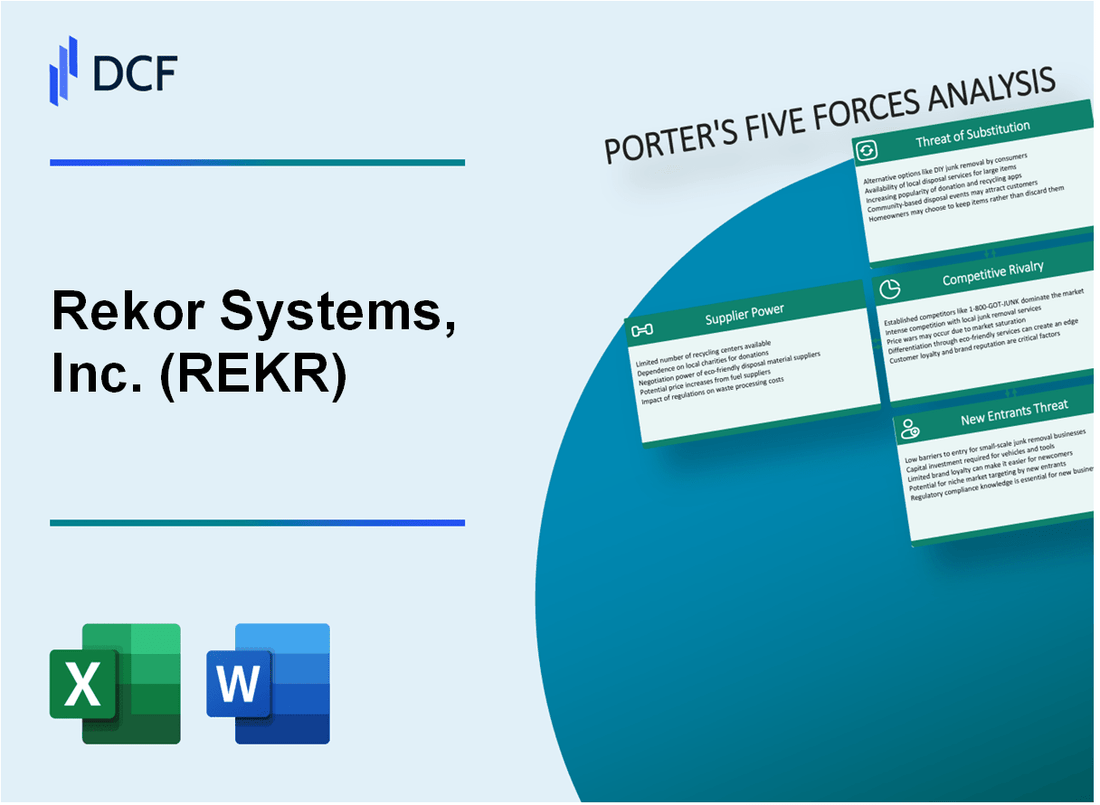
Rekor Systems, Inc. (Rekr): 5 forças Análise [Jan-2025 Atualizada] |
Totalmente Editável: Adapte-Se Às Suas Necessidades No Excel Ou Planilhas
Design Profissional: Modelos Confiáveis E Padrão Da Indústria
Pré-Construídos Para Uso Rápido E Eficiente
Compatível com MAC/PC, totalmente desbloqueado
Não É Necessária Experiência; Fácil De Seguir
Rekor Systems, Inc. (REKR) Bundle
No cenário em rápida evolução da tecnologia de transporte inteligente, a Rekor Systems, Inc. (REKR) navega em um complexo ecossistema de desafios e oportunidades estratégicas. Ao dissecar a estrutura das cinco forças de Michael Porter, revelamos a intrincada dinâmica que molda o posicionamento competitivo da empresa, desde o poder de negociação diferenciado de fornecedores e clientes até as ameaças sofisticadas de substitutos e possíveis novos participantes do mercado. Essa análise de mergulho profundo revela como a IA avançada e as tecnologias de visão computacional de Rekor estão estrategicamente posicionadas para superar as barreiras do mercado e impulsionar a inovação no setor de transporte inteligente.
Rekor Systems, Inc. (REKR) - As cinco forças de Porter: poder de barganha dos fornecedores
Fornecedores de tecnologia e hardware especializados
A partir do quarto trimestre 2023, a Rekor Systems identificou 7 provedores de tecnologia especializados primários nos mercados de visão computacional e IA. O mercado global de visão computacional foi avaliada em US $ 19,67 bilhões em 2023.
| Categoria de fornecedores | Número de provedores -chave | Concentração de mercado |
|---|---|---|
| Hardware de visão computacional | 5-7 Fabricantes especializados | Moderado (Índice CR4: 62%) |
| Componentes semicondutores da AI | 3-4 Fabricantes primários | Alto (Índice CR4: 78%) |
Dependências de fabricação de semicondutores e sensores
A Rekor Systems conta com os fabricantes de semicondutores com as seguintes características da cadeia de suprimentos:
- Receita global de semicondutores em 2023: US $ 574 bilhões
- Principais fabricantes de semicondutores: TSMC, Samsung, Intel
- Custo do componente estimado por sistema de rekor: US $ 1.200- $ 2.500
Restrições da cadeia de suprimentos
Os desafios de fabricação de tecnologia global em 2023-2024 incluem:
- Tempo de entrega de semicondutores: 20-26 semanas
- Impacto global de escassez de chips: 15-20% aumentou custos de componentes
- Restrições de capacidade de fabricação: atrasos na produção de 12 a 18 meses
Concentração do mercado de tecnologia de transporte inteligente
A análise de mercado revela:
| Segmento de mercado | Concentração do fornecedor | Poder de preços |
|---|---|---|
| Sensores de transporte inteligentes | Moderado (4-6 fornecedores-chave) | Alavancagem de preços médios |
| Tecnologia de reconhecimento de IA | Baixo (3-5 fornecedores especializados) | Alto potencial de preços |
Rekor Systems, Inc. (Rekr) - As cinco forças de Porter: Power de clientes de clientes
Agências governamentais e departamentos de transporte como clientes primários
No quarto trimestre 2023, a Rekor Systems garantiu 37 contratos governamentais em 12 estados, com um valor total do contrato de US $ 24,3 milhões.
| Segmento de clientes | Número de contratos | Valor total do contrato |
|---|---|---|
| Departamentos estaduais de transporte | 22 | US $ 14,7 milhões |
| Governos municipais | 15 | US $ 9,6 milhões |
Mudar custos e implementação de tecnologia
A implementação de tecnologia especializada de Rekor envolve:
- Custo médio de implementação: US $ 375.000 por projeto
- Tempo de integração: 4-6 meses
- Complexidade de personalização: altas barreiras técnicas
Soluções de transporte inteligentes abrangentes
A análise de mercado revela as preferências do cliente:
| Preferência da solução | Porcentagem de clientes |
|---|---|
| Plataforma AI integrada | 68% |
| Análise de dados em tempo real | 55% |
| Integração com vários sensores | 47% |
Requisitos de plataforma de tecnologia personalizada
Demandas de escalabilidade do cliente:
- Flexibilidade da plataforma: exigido por 82% dos clientes do governo
- Arquitetura escalável: essencial para 76% dos departamentos de transporte
- Design modular do sistema: preferido por 64% dos clientes em potencial
Pressões competitivas de preços
Análise competitiva de preços da paisagem:
| Concorrente | Custo médio do projeto | Quota de mercado |
|---|---|---|
| Rekor Systems | $425,000 | 12% |
| Concorrente a | $392,000 | 18% |
| Concorrente b | $465,000 | 9% |
Rekor Systems, Inc. (Rekr) - Five Forces de Porter: Rivalidade competitiva
Cenário competitivo Overview
A partir do quarto trimestre 2023, a Rekor Systems opera em um mercado com 7 concorrentes diretos em setores inteligentes de tecnologia e tecnologia de reconhecimento.
| Concorrente | Capitalização de mercado | Receita anual |
|---|---|---|
| Soluções Motorola | US $ 43,2 bilhões | US $ 8,6 bilhões |
| Soluções vigilantes | US $ 1,2 bilhão | US $ 380 milhões |
| Rekor Systems | US $ 112,4 milhões | US $ 24,3 milhões |
Dinâmica competitiva
A análise de mercado revela as principais características competitivas:
- 7 concorrentes diretos em tecnologia de transporte inteligente
- Taxa de concentração de mercado de 42%
- Gastos médios de P&D: 8,5% da receita
Diferenciação tecnológica
Os sistemas Rekor demonstram diferenciação tecnológica através de:
- Precisão de reconhecimento movida a IA de 94,3%
- Algoritmos de aprendizado de máquina processando 12,6 milhões de pontos de dados diariamente
- Portfólio de patentes: 17 patentes de tecnologia ativa
Tendências de consolidação de mercado
As estatísticas recentes de consolidação de mercado indicam:
- 3 fusões estratégicas no setor de tecnologia de transporte em 2023
- Taxa estimada de crescimento de mercado: 6,7% anualmente
- Investimento de capital de risco: US $ 215 milhões em startups de tecnologia de reconhecimento
Rekor Systems, Inc. (Rekr) - As cinco forças de Porter: ameaça de substitutos
Tecnologias alternativas de reconhecimento e rastreamento de veículos
A partir de 2024, o mercado global de reconhecimento automático de placas (ALPR) é avaliado em US $ 3,7 bilhões. A Rekor Systems enfrenta a concorrência de tecnologias alternativas com as seguintes características de mercado:
| Tecnologia | Quota de mercado | Taxa de crescimento anual |
|---|---|---|
| Reconhecimento de veículos baseado em IA | 22.5% | 14.3% |
| Sistemas de rastreamento RFID | 18.7% | 11.6% |
| Rastreamento de veículos GPS | 31.2% | 16.8% |
Blockchain emergente e sistemas de verificação descentralizados
As tecnologias de verificação baseadas em blockchain apresentam um substituto em potencial com métricas de mercado específicas:
- Blockchain global no mercado do mercado de transporte: US $ 1,2 bilhão
- Crescimento do mercado projetado até 2028: US $ 4,6 bilhões
- Taxa de crescimento anual composta (CAGR): 26,7%
Métodos tradicionais de monitoramento e aplicação manuais de tráfego
As tecnologias de monitoramento manual continuam a representar uma ameaça de substituição significativa:
| Método | Porcentagem de uso atual | Eficiência de custos |
|---|---|---|
| Contagem de tráfego manual | 37.5% | Mais baixo |
| Pontos de verificação físicos | 28.3% | Moderado |
Potenciais tecnologias de rastreamento baseadas em satélite e drones
Estatísticas do mercado de rastreamento de satélite e drones:
- Tamanho do mercado global de rastreamento de drones: US $ 2,8 bilhões
- Mercado de tecnologia de rastreamento por satélite: US $ 5,4 bilhões
- Crescimento esperado em 2026: 18,5%
Soluções de gerenciamento de tráfego baseadas em nuvem
Indicadores de mercado de gerenciamento de tráfego baseados em nuvem:
| Segmento | Valor de mercado | Crescimento ano a ano |
|---|---|---|
| Gerenciamento de tráfego em nuvem | US $ 6,2 bilhões | 15.9% |
| Soluções habilitadas para IoT | US $ 4,7 bilhões | 17.3% |
Rekor Systems, Inc. (Rekr) - As cinco forças de Porter: ameaça de novos participantes
Altos custos iniciais de desenvolvimento de tecnologia e pesquisa
A IA da Rekor Systems e o desenvolvimento da tecnologia de visão computacional requerem investimento financeiro significativo. A partir do terceiro trimestre de 2023, a empresa registrou despesas de P&D de US $ 5,6 milhões, representando uma barreira substancial aos possíveis participantes do mercado.
| Categoria de despesa de P&D | Valor ($) |
|---|---|
| Despesas totais de P&D (terceiro trimestre 2023) | 5,600,000 |
| Desenvolvimento de Tecnologia da IA | 3,200,000 |
| Pesquisa de visão computacional | 2,400,000 |
Requisitos significativos de conformidade regulatória
O setor inteligente de transporte e tecnologia de segurança pública envolve paisagens regulatórias complexas.
- Custos federais de conformidade estimados em US $ 750.000 anualmente
- As aprovações regulatórias em nível estadual exigem aproximadamente US $ 250.000 por jurisdição
- Despesas de certificação de segurança cibernética: US $ 450.000 por linha de produto
Experiência técnica especializada em IA e visão computacional
A Rekor Systems emprega 42 Profissionais de Tecnologia Avançada Com habilidades especializadas em IA e visão computacional, criando uma barreira de talento significativa para os novos participantes do mercado.
| Categoria de especialização técnica | Número de profissionais |
|---|---|
| Engenheiros de IA | 18 |
| Especialistas em visão computacional | 24 |
Investimento de infraestrutura de hardware e software
O desenvolvimento de infraestrutura requer investimento substancial de capital.
- Custos de infraestrutura em nuvem: US $ 1,2 milhão anualmente
- Despesas de desenvolvimento de hardware: US $ 3,5 milhões por ciclo do produto
- Investimentos da plataforma de desenvolvimento de software: US $ 2,8 milhões anualmente
Barreiras do processo de compras governamentais
Rekor Systems garantiu 17 contratos governamentais Em várias jurisdições, demonstrando a complexidade da entrada do mercado.
| Tipo de contrato | Número de contratos |
|---|---|
| Contratos federais | 5 |
| Contratos em nível estadual | 8 |
| Contratos municipais | 4 |
Rekor Systems, Inc. (REKR) - Porter's Five Forces: Competitive rivalry
You're looking at the competitive rivalry in the roadway intelligence sector, and honestly, it's a crowded field. The intensity here is a major factor in how Rekor Systems, Inc. (REKR) has to operate day-to-day.
Rivalry is intense with 270 active competitors in the AI/roadway intelligence space. This sheer volume of players means that gaining and holding market share requires constant pressure on pricing, innovation, and operational efficiency. It's not just a few big names; it's a wide array of specialized firms all vying for government and commercial contracts.
Rekor Systems' Q3 2025 preliminary revenue of $14.2 million is small relative to the total market, which underscores the fragmentation and the scale of the competition. To put that revenue in context against the broader AI market, the global AI market was valued at approximately $391 billion as of late 2025. Even within the more specific AI in Computer Vision segment, the market size was estimated at USD 20.59 billion in 2024. Rekor Systems' quarterly revenue is a fraction of these figures, showing the uphill battle for dominance.
This high competition forces the company to maintain strict cost discipline. You see this reflected in the profitability metrics; the company reported a net margin of -89.82%, which is significantly different from some peers, such as SkyWater Technology, which posted a net margin of 36.36%. To fight back against pricing pressure, Rekor Systems has been laser-focused on operational improvements. For instance, operating expenses fell 26% sequentially and 20% year-over-year in Q3 2025, and total operating expenses declined 24% quarter over quarter. This cost control helped push the adjusted gross margin up to 63.4% for the quarter.
The competitive landscape is diverse, featuring both large players and highly specialized firms. This means Rekor Systems, Inc. (REKR) is competing on multiple fronts simultaneously. Here's a look at some of the types of rivals:
- Specialized roadway intelligence firms.
- Large technology companies with AI/vision arms.
- Niche computer vision application developers.
- Companies focused on data engineering for AI models.
The competitive set includes companies like Netradyne, Hayden AI, and Zendrive in the direct roadway/fleet space. Furthermore, they face competition from firms in adjacent technology sectors, such as SkyWater Technology, indie Semiconductor, and SEALSQ, as well as established security and surveillance leaders like Genetec.
Here's a quick comparison of some key financial metrics against a peer, illustrating the margin pressure:
| Metric | Rekor Systems, Inc. (REKR) Q3 2025 | SkyWater Technology (SKYT) Latest Reported |
|---|---|---|
| Revenue (Q3 2025) | $14.2 million | Data not provided in search results |
| Adjusted Gross Margin (Q3 2025) | 63.4% | Data not provided in search results |
| Net Margin | -89.82% | 36.36% |
| Operating Expense Reduction (Seq.) | 26% | Data not provided in search results |
The intensity is further highlighted by the fact that while Rekor Systems is making progress on its operating leverage, profitability remains a key challenge in this highly competitive environment. Finance: draft Q4 2025 operating expense forecast based on Q3 run-rate by next Tuesday.
Rekor Systems, Inc. (REKR) - Porter's Five Forces: Threat of substitutes
You're looking at the threat of substitutes for Rekor Systems, Inc. (REKR), and honestly, the landscape shows a clear push away from the old ways of doing things. The threat from traditional traffic study firms and manual data collection methods is definitely present, but I'd peg it as moderate as of late 2025. Why moderate? Because while the old guard still exists, the numbers show the market is rapidly valuing the speed and accuracy of AI. For instance, traditional traffic studies can run anywhere from $1,500 to $13,000 per intersection, depending on complexity. Compare that to the long-term value proposition Rekor Systems, Inc. is selling; their Q3 2025 revenue hit a record $14.2 million, showing a clear appetite for their modern approach.
The possibility of large government agencies developing in-house software solutions is a persistent concern for any tech provider. However, the sheer scale and specialization required for a comprehensive AI platform present a high barrier to entry for internal development. It's not just about writing code; it's about the data, the continuous model training, and the integration across existing infrastructure. We see the market itself is valued at USD 20.65 billion in 2024, with an expected CAGR of 32.8% through 2032. That kind of growth suggests that building from scratch is often too slow and costly compared to adopting proven platforms. Furthermore, the cost of not adopting AI is measurable: traffic congestion costs U.S. drivers an average of 97 hours and $1,350 annually, according to a 2024 report.
Rekor Systems, Inc.'s non-intrusive Data-as-a-Service (DaaS) model, exemplified by Rekor Discover®, directly counters the limitations of intrusive, traditional sensors. Traditional methods are labor-intensive and have limited operating hours, whereas AI monitoring can run 24/7 with an accuracy range of 95-98%. This shift is validated by Rekor's success in securing a statewide Georgia Department of Transportation (GDOT) contract with a minimum value of $50 million, potentially exceeding $100 million. This DaaS focus is what drove Rekor's Q3 2025 recurring revenue to $6.5 million, an 18% year-over-year increase.
The threat of substitution is significantly reduced by high switching costs once an agency commits to a full AI platform like the one Rekor offers. When an agency signs a multi-year deal, like the one in Georgia which could last up to eight years, the sunk cost in integration, staff training, and data pipeline establishment becomes substantial. This creates a sticky customer base. The value proposition is clear: AI solutions can reduce traffic delays by 25%, and a mere 10% reduction in commute times can yield a 2.9% productivity increase. Once an agency sees those operational improvements and the margin expansion Rekor achieved-with an adjusted gross margin of 63.4% in Q3 2025-the inertia to switch to a competitor or revert to manual methods becomes very low.
Here's a quick comparison of the value proposition against traditional methods:
| Factor | Traditional Manual/Sensor Method | AI/DaaS Model (Rekor Systems, Inc. Context) |
|---|---|---|
| Cost per Intersection (Estimate) | $1,500 to $13,000 | One-time fixed installation plus recurring data charge |
| Data Accuracy | Inconsistent | 95-98% |
| Operating Hours | Limited (Human dependent) | 24/7 |
| Potential Productivity Benefit | N/A | 2.9% increase for every 10% commute time reduction |
The strategic implications for Rekor Systems, Inc. involve capitalizing on these high switching costs. You want to see more of that recurring revenue base, which reached $17.5 million year-to-date for the first nine months of 2025.
- Focus on securing multi-year contracts, like the eight-year potential in Georgia.
- Highlight the $1,350 annual cost of congestion per driver to justify upfront investment.
- Emphasize the $7.9 million improvement in Adjusted EBITDA loss year-over-year in Q3 2025.
- Showcase the 63% adjusted gross margin achieved in Q3 2025, proving the model's financial viability.
Finance: draft the contract renewal risk assessment for the South Carolina initial order of approximately $1 million by next Wednesday.
Rekor Systems, Inc. (REKR) - Porter's Five Forces: Threat of new entrants
You're looking at the barriers to entry for a new competitor trying to take on Rekor Systems, Inc. in the roadway intelligence space. Honestly, the threat level here leans low to moderate, primarily because the required investment in specialized technology and navigating government procurement is substantial. New entrants don't just need a good idea; they need deep pockets and proven compliance.
Threat is low to moderate due to high capital and R&D requirements for proprietary AI/ML.
Developing the proprietary Artificial Intelligence and Machine Learning (AI/ML) capabilities that Rekor Systems, Inc. deploys for traffic management isn't cheap. For an advanced or enterprise-grade system, like the computer vision platforms Rekor Systems uses, the estimated development cost in 2025 can range from $150,000 to over $1,000,000 for complex solutions. Even a mid-complexity ML project starts around $60,000. Furthermore, AI requires continuous investment; you must plan for ongoing costs of 17% to 30% of initial development costs annually just for model fine-tuning and infrastructure scaling. This high, sustained R&D spend immediately weeds out smaller players. To put this in perspective against the incumbent, Rekor Systems, Inc. reported a total revenue of $12.4 million for the second quarter of 2025. A new entrant needs to match that R&D intensity just to compete on technology alone.
Regulatory hurdles and need for government certifications create strong barriers to entry.
Selling into the public sector, which is Rekor Systems, Inc.'s bread and butter, requires more than just functional software; it demands trust and validated security. A new company would immediately face the hurdle of achieving certifications that Rekor Systems, Inc. already possesses. For instance, Rekor Systems secured SOC 2 Type II Certification for its platforms, a critical affirmation of its security controls. Without this, government agencies are unlikely to even consider a bid. Also, the company is actively addressing evolving policy, having announced a patented privacy framework for Automated License Plate Recognition (ALPR) data in November 2025. A new entrant must develop, prove, and get regulatory buy-in for similar compliance measures before they can even enter the running.
Long sales cycles to secure large state contracts like the TxDOT blanket order deter new players.
Government procurement is notoriously slow, and this acts as a significant time-based barrier. Management at Rekor Systems, Inc. has explicitly acknowledged the long sales cycles in government procurement. New competitors must survive a lengthy period of proving efficacy before revenue materializes. The value locked up in these deals is massive, which is attractive but also risky for a startup to pursue without existing capital reserves. Consider the scale: Rekor Systems, Inc. won a multi-year statewide contract with the Texas Department of Transportation (TxDOT) that included an eight-figure blanket purchase order. More recently, their Georgia DOT contract is projected to generate a minimum of $50 million in revenue, with a potential total value exceeding $100 million. Surviving the multi-year process to land a single, large contract like this is a major deterrent for any new, unproven entity.
Need for a proven, privacy-protected data framework is a key barrier.
The market is shifting toward Data-as-a-Service (DaaS) models, which require a history of reliable, compliant data handling. Rekor Systems, Inc. is leveraging its existing deployments-like the one in the Austin TxDOT District which showed a 159% increase in incident detection-to secure these massive follow-on contracts. A new entrant has no track record of delivering measurable results or handling sensitive public data securely at scale. They lack the necessary proof points. This is where the established framework becomes a moat. The company's focus on providing a privacy-protected path forward for ALPR data is a direct response to national concerns, something a startup would take years and significant legal/R&D expense to replicate and validate.
Here's a quick look at how these barriers stack up:
| Barrier Component | Quantifiable Factor/Metric | Impact on New Entrants |
|---|---|---|
| Capital & R&D Intensity | Advanced AI Development Cost: Up to $1,000,000+ | Requires significant upfront capital for proprietary technology development. |
| Regulatory & Certification | Possession of SOC 2 Type II Certification | New entrants lack the baseline security validation required by government clients. |
| Sales Cycle Length | TxDOT Contract Size: Eight-figure blanket order | New players must sustain operations through prolonged, multi-year procurement processes. |
| Data Framework Provenance | GDOT Contract Potential Value: Up to $100 million | Lack of a proven, privacy-compliant data history hinders trust and large-scale adoption. |
The combination of high-cost, high-security development and the slow, high-stakes nature of government sales definitely keeps the competitive field thin. Still, the company's own Q1 2025 revenue miss of $9.2 million against a $13.64 million forecast shows that even established players face execution risk in this environment.
Finance: Draft a sensitivity analysis on the impact of a 12-month delay in the next major state contract award by next Tuesday.
Disclaimer
All information, articles, and product details provided on this website are for general informational and educational purposes only. We do not claim any ownership over, nor do we intend to infringe upon, any trademarks, copyrights, logos, brand names, or other intellectual property mentioned or depicted on this site. Such intellectual property remains the property of its respective owners, and any references here are made solely for identification or informational purposes, without implying any affiliation, endorsement, or partnership.
We make no representations or warranties, express or implied, regarding the accuracy, completeness, or suitability of any content or products presented. Nothing on this website should be construed as legal, tax, investment, financial, medical, or other professional advice. In addition, no part of this site—including articles or product references—constitutes a solicitation, recommendation, endorsement, advertisement, or offer to buy or sell any securities, franchises, or other financial instruments, particularly in jurisdictions where such activity would be unlawful.
All content is of a general nature and may not address the specific circumstances of any individual or entity. It is not a substitute for professional advice or services. Any actions you take based on the information provided here are strictly at your own risk. You accept full responsibility for any decisions or outcomes arising from your use of this website and agree to release us from any liability in connection with your use of, or reliance upon, the content or products found herein.