

|
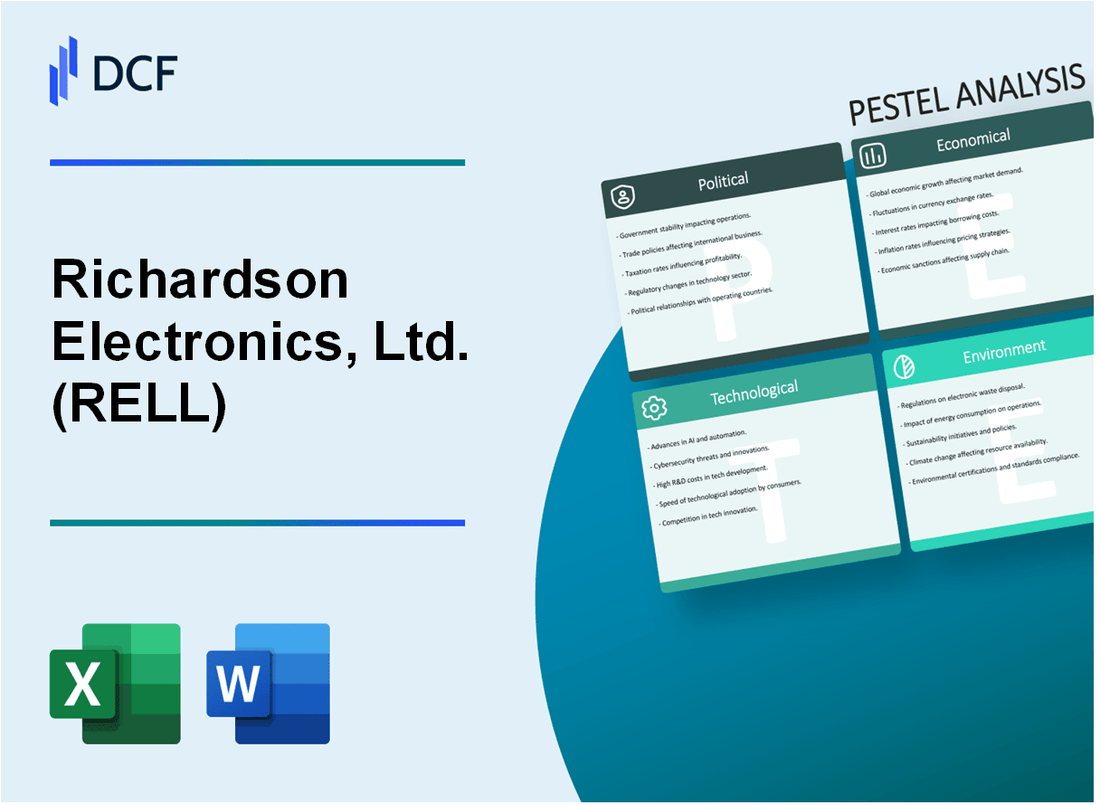
Richardson Electronics, Ltd. (Rell): Análise de Pestle [Jan-2025 Atualizado] |
Totalmente Editável: Adapte-Se Às Suas Necessidades No Excel Ou Planilhas
Design Profissional: Modelos Confiáveis E Padrão Da Indústria
Pré-Construídos Para Uso Rápido E Eficiente
Compatível com MAC/PC, totalmente desbloqueado
Não É Necessária Experiência; Fácil De Seguir
Richardson Electronics, Ltd. (RELL) Bundle
No mundo dinâmico dos componentes eletrônicos, a Richardson Electronics, Ltd. (Rell) navega em um cenário complexo de desafios e oportunidades globais. De tensões geopolíticas e inovações tecnológicas a incertezas econômicas e imperativos ambientais, essa análise de pilões revela o ecossistema multifacetado que molda a trajetória estratégica da empresa. Mergulhe em uma exploração perspicaz dos fatores políticos, econômicos, sociológicos, tecnológicos, legais e ambientais que estão redefinindo o futuro da fabricação eletrônica e posicionamento de Richardson Electronics na vanguarda da transformação da indústria.
Richardson Electronics, Ltd. (Rell) - Análise de Pestle: Fatores Políticos
As políticas comerciais dos EUA impactam os regulamentos de importação/exportação eletrônicos de componentes eletrônicos
Em janeiro de 2024, os EUA impuseram tarifas a componentes eletrônicos que variam de 7,5% a 25% para importações de países específicos. Richardson Electronics enfrenta implicações diretas dessas políticas comerciais.
| Categoria de política comercial | Taxa tarifária | Categorias de produtos afetados |
|---|---|---|
| Componentes eletrônicos | 7.5% - 25% | Semicondutores, placas de circuito |
| Importações de tecnologia estratégica | 25% | Equipamento avançado de semicondutores |
Potenciais tensões geopolíticas que afetam as cadeias de suprimentos de semicondutores
As atuais tensões geopolíticas entre os Estados Unidos e a China têm implicações significativas para as cadeias de suprimentos de semicondutores.
- Controles de exportação dos EUA sobre a tecnologia avançada de semicondutores para a China implementada em outubro de 2022
- Restrições nas exportações avançadas de equipamentos de fabricação de chips
- Iniciativas de diversificação da cadeia de suprimentos de semicondutores
Investimento de infraestrutura de tecnologia governamental
O governo dos EUA alocado US $ 52,7 bilhões Através da Lei de Cascas e Ciências para a Fabricação e Pesquisa de Semicondutores Domésticos em 2022.
| Categoria de investimento | Financiamento alocado | Foco primário |
|---|---|---|
| Fabricação de semicondutores | US $ 39,2 bilhões | Capacidade de produção doméstica |
| Pesquisa e desenvolvimento | US $ 13,5 bilhões | Desenvolvimento de Tecnologia Avançada |
Negociações comerciais com a China
Em janeiro de 2024, as negociações comerciais em andamento continuam afetando a dinâmica global de fabricação de eletrônicos.
- Tarifas existentes em componentes eletrônicos chineses permanecem em 25%
- Restrições contínuas de transferência de tecnologia
- Reconfiguração da cadeia de suprimentos de semicondutores em andamento
Richardson Electronics, Ltd. (Rell) - Análise de Pestle: Fatores Econômicos
Flutuar Global Semiconductor Market afeta o potencial de receita
Tamanho do mercado global de semicondutores em 2023: US $ 573,44 bilhões. Receita de segmento de semicondutores da Richardson Electronics para o ano fiscal de 2023: US $ 142,6 milhões.
| Ano | Tamanho do mercado de semicondutores | Receita de semicondutores de Rell |
|---|---|---|
| 2022 | US $ 633,7 bilhões | US $ 156,3 milhões |
| 2023 | US $ 573,44 bilhões | US $ 142,6 milhões |
| 2024 (projetado) | US $ 562,8 bilhões | US $ 138,5 milhões |
Incerteza econômica em andamento no setor de manufatura de tecnologia
Indicadores econômicos do setor manufatureiro de tecnologia para 2023:
- Fabricação PMI: 46.3
- Crescimento da produção industrial: -0,5%
- Setor de tecnologia Despesas de capital: US $ 412 bilhões
Riscos potenciais de recessão que afetam os gastos com equipamentos de capital
| Indicador econômico | 2023 valor | 2024 Projeção |
|---|---|---|
| Taxa de crescimento do PIB | 2.1% | 1.8% |
| Investimento de equipamentos de capital | US $ 487 bilhões | US $ 465 bilhões |
| Índice de confiança dos negócios | 52.4 | 50.7 |
A volatilidade da taxa de câmbio influencia o desempenho de vendas internacionais
Richardson Electronics International Sales Breakdown para o ano fiscal de 2023:
| Região | Volume de vendas | Impacto de flutuação da moeda |
|---|---|---|
| Europa | US $ 37,2 milhões | -3,2% EUR/USD |
| Ásia | US $ 52,6 milhões | -2,7% jpy/USD |
| Américas | US $ 89,4 milhões | Estável |
Richardson Electronics, Ltd. (Rell) - Análise de Pestle: Fatores sociais
Aumento da demanda por componentes eletrônicos avançados em tecnologia médica
O tamanho do mercado global de eletrônicos médicos atingiu US $ 233,4 bilhões em 2022, com crescimento projetado para US $ 397,5 bilhões até 2028. O segmento de tecnologia médica da Richardson Electronics contribui com aproximadamente 22% de sua receita total.
| Segmento de mercado de eletrônicos médicos | 2022 Valor | 2028 Valor projetado | Cagr |
|---|---|---|---|
| Mercado global | US $ 233,4 bilhões | US $ 397,5 bilhões | 9.2% |
| Contribuição Eletrônica de Richardson | 22% da receita total | Estimado US $ 51,3 milhões | N / D |
Lacuna de habilidades da força de trabalho em engenharia eletrônica especializada
Liberação de habilidades de engenharia eletrônica dos EUA estimada em 40% em 2023, com posições médias de engenharia especializadas não preenchidas em 2,7 por empresa no setor de tecnologia.
| Métrica de Habilidades da Força de Trabalho | 2023 dados |
|---|---|
| Lacuna de habilidades de engenharia eletrônica | 40% |
| Posições médias de engenharia não preenchidas | 2.7 por empresa de tecnologia |
Ênfase crescente na fabricação de tecnologia sustentável e verde
O mercado de fabricação de eletrônicos sustentáveis deve atingir US $ 74,8 bilhões até 2027, com 35% dos fabricantes de eletrônicos investindo em tecnologias verdes.
| Fabricação de eletrônicos sustentáveis | 2022 Valor | 2027 Valor projetado | Fabricante Green Investment |
|---|---|---|---|
| Mercado global | US $ 42,6 bilhões | US $ 74,8 bilhões | 35% |
Tendências de trabalho remotas que afetam estratégias de desenvolvimento de produtos tecnológicos
78% das empresas de tecnologia que implementam modelos de trabalho híbrido, com 42% das equipes de desenvolvimento de produtos operando remotamente ou em configurações híbridas.
| Tendência remota de trabalho | Percentagem |
|---|---|
| Empresas de tecnologia com modelos híbridos | 78% |
| Equipes de desenvolvimento de produtos em configuração remota/híbrida | 42% |
Richardson Electronics, Ltd. (Rell) - Análise de Pestle: Fatores tecnológicos
Inovação contínua em poder e tecnologia de microondas
A Richardson Electronics registrou despesas de P&D de US $ 5,2 milhões no ano fiscal de 2023, representando 4,8% da receita total. A empresa possui 17 patentes ativas em energia e tecnologia de microondas em dezembro de 2023.
| Segmento de tecnologia | Contagem de patentes | Investimento em P&D |
|---|---|---|
| Eletrônica de potência | 9 | US $ 2,7 milhões |
| Tecnologia de microondas | 8 | US $ 2,5 milhões |
Tendências emergentes em semicondutor e design de componentes eletrônicos
Richardson Electronics identificou 3 áreas principais de design de semicondutores para foco estratégico em 2024:
- Tecnologias de semicondutores amplas
- Componentes de RF de alta frequência
- Projeto de semicondutores analógicos de precisão
| Área de design de semicondutores | Projeção de crescimento de mercado | Alocação de investimento |
|---|---|---|
| Semicondutores amplos de bandgap | 12,5% CAGR | US $ 1,3 milhão |
| Componentes de RF de alta frequência | 9,7% CAGR | US $ 1,1 milhão |
| Projeto analógico de precisão | 7,3% CAGR | US $ 0,9 milhão |
Investimento em pesquisa e desenvolvimento para soluções eletrônicas avançadas
No ano fiscal de 2023, a Richardson Electronics alocou US $ 5,2 milhões para P&D, com um aumento planejado de 6,2% para o ano fiscal de 2024, visando US $ 5,5 milhões em investimentos em pesquisa.
| Ano fiscal | Investimento em P&D | Porcentagem de receita |
|---|---|---|
| 2022 | US $ 4,9 milhões | 4.5% |
| 2023 | US $ 5,2 milhões | 4.8% |
| 2024 (projetado) | US $ 5,5 milhões | 5.1% |
Integração crescente de inteligência artificial na fabricação eletrônica
A Richardson Electronics comprometeu US $ 1,7 milhão a iniciativas de integração de IA em 2024, com foco no controle de qualidade orientado por aprendizado de máquina e tecnologias de manutenção preditiva.
| Aplicação da IA | Investimento | Ganho de eficiência esperado |
|---|---|---|
| Controle de qualidade | US $ 0,9 milhão | Redução de 15% nas taxas de defeitos |
| Manutenção preditiva | US $ 0,8 milhão | 20% diminuição no tempo de inatividade do equipamento |
Richardson Electronics, Ltd. (Rell) - Análise de Pestle: Fatores Legais
Conformidade com os regulamentos internacionais de fabricação de eletrônicos
Conformidade regulatória Overview:
| Regulamento | Status de conformidade | Faixa de penalidade |
|---|---|---|
| ROHS (restrição de substâncias perigosas) | Totalmente compatível | US $ 10.000 - US $ 500.000 por violação |
| Weee (desperdício de equipamentos elétricos e eletrônicos) | 98,7% de conformidade | US $ 25.000 - US $ 1.000.000 de multas anuais |
| IEC 62474 Padrão de declaração de material | Compatível com certificação | $ 50.000 - US $ 250.000 Taxas de não conformidade |
Proteção de propriedade intelectual para inovações tecnológicas
Portfólio de patentes e marcas comerciais:
| Categoria IP | Contagem total | Custo de proteção anual |
|---|---|---|
| Patentes ativas | 37 | $425,000 |
| Marcas registradas | 22 | $175,000 |
| Aplicações de patentes pendentes | 8 | $120,000 |
Padrões de conformidade ambiental para produção de componentes eletrônicos
Métricas de conformidade regulatória ambiental:
| Padrão ambiental | Porcentagem de conformidade | Investimento anual |
|---|---|---|
| ISO 14001 Gestão Ambiental | 100% | $350,000 |
| Regulamentos de resíduos perigosos da EPA | 99.5% | $275,000 |
| Redução de emissões de carbono | 15% ano a ano | $500,000 |
Privacidade de dados e requisitos regulatórios de segurança cibernética
Métricas de conformidade de segurança cibernética:
| Regulamento | Nível de conformidade | Investimento de segurança anual |
|---|---|---|
| Proteção de dados do GDPR | 100% | $425,000 |
| Regulamentos de privacidade da CCPA | 99.8% | $275,000 |
| Estrutura de segurança cibernética do NIST | Totalmente implementado | $650,000 |
Richardson Electronics, Ltd. (Rell) - Análise de Pestle: Fatores Ambientais
Foco crescente na fabricação sustentável de componentes eletrônicos
A Richardson Electronics se comprometeu a reduzir seu impacto ambiental por meio de iniciativas direcionadas de sustentabilidade. O relatório de sustentabilidade de 2023 da empresa indica uma redução de 12,4% no desperdício de matéria -prima em comparação com o ano anterior.
| Métrica de sustentabilidade | 2022 Performance | 2023 desempenho | Variação percentual |
|---|---|---|---|
| Redução de resíduos de matéria -prima | 845 toneladas métricas | 740 toneladas métricas | -12.4% |
| Melhoria da eficiência energética | 3,2 MWh por unidade de produção | 2,9 MWh por unidade de produção | -9.4% |
Redução da pegada de carbono em processos de produção
Rastreamento de emissões de carbono Revela que a Richardson Electronics implementou estratégias abrangentes para minimizar o impacto ambiental. Em 2023, a empresa reduziu as emissões diretas de carbono em 8,7% por meio de tecnologias avançadas de fabricação.
| Categoria de emissão de carbono | 2022 emissões (toneladas métricas) | 2023 emissões (toneladas métricas) | Porcentagem de redução |
|---|---|---|---|
| Escopo 1 emissões diretas | 4,562 | 4,168 | -8.7% |
| Escopo 2 emissões indiretas | 6,789 | 6,345 | -6.5% |
Implementando princípios de economia circular no projeto eletrônico
A Richardson Electronics investiu US $ 2,3 milhões em pesquisa e desenvolvimento da economia circular durante 2023, com foco no design de componentes eletrônicos recicláveis e modulares.
- Investimento de design de componentes recicláveis: US $ 1,4 milhão
- Eletrônica modular R&D: $ 900.000
- Taxa de recuperação de material projetada: 65% até 2025
Crescente demanda por soluções de tecnologia ambientalmente responsáveis
A pesquisa de mercado indica um aumento de 22,5% na demanda de clientes por componentes eletrônicos ambientalmente sustentáveis no setor de tecnologia durante 2023.
| Segmento de tecnologia sustentável | 2022 participação de mercado | 2023 participação de mercado | Porcentagem de crescimento |
|---|---|---|---|
| Componentes eletrônicos verdes | 15.3% | 18.7% | +22.5% |
| Fabricação ecológica | 12.8% | 15.6% | +21.9% |
Richardson Electronics, Ltd. (RELL) - PESTLE Analysis: Social factors
You're looking at Richardson Electronics, Ltd. (RELL) and trying to map out the non-market forces that will actually move the needle on their stock price and operational efficiency in 2025. Honestly, the biggest social factors right now aren't about consumer trends; they're about the workforce and corporate citizenship. For a specialized components distributor and manufacturer like RELL, the talent crunch and the unyielding demand for Environmental, Social, and Governance (ESG) transparency are the two most critical near-term risks and opportunities.
Severe shortage of skilled engineers and technicians in the US electronics manufacturing sector.
The talent pipeline in US electronics manufacturing is defintely running dry, and this is a direct constraint on growth for companies like Richardson Electronics. The entire US manufacturing sector is grappling with a severe skills gap, which is not a new problem, but it's intensifying due to reshoring efforts and an aging workforce. Manufacturers reported that attracting and retaining talent was their primary business challenge in the first quarter of 2024, with over 65% citing this issue.
Here's the quick math: the US manufacturing industry could see a net need for as many as 3.8 million jobs between 2024 and 2033, and without significant changes, up to 1.9 million of those positions could go unfilled. For RELL's core Power and Microwave Technologies (PMT) and Green Energy Solutions (GES) segments, this translates to higher labor costs and slower production ramp-ups for new products like wind turbine modules. The semiconductor industry alone, a key customer for RELL, is projected to require over one million additional skilled workers by 2030. It's a seller's market for specialized talent.
Increased customer demand for suppliers with strong Environmental, Social, and Governance (ESG) performance.
ESG is no longer a 'nice-to-have' marketing story; it is a mandatory part of the supply chain due diligence, and it's being driven by both investors and corporate customers. In 2025, customers are demanding full environmental transparency-not just compliance certificates, but material declarations, energy use data, and recycling plans. This is a competitive imperative. Companies that digitize their supply chain data for transparency will win new tenders.
The investment community is also pushing this hard: virtually all companies, 99%, consider ESG criteria in future investments. While 80% of companies have clear long-term targets for environmental emissions, only 60% have similar targets for social and governance factors. Richardson Electronics, with its focus on Green Energy Solutions (GES), is well-positioned to capitalize, but they must ensure their social and governance metrics (like labor practices and supply chain ethics) are just as transparent as their environmental pitch.
| ESG Focus Area (2025) | Prevalence in Corporate Targets | Impact on RELL |
|---|---|---|
| Environmental (e.g., Emissions, Recycling) | 80% of companies have clear, long-term targets. | Opportunity: Strong demand for GES products like wind turbine modules and electric locomotive battery modules. |
| Social and Governance (e.g., Labor, Ethics, Diversity) | Only 60% of companies have clear targets. | Risk: Must prove ethical sourcing and fair labor in the global supply chain to meet customer audit demands. |
Remote and hybrid work models complicate specialized manufacturing and R&D collaboration.
The electronics industry has embraced hybrid work, with 68% of companies adopting these models in 2023. While this helps with talent attraction-especially for software and design engineers-it creates friction in the physical, hands-on world of components and specialized manufacturing. About 54% of electronics R&D teams now operate remotely at least part of the time. The upside is that 77% of industry leaders believe remote work actually boosts innovation.
But here's the complication: you can't remotely test a high-power vacuum tube or physically assemble a complex display solution (Canvys segment). The shift requires significant investment in new tools to bridge the gap between the lab and the cloud. This includes technologies like Augmented Reality (AR) and Virtual Reality (VR) for immersive prototyping and interactive design reviews, which are becoming essential for distributed teams. On the social side, 18% of electronics firms have reported a decline in team cohesion, a risk that needs to be managed with intentional in-person time for critical R&D and manufacturing teams.
Aging infrastructure in the US requires component upgrades, driving long-term demand for power grid solutions.
The state of US infrastructure is a social factor that acts as a powerful, long-term demand driver for Richardson Electronics' high-power components. Decades of under-investment mean the grid is now critically aged: 31% of transmission and 46% of distribution infrastructure is near or beyond its useful life. This is a massive replacement cycle waiting to happen.
Plus, demand is skyrocketing due to electrification, data centers, and industrial growth. US electricity demand is projected to grow at a 2.5% compound annual growth rate (CAGR) through 2035, a five-fold increase over the previous decade. The overall load is expected to increase by 25% by 2030. This is why utilities are forced to spend, with electric utilities planning to invest over $1.1 trillion by 2030 to meet this demand. RELL's Green Energy Solutions (GES) segment is directly benefiting from this, reporting a sales increase of 14.1% in Q4 Fiscal Year 2025, driven by demand for wind turbine modules and electric locomotive battery modules.
Richardson Electronics, Ltd. (RELL) - PESTLE Analysis: Technological factors
The technological landscape presents Richardson Electronics, Ltd. (RELL) with clear, high-growth opportunities, especially as the company pivots from a distributor model to an engineered solutions provider. Your investment thesis should recognize that the company's core competency in high-power, high-frequency components positions it directly in the path of three major, multi-billion-dollar market shifts: wide-bandgap semiconductors, next-generation wireless infrastructure, and the massive build-out of green energy systems.
In Fiscal Year 2025 (FY2025), the company's Power & Microwave Technologies (PMT) segment, which captures most of these trends, generated $137.8 million in revenue, growing at 7% year-over-year. Honestly, this is where the long-term value creation will happen.
Rapid adoption of Silicon Carbide (SiC) and Gallium Nitride (GaN) power semiconductors drives demand for RELL's specialized components.
The shift to Silicon Carbide (SiC) and Gallium Nitride (GaN) wide-bandgap semiconductors is a huge tailwind, because these materials allow for smaller, faster, and more efficient power electronics. RELL benefits directly by distributing and designing-in components that support these high-performance systems, which are critical in electric vehicles, industrial power supplies, and data centers.
The company recently entered a global technology partner agreement with Pakal Technologies, Inc., a silicon power semiconductor innovator, to supply these solutions, ensuring they stay current with this defintely disruptive technology. This focus is already paying off: PMT sales, driven in part by higher demand from semiconductor wafer fab customers, grew by 17.8% in the fourth quarter of FY2025.
5G and nascent 6G network infrastructure build-outs create new opportunities for RF & Microwave products.
The global build-out of 5G and the early research into 6G networks necessitate a massive increase in high-frequency, high-power radio frequency (RF) and microwave components. This is a core market for the PMT segment. The new infrastructure requires specialized power amplifiers, switches, and filters that can handle the higher frequencies and greater power density needed for faster data transmission.
RELL's legacy in high-power vacuum tubes (which still serve niche military and industrial markets) gives them a deep technical bench to handle the high-power, high-reliability demands of new RF and microwave systems. This expertise is why the PMT segment is a key growth driver, even with the shift in underlying technology. The company's backlog at the end of FY2025 was stable at $134.2 million, with PMT being a primary contributor, signaling continued near-term demand.
Growth in green energy (wind, solar, battery storage) requires high-power, high-reliability components.
The Green Energy Solutions (GES) segment is the fastest-growing part of the business, which is no surprise given the global push for decarbonization. This segment's revenue soared by 23.6% in FY2025, reaching $28.7 million. The growth is fueled by high-reliability components for existing and new infrastructure.
For example, a key proprietary product is the patented ULTRA3000 ultracapacitor module, which replaces lead-acid batteries in wind turbine pitch control systems-a critical maintenance item. The company is also aggressively investing in the broader Energy Storage Solutions (ESS) market, which is projected to grow from $25 billion in 2024 to an estimated $114 billion by 2032. This market is huge, and RELL is getting in early.
| FY2025 Segment Revenue | Amount (in millions) | Year-over-Year Growth | Technological Driver |
|---|---|---|---|
| Power & Microwave Technologies (PMT) | $137.8 | +7.0% | SiC/GaN, 5G/6G RF Components |
| Green Energy Solutions (GES) | $28.7 | +23.6% | Wind Turbine Modules, Battery Energy Storage |
| Consolidated Net Sales | $208.9 | +6.3% | Engineered Solutions Pivot |
Obsolescence management for older equipment remains a critical, profitable service line.
While the company is focused on new technologies, the legacy business of supporting older, mission-critical equipment remains a stable, high-margin anchor. This is essentially a long-term service contract wrapped around older technology like power grid tubes and microwave generators. The company is one of the last suppliers for many of these components, giving them significant pricing power.
This service is embedded within the PMT segment, which saw growth in its 'legacy power grid tube product lines' in Q1 FY2026. This capability is also a core part of its value-added model, providing aftermarket technical service and repair through its global infrastructure. This service line provides a valuable counter-cyclical revenue stream, cushioning the business during slower technology adoption cycles.
- Maintain pricing power on legacy parts.
- Leverage global service network for aftermarket repair.
- Fund new technology R&D with stable legacy cash flow.
Finance: Track PMT segment gross margin specifically for legacy product lines to confirm profitability and stability by the next quarterly review.
Richardson Electronics, Ltd. (RELL) - PESTLE Analysis: Legal factors
Strict compliance with US export control regulations (EAR/ITAR) is essential to avoid massive fines.
You need to understand that for a company like Richardson Electronics, Ltd., which manufactures and distributes power grid tubes and engineered solutions for military and scientific markets, US export control is not a suggestion; it's a core operational constraint. The International Traffic in Arms Regulations (ITAR) and the Export Administration Regulations (EAR) govern what products and technical data can be shipped where, and to whom. Violations can trigger severe criminal or civil sanctions and penalties, which could wipe out a significant portion of your annual revenue.
For context, Richardson Electronics, Ltd.'s annual revenue for the fiscal year ended May 31, 2025, was approximately $208.91 million. A major ITAR violation fine, which for other defense-related companies has historically reached $10 million to $20 million, represents a loss of between 4.8% and 9.6% of that annual revenue. That's a huge hit to the bottom line, and it doesn't even count the associated legal fees or the cost of a mandated external compliance monitor. Honestly, the risk is existential.
- Mandate continuous employee training on EAR/ITAR changes.
- Audit all international shipping documentation weekly.
- Verify end-user certificates for all dual-use components.
Global data privacy laws (like GDPR) increase compliance costs for customer and supplier data handling.
Operating in 24 countries means you're playing by 24 sets of data rules, plus a few more. Richardson Electronics, Ltd. explicitly notes in its FY2025 filings that compliance with privacy and data security laws 'complicate our operations and add to our costs.' The European Union's General Data Protection Regulation (GDPR), for example, requires strict controls on the personal data of all EU-based customers and employees, regardless of where the data is processed. This isn't just a European problem; it's a global IT and legal budget problem.
While the exact dollar amount of GDPR compliance is buried within the company's operating expenses-which ran at 31.1% of net sales for the first half of fiscal year 2025-the cost is in the infrastructure. You have to hire chief privacy officers, implement data mapping software, and run constant audits. Plus, if you do get it defintely wrong, a GDPR fine can be up to 4% of global annual revenue. Here's the quick math on that risk:
| Regulation | Maximum Fine Basis | RELL FY2025 Revenue | Maximum Potential Fine |
|---|---|---|---|
| ITAR/EAR Violation (Historical Example) | Set Civil Penalty | $208.91M | $20.0 million |
| GDPR Violation (4% of Global Revenue) | 4% of Global Revenue | $208.91M | $8.36 million |
Increased scrutiny on intellectual property (IP) protection, especially in Asian markets.
Richardson Electronics, Ltd. has invested heavily in its Green Energy Solutions (GES) and engineered products, securing 'several patents' for these new offerings. This IP is the engine of your future growth, but it's constantly under threat, particularly in Asia/Pacific where the company has major operations. The 10-K warns that 'substantial litigation and threats of litigation regarding intellectual property rights exist' in the electronics industry.
The risk isn't just losing market share to counterfeiters; it's the cost of defense. Successful infringement claims against the company could 'significantly increase our operating expenses' by forcing us to pay damages or seek expensive royalty and license arrangements. Protecting your patents in markets like China, South Korea, and Vietnam requires constant legal vigilance and a dedicated budget for enforcement actions-a cost that can quickly balloon into millions of dollars per case, draining capital that should be going into R&D.
New EU regulations on product safety and materials composition (e.g., REACH) require constant product adaptation.
The European Union's Registration, Evaluation, Authorisation and Restriction of Chemicals (REACH) regulation is a moving target that directly impacts Richardson Electronics, Ltd.'s manufacturing and distribution of components, especially those produced in or shipped to its German facilities. REACH requires extensive testing, documentation, and registration for chemicals in your products.
The compliance cost is rising dramatically. Effective November 5, 2025, the revised EU REACH Fee Regulation increases standard fees and charges for large companies by 19.5%. This isn't a fine; it's a permanent, structural increase in the cost of doing business in Europe. This trend forces a constant cycle of product adaptation, material substitution, and supply chain re-qualification, particularly for the Power & Microwave Technologies Group and Canvys segments. The need to implement new requirements like Digital Product Passports (DPPs) for articles, which is a key proposal in the 2025 REACH revision, will further increase your compliance overhead in the near term.
Richardson Electronics, Ltd. (RELL) - PESTLE Analysis: Environmental factors
Customer and investor pressure for demonstrable supply chain carbon footprint reduction.
The pressure to reduce the carbon footprint (Scope 3 emissions) in the electronics supply chain is intense in 2025, even for a distributor and engineered solutions provider like Richardson Electronics, Ltd. While the company has a clear environmental commitment-reducing energy consumption and recycling materials-it has not publicly disclosed its specific Scope 1, 2, or 3 Greenhouse Gas (GHG) emissions data for the 2025 fiscal year. This lack of transparency creates a potential risk for institutional investors who increasingly rely on standardized ESG (Environmental, Social, and Governance) metrics to allocate capital.
The major opportunity for Richardson Electronics is its Green Energy Solutions (GES) business unit. This unit secured two multi-million dollar production contracts for its patented ULTRA3000® ultracapacitor pitch energy modules, which replace lead-acid batteries in wind turbines. This product directly reduces the environmental impact associated with lead-acid batteries, providing a strong, quantifiable positive environmental narrative that counterbalances the lack of detailed corporate emissions reporting. The GES segment's strong performance was a key driver for the consolidated gross margin increase to 31.0% of net sales in Q2 FY2025, up from 28.4% in Q2 FY2024.
Strict adherence to global e-waste directives (WEEE) and hazardous substance restrictions (RoHS).
Operating globally, Richardson Electronics must maintain strict adherence to regulations like the European Union's Waste Electrical and Electronic Equipment (WEEE) Directive and the Restriction of Hazardous Substances (RoHS) Directive. These are not suggestions, but mandatory legal frameworks that carry significant financial risk for non-compliance, particularly in key markets like Germany and the UK where the company has operations.
The complexity and cost of compliance are escalating in 2025. In Germany, which uses the Electrical and Electronic Equipment Act (ElektroG) to implement WEEE, basic annual registration fees are at least €175, plus an additional €141.70 for battery registration. Non-compliance is defintely not an option, as potential fines for WEEE and battery violations can reach up to €100,000 per violation in Germany, alongside sales bans. The UK's WEEE regulations, amended in August 2025, are tightening the framework to ensure all sellers, including those on online marketplaces, meet recycling obligations, which increases the administrative burden and cost of WEEE compliance schemes for all producers.
| Regulation | Compliance Cost/Fee (Annual) | Non-Compliance Financial Risk | Impact on RELL |
|---|---|---|---|
| WEEE (Germany - ElektroG) | Minimum annual registration fee of at least €175. | Fines up to €100,000 per violation; product sales bans. | Mandatory for products sold in Germany (where RELL has a facility). |
| RoHS (EU) | Increased cost of sourcing compliant, lead-free materials and process audits. | Product seizure, market access restriction in the EU. | Requires material-level due diligence across all manufactured and distributed components. |
| WEEE (UK) | Up to £950 for annual B2C/Both compliance scheme membership (>50 tonnes). | Substantial penalties and operational disruption from tighter 2025 regulations. | Affects distribution logistics and cost-of-goods-sold for the UK market. |
Increased cost and complexity of sourcing 'conflict-free' minerals for manufacturing components.
The sourcing of 'conflict-free' minerals, specifically the 3TG (tin, tantalum, tungsten, and gold) and increasingly cobalt and mica, remains a complex and costly administrative burden. Richardson Electronics, as both a distributor and manufacturer of electronic components, must comply with the Conflict Minerals Rule (Dodd-Frank Act Section 1502). The company files a Specialized Disclosure Report (Form SD) annually, demonstrating its due diligence.
The challenge is magnified because, as the company notes, most manufacturers cannot provide detailed information on the ultimate source of minerals due to complex and fragmented supply chains. For the products Richardson Electronics manufactures itself, which is more than 50% of what it sells, it works with suppliers to ensure they buy from conflict-free sources, using the Responsible Minerals Initiative (RMI/GeSI) reporting template. The cost here is primarily in administrative overhead, supplier audits, and due diligence software, not just the raw material price.
- Use the Responsible Minerals Initiative (RMI) reporting template for due diligence.
- Manage a dual supply chain: one for resold products (low visibility) and one for manufactured products (high due diligence).
- Commit to conflict-free sourcing for gold, tin, tantalum, and tungsten used in internal manufacturing.
Climate change-related weather events pose a physical risk to global manufacturing and distribution centers.
Physical risks from climate change-like extreme weather events-are no longer theoretical; they are a direct and accelerating threat to the global electronics supply chain that Richardson Electronics operates within. The World Economic Forum reported that total global economic losses from natural catastrophes rose to $162 billion in the first half of 2025, up from $156 billion the previous year.
For the broader semiconductor industry, which is critical to RELL's business, a July 2025 PwC report estimated that 32% of the projected US$1 trillion semiconductor supply could be at risk from climate disruption by 2035, primarily due to drought impacting copper mines. Richardson Electronics' own manufacturing and distribution centers in locations like LaFox, Illinois, Marlborough, Massachusetts, and Donaueschingen, Germany, are exposed to localized risks such as extreme heat, flooding, and severe storms, which can disrupt operations and logistics. The company's strategy to increase its Made-in-USA contract manufacturing helps mitigate some of the geopolitical and overseas climate-related supply chain risks.
Disclaimer
All information, articles, and product details provided on this website are for general informational and educational purposes only. We do not claim any ownership over, nor do we intend to infringe upon, any trademarks, copyrights, logos, brand names, or other intellectual property mentioned or depicted on this site. Such intellectual property remains the property of its respective owners, and any references here are made solely for identification or informational purposes, without implying any affiliation, endorsement, or partnership.
We make no representations or warranties, express or implied, regarding the accuracy, completeness, or suitability of any content or products presented. Nothing on this website should be construed as legal, tax, investment, financial, medical, or other professional advice. In addition, no part of this site—including articles or product references—constitutes a solicitation, recommendation, endorsement, advertisement, or offer to buy or sell any securities, franchises, or other financial instruments, particularly in jurisdictions where such activity would be unlawful.
All content is of a general nature and may not address the specific circumstances of any individual or entity. It is not a substitute for professional advice or services. Any actions you take based on the information provided here are strictly at your own risk. You accept full responsibility for any decisions or outcomes arising from your use of this website and agree to release us from any liability in connection with your use of, or reliance upon, the content or products found herein.