

|
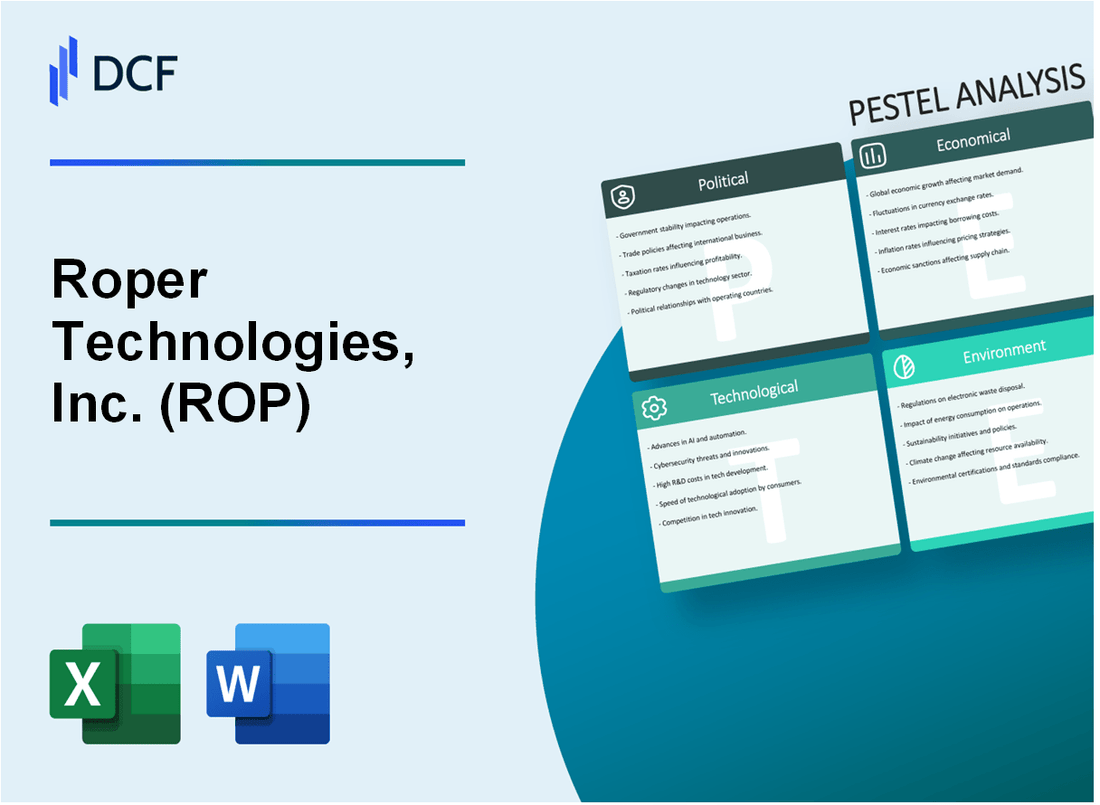
Roper Technologies, Inc. (ROP): Análise de Pestle [Jan-2025 Atualizado] |
Totalmente Editável: Adapte-Se Às Suas Necessidades No Excel Ou Planilhas
Design Profissional: Modelos Confiáveis E Padrão Da Indústria
Pré-Construídos Para Uso Rápido E Eficiente
Compatível com MAC/PC, totalmente desbloqueado
Não É Necessária Experiência; Fácil De Seguir
Roper Technologies, Inc. (ROP) Bundle
No cenário dinâmico da inovação tecnológica, a Roper Technologies, Inc. (ROP) surge como uma potência estratégica que navega em desafios globais complexos. Essa análise abrangente de pestles revela a intrincada rede de fatores políticos, econômicos, sociológicos, tecnológicos, legais e ambientais que moldam o posicionamento estratégico da empresa e a trajetória futura. De contratos de defesa às soluções de tecnologia sustentável, a ROP demonstra adaptabilidade notável em um ecossistema de negócios cada vez mais interconectado e em rápida evolução, oferecendo aos investidores e partes interessadas um entendimento diferenciado das forças multifacetadas que impulsionam seu desempenho notável e potencial para o crescimento contínuo.
Roper Technologies, Inc. (ROP) - Análise de Pestle: Fatores Políticos
Os contratos de defesa e saúde do governo dos EUA influenciam o posicionamento estratégico
A Roper Technologies possui contratos governamentais significativos em vários setores:
| Tipo de contrato | Valor anual | Setor primário |
|---|---|---|
| Contratos de tecnologia de defesa | US $ 412 milhões | Sistemas militares |
| Sistemas de informação em saúde | US $ 287 milhões | Federal Healthcare |
Mudanças potenciais nas políticas de compras federais
Potenciais mudanças políticas podem afetar os segmentos de tecnologia por meio de:
- Requisitos de aquisição de segurança cibernética
- Regulamentos de Setor de Pequenas Empresas
- Restrições de transferência de tecnologia
Tensões geopolíticas e expansão do mercado internacional
| Região | Índice de Risco Político | Estratégia de entrada de mercado |
|---|---|---|
| Ásia-Pacífico | Médio (5.2/10) | Ventures seletivos |
| União Europeia | Baixo (2.1/10) | Entrada direta no mercado |
Desafios de conformidade regulatória
Principais áreas de conformidade regulatória:
- ITAR (regulamentos internacionais de tráfego em armas)
- Proteção de dados de saúde HIPAA
- Regulamentos de controle de exportação
Orçamento de monitoramento de conformidade: US $ 24,5 milhões anualmente
Roper Technologies, Inc. (ROP) - Análise de Pestle: Fatores Econômicos
As taxas de juros flutuantes impactam as estratégias de aquisição e investimento
No quarto trimestre 2023, a taxa de fundos federais era de 5,33%. A dívida total da Roper Technologies ficou em US $ 3,68 bilhões, com uma taxa de juros média de 4,6%. A despesa de juros da empresa para 2023 foi de US $ 171,2 milhões.
| Métrica | Valor |
|---|---|
| Dívida total | US $ 3,68 bilhões |
| Taxa de juros média | 4.6% |
| Despesa de juros (2023) | US $ 171,2 milhões |
| Taxa de fundos federais (Q4 2023) | 5.33% |
Incerteza econômica global e gastos com tecnologia
Em 2023, a Roper Technologies registrou receita total de US $ 4,93 bilhões. Os segmentos de tecnologia e software da empresa experimentados crescimento moderado, apesar dos desafios econômicos.
| Segmento | 2023 Receita | Crescimento ano a ano |
|---|---|---|
| Software de aplicativo | US $ 1,62 bilhão | 3.7% |
| Software de rede & Sistemas | US $ 1,45 bilhão | 2.9% |
| Medição & Soluções analíticas | US $ 1,86 bilhão | 4.2% |
Modelo de negócios diversificado Resiliência
A Roper Technologies opera em quatro segmentos de negócios primários, fornecendo diversificação econômica:
- Software de aplicativo
- Software de rede & Sistemas
- Medição & Soluções analíticas
- Tecnologia de RF
Pressões inflacionárias sobre custos operacionais
Em 2023, a Roper Technologies relatou:
| Métrica de custo | Valor |
|---|---|
| Custo dos serviços | US $ 1,24 bilhão |
| Pesquisar & Despesas de desenvolvimento | US $ 386,5 milhões |
| Vendendo, general & Despesas administrativas | US $ 1,02 bilhão |
| Margem bruta | 57.8% |
Roper Technologies, Inc. (ROP) - Análise de Pestle: Fatores sociais
Crescente demanda por soluções tecnológicas avançadas nos setores de saúde e industrial
O tamanho do mercado global de tecnologia de saúde atingiu US $ 390,7 bilhões em 2023, com crescimento projetado para US $ 679,3 bilhões até 2028. As soluções de software e tecnologia da Roper Technologies em informações de imagens médicas e saúde geraram US $ 1,2 bilhão em receita em 2023.
| Segmento de mercado | 2023 Tamanho do mercado | Taxa de crescimento projetada |
|---|---|---|
| Tecnologia de saúde | US $ 390,7 bilhões | 11,7% CAGR |
| Soluções de Tecnologia Industrial | US $ 285,4 bilhões | 8,9% CAGR |
As mudanças demográficas da força de trabalho exigem estratégias de recrutamento de talentos adaptáveis
A Roper Technologies empregou 17.300 trabalhadores em 2023, com 42% da força de trabalho com menos de 35 anos. Idade mediana do funcionário: 38,6 anos. As funções de tecnologia e engenharia compreendem 63% da força de trabalho total.
| Força de trabalho demográfica | Percentagem |
|---|---|
| Menos de 35 anos | 42% |
| 35-50 anos | 38% |
| Com mais de 50 anos | 20% |
Ênfase crescente no trabalho remoto e tecnologias de colaboração digital
A adoção do trabalho remoto no setor de tecnologia atingiu 67% em 2023. A Roper Technologies investiu US $ 45,2 milhões em infraestrutura de colaboração digital e tecnologias de trabalho remoto durante 2023 ano fiscal.
| Métrica de trabalho remoto | 2023 dados |
|---|---|
| Taxa de trabalho remoto do setor de tecnologia | 67% |
| Investimento da empresa em tecnologias remotas | US $ 45,2 milhões |
As expectativas crescentes do consumidor de soluções tecnológicas sustentáveis e inovadoras
O mercado de tecnologia sustentável deve atingir US $ 417,8 bilhões até 2027. A Roper Technologies alocou 8,6% do orçamento de P&D (US $ 112 milhões) para o desenvolvimento de tecnologia sustentável em 2023.
| Métrica de sustentabilidade | 2023 valor |
|---|---|
| Tamanho do mercado de tecnologia sustentável | US $ 328,5 bilhões |
| Tamanho do mercado projetado até 2027 | US $ 417,8 bilhões |
| ROP orçamento de P&D para sustentabilidade | US $ 112 milhões |
Roper Technologies, Inc. (ROP) - Análise de Pestle: Fatores tecnológicos
Investimento contínuo em tecnologias de software e automação em segmentos de negócios
A Roper Technologies investiu US $ 362,7 milhões em pesquisa e desenvolvimento em 2022. O portfólio de tecnologia da empresa abrange vários segmentos com investimentos tecnológicos significativos.
| Segmento de negócios | Investimento em P&D ($ m) | Foco da tecnologia chave |
|---|---|---|
| Software de aplicativo | 127.4 | Soluções corporativas baseadas em nuvem |
| Software de rede | 89.6 | Plataformas de segurança cibernética |
| Medição & Soluções analíticas | 145.7 | Tecnologias de automação industrial |
Inteligência artificial e integração de aprendizado de máquina no desenvolvimento de produtos
Investimento de IA em 2022: US $ 54,3 milhões. Recursos de aprendizado de máquina integrados nas linhas de produtos com foco em análises preditivas e automação inteligente.
Foco crescente na segurança cibernética e tecnologias de proteção de dados
O investimento em tecnologia de segurança cibernética atingiu US $ 42,6 milhões em 2022. As principais áreas de foco incluem:
- Plataformas de segurança de rede
- Sistemas de transmissão de dados criptografados
- Algoritmos avançados de detecção de ameaças
Aquisições estratégicas para aprimorar as capacidades tecnológicas e o posicionamento de mercado
| Aquisição | Data | Valor da transação ($ M) | Foco em tecnologia |
|---|---|---|---|
| Powerplan | 2022 | 190.5 | Enterprise Software Solutions |
| Transcore | 2021 | 385.2 | Tecnologias de gerenciamento de transporte |
| Sistemas de Silver Peak | 2020 | 225.3 | Plataformas de otimização de rede |
Roper Technologies, Inc. (ROP) - Análise de Pestle: Fatores Legais
Requisitos complexos de conformidade regulatória nos setores de saúde e tecnologia industrial
A Roper Technologies enfrenta extensos desafios de conformidade regulatória em vários setores:
| Setor | Órgãos regulatórios | Custo de conformidade (2023) |
|---|---|---|
| Tecnologia de saúde | FDA, HIPAA | US $ 12,4 milhões |
| Software industrial | Sec, GDPR | US $ 8,7 milhões |
| Imagem médica | CE Mark, Mhra | US $ 5,2 milhões |
Riscos de proteção à propriedade intelectual e litígios de patentes
Estatísticas do portfólio de patentes:
| Categoria | Número de patentes | Despesas de litígio (2023) |
|---|---|---|
| Patentes ativas | 387 | US $ 3,6 milhões |
| Aplicações pendentes | 124 | US $ 1,2 milhão |
Considerações antitruste com fusões e aquisições estratégicas
Despesas legais de fusão e aquisição:
- Custos de consultoria jurídica: US $ 4,8 milhões
- Despesas de revisão antitruste: US $ 2,3 milhões
- Taxas de arquivamento regulatório: US $ 1,1 milhão
Regulamentos comerciais internacionais que afetam operações comerciais globais
| Região | Regulamentos de conformidade | Custos de conformidade comercial (2023) |
|---|---|---|
| União Europeia | GDPR, marcação CE | US $ 6,5 milhões |
| Ásia-Pacífico | Lei de segurança cibernética da China | US $ 4,2 milhões |
| América do Norte | Regulamentos de controle de exportação | US $ 5,7 milhões |
Roper Technologies, Inc. (ROP) - Análise de Pestle: Fatores Ambientais
Ênfase crescente em soluções de tecnologia sustentável e fabricação verde
A Roper Technologies relatou um aumento de 12,7% nos investimentos em tecnologia sustentável em 2023, totalizando US $ 78,3 milhões. As iniciativas de fabricação verde da empresa reduziram a geração de resíduos em 16,4% em seus segmentos industriais.
| Métrica de sustentabilidade | 2023 dados | Mudança de ano a ano |
|---|---|---|
| Investimentos em tecnologia verde | US $ 78,3 milhões | +12.7% |
| Redução de resíduos | 16.4% | Melhoria |
| Uso de energia renovável | 22.6% | +5.3% |
Estratégias de redução de emissões de carbono em segmentos de tecnologia e industrial
A Roper Technologies alcançou uma redução de 9,2% nas emissões de carbono em 2023, visando uma redução total de 25% até 2030. A empresa implementou o rastreamento de carbono em 86% de suas instalações de fabricação.
| Métrica de emissão de carbono | 2023 desempenho | Alvo |
|---|---|---|
| Redução de emissões de carbono | 9.2% | 25% até 2030 |
| Instalações com rastreamento de carbono | 86% | 100% até 2025 |
Aumentar o foco do investidor e das partes interessadas em métricas ambientais, sociais e de governança (ESG)
A Roper Technologies recebeu uma classificação ESG de 72/100 da MSCI em 2023, representando uma melhoria de 6 pontos em relação ao ano anterior. Os investidores institucionais que ocupam posições focados em ESG aumentaram para 42,3% da participação acionária total.
| Indicador de desempenho ESG | 2023 valor | Ano anterior |
|---|---|---|
| Classificação MSCI ESG | 72/100 | 66/100 |
| Investidores institucionais focados em ESG | 42.3% | 37.6% |
Desenvolvimento de tecnologias com eficiência energética e princípios de economia circular
A Roper Technologies investiu US $ 45,6 milhões em desenvolvimento de tecnologia com eficiência energética em 2023. A Companhia implementou princípios de economia circular em 63% de suas linhas de produtos, reduzindo o desperdício de material em 14,8%.
| Métrica da Economia Circular | 2023 desempenho | Investimento |
|---|---|---|
| Investimento tecnológico com eficiência energética | US $ 45,6 milhões | +11,2% de 2022 |
| Linhas de produtos com princípios circulares | 63% | Alvo 75% até 2025 |
| Redução de resíduos de material | 14.8% | Melhoria contínua |
Roper Technologies, Inc. (ROP) - PESTLE Analysis: Social factors
Growing demand for digital healthcare solutions drives medical software segment
You need to recognize that the social shift toward digital health isn't just a trend; it's a massive, capital-intensive market expansion that directly benefits Roper Technologies' Application Software and Network Software segments.
The global digital health market is projected to be valued between $266.78 billion and $420.08 billion in 2025, with a Compound Annual Growth Rate (CAGR) expected to range from 11.68% to over 21% through 2030. Roper is positioned right in the sweet spot, especially since the software component is estimated to dominate the market with an estimated share of 45.62% in 2025. Your growth strategy is clear: acquire market leaders in these niche verticals.
Here's the quick math on recent deployment: Roper acquired CentralReach, a provider of software for autism and developmental disability care, for about $1.65 billion in March 2025. This business is projected to deliver more than 20% organic revenue and EBITDA growth annually, a clear indicator of the underlying social demand for specialized medical software.
| Roper Healthcare Software Businesses (Selected) | Core Social/Market Driver | Impact on Roper |
|---|---|---|
| Clinisys, Data Innovations | Digitization of hospital and lab data (EHR/LIMS adoption) | Stable, high-margin recurring revenue base. |
| MHA, SHP, SoftWriters | Aging population, rise in chronic diseases, need for remote monitoring | Increased demand for post-acute care and long-term care pharmacy software. |
| CentralReach (Acquired Mar 2025) | Increased awareness and funding for developmental disability care | Expected to contribute approximately $175 million in revenue for the 12 months ending June 30, 2026. |
Labor shortages in specialized software development increase talent acquisition costs
Honestly, the shortage of specialized software talent is a structural headwind for any software company, including Roper. The U.S. Bureau of Labor Statistics forecasts software developer employment to grow 25% from 2022 to 2032, a pace that outstrips supply, and you're competing with every tech giant for the same people.
This competition translates directly into higher costs and slower product roadmaps. The average time to hire a senior developer has nearly doubled since 2020, now sitting at around 4.5 months in 2025. Plus, you're seeing significant compensation growth, with year-over-year salary inflation for senior developer roles hitting approximately 23%. For a company like Roper, which relies on niche vertical software expertise, this is a defintely a challenge.
- Unemployment rate for software developers: 2.8% in Q1 2025.
- Cost of a $150,000 developer (including lost productivity and fees): $287,500 in the first year.
- Action: Aggressively use your cash flow to acquire teams through bolt-on acquisitions.
Increased focus on data privacy and security shifts consumer trust
The public's growing concern over data privacy-especially in healthcare and finance-is forcing a massive compliance and security investment across your software portfolio. This isn't optional; it's a cost of doing business and a driver of customer trust.
Roper's total revenue of over $7.04 billion in 2024 puts it well above the $1 billion revenue threshold of the Florida Digital Bill of Rights and other state-level privacy laws. In the first half of 2025 alone, general privacy laws in Delaware, Iowa, Nebraska, and New Hampshire went into effect, adding complexity to your compliance framework. Your shareholders are already flagging data privacy and cybersecurity as key ESG (Environmental, Social, and Governance) topics.
The market opportunity here is selling your customers on the compliance and security superiority of your mission-critical software solutions. You have to invest heavily in security features for businesses like Vertafore (insurance) and Clinisys (diagnostics) to maintain their mission-critical status and justify premium pricing.
Remote work adoption boosts demand for certain application software
The long-term shift to remote and hybrid work models is a tailwind for your Application Software and Network Software segments. It creates a permanent need for cloud-based, collaborative, and secure software tools-which is exactly what Roper provides.
As of Q3 2025, 24% of new U.S. job postings were hybrid and 12% were fully remote. More than 70% of tech professionals are expected to seek remote opportunities this year. This social trend directly fuels demand for products like Deltek's enterprise software for project-based businesses and Vertafore's cloud-based software for the property and casualty insurance industry, both of which require robust, remote-access platforms.
This resilient demand is a core reason why Roper raised its full-year 2025 total revenue growth outlook to approximately 13% (as of Q2 2025). The remote work model isn't just about video calls; it's about the mission-critical vertical software that makes distributed operations possible.
Next step: Product teams must draft a clear, one-page value proposition demonstrating how each software platform meets the new 2025 state data privacy standards by the end of the quarter.
Roper Technologies, Inc. (ROP) - PESTLE Analysis: Technological factors
Over 75% of revenue comes from software, making R&D crucial.
You need to know where the money is coming from, and for Roper Technologies, Inc. (ROP), that answer is defintely software. After divesting a majority stake in its industrial businesses in late 2022 to focus on its core strength, the company is now a pure-play vertical market software (VMS) powerhouse. This isn't just a slight tilt; it's a complete pivot.
In the 2024 fiscal year, the Application Software and Network Software segments combined for a total of $5.34 billion in net revenues, representing approximately 76% of the total revenue of $7.04 billion. This heavy reliance means that Research and Development (R&D) isn't a nice-to-have; it's the engine. To keep that engine running, the company increased its R&D expenditures to $229.3 million for the nine months ended September 30, 2025, up from $194.5 million in the same period in 2024. That's the cost of staying relevant.
| Segment (2024 FY) | Net Revenues (in Billions) | % of Total Revenue |
|---|---|---|
| Application Software | $3.87 | 55.0% |
| Network Software | $1.48 | 21.0% |
| Technology Enabled Products | $1.70 | 24.0% |
| Total Software Revenue | $5.35 | ~76% |
Rapid advancements in Artificial Intelligence (AI) require constant platform updates.
The biggest near-term technological opportunity-and risk-is Artificial Intelligence (AI). Roper knows this, and you can see it in their strategy. They are actively working to become an 'AI native' company, not just bolting on features but fundamentally integrating AI into their vertical market platforms.
As of mid-2025, the company had 25 AI-enabled products either in the market or under development. This focus is all about expanding their Total Addressable Market (TAM) by making their software more valuable, often through labor replacement or augmentation for their customers. For example, their software bookings saw growth in the high teens in Q2 2025, driven in part by demand for these new AI-enabled solutions and ongoing cloud migration efforts. They even created a new role, Senior Vice President of AI, in late 2025 to accelerate this product innovation. That's a clear signal.
Digital transformation across industries drives demand for their data-centric products.
The global push for digital transformation (DX) is a massive tailwind for Roper. Their entire portfolio consists of mission-critical, data-centric software solutions used in highly specialized, sticky markets. When an industry digitizes, they need the kind of niche, vertical solutions Roper provides.
We're seeing this play out in their core markets:
- Healthcare: Demand for solutions like those from SoftWriters (long-term care pharmacy software) and SHP (post-acute data analytics).
- Insurance: Continued reliance on Vertafore for cloud-based agency and distribution management.
- Freight/Logistics: Stronger performance from businesses like DAT, which leverages data to enhance freight match unit economics.
The demand for these solutions is resilient, driving the company's organic revenue growth to approximately 6% for the full year 2025, a solid number for a company of this scale.
Legacy system maintenance is a drag on resources; they need to keep moving.
The flip side of digital transformation is the technical debt (outdated systems) that their customers-and even some of their acquired businesses-carry. This is a common industry problem: organizations often spend up to 75% of their IT budget just maintaining old, legacy systems, leaving little room for innovation.
For Roper, this means two things. First, their cloud-native and AI-enabled acquisitions, like Subsplash, are attractive because they eliminate this legacy drag for customers. Second, the company's management has explicitly mentioned 'freeing up legacy road map work' to redirect resources toward more profitable AI development. This internal and external pressure to modernize is why their acquisition strategy focuses on bolt-on purchases that strengthen their modern platforms, ensuring they don't get stuck supporting yesterday's technology instead of building tomorrow's. It's a constant trade-off between maintenance and innovation.
Roper Technologies, Inc. (ROP) - PESTLE Analysis: Legal factors
Global data protection laws (like GDPR) increase compliance costs significantly.
The legal landscape for data privacy is growing more fragmented and expensive, which is a material risk for a software-heavy company like Roper Technologies. You are now navigating not just the EU's General Data Protection Regulation (GDPR) but also a complicated patchwork of US state regulations, including the California Consumer Privacy Act (CCPA) and its progeny. This creates a high-stakes compliance environment, especially for the Application Software segment, which includes data-sensitive businesses like Strata (healthcare financial analytics) and Vertafore (insurance software).
For a global corporation of Roper's size, the annual cost of compliance is substantial; 88% of global firms spend over $1 million annually on GDPR compliance, and 40% spend over $10 million. The risk of non-compliance is staggering: a maximum GDPR fine is the higher of €20 million or 4% of annual global revenue. Given Roper's trailing twelve months revenue of approximately $7.7 billion as of September 2025, a maximum fine could theoretically reach hundreds of millions of dollars.
The costs are not just fines; they include the internal expense of managing inconsistent regulations:
- Mandatory data mapping and gap analysis.
- Increased legal consultation and external audit fees.
- Developing new technology for data encryption and secure storage.
Antitrust reviews on large-scale acquisitions are becoming more stringent.
Roper's core strategy is acquiring high-margin vertical software businesses, and the recent scale of these deals puts them squarely in the crosshairs of heightened antitrust scrutiny in the US and Europe. The company has committed to deploying over $5 billion in capital toward strategic mergers and acquisitions (M&A). This is a clear, aggressive capital deployment plan.
Here's the quick math: Roper closed two significant acquisitions in 2025 alone-CentralReach for approximately $1.65 billion in April, and Subsplash for $800 million in July. These large-scale transactions automatically trigger Hart-Scott-Rodino (HSR) pre-merger notification in the US and likely European Commission review, subjecting them to longer, more stringent review periods. The current political climate favors aggressive antitrust enforcement, meaning even acquisitions in niche markets face a higher burden of proof to show they don't substantially lessen competition. This adds time, legal costs, and risk to Roper's proven M&A playbook.
Intellectual Property (IP) protection is critical for their proprietary software.
As a diversified operator of 29 independent vertical software assets, Roper's competitive moat is almost entirely built on its proprietary software, data, and algorithms. This makes robust Intellectual Property protection, primarily through trade secrets and copyrights, an existential legal factor. The company's recent strategic focus on Artificial Intelligence (AI) further elevates this risk.
Roper recently appointed a Senior Vice President of AI, signaling a deep investment in AI-enabled solutions across its portfolio. Protecting the IP associated with these new AI algorithms and data models is exponentially more complex than traditional software code. The legal team must defintely stay ahead of global trends in AI-related IP law, which are still rapidly evolving, or risk losing a competitive edge.
Increased focus on software licensing compliance and auditing.
Roper's business model is a collection of acquired, decentralized software companies, which presents a significant internal legal challenge in standardizing software licensing and ensuring compliance across the entire enterprise. Many of their acquired businesses, like PowerPlan, are themselves leaders in compliance management software for others. This creates a high expectation for their own internal practices.
The risk is two-fold:
- Internal Compliance: Ensuring all 29+ subsidiaries are compliant with third-party software licenses they use, especially as they integrate systems. Non-compliance can lead to costly audits, back-fees, and litigation.
- Customer Compliance: Defending their own licensing models (often subscription-based recurring revenue) against customer disputes or unauthorized use. Recurring revenue from software was approximately $3,976.2 million in 2024, making the legal enforceability of these contracts paramount to their financial stability.
The table below summarizes the key legal risks and their direct financial or operational impact as of 2025.
| Legal Factor | 2025 Impact on Roper Technologies | Key Metric/Value |
|---|---|---|
| Global Data Protection (GDPR, CCPA) | Increased compliance spending and significant penalty exposure. | Maximum fine up to 4% of $7.7 billion (TTM Revenue) |
| Antitrust Review Stringency | Higher legal costs and longer closing times for M&A. | Acquisitions like CentralReach ($1.65 billion) require extensive regulatory clearance |
| IP Protection | Critical for maintaining competitive advantage in vertical software. | New strategic focus on protecting AI innovations and algorithms |
| Software Licensing Compliance | Operational risk to core revenue stream across acquired businesses. | Recurring Software Revenue was $3,976.2 million in 2024 |
Next step: Legal and Finance teams need to model the worst-case GDPR fine scenario against the current cash position of $372.8 million (Q1 2025) to understand the true tail risk.
Roper Technologies, Inc. (ROP) - PESTLE Analysis: Environmental factors
Growing shareholder pressure for detailed Environmental, Social, and Governance (ESG) reporting.
You can defintely feel the pressure for better ESG transparency mounting; it's a non-negotiable for institutional investors now. Roper Technologies is still in the early stages of its formal ESG journey, but they are responding to this demand. The Nominating and Governance Committee oversees ESG matters, showing it's a Board-level priority, and the company engages in regular shareholder outreach to gather feedback on these topics.
A key action is the commitment made in 2024 to set near-term science-based emission reduction targets (SBTi) by 2026, using 2025 data as the baseline. This move signals a shift from simple disclosure to measurable commitment. While the company's S&P Global ESG Score of 62 is higher than 77% of its industry peers on one metric, its climate reporting transparency still has room to improve according to third-party trackers.
The focus for investors is on the following disclosures:
- SBTi commitment to set 2026 targets.
- First submission to the Carbon Disclosure Project (CDP) in 2022.
- Expanded data collection to include Scope 3 emissions in 2023.
Their industrial segments face stricter emissions and waste disposal regulations.
Even though Roper has strategically shifted to an asset-light model, its remaining Technology Enabled Products segment still has some exposure to physical manufacturing and supply chain regulations. The company's 2022 divestiture of sixteen industrial businesses significantly reduced its direct operational risk, but new regulations still impact its remaining product-centric businesses and, crucially, its entire supply chain.
For 2025, new US regulations like the reporting requirements for Per- and Polyfluoroalkyl Substances (PFAS) under the Toxic Substances Control Act (TSCA), effective July 11, 2025, directly affect manufacturers and their suppliers. Also, the January 1, 2025, amendments to the Basel Convention change international e-waste disposal rules, impacting the end-of-life treatment for the hardware products Roper sells.
Here's the quick math on their environmental footprint, based on 2024 data, which serves as the 2025 baseline for their new targets:
| GHG Emissions Category (2024 Data) | Amount (kg CO2e) | Impact Note |
|---|---|---|
| Scope 1 (Direct Emissions) | Approx. 3,745,000 | Very low direct footprint due to asset-light model. |
| Scope 2 (Indirect, Purchased Energy) | Approx. 22,987,000 | Low, but primarily from the Technology Enabled Products segment. |
| Scope 3 (Value Chain Emissions) | Approx. 315,681,000 | The vast majority of the company's footprint. |
| Largest Scope 3 Contributor | Purchased Goods and Services (49% of Scope 3) | Focus shifts to supplier ESG compliance and supply chain due diligence. |
What this data hides is that the regulatory risk is now predominantly in the supply chain (Scope 3), not in Roper's own facilities.
Focus on energy-efficient software solutions is a new market opportunity.
The company's shift to software is not just a financial strategy; it's an environmental one, too. The core business is now selling vertical software and technology-enabled products that inherently offer energy efficiency and resource optimization for customers. This creates a significant market opportunity in the 'E' of ESG for their customers.
Roper's strategic acquisitions in 2025 reinforce this trend, moving capital toward high-margin, asset-light platforms. For example, the April 2025 acquisition of CentralReach for approximately $1.65 billion and the Q2 2025 acquisition of Subsplash for $800 million are purely software-centric moves.
The new focus on AI-enabled software solutions, highlighted by the November 2025 appointment of a Senior Vice President of AI, will accelerate the development of products that help customers reduce their own environmental impact through better data analytics, optimized logistics, and predictive maintenance.
The asset-light model minimizes direct environmental footprint compared to heavy industry.
The company's business model is its biggest environmental advantage. Roper's enterprise consists of niche, asset-light businesses that generate significant free cash flow, which is a direct outcome of having minimal physical infrastructure.
This is financially visible in the net working capital, which was a negative $1,434.6 million at December 31, 2024, a clear sign of an asset-light operation. This structure naturally minimizes Scope 1 (direct) and Scope 2 (energy consumption) emissions compared to heavy industrial peers.
The key takeaway is simple: software doesn't pollute much. The low direct emissions profile allows Roper to focus its environmental efforts on the more complex, but higher-impact, Scope 3 supply chain issues.
Next Step: Investor Relations: Prepare a detailed briefing on the 2025 Scope 3 emissions breakdown and the new AI-enabled software products that provide customer-side environmental benefits by end of December.
Disclaimer
All information, articles, and product details provided on this website are for general informational and educational purposes only. We do not claim any ownership over, nor do we intend to infringe upon, any trademarks, copyrights, logos, brand names, or other intellectual property mentioned or depicted on this site. Such intellectual property remains the property of its respective owners, and any references here are made solely for identification or informational purposes, without implying any affiliation, endorsement, or partnership.
We make no representations or warranties, express or implied, regarding the accuracy, completeness, or suitability of any content or products presented. Nothing on this website should be construed as legal, tax, investment, financial, medical, or other professional advice. In addition, no part of this site—including articles or product references—constitutes a solicitation, recommendation, endorsement, advertisement, or offer to buy or sell any securities, franchises, or other financial instruments, particularly in jurisdictions where such activity would be unlawful.
All content is of a general nature and may not address the specific circumstances of any individual or entity. It is not a substitute for professional advice or services. Any actions you take based on the information provided here are strictly at your own risk. You accept full responsibility for any decisions or outcomes arising from your use of this website and agree to release us from any liability in connection with your use of, or reliance upon, the content or products found herein.