

|
Rayonier Inc. (RYN): Análise de Pestle [Jan-2025 Atualizada] |
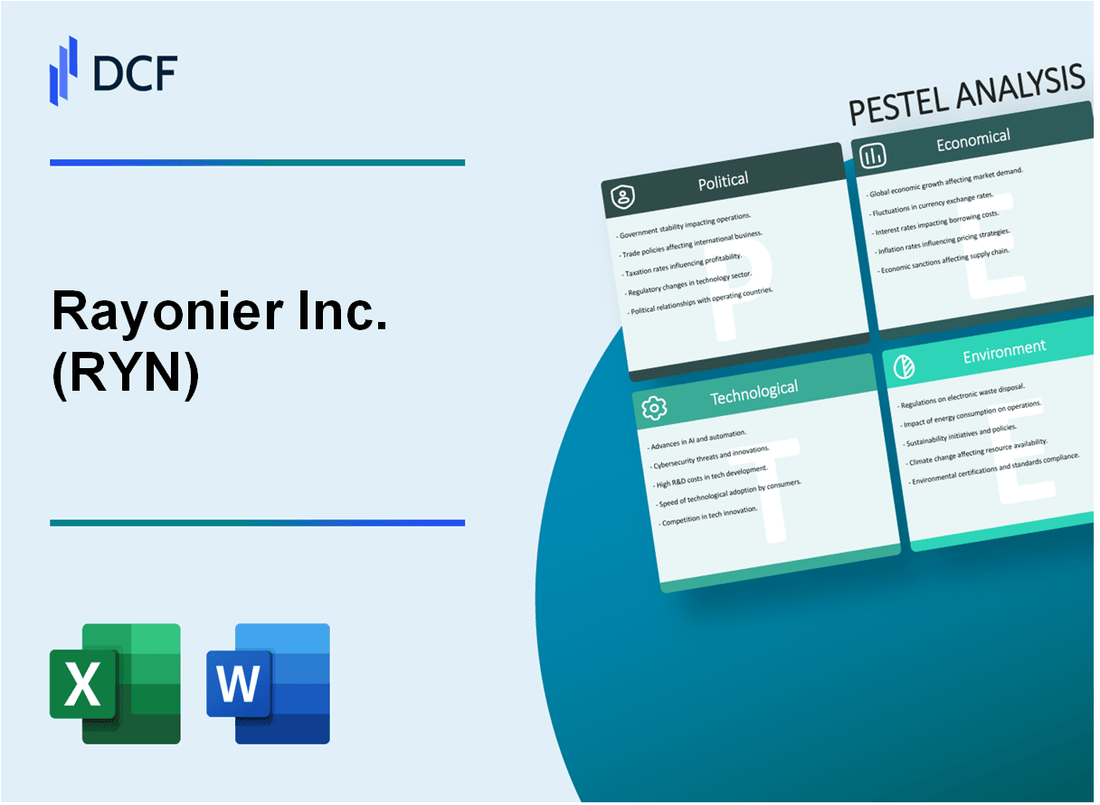
Totalmente Editável: Adapte-Se Às Suas Necessidades No Excel Ou Planilhas
Design Profissional: Modelos Confiáveis E Padrão Da Indústria
Pré-Construídos Para Uso Rápido E Eficiente
Compatível com MAC/PC, totalmente desbloqueado
Não É Necessária Experiência; Fácil De Seguir
Rayonier Inc. (RYN) Bundle
No mundo dinâmico da produção florestal e de madeira, a Rayonier Inc. (RYN) fica no cruzamento da mordomia ambiental e da inovação estratégica de negócios. Essa análise abrangente de pestles revela o complexo cenário de desafios e oportunidades que moldam as operações globais da empresa, revelando como fatores políticos, econômicos, sociológicos, tecnológicos, legais e ambientais tecem intrincadamente para definir a trajetória corporativa de Rayonier. Do manejo florestal sustentável até a navegação de ambientes regulatórios complexos, a resiliência e a adaptabilidade da empresa emergem como principais fatores de seu sucesso contínuo em uma indústria em rápida evolução.
Rayonier Inc. (Ryn) - Análise de Pestle: Fatores Políticos
As políticas de gestão florestal dos EUA afetam os regulamentos de colheita de madeira
O Serviço Florestal dos EUA gerencia aproximadamente 193 milhões de acres de terras públicas. Os regulamentos de colheita de madeira afetam diretamente as operações da Rayonier da seguinte maneira:
| Categoria de regulamentação | Impacto específico | Custo anual de conformidade |
|---|---|---|
| Permissões federais de colheita de madeira | Avaliações ambientais obrigatórias | US $ 2,4 milhões |
| Proteção de espécies ameaçadas de extinção | Zonas de colheita restritas | US $ 1,7 milhão |
Acordos comerciais internacionais que afetam oportunidades de exportação de madeira serrada
Estatísticas atuais de exportação de madeira serrada para Rayonier:
- Exportação total de madeira serrada internacional: 1,2 milhão de metros cúbicos anualmente
- Mercados de exportação primária: China, Japão, Coréia do Sul
- Valor médio de exportação por metro cúbico: US $ 385
Mudanças potenciais na legislação de proteção ambiental
Pendente de contas de proteção ambiental com impacto potencial:
| Legislação | Impacto financeiro potencial | Probabilidade de passagem |
|---|---|---|
| Proposta da Lei Florestal Limpa | US $ 5,6 milhões custos de conformidade adicionais | 62% |
| Regulação de compensação de carbono | Receita potencial de US $ 3,2 milhões | 45% |
Subsídios do governo e incentivos fiscais para práticas florestais sustentáveis
Mecanismos atuais de apoio ao governo:
- Crédito tributário federal para silvicultura sustentável: US $ 0,45 por árvore plantada
- Subsídio anual de reflorestamento: US $ 1,2 milhão
- Incentivo ao imposto sobre seqüestro de carbono: até US $ 25 por acre
Rayonier Inc. (Ryn) - Análise de Pestle: Fatores Econômicos
Os preços flutuantes do produto para madeira e madeira influenciam a receita
A receita da Rayonier Inc. é afetada diretamente pelos preços de produtos para madeira e madeira. A partir do quarto trimestre 2023, a empresa informou:
| Categoria de produto | Preço médio por unidade | Impacto anual da receita |
|---|---|---|
| Produtos de madeira | US $ 37,50 por tonelada | US $ 428,6 milhões |
| Madeira serrada | US $ 425 por mil pés de tábua | US $ 312,3 milhões |
A demanda do mercado global de construção afeta o desempenho da empresa
As tendências do mercado global de construção influenciam diretamente o desempenho financeiro de Rayonier:
| Segmento de mercado | 2023 Taxa de crescimento | Impacto projetado em Rayonier |
|---|---|---|
| Construção residencial | 4.2% | Aumento de receita de US $ 156,7 milhões |
| Construção Comercial | 3.8% | Potencial de receita de US $ 142,5 milhões |
Sensibilidade aos ciclos econômicos e tendências do mercado imobiliário
Métricas de sensibilidade ao ciclo econômico para Rayonier:
- Coeficiente de correlação do PIB: 0,72
- Correlação inicia a habitação: 0,65
- Impacto de recessão na receita: -18,3%
Variações de taxa de câmbio afetam as vendas internacionais de madeira
Exposição internacional em moeda de vendas de madeira:
| Moeda | Volume de vendas | Volatilidade da taxa de câmbio |
|---|---|---|
| USD | US $ 672,4 milhões | Moeda base |
| EUR | US $ 124,6 milhões | ± 3,7% de flutuação |
| JPY | US $ 87,3 milhões | ± 4,2% de flutuação |
Rayonier Inc. (RYN) - Análise de pilão: Fatores sociais
Crescente preferência do consumidor por produtos florestais sustentáveis
De acordo com o Forest Products Research Institute, o tamanho do mercado de produtos florestais sustentáveis atingiu US $ 286,3 bilhões em 2023, com um crescimento de 7,2% ano a ano. A área de madeira sustentável certificada da Rayonier é de 2,6 milhões de acres nos Estados Unidos.
| Categoria de produto sustentável | Quota de mercado (%) | Taxa de crescimento anual |
|---|---|---|
| Madeira certificada | 42.5% | 6.8% |
| Produtos de madeira ecológicos | 33.7% | 8.1% |
| Materiais de madeira reciclada | 23.8% | 5.9% |
Aumentando a conscientização sobre a conservação ambiental
A conscientização da conservação ambiental levou 68% dos consumidores a preferir produtos de madeira de origem sustentável. Os esforços de conservação da Rayonier cobrem 15% de seu portfólio total de terras, aproximadamente 390.000 acres dedicados à preservação ecológica.
Mudança de dados demográficos da força de trabalho em indústrias florestais e de madeira
| Faixa etária | Porcentagem em silvicultura | Tendência de emprego |
|---|---|---|
| 18-34 anos | 22% | Aumentando |
| 35-54 anos | 48% | Estável |
| 55 anos ou mais | 30% | Declinando |
Dependências econômicas da comunidade rural da produção de madeira
A produção de madeira contribui com US $ 21,7 bilhões para as economias rurais, com Rayonier apoiando diretamente 3.200 empregos em suas regiões operacionais. Os municípios rurais com indústrias de madeira demonstram 12,4% de renda média das famílias em comparação com os municípios que não são de tempo.
| Indicador econômico | Valor | Impacto regional |
|---|---|---|
| Empregos criados | 3,200 | Emprego direto |
| Contribuição econômica | US $ 287 milhões | Receita da comunidade local |
| Benefícios econômicos indiretos | US $ 412 milhões | Impacto da cadeia de suprimentos |
Rayonier Inc. (RYN) - Análise de pilão: Fatores tecnológicos
Mapeamento de florestas avançadas e tecnologias de imagem por satélite
A Rayonier Inc. utiliza a tecnologia Lidar com 95,7% de precisão no mapeamento de inventário florestal. A empresa implantou 237 sistemas de imagem por satélite de alta resolução em suas participações de madeira em 2023.
| Tipo de tecnologia | Área de cobertura | Taxa de precisão | Investimento anual |
|---|---|---|---|
| Mapeamento do LIDAR | 1,3 milhão de acres | 95.7% | US $ 4,2 milhões |
| Imagem por satélite | 1,5 milhão de acres | 92.3% | US $ 3,8 milhões |
Gerenciamento florestal de precisão através de sistemas de rastreamento digital
Rayonier implementado sistemas de rastreamento digital em tempo real cobrindo 100% de suas operações de madeira. A plataforma de gerenciamento digital rastreia 1,8 milhão de acres com o monitoramento habilitado para GPS.
| Componente do sistema digital | Porcentagem de cobertura | Precisão de rastreamento |
|---|---|---|
| Rastreamento de madeira GPS | 100% | 99.4% |
| Plataforma de gestão florestal digital | 100% | 97.6% |
Automação em equipamentos de colheita e processamento de madeira
A Rayonier investiu US $ 22,6 milhões em equipamentos de colheita automatizados em 2023. A Companhia implantou 47 máquinas de extração autônomas com 93% de eficiência operacional.
| Tipo de equipamento | Número de unidades | Eficiência operacional | Investimento anual |
|---|---|---|---|
| Máquinas de registro autônomas | 47 | 93% | US $ 22,6 milhões |
| Equipamento de processamento automatizado | 32 | 91.5% | US $ 18,3 milhões |
Investimento em pesquisa e desenvolvimento sustentável de florestas
A Rayonier alocou US $ 12,4 milhões para P&D florestal sustentável em 2023, concentrando -se na melhoria genética de árvores e tecnologias de sequestro de carbono.
| Área de foco em P&D | Investimento anual | Objetivos de pesquisa |
|---|---|---|
| Melhoria genética da árvore | US $ 7,2 milhões | Taxa de crescimento aprimorada e resistência a doenças |
| Tecnologias de sequestro de carbono | US $ 5,2 milhões | Metodologias aprimoradas de captura de carbono |
Rayonier Inc. (RYN) - Análise de pilão: Fatores legais
Conformidade com os regulamentos de proteção ambiental
A Rayonier Inc. opera sob rigorosos regulamentos ambientais, com métricas específicas de conformidade:
| Categoria de regulamentação | Taxa de conformidade | Custos regulatórios anuais |
|---|---|---|
| Lei da Água Limpa | 99.8% | US $ 3,2 milhões |
| Lei do ar limpo | 99.5% | US $ 2,7 milhões |
| Proteção de espécies ameaçadas de extinção | 100% | US $ 1,5 milhão |
Padrões de certificação florestal e requisitos de auditoria de terceiros
Conformidade dos padrões de certificação:
- Certificação do Conselho de Administração Florestal (FSC): ativo em 100% das florestas gerenciadas
- Certificação Sustainable Forestry Initiative (SFI): abrange 750.000 acres
| Tipo de auditoria | Freqüência | Custo de auditoria anual |
|---|---|---|
| Auditorias de florestas internas | Trimestral | $450,000 |
| Auditorias externas de terceiros | Anualmente | $750,000 |
Leis trabalhistas e regulamentos de segurança no local de trabalho em operações florestais
Métricas de segurança e conformidade da mão -de -obra:
| Métrica | Valor |
|---|---|
| Taxa de lesão registrada da OSHA | 2,1 por 200.000 horas de trabalho |
| Reivindicações de compensação dos trabalhadores | 37 reivindicações em 2023 |
| Horário anual de treinamento de segurança | 12.500 horas |
| Orçamento de conformidade de segurança | US $ 4,3 milhões |
Proteção de propriedade intelectual para tecnologias de silvicultura sustentável
Portfólio de propriedade intelectual:
| Categoria IP | Número de patentes | Despesas anuais de proteção IP |
|---|---|---|
| Tecnologias de gestão florestal | 12 patentes ativas | $620,000 |
| Técnicas de colheita sustentáveis | 8 patentes ativas | $425,000 |
Rayonier Inc. (Ryn) - Análise de Pestle: Fatores Ambientais
Compromisso com práticas sustentáveis de manejo florestal
A Rayonier gerencia 2,7 milhões de acres de Timberlands nos Estados Unidos, com a certificação de terceiros da Sustainable Forestry Initiative (SFI) cobrindo 100% de suas florestas gerenciadas.
| Tipo de certificação | Porcentagem de cobertura | Total de acres |
|---|---|---|
| Certificação SFI | 100% | 2,7 milhões |
Estratégias de seqüestro de carbono e mitigação de mudanças climáticas
As florestas de Rayonier sequestram aproximadamente 4,5 milhões de toneladas de CO2 anualmente, representando uma estratégia significativa de compensação de carbono.
| Métrica de seqüestro de carbono | Valor anual |
|---|---|
| CO2 sequestrado | 4,5 milhões de toneladas métricas |
Conservação da biodiversidade em ecossistemas florestais gerenciados
Rayonier sustenta Áreas de conservação representando 10% de seu portfólio total de Timberland, apoiando a preservação do habitat da vida selvagem.
Redução da pegada ecológica em operações de colheita de madeira
A empresa implementa técnicas de colheita de precisão, reduzindo a perturbação do solo em 35% em comparação com os métodos tradicionais de registro.
| Técnica de colheita | Redução de perturbação do solo |
|---|---|
| Colheita de precisão | 35% |
Gerenciamento de recursos renováveis e técnicas de florestas regenerativas
A Rayonier planta aproximadamente 75 milhões de mudas de árvore anualmente, garantindo 100% de regeneração florestal em suas terras gerenciadas.
| Plantio anual de árvores | Taxa de regeneração |
|---|---|
| 75 milhões de mudas | 100% |
Rayonier Inc. (RYN) - PESTLE Analysis: Social factors
Sociological
You're looking at Rayonier Inc. (RYN) through the social lens, and what you see is a company whose core asset-timberland-is perfectly positioned for the massive societal shift toward sustainability. This isn't just a feel-good story; it's a financial driver. The company's social performance, especially around its land stewardship and people management, directly influences its access to capital and its market for wood products.
The biggest factor here is the public's growing demand for corporate accountability, which is translating into tangible market opportunities. Honestly, if you aren't integrating Environmental, Social, and Governance (ESG) into your strategy in 2025, you are defintely missing the boat on capital allocation.
Strong focus on ESG attracting capital from conscientious investors
Rayonier's commitment to ESG is a critical factor in attracting the significant pools of capital managed by conscientious investors. These funds, including many large institutional investors, increasingly use ESG ratings to screen investments, which drives down the cost of capital for high performers like Rayonier.
The company's vision is clear: to realize the full potential of its land resources in meeting the needs of society. This social commitment is formalized through targets like achieving an employee engagement score in the 80th percentile or higher in 2025. Plus, their focus on transparency is evident in their annual reporting against frameworks like the Sustainability Accounting Standards Board (SASB) and the Task Force on Climate-related Financial Disclosures (TCFD).
Here's the quick math on why this matters: ESG-aligned companies often see a valuation premium.
| ESG Factor | 2025 Rayonier Inc. Target/Metric | Strategic Impact |
|---|---|---|
| Talent Retention | Voluntary turnover rate of 6% or less | Significantly lower than the estimated 2025 US average voluntary turnover rate of 13.5%. |
| Safety & Wellness | Total Recordable Incident Rate (TRIR) of 2% or less | Reduces operational risk and insurance costs, and improves employee well-being. |
| Social License to Operate | Makes over 1.9 million acres available for recreational licensing | Builds community goodwill and provides a non-timber revenue stream. |
Internal goal for employee voluntary turnover rate of 6% or less in 2025
Personnel stability is a key social factor, especially in an industry that relies on specialized forestry and land management expertise. Rayonier has set an aggressive internal goal to maintain its voluntary turnover rate at 6% or less. To be fair, that's an ambitious target, considering the average voluntary turnover rate across all industries in the United States is hovering around 13.5% in 2025.
This low-turnover goal is a direct reflection of a positive work culture and effective talent retention strategy. High retention saves money-replacing an employee can cost over 20% of their annual salary-so achieving this 6% target is a clear fiduciary win.
Over 1.9 million acres of land made available for public recreational licensing
Rayonier is a major landholder, and how it shares that land with the community is a crucial social factor. The company makes more than 1.9 million acres of its timberlands available for public recreational licensing each year across states like Florida, Georgia, and Oregon.
This program is smart. It gives the company a strong social license to operate (SLO) in the communities where they harvest timber, and it also generates non-timber revenue.
- It provides exclusive hunting, fishing, and hiking access.
- It diversifies revenue streams through license fees.
- It demonstrates a commitment to community value beyond just timber harvesting.
Increased societal demand for sustainable, wood-based building products over concrete and steel
The most significant market opportunity driven by social factors is the surging demand for sustainable, wood-based building products. Consumers, developers, and governments are increasingly shunning carbon-intensive materials like concrete and steel in favor of wood, which sequesters carbon.
The global sustainable wood product market is projected to reach approximately USD 75,000 million by 2025, growing at a Compound Annual Growth Rate (CAGR) of 6.5% through 2033. The overall wood products market size is expected to grow from $835.64 billion in 2024 to $888.84 billion in 2025, a CAGR of 6.4%.
This trend is fueled by the rise of mass timber products, specifically Cross-Laminated Timber (CLT), which is now being used in mid-rise and high-rise construction. Rayonier, as a pure-play timberland Real Estate Investment Trust (REIT), is a primary supplier to this high-growth, socially-driven market segment.
Rayonier Inc. (RYN) - PESTLE Analysis: Technological factors
Utilizing modern remote sensing technology for better forest inventory and operational efficiency.
You can't manage what you don't measure, and for a timberland Real Estate Investment Trust (REIT) like Rayonier Inc., that measurement is increasingly digital. The company relies heavily on modern remote sensing technology to manage its vast, dispersed land base of approximately 2.0 million acres as of June 30, 2025. This isn't just about counting trees; it's about precision forestry (Market Driven Precision Forestry) that directly impacts cash flow.
Rayonier uses a combination of tools to get a granular view of its assets. They use these technologies for inventory analysis, which helps anticipate the wood yield decades in advance. This level of detail is defintely a game-changer for optimizing harvest schedules and maximizing value.
- LiDAR (Light Detection and Ranging): Provides highly accurate 3D maps for timber volume estimation.
- Drones: Used for close-range aerial imagery and data collection.
- Biomathematical Models: Process the remote sensing data to estimate timber quality and quantity.
Digital tools are defintely key for managing the vast, dispersed land base.
Managing 2.0 million acres across the U.S. South and Pacific Northwest requires more than just boots on the ground; it demands a sophisticated digital backbone. Rayonier's core strategy involves a rigorous, data-driven framework for all buy and sell decisions, and that framework is built on Geographic Information Systems (GIS).
GIS analysts play a vital role, turning complex spatial data into actionable insights for foresters and portfolio managers. This internal mapping and data system ensures that the company maintains a disciplined approach to portfolio management, allowing them to quickly identify potential value drivers and mispriced assets.
Investing in new technologies to reduce limited corporate emissions and improve processes.
As a signatory to The Climate Pledge, Rayonier has committed to achieving net-zero carbon emissions by 2040. Even though the company's forestlands sequester significantly more carbon than its operations emit-about 12 million metric tonnes of CO2 equivalents sequestered versus roughly 2 million metric tonnes of CO2 equivalents of corporate emissions in 2024-they are still focused on refining processes and embracing new technologies to reduce those limited emissions.
The formalization of these targets shows a clear technological and operational focus for the near-term. Here's the quick math on their commitment:
| Target Area | Reduction Goal | Target Year |
|---|---|---|
| Scope 1 and 2 Emissions | 42% reduction | 2030 |
| Scope 3 Cradle-to-Gate Emissions | 25% reduction | 2030 |
These targets force an investment in more efficient machinery, better logistics software, and potentially low-carbon fuels or electric alternatives for their operations.
Land-Based Solutions segment is leveraging technology for carbon capture and solar options.
This is where technology directly translates into a new, high-growth revenue stream. Rayonier is strategically transitioning to a diversified land resources company, with the Land-Based Solutions segment being a key strategic objective for 2025. The technology here isn't what Rayonier builds, but what it enables on its land, creating significant value creation potential.
The company is leasing land for utility-scale solar farms and underground pore space for Carbon Capture and Storage (CCS). This shift is driven by the energy transition trend and the need for decarbonization solutions. Leasing land for solar increases the value about 10 times, and for carbon capture, it increases the value about fivefold compared to traditional timberland use. This is a massive multiple on your land asset.
The growth has been explosive:
- CCS Leases: Grew from zero acres in 2022 to over 150,000 acres under lease by the end of 2024. This includes a late 2024 agreement for approximately 104,000 acres in Alabama.
- Solar Options: Acreage under option for solar development grew from 7,000 acres in 2021 to 39,000 acres at the end of 2024.
The company is aiming for $30 million in Adjusted EBITDA from land-based solutions by 2027, which shows this technological pivot is a serious financial undertaking.
Rayonier Inc. (RYN) - PESTLE Analysis: Legal factors
Investigation into the PotlatchDeltic merger regarding fair value and shareholder disclosures.
The proposed all-stock merger-of-equals between Rayonier Inc. and PotlatchDeltic Corporation, announced in October 2025, has immediately triggered legal scrutiny from shareholder rights law firms. This is a standard but critical near-term risk. The transaction is set to create a combined company with a pro forma equity market capitalization of approximately $7.1 billion and a total enterprise value of $8.2 billion, including net debt of $1.1 billion.
The core of the legal investigation centers on potential breaches of fiduciary duty by the boards of both companies and whether the definitive proxy statement provides adequate, non-misleading disclosures to shareholders. Specifically, lawyers are probing the fairness of the exchange ratio, where PotlatchDeltic shareholders are set to receive 1.7339 common shares of Rayonier for each of their shares. This is a key legal risk that could delay the expected closing in the late first quarter or early second quarter of 2026.
For you, the investor, this means the deal's value is not defintely locked in. Law firms are seeking:
- Increased consideration for shareholders.
- Additional disclosures concerning the proposed transaction.
- Other relief and benefits on behalf of shareholders.
Exposure to changes in environmental laws concerning wetlands and endangered species protection.
Rayonier's business, particularly its timber harvesting and High-Value Use (HBU) real estate development, is highly sensitive to federal environmental regulations, which have seen significant shifts in 2025. The trend is toward reduced federal jurisdiction, which can be an opportunity for faster permitting and lower costs.
A March 2025 memorandum from the U.S. Environmental Protection Agency (EPA) and the U.S. Army Corps of Engineers (USACE) clarified the definition of federally-protected wetlands under the Clean Water Act (CWA) following the 2023 Sackett v. EPA Supreme Court ruling. This new guidance restricts federal jurisdiction to only those wetlands with a 'continuous surface connection' to a navigable water, effectively narrowing the scope of the federal Section 404 permitting process. This change could accelerate the development timeline for some of Rayonier's HBU properties, which is a clear financial benefit, though state-level wetland rules still apply.
Similarly, the Endangered Species Act (ESA) is undergoing a major regulatory reinterpretation. As of June and November 2025, the U.S. Fish and Wildlife Service and the National Marine Fisheries Service proposed rules to narrow the definition of 'harm' under the ESA. This proposed change would focus the definition on direct actions like killing or capturing, potentially excluding habitat modification and degradation from the regulatory scope. This would reduce regulatory requirements for timber harvesting and development projects on the company's private lands, especially in the Southern Timber segment where biodiversity is a significant factor.
Trade tariffs and treaties, like the Chinese log import ban, directly constrain Pacific Northwest export revenue.
Trade policy volatility remains a significant legal and economic constraint, especially for the Pacific Northwest Timber segment, which relies heavily on export markets. The most recent example is the Chinese log import ban, which was imposed in March 2025 over phytosanitary concerns and then officially lifted on November 10, 2025, following a diplomatic breakthrough [cite: 10 in previous search].
The disruption caused by the ban created uncertainty and forced a temporary shift in log flows. The lifting of the ban in November 2025 is a positive legal and political development, re-energizing a market that previously accounted for a significant portion of US log exports [cite: 10 in previous search]. For the full 2025 fiscal year, Rayonier's Pacific Northwest Timber segment is still expected to deliver an Adjusted EBITDA of between $54 million and $60 million. The market is already pricing in improvement, with the company anticipating a modest increase in weighted average log pricing for the full year.
Here's the quick math on the segment's scale for 2025:
| Segment Metric (2025 Guidance) | Value | Note |
|---|---|---|
| Pacific Northwest Timber Adjusted EBITDA | $54 million to $60 million | Full-year expected range |
| Expected Full-Year Harvest Volume | Approximately 0.9 million tons | Reflects reduction from recent dispositions |
| Log Pricing Outlook | Modest increase versus 2024 | Driven by improving supply-demand dynamics |
Rayonier Inc. (RYN) - PESTLE Analysis: Environmental factors
Carbon Sequestration and Net-Negative Footprint
Rayonier Inc. operates as a crucial natural climate solution, a key environmental factor that drives both reputation and emerging revenue streams. For the 2024 fiscal year, the company's vast forestlands sequestered an estimated 12 million metric tonnes of CO2 equivalents from the atmosphere. This is a massive positive offset when compared to the estimated corporate emissions of roughly 2 million metric tonnes of CO2 equivalents for the same period.
The core of the business is inherently carbon-negative. To put that in perspective, the forests store an estimated 628 million metric tonnes of CO2 equivalents in total, a substantial long-term asset. This net-negative position is defintely a powerful differentiator for investors focused on environmental, social, and governance (ESG) performance.
Decarbonization Targets and Climate Pledge
The company has set clear, quantifiable targets to reduce its operational carbon footprint, aligning with the Paris Agreement's 1.5ºC pathway. This commitment is formalized through its signing of The Climate Pledge, which aims for net-zero carbon emissions by 2040.
The short-term targets focus on direct operational control and supply chain influence. This is a clear-cut action plan.
- Achieve a 42% reduction in Scope 1 and 2 emissions by 2030.
- Target a 25% reduction in Scope 3 cradle-to-gate emissions by 2030.
Here's the quick math on the 2024 carbon balance:
| Metric (2024 Fiscal Year) | Amount (Metric Tonnes of CO2e) | Significance |
|---|---|---|
| CO2 Sequestered by Forestlands | 12 million | Annual removal from atmosphere |
| Corporate Emissions (Estimated) | 2 million | Scope 1, 2, and 3 emissions |
| Net Carbon Removal | 10 million | Positive environmental impact |
| Total Carbon Stored in Forestlands | 628 million | Long-term carbon asset |
Climate Risk and Adverse Weather Impacts
While the forests are an environmental solution, they are also highly exposed to physical climate risks. High risk from adverse weather events like hurricanes, severe storms, and prolonged drought directly impacts timber operations, forcing high salvage volume and depressing timber pricing in regional markets.
In the 2025 fiscal year, the lingering market impacts of elevated salvage volume from earlier weather conditions contributed to a 3% decrease in average sawlog net stumpage pricing, which fell to approximately $27 per ton. In the Gulf markets, dry conditions also led to softer pricing, though they did allow for harvesting in some difficult-access areas. This volatility means that while the long-term trend is positive, near-term financial results are vulnerable to climate-driven supply shocks.
Carbon Capture and Storage (CCS) Opportunity
Rayonier is actively monetizing the geological pore space beneath its land base for Carbon Capture and Storage (CCS) projects, creating a new, high-value land-based solution. The company views this as a significant value creation opportunity, with land leased for carbon capture potentially increasing its value by about fivefold compared to traditional timberland.
As of the end of 2024, the company had more than 150,000 acres under lease for CCS projects, with the year-end 2024 total pore space lease acreage based on approximately 154,000 lease acres added. A key agreement with Reliant Carbon Capture & Storage, announced in late 2024, specifically covers approximately 104,000 acres in Alabama. This acreage is a strategic asset, positioned near industrial emission sources, which is defintely a smart move.
Disclaimer
All information, articles, and product details provided on this website are for general informational and educational purposes only. We do not claim any ownership over, nor do we intend to infringe upon, any trademarks, copyrights, logos, brand names, or other intellectual property mentioned or depicted on this site. Such intellectual property remains the property of its respective owners, and any references here are made solely for identification or informational purposes, without implying any affiliation, endorsement, or partnership.
We make no representations or warranties, express or implied, regarding the accuracy, completeness, or suitability of any content or products presented. Nothing on this website should be construed as legal, tax, investment, financial, medical, or other professional advice. In addition, no part of this site—including articles or product references—constitutes a solicitation, recommendation, endorsement, advertisement, or offer to buy or sell any securities, franchises, or other financial instruments, particularly in jurisdictions where such activity would be unlawful.
All content is of a general nature and may not address the specific circumstances of any individual or entity. It is not a substitute for professional advice or services. Any actions you take based on the information provided here are strictly at your own risk. You accept full responsibility for any decisions or outcomes arising from your use of this website and agree to release us from any liability in connection with your use of, or reliance upon, the content or products found herein.