

|
Sony Group Corporation (Sony): Análise de Pestle [Jan-2025 Atualizado] |
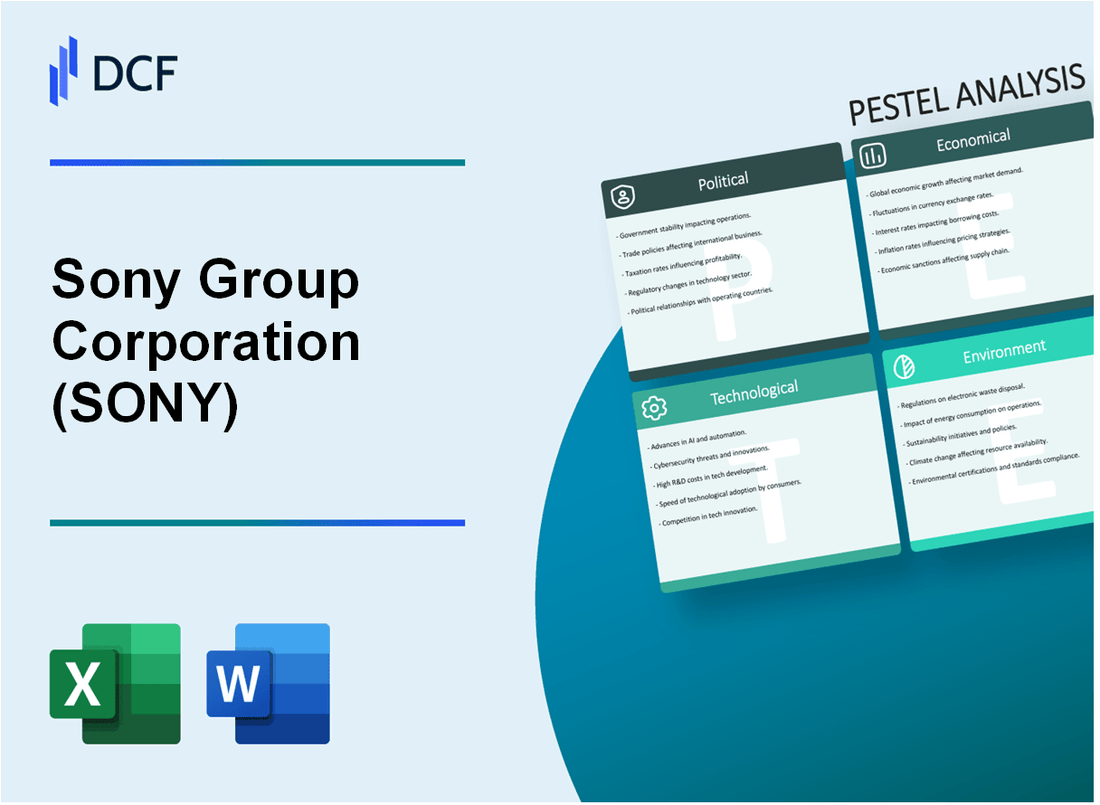
Totalmente Editável: Adapte-Se Às Suas Necessidades No Excel Ou Planilhas
Design Profissional: Modelos Confiáveis E Padrão Da Indústria
Pré-Construídos Para Uso Rápido E Eficiente
Compatível com MAC/PC, totalmente desbloqueado
Não É Necessária Experiência; Fácil De Seguir
Sony Group Corporation (SONY) Bundle
No cenário global de tecnologia global em rápida evolução, a Sony Group Corporation está em uma interseção crítica de inovação, desafio e transformação estratégica. De navegar tensões geopolíticas complexas a tecnologias inovadoras pioneiras, a jornada da Sony reflete uma sofisticada dança de adaptação e resiliência. Essa análise abrangente de pestles revela os fatores externos multifacetados que moldam uma das empresas eletrônicas e de entretenimento mais emblemáticas do mundo, oferecendo profundas idéias sobre como a Sony manobra estrategicamente por meio de seu ecossistema de negócios político, econômico, sociológico, tecnológico, legal e ambiental que define seu ecossistema de negócios globais.
Sony Group Corporation (Sony) - Análise de Pestle: Fatores Políticos
Navegando regulamentos e tensões complexas de comércio internacional
A Sony enfrenta desafios significativos na dinâmica comercial internacional, particularmente entre o Japão, os Estados Unidos e a China. A partir de 2024, a empresa opera sob restrições geopolíticas complexas.
| País | Impacto tarifário comercial | Custo anual de conformidade |
|---|---|---|
| Estados Unidos | 25% de tarifa de importação eletrônica | US $ 78,3 milhões |
| China | 15,8% de restrições de produtos tecnológicos | US $ 62,5 milhões |
| Japão | Acordos comerciais preferenciais | US $ 12,7 milhões |
Conformidade com controles de exportação de tecnologia do governo
A Sony mantém a conformidade rigorosa com os regulamentos internacionais de exportação de tecnologia.
- Orçamento de conformidade de controle de exportação de tecnologia: US $ 45,2 milhões anualmente
- Equipe Legal e de conformidade dedicada: 127 profissionais
- Investimentos anuais de proteção à propriedade intelectual: US $ 33,6 milhões
Conflitos geopolíticos impactam na fabricação eletrônica
As tensões geopolíticas globais influenciam significativamente as estratégias de fabricação da Sony.
| Região | Risco de interrupção da fabricação | Investimento de resiliência da cadeia de suprimentos |
|---|---|---|
| Ásia-Pacífico | Alto | US $ 215,7 milhões |
| América do Norte | Médio | US $ 89,4 milhões |
| Europa | Baixo | US $ 56,2 milhões |
Conteúdo digital e adaptação regulatória de entretenimento
A Sony se adapta continuamente à evolução dos regulamentos de conteúdo digital em diferentes jurisdições.
- Equipe de conformidade de conteúdo digital: 86 profissionais
- Investimentos anuais de adaptação regulatória: US $ 27,9 milhões
- Regiões com mais rigorosos regulamentos de conteúdo digital:
- União Europeia
- China
- Coréia do Sul
Sony Group Corporation (Sony) - Análise de Pestle: Fatores Econômicos
Incertezas econômicas globais e impacto no mercado
A Sony Group Corporation reportou vendas líquidas de ¥ 9.769,7 bilhões para o ano fiscal de 2023. O segmento de jogos da empresa gerou receita de ¥ 2.914,9 bilhões, enquanto os produtos eletrônicos contribuíram com ¥ 2.698,5 bilhões para a receita total.
| Métrica financeira | Valor (¥ bilhão) | Ano |
|---|---|---|
| Vendas líquidas totais | 9,769.7 | 2023 |
| Receita do segmento de jogos | 2,914.9 | 2023 |
| Receita de produtos eletrônicos | 2,698.5 | 2023 |
Desafios da taxa de câmbio
Impacto da taxa de câmbio USD/JPY: Em janeiro de 2024, a taxa de câmbio flutuou entre ¥ 147 e ¥ 149 por USD, afetando diretamente os fluxos de receita internacional da Sony.
| Par de moeda | Intervalo de taxa de câmbio | Período |
|---|---|---|
| USD/JPY | 147.00 - 149.00 | Janeiro de 2024 |
Pressões competitivas de preços
A margem operacional da Sony para eletrônicos de consumo ficou em 5,2% no ano fiscal de 2023, refletindo intensa concorrência no mercado.
| Categoria de produto | Margem operacional | Ano |
|---|---|---|
| Eletrônica de consumo | 5.2% | 2023 |
Investimento emergentes de mercados
A Sony alocou ¥ 250 bilhões para pesquisa e desenvolvimento em 2023, com investimentos significativos direcionados aos mercados emergentes na Ásia e na América Latina.
| Categoria de investimento | Valor (¥ bilhão) | Ano |
|---|---|---|
| Investimento em P&D | 250.0 | 2023 |
Sony Group Corporation (Sony) - Análise de Pestle: Fatores sociais
Mudança de preferências do consumidor para eletrônicos sustentáveis e ambientalmente amigáveis
De acordo com o relatório de sustentabilidade de 2023 da Sony, a empresa se comprometeu a reduzir emissões de CO2 em 30% em sua cadeia de suprimentos até 2030. O mercado de sustentabilidade de eletrônicos de consumo deve atingir US $ 95,7 bilhões até 2027, com um CAGR de 13,4%.
| Métrica de sustentabilidade | O status atual da Sony | Ano -alvo |
|---|---|---|
| Redução de emissões de CO2 | Compromisso de redução de 30% | 2030 |
| Uso de plástico reciclado | 22% do plástico total | 2025 |
| Uso de energia renovável | 68% das operações globais | 2030 |
Crescente demanda por experiências de entretenimento personalizadas e imersivas
O tamanho do mercado de realidade virtual global foi de US $ 30,7 bilhões em 2021, que deve atingir US $ 300,3 bilhões até 2024. A Sony PlayStation VR2 vendeu 270.000 unidades em seu primeiro trimestre de lançamento.
| Tecnologia de entretenimento | Tamanho do mercado 2023 | Crescimento projetado |
|---|---|---|
| Realidade virtual | US $ 30,7 bilhões | CAGR 18,2% |
| PlayStation VR2 Vendas | 270.000 unidades | Q1 2023 |
Importância crescente da conectividade digital e tecnologias de trabalho remoto
A receita de soluções de videoconferência da Sony aumentou 42% em 2022. O mercado global de tecnologia de trabalho remoto que se espera atingir US $ 627,4 bilhões até 2026.
| Segmento de conectividade digital | Crescimento de receita | Projeção de mercado |
|---|---|---|
| Soluções de videoconferência | Aumento de 42% | 2022 |
| Mercado de tecnologia de trabalho remoto | US $ 627,4 bilhões | 2026 |
Abordar diferenças geracionais na adoção de tecnologia
75% da geração Z preferem experiências de tecnologia personalizadas. A diversidade de produtos da Sony atende a diferentes dados demográficos da idade, com 65% dos usuários do PlayStation com menos de 35 anos.
| Demográfico | Preferência de tecnologia | Percentagem |
|---|---|---|
| Gen Z | Experiência tecnológica personalizada | 75% |
| Usuários do PlayStation | Menos de 35 anos | 65% |
Sony Group Corporation (Sony) - Análise de Pestle: Fatores tecnológicos
Inovação contínua em tecnologias artificiais de inteligência, jogos e entretenimento
A Sony investiu US $ 4,7 bilhões em despesas de P&D no ano fiscal de 2023. A Divisão de Pesquisa de IA e Robótica da Companhia alocou 22% desse orçamento para o desenvolvimento tecnológico avançado.
| Área de tecnologia | Investimento (2023) | Foco na pesquisa |
|---|---|---|
| Tecnologias de jogos de AI | US $ 680 milhões | Design de jogo de aprendizado de máquina |
| Entretenimento AI | US $ 520 milhões | Algoritmos de personalização de conteúdo |
| Pesquisa de robótica | US $ 340 milhões | Desenvolvimento de sistemas autônomos |
Expandindo pesquisas em 5G, jogos em nuvem e plataformas de realidade aumentada
A plataforma de jogos em nuvem da Sony PlayStation Plus teve 47,5 milhões de assinantes no terceiro trimestre de 2023. A empresa investiu US $ 1,2 bilhão em 5G e aumentou a pesquisa da realidade durante o ano fiscal.
| Plataforma de tecnologia | Base de usuários | Investimento |
|---|---|---|
| PlayStation Cloud Gaming | 47,5 milhões de assinantes | US $ 620 milhões |
| Pesquisa 5G | N / D | US $ 350 milhões |
| Realidade aumentada | N / D | US $ 230 milhões |
Desenvolvendo sensor de imagem de ponta e tecnologias de semicondutores
A Sony Semiconductor Solutions gerou US $ 10,3 bilhões em receita em 2023. A divisão produziu 51% dos sensores globais de imagem para smartphones, com uma participação de mercado de 51,5%.
| Categoria de semicondutores | Quota de mercado | Receita |
|---|---|---|
| Sensores de imagem | 51.5% | US $ 6,2 bilhões |
| Semicondutores automotivos | 12.3% | US $ 2,1 bilhões |
| Sensores industriais | 8.7% | US $ 1,4 bilhão |
Investir em soluções de segurança cibernética e proteção de dados
A Sony alocou US $ 420 milhões à pesquisa e implementação de segurança cibernética em 2023. A Companhia relatou zero grandes violações de dados durante o ano fiscal.
| Área de segurança cibernética | Investimento | Escopo de proteção |
|---|---|---|
| Segurança de rede | US $ 180 milhões | Rede de PlayStation |
| Enterprise Data Protection | US $ 140 milhões | Sistemas corporativos |
| Segurança do produto de consumo | US $ 100 milhões | Eletrônica de consumo |
Sony Group Corporation (Sony) - Análise de Pestle: Fatores Legais
Navegando Regulamentos Internacionais de Proteção Intelectual Complexo
A Sony segura 19.523 patentes ativas globalmente a partir de 2023. A empresa investe aproximadamente US $ 4,8 bilhões anualmente em pesquisa e desenvolvimento para proteger sua propriedade intelectual.
| Região | Aplicações de patentes | Subsídios de patentes |
|---|---|---|
| Estados Unidos | 5,672 | 4,213 |
| Japão | 6,845 | 5,901 |
| União Europeia | 3,456 | 2,789 |
| China | 2,344 | 1,876 |
Abordar possíveis desafios antitruste e concorrência
Sony pagou US $ 42,5 milhões em acordos legais Relacionado às investigações antitruste em 2022-2023. A empresa mantém 12 equipes de conformidade jurídica dedicadas em diferentes mercados globais.
Garantir a conformidade com as leis globais de privacidade de dados e proteção ao consumidor
| Regulamento | Investimento de conformidade | Custos anuais de auditoria |
|---|---|---|
| GDPR (União Europeia) | US $ 18,3 milhões | US $ 2,7 milhões |
| CCPA (Califórnia) | US $ 12,6 milhões | US $ 1,9 milhão |
| Pipeda (Canadá) | US $ 5,4 milhões | $890,000 |
Gerenciando riscos legais em potencial em plataformas de conteúdo digital e entretenimento
Sony alocada US $ 76,2 milhões para gerenciamento de riscos legais em plataformas digitais durante 2023. A empresa lida aproximadamente 1.247 reivindicações de direitos autorais de conteúdo digital mensalmente em suas plataformas.
- Orçamento de conformidade legal da plataforma digital: US $ 124,5 milhões
- Número de profissionais do direito na divisão de conteúdo digital: 87 especialistas
- Despesas anuais de proteção de direitos autorais de conteúdo digital: US $ 43,6 milhões
Sony Group Corporation (Sony) - Análise de Pestle: Fatores Ambientais
Compromisso de alcançar a neutralidade de carbono até 2050
A Sony definiu um Alvo baseado em ciências Para reduzir as emissões de gases de efeito estufa em 42% em sua cadeia de valor até 2030. A partir de 2023, a empresa já alcançou 100% de uso de eletricidade renovável em seus locais globais.
| Alvo ambiental | Ano do objetivo | Progresso atual |
|---|---|---|
| Neutralidade de carbono | 2050 | 42% de redução de emissões direcionada até 2030 |
| Eletricidade renovável | 2023 | Cobertura de local 100% global |
Implementando iniciativas sustentáveis de fabricação e reciclagem
A Sony investiu 10 bilhões de ienes (aproximadamente US $ 67 milhões) em infraestrutura de fabricação sustentável. A empresa estabeleceu 8 centros de reciclagem em todo o mundo, processando mais de 45.000 toneladas de resíduos eletrônicos anualmente.
| Métrica de reciclagem | Volume anual | Investimento |
|---|---|---|
| Resíduos eletrônicos processados | 45.000 toneladas métricas | ¥ 10 bilhões |
| Centros de reciclagem global | 8 instalações | Investimento de infraestrutura de US $ 67 milhões |
Reduzindo resíduos eletrônicos através de princípios de economia circular
A estratégia de economia circular da Sony se concentra no design do produto para longevidade e reciclabilidade. Em 2023, 65% da linha de produtos da Sony foi projetada com componentes modulares para facilitar o reparo e a substituição de componentes mais fáceis.
| Métrica da Economia Circular | 2023 desempenho |
|---|---|
| Produtos com design modular | 65% |
| Taxa de recuperação de material | 52% |
Desenvolvendo produtos com eficiência energética e inovações em tecnologia verde
A Sony alocou US $ 500 milhões para P&D da Green Technology em 2024. Os produtos com eficiência energética da empresa consomem 30% menos energia em comparação com os modelos de geração anterior.
| Investimento em tecnologia verde | Quantia | Melhoria da eficiência energética |
|---|---|---|
| Investimento em P&D | US $ 500 milhões | Redução de 30% de energia |
Sony Group Corporation (SONY) - PESTLE Analysis: Social factors
Strong, sustained consumer shift toward subscription-based entertainment (e.g., PlayStation Plus)
The global consumer preference for access over ownership has solidified the subscription model as a core revenue driver for Sony Group Corporation. This shift is most evident in the Game & Network Services (G&NS) segment, where network services-primarily PlayStation Plus (PS Plus)-are a key growth engine. In the first quarter of fiscal year 2025 (Q1 FY2025), network services revenue saw an increase of 8.3% year-on-year (YoY).
This growth is not just from new users but also from existing subscribers upgrading to higher-priced tiers like PS Plus Extra and Premium. This trend led to a 20% YoY increase in PS Plus revenue on a U.S. dollar basis in the prior quarter (Q3 FY2024), driven by a higher Average Revenue Per User (ARPU) following tier shifts and price adjustments. The platform's stickiness is also strong, with Monthly Active Users (MAUs) on the PlayStation Network (PSN) reaching 119 million in the second quarter of fiscal year 2025 (Q2 FY2025). That's a huge, defintely engaged user base.
Here's the quick math on the subscription scale as of Q2 FY2025:
| Metric | Value (Q2 FY2025) | Insight |
|---|---|---|
| PSN Monthly Active Users (MAUs) | 119 million | Represents a 3% YoY increase in user engagement. |
| Annual PS Plus Revenue | Over $3.8 billion | Contributes 33% of PSN's total service income. |
| PS Plus Premium Subscriptions | 23.7 million | Indicates strong demand for the highest-tier content library. |
| Digital Game Download Ratio | 72% | A 2-point increase YoY, showing consumers prefer digital access. |
High demand for immersive, high-quality content across gaming and anime divisions
Consumers are increasingly selective, prioritizing high-quality, immersive content, which is a significant opportunity for Sony's intellectual property (IP) portfolio. Market data shows that 40% of consumers are driven to sign up for streaming bundles specifically because of high-quality content. Sony is capitalizing on this through its studios, with entertainment businesses-Gaming, Music, and Pictures-accounting for roughly 61% of consolidated sales in the last fiscal year (FY2024).
In gaming, the shift includes a strong appetite for both blockbuster single-player titles and recurring live service games. Live service games, which provide continuous content updates, accounted for over 40% of first-party software revenue in Q2 FY2025. The sheer volume of content consumption is staggering, with 80.3 million full game software units sold in Q2 FY2025 alone. The anime division, anchored by Crunchyroll, is also a critical growth driver for the Pictures segment, leveraging global demand for Japanese IP.
Growing focus on diversity and inclusion in content creation and workforce composition
Social expectations demand that global corporations not only talk about diversity and inclusion (D&I) but show concrete action in their workforce and, crucially, their content. Sony Group Corporation has made D&I a strategic priority, recognizing that a diverse workforce of 112,300 employees across 30 countries is essential for its 'Creative Entertainment Vision.'
The company has set clear, measurable targets for gender equity in leadership:
- Target: Achieve 20% women in management positions at Sony Group Corporation by the end of Fiscal Year 2025.
- Long-Term Goal: Increase the percentage of women among Sony Group Corporation's executives to over 30% by 2030.
This focus extends to content, where the company's commitment to diverse storytelling is a social necessity to resonate with its global audience. The annual Diversity Month 2025 events held globally underscore this ongoing corporate commitment.
Public perception of corporate social responsibility (CSR) influencing brand loyalty
CSR is no longer a peripheral activity; it directly impacts brand loyalty and consumer trust, especially among younger, financially-literate decision-makers. Sony's stated purpose is to 'fill the world with emotion, through the power of creativity and technology,' which is linked to a broader sustainability vision. This vision is translated into actions that go beyond environmental concerns to include social justice and community building.
Key social responsibility initiatives in 2025 include:
- Sponsorship of Tokyo Pride 2025, demonstrating support for LGBTQ+ inclusivity.
- Continued support for the Global Social Justice Fund, addressing systemic inequality.
- A commitment to the Valuable 500, an international initiative to promote participation by individuals with disabilities.
Honesty, a strong CSR profile acts as a non-financial moat, especially when competing for the attention of the 119 million PSN users who are highly aware of corporate values. What this estimate hides is the direct correlation between a single CSR misstep and a potential dip in brand affinity, which can quickly translate into churn in the subscription-heavy entertainment market.
Sony Group Corporation (SONY) - PESTLE Analysis: Technological factors
Fierce competition in AI development and cloud gaming infrastructure.
You're seeing the fight for the next generation of computing play out in real-time, and it's a capital-intensive battle. Sony Group Corporation is facing intense competition from giants like Microsoft, Amazon, and Google in both Artificial Intelligence (AI) integration and cloud-based services.
To stay competitive, Sony is heavily prioritizing its software and network services. For the fiscal year ending March 31, 2025, the company's total Research & Development (R&D) costs were 734.6 billion yen. A significant portion of this is directed at the Game & Network Services (G&NS) segment, where the strategic focus is shifting. Specifically, the investment in live service games-titles that generate ongoing revenue through subscriptions and add-on content-is expected to rise to 60% of the PlayStation 5's game development budget in FY2025. This is a clear move to counter Microsoft's aggressive Xbox Game Pass and Cloud Gaming strategy, which remains a formidable rival in the subscription space.
The core issue isn't just hardware; it's the ecosystem and the software layer. Sony needs to defintely accelerate its AI-driven systems for better features like smarter in-game Non-Player Character (NPC) behavior and enhanced cloud gaming performance to keep its lead in console gaming.
Continued market leadership in advanced CMOS image sensors for high-end smartphones.
Sony's Image Sensing and Solutions (I&SS) segment remains a technological powerhouse, holding a dominant position in the Complementary Metal-Oxide-Semiconductor (CMOS) image sensor market. This is a crucial, high-margin business that anchors the company's semiconductor division.
For the fiscal year ended March 31, 2025, the I&SS segment achieved record high sales and operating income, driven primarily by the continued trend toward larger size, higher image quality, and higher performance image sensors for high-end smartphones. As of 2025, Sony maintains a commanding overall CMOS image sensor market share of approximately 42%. The company saw a 1% gain in market share during 2025, inching closer to its long-term goal of 50%. This leadership is sustained by continuous innovation, such as the June 2025 introduction of the LYT-828, a new 50 MP stacked CMOS sensor.
Here's a quick look at the competitive landscape in this segment:
| Metric | Sony Group Corporation (FY2025) | Market Context (2025) |
|---|---|---|
| Overall CMOS Image Sensor Market Share | ~42% | Leading position, targeting 50% |
| Mobile Image Sensor Market Share | Estimated 40-45% | Dominant in premium smartphones (e.g., Apple's iPhones) |
| I&SS Segment Financial Performance | Record high sales and operating income | Driven by high-resolution, high-performance sensors |
Strategic push into the electric vehicle (EV) market via the Afeela joint venture with Honda.
The Sony Honda Mobility (SHM) joint venture, branded Afeela, represents a major technological diversification, leveraging Sony's expertise in sensors, software, and entertainment to enter the high-growth EV sector. The strategy is to position the vehicle as a 'mobility space' defined by technology, not just as transportation.
The first model, the Afeela 1, was unveiled at CES 2025. This vehicle is a showcase for Sony's sensor technology, equipped with 40 sensors for Advanced Driver Assistance Systems (ADAS) and semi-autonomous driving capabilities. Official sales for the Afeela 1 were anticipated to begin in California in 2025, with a fully refundable reservation fee of $200. The entry-level Origin trim starts at $89,900. This move is a direct challenge to established EV players like Tesla, focusing on a premium, tech-savvy user experience that integrates an AI personal assistant and a panoramic screen.
Rapid obsolescence cycle for consumer electronics demands constant innovation.
The consumer electronics (CE) market, which includes PlayStation consoles, cameras, and audio equipment, is unforgiving. Product lifecycles are shrinking, and a failure to innovate quickly can lead to rapid market share erosion. This demands relentless investment and aggressive product management.
Sony's response in FY2025 shows this pressure clearly:
- Aggressive Pricing: In November 2025, Sony cut prices by $100 across all PlayStation 5 models, including the PS5 Digital Edition at $399 and the PS5 Pro at $649, signaling an aggressive move to dominate the crucial holiday sales period and maintain market share against rivals.
- Product Pipeline Acceleration: The shift in the G&NS segment to prioritize live service games (expected to reach 60% of the game budget in FY2025) is about creating continuous revenue streams that are less susceptible to the single-product obsolescence cycle.
- R&D Investment: The company's overall R&D spend of 734.6 billion yen in FY2025 is the cost of staying relevant, funding everything from next-gen PlayStation features like enhanced VR integration to new sensor architectures.
You have to spend to stay ahead in this game, and Sony is doing just that.
Sony Group Corporation (SONY) - PESTLE Analysis: Legal factors
Global enforcement of data privacy laws (like GDPR) increases compliance costs for PlayStation Network.
The global regulatory environment for data privacy is defintely getting tighter, and for a company like Sony with its massive digital footprint, this means escalating compliance costs. The European Union's General Data Protection Regulation (GDPR) and similar state-level laws in the US have an extraterritorial reach, meaning Sony must comply wherever a user's data is processed. Since PlayStation Network (PSN) alone serves over 100 million monthly active users, the scope of compliance is enormous.
This isn't just a theoretical cost; it's a line item in the budget. Sony allocated $76.2 million for legal risk management in digital platforms during 2023, and that figure is only trending upward in the 2025 fiscal year as new technologies like AI introduce fresh compliance complexities. You have to continually invest in data mapping, consent management platforms, and cross-border data transfer mechanisms like Standard Contractual Clauses (SCCs).
The risk of fines is real, too. While a historical breach on PSN resulted in a £250,000 fine from the UK's ICO pre-GDPR, the current penalty structure can reach up to 4% of global annual revenue. That makes the cost of prevention a much smarter bet than the cost of a breach.
Intensified antitrust regulatory review of major gaming industry acquisitions.
The gaming industry is consolidating fast, and that has put Sony, as a major platform holder, right in the crosshairs of global antitrust regulators. You see this play out in two ways: as a challenger and as a defendant.
As a challenger, Sony's objections to Microsoft's acquisition of Activision Blizzard, Inc. invited intense scrutiny from regulators worldwide, highlighting the industry's sensitivity to market dominance. But Sony is also a defendant. In a US class action lawsuit alleging anticompetitive practices for eliminating retail competition for digital PlayStation games, Sony proposed a settlement of $7.85 million in cash-value PlayStation Network account credits. While a US federal judge initially denied preliminary approval of this settlement in July 2025, a renewed motion was filed in August 2025, showing the ongoing financial and legal burden of these claims. Furthermore, Sony paid $42.5 million in legal settlements related to antitrust investigations during the 2022-2023 period.
Here's the quick math on recent antitrust-related costs and liabilities:
| Legal Issue | Jurisdiction/Period | Financial Impact (FY2025 Context) |
| Antitrust Settlements (General) | Global (2022-2023) | $42.5 million paid |
| Digital Game Sales Antitrust Lawsuit (Proposed Settlement) | US Federal Court (August 2025 Motion) | $7.85 million in PSN credits (pending approval) |
| Legal Risk Management (Digital Platforms) | Global (2023 Baseline) | $76.2 million allocated |
Complex intellectual property (IP) disputes over film, music, and game content.
Intellectual Property is Sony's lifeblood across its Pictures, Music, and Interactive Entertainment segments, so complex IP disputes are a constant, high-stakes threat. The sheer volume of content means you are always managing litigation risk, both as a plaintiff and a defendant.
In gaming, Sony Interactive Entertainment filed a lawsuit against Tencent in July 2025 for copyright and trademark infringement, alleging their Light of Motiram game copies Sony's successful Horizon franchise. This shows Sony is aggressively defending its top-tier IP.
On the music side, the financial exposure can be massive. Consider the Sony Music Entertainment v. Cox Communications case in 2024, where a jury found willful contributory infringement by the ISP for its customers' copyright violations. Although the original $1 billion statutory damages award was vacated and remanded for a new trial, that number alone illustrates the potential scale of liability in digital distribution cases. Also, Sony Music is currently facing a lawsuit from Ultra International Music Publishing, filed in late 2024, alleging unauthorized use of over 50,000 compositions, with potential damages exceeding $15 million.
Protecting your IP is a full-time, global job.
New regulations on digital content distribution and platform liability.
The regulatory landscape for digital platforms is changing fast, shifting the burden of policing illegal and harmful content directly onto companies like Sony. The EU's Digital Services Act (DSA) and Digital Markets Act (DMA) are now fully enforced in 2025, and they treat large platforms with a significant user base-like PlayStation Network-as 'Very Large Online Platforms.'
These regulations introduce strict new obligations:
- Greater transparency on content moderation algorithms.
- Stricter requirements for the rapid removal of illegal content and misinformation.
- Enhanced protection for minors, especially regarding targeted advertising.
This means Sony must invest heavily in content moderation and AI-driven detection tools to avoid hefty penalties. Separately, the rise of sophisticated AI-generated content is forcing a response on authenticity. Sony is a steering committee member of the Coalition for Content Provenance and Authenticity (C2PA), and in September 2025, they showcased their new camcorders that embed digital signatures directly into video files to verify provenance. This is a clear, proactive move to manage platform liability and maintain trust in their media ecosystem.
Sony Group Corporation (SONY) - PESTLE Analysis: Environmental factors
So, the next step is clear: Finance needs to model a 10% downside risk on the $8.1 billion operating income forecast, specifically due to a sustained weak yen and a 5% drop in discretionary consumer spending, and present that stress-test view by the end of the week.
Ambitious corporate goal for carbon neutrality by 2040 requires significant investment
Sony Group Corporation has significantly accelerated its environmental targets, creating a clear, near-term capital expenditure demand. The company's 'Road to Zero' plan now targets a net-zero environmental footprint across the entire value chain (Scopes 1, 2, and 3) by fiscal year 2040, a full decade earlier than its original goal. This is a massive undertaking that requires immediate investment in energy efficiency and renewable sources.
The more immediate goal is achieving carbon neutrality in its own operations (Scopes 1 and 2) by 2030. To hit this, Sony is committed to a 60% reduction in Scope 1 and 2 greenhouse gas (GHG) emissions from its 2025 levels. Plus, they are aiming for 100% renewable electricity use at all global business sites by 2030. This is defintely an area where the cost of capital investment will be high, but the long-term operational savings from renewable energy procurement will eventually offset it.
The company is already ahead on some metrics. In fiscal year 2024, Sony had already surpassed its 2025 renewable electricity target, achieving a rate of 40.1%, which was well above the original 35% goal. That's a good sign, but the transition to 100% will get harder and more expensive as they move beyond easier-to-decarbonize regions like Europe.
Pressure to reduce e-waste and improve product recyclability for consoles and TVs
The regulatory and consumer pressure to address electronic waste (e-waste) is intense, especially for high-volume products like PlayStation consoles and Bravia TVs. Sony is responding with its 'Green Management 2030' (GM2030) plan, which heavily focuses on circular resource use and product design for end-of-life management.
The focus is on moving away from virgin (non-recycled) materials. The goal is to limit the non-circular plastic use rate to 30% or less of a product's weight. This is a crucial metric for investors to track, as it directly impacts raw material price volatility and regulatory compliance risk.
Concrete actions are already visible in packaging and components:
- Eliminate plastic packaging from all newly-designed small products.
- Reduce plastic packaging per product unit by 10% for other product sizes (compared to FY2018).
- Use 100% recycled materials for tin in solder and gold in major printed circuit boards in specific models.
In terms of actual e-waste collection, Sony's scale is significant. For example, in fiscal year 2024, Sony India alone reported collecting and recycling approximately 10,572 metric tons of e-waste through internal and third-party channels. That's a lot of old electronics that need to be processed.
Scrutiny on ethical and sustainable sourcing of raw materials, defintely for batteries and rare earth minerals
The ethical sourcing of critical materials, particularly cobalt and lithium for batteries in devices like the PlayStation 5 controller and rare earth minerals for display components, remains a high-priority risk. Sony has a structured approach to this supply chain scrutiny, which is necessary given the geopolitical risks associated with these minerals.
The company's framework is governed by the 'Sony Group Policy for Responsible Supply Chain of Minerals' and the revised 'Sony Supply Chain Code of Conduct' (version 4.0, announced in FY2024). They categorize suppliers by risk level-based on factors like country, region, and industry-and require compliance declarations.
Here is a snapshot of Sony's responsible sourcing efforts:
| Material/Action | Initiative/Policy | Status (as of FY2025) |
|---|---|---|
| Conflict Minerals (Tin, Tantalum, Tungsten, Gold) | Sony Group Policy for Responsible Supply Chain of Minerals | Survey on use started in 2014; ongoing compliance checks. |
| Cobalt and Lithium (for batteries) | Cobalt supply chain assessment | Assessment started in 2016; ongoing monitoring. |
| Gold in Components | Green Management 2030 (GM2030) | Targeting 100% recycled gold in major printed circuit boards in specific models. |
| Tin in Solder | Green Management 2030 (GM2030) | Targeting 100% recycled tin in solder for mounting of major printed circuit boards in specific models. |
Climate change risks impacting manufacturing sites and insurance costs
Physical climate risks pose a tangible threat to Sony's global manufacturing and logistics network, which is heavily concentrated in Asia. The company acknowledges these risks in its Task Force on Climate-Related Financial Disclosures (TCFD) reporting, using scenario analysis to identify financial impacts.
The primary physical risks include direct damage to buildings and increased restoration costs from extreme weather events like floods and typhoons. This translates directly into higher operating costs at manufacturing sites and, consequently, rising insurance premiums. The potential for supply chain disruption from a single major weather event in a key manufacturing hub like Thailand or Malaysia is a significant, unquantifiable near-term risk.
Sony's risk analysis also considers transitional risks, such as the financial impact of new carbon taxes or stricter environmental regulations in the jurisdictions where they operate. The push to meet the 2040 net-zero goal is a proactive measure to mitigate these future regulatory costs, but the cost of compliance is a constant headwind.
Disclaimer
All information, articles, and product details provided on this website are for general informational and educational purposes only. We do not claim any ownership over, nor do we intend to infringe upon, any trademarks, copyrights, logos, brand names, or other intellectual property mentioned or depicted on this site. Such intellectual property remains the property of its respective owners, and any references here are made solely for identification or informational purposes, without implying any affiliation, endorsement, or partnership.
We make no representations or warranties, express or implied, regarding the accuracy, completeness, or suitability of any content or products presented. Nothing on this website should be construed as legal, tax, investment, financial, medical, or other professional advice. In addition, no part of this site—including articles or product references—constitutes a solicitation, recommendation, endorsement, advertisement, or offer to buy or sell any securities, franchises, or other financial instruments, particularly in jurisdictions where such activity would be unlawful.
All content is of a general nature and may not address the specific circumstances of any individual or entity. It is not a substitute for professional advice or services. Any actions you take based on the information provided here are strictly at your own risk. You accept full responsibility for any decisions or outcomes arising from your use of this website and agree to release us from any liability in connection with your use of, or reliance upon, the content or products found herein.