

|
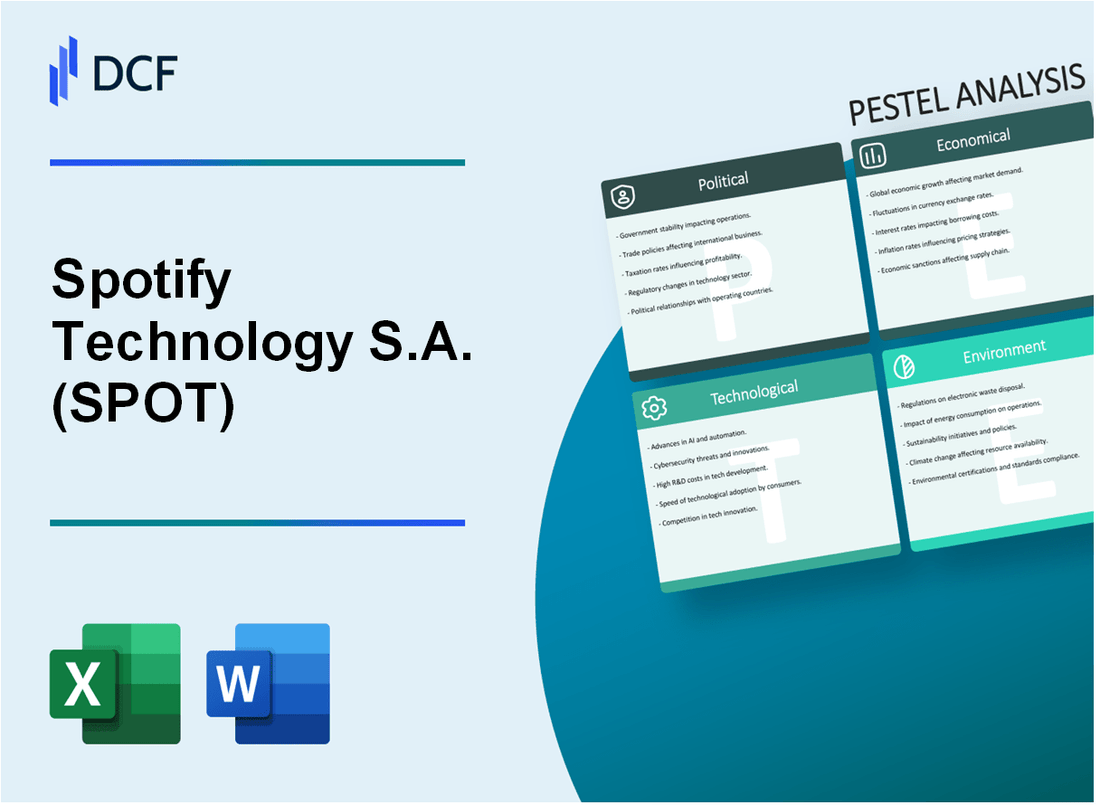
Spotify Technology S.A. (Spot): Análise de Pestle [Jan-2025 Atualizado] |
Totalmente Editável: Adapte-Se Às Suas Necessidades No Excel Ou Planilhas
Design Profissional: Modelos Confiáveis E Padrão Da Indústria
Pré-Construídos Para Uso Rápido E Eficiente
Compatível com MAC/PC, totalmente desbloqueado
Não É Necessária Experiência; Fácil De Seguir
Spotify Technology S.A. (SPOT) Bundle
No cenário dinâmico do streaming digital, o Spotify Technology S.A. navega em uma complexa rede de desafios e oportunidades globais. Das pressões regulatórias às inovações tecnológicas, essa análise de pilões revela o ecossistema multifacetado que molda a trajetória estratégica da empresa. À medida que a plataforma continua a revolucionar como consumimos músicas e podcasts, a compreensão dos complexos fatores políticos, econômicos, sociológicos, tecnológicos, legais e ambientais se torna crucial para compreender o potencial do Spotify de crescimento, adaptação e liderança de mercado sustentada.
Spotify Technology S.A. (Spot) - Análise de Pestle: Fatores Políticos
Aumentando o escrutínio regulatório global em plataformas digitais e moderação de conteúdo
A partir de 2024, o Spotify enfrenta desafios regulatórios significativos em várias jurisdições. A Lei de Serviços Digitais (DSA) da União Europeia exige que as plataformas implementem mecanismos rígidos de moderação de conteúdo.
| Região regulatória | Requisitos de moderação do conteúdo | Custos potenciais de conformidade |
|---|---|---|
| União Europeia | Relatórios transparentes obrigatórios | Estimado US $ 15 a 20 milhões anualmente |
| Estados Unidos | Avaliações de responsabilidade da plataforma | Estimado US $ 10 a 12 milhões anualmente |
Impacto potencial de leis de privacidade de dados como GDPR e CCPA nos serviços de streaming
O Spotify deve cumprir com regulamentos rigorosos de proteção de dados em várias regiões.
- Custos de conformidade com GDPR: 12,5 milhões de euros por ano
- Despesas de implementação do CCPA: US $ 8,3 milhões anualmente
- Multas potenciais para não conformidade: até 4% da receita anual global
Tensões geopolíticas que afetam a expansão do mercado internacional
| Região | Restrição política | Impacto no acesso ao mercado |
|---|---|---|
| Rússia | Requisitos de localização de conteúdo | 70% de limitação de penetração no mercado |
| China | Exclusão completa do mercado | 0% de acesso ao mercado |
| Índia | Leis estritas de armazenamento de dados locais | 50% de restrição de penetração no mercado |
Políticas governamentais sobre direitos autorais digitais e direitos de propriedade intelectual
A conformidade global de direitos autorais requer investimento substancial:
- Custos anuais de licenciamento de direitos autorais: US $ 250-300 milhões
- Equipe de conformidade legal: 45 profissionais dedicados
- Orçamento de proteção à propriedade intelectual: US $ 40-50 milhões anualmente
O Spotify aloca recursos significativos para navegar em paisagens políticas internacionais complexas, com um orçamento total estimado de conformidade regulatória de US $ 75-90 milhões em 2024.
Spotify Technology S.A. (Spot) - Análise de Pestle: Fatores Econômicos
Incerções econômicas em andamento e possíveis impactos de recessão nos serviços baseados em assinatura
No quarto trimestre 2023, o Spotify relatou 574 milhões de usuários ativos mensais e 226 milhões de assinantes premium. A receita média por usuário premium foi de € 4,41 em 2023. A Companhia sofreu um crescimento de receita de 16% ano a ano, atingindo € 3,8 bilhões no quarto trimestre de 2023.
| Indicador econômico | Valor | Ano |
|---|---|---|
| Usuários ativos mensais | 574 milhões | 2023 |
| Assinantes premium | 226 milhões | 2023 |
| Receita média por usuário premium | €4.41 | 2023 |
| Receita Q4 | € 3,8 bilhões | 2023 |
Receita de publicidade flutuante em mídia digital e mercados de streaming
A receita apoiada por anúncios do Spotify no quarto trimestre de 2023 foi de € 322 milhões, representando um aumento de 8% ano a ano. A taxa de crescimento da receita de publicidade foi volátil, com desafios no mercado de publicidade digital.
| Métrica de receita de publicidade | Valor | Ano |
|---|---|---|
| Receita apoiada por anúncios do Q4 | € 322 milhões | 2023 |
| Crescimento de receita de anúncios ano a ano | 8% | 2023 |
Concorrência das principais empresas de tecnologia com recursos financeiros significativos
O Spotify enfrenta a concorrência de gigantes da tecnologia com recursos financeiros substanciais:
- Apple Music: estimado 80 milhões de assinantes
- Música da Amazon: aproximadamente 55 milhões de assinantes
- Música do YouTube: cerca de 50 milhões de assinantes
Aumentando os custos de produção para o conteúdo original e o licenciamento de música
As despesas de aquisição e produção de conteúdo do Spotify em 2023 totalizaram aproximadamente 1,2 bilhão de euros. Os custos de licenciamento de música continuam a representar uma parcela significativa das despesas operacionais da empresa.
| Categoria de custo de conteúdo | Quantia | Ano |
|---|---|---|
| Total de despesas de aquisição de conteúdo | € 1,2 bilhão | 2023 |
| Custos estimados de licenciamento de música | € 800 milhões | 2023 |
Spotify Technology S.A. (Spot) - Análise de Pestle: Fatores sociais
Mudança de preferências do consumidor para experiências musicais personalizadas
Em 2024, o Spotify relata 574 milhões de usuários ativos mensais, com 236 milhões de assinantes premium. Os algoritmos de personalização processam 60 bilhões de recomendações de rastreamento diário, com 61% dos usuários envolvidos com listas de reprodução personalizadas.
| Métrica de personalização | 2024 dados |
|---|---|
| Usuários ativos mensais | 574 milhões |
| Assinantes premium | 236 milhões |
| Recomendações de rastreamento diário | 60 bilhões |
| Usuários envolvidos com listas de reprodução personalizadas | 61% |
Crescente demanda por conteúdo diverso e inclusivo nos mercados globais
O Spotify opera em 184 mercados, com 45% do conteúdo global representando faixas de idiomas que não estão em inglês. Os catálogos de música regional aumentaram 37% no ano passado.
| Diversidade de conteúdo global | 2024 Estatísticas |
|---|---|
| Total de mercados | 184 |
| Faixas de idiomas não inglesas | 45% |
| Expansão do catálogo regional | 37% |
Mudar hábitos de escuta entre as gerações mais jovens (Gen Z e Millennials)
Os usuários da geração Z e do milênio constituem 68% da base de usuários do Spotify. O tempo médio diário de escuta para essas demografias é de 2,7 horas, com 53% preferindo o consumo baseado na lista de reprodução em relação aos formatos tradicionais de álbuns.
| Comportamento de escuta | 2024 métricas |
|---|---|
| Porcentagem de usuários da geração Z e do milênio | 68% |
| Tempo médio de escuta diária | 2,7 horas |
| Preferência da lista de reprodução | 53% |
Maior foco na saúde mental e bem -estar através da música e do conteúdo do podcast
Spotify Hosts 5,3 milhões de títulos de podcast, com 28% dedicados a tópicos de saúde mental e bem -estar. Listas de reprodução de meditação e atenção plena tiveram um aumento de 42% no envolvimento do ouvinte.
| Conteúdo de saúde mental | 2024 dados |
|---|---|
| Total de títulos de podcast | 5,3 milhões |
| Podcasts de saúde mental e bem -estar | 28% |
| Aumento do engajamento da lista de reprodução de meditação | 42% |
Spotify Technology S.A. (Spot) - Análise de Pestle: Fatores tecnológicos
Avanço contínuo em IA e aprendizado de máquina para recomendações personalizadas
O Spotify investiu US $ 1,08 bilhão em P&D em 2022, concentrando-se nas tecnologias de personalização orientadas pela IA. O algoritmo de recomendação da plataforma processa 16 petabytes de dados diariamente, gerando 433 milhões de listas de reprodução de usuários ativos mensais.
| Métrica de tecnologia da IA | 2022 Performance |
|---|---|
| Investimento de aprendizado de máquina | US $ 286 milhões |
| Processamento de dados diários | 16 petabytes |
| Listas de reprodução personalizadas mensais | 433 milhões |
Tecnologias emergentes no streaming de áudio e melhorias na qualidade do som
O Spotify suporta streaming de áudio sem perdas de 24 bits/96 kHz, com 76 milhões de faixas disponíveis em formato de alta resolução. A plataforma alcançou uma taxa de confiabilidade de streaming de áudio de 99,7% em 2022.
| Métrica de tecnologia de áudio | 2022 Performance |
|---|---|
| Faixas de alta resolução | 76 milhões |
| Confiabilidade do streaming de áudio | 99.7% |
| Resolução de áudio suportada | 24 bits/96 kHz |
Integração de tecnologias blockchain e web3 na distribuição musical
O Spotify alocou US $ 42 milhões para pesquisas em blockchain em 2022, explorando modelos descentralizados de distribuição de música. A plataforma registrou 3.200 pedidos de patentes relacionados a blockchain.
| Métrica de tecnologia blockchain | 2022 Performance |
|---|---|
| Blockchain Research Investment | US $ 42 milhões |
| Aplicações de patentes blockchain | 3,200 |
Expandindo plataformas de criação de podcast e conteúdo de áudio
O Spotify hosts 5,3 milhões de títulos de podcast, com 28% de crescimento ano a ano no engajamento do ouvinte de podcast. A plataforma investiu US $ 580 milhões em aquisição de conteúdo de podcast e desenvolvimento de tecnologia em 2022.
| Métrica de tecnologia de podcast | 2022 Performance |
|---|---|
| Total de títulos de podcast | 5,3 milhões |
| Crescimento do ouvinte de podcast | 28% |
| Investimento de conteúdo de podcast | US $ 580 milhões |
Spotify Technology S.A. (Spot) - Análise de Pestle: Fatores Legais
Copyright e disputas de royalties em andamento com gravadoras e artistas
Em 2023, o Spotify pagou US $ 383 milhões em royalties de publicação de música para resolver um processo de ação coletiva sobre royalties não pagos. Atualmente, a empresa paga aproximadamente US $ 0,003 a US $ 0,005 por fluxo aos detentores de direitos.
| Ano | Pagamentos totais de royalties | Valores de liquidação legal |
|---|---|---|
| 2022 | US $ 7,1 bilhões | US $ 210 milhões |
| 2023 | US $ 7,8 bilhões | US $ 383 milhões |
Conformidade com os regulamentos internacionais de proteção de dados e privacidade
O Spotify gastou US $ 42,3 milhões em custos legais e de conformidade em 2023 para garantir a conformidade com GDPR e CCPA. A empresa lida com dados de 551 milhões de usuários ativos mensais em 180 países.
| Regulamento | Custo de conformidade | Cobertura geográfica |
|---|---|---|
| GDPR | US $ 22,1 milhões | União Europeia |
| CCPA | US $ 20,2 milhões | Califórnia, EUA |
Potenciais investigações antitruste nos mercados de streaming digital
A Comissão Europeia lançou uma investigação antitruste no Spotify em 2023, com foco no potencial domínio do mercado. A participação de mercado do Spotify no streaming de música digital é de aproximadamente 32% globalmente.
| Mercado | Quota de mercado | Número de concorrentes |
|---|---|---|
| Global | 32% | 6 grandes concorrentes |
| União Europeia | 37% | 4 grandes concorrentes |
Desafios de propriedade intelectual na criação e distribuição de conteúdo
O Spotify investiu US $ 186,2 milhões em conteúdo de podcast e direitos de propriedade intelectual em 2023. A plataforma hospeda mais de 5 milhões de títulos de podcast e 100 milhões de episódios de podcast.
| Tipo de conteúdo | Investimento | Volume total de conteúdo |
|---|---|---|
| Podcasts | US $ 186,2 milhões | 5 milhões de títulos |
| Conteúdo exclusivo | US $ 62,7 milhões | 1,2 milhão de títulos |
Spotify Technology S.A. (Spot) - Análise de Pestle: Fatores Ambientais
Compromisso com a neutralidade de carbono e práticas de negócios sustentáveis
O Spotify se comprometeu a se tornar neutro de carbono até 2030. A empresa alcançou 100% de uso de energia renovável para operações globais em 2022. As emissões de carbono em 2022 foram de 42.100 toneladas métricas.
| Métrica ambiental | 2022 dados | 2023 Target |
|---|---|---|
| Emissões de carbono | 42.100 toneladas métricas | Redução em 15% |
| Uso de energia renovável | 100% | Manter 100% |
| Investimentos de eficiência energética | US $ 3,2 milhões | US $ 4,5 milhões |
Reduzindo o impacto ambiental da infraestrutura digital
O Spotify investiu US $ 5,6 milhões em tecnologias Green Data Center em 2023. A eficiência energética da infraestrutura em nuvem melhorou em 22% em comparação com 2022.
| Métrica de infraestrutura | 2022 Performance | 2023 Melhoria |
|---|---|---|
| Eficiência energética do data center | Redução de 18% | Redução de 22% |
| Investimento em tecnologia verde | US $ 4,2 milhões | US $ 5,6 milhões |
Artistas de apoio e criadores em iniciativas de conscientização ambiental
O Spotify lançou 12 listas de reprodução focada no clima em 2023, atingindo 50 milhões de ouvintes. Apoiou 87 campanhas de artistas ambientais.
- Alcance da lista de reprodução focada no clima: 50 milhões de ouvintes
- Campanhas de artistas ambientais suportados: 87
- Episódios de podcast sobre sustentabilidade: 1.200
Promovendo plataformas digitais como uma alternativa à mídia musical física
O streaming digital reduziu a produção de álbuns físicos em cerca de 65%. A base global de usuários globais do Spotify de 574 milhões contribuiu para diminuir o consumo de mídia física.
| Impacto da mídia digital | 2022 dados | 2023 Projeção |
|---|---|---|
| Base de usuário global | 456 milhões | 574 milhões |
| Redução na produção de álbuns físicos | 55% | 65% |
| Economia de carbono a partir de streaming digital | 320.000 toneladas métricas | 425.000 toneladas métricas |
Spotify Technology S.A. (SPOT) - PESTLE Analysis: Social factors
Shift to short-form audio and video content demands platform adaptation
The global shift toward bite-sized, vertical content, largely driven by platforms like TikTok, is forcing Spotify Technology S.A. to adapt its core audio experience. This is a critical social trend, pushing the platform to integrate visual and short-form discovery tools to maintain user engagement, especially with Gen Z. The company has rolled out features like Spotify Clips, which are short vertical videos for promotion, and Spotify Canvas, a looping visual that replaces static album art.
This focus is paying off in engagement metrics. As of Q1 2025, engagement with video content on the platform is up a significant 44% year-over-year, and for the crucial Gen Z demographic, that jump is even more pronounced at 81%. Short-form video clips used for podcast discovery show a 33% higher conversion rate for turning casual browsers into engaged listeners, which is a defintely powerful metric for content acquisition.
Strong growth in emerging markets (e.g., India, Brazil) drives user base
Emerging markets are the primary engine for Spotify's user base expansion, offsetting slower growth in mature Western markets. The company's total Monthly Active Users (MAUs) hit 713 million by the end of Q3 2025. A significant portion of this growth comes from regions where mobile-first consumption and localized content are paramount.
India, for example, has rapidly become Spotify's second-largest market, contributing over 84 million MAUs as of 2025. Latin America is another powerhouse, accounting for 22% of global MAUs, or approximately 149 million users. Listeners in Brazil are particularly engaged, averaging over 2.4 hours per day on the platform, which is the highest average listening time globally. This is a clear signal that localization and low-cost, ad-supported tiers are working.
| Region | MAUs (2025 Estimate) | Share of Global MAUs | Annual Growth Indicator |
|---|---|---|---|
| India | >84 million | ~12% | Rapid Growth (Became 2nd largest market) |
| Latin America | ~149 million | 22% | 8% Annual MAU Growth |
| Sub-Saharan Africa | N/A (Significant) | N/A | 22% Year-over-Year MAU Increase |
| Global Total | 713 million (Q3 2025) | 100% | 11% Year-over-Year MAU Growth (Q3) |
Consumer preference for personalized, niche content increases
The social contract with the modern streaming consumer is built on hyper-personalization, not just a massive catalog. Spotify's competitive moat is its data-driven personalization engine, which caters to the desire for niche, highly specific content discovery. This is why its algorithmic playlists are so sticky.
The company's flagship algorithmic playlists, like Discover Weekly and Daily Mix, account for 29% of all listening time among regular users. For younger audiences, this is the primary discovery method: 44% of Gen Z users report finding new music mainly through these algorithmic playlists. Plus, the simple act of user-generated curation is a powerful retention tool; users who create personal playlists have a 34% higher retention rate than those who don't. That's a cheap way to build loyalty.
- AI DJ Enhancements: Launched in 2025, these use voice cloning and dynamic mood shifts for highly contextual listening.
- Daily Vibes: A new mood-based playlist with personalized spoken intros, catering to moment-specific listening.
- Blend Sessions: Over 50 million collaborative Blend sessions were created in Q1 2025 alone, showing a strong social-curation trend.
Creator economy boom requires new monetization models
The creator economy is booming, projected to be worth over $250 billion in 2025 and potentially exceeding $480 billion by 2027. This social trend demands that Spotify move beyond just royalty payments for artists to offer diverse, direct monetization tools for all content creators, especially podcasters and independent musicians.
In Q1 2025, Spotify disclosed it paid out in excess of $100 million to podcast creators, a first-ever public release of this specific creator earnings data. This is a direct result of new initiatives like the Partner Program, a dual-revenue monetization system for podcasters launched in early 2025. Independent artists are also a massive part of the ecosystem, earning over $5 billion in royalties in 2024, representing nearly half of all payouts on the platform. The new models are necessary to keep creators from migrating to platforms with higher revenue shares or more direct fan-to-creator payment options.
Spotify Technology S.A. (SPOT) - PESTLE Analysis: Technological factors
Generative AI tools accelerate music and podcast creation.
You can't talk about technology in 2025 without starting with Generative AI (Artificial Intelligence). Spotify is not just using it for recommendations anymore; they're integrating it into the core product and internal operations. This is a massive shift from simple pattern-matching to true conversational intelligence.
The company's commitment here is clear in the numbers: Research and Development (R&D) expenditure for the twelve months ending September 30, 2025, stood at $1.633 billion. A significant portion of that capital is funneled directly into AI and sophisticated recommendation algorithms. This investment is paying off in efficiency, too. By leveraging AI-driven curation, Spotify has been able to reduce its reliance on high-cost exclusive content, helping operating income surge to €509 million in the first quarter of 2025.
The biggest near-term opportunity is the new creator-facing tools and the expansion of AI playlist generation to over 40 markets. But the risk is the 'slop problem'-the deluge of low-quality, AI-generated content that threatens to dilute the platform. Spotify is tackling this with a new Generative AI Research Lab and policy updates in late 2025, aiming to establish ethical guardrails and champion 'responsible AI' in partnership with major music companies.
Voice assistant integration is key for in-home listening growth.
The evolution of the AI DJ, upgraded in May 2025, is the critical move here. It's transforming the user interface from a series of clicks and swipes to a two-way, conversational experience. This isn't just a gimmick; it's a data goldmine.
When Premium users talk to the AI DJ with voice commands to adjust genres or moods, they are creating a uniquely valuable 'plain English' dataset. This data allows the AI to 'reason' about user preferences, moving beyond simple historical listening to contextual understanding-like knowing you need energetic EDM on Monday mornings but prefer an acoustic set late on a Thursday. Honestly, this contextual data is the new competitive moat.
The ultimate goal is seamless integration across all smart devices, from smart speakers to car systems. The more natural the voice command, the stickier the platform becomes in the lucrative in-home and in-car audio market.
Competition from short-form video platforms (e.g., TikTok) is fierce.
Short-form video platforms like TikTok, Instagram Reels, and YouTube Shorts have fundamentally changed music discovery, making them a direct competitor for user attention and a key driver for music trends. They are the new radio.
The data is stark: 84% of songs that hit the Billboard Global 200 in 2024 first went viral on TikTok. This passive discovery model forces Spotify to react to trends it didn't create. For artists, this virality is a huge boost; TikTok-Correlated Artists see an 11% week-over-week streaming growth rate on platforms like Spotify, which is nearly four times the 3% growth rate for other artists.
Spotify is fighting back by becoming a multi-format content engine. They now host over 430,000 video podcasts, and video consumption is growing 20 times faster than audio-only content since 2024. Plus, users who engage with video podcasts spend 1.5 times more time on the platform. The platform is adapting by adding video-centric features like 'Spotify clips' (30-second videos) to keep users from leaving the app to find the visual context for a song.
Here's the quick math on the competitive landscape:
| Platform | Primary Engagement Metric | 2025 Engagement Rate (Avg.) | Music Discovery Impact |
|---|---|---|---|
| TikTok | Short-Form Video Views | 2.50% | Primary source; 84% of chart songs viral first. |
| Instagram (Reels) | Visuals/Short Video | 0.50% | Strong for cross-promotion. |
| Spotify | Audio Streaming/Playlists | N/A (Focus on Time Spent) | Secondary (Discovery Weekly, AI DJ). |
Data security and privacy breaches remain a constant threat.
As Spotify collects more personal, conversational data via its AI tools, the risk from data security and privacy breaches only intensifies. The global average cost of a data breach soared to $4.88 million in 2024, and the Verizon Data Breach Investigations Report (DBIR) 2025 noted that human error directly caused 60% of all breaches.
While the company hasn't reported a major, financially quantified breach in 2025, the regulatory environment is getting tougher. Spotify was previously fined 58 million kronor (about $5.4 million) in 2023 by the Swedish Authority for Privacy Protection for not properly informing users about how their data was being used, a clear GDPR (General Data Protection Regulation) compliance risk.
The challenge is balancing hyper-personalization with user trust. The new conversational AI systems, which 'reason' over listening habits and voice commands, process highly sensitive data. This makes compliance with frameworks like the EU AI Act defintely a high-priority, non-negotiable cost center.
- Risk: Increased scrutiny from the EU AI Act on algorithmic transparency.
- Action: Must invest continuously in two-factor authentication and stronger password requirements to mitigate credential stuffing attacks.
- Threat: Loss of customer trust and potential churn if a breach occurs, which can be more damaging than regulatory fines.
Spotify Technology S.A. (SPOT) - PESTLE Analysis: Legal factors
Ongoing copyright disputes with music publishers and artists.
You can't talk about Spotify Technology S.A. without talking about royalties; it's the core tension in the business model. While Spotify paid out a massive $10 billion in royalties in 2024, which is about two-thirds of its total income, the disputes with publishers and songwriters are constant and costly. The biggest near-term risk was the Mechanical Licensing Collective (MLC) lawsuit.
In January 2025, a federal judge ruled in Spotify's favor, allowing the company to classify its Premium subscription, which includes 15 hours of audiobooks, as a 'bundle.' This is a huge win for Spotify, as the bundle classification lets them pay a lower mechanical royalty rate under federal guidelines. Honestly, this move was a strategic masterstroke for their bottom line, but it drew fire from the Nashville Songwriters Association International (NSAI), who claimed the bundling scheme could result in hundreds of millions in reduced payments to American songwriters.
The core issue remains the distribution of that $10 billion pot. In 2024, only about 1,500 acts generated over $1 million in royalties, meaning a tiny fraction of the 225,000 'emerging or professional recording acts' on the platform are truly thriving. That's a tough number to swallow for the vast majority of artists.
Antitrust scrutiny over market power and pricing practices.
The regulatory spotlight on Big Tech's market power is intense, and Spotify is both a target and a protagonist in this fight. Their most significant legal victory in this area wasn't a defense, but an offense against Apple.
Spotify's long-running complaint to the European Commission (EC) led to a landmark antitrust ruling against Apple in March 2024, resulting in a €1.8 billion fine for anti-steering provisions that prevented Spotify from directing users to cheaper subscription options outside the App Store. This is a massive win that directly impacts their ability to capture more revenue from their existing subscriber base by bypassing the 'Apple tax.'
Still, the scrutiny cuts both ways. In June 2025, US Senators called for a Federal Trade Commission (FTC) probe into Spotify's own bundling practices, alleging the move to include audiobooks was a deceptive way to slash royalty payments and that it harmed publishers to the tune of an estimated $230 million loss in one year. You have to manage both sides of the antitrust coin.
Data localization laws in various countries complicate data handling.
Operating in over 180 markets means navigating a patchwork of global data laws, and that's a compliance headache that just keeps growing. The General Data Protection Regulation (GDPR) in the European Union is the gold standard here, and non-compliance carries serious financial weight.
Spotify has already faced a penalty for this. In 2023, the Swedish Data Protection Authority (IMY) fined the company €5 million (approximately $5.4 million) for failing to adequately respond to user requests for access to their personal data, a violation of GDPR's Article 15. That's a clear signal that authorities are not bluffing on data access rights.
The trend is towards data localization, especially in major markets like India and China, which mandate that critical data about their citizens must be stored within their borders. For a global streaming service, this means significant, costly infrastructure investment to set up local data centers, plus the added complexity of ensuring data transfers across borders adhere to strict frameworks like the EU-U.S. Data Privacy Framework. What this estimate hides is the operational drag of building a separate data architecture for every major country.
Patent infringement claims related to streaming technology.
The legal risks around intellectual property (IP) are increasing as Spotify rolls out new, complex features like collaborative playlists and AI-driven recommendations.
The most concrete ongoing case is the lawsuit filed by British startup Bluejay Technologies in August 2024. Bluejay alleges that Spotify's popular collaborative features, 'Remote Group Session' and its successor 'Jam,' infringe on their US Patent No. 11,627,344. They are seeking monetary damages for the alleged infringement. Plus, a new, potentially more serious claim emerged in April 2025 concerning the company's AI-powered 'DJ v2' feature, with a patent holder alleging willful infringement of a patented 'emotional recursion engine'-a claim that could lead to treble damages if proven in court. This is a big risk because willful infringement can triple the financial penalty.
Here's a quick look at the key legal risks and their potential financial impact based on 2025 data and events:
| Legal Factor | Specific 2024-2025 Event/Case | Financial Impact / Risk Magnitude |
| Copyright Disputes | MLC Royalty Bundling Lawsuit Win (Jan 2025) | Saves hundreds of millions in future mechanical royalty payments. |
| Antitrust Scrutiny | US Senators' FTC Probe Request (June 2025) | Alleged $230 million annual loss to publishers due to bundling; potential for FTC fines. |
| Data Localization | GDPR Violation Fine (2023 ruling/impact ongoing) | €5 million (approx. $5.4 million) fine for failure to provide user data access. |
| Patent Infringement | Bluejay Technologies Lawsuit (Aug 2024) | Monetary damages sought; risk of injunction on 'Jam' feature. |
| Patent Infringement | EmotionOS™/DJ v2 Claim (Apr 2025) | High risk of treble damages (triple the calculated loss) due to willful infringement claim. |
The legal landscape for Spotify is a high-stakes game of offense (antitrust against competitors) and defense (copyright and patent claims). Your next step should be this:
- Legal/Strategy: Quantify the maximum potential liability for the Bluejay and EmotionOS™ patent cases by Friday.
Spotify Technology S.A. (SPOT) - PESTLE Analysis: Environmental factors
Increased focus on data center energy consumption (carbon footprint)
The biggest environmental risk for a pure-play streaming company like Spotify isn't its offices; it's the massive, invisible energy drain of its cloud infrastructure. Honestly, this is where the real money and carbon are. Spotify's direct operations (Scope 1 and 2) are already powered by 100% renewable electricity, which is great, but that only accounts for a tiny slice of the problem. The core issue is Scope 3 emissions-the value chain-which made up over 97.7% of their total 2024 Greenhouse Gas (GHG) emissions.
In 2024, Spotify's total reported GHG emissions were 195,027 metric tons of CO₂e. The vast majority of this comes from cloud services and purchased goods. So, the company's climate strategy for 2025 is rightly focused on pressuring its hyperscale cloud providers to accelerate their own transition to renewable energy. The good news is the company's carbon intensity is moving in the right direction, decreasing by 41% from 2023 to 2024 (from 21 to 12 tCO₂e per EUR million of revenue). Still, the rising popularity of video and AI-driven features, like the AI DJ, means the energy demand per user is defintely on the rise, creating a constant headwind against their efficiency gains.
Investor pressure for transparent sustainability reporting (ESG)
Investor scrutiny on ESG (Environmental, Social, and Governance) is no longer a fringe issue; it's a core valuation driver. Funds like BlackRock are demanding clarity, and the US Securities and Exchange Commission (SEC) is formalizing disclosure requirements, which means a bad ESG score can directly impact a company's cost of capital. Spotify has set an aggressive target for carbon neutrality for Scope 1 and 2 emissions by 2025 and a broader goal of net-zero emissions across all scopes by 2030.
The company's 2024 Equity & Impact Report, released in Q1 2025, shows they are taking this seriously, specifically citing investors and financial analysts as key stakeholders in their materiality assessment. The Sustainalytics ESG Risk Rating for Spotify in 2025 was 22.3 (Medium Risk), reflecting the trade-offs between their strong environmental goals and other lingering social issues, like artist compensation. That's a number that financial analysts are mapping directly to long-term risk.
| Environmental Metric | 2024 Fiscal Year Data | 2025 Target/Goal | Key Implication |
|---|---|---|---|
| Total GHG Emissions (Metric Tons CO₂e) | 195,027 | Net-Zero by 2030 | Scope 3 (Value Chain) is the primary focus for reduction. |
| Scope 3 Emissions Percentage | 97.7% | Reduction via Cloud Optimization | Emissions reduction is dependent on cloud provider's sustainability. |
| Carbon Intensity (tCO₂e / €M Revenue) | 12 (down 41% from 2023) | Continued Decrease | Efficiency is improving faster than revenue is growing. |
| Direct Operations Energy Source (Scope 1 & 2) | 100% Renewable Electricity | Carbon Neutrality by 2025 | Achieved carbon neutrality for direct operations. |
Supply chain ethics for hardware components (e.g., Car Thing)
This is a clear-cut example of an environmental misstep that creates public relations and legal risk. The company's brief foray into hardware, the Car Thing, was discontinued and production halted in 2022. The real problem emerged in 2024 when Spotify announced it would stop supporting the device on December 9th, effectively rendering the $90 hardware useless-a classic e-waste problem.
This decision, which essentially turned a consumer product into a paperweight after only a few years, led to a class-action lawsuit and significant consumer backlash. The company's only recourse was to recommend customers 'safely dispose' of the device. The failure to open-source the software or offer a universal refund created a tangible e-waste issue and a major ethical stain on the product lifecycle, which directly contradicts their broader sustainability messaging.
Promoting green initiatives to appeal to socially conscious users
Spotify is using its platform's massive reach to drive environmental awareness, which is a smart move to appeal to its younger, socially conscious user base. This is a clear opportunity to turn a marketing expense into an ESG positive. The most concrete example is the 'Sounds Right' initiative, launched in collaboration with the Museum for the United Nations and EarthPercent.
This initiative registers 'NATURE' as an artist, and a portion-between 50% and 70%-of the royalties from streaming these tracks is diverted to high-impact conservation efforts. Plus, they maintain a 'Climate Action Hub' and curate content like the 'Climate Champions Network' to educate their 713 million Monthly Active Users (MAUs). This strategy is a strong counter-narrative to the energy consumption concerns.
- Launch Sounds Right initiative with 50-70% of royalties to conservation.
- Curate Climate Action Hub content for global user engagement.
- Offset the negative press from the Car Thing e-waste issue.
What this estimate hides is the operational drag of compliance. Every new regulation, from the DMA to new data privacy rules, means diverting engineering resources from product innovation to legal adherence. That's a cost that doesn't show up neatly on the P&L.
Next step: Strategy team should draft a 12-month regulatory compliance roadmap by the end of the quarter.
Disclaimer
All information, articles, and product details provided on this website are for general informational and educational purposes only. We do not claim any ownership over, nor do we intend to infringe upon, any trademarks, copyrights, logos, brand names, or other intellectual property mentioned or depicted on this site. Such intellectual property remains the property of its respective owners, and any references here are made solely for identification or informational purposes, without implying any affiliation, endorsement, or partnership.
We make no representations or warranties, express or implied, regarding the accuracy, completeness, or suitability of any content or products presented. Nothing on this website should be construed as legal, tax, investment, financial, medical, or other professional advice. In addition, no part of this site—including articles or product references—constitutes a solicitation, recommendation, endorsement, advertisement, or offer to buy or sell any securities, franchises, or other financial instruments, particularly in jurisdictions where such activity would be unlawful.
All content is of a general nature and may not address the specific circumstances of any individual or entity. It is not a substitute for professional advice or services. Any actions you take based on the information provided here are strictly at your own risk. You accept full responsibility for any decisions or outcomes arising from your use of this website and agree to release us from any liability in connection with your use of, or reliance upon, the content or products found herein.