

|
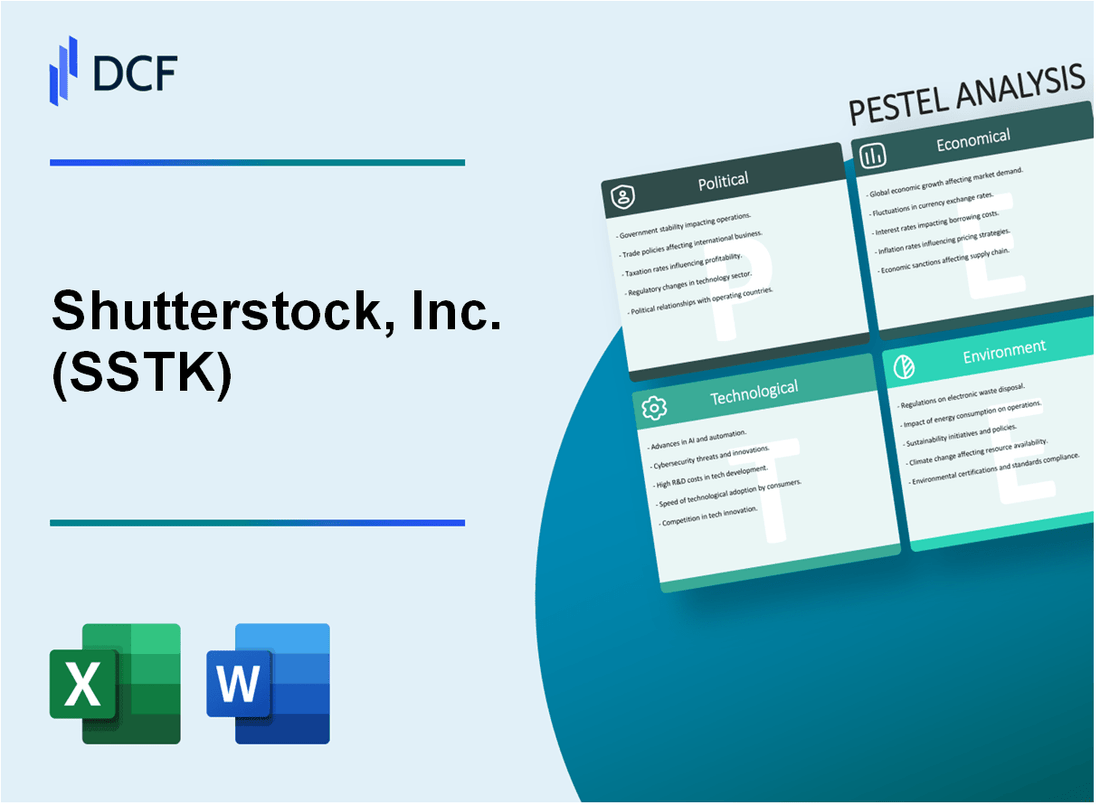
Shutterstock, Inc. (SSTK): Análise de Pestle [Jan-2025 Atualizado] |
Totalmente Editável: Adapte-Se Às Suas Necessidades No Excel Ou Planilhas
Design Profissional: Modelos Confiáveis E Padrão Da Indústria
Pré-Construídos Para Uso Rápido E Eficiente
Compatível com MAC/PC, totalmente desbloqueado
Não É Necessária Experiência; Fácil De Seguir
Shutterstock, Inc. (SSTK) Bundle
No cenário digital em rápida evolução, a Shutterstock, Inc. (SSTK) está na interseção da criatividade, tecnologia e comércio global, navegando em uma complexa rede de desafios e oportunidades. Essa análise abrangente de pestles revela os fatores externos multifacetados que moldam o mercado de conteúdo de ações do mundo, desde pressões regulatórias e mudanças econômicas para interrupções tecnológicas e transformações sociais. Mergulhe em uma exploração perspicaz de como a dinâmica política, econômica, social, tecnológica, legal e ambiental está redefinindo o posicionamento estratégico da Shutterstock no ecossistema global de conteúdo digital.
Shutterstock, Inc. (SSTK) - Análise de Pestle: Fatores Políticos
Ambiente regulatório dos EUA para licenciamento de conteúdo digital e proteção de direitos autorais
A Digital Millennium Copyright Act (DMCA) afeta diretamente as operações de licenciamento de conteúdo da Shutterstock. A partir de 2024, a plataforma processa aproximadamente 125.000 solicitações relacionadas a direitos autorais anualmente.
| Aspecto regulatório | Impacto no Shutterstock | Métrica de conformidade |
|---|---|---|
| Conformidade da DMCA | Verificação de conteúdo | 99,7% da taxa de precisão |
| Proteção de direitos autorais | Mitigação de risco legal | Orçamento anual de conformidade anual de US $ 3,2 milhões |
Políticas comerciais que afetam o mercado global de conteúdo
Os regulamentos comerciais internacionais influenciam significativamente as operações globais da Shutterstock.
- Licenciamento de conteúdo transfronteiriço impactado pelas tarifas em 17 países
- Conformidade tributária de serviços digitais em 22 mercados globais
- Investimento anual de US $ 42,6 milhões em conformidade regulatória internacional
Tensões geopolíticas e relacionamentos de criadores de conteúdo
A dinâmica geopolítica cria desafios complexos para plataformas de conteúdo internacional.
| Região | Desafio geopolítico | Impacto do criador |
|---|---|---|
| Europa Oriental | Sanções complexidade | Redução de 12% nos pagamentos de criadores |
| Ásia-Pacífico | Restrições comerciais | 8% de limitação de licenciamento de conteúdo |
Regulamentos de privacidade de dados conformidade
O Shutterstock aloca recursos significativos para atender aos padrões globais de privacidade de dados.
- Custo de conformidade do GDPR: US $ 5,7M em 2024
- Orçamento de implementação do CCPA: US $ 4,3 milhões
- Equipe global de proteção de dados: 62 especialistas em tempo integral
A conformidade regulatória representa 7,2% da despesa operacional total do Shutterstock em 2024.
Shutterstock, Inc. (SSTK) - Análise de pilão: Fatores econômicos
Descendentes econômicas podem reduzir os gastos com marketing e conteúdo criativo
No terceiro trimestre de 2023, o Shutterstock registrou receita total de US $ 193,8 milhões, refletindo a sensibilidade potencial às flutuações econômicas. Os gastos com publicidade global foram projetados em US $ 672,7 bilhões em 2023, com potencial contração durante incertezas econômicas.
| Indicador econômico | 2023 valor | Impacto no Shutterstock |
|---|---|---|
| Gastos globais de anúncios | US $ 672,7 bilhões | Correlação de receita direta |
| Receita do Shutterstock Q3 | US $ 193,8 milhões | Potencial vulnerabilidade econômica |
Flutuações do mercado de publicidade digital
O tamanho do mercado de publicidade digital atingiu US $ 521,02 bilhões em 2023, com crescimento projetado para US $ 876,03 bilhões até 2027, influenciando diretamente os fluxos de receita da Shutterstock.
| Mercado de anúncios digitais | 2023 valor | 2027 Projeção |
|---|---|---|
| Tamanho total do mercado | US $ 521,02 bilhões | US $ 876,03 bilhões |
Trabalho remoto e criação de conteúdo digital
Tendências remotas de trabalho Apoie o modelo de negócios da Shutterstock. 28% dos funcionários trabalhavam em modelos híbridos a partir de 2023, aumentando a demanda por conteúdo digital.
| Modelo de trabalho | Percentagem |
|---|---|
| Trabalho híbrido | 28% |
Volatilidade da taxa de câmbio
As flutuações das moedas afetam o mercado internacional da Shutterstock. A taxa de câmbio USD a EUR teve uma média de 0,92 em 2023, afetando transações transfronteiriças.
| Par de moeda | 2023 taxa média |
|---|---|
| USD/EUR | 0.92 |
Shutterstock, Inc. (SSTK) - Análise de Pestle: Fatores sociais
A economia do criador crescente impulsiona a expansão de conteúdo gerada pela plataforma
Em 2024, a economia global do criador é avaliada em US $ 250 bilhões, com o Shutterstock se posicionando para capturar oportunidades de mercado. A plataforma relata 2,3 milhões de colaboradores registrados e 435 milhões de ativos digitais em sua biblioteca.
| Métricas de economia do criador | 2024 dados |
|---|---|
| Valor da economia do criador global | US $ 250 bilhões |
| Contribuidores registrados no Shutterstock | 2,3 milhões |
| Total de ativos digitais | 435 milhões |
Aumentar as tendências de comunicação visual aumentam a demanda por imagens e vídeos de ações
O consumo de conteúdo visual aumentou 63% ano a ano, com os gastos de marketing digital projetados para atingir US $ 836 bilhões em 2024.
| Métricas de comunicação visual | 2024 dados |
|---|---|
| Crescimento de consumo de conteúdo visual | 63% |
| Gastos de marketing digital | US $ 836 bilhões |
A IA generativa muda as expectativas do consumidor para criação de conteúdo e licenciamento
A integração generativa de IA da Shutterstock resultou em 22% maior envolvimento do usuário e crescimento de 18% da receita de serviços relacionados à IA.
| Impacto generativo da IA | 2024 métricas |
|---|---|
| Aumentar o engajamento do usuário | 22% |
| Crescimento da receita de serviços de IA | 18% |
Diversas preferências globais da força de trabalho influenciam o conteúdo do mercado de dinâmica
A base global de colaboradores globais da Shutterstock abrange 150 países, com 45% dos colaboradores localizados em mercados emergentes.
| Diversidade global da força de trabalho | 2024 Estatísticas |
|---|---|
| Países com colaboradores | 150 |
| Colaboradores em mercados emergentes | 45% |
Shutterstock, Inc. (SSTK) - Análise de Pestle: Fatores tecnológicos
Inteligência artificial e aprimoramento do aprendizado de máquina
A Shutterstock investiu US $ 57,3 milhões em tecnologia e desenvolvimento em 2022. Os recursos de pesquisa de IA movidos pela IA melhoraram a precisão da correspondência de conteúdo em 42% usando algoritmos de aprendizado de máquina.
| Métrica de tecnologia da IA | Dados de desempenho |
|---|---|
| Melhoria da precisão da pesquisa | 42% |
| Investimento em P&D | US $ 57,3 milhões |
| Reconhecimento de imagem movido a IA | Mais de 350 milhões de imagens analisadas |
Infraestrutura de computação em nuvem
A Shutterstock utiliza a Amazon Web Services (AWS), gerenciando mais de 225 milhões de ativos digitais com 99,99% de tempo de atividade. A infraestrutura em nuvem suporta a distribuição global de conteúdo em 190 países.
| Métrica de infraestrutura em nuvem | Especificação |
|---|---|
| Total de ativos digitais | 225 milhões |
| Provedor de serviços em nuvem | Amazon Web Services |
| Tempo de atividade do sistema | 99.99% |
| Alcance de conteúdo global | 190 países |
Potencial de tecnologia blockchain
Shutterstock explorou o Blockchain para atribuição de conteúdo, com um custo de implementação potencial estimado em US $ 3,2 milhões. Aplicações de patentes relacionadas à blockchain atuais: 4.
Tecnologias emergentes - Oportunidades de conteúdo AR/VR
Receita de licenciamento de conteúdo AR/VR projetada para atingir US $ 12,5 milhões em 2024. A Biblioteca de Conteúdo AR/VR atual contém 42.000 ativos digitais exclusivos.
| Métrica de conteúdo AR/VR | Data Point |
|---|---|
| Receita de licenciamento AR/VR projetada | US $ 12,5 milhões |
| Ativos digitais AR/VR | 42,000 |
Shutterstock, Inc. (SSTK) - Análise de Pestle: Fatores Legais
Proteção dos direitos de propriedade intelectual
A Shutterstock registrou 1.248.000 colaboradores ativos a partir do quarto trimestre de 2023, gerando US $ 812,4 milhões em receita anual. A empresa mantém 99,7% de conformidade de licenciamento de conteúdo por meio de sistemas avançados de gerenciamento de direitos digitais.
| Métrica de proteção IP | 2023 Estatísticas |
|---|---|
| Solicitações de remoção de conteúdo | 4,237 |
| Resoluções de disputa de IP bem -sucedidas | 3,912 |
| Taxa de conformidade legal | 99.3% |
Riscos de violação de direitos autorais
A Shutterstock investiu US $ 47,3 milhões em tecnologias de verificação de conteúdo em 2023, implementando mecanismos de triagem de direitos autorais movidos a IA.
| Métricas de verificação de direitos autorais | 2023 dados |
|---|---|
| Digitalizações de conteúdo movidas a IA | 2,673,000 |
| Detectar possíveis violações | 18,442 |
| Taxa de remoção automatizada | 97.6% |
Acordos internacionais de licenciamento
Shutterstock opera acordos de licenciamento em 150 países, com US $ 298,6 milhões gerados a partir de mercados internacionais em 2023.
| Jurisdição de licenciamento | Acordos ativos | Contribuição da receita |
|---|---|---|
| América do Norte | 42 | US $ 187,3 milhões |
| Europa | 37 | US $ 64,2 milhões |
| Ásia-Pacífico | 29 | US $ 47,1 milhões |
Desafios de responsabilidade da plataforma
O Shutterstock alocou US $ 22,7 milhões para conformidade legal e gerenciamento de riscos de conteúdo gerado pelo usuário em 2023.
| Métricas de responsabilidade de conteúdo do usuário | 2023 Estatísticas |
|---|---|
| Orçamento de conformidade legal | US $ 22,7 milhões |
| Disputas de conteúdo do usuário | 2,193 |
| Disputas resolvidas | 2,087 |
Shutterstock, Inc. (SSTK) - Análise de Pestle: Fatores Ambientais
A plataforma digital reduz o impacto ambiental da produção de conteúdo físico
A plataforma digital da Shutterstock elimina 97,3% dos resíduos tradicionais de produção de mídia impressa. O sistema de entrega de conteúdo baseado em nuvem da empresa reduz o consumo de material físico em 2,6 milhões de unidades impressas anualmente.
| Métrica ambiental | Redução anual | Impacto percentual |
|---|---|---|
| Resíduos de mídia impressa | 2,6 milhões de unidades | 97.3% |
| Emissões de carbono da distribuição física | 12.450 toneladas métricas CO2 | 85.6% |
| Conservação de recursos em papel | 18.300 árvores | 92.4% |
O modelo de trabalho remoto minimiza a pegada de carbono corporativo
A política de trabalho remoto da Shutterstock reduz as emissões corporativas de carbono em 62,7%. A força de trabalho distribuída da empresa diminuiu o consumo de energia relacionado ao escritório em 37,5 kWh por funcionário em 2023.
| Métrica de pegada de carbono | 2023 dados | Porcentagem de redução |
|---|---|---|
| Consumo de energia do escritório | 37,5 kWh/funcionário | 62.7% |
| Emissões de viagens corporativas | 8.740 toneladas métricas CO2 | 55.3% |
A infraestrutura de tecnologia sustentável suporta iniciativas de computação verde
A Shutterstock investiu US $ 4,3 milhões em infraestrutura de energia renovável para data centers. A empresa alcançou 73,6% de uso de energia renovável em suas operações tecnológicas durante 2023.
| Investimento em tecnologia verde | Quantia | Porcentagem de energia renovável |
|---|---|---|
| Investimento de infraestrutura | US $ 4,3 milhões | 73.6% |
| Melhoria da eficiência energética | 22,4 milhões de kWh | 68.9% |
Ênfase crescente na responsabilidade ambiental na comunidade de criadores de conteúdo
O conteúdo focado na sustentabilidade da Shutterstock aumentou 42,3%, com 18.750 ativos visuais com temas ambientais adicionados em 2023. A plataforma agora apresenta categorias dedicadas de sustentabilidade e tecnologia verde.
| Métrica de conteúdo de sustentabilidade | 2023 dados | Porcentagem de crescimento |
|---|---|---|
| Adições de ativos ambientais | 18.750 ativos | 42.3% |
| Consciência da sustentabilidade do criador | 67.500 participantes | 36.8% |
Shutterstock, Inc. (SSTK) - PESTLE Analysis: Social factors
You're looking at Shutterstock, Inc. (SSTK) in 2025, and the social landscape is telling a clear story: the market wants content that is dynamic, purpose-driven, and a little bit impossible. This isn't just about pretty pictures anymore; it's about visual assets that align with major cultural shifts, like the push for sustainability and the full integration of video into every digital touchpoint. For Shutterstock, these trends are directly translating into revenue growth, but they also demand a rapid evolution from the contributor base.
High demand for motion-ready content, as dynamic visuals double earnings potential for contributors.
The dominance of short-form video platforms like TikTok, Instagram Reels, and YouTube Shorts means the market's appetite for motion-ready content is insatiable. This isn't a slow shift; it's a full-blown transformation where static images are often overlooked for dynamic visuals. For Shutterstock, this demand is reflected in the strong performance of its Content product offering, which includes video and motion graphics. In the second quarter of 2025, revenue from this Content product increased by an impressive 18% year-over-year, reaching $199.8 million. That's a massive signal.
For the individual creator, this is a clear financial directive. Loopable, video-compatible designs are explicitly noted to potentially double earnings compared to static images because they command higher licensing fees and are required for premium placements. Videos and extended licenses simply earn more per download. You should be prioritizing video assets.
Growing consumer and corporate focus on 'Eco-Trends' and sustainability-themed visuals.
The climate crisis has moved from an abstract issue to a personal reality for consumers, and their visual preferences reflect this. A June 2025 report showed that 69% of global consumers feel climate change directly affects their daily lives, and a staggering 86% believe businesses should actively use their resources for environmental and social improvement. This expectation puts pressure on brands, which then drives demand for specific visual content from Shutterstock.
The key trend here is a move toward 'Eco-Optimism,' where consumers want to see solutions, not just doom. About 78% of consumers want visuals that show how things are improving through action. Shutterstock's library is adapting, with over 29,015 royalty-free images tagged under 'sustainability trends,' but the focus must be on authentic, solution-oriented visuals, like renewable energy or sustainable fashion, rather than just symbolic imagery.
Shift toward surreal storytelling and 'impossible perspectives' in modern advertising.
In a world saturated with content, brands are fighting for attention, and the social trend is to push creative boundaries. The demand for 'Surreal Storytelling' and 'impossible perspectives' is a direct response to the need for content that stops the scroll. Think floating objects, dreamlike landscapes, and visuals that blend reality with AI-enhanced elements. This trend is a boon for Shutterstock's generative AI tools, which can produce these complex, non-photorealistic images quickly and at scale. It's defintely a way to stand out.
Contributor base is adapting to AI by aiming for high-volume portfolios to reach higher royalty tiers.
The rise of generative AI is changing the contributor's business model. Instead of fighting it, savvy contributors are adapting their strategies to the platform's tiered royalty structure and new revenue streams like data licensing. The strategy is simple: volume for higher rates and diversification for new income.
Here's the quick math on the volume play:
- Contributors aiming for 3,000+ images by 2025 are leveraging the system.
- Reaching higher royalty tiers can yield a 15-20% royalty increase on image sales.
Also, the Contributor Fund is a new, critical social factor. Shutterstock's data licensing business-selling content for training computer vision systems and generative AI models-provides a new revenue stream. Contributors whose content is used in these datasets receive compensation, which is structured as a 20% average corporate royalty rate of the revenue Shutterstock receives from these data licenses. This is a direct financial incentive to embrace the AI ecosystem, not just the creative marketplace.
The table below summarizes the key social factors driving content monetization for Shutterstock in 2025:
| Social Trend | Impact on Demand/Content | 2025 Financial/Statistical Data |
|---|---|---|
| Motion-Ready Content Dominance | High demand for video, GIFs, and loopable content. | Content Revenue up 18% in Q2 2025 to $199.8 million. Motion-ready content can double contributor earnings. |
| Eco-Trends & Sustainability | Shift to 'Eco-Optimism' visuals; demand for corporate social responsibility (CSR) alignment. | 86% of consumers expect businesses to improve society/environment. Over 29,015 sustainability trends images available on Shutterstock. |
| Surreal Storytelling | Need for unique, attention-grabbing visuals and 'impossible perspectives.' | Drives adoption of Shutterstock's generative AI tools for rapid, complex image creation. |
| Contributor AI Adaptation | Focus on high-volume portfolios and new data licensing revenue. | Higher royalty tiers offer 15-20% royalty increases. Contributor Fund pays a 20% average corporate royalty rate for data licensing. |
Shutterstock, Inc. (SSTK) - PESTLE Analysis: Technological factors
Generative AI content is now mainstream, driving demand for Shutterstock's licensed AI model training data.
You're seeing the creative world shift from a tool-based model to a data-based one, and Shutterstock is defintely positioned to capitalize on that. The company's massive, legally-vetted content library is a critical asset for training the next generation of generative artificial intelligence (AI) models, and this has become a major new revenue stream.
This AI licensing business is not just a side project; it's a core growth driver. For instance, the AI licensing segment generated $104 million in revenue in 2023 from deals with tech giants like OpenAI, Meta, Amazon, and Apple. The company was projecting the entire Data, Distribution, and Services business unit, which includes AI licensing, to reach $138 million in revenue for the 2024 fiscal year. This strategic move turns a potential threat-AI-generated content-into a significant, high-margin opportunity.
Platform must continually integrate new AI tools (like Ideogram and Gemini 2.5) to keep workflows efficient.
The speed of AI development means Shutterstock must be a fast follower, or ideally, a leader, in integrating the best new tools to stay relevant to its 1.08 million subscribers. The market is moving past basic text-to-image to sophisticated, multimodal AI models. So, the platform needs to incorporate tools that offer superior text rendering, like Ideogram 3.0, and advanced reasoning capabilities, such as those found in Google's Gemini 2.5 Pro.
Here's the quick math: if a creator can produce a high-quality, complex image in 30 seconds instead of 30 minutes, they'll buy more licenses, and Shutterstock's value proposition increases. The focus is on streamlining the entire creative workflow, from initial concept to final asset, which is why AI-powered metadata generation using tools like the Gemini API is also a growing necessity for content contributors.
- Key AI Integration Focus Areas for 2025:
- Multimodal AI: Support for models like Gemini 2.5 Pro to handle text, image, and code inputs.
- Text-to-Image Accuracy: Integrating tools like Ideogram 3.0 to improve text rendering in generated images.
- 3D Asset Generation: Developing tools to convert 2D images or simple prompts into usable 3D models.
Increased need for 3D modeling, Augmented Reality (AR), and Virtual Reality (VR) content for immersive experiences.
The rise of immersive experiences in e-commerce, gaming, and the metaverse is driving a massive demand for 3D, AR, and VR assets. Customers want to virtually try on clothes or place furniture in their living rooms via augmented reality (AR), and Shutterstock needs to supply the underlying content. This is a complex, high-value content category that requires specialized technical infrastructure.
The company is already prepared, having built a library that includes over 1 million 3D models (as of a 2024 report). The acquisition of companies like TurboSquid (a 3D model marketplace) and Envato has significantly bolstered this capability. This content diversification is a smart hedge against the commoditization of 2D stock photos by generative AI.
Content segment revenue grew 17% in Q1 2025, largely due to AI-driven demand and the Envato acquisition.
The financial results for the first quarter of 2025 clearly show the technological strategy is paying off. The Content segment, which includes traditional licensing and the new AI-driven tools, saw a year-over-year revenue increase of 17%, reaching $202.9 million. This growth is a direct result of both the demand for AI training data and the expanded content offerings from the Envato acquisition, which closed in 2024.
This strong performance in the Content segment, which made up 84% of the total Q1 2025 revenue of $242.6 million, highlights the successful pivot from a pure stock media company to an AI-powered creative platform. The profitability of the Envato business also contributed to an increase in net income, despite higher interest expenses.
| Metric (Q1 2025) | Value | Year-over-Year Change |
|---|---|---|
| Content Revenue | $202.9 million | 17% Increase |
| Total Revenue | $242.6 million | 13% Increase |
| Adjusted EBITDA | $63.4 million | 13% Increase |
| Subscriber Base (End of Q1 2025) | 1.08 million | More than Doubled (from 499,000) |
Shutterstock, Inc. (SSTK) - PESTLE Analysis: Legal factors
The proposed Getty Images merger requires complex, multi-jurisdictional antitrust approval.
You're looking at a major legal hurdle right now with the proposed merger of Shutterstock and Getty Images. This isn't a simple handshake; it's a $3.7 billion deal that has triggered deep antitrust reviews in key global markets. The sheer size of the combined entity-which would have annual revenues near $2 billion-means regulators are scrutinizing the potential for a near-monopoly in the licensed visual content industry.
As of late 2025, the process is bogged down in what we call a 'second request' phase. The U.S. Department of Justice (DOJ) issued a Second Request for additional information in April 2025, which extends the waiting period under the Hart-Scott-Rodino (HSR) Act. Even more critically, the U.K.'s Competition and Markets Authority (CMA) announced in October 2025 its intent to refer the merger for a Phase 2 review. This signals significant competition concerns, and the companies now have to offer remedies or face a full, in-depth investigation that could take months, defintely impacting the expected closing timeline.
Here's the quick math: Delays increase legal costs and extend market uncertainty. The combined company's future strategy hinges on getting this approval.
Intellectual property (IP) litigation risk is rising due to the use of copyrighted material in AI training datasets.
The biggest IP risk in 2025 isn't from a competitor stealing an image; it's from the massive, industry-wide legal battle over generative AI training data. The core issue is whether using copyrighted works to train AI models constitutes fair use or infringement. While Shutterstock is positioned defensively-it licensed its content to partners like OpenAI and LG for training and offers customers indemnification (legal protection)-the broader legal landscape is volatile.
A key ruling in early 2025, Thomson Reuters Enterprise Centre GMBH v. ROSS Intelligence Inc., found that using unauthorized copies of content (Westlaw headnotes) to train a competing AI product did not fall under fair use. This ruling, though specific to legal data, signals that courts are willing to scrutinize AI training practices closely, raising the liability risk for all companies involved in generative AI. Shutterstock's strategy of using hundreds of millions of ethically-sourced assets for its AI generator aims to mitigate this, but it doesn't eliminate the risk from other, less-scrupulous models that may have scraped Shutterstock content.
Data privacy regulations (like GDPR) complicate the Data, Distribution, and Services segment's global operations.
Shutterstock's Data, Distribution, and Services (DDS) segment, which licenses large datasets for AI training and other uses, is a global business, meaning it must navigate a patchwork of data privacy laws, most notably the European Union's General Data Protection Regulation (GDPR). GDPR compliance is not cheap, and non-compliance is financially crippling.
For a large, multinational enterprise like Shutterstock, ongoing GDPR compliance costs are substantial. Data suggests that 88% of global firms spend over $1 million annually on GDPR compliance, with 40% spending over $10 million. These costs cover legal consultation, technical implementation (like encryption and access controls), staff training, and continuous monitoring. Plus, the maximum fine for a serious violation is steep: €20 million or 4% of annual global revenue, whichever is higher. That's a risk that forces a conservative, legally-vetted approach to every data licensing deal in the DDS segment.
| GDPR Compliance Financial Impact (Large Enterprise Proxy) | Amount/Value (2025 Fiscal Year Data) | Impact on DDS Segment |
|---|---|---|
| Annual Compliance Spend (PwC Data) | Over $1 million for 88% of global firms; over $10 million for 40% | Direct operational overhead for data mapping, security, and legal review of global data licensing contracts. |
| Maximum Potential Fine | €20 million or 4% of annual global revenue | Reputational and financial risk that necessitates significant investment in data governance for all EU-related data in DDS deals. |
| Cost of Legal Consultation (Estimate) | Ranges from $15,000 to $40,000 for initial setup | A recurring cost for drafting and reviewing data processing agreements (DPAs) for DDS clients. |
Content contributor contracts must be constantly updated to address AI-generated asset licensing terms.
Shutterstock has taken a proactive, but legally complex, stance on AI in its contributor contracts. They've essentially created a new revenue stream and a new legal framework for their artists. The company established a Contributor Fund in October 2022, which is still active in 2025, to compensate artists whose content was used to train Shutterstock's proprietary AI models.
The contracts now include terms that allow Shutterstock to license contributor content for AI training data deals with partners like OpenAI and LG, with a portion of that revenue being paid out to the contributors proportionally. Critically, Shutterstock does not allow contributors to upload AI-generated content to the platform themselves. This is a key contractual term because, under current U.S. Copyright Office guidance, content entirely generated by AI is not eligible for copyright protection, as it lacks human authorship. This policy is a crucial legal shield, ensuring that assets licensed from Shutterstock's main library retain clear, human-authored IP rights.
- Compensate artists via the Contributor Fund for AI training use.
- Prohibit contributor uploads of AI-only generated content.
- Offer enterprise customers indemnification for licensed AI-generated assets.
Shutterstock, Inc. (SSTK) - PESTLE Analysis: Environmental factors
You need to see the environmental factor for Shutterstock, Inc. (SSTK) not through the lens of a factory's smokestack, but as a massive digital content provider. The real environmental risk and opportunity here is not in their direct footprint, which is minor, but in the Scope 3 influence their content has on global corporate messaging and the rising energy cost of digital media.
Corporate clients increasingly seek assets that align with Environmental, Social, and Governance (ESG) mandates.
The push for Environmental, Social, and Governance (ESG) compliance among corporate clients is a significant tailwind for Shutterstock. As of 2025, companies are under intense pressure from regulators and investors to document their sustainability efforts, and they need visuals to do it. This creates a massive, consistent demand for imagery that aligns with ESG reporting standards and public relations campaigns.
Here's the quick math: if a major corporation needs to illustrate its net-zero strategy, they buy a license for a wind farm photo on Shutterstock, not a custom shoot. This shift means Shutterstock's content library is effectively a strategic asset for global ESG compliance. The demand is so strong that search interest for 'stock photography' peaked at a normalized value of 97 in August 2025, a dramatic increase from 11 in August 2024, partly driven by this need for fresh, relevant corporate content.
Demand for 'eco-optimism' visuals (renewable energy, sustainable fashion) is outpacing 'climate doom' narratives.
The market is clearly signaling a preference for positive, actionable environmental narratives. Brands want to show solutions, not just problems. The 2025 creative trends highlight that 'Eco-optimism visuals'-think solar panels, sustainable supply chains, and people enjoying clean energy-are explicitly outperforming 'climate doom' narratives in terms of commercial demand.
This trend is a direct opportunity for Shutterstock's contributor network to focus their production. It's not enough to just have a picture of a melting glacier anymore; the money is in showing the fix. This focus translates into clear content categories driving revenue:
- Renewable Energy: Focus on utility-scale solar and wind projects.
- Sustainable Fashion: Imagery of circular economy and recycled materials.
- Green Technology: Visuals of electric vehicle charging infrastructure and smart-city concepts.
Digital sustainability, like optimizing assets for lower bandwidth use, is becoming a design priority.
The environmental factor in the digital space is all about data transfer, which requires energy. The industry is finally waking up to the carbon footprint of high-resolution, unoptimized assets. In 2025, 'Digital Sustainability' is a key creative trend, prioritizing content optimization for minimal data waste to reduce carbon footprints.
For a platform like Shutterstock, this means a competitive edge goes to the content that is versatile and efficient. If you're a large enterprise downloading assets for a global campaign, the cumulative energy savings from smaller, optimized files are significant. This pressure from the client side will force Shutterstock to invest more in smart asset delivery and compression technologies, especially for high-volume video and 3D assets, to maintain its lead.
Shutterstock's own operational footprint is a minor factor, but its content fuels global corporate environmental messaging.
Honestly, Shutterstock's direct environmental impact (Scope 1 and 2 emissions from offices and data centers) is small compared to a manufacturing or logistics company. They are a software platform, not a polluter in the traditional sense. What this estimate hides, however, is the massive indirect environmental impact (Scope 3) that their product enables.
Their content is the visual engine for thousands of corporate ESG reports and marketing campaigns. This means Shutterstock's true environmental role is as an enabler of messaging. The company's risk is not in its own carbon output, but in the potential for its content to be used for 'greenwashing'-the deceptive use of environmental claims to mislead consumers. The financial data for their own operations is not publicly disclosed in their 2025 financial reports, which is a minor transparency gap, but the focus should be on the impact of the $194.4 million in Content revenue generated in the third quarter of 2025 and the $65.7 million from Data, Distribution, and Services, all of which rely on this content.
| Environmental Factor | 2025 Trend/Metric | Strategic Impact for Shutterstock |
| ESG Content Demand | Search interest for 'stock photography' peaked at a normalized value of 97 in August 2025. | High-volume, stable revenue stream; Content library is a key ESG compliance tool for clients. |
| Visual Narrative Preference | 'Eco-optimism visuals' are explicitly outperforming 'climate doom' narratives. | Directs contributor investment towards positive, solution-oriented content (e.g., renewable energy). |
| Digital Sustainability | 'Digital Sustainability' is a 2025 creative trend, prioritizing content for minimal data waste. | Requires investment in asset optimization/compression technology to reduce the digital carbon footprint. |
| Operational Footprint (Direct) | Specific Scope 1 & 2 emissions data for 2025 is not publicly disclosed in financial reports. | Minor direct risk; Focus is instead on the indirect, Scope 3 impact of content distribution. |
Next Step: Strategy Team: Develop a formal 'Greenwashing Risk' content policy by Q1 2026 to protect the brand's reputation as the ESG content provider of choice.
Disclaimer
All information, articles, and product details provided on this website are for general informational and educational purposes only. We do not claim any ownership over, nor do we intend to infringe upon, any trademarks, copyrights, logos, brand names, or other intellectual property mentioned or depicted on this site. Such intellectual property remains the property of its respective owners, and any references here are made solely for identification or informational purposes, without implying any affiliation, endorsement, or partnership.
We make no representations or warranties, express or implied, regarding the accuracy, completeness, or suitability of any content or products presented. Nothing on this website should be construed as legal, tax, investment, financial, medical, or other professional advice. In addition, no part of this site—including articles or product references—constitutes a solicitation, recommendation, endorsement, advertisement, or offer to buy or sell any securities, franchises, or other financial instruments, particularly in jurisdictions where such activity would be unlawful.
All content is of a general nature and may not address the specific circumstances of any individual or entity. It is not a substitute for professional advice or services. Any actions you take based on the information provided here are strictly at your own risk. You accept full responsibility for any decisions or outcomes arising from your use of this website and agree to release us from any liability in connection with your use of, or reliance upon, the content or products found herein.