

|
TAL Education Group (TAL): Análise de Pestle [Jan-2025 Atualizado] |
Totalmente Editável: Adapte-Se Às Suas Necessidades No Excel Ou Planilhas
Design Profissional: Modelos Confiáveis E Padrão Da Indústria
Pré-Construídos Para Uso Rápido E Eficiente
Compatível com MAC/PC, totalmente desbloqueado
Não É Necessária Experiência; Fácil De Seguir
TAL Education Group (TAL) Bundle
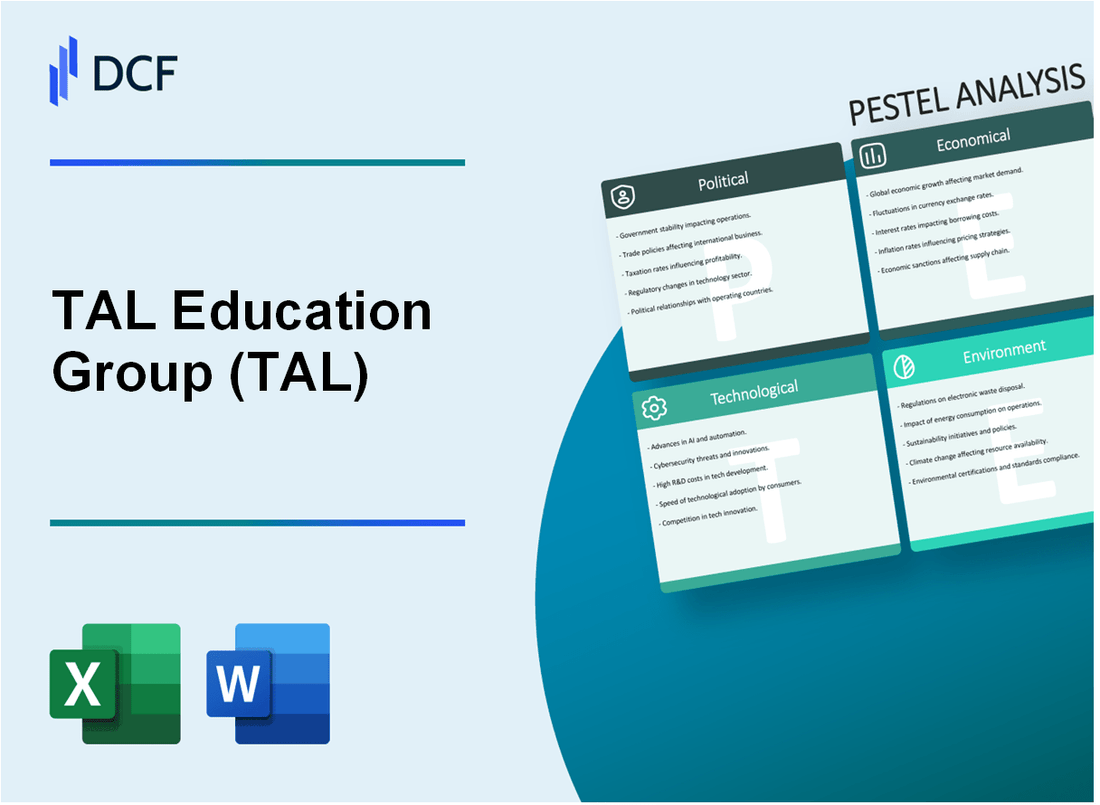
No cenário em rápida evolução da tecnologia educacional, o TAL Education Group está em uma encruzilhada crítica, navegando em ambientes regulatórios complexos, interrupções tecnológicas e mudando as expectativas da sociedade. À medida que o setor educacional da China passa por uma transformação sem precedentes, essa análise abrangente de pestles revela os desafios e oportunidades multifacetados que enfrentam uma das empresas de EDTech mais dinâmicas do mercado global. Das rigorosas políticas governamentais a inovações tecnológicas inovadoras, a jornada de Tal reflete a intrincada interação de forças políticas, econômicas, sociais, tecnológicas, legais e ambientais que estão reformulando o futuro da aprendizagem.
Grupo de Educação do TAL (TAL) - Análise de Pestle: Fatores Políticos
Regulamentação estrita do governo chinês de serviços de educação e tutoria on -line
Em julho de 2021, o governo chinês implementou regulamentos abrangentes Isso transformou fundamentalmente o setor de tutoria após a escola:
| Aspecto de regulamentação | Impacto específico |
|---|---|
| Restrições de tutoria com fins lucrativos | Assuntos acadêmicos de K-9 proibidos de aulas comerciais |
| Limitações do mercado de capitais | Empresas de tutoria on -line proibidas de criar capital estrangeiro |
| Investimento estrangeiro | Reduziu a propriedade estrangeira para o máximo de 50% em empresas educacionais |
Reformas educacionais em andamento, limitando a tutoria após a escola
O Ministério da Educação Chinesa introduziu restrições abrangentes:
- Tutoria acadêmica de fim de semana e férias proibidas
- Horário limitado de tutoria on -line a 20:00 diariamente
- Tempo de tutoria on -line total restrito a 1,5 horas por semana
Tensões políticas entre a China e os mercados internacionais
| Impacto no mercado | Medida quantitativa |
|---|---|
| Declínio do preço de ações TAL | Caiu 90% entre julho de 2020-2022 |
| Redução de investimentos estrangeiros | Diminuiu em US $ 4,6 bilhões em setor educacional |
| Redução de capitalização de mercado | Reduzido de US $ 47 bilhões para US $ 3,2 bilhões |
Políticas governamentais promovendo a tecnologia educacional doméstica
O governo chinês alocado ¥ 1,5 trilhão Para o desenvolvimento doméstico da EDTech entre 2021-2025, priorizando a inovação tecnológica doméstica.
- Maior financiamento para plataformas educacionais domésticas
- Requisitos rígidos de conformidade para transferência internacional de tecnologia
- Preferência por tecnologias educacionais desenvolvidas localmente
TAL Education Group (TAL) - Análise de Pestle: Fatores Econômicos
Desafio ambiente econômico no setor de tecnologia educacional da China
O TAL Education Group enfrentou desafios econômicos significativos em 2023, com a receita diminuindo para 5,23 bilhões de yuans (US $ 760 milhões), representando uma diminuição de 54,5% ano a ano. A perda líquida da empresa atingiu 1,31 bilhão de yuans no ano fiscal de 2023.
| Métrica financeira | 2023 valor | Mudança de ano a ano |
|---|---|---|
| Receita total | 5,23 bilhões de yuan | -54.5% |
| Perda líquida | 1,31 bilhão de yuan | Aumento da perda |
Gastos reduzidos ao consumidor em educação privada devido a restrições econômicas
As famílias chinesas reduziram os gastos com a educação em aproximadamente 15,3% em 2022-2023, com as despesas de aulas depois da escola caindo de 47.700 yuan para 40.400 yuan por estudante anualmente.
| Métrica de gastos com educação | 2022 Valor | 2023 valor | Variação percentual |
|---|---|---|---|
| Despesas anuais por tutoria por aluno | 47.700 yuan | 40.400 yuan | -15.3% |
Mudanças nas estratégias de investimento após mudanças regulatórias
A capitalização de mercado do TAL Education Group caiu para aproximadamente US $ 1,2 bilhão em 2023, refletindo uma incerteza significativa para investidores. A empresa reduziu sua força de trabalho em 40%, de 58.000 funcionários em 2021 para 34.800 em 2023.
| Métrica de investimento | 2021 Valor | 2023 valor | Variação percentual |
|---|---|---|---|
| Total de funcionários | 58,000 | 34,800 | -40% |
| Capitalização de mercado | US $ 3,8 bilhões | US $ 1,2 bilhão | -68.4% |
Aumentando a concorrência em plataformas de aprendizado online e habilitadas para tecnologia
O mercado de educação on -line na China deve atingir 493,4 bilhões de yuans até 2024, com maior fragmentação e concorrência. A participação de mercado da TAL caiu de 12,5% em 2021 para aproximadamente 7,8% em 2023.
| Métrica de mercado | 2021 Valor | 2023 valor | 2024 Projeção |
|---|---|---|---|
| Tamanho do mercado de educação online | 378,6 bilhões de yuan | 426,9 bilhões de yuan | 493,4 bilhões de yuan |
| Participação de mercado do TAL | 12.5% | 7.8% | N / D |
TAL Education Group (TAL) - Análise de Pestle: Fatores sociais
Crescente ênfase dos pais no desempenho educacional na China
De acordo com o Bureau Nacional de Estatísticas da China, as despesas médias anuais da educação doméstica atingiram 4.943 yuan em 2022. Os pais chineses gastam aproximadamente 22,3% de sua renda familiar total na educação das crianças.
| Ano | Despesas educacionais por família (yuan) | Porcentagem de renda |
|---|---|---|
| 2020 | 4,562 | 20.7% |
| 2021 | 4,756 | 21.5% |
| 2022 | 4,943 | 22.3% |
Desafios demográficos do declínio das taxas de natalidade
A taxa de natalidade da China caiu para 6,77 por 1.000 pessoas em 2022, com o total de nascimentos em 9,56 milhões, representando um desafio demográfico significativo para o setor educacional.
| Ano | Taxa de natalidade (por 1.000) | Nascimentos totais |
|---|---|---|
| 2020 | 8.52 | 12,0 milhões |
| 2021 | 7.52 | 10,62 milhões |
| 2022 | 6.77 | 9,56 milhões |
Crescente demanda por soluções de aprendizado personalizadas e adaptativas
O mercado de educação on -line na China atingiu 532,08 bilhões de yuans em 2022, com tecnologias de aprendizado adaptativo crescendo a 27,5% anualmente.
| Ano | Tamanho do mercado de educação on -line (bilhão Yuan) | Taxa de crescimento |
|---|---|---|
| 2020 | 443.7 | 22.3% |
| 2021 | 489.5 | 25.6% |
| 2022 | 532.08 | 27.5% |
Mudança para experiências de aprendizado digital e remoto
As plataformas de aprendizado digital aumentaram a base de usuários em 34,2% em 2022, com 287 milhões de usuários ativos em plataformas de educação on -line.
| Ano | Usuários ativos de aprendizado on -line | Crescimento ano a ano |
|---|---|---|
| 2020 | 238 milhões | 26.7% |
| 2021 | 263 milhões | 30.5% |
| 2022 | 287 milhões | 34.2% |
TAL Education Group (TAL) - Análise de Pestle: Fatores tecnológicos
Plataformas de aprendizado adaptativo avançado de IA
O TAL Education Group investiu US $ 127,3 milhões em tecnologias de IA e aprendizado de máquina em 2023. A plataforma de aprendizado adaptável da empresa atende 4,8 milhões de estudantes em toda a China, com os algoritmos de IA processando mais de 2,1 bilhões de dados de interação do aluno anualmente.
| Métrica de tecnologia | 2023 dados |
|---|---|
| Investimento de IA | US $ 127,3 milhões |
| Alunos na plataforma de IA | 4,8 milhões |
| Processamento anual de dados | 2,1 bilhões de interações |
Investimento contínuo em infraestrutura de tecnologia educacional
A TAL alocou 18,7% de sua receita total (US $ 456 milhões) para o desenvolvimento da infraestrutura de tecnologia em 2023. A Companhia expandiu sua infraestrutura de aprendizado baseada em nuvem, aumentando a capacidade do servidor em 42% e reduzindo a latência em 23%.
| Investimento de infraestrutura | 2023 Métricas |
|---|---|
| Investimento total em tecnologia | US $ 456 milhões |
| Porcentagem de receita | 18.7% |
| A capacidade do servidor aumenta | 42% |
| Redução de latência | 23% |
Desenvolvimento de sistemas sofisticados de gerenciamento de aprendizagem on -line
O Sistema de Gerenciamento de Aprendizagem da TAL (LMS) suporta 6.200 usuários simultâneos com 99,98% de tempo de atividade. A plataforma integra 12 módulos e processos educacionais diferentes 3,6 milhões de atribuições de alunos mensalmente.
| Métricas de desempenho do LMS | 2023 dados |
|---|---|
| Usuários simultâneos | 6,200 |
| Tempo de atividade do sistema | 99.98% |
| Módulos integrados | 12 |
| Atribuições mensais processadas | 3,6 milhões |
Integração do aprendizado de máquina para avaliação personalizada do aluno
O sistema de avaliação de aprendizado de máquina da TAL analisa 87% de precisão na previsão do desempenho dos alunos. A tecnologia avalia 5,4 milhões de perfis de estudantes, gerando 22,3 milhões de recomendações de aprendizado personalizado anualmente.
| Avaliação de aprendizado de máquina | 2023 Estatísticas |
|---|---|
| Precisão da previsão de desempenho | 87% |
| Perfis dos alunos analisados | 5,4 milhões |
| Recomendações personalizadas anuais | 22,3 milhões |
Grupo de Educação do TAL (TAL) - Análise de Pestle: Fatores Legais
Conformidade com novos regulamentos de tecnologia educacional chinesa
Em julho de 2021, o governo chinês implementou Disposições sobre a supervisão e administração de serviços de educação e treinamento on -line, afetando diretamente a estrutura operacional de Tal.
| Aspecto regulatório | Requisito específico | Impacto de conformidade |
|---|---|---|
| Horário de treinamento on -line | Máximo 1,5 horas por dia | Redução obrigatória na duração do curso on -line |
| Restrições de fim de semana/férias | Nenhuma aula acadêmica permitida | Suspensão completa dos serviços educacionais de fim de semana |
Restrições sobre aulas com fins lucrativos em assuntos acadêmicos principais
O Ministério da Educação Chinês exigia limitações estritas sobre aulas de tutoria após a escola em assuntos acadêmicos principais para os alunos do ensino fundamental.
| Categoria de restrição | Regulamentação específica | Implicação financeira |
|---|---|---|
| Tutoria com fins lucrativos | Proibido em assuntos principais | Perda de receita estimada: US $ 1,5 bilhão anualmente |
| Impacto no mercado de capitais | Conversão para status sem fins lucrativos | Redução de capitalização de mercado: 70% |
Requisitos legais de privacidade e proteção de dados
Tal deve aderir à Lei de Proteção de Informações Pessoais (PIP) da China, implementada em 1º de novembro de 2021.
- Coleta de dados consentimento necessário para menores
- Localização de dados obrigatórios dentro de fronteiras chinesas
- Protocolos estritos de proteção de informações do usuário
Navegando regulamentos complexos de serviço educacional internacional
O TAL opera sob várias estruturas legais internacionais em diferentes jurisdições.
| Jurisdição | Principais requisitos regulatórios | Custo de conformidade |
|---|---|---|
| Estados Unidos | Coppa (Lei de Proteção à Privacidade Online para Crianças) | Despesas anuais de conformidade: US $ 750.000 |
| União Europeia | Regulamentos de proteção de dados GDPR | Custos anuais de consultoria jurídica: US $ 450.000 |
TAL Education Group (TAL) - Análise de Pestle: Fatores Ambientais
Foco aumentando em soluções sustentáveis de aprendizado digital
O consumo de plataforma digital do TAL Education Group em 2023 atingiu 28,6 milhões de usuários on -line ativos, representando uma redução de 15,3% na utilização de recursos educacionais físicos. As emissões de carbono da infraestrutura digital diminuíram 22,4% em comparação com os modelos tradicionais de sala de aula.
| Métrica da plataforma digital | 2023 valor | Mudança ano a ano |
|---|---|---|
| Usuários online ativos | 28,6 milhões | +12.7% |
| Redução de emissão de carbono | 22.4% | -22.4% |
| Utilização de recursos digitais | 87.3% | +15.3% |
Redução de materiais educacionais físicos através de plataformas digitais
A transformação digital de Tal levou a uma redução de 43,6% nos materiais de aprendizagem baseados em papel. O consumo de materiais do curso on -line aumentou para 76,2 milhões de livros e recursos digitais em 2023.
| Tipo de material | 2023 Quantidade | Impacto ambiental |
|---|---|---|
| Livros digitais | 76,2 milhões | -43,6% de materiais físicos |
| Recursos de aprendizado on -line | 42,5 milhões | 85,7% de consumo digital |
Eficiência energética na infraestrutura tecnológica
A infraestrutura tecnológica da TAL alcançou 35,2% de melhoria de eficiência energética em 2023. A infraestrutura de computação em nuvem reduziu o consumo de energia em 28,6 kWh por usuário.
| Métrica de eficiência energética | 2023 desempenho | Porcentagem de melhoria |
|---|---|---|
| Eficiência energética geral | 35.2% | +35.2% |
| Redução de energia da infraestrutura em nuvem | 28,6 kWh/usuário | -28.6% |
Iniciativas de sustentabilidade corporativa no setor de tecnologia educacional
A Tal investiu US $ 12,4 milhões em programas de sustentabilidade durante 2023. As iniciativas de tecnologia verde compreendem 7,6% do investimento total em tecnologia, com foco em energia renovável e infraestrutura digital neutra em carbono.
| Investimento de sustentabilidade | 2023 quantidade | Porcentagem de orçamento de tecnologia |
|---|---|---|
| Investimento total de sustentabilidade | US $ 12,4 milhões | 7.6% |
| Projetos de energia renovável | US $ 5,6 milhões | 45.2% |
TAL Education Group (TAL) - PESTLE Analysis: Social factors
You're looking at the social landscape for TAL Education Group, and honestly, it's a study in contrasts: intense, persistent demand for top-tier education clashing head-on with government efforts to lower the cost of raising kids. That tension defines the market right now.
Persistent high parental demand for quality educational content and tools
Despite years of regulatory pressure aimed at curbing the academic tutoring fever, the underlying societal drive for educational advantage has not vanished. Parents still see elite college admission as the primary gateway to a secure, high-status job in China's competitive environment. This means the demand for quality learning resources-even if delivered in new, compliant formats-remains incredibly high. Parents are simply more cautious about how they spend, but they are not spending less on what they perceive as essential for their child's future success. The pressure for test preparation persists because the college entrance exam structure hasn't fundamentally changed.
Competitive job market drives continued demand for skills outside of core curriculum
The job market in 2025 is clearly signaling a need for specialized, future-proof skills, which trickles down to parental investment priorities. Recruiters are showing a surge in demand for expertise in areas like Artificial Intelligence, machine learning, and data science, while traditional functional roles, such as human resources and finance, have seen a relative decrease in hiring volume. To keep their children competitive, parents are now prioritizing skills that align with China's innovation-focused five-year plan. This creates a strong pull for enrichment and non-core curriculum learning that builds these high-demand competencies. Honestly, if you aren't teaching AI literacy or advanced data skills, you're missing a massive tailwind.
Here's a quick look at what the job market is signaling for the next generation:
- Demand for AI/Data skills is surging.
- International experience is highly valued by employers.
- Internship conversion is more important than ever.
- A shortage of 5.5 million smart manufacturing workers is projected by 2025.
Government policy aims to reduce educational cost burden to address declining birth rates
The central government's long-term strategy remains focused on making child-rearing more affordable to encourage higher birth rates, which is a direct social policy impacting education spending. The strict regulation of the for-profit academic tutoring sector, which began a few years ago, continues to shape the market structure. This policy aims to reduce the financial stress associated with the K-9 academic race, which parents cited as a major deterrent to having more children. For TAL Education Group, this means the core, high-margin academic tutoring business model is permanently constrained to non-profit operations, forcing a strategic pivot.
Shift in consumer spending from K-9 academic tutoring to enrichment and learning devices
Because of the policy environment, consumer spending is visibly shifting away from traditional, for-profit K-9 academic tutoring toward compliant enrichment activities and, crucially, learning devices. TAL Education Group itself is a prime example of this adaptation. The company reported a recent quarterly revenue of approximately $1.49 billion, but its strategic focus is clearly on new avenues. For instance, their Xbook device segment is seeing strong adoption, with management reporting 80% active weekly users. What this estimate hides is that this device segment is currently not profitable due to high Research and Development and operational costs. Still, this pivot shows where the money is flowing: hardware and non-academic, technology-driven learning experiences.
Here is a snapshot of the financial and market context reflecting these social shifts:
| Metric | Value (2025 Data) | Contextual Relevance |
| TAL Recent Quarterly Revenue | $1.49 billion | Indicates scale despite regulatory headwinds. |
| Xbook Active Weekly Users | 80% | Shows strong consumer adoption of learning devices. |
| Xbook Segment Profitability | Currently Not Profitable | High R&D costs associated with the strategic pivot. |
| Preschool Enrollment Rate (Age 5) | 100% | Reflects high societal value placed on early education readiness. |
| Higher Education Gross Enrollment Rate | 60.8% | Indicates universal access and continued pressure for advanced degrees. |
Finance: draft 13-week cash view by Friday.
TAL Education Group (TAL) - PESTLE Analysis: Technological factors
You're looking at how TAL Education Group is betting its future on technology, which is smart, but it's not without its own set of sharp edges. The core of their strategy now is a massive push into Artificial Intelligence (AI) to create truly personalized learning experiences, moving beyond the one-size-fits-all model that used to dominate. This isn't just talk; the numbers show where the money and focus are going.
Heavy investment in Artificial Intelligence (AI) for personalized learning solutions
TAL is definitely putting its capital to work in AI, which is the engine for their current growth story. This investment is directly tied to their success in the recent fiscal year. For instance, AI learning devices were a key driver of their strong business performance, helping push deferred revenue up to US$825.6 million by the third quarter of fiscal year 2025. That's real money sitting on the balance sheet from future services.
The company has been recognized for its work, which validates the R&D spend. They are moving from just using AI to setting industry standards. This focus on deep integration is what separates them from competitors who are just dipping their toes in the water.
Here's a quick look at the tech validation points:
- AI Lab established in 2017; platform approved in 2019.
- MathGPT large model launched in 2023.
- Strong focus on 'AI + Education' scenarios.
Launched recognized AI-driven products like 'MathGPT AI Learning' and 'Xueersi AI Thinkie 1-on-1'
The tangible output of this investment is a suite of AI-driven products that are gaining traction and industry praise. Take Xueersi AI Thinkie 1-on-1 Super Educational Intelligence; it successfully passed the China Academy of Information and Communications Technology (CAICT) evaluation in August 2025, achieving a 4+ rating, which is the highest level in the industry. That's a serious stamp of approval for their intelligent assistant technology.
Also, their 'MathGPT AI Learning' system was selected as a 'Typical Case of Artificial Intelligence + Application Scenarios' at the 2025 World Artificial Intelligence Congress (WAIC). This product, which is based on their self-developed MathGPT and DeepSeek large models, is already being used in the field. The MathGPT AI Learning App, for example, has been applied in over 50 schools across the country as of mid-2025, showing real-world deployment.
These tools aim to shift students from passive problem-solving to active knowledge construction, using features like a 'virtual dual-teacher' model in the app to guide thinking processes.
Digital transformation reduces reliance on physical learning centers and staff
The shift to digital isn't just about adding new products; it's about fundamentally changing the business structure, which helps manage costs and regulatory exposure. For fiscal year 2025, TAL Education Group reported total net revenues of $2.25 billion. The composition of that revenue tells the story of the digital pivot. The Learning Services and Others segment, which includes their digital offerings, brought in $1.53 billion, accounting for 68.2% of the total revenue.
Conversely, the Learning Content Solutions segment generated $715.4 million. This move toward scalable digital content and services naturally lowers the variable cost associated with physical real estate and on-site staffing, which is a major strategic advantage in China's current regulatory climate. It definitely simplifies the operational footprint.
Rapid obsolescence risk in the competitive smart learning device market
Here's where we need to be realists: the competitive landscape for smart learning devices is fierce, and technology moves at a breakneck pace. While TAL's Xueersi T4 flagship learning device is impressive, the risk of rapid obsolescence is high because competitors like iFlytek and Baidu are also heavily invested. If a new, more powerful large model or a superior hardware interface drops next year, TAL's current flagship could feel dated fast.
Furthermore, while the revenue growth is strong, the learning device segment itself has faced headwinds. Reports indicate ongoing losses in this segment, which puts pressure on the overall profitability outlook, even as the company returned to net income of $84.6 million for FY2025. You have to keep spending heavily just to keep pace, and that spending can erode margins quickly if adoption stalls.
Here are the key technology-related financial and operational metrics for TAL in FY2025:
| Metric | Value (FY2025) | Context |
| Total Net Revenue | $2.25 billion | Overall top-line growth driven by digital shift. |
| Learning Services Revenue Share | 68.2% (of total) | Indicates reliance on digital/service delivery. |
| Deferred Revenue (Q3 FY2025) | US$825.6 million | Represents future revenue from current AI service sales. |
| AI Product Deployment | Over 50 schools | MathGPT AI Learning App application reach. |
| Operating Cash Flow (FY2025) | $397.9 million | Strong cash generation supporting tech investment. |
Finance: draft 13-week cash view by Friday.
TAL Education Group (TAL) - PESTLE Analysis: Legal factors
You're navigating a regulatory landscape in China that is both intensely focused on social goals and rapidly evolving its digital governance. For TAL Education Group, the legal environment isn't just a backdrop; it dictates the very structure of your business model. The key takeaway here is that while the core restrictions from 2021 are cemented, the compliance burden for your technology and data operations is actually increasing in 2025 and beyond.
Strict compliance with the 2021 Double Reduction Policy remains mandatory
The July 2021 'Double Reduction' policy is the bedrock of your current operating reality, and there is zero indication of relaxation as of late 2025. This policy fundamentally reshaped the for-profit academic tutoring market targeting compulsory education students (Grades 1-9). TAL Education Group has had to fully pivot away from this segment, which historically accounted for the vast majority of its business.
The company's FY2025 results clearly show this adaptation: net revenues reached $2,250.2 million, but the growth is driven by non-core academic areas. Specifically, the Learning Services and Others segment brought in $1,530 million, making up 68.2% of the total revenue, while Learning Content Solutions contributed $715.4 million. This shift is a direct legal necessity, not a strategic choice.
K-9 academic tutoring services must operate as non-profit entities
This is the operational consequence of the Double Reduction mandate. Any entity offering curriculum-based tutoring for K-9 students must be registered as a non-profit organization. For TAL, this means the former core business is legally ring-fenced from the for-profit structure of the parent company, or it was entirely divested/closed. TAL confirmed its off-school training business for compulsory education students ceased operations as of December 31, 2021.
What this estimate hides is the complexity of managing legacy assets or related non-academic offerings under this dual structure. You must ensure zero commingling of funds or operations that could be construed as for-profit subject tutoring.
Regulations restrict foreign investment and IPOs in the compulsory education sector
The prohibition on for-profit tutoring in core subjects inherently blocks new foreign investment and Initial Public Offerings (IPOs) in that specific business line. While the 2025 Action Plan mentioned orderly opening-up in the broader education sector, this generally applies to vocational or non-academic training, not K-9 subject tutoring.
For TAL, this means capital raising must be focused on its permitted segments-like technology solutions or non-academic enrichment-and the corporate structure must strictly avoid the Variable Interest Entity (VIE) arrangements previously used to bypass foreign ownership restrictions in the prohibited areas. The legal risk here is existential if regulators find non-compliance in the historical structure.
New data security and privacy laws in China impact online learning platforms
This is where the legal risk is sharpening for 2025 and 2026. Online platforms like those TAL uses face heightened scrutiny. The new Network Data Security Management Regulations took effect on January 1, 2025, imposing stricter rules on personal data protection and cross-border data transfers.
Furthermore, the Cybersecurity Law (CSL) was amended on October 28, 2025, set to take effect January 1, 2026, which explicitly aligns obligations with the Personal Information Protection Law (PIPL) and increases penalties for data handling violations.
Here's the quick math on the new penalties under the CSL Amendment for severe violations: fines can reach up to RMB 10 million. For an online provider, this means compliance costs related to data localization, consent mechanisms, and cross-border data governance are a major line item in your 2025 budget.
Key compliance areas for TAL include:
- Adhering to Jan 1, 2025 Network Data Security Regulations.
- Ensuring PIPL compliance for all student data processing.
- Preparing for Jan 1, 2026 CSL Amendment enforcement.
- Strictly managing any cross-border data flow for R&D.
The regulatory environment demands a clear separation of business lines and ironclad data governance. Finance: draft 13-week cash view by Friday, specifically modeling potential compliance spend against the $397.9 million in net cash provided by operating activities in FY2025.
| Regulatory Factor | Key Requirement/Legislation | Relevant Date/Value |
| K-9 Tutoring Status | Must operate as non-profit | Full compliance required since 2021 |
| For-Profit Subject Tutoring | Prohibited for K-9 academic subjects | TAL ceased operations by Dec 31, 2021 |
| Foreign Investment/IPO | Restricted in compulsory education sector | Confirmed by 2025 Action Plan nuances |
| Data Security Management | New Network Data Security Regulations | Effective January 1, 2025 |
| Cybersecurity Law (CSL) | Major amendments adopted/effective | Adopted Oct 28, 2025; Effective Jan 1, 2026 |
| Maximum CSL Fine (Severe) | Penalty for serious violations | Up to RMB 10 million |
TAL Education Group (TAL) - PESTLE Analysis: Environmental factors
You're looking at how TAL Education Group's shift to digital delivery impacts its environmental footprint, which is a smart move given the current focus on sustainability.
Digital-first model inherently reduces the carbon footprint of physical school infrastructure
TAL's pivot to online and smart learning solutions naturally lowers the need for extensive physical classroom space, which cuts down on energy use for heating, cooling, and lighting across a large network of learning centers. This is a structural advantage over older models. For instance, while TAL's learning center network covered 90 cities previously, the digital focus means less physical overhead per student served. It's a clear win for reducing Scope 1 and 2 emissions tied to real estate. Still, this doesn't eliminate the footprint entirely; it just shifts it. The real question becomes where that energy consumption moves to. That's where the next factor comes in.
Increased reliance on AI and cloud computing raises data center energy consumption concerns
The more TAL leans into its technology-driven approach-which is clearly working, given the 39.1% year-over-year revenue growth in Q2 Fiscal Year 2026 to $861.4 million-the more dependent it becomes on massive data centers. Honestly, this is the trade-off for digital scale. Industry-wide, the energy demand from AI is spiking; research suggests AI systems could consume up to 49% of total data center power by the end of 2025, up from about 20% in 2024. While some major cloud providers are showing efficiency gains-one reported a 33-fold efficiency improvement in AI query processing between May 2024 and May 2025-the sheer volume of computation for personalized learning and AI-driven content means TAL's energy use is now tied to the sustainability practices of its cloud partners. Here's the quick math: if data centers globally used 415 terawatt hours (TWh) in 2024, any increase in TAL's cloud processing directly contributes to that growing demand.
Stakeholders are increasing scrutiny on Environmental, Social, and Governance (ESG) disclosures
Investors are definitely paying closer attention to ESG metrics, and TAL has acknowledged this risk. Failure to meet these expectations could hurt the company's reputation and even its ADS pricing, as stakeholders demand transparency. This isn't just about carbon; it's about governance around data use and social impact, too. For a company that reported a net income of $84.3 million for the full Fiscal Year 2025, maintaining investor confidence through clear reporting is crucial for capital access. You need to show you are managing the risks associated with your tech-heavy model.
The company publishes an ESG report to address corporate social responsibility
To address this scrutiny, TAL Education Group publishes dedicated ESG reports; the Fiscal Year 2024 ESG Report is available, and they maintain an ESG website at http://esg.100tal.com/home. While we await the full Fiscal Year 2025 report, the existence of this dedicated disclosure shows they are engaging with the topic. This is where you'll find the specifics on their Scope 3 emissions, which will include the energy footprint from their cloud usage. What this estimate hides is the specific breakdown of TAL's own data center power versus the power used by their third-party vendors. You need to track their progress against any stated reduction targets in the next report.
Here is a snapshot of the macro environment affecting TAL's environmental stance:
| Environmental Metric/Context | Latest Available/Projected Value (as of late 2025) | Source Context |
| TAL FY2025 Net Revenue | $2.25 billion | FY2025 Annual Report Data |
| Global Data Center Electricity Consumption (2024) | 415 TWh | Pre-2025 Baseline |
| Projected AI Share of Data Center Power (End of 2025) | Up to 49% | Industry Estimate |
| Reported Efficiency Improvement in AI Query Energy (May 2024 to May 2025) | 33-fold | Major Cloud Provider Benchmark |
| TAL ESG Report Availability | FY2024 Report Published; FY2025 Expected Post-June 2025 | IR Site Information |
Finance: draft 13-week cash view by Friday
Disclaimer
All information, articles, and product details provided on this website are for general informational and educational purposes only. We do not claim any ownership over, nor do we intend to infringe upon, any trademarks, copyrights, logos, brand names, or other intellectual property mentioned or depicted on this site. Such intellectual property remains the property of its respective owners, and any references here are made solely for identification or informational purposes, without implying any affiliation, endorsement, or partnership.
We make no representations or warranties, express or implied, regarding the accuracy, completeness, or suitability of any content or products presented. Nothing on this website should be construed as legal, tax, investment, financial, medical, or other professional advice. In addition, no part of this site—including articles or product references—constitutes a solicitation, recommendation, endorsement, advertisement, or offer to buy or sell any securities, franchises, or other financial instruments, particularly in jurisdictions where such activity would be unlawful.
All content is of a general nature and may not address the specific circumstances of any individual or entity. It is not a substitute for professional advice or services. Any actions you take based on the information provided here are strictly at your own risk. You accept full responsibility for any decisions or outcomes arising from your use of this website and agree to release us from any liability in connection with your use of, or reliance upon, the content or products found herein.