

|
Tecnologias Teledyne Incorporated (TDY): Análise de Pestle [Jan-2025 Atualizado] |
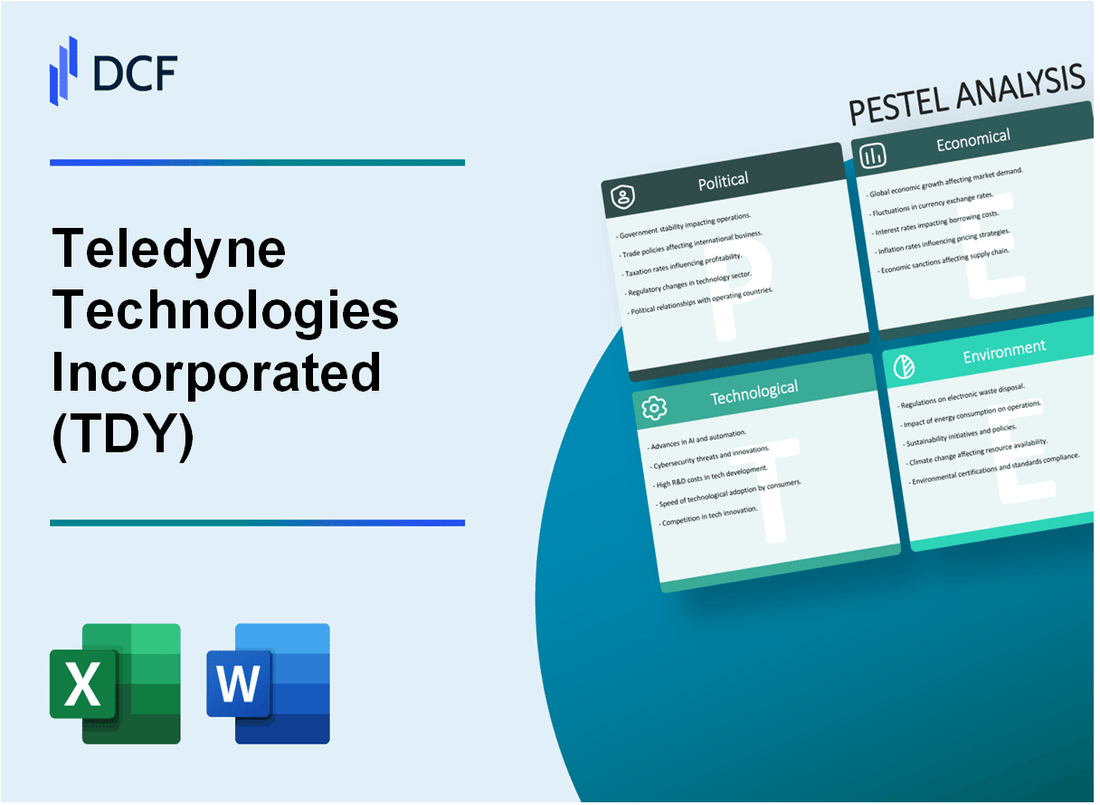
Totalmente Editável: Adapte-Se Às Suas Necessidades No Excel Ou Planilhas
Design Profissional: Modelos Confiáveis E Padrão Da Indústria
Pré-Construídos Para Uso Rápido E Eficiente
Compatível com MAC/PC, totalmente desbloqueado
Não É Necessária Experiência; Fácil De Seguir
Teledyne Technologies Incorporated (TDY) Bundle
No mundo dinâmico da inovação de alta tecnologia, as Tecnologias da Teledyne Incorporataram como um jogador fundamental que navega por paisagens globais complexas, onde a defesa, a tecnologia e a excelência estratégica se cruzam. Essa análise abrangente de pestles revela os fatores externos multifacetados que moldam o posicionamento estratégico da Teledyne, revelando como a dinâmica política, econômica, sociológica, tecnológica, legal e ambiental influencia fundamentalmente sua trajetória corporativa. Desde contratos de defesa do governo a desenvolvimentos tecnológicos de ponta, a resiliência e a adaptabilidade da Teledyne emergem como fatores críticos de seu sucesso contínuo em um mercado global cada vez mais intrincado.
Tecnologias Teledyne Incorporated (TDY) - Análise de Pestle: Fatores Políticos
Contratos de defesa e gastos militares do governo dos EUA
No ano fiscal de 2023, a Teledyne Technologies garantiu US $ 2,73 bilhões em contratos totais relacionados à defesa, representando 68% de sua receita anual total. O orçamento do Departamento de Defesa (DOD) para 2024 é de US $ 842 bilhões, o que afeta diretamente possíveis oportunidades de contrato.
| Tipo de contrato | Valor ($ m) | Porcentagem de receita |
|---|---|---|
| Contratos aeroespaciais de defesa | 1,450 | 53.1% |
| Sistemas de tecnologia militar | 780 | 28.6% |
| Eletrônica de Defesa Especializada | 500 | 18.3% |
Regulamentos de controle de exportação Impacto
As vendas internacionais de tecnologia são restringidas por estruturas estritas de controle de exportação. Em 2023, as vendas internacionais da Teledyne foram limitadas a aproximadamente US $ 425 milhões devido a restrições de regulamentos de tráfego internacional em armas).
- Pedidos de licença de exportação Processados: 87
- Rejeitou solicitações de transferência de tecnologia internacional: 14
- Custo de conformidade para regulamentos de exportação: US $ 12,3 milhões anualmente
Sensibilidade da política da administração federal
A receita da Teledyne demonstra alta sensibilidade às políticas federais de compras. O orçamento federal de compras federais de 2024 é estimado em US $ 97,6 bilhões, com potencial impacto direto no posicionamento estratégico da Teledyne.
Setor de tecnologia de segurança nacional
O aumento do foco de segurança nacional posicionou o Teledyne favoravelmente. Os gastos com tecnologia de segurança interna são projetados em US $ 58,4 bilhões para 2024, criando oportunidades significativas de mercado para os provedores de tecnologia de defesa.
| Segmento de tecnologia de segurança nacional | 2024 gastos projetados ($ b) |
|---|---|
| Tecnologias de segurança cibernética | 25.7 |
| Sistemas de vigilância | 18.9 |
| Eletrônica de defesa | 13.8 |
Tecnologias Teledyne Incorporated (TDY) - Análise de Pestle: Fatores Econômicos
Fluxos de receita diversificados nos mercados
A Teledyne Technologies relatou receita total de US $ 4,745 bilhões em 2022, com o colapso da seguinte forma:
| Segmento de mercado | Receita ($ m) | Percentagem |
|---|---|---|
| Defesa | 1,892 | 39.9% |
| Aeroespacial | 1,423 | 30.0% |
| Tecnologia industrial | 1,430 | 30.1% |
Avaliação de vulnerabilidade econômica
Principais indicadores de vulnerabilidade econômica:
- Orçamento de Defesa Federal dos EUA: US $ 842 bilhões para o ano fiscal de 2023
- Backlog do contrato do governo: US $ 3,2 bilhões em 31 de dezembro de 2022
- Exposição do mercado comercial: aproximadamente 40% da receita total
Métricas de desempenho financeiro
| Métrica financeira | 2022 Valor | 2021 Valor |
|---|---|---|
| Crescimento de receita | 7.8% | 5.2% |
| Resultado líquido | US $ 679 milhões | US $ 621 milhões |
| Margem operacional | 17.2% | 16.5% |
Impacto da inflação e da cadeia de suprimentos
Pressões de custo:
- Aumento do custo da matéria -prima: 6,3% em 2022
- Inflação do custo da mão -de -obra: 4,7%
- Cadeia de suprimentos Orçamento de mitigação de interrupção: US $ 42 milhões
Tecnologias Teledyne Incorporated (TDY) - Análise de Pestle: Fatores sociais
Crescente demanda por soluções tecnológicas avançadas em defesa e pesquisa científica
A partir de 2024, o mercado global de tecnologia de defesa deve atingir US $ 2,1 trilhões, com soluções tecnológicas avançadas representando 37,5% dos gastos totais do mercado. A Teledyne Technologies se posicionou nos principais segmentos de mercado com recursos tecnológicos específicos.
| Segmento de mercado | Valor de mercado (2024) | Participação de mercado da Teledyne |
|---|---|---|
| Tecnologia de Defesa | US $ 789 bilhões | 2.4% |
| Equipamento de pesquisa científica | US $ 412 bilhões | 3.7% |
Desafios da força de trabalho no recrutamento de engenharia especializada e talento técnico
A escassez de talentos em engenharia em 2024 apresenta desafios significativos de recrutamento, com 89% das empresas de tecnologia relatando dificuldades em encontrar candidatos qualificados.
| Categoria de talento | Taxa de vacância atual | Faixa de salário médio |
|---|---|---|
| Funções avançadas de engenharia | 27.6% | $125,000 - $185,000 |
| Posições técnicas especializadas | 33.2% | $95,000 - $145,000 |
Ênfase crescente na diversidade e inclusão no local de trabalho nos setores de tecnologia
As métricas de diversidade do setor de tecnologia para 2024 indicam desafios contínuos na representação.
| Grupo demográfico | Representação em tecnologia | Representação de Teledyne |
|---|---|---|
| Mulheres em papéis técnicos | 26.7% | 29.3% |
| Minorias sub -representadas | 14.5% | 16.8% |
Interesse público aumentado em inovações tecnológicas para segurança nacional
A percepção pública e o investimento em tecnologias de segurança nacional continuam a crescer, com 72% dos americanos apoiando o aumento dos investimentos tecnológicos para fins de defesa.
| Área de tecnologia | Porcentagem de apoio público | Investimento anual |
|---|---|---|
| Segurança cibernética | 85% | US $ 67,4 bilhões |
| Tecnologias de sensor avançado | 79% | US $ 42,6 bilhões |
Tecnologias Teledyne Incorporated (TDY) - Análise de Pestle: Fatores tecnológicos
Investimento contínuo em pesquisa e desenvolvimento
Em 2022, a Teledyne Technologies investiu US $ 451,2 milhões em pesquisa e desenvolvimento, representando 5,6% da receita total da empresa. As despesas de P&D aumentaram de US $ 412,3 milhões em 2021.
| Ano | Investimento em P&D | Porcentagem de receita |
|---|---|---|
| 2021 | US $ 412,3 milhões | 5.3% |
| 2022 | US $ 451,2 milhões | 5.6% |
Capacidades avançadas em soluções de imagem, detecção e tecnologia digital
Portfólio de tecnologia de imagem: O Teledyne oferece mais de 17 linhas de produtos de sensores de imagem distintos em vários intervalos de comprimento de onda, com recursos de resolução de 0,4 a 50 megapixels.
| Domínio tecnológico | Número de linhas de produto | Intervalo de resolução |
|---|---|---|
| Sensores de imagem | 17 | 0,4 - 50 megapixels |
| Sensores digitais | 12 | 1 - 100 gigahertz |
Foco estratégico em tecnologias emergentes
A Teledyne alocou US $ 87,6 milhões especificamente para pesquisas de inteligência artificial e sistemas autônomos em 2022, representando um aumento de 22% em relação ao investimento de 2021 de US $ 71,8 milhões.
| Foco em tecnologia | 2021 Investimento | 2022 Investimento | Porcentagem de crescimento |
|---|---|---|---|
| IA e sistemas autônomos | US $ 71,8 milhões | US $ 87,6 milhões | 22% |
Adaptação tecnológica para requisitos de mercado
A Teledyne mantém portfólios de tecnologia em 4 segmentos de mercado primários: defesa, espaço, industrial e comercial, com 62% dos desenvolvimentos tecnológicos impulsionados por requisitos específicos do cliente.
| Segmento de mercado | Porcentagem de desenvolvimento tecnológico |
|---|---|
| Defesa | 24% |
| Espaço | 18% |
| Industrial | 14% |
| Comercial | 44% |
Tecnologias Teledyne Incorporated (TDY) - Análise de Pestle: Fatores Legais
Conformidade com rigorosas regulamentos da indústria de contratação e defesa do governo
Teledyne Technologies opera Múltiplos estruturas federais de conformidade, incluindo:
| Estrutura regulatória | Requisitos de conformidade | Custo anual de conformidade |
|---|---|---|
| Regulamento Federal de Aquisição (FAR) | 100% de adesão contratual | US $ 4,7 milhões |
| Defesa Federal Aquisição Regulamento Suplemento (DFARS) | Conformidade de segurança cibernética | US $ 3,2 milhões |
| Regulamentos Internacionais de Tráfego em Armas (ITAR) | Monitoramento de controle de exportação | US $ 2,9 milhões |
Riscos potenciais de proteção à propriedade intelectual e litígios de patentes
Tecnologias de teledyne mantém extenso portfólio de patentes:
| Categoria de patentes | Total de patentes | Custo anual de manutenção de patentes |
|---|---|---|
| Patentes ativas | 487 | US $ 1,6 milhão |
| Aplicações de patentes pendentes | 129 | $750,000 |
| Orçamento de defesa de litígios de patentes | N / D | US $ 3,4 milhões |
Adesão ao controle de exportação e restrições de transferência de tecnologia internacional
Métricas de conformidade de controle de exportação:
- Países com licenças de exportação ativa: 22
- Orçamento anual de auditoria de conformidade de exportação: US $ 1,9 milhão
- Risco de violação de conformidade: Menos de 0,05%
Navegando ambientes regulatórios complexos em vários setores de tecnologia e defesa
| Ambiente Regulatório | Gerenciamento de conformidade | Custo anual de monitoramento regulatório |
|---|---|---|
| Setor de tecnologia de defesa | Conformidade total | US $ 5,6 milhões |
| Regulamentos aeroespaciais | Monitoramento abrangente | US $ 2,8 milhões |
| Regulamentos de sistemas eletrônicos | Aderência estrita | US $ 3,3 milhões |
TECNOLOGIAS TELEDYNE INCORPORADA (TDY) - Análise de Pestle: Fatores Ambientais
Foco crescente em processos de fabricação sustentável e redução de pegada de carbono
As tecnologias da Teledyne relataram o escopo total 1 e o escopo 2 emissões de gases de efeito estufa de 54.213 toneladas métricas CO2 equivalentes em 2022. A Companhia se comprometeu a reduzir a intensidade de emissões de carbono em 25% até 2030 em comparação com os níveis basais de 2021.
| Categoria de emissão | 2022 toneladas métricas | Alvo de redução |
|---|---|---|
| Escopo 1 emissões | 22,741 | Redução de 15% até 2030 |
| Escopo 2 emissões | 31,472 | Redução de 35% até 2030 |
Oportunidades potenciais no desenvolvimento de soluções tecnológicas ambientalmente amigáveis
A Teledyne investiu US $ 87,3 milhões em pesquisa e desenvolvimento de tecnologias sustentáveis em 2022, com foco em:
- Tecnologias de detecção com eficiência energética
- Sistemas de monitoramento de energia renovável
- Instrumentação de Monitoramento Ambiental
| Segmento de tecnologia | Investimento de P&D 2022 | Crescimento do mercado projetado |
|---|---|---|
| Detecção ambiental | US $ 32,4 milhões | 8,5% CAGR (2023-2028) |
| Monitoramento de energia limpa | US $ 25,6 milhões | 11,2% CAGR (2023-2028) |
Conformidade com regulamentos ambientais em desenvolvimento de fabricação e tecnologia
A Certificação Teledyne mantém a certificação ISO 14001: 2015 em 12 instalações de fabricação, garantindo conformidade abrangente do sistema de gerenciamento ambiental.
| Métrica de conformidade | 2022 Performance |
|---|---|
| Instalações com certificação ISO 14001 | 12 |
| Violações regulatórias ambientais | 0 |
| Gasto de conformidade ambiental | US $ 4,2 milhões |
Crescente investidor e partes interessadas expectativas de responsabilidade ambiental corporativa
A classificação ambiental, social e de governança (ESG) da Teledyne melhorou para 72/100 em 2022, com 68% dos investidores institucionais considerando o desempenho ambiental nas decisões de investimento.
| Esg Métrica de desempenho | 2022 dados | 2021 dados |
|---|---|---|
| Classificação ESG | 72/100 | 65/100 |
| Transparência do relatório de sustentabilidade | UM- | B+ |
| Investidor ESG consideração | 68% | 55% |
Teledyne Technologies Incorporated (TDY) - PESTLE Analysis: Social factors
You're operating Teledyne Technologies Incorporated in a market where your biggest asset-your highly specialized workforce-is also your most significant constraint. The core challenge isn't just about finding talent; it's about retaining it in an Aerospace & Defense (A&D) sector that has an attrition problem. Plus, the public is becoming defintely more critical of the surveillance and defense technologies that underpin a major part of your revenue.
Shortage of highly skilled engineers and scientists for R&D and specialized manufacturing.
The talent crunch in the A&D sector is a major headwind for Teledyne, especially given your focus on high-tech R&D and specialized manufacturing. Data shows the A&D industry's attrition rate is holding steady at nearly 15% in 2024, which is more than double the average across other U.S. industries. This high turnover directly impacts your ability to execute on a growing backlog and integrate complex acquisitions like Teledyne FLIR.
To keep pace with innovation, Teledyne's R&D expenses for the twelve months ending September 30, 2025, reached $0.312 billion, marking a substantial 40.82% increase year-over-year. But money alone won't solve the pipeline issue. A striking 76% of Aerospace Industries Association (AIA) member organizations reported sustained challenges in hiring engineering talent, particularly for broad-based engineering and skilled manufacturing roles. Your total employee base of approximately 14,900 as of 2024 needs a constant, high-quality influx of specialized talent, and that supply is drying up.
Public scrutiny of surveillance and defense technologies affects brand perception.
The public perception of surveillance and defense technologies creates a significant ethical and reputational risk, especially for your Digital Imaging segment, which includes Teledyne FLIR's thermal and visible spectrum sensors. The societal concern over privacy, bias, and mission creep is actively constraining the adoption of advanced security tools.
Here's the quick math on the risk: Litigation against retailers using emotion recognition or demographic profiling in surveillance systems increased by 220% between 2022 and 2024. More directly, 53% of federal agencies have delayed or canceled AI security pilot programs due to community opposition or ethical review board rejections. When Teledyne markets a mobile counter-drone system or advanced surveillance equipment, you're stepping directly into this heightened ethical debate, which can affect recruitment and government contract approvals.
Growing demand for remote sensing and monitoring solutions in environmental science.
This is a clear opportunity for Teledyne, as your core expertise in sensors and instrumentation perfectly aligns with the global push for environmental monitoring and climate intelligence. The global remote sensing technology market is valued at $25.37 billion in 2025 and is projected to grow at a Compound Annual Growth Rate (CAGR) of 11.79% to reach $69.18 billion by 2034. Your marine instrumentation business, for example, is benefiting from this trend, delivering sales growth on subsea defense-related and critical undersea infrastructure monitoring systems.
The demand drivers are concrete, spanning multiple segments of your business:
- Climate Science: Need for real-time, precise geospatial data for climate change modeling.
- Natural Resource Management: Growing use of remote sensing in precision agriculture and water resource monitoring.
- Infrastructure: Monitoring critical undersea cables and pipelines using your advanced sonar and autonomous underwater vehicles.
Focus on supply chain ethical sourcing and labor practices by institutional investors.
Institutional investors are no longer treating Environmental, Social, and Governance (ESG) factors as a side note; it's a core risk assessment tool. This means your supply chain's ethical sourcing and labor practices are under a microscope. By 2026, ESG-focused institutional investments are projected to reach $33.9 trillion. You can't afford to be excluded from that capital pool.
Investors are demanding material disclosures on non-financial risks, specifically citing supply chain vulnerabilities and workforce stability as key areas of interest. For a company with a global footprint and complex manufacturing like Teledyne, a single supply chain lapse can trigger a major reputational and financial hit. In Europe, 81% of institutional investors already integrate ESG factors into their investment decisions, setting a standard that U.S. companies must meet to access global capital.
This scrutiny translates into measurable metrics you need to manage:
| ESG Focus Area | Investor Demand | Teledyne Implication |
|---|---|---|
| Ethical Sourcing | Transparency on conflict minerals and forced labor. | Risk of disruption and reputational damage in defense/electronics component supply chains. |
| Workforce Stability | Data on attrition, diversity, and health & safety. | Directly linked to the high 15% A&D industry attrition rate; poor performance can signal operational risk. |
| Data Privacy/Ethics | Policy on use of surveillance and AI technologies. | Mitigating the 220% rise in surveillance-related litigation risk on Teledyne FLIR products. |
Teledyne Technologies Incorporated (TDY) - PESTLE Analysis: Technological factors
Rapid advancements in AI and machine learning require integration into imaging and sensor data processing.
You see Teledyne Technologies Incorporated (TDY) making a hard pivot into artificial intelligence (AI) and machine learning (ML) because raw sensor data is useless without smart processing. The sheer volume of data from high-resolution sensors-whether it's for factory automation or defense-demands on-camera decision-making to reduce latency and system complexity.
The company is embedding this capability directly into hardware. For example, the Teledyne Firefly DL camera uses proprietary Neuro technology to deploy trained neural networks right on the camera, eliminating the need for a host PC. Plus, their Astrocyte™ AI Tool is a code-free training solution, which is smart because it lets non-coders quickly build models for tasks like anomaly detection and classification. That's how you make AI actionable for a broad customer base.
Here's a snapshot of their AI-enabled products in the market as of 2025:
- Bumblebee® X: High-precision stereo camera with deep learning for depth map output.
- BOA™3 AI: Optical inspection camera for high-standard, intelligent quality control.
- Sherlock®8 AI: Advanced software platform for machine vision and inspection.
Increased R&D spending on next-generation infrared and visible light sensors.
The core of Teledyne's business is sensing, so R&D investment here is defintely a leading indicator of future growth. The company's commitment to innovation is clear in their 2025 financials: Research and Development (R&D) expenses saw a significant uptick, increasing by $10.7 million in Q2 2025 alone in the Digital Imaging and Instrumentation segments. Total R&D expenses for the period ending in July 2025 reached approximately $449.3 million. This investment is driving a new generation of sensors that blend visible and infrared capabilities.
This push is delivering tangible products that expand their market reach, from industrial inspection to the high-reliability demands of space and defense.
| Next-Generation Sensor Product (2025) | Key Technology/Spectrum | Primary Application/Advantage |
|---|---|---|
| Lince5M™ NIR Image Sensor | Visible and Near-Infrared (NIR) Wavelengths | High-speed imaging, industrial metrology, retinal imaging. |
| OnyxMax™ + MicroCalibir™ Fusion | Near-Infrared and Thermal Imaging | Defense and security, combining high-sensitivity with thermal detection. |
| Ruby 1.3M USV / Emerald Gen2 12M USV | Upscreened CMOS Image Sensors | New Space market, Earth observation, star trackers, and moon landers. |
Miniaturization and power efficiency demands for Unmanned Aerial Systems (UAS) components.
The market for Unmanned Aerial Systems (UAS), or drones, is hyper-focused on Size, Weight, and Power (SWaP) optimization. Teledyne is a critical supplier here, providing the high-performance sensors, electronic components, and thermal imaging solutions that allow a drone to fly longer and carry a greater effective payload. Miniaturization is the only way to meet the demand for smaller, more agile military and commercial drones that retain powerful capabilities.
Teledyne FLIR's thermal components, for example, are designed with industry-leading performance and reliability, but also with a focus on low SWaP, making them the first choice for defense and security OEMs worldwide. This emphasis on power efficiency is critical because every gram saved on a component translates directly into extended flight time or increased mission capability for the end-user.
Cybersecurity threats to highly sensitive government and proprietary data systems.
As a major defense contractor and handler of proprietary industrial data, Teledyne faces severe and persistent cybersecurity threats, including advanced attacks from state-affiliated groups and sophisticated ransomware. The stakes are immense: the global average cost of a data breach crossed $4.88 million in 2024, and global cybercrime costs are projected to cross $10.5 trillion annually by 2025. This isn't just an IT problem; it's a critical business risk.
The company's strategy is aligned with the U.S. NIST (National Institute of Standards and Technology) control frameworks, which is the gold standard for government-related work. They mitigate this risk through a multi-layered defense system, including:
- Active threat hunting and vulnerability scanning to anticipate risks.
- Engagement of third-party expertise and threat intelligence feeds.
- Executive and technical-level 'tabletop' exercises to maintain incident response readiness.
A single breach of sensitive government or proprietary data could severely impact their Aerospace and Defense Electronics segment, which is why compliance and continuous monitoring are non-negotiable costs of doing business.
Teledyne Technologies Incorporated (TDY) - PESTLE Analysis: Legal factors
Strict compliance with US government contracting regulations (FAR, DFARS) is mandatory.
For a company like Teledyne Technologies Incorporated, which is a key supplier to the Department of Defense and other federal agencies, compliance with the Federal Acquisition Regulation (FAR) and the Defense Federal Acquisition Regulation Supplement (DFARS) is the single largest legal risk factor. Honestly, a misstep here can cost you the contract and the business. In 2024, sales under U.S. Government contracts, as a prime contractor or subcontractor, represented 24.3% of Teledyne's total net sales, equating to approximately $1,377.21 million based on the full year 2024 net sales of $5,670.0 million.
The regulatory landscape is undergoing a major, near-term overhaul in 2025. In April 2025, an Executive Order initiated the 'Revolutionary FAR Overhaul' (or FAR 2.0), directing the removal of non-statutory clauses by mid-October 2025 to simplify the process. Simultaneously, the Department of Defense (DoD) is prioritizing 'commercial solutions' and non-traditional acquisition methods like Other Transactions Authority (OTA), which are not fully regulated by the FAR/DFARS. This shift means Teledyne must quickly adapt its internal cost accounting and compliance systems to a contracting environment that values speed and commercial pricing over traditional, heavily regulated defense procurement rules.
- Adapt cost systems to new FAR 2.0 rules.
- Prioritize OTA-friendly commercial product lines.
- Maintain strict DFARS cybersecurity mandates.
Ongoing risk of penalties related to Foreign Corrupt Practices Act (FCPA) due to global operations.
Teledyne's global footprint, especially in its marine instrumentation and digital imaging segments, exposes it to significant Foreign Corrupt Practices Act (FCPA) and anti-corruption risk, particularly concerning third-party agents and distributors. The Department of Justice (DOJ) explicitly paused new FCPA investigations for 180 days in February 2025 via Executive Order, but it resumed enforcement in June 2025 under new Guidelines that prioritize cases harming U.S. national security interests. This means the aerospace and defense sector, where Teledyne operates, faces heightened scrutiny.
The risk is real, and the fines are steep. Here's the quick math on peer exposure: In October 2024, a subsidiary of the global defense contractor Raytheon was part of a criminal FCPA resolution involving nearly $2 million in alleged corrupt payments to a Qatari Air Force official. Also in 2024, the SEC resolved an FCPA matter with Moog Inc.'s Indian subsidiary for internal accounting violations tied to bribes to a government-owned railway. Teledyne must ensure its August 2025 Anti-Corruption Guidelines for Third Parties are rigorously enforced, especially in high-risk foreign markets.
Evolving data privacy and protection laws impact data collection and storage practices.
The U.S. data privacy landscape is a fragmented, expensive mess right now. In the absence of a federal law, eight new U.S. state privacy laws came into effect in 2025 alone, including the Delaware Personal Data Privacy Act (DPDPA), the Iowa Consumer Data Protection Act (ICDPA), and the New Jersey Data Privacy Law (NJDPL). This patchwork requires a massive, state-by-state compliance effort.
The DPDPA, effective January 1, 2025, is a perfect example of the expanding scope, applying to companies processing data of just 10,000 consumers if more than 20% of gross revenue comes from data sales. For a company with Teledyne's commercial business lines (e.g., digital imaging, instrumentation), this is a low bar. Failure to comply can result in significant penalties; for instance, the Iowa law allows for fines up to $7,500 per violation. Teledyne's June 2025 Privacy Notice shows awareness, but the operational cost of managing 21 different state privacy frameworks is a substantial, non-revenue generating expense.
Adherence to international trade sanctions and tariffs on components and finished goods.
Teledyne operates in a high-risk trade environment due to its sophisticated technology products, which are often subject to strict export controls under the International Traffic in Arms Regulations (ITAR) and Export Administration Regulations (EAR). The company explicitly cites the risk of 'intensifying global economic sanctions and export controls, including export controls related to China, sanctions related to Russia'.
The continuing review and resolution of trade compliance and tax matters related to the Teledyne FLIR acquisition remains an ongoing legal exposure. The complexity is compounded by the need to secure timely export licenses and the risk of unauthorized release of export-controlled information. Furthermore, the imposition of tariffs, such as Section 301 tariffs on Chinese imports, impacts the cost of components and finished goods across the supply chain, directly affecting margins on commercial and defense products.
| Legal Risk Area | 2025 Impact/Metric | Actionable Compliance Focus |
|---|---|---|
| US Government Contracts (FAR/DFARS) | Sales were 24.3% of 2024 net sales (~$1,377.21 million). | Adapt to FAR 2.0 overhaul; shift to 'commercial solutions' and OTA acquisition models mandated by April 2025 EOs. |
| Foreign Corrupt Practices Act (FCPA) | Defense sector is a new DOJ priority under June 2025 Guidelines. | Rigorously vet and monitor third-party agents; risk of fines in the $2 million+ range based on peer (Raytheon) 2024 resolution. |
| Data Privacy & Protection | Eight new US state laws (e.g., DPDPA, NJDPL) effective in 2025. | Implement compliance for low-threshold laws (e.g., DPDPA applies at 10,000 consumers); automate consumer request responses. |
| International Trade & Sanctions | Intensifying sanctions against Russia and China; ongoing Teledyne FLIR compliance review. | Ensure timely export license acquisition; mitigate supply chain tariff costs; prevent unauthorized data release. |
Teledyne Technologies Incorporated (TDY) - PESTLE Analysis: Environmental factors
Stricter EPA regulations on manufacturing waste and hazardous material disposal.
The regulatory environment for a high-tech manufacturer like Teledyne Technologies Incorporated is getting more complex, not just stricter, in 2025. While there's a push for deregulation at the federal level, specific new rules still create compliance hurdles. One major factor is the new reporting requirement for Per- and Polyfluoroalkyl Substances (PFAS) under the Toxic Substances Control Act (TSCA), which takes effect on July 11, 2025. Since the aerospace and defense sector uses these chemicals, Teledyne Technologies must now report data on PFAS uses, production volumes, and disposal to the Environmental Protection Agency (EPA). That's a huge data-gathering exercise.
Also, the EPA's third rule concerning electronic manifests (e-Manifests) for hazardous waste under the Resource Conservation and Recovery Act (RCRA) takes effect on December 1, 2025. This forces both small and large hazardous waste generators to register for e-Manifest to obtain final signed copies electronically. Honestly, this shift to digital tracking is meant to improve oversight, but it requires a defintely clean process overhaul at the operational level across Teledyne Technologies' manufacturing sites. The company already strives to follow international guidelines for all waste disposal through its Environmental Management System (EMS).
Growing investor pressure for detailed Environmental, Social, and Governance (ESG) reporting.
Investor demand for transparent Environmental, Social, and Governance (ESG) data is a stronger force than any shifting regulatory deadline right now. By 2025, investors are demanding disclosures that are financially relevant, not just feel-good stories. Over 70% of investors in a recent survey stated that sustainability must be integrated into corporate strategy, making ESG a 'right to play' for attracting capital.
Teledyne Technologies has responded with a clear, long-term commitment: its '40 by '40' goal. This targets a 40% reduction in Scope 1 and Scope 2 combined greenhouse gas (GHG) emissions, normalized for revenue, from 2020 levels by the end of fiscal year 2040. Here's the quick math on their current footprint, based on the latest available data:
| Metric (2024 Fiscal Year) | Amount (Metric Tons CO2e) | Source |
|---|---|---|
| Gross Global Scope 1 Total Emissions | 58,970 | Direct emissions from owned/controlled sources. |
| Gross Global Scope 2 Total Emissions | 51,971 | Indirect emissions from purchased electricity, heat, or steam. |
| Gross Global Scope 1 and 2 Total Emissions | 110,941 | Total operational carbon footprint. |
This data is what institutional investors are using to model transition risk (the risk associated with a shift to a lower-carbon economy) in their portfolios. You need to show a clear path to that 40% reduction to maintain top-tier investor confidence. The pressure is real; 66% of companies globally reported increasing the resources devoted to sustainability reporting over the past year.
Climate-change-driven demand for oceanographic and atmospheric monitoring instrumentation.
This is a massive opportunity for Teledyne Technologies, as their core business directly addresses climate change monitoring. The global Oceanographic Monitoring System Market, which includes Teledyne Technologies' marine instrumentation products like the Slocum® Glider, was valued at approximately $1,275.59 Million in 2025 and is projected to grow at a Compound Annual Growth Rate (CAGR) of 5.2% through 2033. The demand is driven by the increasing frequency of extreme weather events and the need for accurate oceanographic data to predict storm surges and plan resilient infrastructure.
The company is already capitalizing on this trend. In the second quarter of 2025, net sales from marine instrumentation increased by $23.7 million, and environmental instrumentation sales increased by $6.4 million, compared to the prior year period. This trend continued in the third quarter of 2025, with an $8.1 million increase in environmental instrumentation sales. The market is shifting; sales related to ocean science, hydrography, and marine mapping now significantly exceed those tied to offshore energy exploration. That's a structural tailwind for the business.
Need to improve energy efficiency in large-scale manufacturing and R&D facilities.
Improving energy efficiency is critical for meeting the 2040 emissions goal and managing operational costs. Teledyne Technologies has been managing energy usage through its company-wide 'Go Green' initiative since 2016. They've engaged an outside energy auditor to review worldwide operations and develop a plan for further efficiencies, having already assessed several facilities that are the most significant energy users.
Concrete actions are underway to reduce electricity and natural gas usage:
- Replacing fluorescent lighting with energy-saving LED systems.
- Installing electric vehicle (EV) charging stations and promoting eco-mobility for employees.
- Replacing aging heating and air conditioning (HVAC) equipment.
- Assessing the use of solar panels and renewable energy contracts.
What this estimate hides is the water footprint. In 2024, Teledyne Technologies' operating units used approximately 241 million gallons of water. While the company tracks this and aims for reduction, optimizing water usage in large-scale manufacturing and R&D facilities is another key area for cost and environmental improvement.
Disclaimer
All information, articles, and product details provided on this website are for general informational and educational purposes only. We do not claim any ownership over, nor do we intend to infringe upon, any trademarks, copyrights, logos, brand names, or other intellectual property mentioned or depicted on this site. Such intellectual property remains the property of its respective owners, and any references here are made solely for identification or informational purposes, without implying any affiliation, endorsement, or partnership.
We make no representations or warranties, express or implied, regarding the accuracy, completeness, or suitability of any content or products presented. Nothing on this website should be construed as legal, tax, investment, financial, medical, or other professional advice. In addition, no part of this site—including articles or product references—constitutes a solicitation, recommendation, endorsement, advertisement, or offer to buy or sell any securities, franchises, or other financial instruments, particularly in jurisdictions where such activity would be unlawful.
All content is of a general nature and may not address the specific circumstances of any individual or entity. It is not a substitute for professional advice or services. Any actions you take based on the information provided here are strictly at your own risk. You accept full responsibility for any decisions or outcomes arising from your use of this website and agree to release us from any liability in connection with your use of, or reliance upon, the content or products found herein.