

|
TC Energy Corporation (TRP): Análise de Pestle [Jan-2025 Atualizado] |
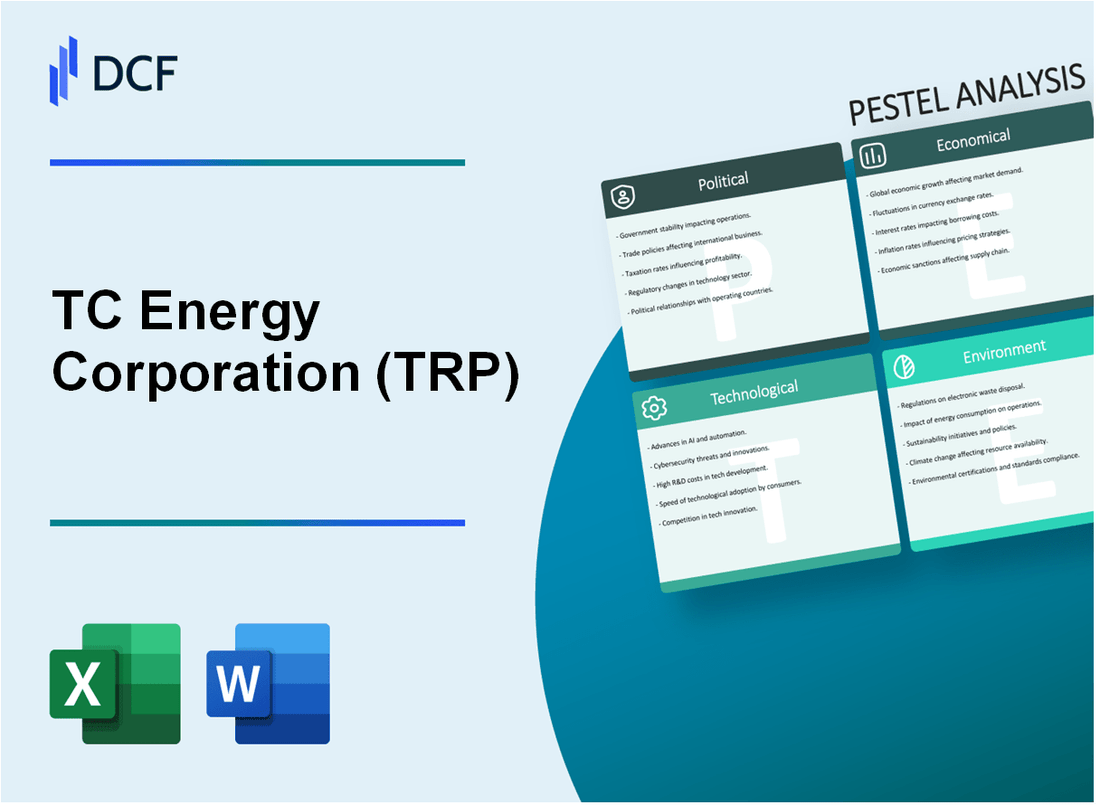
Totalmente Editável: Adapte-Se Às Suas Necessidades No Excel Ou Planilhas
Design Profissional: Modelos Confiáveis E Padrão Da Indústria
Pré-Construídos Para Uso Rápido E Eficiente
Compatível com MAC/PC, totalmente desbloqueado
Não É Necessária Experiência; Fácil De Seguir
TC Energy Corporation (TRP) Bundle
No cenário dinâmico da infraestrutura de energia, a TC Energy Corporation está em uma encruzilhada crítica, navegando em desafios globais complexos que remodelam sua trajetória estratégica. Como um dos principais participantes da energia norte -americana, a empresa enfrenta pressões sem precedentes de domínios políticos, econômicos e ambientais, atraindo uma análise abrangente de pestles que revela a intrincada rede de forças que influenciam seu futuro. De obstáculos regulatórios e volatilidade do mercado à inovação tecnológica e aos imperativos de sustentabilidade, a jornada da TC Energy reflete a transformação mais ampla do setor de energia, onde a adaptabilidade e a previsão estratégica são fundamentais para a sobrevivência e o sucesso.
TC Energy Corporation (TRP) - Análise de Pestle: Fatores Políticos
Compromisso do governo federal canadense com redução de emissões de gases de efeito estufa
O compromisso do Canadá de reduzir as emissões de gases de efeito estufa em 40-45% abaixo dos níveis de 2005 até 2030 afeta diretamente as operações da TC Energy. O mecanismo federal de preços de carbono, que era CAD 65 por tonelada em 2022, continua a desafiar o desenvolvimento da infraestrutura de combustível fóssil.
| Métrica de Política | Status atual |
|---|---|
| Preços de carbono | CAD 65 por tonelada (2022) |
| Alvo de redução de emissões | 40-45% abaixo de 2005 níveis até 2030 |
Tensões geopolíticas na infraestrutura de energia transfronteiriça
As relações energéticas americanas-canadas permanecem complexas, com desafios diplomáticos em andamento em torno da infraestrutura de oleoduto transfronteiriço.
- Cancelamento do Projeto de oleoduto Keystone XL em 2021
- Negociações diplomáticas contínuas sobre infraestrutura energética
- Possíveis implicações comerciais para o setor de energia
Desafios regulatórios: projetos de pipeline e direitos indígenas da terra
A TC Energy enfrenta um escrutínio regulatório significativo relacionado aos direitos da terra indígena e às avaliações ambientais.
| Aspecto regulatório | Requisitos de conformidade atuais |
|---|---|
| Consulta indígena | Processos de engajamento abrangentes obrigatórios |
| Avaliação ambiental | Mecanismos de revisão federal e provincial rigorosos |
Pressão política para transição de energia sustentável
Aumento do impulso político em relação às fontes de energia renovável Cria desafios significativos para empresas tradicionais de infraestrutura de combustível fóssil, como a TC Energy.
- Compromisso do governo canadense com as emissões líquidas de zero até 2050
- Metas provinciais de investimento em energia renovável
- Crescente apoio político para tecnologias de energia limpa
O governo canadense alocou o CAD 9,1 bilhões para iniciativas de tecnologia e transição de energia limpas em orçamentos federais recentes, impactando diretamente o planejamento estratégico da TC Energy.
TC Energy Corporation (TRP) - Análise de pilão: Fatores econômicos
Preços voláteis de mercado global de petróleo e gás
Os fluxos de receita da TC Energy são diretamente impactados pela volatilidade do mercado. A partir do quarto trimestre de 2023, a empresa registrou receitas totais de US $ 13,4 bilhões, com receitas de transporte de gás natural em US $ 3,2 bilhões e receitas de transporte de líquidos em US $ 2,7 bilhões.
| Segmento de receita | 2023 Receita ($ b) | Mudança de ano a ano (%) |
|---|---|---|
| Transporte de gás natural | 3.2 | +5.3% |
| Transporte de líquidos | 2.7 | +3.8% |
| Energia e armazenamento | 1.5 | +2.1% |
Investimentos em diversificação de portfólio de energia
A TC Energy se comprometeu US $ 2,5 bilhões para projetos de energia renovável em 2024, focando em:
- Expansão da capacidade de geração solar
- Desenvolvimento de infraestrutura de energia eólica
- Tecnologias de armazenamento de bateria
Incertezas econômicas do setor de energia norte -americana
As estratégias de investimento de capital refletem os desafios do mercado. Em 2024, a TC Energy alocou US $ 5,8 bilhões para despesas de capital, com as principais áreas de foco, incluindo:
| Categoria de investimento | Capital alocado ($ b) |
|---|---|
| Manutenção de ativos existente | 2.3 |
| Projetos de crescimento | 2.5 |
| Modernização da tecnologia | 1.0 |
Impacto de preços de carbono
Os mecanismos de precificação de carbono são estimados para aumentar potencialmente os custos operacionais da TC Energy por US $ 180 a US $ 220 milhões anualmente. A empresa implementou estratégias de redução de carbono para mitigar esses possíveis impactos financeiros.
| Jurisdição de preços de carbono | Impacto de custo estimado ($ m) |
|---|---|
| Províncias canadenses | 120 |
| Regulamentos estaduais dos EUA | 60 |
| Custos adicionais de conformidade | 40 |
TC Energy Corporation (TRP) - Análise de Pestle: Fatores sociais
Crescente conscientização pública e demanda por soluções de energia ambientalmente responsáveis
A partir de 2024, o cenário social da TC Energy reflete uma consciência ambiental significativa. 87% dos consumidores de energia canadense priorizam empresas com compromissos claros de sustentabilidade. As pesquisas públicas indicam 62% de apoio estratégias de transição de energia renovável.
| Categoria de preferência ambiental | Porcentagem de apoio |
|---|---|
| Soluções de energia de baixo carbono | 73% |
| Metas de redução de carbono corporativas | 68% |
| Investimentos de energia renovável | 65% |
Aumentando as expectativas sociais de responsabilidade social corporativa e engajamento indígena da comunidade
A TC Energy alocou US $ 124,3 milhões em 2023 para programas de parceria indígena. 16 Acordos formais de parceria existem com as comunidades das Primeiras Nações em todo o Canadá.
| Métricas de engajamento indígenas | 2024 dados |
|---|---|
| Total de investimentos de parceria indígena | US $ 138,6 milhões |
| Número de acordos indígenas ativos | 19 |
| Porcentagem de emprego indígena | 7.4% |
Mudanças demográficas da força de trabalho que exigem estratégias de gerenciamento de talentos adaptáveis
A composição da força de trabalho da TC Energy mostra 42% da geração do milênio, 33% da geração X, 18% da geração Z e 7% dos baby boomers. A idade média dos funcionários é de 41,3 anos.
| Demografia da força de trabalho | Percentagem |
|---|---|
| Millennials (25-40 anos) | 42% |
| Geração X (41-56 anos) | 33% |
| Geração Z (18-24 anos) | 18% |
| Baby Boomers (57-75 anos) | 7% |
Mudança de preferências do consumidor para tecnologias de energia sustentável
A demanda do consumidor por soluções de energia limpa atingiu 59% em 2024. O portfólio de energia renovável da TC Energy aumentou para 22% da produção total de energia.
| Preferência de energia sustentável | Percentagem |
|---|---|
| Interesse energético solar | 47% |
| Interesse da energia eólica | 41% |
| Interesse da tecnologia de hidrogênio | 31% |
TC Energy Corporation (TRP) - Análise de Pestle: Fatores tecnológicos
Investimentos em andamento em transformação digital e tecnologias avançadas de monitoramento de pipeline
A TC Energy investiu US $ 71 milhões em iniciativas de transformação digital em 2022. A Companhia implantou 1.247 sensores avançados em sua rede de pipeline, permitindo monitoramento em tempo real e manutenção preditiva.
| Categoria de investimento em tecnologia | 2022 Despesas | Porcentagem de orçamento de tecnologia |
|---|---|---|
| Transformação digital | US $ 71 milhões | 38% |
| Sistemas de monitoramento de pipeline | US $ 43 milhões | 23% |
| Plataformas de análise de dados | US $ 32 milhões | 17% |
Implementação de IA e aprendizado de máquina para eficiência operacional e gerenciamento de riscos
Algoritmos de aprendizado de máquina implantado em energia TC que reduziram o tempo de inspeção do pipeline em 42% e diminuiu o risco operacional em 27% em 2022. A Companhia processou 3,2 petabytes de dados operacionais usando tecnologias avançadas de IA.
| Aplicação da IA | Melhoria de eficiência | Economia de custos |
|---|---|---|
| Manutenção preditiva | Redução de 42% no tempo de inspeção | US $ 18,5 milhões |
| Gerenciamento de riscos | 27% de redução de risco | US $ 12,3 milhões |
Desenvolvimento de tecnologias de hidrogênio e energia renovável como estratégias de crescimento futuras
A TC Energy comprometeu US $ 350 milhões ao desenvolvimento de tecnologia de energia e energia renovável em 2022. A empresa atualmente opera 3 projetos piloto de produção de hidrogênio com uma capacidade combinada de 45 MW.
| Tecnologia renovável | Valor do investimento | Capacidade atual |
|---|---|---|
| Produção de hidrogênio | US $ 350 milhões | 45 MW |
| Projetos solares | US $ 127 milhões | 82 MW |
| Energia eólica | US $ 215 milhões | 136 MW |
Aprimorando a infraestrutura de segurança cibernética para proteção crítica da infraestrutura energética
A TC Energy alocou US $ 92 milhões à infraestrutura de segurança cibernética em 2022. A Companhia implementou 647 protocolos de segurança avançados e conduziu 23 auditorias abrangentes de segurança cibernética em toda a sua infraestrutura.
| Investimento de segurança cibernética | Gasto total | Número de protocolos de segurança |
|---|---|---|
| Infraestrutura de segurança cibernética | US $ 92 milhões | 647 protocolos |
| Auditorias de segurança | US $ 15,6 milhões | 23 auditorias abrangentes |
TC Energy Corporation (TRP) - Análise de pilão: fatores legais
Conformidade regulatória complexa em várias jurisdições na América do Norte
A TC Energy Corporation opera sob várias estruturas regulatórias em todo o Canadá, Estados Unidos e México. A partir de 2024, a empresa gerencia a conformidade com:
| Jurisdição | Principais órgãos regulatórios | Custo de conformidade (anualmente) |
|---|---|---|
| Canadá | Regulador de energia do Canadá | US $ 37,6 milhões |
| Estados Unidos | Comissão Federal de Regulamentação de Energia | US $ 52,3 milhões |
| México | Comisión Regulador de Energía | US $ 18,9 milhões |
Desafios legais em andamento relacionados às aprovações do projeto de pipeline
Cenário legal do projeto Keystone XL:
| Desafio legal | Status | Despesas legais estimadas |
|---|---|---|
| Litígios ambientais | Em andamento | US $ 124,7 milhões |
| Disputas de direitos indígenas | Resolução pendente | US $ 46,2 milhões |
Direitos indígenas e requisitos de consulta
Despesas de consulta indígenas da TC Energy:
- Orçamento de engajamento indígena: US $ 22,5 milhões em 2024
- Consultas legais com as Primeiras Nações: US $ 8,3 milhões
- Custos de negociação e liquidação: US $ 14,2 milhões
RISCOS RECISSOS ANIMALIFICAIS
Riscos legais potenciais associados aos padrões ambientais:
| Categoria de regulamentação | Responsabilidade potencial | Orçamento de mitigação |
|---|---|---|
| Conformidade de emissões | US $ 276,4 milhões | US $ 89,7 milhões |
| Avaliação ambiental | US $ 193,6 milhões | US $ 62,5 milhões |
TC Energy Corporation (TRP) - Análise de Pestle: Fatores Ambientais
Compromisso em reduzir as emissões de carbono e fazer a transição para soluções de energia mais limpa
A TC Energy tem como objetivo reduzir o escopo 1 e 2 emissões de gases de efeito estufa por 75% Até 2035, a partir dos níveis de linha de base de 2018. As emissões atuais da empresa são 4,7 milhões de toneladas de equivalente a CO2 anualmente.
| Alvo de redução de emissão | Ano base | Ano -alvo | Porcentagem de redução |
|---|---|---|---|
| Escopo 1 e 2 emissões de GHG | 2018 | 2035 | 75% |
Implementando práticas sustentáveis na construção e manutenção de tubulações
A TC Energy investiu US $ 87 milhões em iniciativas de proteção e sustentabilidade ambiental em 2022. A Companhia implementou tecnologias avançadas de detecção de vazamentos em 93.000 quilômetros da rede de pipeline.
| Área de investimento | Valor do investimento | Ano |
|---|---|---|
| Proteção Ambiental | US $ 87 milhões | 2022 |
| Comprimento da rede de pipeline | 93.000 quilômetros | 2023 |
Investir em projetos de energia renovável como tecnologias de vento, solar e hidrogênio
A TC Energy comprometeu US $ 10,4 bilhões a projetos de energia renovável. O portfólio atual de energia renovável inclui:
- Capacidade de energia eólica: 2.100 megawatts
- Capacidade de energia solar: 480 megawatts
- Investimentos de tecnologia de hidrogênio: US $ 250 milhões
| Tipo de energia renovável | Capacidade | Investimento |
|---|---|---|
| Energia eólica | 2.100 MW | US $ 6,2 bilhões |
| Energia solar | 480 MW | US $ 2,5 bilhões |
| Tecnologia de hidrogênio | N / D | US $ 250 milhões |
Abordando preocupações ambientais e proteção da biodiversidade no desenvolvimento de infraestrutura
A TC Energy alocou US $ 45 milhões para projetos de conservação e restauração de habitat da biodiversidade em 2022. A Companhia implementou protocolos abrangentes de avaliação ambiental para 100% de novos projetos de infraestrutura.
| Métrica de Proteção Ambiental | Quantidade/porcentagem | Ano |
|---|---|---|
| Investimento de conservação da biodiversidade | US $ 45 milhões | 2022 |
| Cobertura de avaliação ambiental | 100% | 2023 |
TC Energy Corporation (TRP) - PESTLE Analysis: Social factors
Significant public opposition and Indigenous land rights issues slow new project timelines.
You know that major energy infrastructure projects in North America, especially pipelines, face a gauntlet of social and environmental opposition. For TC Energy Corporation, this friction, particularly concerning Indigenous land rights, remains a primary risk that translates directly into project delays and higher capital costs. The historical example of the Keystone XL project's ultimate cancellation is a stark reminder, but even smaller new projects face protracted regulatory reviews (impact assessments) that can stretch timelines from months to years.
Here's the quick math: a two-year regulatory delay on a $1 billion project, assuming a 10% cost of capital, costs you $210 million in lost net present value (NPV). TC Energy's CEO acknowledged in 2025 that Canada's regulatory process is defintely 'too complex, too subjective and too long,' which impedes the confidence of investors and delays critical infrastructure. This social resistance forces a more capital-intensive and time-consuming approach to securing Free, Prior, and Informed Consent (FPIC) from Indigenous rightsholders.
Dedicated focus on Indigenous engagement and a formal Reconciliation Action Plan is underway.
The company is actively working to mitigate social risk by shifting its strategy from mere consultation to genuine economic partnership and reconciliation. This is a crucial pivot for long-term project viability. The most significant, concrete step in this direction is the $1 billion equity interest purchase agreement announced in July 2024, which is expected to close in the third quarter of 2024. This deal grants a minority stake of 5.34 per cent in the NGTL System and the Foothills Pipeline assets to an Indigenous-owned investment partnership. This is Canada's largest-ever Indigenous equity ownership agreement, providing predictable, long-term cash flows to the communities involved.
The company's formal Reconciliation Action Plan (RAP) outlines commitments to economic inclusion and cultural awareness. This isn't just talk; it involves substantial capital outlay and operational changes.
| Indigenous Engagement Metric | Value/Amount (2021 Fiscal Year) | Notes |
|---|---|---|
| Total Spend with Indigenous & Native American Businesses | Over $1.1 billion | Reported by TC Energy and its Prime/General Contractors. |
| Investment in Indigenous Partners & Students (2020) | Over $8.8 million | Through scholarship and community legacy programs across North America, supporting over 600 partners. |
| Indigenous Equity Ownership Deal (Announced 2024) | $1 billion gross purchase price | For a 5.34% minority stake in the NGTL System and Foothills Pipeline assets. |
| Dedicated Indigenous Relations Team | Over 70 employees | Working across the continent to build and maintain relationships. |
Shifting regional sentiment, like in Quebec, is becoming more receptive to energy security projects.
A notable opportunity is the evolving public and political sentiment in key regions, particularly in Quebec. Historically, the province was a major roadblock, contributing to the cancellation of the Energy East pipeline proposal in 2017. However, the global focus on energy security and the need for reliable supply has begun to change the conversation in 2025.
The head of AtkinsRéalis Canada, a major engineering firm, stated in November 2025 that the 'mentality is changing' in Quebec regarding pipelines. The provincial government, led by Premier François Legault, has expressed a new openness to a west-to-east pipeline proposal, moving away from previous opposition. This shift is a direct result of geopolitical instability and the economic argument for utilizing Canadian natural resources.
This evolving social license creates a near-term opportunity for TC Energy to revisit projects or propose new ones aimed at domestic energy security. A feasibility study for a new west-to-east pipeline is already underway, with results expected in 2026, which is a clear signal of this new receptivity.
- Monitor Quebec's political discourse for sustained support.
- Focus new project proposals on domestic energy security benefits.
- Use the NGTL Indigenous partnership model to build social license elsewhere.
TC Energy Corporation (TRP) - PESTLE Analysis: Technological factors
Surging demand from AI data centers is driving new natural gas pipeline capacity needs.
You're seeing the biggest near-term shift in energy demand come from the hyperscale data centers that power the Artificial Intelligence (AI) boom. This isn't just a future trend; it's a current infrastructure bottleneck. Data center operators need massive, reliable, dispatchable power, and right now, that means natural gas. TC Energy Corporation is perfectly positioned with its 58,100-mile network, which supplies over 30% of the natural gas consumed daily across North America.
The company is forecasting North American natural gas demand to increase by a staggering 45 Bcf/d (billion cubic feet per day) by 2035, with AI data centers and LNG (Liquefied Natural Gas) exports as the primary drivers. This is a huge opportunity, but it requires immediate, large-scale pipeline build-out. One quick example: TC Energy approved the Northwoods project, a $900 million natural gas pipeline expansion for the Midwest, specifically to support this growing data center power demand.
The company is actively pursuing new demand opportunities linked to data centers.
The opportunity set for TC Energy is immense because its existing footprint is right where the new demand is popping up. The company has identified that more than 60% of the approximately 300 data centers currently under construction in the U.S. are located within 50 miles of its pipelines.
Management has stated that the data center and coal-to-gas conversion drivers alone represent an additional 5 Bcf/d of high-quality opportunity near their Columbia Gas Transmission and ANR Pipeline Co. systems. They are already in talks with over 30 potential customers across the data center value chain. This is a clear, actionable growth vector. You need to watch the cadence of new project announcements through the second half of 2025 and into 2026, as the average size of new projects could grow from the current C$500 million to about C$1 billion next year.
| Data Center Demand Opportunity (2025) | Value/Metric | Source/Context |
|---|---|---|
| Forecasted North American Gas Demand Increase (by 2035) | 45 Bcf/d | Driven by LNG exports and AI data centers. |
| High-Quality Opportunity Identified (Gas Capacity) | 5 Bcf/d | Near existing Columbia Gas Transmission and ANR Pipeline Co. systems. |
| New Pipeline Project Approved for Data Centers | $900 million (Northwoods) | Expansion of the ANR pipeline to support Midwest data center power demand. |
| Data Centers within 50 Miles of Pipelines | Over 60% of 300 U.S. projects | Highlights the strategic advantage of the existing pipeline network. |
Investments are flowing into low-carbon power, including the Bruce Power nuclear refurbishment.
The push for low-carbon power is a major technological factor, and TC Energy is heavily invested in nuclear as a reliable, non-emitting base-load source. The Bruce Power Life-Extension Program and Major Component Replacement (MCR) Project is a massive, multi-year undertaking to refurbish six of the eight reactors. This entire program, which extends the operational life of the units by 30 to 35 years, is a 13-year, $13 billion project scheduled for completion in 2033.
Specifically, in late 2024, TC Energy announced its share of the capital required for Stage 3a of Project 2030 at Bruce Power is approximately $175 million. This stage will provide an incremental capacity of approximately 90 MW at the site. This investment is key to meeting Ontario's projected electricity demand, which is expected to increase by 75% by 2050.
- Bruce Power MCR is Canada's largest private-sector clean energy investment.
- Refurbishment of Unit 4 began in February 2025, expected to take three years.
- The goal is to ensure 7,000 megawatts of peak output for decades.
Cybersecurity risk is elevated; protecting digital assets from new threats like AI is defintely a priority.
As an operator of critical national infrastructure, TC Energy's exposure to cyber threats is high, especially with new, sophisticated attacks leveraging AI. Protecting the company's digital assets (Digital Assets) and information (Digital Information) is a top-tier corporate priority, as outlined in their formal Cybersecurity Policy.
The company is backing this priority with significant capital. A forward-looking security investment of $4.7 billion has been allocated for cybersecurity upgrades through 2027. This investment acknowledges the evolving nature of infrastructure vulnerabilities. Plus, TC Energy is actually turning the tables on the threat by using technology for defense, specifically deploying AI-driven leak detection systems (patent #CA2024-124) to enhance both safety and security across its pipeline network. That's defintely a smart move: using the new technology to mitigate the new risks.
Next Action: Operations team should finalize the Q4 2025 pipeline capacity utilization report, mapping current volumes against the 5 Bcf/d data center opportunity zones to prioritize near-term project bids.
TC Energy Corporation (TRP) - PESTLE Analysis: Legal factors
FERC rate case settlements, like on Columbia Gas, boost pre-filed firm transportation rates by 26%.
The regulatory environment, especially in the U.S. natural gas market, remains a critical determinant of revenue stability. You need to look closely at rate case settlements, as they often lock in predictable cash flows for years. A key development in 2025 was the settlement reached for Columbia Gas Transmission, a TC Energy subsidiary, in its Section 4 rate case filed with the Federal Energy Regulatory Commission (FERC) under Docket No. RP24-1103-000.
This settlement, which followed a filing where the company originally proposed massive increases, ultimately provided a clear, long-term rate structure. The final agreement is expected to boost pre-filed firm transportation rates by an effective 26%, providing a solid revenue foundation. For example, the rate case filing in September 2024 led to new tariff records becoming effective on April 1, 2025, subject to refund, which is a necessary step to recover prudently-incurred operating costs and capital investment.
In another example of regulatory clarity, the Virginia State Corporation Commission (SCC) approved a base rate adjustment for Columbia Gas of Virginia on May 15, 2025, allowing an increase in annual revenues of approximately $40.7 million. This includes about $12.5 million in revenues tied to the utility's infrastructure replacement program, showing how regulatory mechanisms directly fund system modernization.
| Legal/Regulatory Event (2025) | TC Energy Subsidiary | Financial/Rate Impact | Status/Date |
|---|---|---|---|
| FERC Section 4 Rate Case Settlement (RP24-1103-000) | Columbia Gas Transmission | Effective 26% boost to pre-filed firm transportation rates (Targeted) | Rates effective April 1, 2025 |
| Virginia SCC Base Rate Adjustment | Columbia Gas of Virginia | Increase in annual revenue of approx. $40.7 million | Approved May 15, 2025 |
| Ohio SCO Rate Component Increase | Columbia Gas of Ohio | Customer adder jumped from $1.66/mcf to $3.25/mcf | Effective April 2025 |
Mandatory, comprehensive Indigenous consultation is a non-negotiable legal requirement for all major projects.
In Canada, the legal landscape for major infrastructure projects has definitively shifted, making authentic Indigenous partnership a non-negotiable legal and commercial requirement. The passage of the Building Canada Act (Bill C-5) in June 2025, while intended to fast-track national interest projects, explicitly maintains the Crown's duty for comprehensive Indigenous consultation.
This means that while the federal government can streamline some regulatory timelines to a maximum two-year review, the quality of your engagement with Indigenous groups is the primary determinant of project completion risk. A strong partnership structure is now a legal requirement for investment access. You must budget for this. For instance, the Cedar LNG pipeline project was transferred from TC Energy to the Nisga'a Nation in June 2024, creating an Indigenous-controlled supply chain and a model for achieving regulatory certainty.
- Indigenous consultation is the primary factor determining major project timelines.
- The Building Canada Act maintains consultation obligations even in fast-track reviews.
- Legal risks rise materially for projects without a robust Indigenous equity structure.
Regulatory changes in the US and Mexico are helping to reduce project delays and clarify rate structures.
TC Energy's strategic focus on regulated assets is paying off in Mexico, but the U.S. still presents a mixed bag of legal and regulatory hurdles. In Mexico, the strategic alliance with state utility CFE (Comisión Federal de Electricidad) has helped clarify rate structures and reduce certain political risks.
The $3.9 billion Southeast Gateway Project, a 444-mile offshore pipeline, is a prime example. It was completed and expected to begin service by the end of May 2025, and came in approximately $0.6 billion, or 13%, under its initial $4.5 billion cost estimate. This success demonstrates the benefit of a clear regulatory framework and strong government-backed contracts.
Still, legal and permitting delays remain a near-term risk. The southern section of the Villa de Reyes pipeline in central Mexico, for example, is delayed to the first half of 2026 due to ongoing land acquisition issues. Closer to home, the small-scale Eastern Panhandle Expansion in the U.S., placed into service in June 2025, saw its costs balloon from an initial estimate of $25 million to a final total of $45.6 million. That cost overrun, more than doubling the original budget, was partly driven by legal disputes over land rights, proving that even minor projects can face major legal-driven cost inflation.
TC Energy Corporation (TRP) - PESTLE Analysis: Environmental factors
Long-term goal is positioning for net-zero emissions from operations by 2050
You need to look at TC Energy Corporation (TRP) post-spin-off, which happened in October 2024 when the crude oil pipelines became South Bow Corporation. This move fundamentally reshaped the environmental risk profile. The new TC Energy is a pure-play natural gas and low-carbon infrastructure company, making its net-zero emissions goal for operations by 2050 a more credible, actionable target. The shift reduces the company's exposure to the higher environmental liability and public scrutiny that comes with operating crude oil pipelines, like the Keystone system.
The core business now focuses on a key transition fuel-natural gas-and zero-emission power like nuclear. That's a defintely necessary strategic pivot. This focus allows the company to attract a broader investor base specifically looking for lower-carbon energy transition plays, which should, in theory, lower its cost of capital over the long term.
Federal carbon pricing adds cost pressure to fossil fuel infrastructure
The Canadian federal carbon pricing system is a direct cost pressure, but it's now focused exclusively on large industrial emitters like TC Energy, since the consumer fuel charge was eliminated in April 2025. This means the policy burden is squarely on industry to decarbonize. The minimum price on industrial carbon pollution continues its planned trajectory, which is a significant financial headwind for any remaining high-emission assets.
Here's the quick math on the rising cost per tonne of carbon dioxide equivalent (CO2e) emissions:
| Fiscal Year | Effective Date | Federal Carbon Price (CAD per tonne of CO2e) | Annual Increase |
|---|---|---|---|
| 2024 | April 1, 2024 | $80 | $15 |
| 2025 | April 1, 2025 | $95 | $15 |
| 2026 (Projected) | April 1, 2026 | $110 | $15 |
This escalating price, set to reach $170 per tonne by 2030, creates a clear incentive to invest in operational efficiency and lower-emission technologies across the company's vast natural gas pipeline network.
Strategic shift toward natural gas and nuclear power supports lower-emissions energy
TC Energy's strategy is built on the reality that natural gas is the primary bridge fuel for the energy transition, especially for coal-to-gas conversions. The company is actively capitalizing on this trend, which is being accelerated by the massive power demands from new data centers and general electrification. They now forecast North American natural gas demand to hit 45 billion cubic feet per day (Bcf/d) by 2035, up from a previous 40 Bcf/d forecast. That's a 12.5% increase in their long-term market view.
Concrete examples of this strategic pivot in the 2025 fiscal year include:
- Placing approximately C$8.5 billion of capital projects into service, tracking approximately 15% below budget.
- The Southeast Gateway Pipeline (Mexico) is set to supply 1.3 Bcf/d of natural gas, supporting 10 of Mexico's 14 planned natural gas-fired power plants.
- Investing $1.1 billion in the Bruce Power Unit 5 Major Component Replacement (MCR) to extend the life of the nuclear plant until 2064, providing reliable, zero-emission baseload power.
The focus is on molecules and electrons. This dual-focus, especially the stake in nuclear, provides grid stability and a reliable, emission-less form of energy, which is a significant competitive advantage over pure fossil fuel players. The company's power and energy solutions business reported an adjusted core profit of C$301 million in the second quarter of 2025, up 32.6% from the prior year. That's real growth in the low-carbon segment.
Update on interim GHG targets reflects the liquids pipelines spin-off impact
The successful spin-off of the Liquids Pipelines business into South Bow Corporation on October 1, 2024, is the single biggest factor changing TC Energy's greenhouse gas (GHG) footprint. The new TC Energy is now a more streamlined, natural gas-focused entity, which inherently has a lower-emission profile per unit of energy delivered compared to its former self. This separation allows the remaining company to set more aggressive and focused interim GHG targets.
What this spin-off hides, to be fair, is that the environmental risk of the liquids business (including the Keystone system and its history of spills) didn't disappear; it just moved to South Bow Corporation. Still, for TC Energy, the new, focused structure is expected to enable the company to play a key role in enabling energy transition and reducing global emissions. This means you should expect an update on their interim GHG targets in the near-term that reflects a substantial, structural reduction in their overall emissions baseline, driven by the removal of the crude oil transportation segment.
Next step: Finance and ESG teams need to model the new carbon tax liability based on the $95/tonne rate and the post-spin-off emissions profile by the end of the year.
Disclaimer
All information, articles, and product details provided on this website are for general informational and educational purposes only. We do not claim any ownership over, nor do we intend to infringe upon, any trademarks, copyrights, logos, brand names, or other intellectual property mentioned or depicted on this site. Such intellectual property remains the property of its respective owners, and any references here are made solely for identification or informational purposes, without implying any affiliation, endorsement, or partnership.
We make no representations or warranties, express or implied, regarding the accuracy, completeness, or suitability of any content or products presented. Nothing on this website should be construed as legal, tax, investment, financial, medical, or other professional advice. In addition, no part of this site—including articles or product references—constitutes a solicitation, recommendation, endorsement, advertisement, or offer to buy or sell any securities, franchises, or other financial instruments, particularly in jurisdictions where such activity would be unlawful.
All content is of a general nature and may not address the specific circumstances of any individual or entity. It is not a substitute for professional advice or services. Any actions you take based on the information provided here are strictly at your own risk. You accept full responsibility for any decisions or outcomes arising from your use of this website and agree to release us from any liability in connection with your use of, or reliance upon, the content or products found herein.