

|
Tesla, Inc. (TSLA): Modelo de negócios Canvas [Jan-2025 Atualizado] |
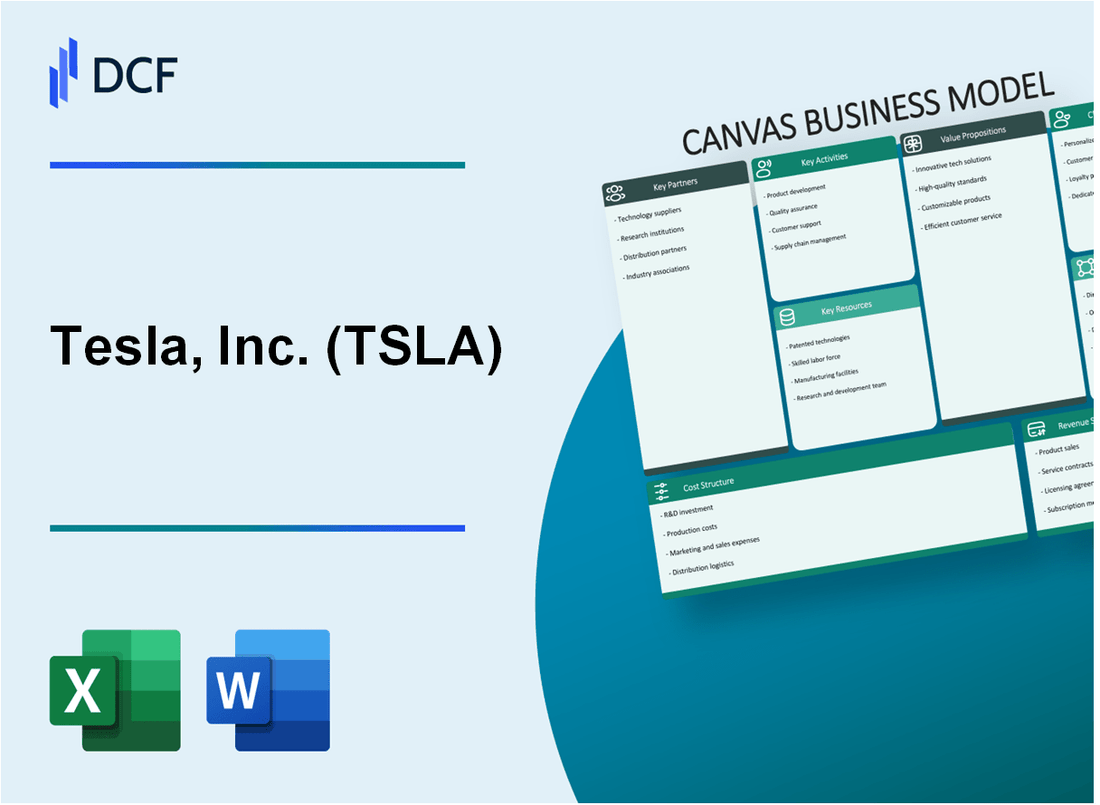
Totalmente Editável: Adapte-Se Às Suas Necessidades No Excel Ou Planilhas
Design Profissional: Modelos Confiáveis E Padrão Da Indústria
Pré-Construídos Para Uso Rápido E Eficiente
Compatível com MAC/PC, totalmente desbloqueado
Não É Necessária Experiência; Fácil De Seguir
Tesla, Inc. (TSLA) Bundle
A Tesla, Inc. revolucionou o cenário automotivo e de energia limpa, criando um modelo de negócios inovador que transcende os paradigmas de fabricação tradicionais. Ao integrar perfeitamente a tecnologia inovadora de veículos elétricos, soluções de energia sustentável e estratégias de vendas diretas ao consumidor, a Tesla interrompeu vários setores simultaneamente. Sua abordagem única combina inovação tecnológica de ponta, integração vertical e uma missão visionária para acelerar a transição mundial para a energia sustentável, tornando-as muito mais do que apenas uma empresa automobilística, mas uma empresa global transformadora reformulando como pensamos sobre transporte e energia renovável.
Tesla, Inc. (TSLA) - Modelo de negócios: Parcerias -chave
Parceria da Bateria da Panasonic
A Tesla e a Panasonic têm uma parceria de produção de bateria de longa data, com um investimento total de US $ 1,6 bilhão no Nevada Gigafactory a partir de 2023. Em 2022, eles produziram em conjunto aproximadamente 37 GWh de células de bateria.
| Detalhes da parceria | Métricas |
|---|---|
| Investimento total | US $ 1,6 bilhão |
| Produção anual de bateria | 37 GWh |
| Duração da parceria | Desde 2014 |
Fornecedores de componentes da bateria
A Tesla colabora com vários fornecedores de componentes de bateria para diversificar sua cadeia de suprimentos.
| Fornecedor | Fornecimento de componentes da bateria (2023) |
|---|---|
| Catl | 40 gwh |
| LG Chem | 25 gwh |
| Panasonic | 37 GWh |
Fabricantes de semicondutores
- Micro Dispositivos Avançados (AMD)
- Nvidia
- Samsung Foundry
Parceiros de infraestrutura de carregamento global
| Parceiro | Estações de carregamento (2023) |
|---|---|
| ChargePoint | 4.500 estações |
| EVGO | 1.800 estações |
| Eletrifice a América | 3.600 estações |
Fornecedores de equipamentos de fabricação automotiva
- Robótica da ABB
- Robótica Kuka
- Automação industrial da Siemens
Investimento total de parceria: aproximadamente US $ 2,5 bilhões em várias colaborações estratégicas a partir de 2024.
Tesla, Inc. (TSLA) - Modelo de negócios: Atividades -chave
Projeto e fabricação de veículos elétricos
A Tesla produziu 1.369.611 veículos em 2022, com 1.313.851 entregas. As instalações de fabricação incluem:
| Localização | Capacidade de produção anual |
|---|---|
| Fremont, Califórnia | 500.000 veículos |
| Xangai, China | 750.000 veículos |
| Berlim, Alemanha | 375.000 veículos |
| Austin, Texas | 500.000 veículos |
Pesquisa e desenvolvimento de tecnologia de bateria
Investimento em tecnologia de bateria:
- Despesas de P&D: US $ 2,5 bilhões em 2022
- 4680 Capacidade de produção de células de bateria: 42 GWh a partir de 2023
- Portfólio de patentes de tecnologia da bateria: mais de 1.800 patentes
Painel solar e produção do sistema de armazenamento de energia
Estatísticas de geração e armazenamento de energia:
| Produto | Produção anual |
|---|---|
| Telhas solares | 12.000 instalações em 2022 |
| Powerwall | 50.000 unidades vendidas em 2022 |
| Megapack | 6,5 GWh implantado em 2022 |
Desenvolvimento de software de direção autônoma
Métricas de desenvolvimento de direção autônoma:
- FSD (Autocrodução completa) Usuários beta: 400.000 a partir do quarto trimestre 2022
- Investimento anual de desenvolvimento de software: US $ 1,3 bilhão
- Miles de piloto automático conduzidos: mais de 3 bilhões de milhas cumulativas
Expansão e manutenção da rede de supercharger
Estatísticas de rede de supercharger:
| Região | Número de estações de superalimentador | Barracas de carregamento total |
|---|---|---|
| América do Norte | 1,441 | 13,472 |
| Europa | 987 | 8,631 |
| Ásia | 612 | 5,987 |
Tesla, Inc. (TSLA) - Modelo de negócios: Recursos -chave
Tecnologia avançada de bateria e propriedade intelectual
A Tesla possui 241 patentes relacionadas à bateria a partir de 2023. O portfólio de tecnologia de bateria da empresa inclui:
- 4680 design de célula de bateria
- Tecnologia de bateria de íons de lítio
- Inovações do sistema de gerenciamento de bateria
| Categoria de patentes | Número de patentes |
|---|---|
| Tecnologia de células da bateria | 87 |
| Sistemas de gerenciamento de bateria | 54 |
| Fabricação de bateria | 100 |
Instalações de fabricação altamente automatizadas
A Tesla opera instalações de fabricação com automação significativa:
- Fremont, Califórnia: 5,3 milhões de pés quadrados
- GigaFactory Texas: 2,5 milhões de pés quadrados
- GigaFactory Shanghai: 1,2 milhão de pés quadrados
| Instalação | Capacidade de produção anual |
|---|---|
| Fábrica de Fremont | 500.000 veículos |
| GigaFactory Texas | 250.000 veículos |
| GigaFactory Shanghai | 750.000 veículos |
Forte reputação da marca em veículos elétricos
Valor da marca da Tesla em 2023: US $ 45,3 bilhões
| Métrica da marca | Valor |
|---|---|
| Valor da marca | US $ 45,3 bilhões |
| Participação de mercado global | 17.4% |
Engenharia e Pesquisa Esportiva talento
Total de funcionários da Tesla: 127.855 a partir do quarto trimestre 2023
| Categoria de funcionários | Número |
|---|---|
| Equipe de engenharia | 38,357 |
| Pesquisar & Desenvolvimento | 15,542 |
Extensa infraestrutura de carregamento global
Estatísticas de rede de supercharger Tesla:
- Estações totais de superalimentador: 5.404
- Conectores Total de Supercharger: 48.636
- Cobertura global: 46 países
| Região | Número de estações de superalimentador |
|---|---|
| América do Norte | 1,802 |
| Europa | 1,521 |
| Ásia -Pacífico | 2,081 |
Tesla, Inc. (TSLA) - Modelo de negócios: proposições de valor
Veículos elétricos de alto desempenho com tecnologia de ponta
Aceleração xadrez da Tesla Model S: 0-60 mph em 1,99 segundos. Velocidade máxima da xadrez do Modelo S: 200 mph. Faixa de bateria para o longo alcance do Modelo S: 405 milhas por carga. Eficiência da bateria: 4,1 milhas por kWh.
| Modelo | Aceleração (0-60 mph) | Velocidade máxima | Faixa |
|---|---|---|---|
| Manta do modelo S. | 1,99 segundos | 200 mph | 396 milhas |
| Modelo 3 de longo alcance | 4,2 segundos | 145 mph | 358 milhas |
| Modelo X xadrez | 2,5 segundos | 163 mph | 333 milhas |
Soluções sustentáveis de transporte e energia
Energia solar total gerada em 2022: 3,9 TWH. O armazenamento total de energia implantado em 2022: 6,5 GWh. Compensação de carbono através de veículos elétricos: estimado 13,4 milhões de toneladas de CO2 em 2022.
- Eficiência do telhado solar: 22,8% da taxa de conversão do painel solar
- Capacidade de armazenamento do Powerwall: 13,5 kWh por unidade
- MEGAPACK Energy Storage System: 3 MWh por unidade
Capacidades avançadas de direção autônoma
Usuários beta autônomos completos (FSD): 400.000 a partir do quarto trimestre 2023. Taxa de engajamento do piloto automático: 90% durante a direção da rodovia. Taxa de intervenção de segurança: 0,2 incidentes por milhão de milhas.
| Recurso autônomo | Capacidade | Precisão |
|---|---|---|
| Navegue no piloto automático | Muda de pista da rodovia | 97.5% |
| Reconhecimento do semáforo | Parada/vá automática | 99.1% |
Design de veículos premium e inovador
Pedidos de patente de design em 2022: 87. Pesquisa e desenvolvimento Gastos: US $ 3,1 bilhões em 2022. Awards de design recebidos: 12 reconhecimento de design internacional.
Custos de propriedade mais baixos a longo prazo
Custo médio de manutenção em 5 anos: US $ 4.600 (em comparação com US $ 8.300 para veículos de luxo tradicionais). Custo de energia por milha: US $ 0,04 (eletricidade) versus US $ 0,12 (gasolina). Garantia da bateria: 8 anos ou 150.000 milhas.
| Categoria de custo | Tesla | Veículo tradicional |
|---|---|---|
| Manutenção de 5 anos | $4,600 | $8,300 |
| Custo de energia por milha | $0.04 | $0.12 |
Tesla, Inc. (TSLA) - Modelo de negócios: relacionamentos com o cliente
Modelo de vendas diretas através de lojas de propriedade da empresa
A partir do quarto trimestre de 2023, a Tesla opera 891 lojas e galerias de varejo em todo o mundo. A empresa mantém uma abordagem de vendas diretas com 440 lojas na América do Norte, 267 na Europa e 184 nas regiões da Ásia-Pacífico.
| Região | Número de lojas | Porcentagem de presença global |
|---|---|---|
| América do Norte | 440 | 49.4% |
| Europa | 267 | 30% |
| Ásia-Pacífico | 184 | 20.6% |
Plataforma de configuração e compra online
A plataforma on -line da Tesla gera aproximadamente US $ 17,7 bilhões em receita direta de vendas on -line em 2023. A plataforma de compra digital suporta:
- Configuração do veículo em tempo real
- Citações de preços instantâneos
- Opções de financiamento
- Avaliação de troca
- Pedidos on -line diretos
Rede robusta de suporte ao cliente e serviço
A Tesla mantém 181 centros de serviço globalmente, com um tempo médio de resposta ao atendimento ao cliente de 24 a 48 horas. A rede de serviços abrange 38 países e suporta aproximadamente 1,5 milhão de proprietários de veículos ativos.
| Métrica de serviço | 2023 dados |
|---|---|
| TOTAL CENTERS DE SERVIÇO | 181 |
| Países cobertos | 38 |
| Proprietários de veículos ativos | 1,500,000 |
Atualizações de software Over-the-Air
A Tesla oferece aproximadamente 35-40 atualizações de software anualmente, com um tempo médio de instalação de 30 minutos. Em 2023, 95% dos veículos da Tesla receberam pelo menos uma grande atualização de software.
Mídia social ativa e envolvimento da comunidade
A presença das mídias sociais de Tesla inclui:
- Twitter/X: 19,4 milhões de seguidores
- Instagram: 12,7 milhões de seguidores
- YouTube: 2,3 milhões de assinantes
- Facebook: 8,6 milhões de seguidores
A empresa gera aproximadamente 78% do envolvimento do cliente por meio de plataformas digitais, com um volume anual de interação anual de mídia social de 42 milhões de compromissos.
Tesla, Inc. (TSLA) - Modelo de Negócios: Canais
Plataforma online tesla.com
A partir de 2024, o principal canal de vendas direto da Tesla é seu site oficial, Tesla.com. A plataforma lida com aproximadamente 80% dos pedidos de veículo diretamente.
| Métricas de plataforma online | 2024 dados |
|---|---|
| Visitantes diários do site | 1,2 milhão |
| Taxa de conversão de pedidos on -line | 3.7% |
| Valor médio do pedido | $57,500 |
Lojas de varejo de propriedade da empresa
A Tesla opera 438 locais de varejo globalmente a partir do primeiro trimestre de 2024.
| Distribuição de lojas de varejo | Número de lojas |
|---|---|
| Estados Unidos | 285 |
| Europa | 98 |
| China | 55 |
Unidades de vendas e serviços móveis
A Tesla mantém 672 veículos de serviço móvel em suas regiões operacionais.
- Tempo médio de resposta: 24-48 horas
- Taxa de conclusão de serviço: 92%
- Interações anuais de serviço móvel: 1,4 milhão
Marketing digital e mídia social
Os canais de marketing digital da Tesla atingem aproximadamente 45 milhões de seguidores entre plataformas.
| Plataforma de mídia social | Contagem de seguidores |
|---|---|
| Twitter/x | 19,2 milhões |
| 15,6 milhões | |
| YouTube | 10,2 milhões |
Mercados automotivos de terceiros
A Tesla utiliza canais limitados de terceiros, com menos de 5% das vendas ocorrendo através de plataformas externas.
- Vendas certificadas de veículos usados: 22.000 unidades anualmente
- Penetração de mercado de terceiros: 4,3%
- Valor médio da transação de terceiros: US $ 52.300
Tesla, Inc. (TSLA) - Modelo de negócios: segmentos de clientes
Entusiastas da tecnologia de alta renda
Renda familiar média anual: US $ 150.000+
| Característica demográfica | Percentagem |
|---|---|
| Faixa etária de 25 a 45 | 62% |
| Profissional de Tecnologia | 48% |
| Gastos com tecnologia anual | $7,500 |
Consumidores conscientes ambientais
Tamanho do mercado: 37% dos consumidores automotivos globais
- Disposto a pagar prêmio pelo transporte sustentável
- Média disposição adicional de gastar: US $ 8.500 por veículo
- Idade primária demográfica: 35-55 anos
Mercado de carros de luxo
| Segmento de mercado | Volume anual de vendas |
|---|---|
| Segmento de veículo elétrico premium | 285.000 unidades |
| Faixa de preço médio | $65,000 - $125,000 |
| Participação de mercado (Tesla) | 52% |
Gerentes de frota corporativa
Mercado endereçável total: 18.500 operações de frota corporativa na América do Norte
- Tamanho médio da frota: 250-500 veículos
- Orçamento anual de transição de veículo elétrico: US $ 3,2 milhões
- Mercado total de eletrificação potencial de frota: US $ 59,3 bilhões
Primeiros adotantes de tecnologia
| Característica | Percentagem |
|---|---|
| Idade mediana | 38 anos |
| Investimento de tecnologia anual | $12,500 |
| Primeiro a comprar novas tecnologias | 73% |
Tesla, Inc. (TSLA) - Modelo de negócios: estrutura de custos
Altas despesas de pesquisa e desenvolvimento
As despesas de P&D da Tesla para o ano fiscal de 2022 foram de US $ 3,075 bilhões, representando um investimento significativo em inovação tecnológica.
| Ano | Despesas de P&D ($) | Porcentagem de receita |
|---|---|---|
| 2022 | 3,075,000,000 | 5.6% |
| 2021 | 2,592,000,000 | 6.1% |
Investimentos de infraestrutura de fabricação
A Tesla investiu pesadamente em instalações de fabricação em todo o mundo.
- GigaFactory Texas: custo de construção estimado de US $ 1,1 bilhão
- GigaFactory Berlin: investimento estimado de € 5 bilhões
- GigaFactory Shanghai: investimento inicial de aproximadamente US $ 2 bilhões
Produção de bateria e desenvolvimento de tecnologia
Os custos de produção de bateria da Tesla são críticos para seu modelo de negócios.
| Tipo de Bateria | Custo de produção estimado por kWh |
|---|---|
| 4680 célula da bateria | $ 60- $ 70 por kWh |
| Células de geração anterior | $ 100- $ 130 por kWh |
Custos globais de expansão e instalação
A Tesla continua a expandir sua pegada global de fabricação.
- Total de instalações de fabricação global: 5 gigAfactories
- Investimento cumulativo em fabricação global: aproximadamente US $ 10,5 bilhões
Marketing e desenvolvimento de marca
As despesas de marketing da Tesla são notavelmente baixas em comparação com os fabricantes automotivos tradicionais.
| Ano | Despesas de marketing ($) | Porcentagem de receita |
|---|---|---|
| 2022 | 237,000,000 | 0.43% |
| 2021 | 170,000,000 | 0.40% |
Despesas operacionais totais para 2022: US $ 20,63 bilhões
Tesla, Inc. (TSLA) - Modelo de negócios: fluxos de receita
Vendas de veículos elétricos
O fluxo de receita principal da Tesla das vendas de veículos elétricos em 2023 totalizou US $ 81,46 bilhões. Os números de entrega de veículos atingiram 1.810.000 unidades globalmente.
| Modelo de veículo | 2023 Volume de vendas | Preço médio de venda |
|---|---|---|
| Modelo 3 | 760.000 unidades | $40,240 |
| Modelo Y. | 785.000 unidades | $47,490 |
| Modelo S. | 95.000 unidades | $87,490 |
| Modelo X. | 170.000 unidades | $98,940 |
Vendas do sistema de armazenamento de energia
A receita de armazenamento de energia e geração atingiu US $ 6,02 bilhões em 2023.
- Vendas de baterias residenciais do Powerwall: US $ 1,2 bilhão
- MEGAPACK Comercial/Utility em escala de utilidade Vendas: US $ 4,82 bilhões
Painel solar e instalações de telhado solar
A implantação solar em 2023 totalizou 2,4 gigawatts, gerando US $ 1,56 bilhão em receita.
Vendas regulatórias de crédito de carbono
As vendas de crédito de carbono em 2023 totalizaram US $ 1,78 bilhão, com vendas para outros fabricantes automotivos.
Software e recursos de direção autônoma
A receita de software completa autônomo (FSD) atingiu US $ 1,2 bilhão, com aproximadamente 400.000 assinantes ativos pagando US $ 199 a US $ 12.000 por atualização do veículo.
| Recurso de software | 2023 Receita | Base de usuários |
|---|---|---|
| Completo autônomo | US $ 1,2 bilhão | 400.000 assinantes |
| Conectividade premium | US $ 380 milhões | 250.000 assinantes |
Tesla, Inc. (TSLA) - Canvas Business Model: Value Propositions
You're looking at the core reasons customers choose Tesla, Inc. (TSLA) over the competition right now, late in 2025. It's not just about the car; it's the whole package, from performance specs to the energy grid you plug into.
Superior Electric Vehicle Performance, Range, and Safety Ratings
The vehicles deliver raw capability that still turns heads. Take the Model Y Performance, for example; it launches from 0 to 100km/h in just 3.5 seconds and hits a top speed of 250km/h. You can expect efficiency around 17.4kWh/100km, and it charges at up to 250kW on the network.
Safety is a major selling point, backed by independent testing. The 2025 Model Y achieved a five-star ANCAP safety rating with impressive scores: 91% for adult occupancy protection, 95% for child occupancy, 86% for vulnerable road users, and 92% for safety assistance. Similarly, the redesigned 2025 Model 3 earned a five-star Euro NCAP rating, scoring 90% for adult occupant protection and 93% for child occupant safety. Still, for a broader view, Consumer Reports' 2026 Automotive Brand Ranking placed Tesla tenth overall with a score of 72, and its reliability score was 50 (ninth place), with the Model Y noted as the most reliable EV.
Software-Defined Vehicle Experience with Over-the-Air Updates
The vehicle evolves after you buy it, thanks to software. For instance, the Full Self-Driving (FSD) capability option is currently priced at $10,100 on performance trims. On the manufacturing side, the company has driven the average cost per vehicle below $35,000 as of February 1, 2025, a significant drop from seven years prior, reflecting manufacturing efficiencies that feed into the product value. This software integration is key to keeping the vehicle feeling current.
Integrated Energy Ecosystem (Solar Roof, Powerwall, Megapack)
Tesla's energy division is scaling rapidly, offering a complete solution from home backup to utility-scale storage. In the third quarter of 2025, the company deployed a record 12.5 GWh of battery storage systems globally, which is an 81% year-over-year increase. This segment brought in $3.4 billion in revenue in Q3 2025, up 27% from the prior year, achieving a segment gross margin of 31%.
Here's a quick look at the capacity of the core hardware components as of Q2 2025 deployments:
| Product | Capacity/Unit | Q2 2025 Deployment (GWh) |
| Megapack | Up to 3 MWh | 6.2 GWh |
| Powerwall | 13.5 kWh | 2.6 GWh |
| Powerpack | Roughly 210 kWh | 0.8 GWh |
The utility-scale Megapack 3, part of the new Megablock platform, can form a 20 MWh solution, boasting a site-level density of 248 MWh AC-per-acre. The cost efficiency is also improving; the average installed cost per kWh for a Megapack system fell to $290 in Q2 2025.
Potential for Future Autonomous Mobility via Robotaxi and CyberCab
The vision for fully autonomous mobility is materializing, albeit with shifting timelines. CEO Elon Musk announced that production for the purpose-built Cybercab-a vehicle with no steering wheel or pedals-is targeted to begin in April 2025 at the Austin factory, aiming for an annual output of 2-3 million units with a 10-second cycle time. The Cybercab is designed with only 80 structural parts, compared to the Model Y's 200+. For immediate deployment, the company scaled back its goal for unsupervised Robotaxi service to launching in eight to 10 U.S. metro areas within the next two months (from late October 2025). The initial rollout, which began around June 2025 in Austin, utilized existing Model Y vehicles running the latest FSD software.
Access to the World's Largest, Most Reliable Fast-Charging Network
The Supercharger network remains a significant moat, expanding aggressively. As of November 2025, Tesla operates over 75,000 Supercharger stalls across more than 7,800 sites globally. In Q3 2025 alone, the company added 3,589 new stalls, an increase of 27% year-over-year, with a quarterly throughput of approximately 1.8 TWh of energy.
The network is also getting faster and more accessible:
- V4 Superchargers enable charging speeds up to 500 kW for passenger vehicles.
- V4 capacity can climb to 1.2 MW per stall for the Tesla Semi.
- Almost two-thirds (or 65%) of the stalls are open to non-Tesla EVs.
- The anticipated cost for a new V4 stall in the U.S. may drop to less than $40,000, down from the $40-45k range for V3.
Finance: draft 13-week cash view by Friday.
Tesla, Inc. (TSLA) - Canvas Business Model: Customer Relationships
Direct-to-consumer sales model via online orders and company showrooms
Tesla, Inc. vehicle deliveries for the first half of 2025 totaled over 718,000 units (Q1: over 336,000; Q2: over 384,000). The FactSet consensus estimate for full-year 2025 deliveries was 1.66 million electric vehicles.
The company sold 86,700 China-made electric vehicles in November 2025, which was 10% more than November 2024. The revamped Model Y was launched in the U.S. market in March 2025.
Digital, low-touch service model with mobile service and remote diagnostics
Tesla's mobile service program sees technicians perform routine maintenance and minor repairs at the customer's location. Mobile service units handle 80% of repairs on-site.
High-engagement community and social media interaction
Tesla brand loyalty as of mid-2025 stood at 52.1%, down from approximately 67% in 2022-2023. Tesla fuel-type loyalty as of mid-2025 was 68.9%.
In 2022, the referral program contributed to 10% of new sales.
Subscription-based services for FSD and premium connectivity
The total paid Full Self-Driving (FSD) customer base represented approximately 12% of the existing fleet as of the third quarter of 2025. Tesla boasts over 1 million FSD-equipped vehicles as of mid-2025.
FSD (Supervised) software costs $8,000 outright or $99 per month as of late 2025.
The FSD take rate for the broader fleet has climbed to the teens from single-digit percentages.
For newer Model S and Model X buyers, the outright purchase take rate for FSD was 50-60% before the mandatory inclusion in the Luxe Package.
The FSD V14 update achieved a 30% improvement in intervention rates compared to V13, as shared in the Q3 2025 update.
The company reported a 15% rise in software-related income in its Q3 2025 earnings call.
FSD-related revenue in Q3 2025 was lower than the $326 million recorded in the same period of 2024.
Analysts forecast that recurring FSD revenue could contribute over $1 billion annually by 2026.
| Metric | Value/Rate (as of late 2025) | Context/Period |
| Total Paid FSD Customer Base | 12% of existing fleet | Q3 2025 |
| FSD Outright/Subscription Price | $8,000 / $99 per month | Late 2025 Pricing |
| Model S/X FSD Purchase Take Rate | 50-60% | Pre-Luxe Package |
| Broader Fleet FSD Take Rate | In the teens | Late 2025 |
| FSD V14 Intervention Improvement vs V13 | 30% | Q3 2025 Update |
| Software-Related Income Growth | 15% increase | Q3 2025 |
| FSD Revenue (Q3 2024) | $326 million | Q3 2024 Benchmark |
The company's total revenue for the third quarter of 2025 was $28.1 billion.
The goal for the proposed $1 trillion pay package includes hitting 10 million FSD subscriptions by 2035.
The new vehicle rental program offers flexible durations from three to seven days.
Tesla, Inc. (TSLA) - Canvas Business Model: Channels
You're looking at how Tesla, Inc. gets its products and services in front of customers, which is a mix of direct control and massive infrastructure investment. This approach is key to their entire sales and ownership experience.
Company-owned physical showrooms and galleries globally
Tesla relies on a direct-to-consumer model, bypassing traditional independent dealerships. This channel is where customers see, test drive, and take delivery of vehicles. While specific, up-to-the-minute figures for showrooms and galleries alone as of late 2025 aren't explicitly separated in the latest reports, the combined physical footprint is substantial. As of the end of fiscal year 2024, Tesla operated over 1,300 stores and service locations globally. This physical presence is critical for brand experience and initial customer touchpoints, even as transaction volumes shift.
Direct online sales platform for vehicles and energy products
The primary transaction channel for most sales is the direct online platform. Customers configure and order vehicles, Powerwalls, and other energy products entirely through the Tesla website or app. This digital channel allows for rapid price adjustments and direct communication of product availability, though specific revenue or volume percentages attributed solely to online sales for 2025 aren't broken out in the most recent public filings.
Global Supercharger network for charging and brand exposure
The Supercharger network functions as a critical channel for enabling long-distance travel and reinforcing brand loyalty. As of the third quarter of 2025, Tesla operated 7,753 DC fast-charging stations worldwide, comprising 73,817 connectors (stalls). By November 2025, some reports place the network at about 7,900 stations with over 75,000 connectors. The latest V4 hardware supports peak charging rates up to 500 kW for passenger vehicles and up to 1.2 MW for the Tesla Semi. This network is also increasingly a channel for non-Tesla revenue as it opens to other brands.
Dedicated mobile service fleet and fixed service centers
Service delivery is a two-pronged channel: fixed service centers and the mobile fleet. The fixed centers handle more complex repairs, while the mobile fleet brings service directly to the customer. By the end of fiscal year 2024, the dedicated mobile service fleet had grown to over 1,900 vehicles, designed to handle a high volume of routine repairs conveniently. The fixed service locations, which are included in the 1,300+ total locations as of the end of fiscal year 2024, support the mobile units and handle major work.
Here's the quick math on the physical and charging infrastructure scale:
| Channel Component | Metric | Latest Reported Number (as of late 2025 or closest) |
| Fixed Sales/Service Locations | Total Count (End of FY 2024) | Over 1,300 |
| Mobile Service Fleet | Total Vehicle Count (End of FY 2024) | Over 1,900 vehicles |
| Supercharger Network | Total Stations (Q3 2025) | 7,753 stations |
| Supercharger Network | Total Connectors/Stalls (Q3 2025) | 73,817 connectors |
| Supercharger Network | Peak Power (V4 Passenger Vehicle) | 500 kW |
| Supercharger Network | Peak Power (V4 Tesla Semi) | 1.2 MW |
The growth in energy deployments also uses these channels, with 12.5 GWh of storage deployed in Q3 2025.
The physical and digital channels work together to support the entire product lifecycle:
- Physical Showrooms: Initial product viewing and test drives.
- Online Platform: Primary point of sale for vehicles and energy products.
- Supercharger Network: Essential post-sale infrastructure support.
- Service Fleet/Centers: Maintenance and repair support.
Tesla, Inc. (TSLA) - Canvas Business Model: Customer Segments
You're looking at the core customer groups for Tesla, Inc. (TSLA) as of late 2025, based on the latest available delivery and deployment figures from the third quarter of 2025. It's clear the business is heavily weighted toward the mass market, but the other segments are showing significant growth momentum.
High-end consumers and early technology adopters (Cybertruck, Model S/X)
This segment, comprising the Model S, Model X, and the Cybertruck, represents the premium and niche end of the automotive business. Honestly, these models are now a small fraction of the total volume, but they carry the brand's halo effect.
In Q3 2025, deliveries for Model S, Model X, and Cybertruck combined totaled 15,933 units. That was only about 3% of the total vehicle deliveries for the quarter. To give you a specific example of the split, the Cybertruck alone accounted for 5,385 units sold in the US during Q3 2025. For context, in Q2 2025, the older models (S/X) made up just 1.6% of total sales, amounting to 6,394 units. This group is definitely the enthusiast and high-margin buyer, but they aren't driving the volume.
Mass-market EV buyers globally (Model 3/Y Standard)
This is where the overwhelming majority of Tesla's business volume lies. The Model 3 and Model Y are the workhorses, especially with the introduction of the Standard versions designed for cost efficiency.
The sheer scale here is what matters for the top-line numbers. For Q3 2025, the Model 3 and Model Y deliveries hit 481,166 units globally. That single group represented approximately 97% of all vehicles delivered that quarter. Even in the softer Q2 2025, these two models accounted for 373,728 units, or 97.3% of the total. The Model Y continues to be a sales leader, with an estimated 114,897 units sold in the US in Q3 2025 alone.
Here's a quick comparison of the volume drivers:
| Metric | Model 3/Y (Q3 2025) | Other Models (Q3 2025) |
| Production Units | 435,826 | 11,624 |
| Deliveries | 481,166 | 15,933 |
| % of Total Deliveries | ~97% | ~3% |
Commercial and utility-scale energy storage providers (Megapack, Megablock)
The Energy segment is a fast-growing customer base, primarily utility companies and large commercial operators buying Megapack systems. This area boasts 30%+ gross margins.
Tesla deployed 12.5 GWh of energy storage products in Q3 2025, which was an 81% year-over-year increase from the 6.9 GWh delivered in Q3 2024. The revenue from this segment was substantial, bringing in $3.4 billion in Q3 2025, compared to $21.2 billion from the automotive segment in the same period. For the utility-scale market specifically, Tesla was ranked the 3rd leading supplier for global BESS cell shipments in the first three quarters of 2025, with total shipments reaching 252.5 GWh in that period. Furthermore, the new Megablock solution is designed to be a 20 MWh system using four Megapack 3 units.
Fleet operators and future Robotaxi network participants
This segment is currently nascent but has the highest projected future revenue potential, centered around the autonomous ride-hailing service. You should note that the actual operational fleet is still small as of late 2025, but the targets are aggressive.
CEO Elon Musk stated the goal is to have Robotaxi service available to half the population of the US by the end of 2025, subject to regulatory approvals. Deutsche Bank estimates the fleet could reach as many as 1,500 robotaxis by year-end 2025, ramping up from an estimated current base of 150 to 200 autonomous vehicles. The plan targeted 1,000 vehicles in the Bay Area and 500 or more in Austin by the end of the year. The software supporting this, FSD 13.2, is targeting a rollout to 100,000 vehicles by year-end. The projected fare for this service is between $0.30-$0.40 per mile.
Key near-term metrics for this customer group include:
- Projected year-end 2025 Robotaxi fleet size: 1,500 vehicles.
- Targeted expansion fleet size by Q4 2025: 10,000 units.
- Current operational fleet estimate (late 2025): 150 to 200 AVs.
- Projected Robotaxi revenue per mile: $0.30-$0.40.
Finance: draft 13-week cash view by Friday.
Tesla, Inc. (TSLA) - Canvas Business Model: Cost Structure
You're looking at the expense side of the ledger for Tesla, Inc. (TSLA) as of late 2025, and it's clear that growth demands serious capital. The cost structure is dominated by massive, forward-looking investments rather than just keeping the lights on for current sales.
Significant Capital Expenditure (CapEx)
Capital spending remains a huge drain, though the forecast has been adjusted downward from earlier expectations. Management now projects capital expenditures in 2025 to be around $9 billion, a reduction from previous guidance of over $10 billion, and below the average analyst estimate of $10.16 billion for the year. This spending is spread across developing and ramping new products, building or ramping manufacturing facilities on three continents, piloting new battery cell technologies, expanding the Supercharger network, and investing in autonomy and AI training products. For context, the company's CapEx for the period ending December 31, 2024, was $2.78 billion, showing the significant step-up planned for the current fiscal year. Still, some analyses projected CapEx to reach $10 billion in 2025 before a slight decrease. Here's the quick math on the recent CapEx trajectory:
| Metric | Value/Projection | Source Context |
|---|---|---|
| Projected 2025 CapEx (Management) | Around $9 billion | Cybercab manufacturing, semi production, and AI infrastructure build-out |
| Previous 2025 CapEx Guidance | Over $10 billion | Before July 2025 revision |
| Analyst Estimate for 2025 CapEx | $10.16 billion | Average estimate |
| CapEx for Period Ending Dec 31, 2024 | $2.78 billion | Reflecting prior investment levels |
High Cost of Goods Sold (COGS)
The cost of making the vehicles and energy products is under pressure, largely due to raw materials. The cost of sales for vehicles spiked 61% Year-over-Year (YoY), which translated to an increase of nearly $5 billion in the third quarter of a recent year, driven by rising commodity costs. Battery cell procurement is a major component here; key raw materials like cobalt, lithium, and nickel represent about a third of the total costs of a battery cell. To counter this, Tesla is heavily investing in its own battery production, such as the joint battery cell manufacturing plant with Panasonic, a $4 billion project that faced cost increases. The shift in cathode material chemistry, for example, from NCA to NCM, is partly driven by the fact that manganese is significantly cheaper than aluminum-almost incomparable.
Operating Expenses and Compensation
Operating expenses reflect the intense focus on future technology, which compresses current profitability. In the third quarter of fiscal 2025, the operating margin was down 5 percentage points YoY to 5.8%. This compression stems from several areas:
- Increased restructuring costs.
- Significant spending on AI chip design efforts.
- Rising legal expenses.
- Increasing compensation packages.
Stock-based compensation is a notable line item; one analyst noted that Tesla dilutes its shareholders at about 3.6% per year, a rate not offset by share buybacks. Furthermore, the potential cost associated with the CEO's new performance award, if all targets are met, is an unprecedented potential liability, aiming for nearly $7.5 trillion in shareholder value creation over the vesting period, though this is tied to massive future performance milestones.
Continuous Investment in Expansion and Efficiency
The CapEx figures directly fund the continuous push for scale and efficiency. The investment supports the expansion of Gigafactories across three continents, which is essential for meeting global demand and ultimately reducing per-unit production costs. The goal is to improve supply chain efficiency through vertical integration, especially in battery manufacturing. For instance, one key battery plant is projected to increase US production capacity by 60 percent by March 2027. This aggressive build-out is intended to stabilize COGS by 2026 as new production technologies come online.
Supercharger Network Costs
Costs associated with the Supercharger network are factored into the overall capital spending plans. This includes the capital outlay for the build-out of new charging locations globally, as well as ongoing maintenance expenses to keep the network operational and reliable for the growing fleet. Specific 2025 dollar amounts allocated solely to the Supercharger network build-out and maintenance are typically bundled within the broader CapEx guidance.
Finance: draft 13-week cash view by Friday.
Tesla, Inc. (TSLA) - Canvas Business Model: Revenue Streams
The Revenue Streams component of Tesla, Inc.'s Business Model Canvas is built upon several distinct, yet increasingly interconnected, sources of income as of late 2025. The core remains vehicle sales, but the growth trajectory is heavily influenced by energy products and software monetization.
The primary revenue components for Tesla, Inc. in the third quarter of 2025 were:
- Automotive sales revenue, totaling $20.36 billion in Q3 2025
- Energy Generation and Storage sales, reaching $3.42 billion in Q3 2025
- Services and Other revenue (Supercharging, maintenance, insurance) at $3.48 billion in Q3 2025
- Sales of Automotive Regulatory Credits, which were $417 million in Q3 2025
The Full Self-Driving (FSD) software component represents a critical, high-margin revenue opportunity, though its reported quarterly revenue recognition can fluctuate based on prior period sales and subscription adoption rates.
Here's a quick look at the key revenue figures from the third quarter of 2025, showing the relative scale of each segment:
| Revenue Stream | Q3 2025 Amount |
| Automotive Sales Revenue | $20.36 billion |
| Energy Generation and Storage Sales | $3.42 billion |
| Services and Other Revenue | $3.48 billion |
| Automotive Regulatory Credits Sales | $417 million |
Focusing specifically on the software monetization aspect, the Full Self-Driving (FSD) stream is characterized by its pricing structure and user base metrics:
- Tesla reported over 1.2 million active FSD subscriptions in Q3 2025.
- Only about 12% of the existing fleet are paid FSD customers as of the Q3 2025 earnings call.
- The one-time purchase price for FSD (Supervised) in the US market is $8,000.
- The monthly subscription option for FSD is priced at $99 per month.
- FSD-related revenue for Q3 2025 was reported to be lower than the $326 million recognized in the same period of 2024.
The Energy Generation and Storage segment showed significant year-over-year growth, with its revenue surging approximately 44% compared to Q3 2024, driven by record deployments of energy storage products like Megapack and Powerwall.
Disclaimer
All information, articles, and product details provided on this website are for general informational and educational purposes only. We do not claim any ownership over, nor do we intend to infringe upon, any trademarks, copyrights, logos, brand names, or other intellectual property mentioned or depicted on this site. Such intellectual property remains the property of its respective owners, and any references here are made solely for identification or informational purposes, without implying any affiliation, endorsement, or partnership.
We make no representations or warranties, express or implied, regarding the accuracy, completeness, or suitability of any content or products presented. Nothing on this website should be construed as legal, tax, investment, financial, medical, or other professional advice. In addition, no part of this site—including articles or product references—constitutes a solicitation, recommendation, endorsement, advertisement, or offer to buy or sell any securities, franchises, or other financial instruments, particularly in jurisdictions where such activity would be unlawful.
All content is of a general nature and may not address the specific circumstances of any individual or entity. It is not a substitute for professional advice or services. Any actions you take based on the information provided here are strictly at your own risk. You accept full responsibility for any decisions or outcomes arising from your use of this website and agree to release us from any liability in connection with your use of, or reliance upon, the content or products found herein.