
|
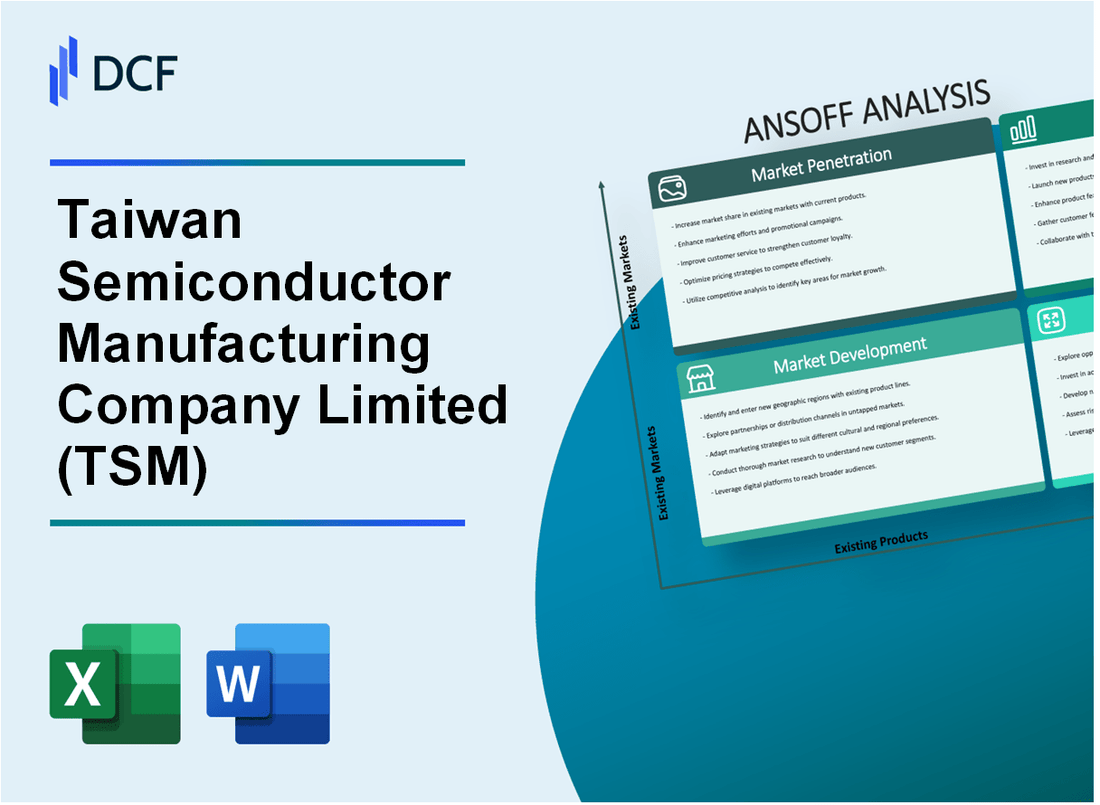
Taiwan Semiconductor Manufacturing Company Limited (TSM): ANSOFF MATRIX ANÁLISE [JAN-2025 Atualizado] |
Totalmente Editável: Adapte-Se Às Suas Necessidades No Excel Ou Planilhas
Design Profissional: Modelos Confiáveis E Padrão Da Indústria
Pré-Construídos Para Uso Rápido E Eficiente
Compatível com MAC/PC, totalmente desbloqueado
Não É Necessária Experiência; Fácil De Seguir
Taiwan Semiconductor Manufacturing Company Limited (TSM) Bundle
No mundo dinâmico da fabricação de semicondutores, a Taiwan Semiconductor Manufacturing Company (TSM) fica na vanguarda da inovação tecnológica, navegando estrategicamente paisagens complexas de mercado por meio de sua matriz de Ansoff meticulosamente criada. Com uma busca incansável de crescimento e liderança tecnológica, o TSM está pronto para redefinir os limites da fabricação de chips, direcionando nós avançados de processo, mercados emergentes e tecnologias de ponta que moldarão o futuro da computação e ecossistemas eletrônicos. Mergulhe nessa exploração do roteiro estratégico do TSM, onde a inovação atende à expansão calculada em várias dimensões estratégicas.
Taiwan Semiconductor Manufacturing Company Limited (TSM) - Ansoff Matrix: Penetração de mercado
Expandir a capacidade avançada de fabricação de chips nos mercados de semicondutores existentes
A capacidade de 5 nm da TSMC atingiu 146.000 bolachas de 12 polegadas por mês em 2022. A Companhia investiu US $ 32,4 bilhões em despesas de capital em 2022 para expandir as capacidades de fabricação.
| Nó de fabricação | Capacidade mensal da bolacha | Investimento |
|---|---|---|
| 5nm | 146.000 bolachas de 12 polegadas | US $ 32,4 bilhões (2022) |
| 3nm | 55.000 bolachas de 12 polegadas | US $ 36 bilhões de investimento planejado |
Aumente os preços competitivos para os nós do processo de semicondutores de ponta
O preço médio de venda da TSMC por bolacha foi de US $ 3.500 para nós avançados em 2022.
Fortalecer o relacionamento com os clientes com os principais clientes de tecnologia
- A Apple representou 26% da receita total do TSMC em 2022
- Nvidia representou 15% da receita total em 2022
- A base total de clientes inclui mais de 480 clientes ativos
Otimize a eficiência da produção para reduzir os custos de fabricação
O TSMC alcançou uma margem bruta de 52,4% em 2022, indicando eficiência significativa da produção.
| Métrica | 2022 Performance |
|---|---|
| Margem bruta | 52.4% |
| Margem operacional | 43.5% |
Invista em pesquisas avançadas para manter a liderança tecnológica
A TSMC alocou US $ 3,6 bilhões para pesquisa e desenvolvimento em 2022, representando 7,5% da receita total.
- A pesquisa se concentra nas tecnologias de processo de 3 nm e 2nm
- Mais de 6.000 engenheiros dedicados à pesquisa avançada de semicondutores
Taiwan Semiconductor Manufacturing Company Limited (TSM) - Ansoff Matrix: Desenvolvimento de Mercado
Expandir a presença geográfica em mercados de tecnologia emergentes
Em 2022, a TSMC investiu US $ 7 bilhões em uma nova instalação de fabricação de semicondutores no Arizona, EUA. A empresa planeja investir um total de US $ 40 bilhões em fabricação avançada de chips nos Estados Unidos até 2028.
| Mercado | Investimento | Capacidade |
|---|---|---|
| Índia | US $ 1,2 bilhão | Nó de tecnologia de 5 nm |
| Sudeste Asiático | US $ 3,5 bilhões | Produção avançada de semicondutores |
Desenvolva parcerias estratégicas com fabricantes de tecnologia regional
A TSMC estabeleceu parcerias com 14 empresas principais de tecnologia em todo o mundo, incluindo Apple, Nvidia e Qualcomm.
- Receita de parceria em 2022: US $ 68,4 bilhões
- Aliança Estratégica com Mediatek em Taiwan
- Colaboração com ARM Holdings for Advanced Chip Design
Tarde novos segmentos de clientes em eletrônicos automotivos e industriais
A receita de semicondutores automotivos da TSMC atingiu US $ 4,2 bilhões em 2022, representando um crescimento de 35% ano a ano.
| Setor | Receita | Taxa de crescimento |
|---|---|---|
| Eletrônica automotiva | US $ 4,2 bilhões | 35% |
| Eletrônica industrial | US $ 3,7 bilhões | 28% |
Estabelecer instalações de fabricação adicionais
A TSMC opera instalações de fabricação em Taiwan, China, Estados Unidos, e está planejando a expansão no Japão.
- Capacidade total de fabricação: 13 milhões de bolachas equivalentes de 12 polegadas por ano
- Investimento planejado no Japão: US $ 7,5 bilhões
- Novo fabuloso no Arizona espera produzir lascas de 4 e 3 nm
Explore oportunidades em mercados emergentes
O TSMC identificou os principais mercados emergentes com a crescente demanda de semicondutores, incluindo Índia, Sudeste Asiático e países europeus selecionados.
| Mercado | Crescimento da demanda de semicondutores | Investimento projetado |
|---|---|---|
| Índia | 22% de crescimento anual | US $ 1,2 bilhão |
| Sudeste Asiático | Crescimento anual de 18% | US $ 3,5 bilhões |
Taiwan Semiconductor Manufacturing Company Limited (TSM) - Ansoff Matrix: Desenvolvimento de produtos
Invista em tecnologias de processo de semicondutores de 3 nm e 2Nm
A TSMC investiu US $ 28 bilhões em despesas de capital para 2022 para desenvolver tecnologias avançadas de processo. A tecnologia de processo de 3 nm da empresa possui 1,6 vezes a densidade lógica de 5 nm e oferece redução de 10 a 15% e melhoria de desempenho de 5 a 10%.
| Nó de processo | Investimento | Melhoria de desempenho |
|---|---|---|
| 3nm | US $ 8,5 bilhões | 10-15% de ganho de desempenho |
| 2nm | US $ 12 bilhões planejados | Ganho de desempenho esperado de 15 a 20% |
Desenvolva chips especializados para aplicações de inteligência artificial e aprendizado de máquina
A participação de mercado de Chip AI da TSMC atingiu 70% em 2022, com receita de US $ 15,4 bilhões de soluções de semicondutores avançadas para aplicativos de IA.
- Capacidade de produção de chips de IA: 300.000 bolachas por mês
- Crescimento do mercado de chips de IA: 40% ano a ano
- Preço médio de venda para chips de IA: US $ 5.200 por bolacha
Crie soluções de semicondutores personalizadas para mercados de computação de alto desempenho
A TSMC garantiu US $ 9,2 bilhões em contratos de computação de alto desempenho em 2022, com crescimento projetado de 25% em 2023.
| Segmento de mercado | Receita | Projeção de crescimento |
|---|---|---|
| Chips de data center | US $ 6,5 bilhões | Crescimento de 30% |
| Supercomputer Solutions | US $ 2,7 bilhões | 20% de crescimento |
Aprimorar projetos de chips com eficiência energética para aplicativos móveis e de data center
O TSMC alcançou 30% de melhoria de eficiência de energia nos designs de chips móveis e de data center para 2022.
- Redução de energia: 25-35% em plataformas móveis
- Investimento de eficiência energética: US $ 3,6 bilhões
- Desempenho energético de chip móvel: 40% de melhoria
Inovar em embalagens avançadas e tecnologias de interconexão
A TSMC investiu US $ 2,5 bilhões em tecnologias avançadas de embalagens em 2022, com 45% de participação de mercado na embalagem avançada de semicondutores.
| Tecnologia de embalagem | Investimento | Quota de mercado |
|---|---|---|
| Chip-on-Wafer | US $ 850 milhões | 35% |
| Wafer-on-Wafer | US $ 650 milhões | 40% |
| Embalagem de fan-Out | US $ 1 bilhão | 50% |
Taiwan Semiconductor Manufacturing Company Limited (TSM) - Ansoff Matrix: Diversificação
Integração vertical nos serviços de design de semicondutores
A TSM investiu US $ 2,9 bilhões em pesquisa e desenvolvimento em 2022. A Companhia estabeleceu uma divisão de serviços de design dedicada com 1.200 engenheiros especializados.
| Categoria de serviço de design | Valor do investimento | Pessoal |
|---|---|---|
| Design lógico avançado | US $ 850 milhões | 450 engenheiros |
| Soluções de design de memória | US $ 620 milhões | 350 engenheiros |
| Design de chip personalizado | US $ 430 milhões | 400 engenheiros |
Programas de licenciamento de propriedade intelectual
A TSM gerou US $ 413 milhões com o licenciamento de propriedade intelectual em 2022.
- Acordos totais de licenciamento de IP: 87
- Receita média de licenciamento por contrato: US $ 4,75 milhões
- Distribuição geográfica de licenças de PI: 42% Ásia, 33% da América do Norte, 25% Europa
Investimentos de pesquisa de computação quântica
A TSM alocou US $ 675 milhões para pesquisa de computação quântica em 2022-2023.
| Foco na pesquisa | Investimento | Pessoal de pesquisa |
|---|---|---|
| Desenvolvimento de chips quânticos | US $ 290 milhões | 180 pesquisadores |
| Materiais Quânticos | US $ 215 milhões | 120 pesquisadores |
| Algoritmos de computação quântica | US $ 170 milhões | 95 pesquisadores |
Investimentos estratégicos de capital de risco
A TSM comprometeu US $ 1,2 bilhão a investir em Venture Capital Investments em 2022.
- Número de investimentos em inicialização: 24
- Investimento médio por startup: US $ 50 milhões
- Setores de investimento: tecnologia de semicondutores, IA, materiais avançados
Materiais avançados e fabricação de equipamentos semicondutores
A TSM investiu US $ 1,5 bilhão em pesquisa avançada de materiais e equipamentos.
| Segmento de tecnologia | Investimento | Foco de desenvolvimento |
|---|---|---|
| Materiais avançados | US $ 680 milhões | Substratos semicondutores de próxima geração |
| Fabricação de equipamentos | US $ 820 milhões | Ferramentas de litografia de precisão |
Taiwan Semiconductor Manufacturing Company Limited (TSM) - Ansoff Matrix: Market Penetration
Market Penetration for Taiwan Semiconductor Manufacturing Company Limited (TSM) centers on maximizing sales of existing process technologies and services within current customer segments, primarily driven by the insatiable demand for High-Performance Computing (HPC) and Artificial Intelligence (AI) chips.
To meet the surging AI demand, Taiwan Semiconductor Manufacturing Company Limited (TSM) is executing a plan to double advanced packaging (CoWoS) capacity in 2025. Industry sources estimate that monthly CoWoS capacity will reach between 65,000 and 75,000 wafers by the end of 2025, a significant increase from the 35,000 to 40,000 wafers per month capacity in 2024. Some projections even target an increase to approximately 90,000 wafers per month by the end of 2025, up from about 36,000 wafers per month currently.
The utilization of the most advanced nodes is near total, supporting pricing power. Due to this tight supply, Taiwan Semiconductor Manufacturing Company Limited (TSM) is moving to increase pricing for 3nm and 5nm nodes by 5% to 10%. Reports suggest these hikes could be implemented as early as January 2025. For context, the 3nm process accounted for 22% of wafer revenue in Q1 2025, while the 5nm node contributed 36% of wafer revenue in that same quarter. The 3nm and 5nm facilities are reportedly expected to be 100% booked out in 2026.
The sales focus is squarely on the highest-margin, highest-demand sector. HPC/AI drove 59% of Taiwan Semiconductor Manufacturing Company Limited (TSM)'s revenue in Q1 2025, growing 7% quarter-over-quarter, even as smartphone revenue sequentially decreased by 22% to account for 28% of total revenue. Management has forecast that AI-focused chip revenue should roughly double in 2025.
Securing anchor client volume is critical to justifying capacity investments. NVIDIA has reportedly secured over 70% of Taiwan Semiconductor Manufacturing Company Limited (TSM)'s advanced packaging capacity for 2025, primarily for its next-generation Blackwell AI processors. Furthermore, Apple has allegedly secured more than half of the initial capacity for the 2nm process node, which is set for volume production in the second half of 2025.
To solidify market leadership, Taiwan Semiconductor Manufacturing Company Limited (TSM) is aggressively scaling its most advanced process. The company expects to expand 3nm capacity by over 60% in 2025. This expansion aims to increase monthly wafer production from between 100,000 and 110,000 units at the end of the prior year to an estimated 160,000 monthly units by the end of 2025. In Q3 2025, the 3nm process alone accounted for 23% of total revenue.
Here are the key figures underpinning the Market Penetration strategy:
| Metric | Value/Range | Context/Timeframe |
| HPC/AI Revenue Share | 59% | Q1 2025 Revenue |
| 3nm Wafer Revenue Share | 22% | Q1 2025 Wafer Revenue |
| 5nm Wafer Revenue Share | 36% | Q1 2025 Wafer Revenue |
| Projected 3nm Capacity Growth | Over 60% | 2025 Expansion |
| Projected 3nm Monthly Output | 160,000 wafers | End of 2025 Estimate |
| Projected CoWoS Capacity | 65,000 to 75,000 wafers/month | 2025 Target |
| NVIDIA CoWoS Contract Share | Over 70% | 2025 Capacity |
| 3nm/5nm Price Increase | 5% to 10% | Expected 2025/2026 Hikes |
The concentration of revenue in the most advanced nodes dictates the near-term actions:
- Double monthly CoWoS output to meet AI accelerator needs.
- Targeted price increases of 5% to 10% on 3nm and 5nm nodes.
- HPC/AI segment revenue expected to double for the full year 2025.
- Securing long-term volume commitments from NVIDIA (over 70% of packaging) and Apple (over half of 2nm).
- Scaling 3nm capacity by over 60% to reach 160,000 monthly wafers by year-end.
Finance: draft 13-week cash view by Friday.
Taiwan Semiconductor Manufacturing Company Limited (TSM) - Ansoff Matrix: Market Development
Market Development for Taiwan Semiconductor Manufacturing Company Limited (TSM) centers on establishing manufacturing footprints in key geographic markets to serve local demand, particularly for automotive and industrial clients, while maintaining quality consistency across its global operations.
Accelerate construction of the $65 billion US fabs in Arizona for advanced nodes.
You're looking at a massive commitment to the United States, which is now significantly larger than initially planned. The initial investment in Arizona is now part of a total planned investment reaching $165 billion in the U.S., announced in March 2025, which includes three cutting-edge wafer fabs, two advanced packaging facilities, and a major R&D Center. The first fab module, near the existing Fab 21, began producing advanced 4-nanometer (nm) chips for U.S. customers in January 2025. The second fab is slated to start mass production using the more sophisticated 3nm and 2nm processes in 2028. The third fab is planned to begin production of chips using 2nm or more advanced processes by the end of the decade. This entire Arizona undertaking is supported by a substantial financial package from the U.S. government under the CHIPS and Science Act, totaling $11.6 billion, composed of $6.6 billion in grants and up to $5 billion in loans. This scale of investment is projected to create approximately 6,000 direct manufacturing jobs and over 20,000 construction positions. Furthermore, $50 million has been set aside specifically for training local talent.
Ramp up production at the Kumamoto, Japan, fab for automotive and specialty chips.
The first facility in Kumamoto, operating under the joint venture JASM Inc., started mass production at the end of 2024. This plant focuses on mature process logic chips in the 12nm to 28nm range, directly targeting the automotive and image sensor markets, with Sony Group and Denso Corp. as initial customers. In 2024, TSMC's Japan operations contributed over $4 billion in revenue, representing about 4% of the company's total revenue, with wafer shipments equivalent to over 1.49 million 12-inch wafers. The Japanese government is supporting this effort with over 1 trillion yen in subsidies. The total investment for both planned Kumamoto fabs is estimated at 2.96 trillion yen, with the Japanese government contributing approximately 1.2 trillion yen. Construction for the second Kumamoto fab, which will introduce more advanced 6nm and 7nm technology to Japan, is scheduled to begin in the second half of 2025 (after July), with operations expected by the end of 2027. Once both facilities are fully operational, their combined monthly output is projected to exceed 100,000 wafers. As of April 2025, JASM's local headcount reached approximately 2,400 employees, following the addition of 527 new local hires since the start of the year.
Establish the planned specialty technology fab in Dresden, Germany, targeting European automotive clients.
The European expansion is materializing through the European Semiconductor Manufacturing Company (ESMC) joint venture in Dresden. The German government has approved financing for this project, which involves an overall investment exceeding EUR10 billion (about $10.5 billion). The German government is providing roughly half of the funding, or EUR5 billion. TSM's direct investment commitment is approximately 35% of the total, or 3.5 billion euros. European partners Bosch, Infineon, and NXP Semiconductors each hold a 10% stake. This fab will specifically use mature processes, from 28nm to 12nm FinFET, to support the European automotive and industrial sectors. The target is a monthly production capacity of around 40,000 to 41,700 12-inch wafers, with production slated to start by the end of 2027.
Here's a quick look at the three major overseas fab developments:
| Location | Process Node Focus | Estimated Total Investment (TSM Share) | Target Start of Production |
| Arizona, US | 4nm, 3nm, 2nm and more advanced | Over $65 billion (Total project $\sim$$165 billion) | 2025 (Fab 1), 2028 (Fab 2) |
| Kumamoto, Japan | 12nm to 28nm (Fab 1), 6nm/7nm (Fab 2) | Estimated 2.96 trillion yen (Total for both fabs) | 2024 (Fab 1 ramp), End of 2027 (Fab 2) |
| Dresden, Germany | 12nm to 28nm | 3.5 billion euros (TSM share) | End of 2027 |
Leverage the global E-Fab network to ensure consistent quality across all new regions.
TSM's strategy relies on its established reputation for precision and quality control, which has allowed it to capture over 60% of global spending at chip foundries. The company serves a diverse global customer base of 522 companies, manufacturing more than 12,302 products across various applications. A key assurance for market development is the commitment that the production line at the first Kumamoto facility will deliver the same quality as those in Taiwan. This consistency is vital as TSM expands its manufacturing footprint to new regions like the U.S. and Germany.
Target new industrial sectors requiring mature nodes, like IoT and edge computing.
While the focus for new fabs is often on leading-edge nodes, the existing and planned mature node capacity is crucial for specific market segments. For the second quarter of 2025, the IoT and Automotive segments each accounted for 5% of TSM's revenue. Recovery for mature nodes (28/22nm and above) is anticipated in the second half of 2025 as inventory restocking picks up, following a slower period due to weaker consumer electronics demand. This contrasts with the advanced nodes; for the first quarter of 2025, technologies of 7nm and below accounted for 73% of total wafer revenue. The overall financial outlook remains strong, with management reaffirming its full-year 2025 revenue growth forecast at approximately 30% in U.S. dollar terms, with capital expenditure guidance set between $38 billion and $42 billion for the year.
You should track the utilization rates for the mature nodes closely, as that will signal the success of targeting these industrial sectors.
- Q1 2025 revenue from 3-nanometer accounted for 22% of total wafer revenue.
- Q1 2025 revenue from 5-nanometer accounted for 36% of total wafer revenue.
- The company's gross margin for Q1 2025 was 58.8%.
- For September 2025, revenue was approximately NT$330.98 billion (about $10.83 billion USD).
Taiwan Semiconductor Manufacturing Company Limited (TSM) - Ansoff Matrix: Product Development
You're looking at the core of Taiwan Semiconductor Manufacturing Company Limited's (TSM) future revenue stream, which is all about pushing the physical limits of silicon. This is Product Development in action-taking existing market needs and serving them with entirely new, bleeding-edge technology.
The immediate focus is the 2nm (N2) node. We expect volume production to kick off in the H2 2025 timeframe. Initial capacity is reportedly set around 40,000 wafers per month, which is a significant ramp for a brand-new process. This N2 technology, featuring the first-generation nanosheet transistor structure, is designed to deliver substantial gains over the prior generation, N3E. Here's the quick math on the performance uplift:
| Metric vs. N3E | Performance Improvement | Power Reduction | Density Increase |
|---|---|---|---|
| N2 Node | 10-15% speed at same power | 22-30% power at same speed | 15% |
| N2P Node (Extension) | 7-10% additional speed (with SPR) | 15-20% additional power reduction (with SPR) | Not specified |
To be fair, the cost structure for N2 is expected to be one of the most expensive for clients to integrate, but the demand is reportedly higher than what 3nm saw initially, so the market is clearly willing to pay for that performance edge, especially for AI and HPC workloads.
The roadmap doesn't stop there; TSM is already planning the next step. The A16 node, which is their first angstrom-class technology, is slated for mass production in the H2 2026. This node will incorporate the innovative Super Power Rail (SPR) architecture, which is key for handling the power demands of next-generation high-performance computing chips.
This aggressive R&D push is backed by serious capital. For 2025, TSM has set its total capital expenditure guidance between $40 billion and $42 billion. The bulk of this-a substantial 70% of the total budget-is earmarked for advanced process technologies, which is where the N2, N2P, and A16 development lives. This allocation is the financial commitment to staying ahead of competitors in the sub-7nm space.
Beyond the leading-edge planar scaling, 3D integration is a major product development pillar. TSM is scaling its SoIC (System on Integrated Chips) platform this year. Specifically, you should track the support for 6um face-to-face hybrid bonding in 2025. This technology is crucial for heterogeneous integration, allowing them to stack different chiplets together. The goal is ambitious: enabling A14-on-N2 chip stacking by 2029, which implies a massive 20x increase in I/O density compared to the first SoIC generation. The bond pitch itself starts from the sub-10µm rule, showing the incredible precision involved.
To capture diverse market segments even within the advanced node space, TSM is offering tailored 3nm variants. You need to know these specific offerings:
- N3A: Tailored specifically for automotive applications.
- N3X: Designed to meet the needs of high-performance computing (HPC) applications, which includes many client CPUs.
- N3E and N3P: Enhanced versions of the base N3 for better power, performance, and density.
- N3C: Supports value-tier products with a focus on better cost effectiveness.
Finance: review the Q3 2025 capital allocation report against the 70% target for advanced nodes by next Tuesday.
Taiwan Semiconductor Manufacturing Company Limited (TSM) - Ansoff Matrix: Diversification
You're looking at where Taiwan Semiconductor Manufacturing Company Limited (TSM) is placing its bets outside of its core, established process nodes, which is where diversification lives in the Ansoff Matrix. Honestly, this is where the next decade of growth is forged, and the numbers show a serious commitment. For the twelve months ending September 30, 2025, Taiwan Semiconductor Manufacturing Company Limited (TSM) recorded research and development expenses of $7.479B, marking a 19.08% increase year-over-year. To put that in perspective, in 2024, total R&D expenditures amounted to 7.1% of revenue.
The long-term play definitely involves pushing past current limits, like funding research into Complementary FET (CFET) architecture, even for the A7 node. This exploratory work is focused on nodes beyond A14, alongside 3D transistors and new memories, to lay the foundation for future technology platforms. The A14 or 14-Angstrom node generation of chip technology is slated for mass production by 2028, following the late-2025 start for 2 nm chips.
Here's a quick look at how these next-generation process targets stack up:
| Technology Node | Target Mass Production Year | Performance Improvement over Previous Node (Example) |
| 2 nm | 2025 (Late) | Baseline for comparison |
| A14 (1.4 nm) | 2028 | 15% more speed; 20% increase in logic density over 2 nm |
Also critical to this diversification is exploring novel materials like 2D transition metal dichalcogenides (TMD) for post-silicon transistors. These materials are seen as promising for next-generation computing to address the pressing challenges of achieving higher density integration and enhanced energy efficiency. This research signals a transition from laboratory demonstrations to industrial-scale applications, which is a necessary step for any long-term technology shift.
For data center connectivity, the development of silicon photonics via the Compact Universal Photonic Engine (COUPE) is a major focus. K.C. Hsu, Vice President of Integrated Interconnect & Packaging, called 2024 the "awakening year" for this technology. The goal is to launch co-packaged optical (CPO) modules based on CoWoS packaging technology in 2026, after completing technical verification for small-size pluggable devices in 2025. To secure this lead, Taiwan Semiconductor Manufacturing Company Limited (TSM) filed 50 U.S. patents related to core silicon photonics technology in 2024, which was roughly double Intel's 26 filings that same year.
Capturing the next wave of AI applications by 2028 involves investing in neuromorphic computing chip research. This is a market poised for massive growth; the neuromorphic chip market size stands at USD 0.33 billion in 2025 and is projected to surge to USD 11.77 billion by 2030, expanding at a 104.7% CAGR. In 2024, digital chips accounted for a 44.1% share of that market. New products resulting from quantum computing research are expected to materialize around 2028.
Finally, expanding specialty chip offerings for aerospace and military hardware is achieved through partnerships with defense contractors. While specific revenue figures from these segments aren't broken out, the general trend shows that the overall AI chip market size is estimated at $94.5Bn with a 29% CAGR. The capability to fabricate advanced, high-reliability chips is the key offering here.
- COUPE uses SoIC-X chip stacking technology.
- The brain-inspired neuromorphic chip market is forecast to grow at a 105.6% CAGR for ReRAM-centric designs through 2030.
- The A14 node aims to improve processing speeds for artificial intelligence applications.
- TSM's 2025 wafer shipment is expected to be 14-15 million 12-inch equivalent wafers.
Finance: draft 13-week cash view by Friday.
Disclaimer
All information, articles, and product details provided on this website are for general informational and educational purposes only. We do not claim any ownership over, nor do we intend to infringe upon, any trademarks, copyrights, logos, brand names, or other intellectual property mentioned or depicted on this site. Such intellectual property remains the property of its respective owners, and any references here are made solely for identification or informational purposes, without implying any affiliation, endorsement, or partnership.
We make no representations or warranties, express or implied, regarding the accuracy, completeness, or suitability of any content or products presented. Nothing on this website should be construed as legal, tax, investment, financial, medical, or other professional advice. In addition, no part of this site—including articles or product references—constitutes a solicitation, recommendation, endorsement, advertisement, or offer to buy or sell any securities, franchises, or other financial instruments, particularly in jurisdictions where such activity would be unlawful.
All content is of a general nature and may not address the specific circumstances of any individual or entity. It is not a substitute for professional advice or services. Any actions you take based on the information provided here are strictly at your own risk. You accept full responsibility for any decisions or outcomes arising from your use of this website and agree to release us from any liability in connection with your use of, or reliance upon, the content or products found herein.