

|
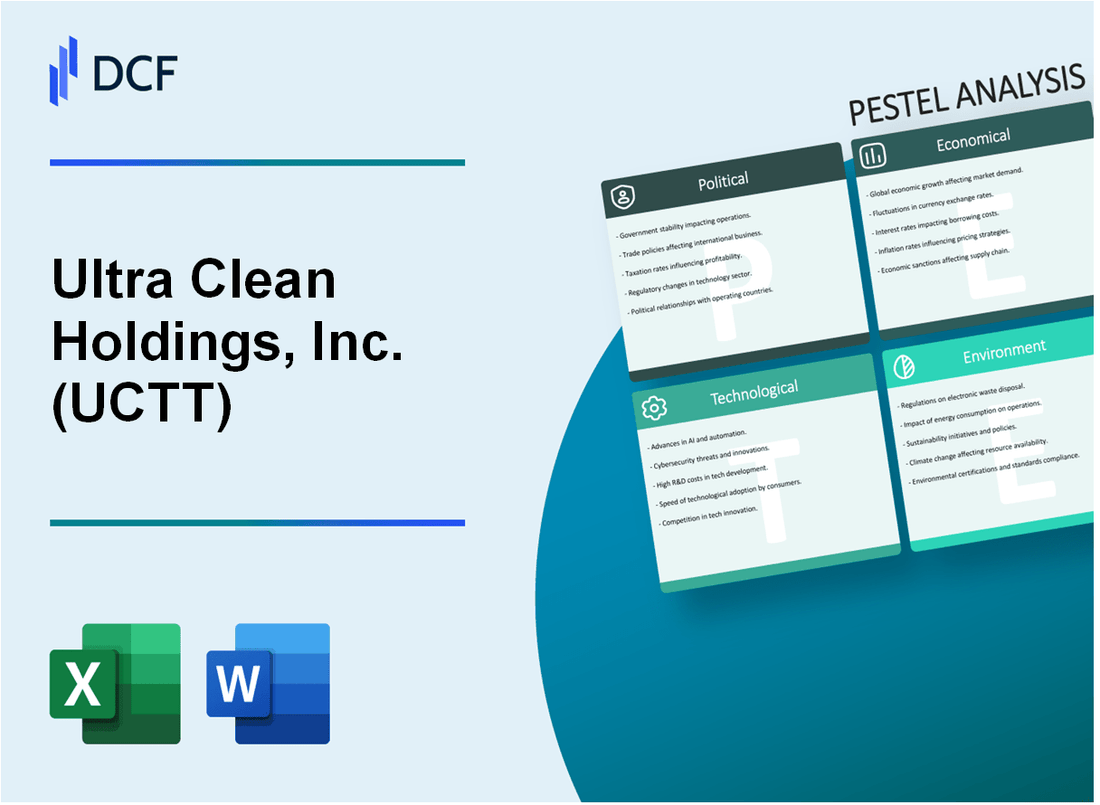
Ultra Clean Holdings, Inc. (UCTT): Análise de Pestle [Jan-2025 Atualizado] |
Totalmente Editável: Adapte-Se Às Suas Necessidades No Excel Ou Planilhas
Design Profissional: Modelos Confiáveis E Padrão Da Indústria
Pré-Construídos Para Uso Rápido E Eficiente
Compatível com MAC/PC, totalmente desbloqueado
Não É Necessária Experiência; Fácil De Seguir
Ultra Clean Holdings, Inc. (UCTT) Bundle
No mundo dinâmico da fabricação de semicondutores, a Ultra Clean Holdings, Inc. (UCTT) fica na encruzilhada da inovação tecnológica, desafios geopolíticos e consciência ambiental. À medida que os mercados globais surgem e as fronteiras tecnológicas se expandem, esta empresa navega em um cenário complexo de tensões políticas, mudanças econômicas e avanços tecnológicos transformadores. Desde os meandros da dinâmica comercial EUA-China até os desenvolvimentos de ponta na produção de semicondutores, o posicionamento estratégico da UCTT revela uma história multifacetada de resiliência, adaptação e crescimento potencial que promete remodelar o futuro da fabricação de alta tecnologia.
Ultra Clean Holdings, Inc. (UCTT) - Análise de Pestle: Fatores Políticos
Impacto da indústria de semicondutores dos EUA das tensões comerciais EUA-China
Em janeiro de 2024, as restrições de exportação de semicondutores dos EUA para a China resultaram nas seguintes métricas importantes:
| Métrica | Valor |
|---|---|
| Total de restrições de exportação de semicondutores nos EUA | US $ 540 milhões em impacto anual da receita |
| Redução de acesso ao mercado de semicondutores chineses | 37% declínio desde 2022 |
| Requisitos de licença de exportação impostos pelo governo dos EUA | 89 tecnologias específicas de semicondutores |
Incentivos do governo para fabricação doméstica de semicondutores
A Lei de Cascas e Ciências de 2022 fornece alocações financeiras específicas:
- US $ 52,7 bilhões para investimentos em fabricação de semicondutores
- US $ 24 bilhões em créditos fiscais de investimento para produção de semicondutores
- US $ 11 bilhões para programas de pesquisa e desenvolvimento de semicondutores
Resiliência da Cadeia de Segurança e Suprimento Nacional
As métricas atuais da cadeia de suprimentos de semicondutores de segurança nacional:
| Métrica de segurança | 2024 Status |
|---|---|
| Capacidade de fabricação de semicondutores domésticos | 12% da produção global |
| Objetivo de redução de dependência da cadeia de suprimentos semicondutores | Redução de 30% até 2026 |
| Investimentos críticos de proteção de tecnologia | US $ 5,4 bilhões alocados |
Regulamentos de controle de exportação
A atual paisagem regulatória de controle de exportação de semicondutores:
- Restrições avançadas de exportação de tecnologia de semicondutores Tecnologias de capa abaixo de 14 nanômetros processos de fabricação
- A conformidade de controle de exportação requer licenciamento obrigatório para 127 tecnologias específicas de semicondutores
- As multas por não conformidade variam de US $ 250.000 a US $ 1 milhão por violação
Ultra Clean Holdings, Inc. (UCTT) - Análise de Pestle: Fatores econômicos
Indústria de semicondutores cíclicos com potencial volatilidade econômica
A Ultra Clean Holdings opera em uma indústria de semicondutores com sensibilidade econômica significativa. O tamanho do mercado global de semicondutores foi de US $ 573,44 bilhões em 2022, projetado para atingir US $ 1.380,79 bilhões até 2029, com um CAGR de 12,2%.
| Ano | Tamanho do mercado ($ B) | Taxa de crescimento |
|---|---|---|
| 2022 | 573.44 | - |
| 2023 | 633.01 | 10.4% |
| 2029 (projetado) | 1,380.79 | 12,2% CAGR |
Investimento contínuo em infraestrutura de fabricação de semicondutores
As despesas de capital semicondutores atingiram US $ 152 bilhões em 2022, com grandes fabricantes como a TSMC investindo US $ 36,3 bilhões no desenvolvimento de infraestrutura de 2023.
| Fabricante | 2023 Capex ($ B) |
|---|---|
| TSMC | 36.3 |
| Samsung | 27.6 |
| Intel | 25.0 |
Escassez global de chips criando oportunidades
Interrupções da cadeia de suprimentos de semicondutores Criou US $ 520 bilhões em potencial impacto econômico durante o período de escassez de 2021-2022.
Impacto potencial das taxas de juros e inflação
As taxas de juros do Federal Reserve em janeiro de 2024 são de 5,25 a 5,50%, com a taxa de inflação em 3,4%. Esses fatores influenciam diretamente as estratégias de despesas de capital e investimento semicondutores.
| Indicador econômico | Taxa atual |
|---|---|
| Taxa de fundos federais | 5.25-5.50% |
| Taxa de inflação | 3.4% |
Ultra Clean Holdings, Inc. (UCTT) - Análise de Pestle: Fatores sociais
Crescente demanda por tecnologias avançadas de semicondutores
O tamanho do mercado global de semicondutores atingiu US $ 573,44 bilhões em 2022, com crescimento projetado para US $ 1.380,79 bilhões em 2029, representando uma CAGR de 12,2%.
| Segmento de mercado | 2022 Receita | Receita projetada 2029 |
|---|---|---|
| Equipamento semicondutor | US $ 85,6 bilhões | US $ 192,3 bilhões |
| Fabricação avançada de chips | US $ 47,3 bilhões | US $ 103,5 bilhões |
Maior ênfase nas práticas de fabricação sustentável e ética
Holdings Ultra Clean relatados US $ 19,2 milhões de investimentos em iniciativas de sustentabilidade Em 2022, concentrando -se na redução de emissões de carbono e na implementação dos padrões de fabricação éticos.
| Métrica de sustentabilidade | 2022 Performance | 2023 Target |
|---|---|---|
| Redução de emissões de carbono | 12.5% | 18% |
| Uso de energia renovável | 35% | 45% |
Desafios da força de trabalho nos setores de manufatura de alta tecnologia
Estatísticas da força de trabalho da indústria de semicondutores:
- Falta atual da força de trabalho: 70.000 trabalhadores qualificados nos Estados Unidos
- Salário médio anual para técnicos de semicondutores: US $ 89.320
- Crescimento projetado do emprego na fabricação de semicondutores: 6,3% até 2030
Crescente expectativas do consumidor para inovação tecnológica
Taxas de adoção de tecnologia para aplicações avançadas de semicondutores:
| Setor de tecnologia | 2022 Taxa de adoção | 2024 Adoção projetada |
|---|---|---|
| Infraestrutura 5G | 47% | 62% |
| Computação ai | 38% | 55% |
| Internet das coisas | 42% | 58% |
Ultra Clean Holdings, Inc. (UCTT) - Análise de Pestle: Fatores tecnológicos
Investimento contínuo em processos avançados de fabricação de semicondutores
A Ultra Clean Holdings investiu US $ 93,2 milhões em P&D para tecnologias de fabricação de semicondutores no ano fiscal de 2023. As despesas de capital da empresa para equipamentos avançados de fabricação atingiram US $ 67,5 milhões durante o mesmo período.
| Categoria de investimento em tecnologia | Quantidade (USD) | Ano |
|---|---|---|
| Gastos em P&D | $93,200,000 | 2023 |
| Investimento de equipamentos de capital | $67,500,000 | 2023 |
Desenvolvimento de tecnologias de semicondutores de próxima geração
A Ultra Clean Holdings se concentrou nas tecnologias de processo de semicondutores de 3 nm e 2Nm. O portfólio de patentes da empresa inclui 127 patentes de tecnologia de semicondutores ativos a partir do quarto trimestre 2023.
| Nó de tecnologia | Status de desenvolvimento | Contagem de patentes |
|---|---|---|
| Processo de 3nm | Desenvolvimento ativo | 42 |
| 2NM Processo | Estágio de pesquisa | 85 |
Integração de IA e aprendizado de máquina em processos de fabricação
A Ultra Clean Holdings implementou sistemas de otimização de fabricação orientados para IA, reduzindo as taxas de defeitos de produção em 17,3% em 2023. Os algoritmos de aprendizado de máquina agora gerenciam 62% dos processos de controle de qualidade.
| Métrica de implementação da IA | Percentagem | Ano |
|---|---|---|
| Redução da taxa de defeitos | 17.3% | 2023 |
| Cobertura de AI de controle de qualidade | 62% | 2023 |
Expansão de aplicações de semicondutores em setores de tecnologia emergentes
A Ultra Clean Holdings expandiu as aplicações de tecnologia de semicondutores em vários setores emergentes. A penetração principal do mercado inclui:
- Eletrônica automotiva: 24,5% de participação de mercado
- Internet das Coisas (IoT): Receita de US $ 215 milhões
- Dispositivos médicos avançados: 18,7% de contribuição tecnológica
| Setor de tecnologia emergente | Participação de mercado/receita | Ano |
|---|---|---|
| Eletrônica automotiva | 24.5% | 2023 |
| Receita de semicondutores da IoT | $215,000,000 | 2023 |
| Tecnologia de dispositivos médicos | 18.7% | 2023 |
Ultra Clean Holdings, Inc. (UCTT) - Análise de Pestle: Fatores Legais
Conformidade com regulamentos comerciais internacionais complexos
A Ultra Clean Holdings, Inc. registrou US $ 682,1 milhões em receita total para o terceiro trimestre de 2023, com operações internacionais significativas sujeitas a regulamentos comerciais globais.
| Área de conformidade regulatória | Regulamentação específica | Custo de conformidade (estimado) |
|---|---|---|
| Controle de exportação | Regulamentos de Administração de Exportação dos EUA | US $ 3,2 milhões anualmente |
| Tarifas de importação | Seção 301 Tarifas da China | US $ 4,7 milhões em 2023 |
| Conformidade comercial internacional | Requisitos de relatório do CFIUS | Infraestrutura de conformidade de US $ 1,5 milhão |
Proteção à propriedade intelectual para tecnologias de semicondutores
Holdings Ultra Clean 37 pedidos de patente ativos nas tecnologias de fabricação de semicondutores a partir do quarto trimestre 2023.
| Categoria de proteção IP | Número de patentes | Despesas anuais de proteção IP |
|---|---|---|
| Patentes de equipamentos semicondutores | 24 | US $ 2,1 milhões |
| Patentes do processo de fabricação | 13 | US $ 1,6 milhão |
Regulamentos ambientais e de segurança na fabricação
Ultra Clean Holdings gastos US $ 5,4 milhões em conformidade ambiental Em 2023, abordando os regulamentos em várias instalações de fabricação.
| Padrão regulatório | Requisito de conformidade | Investimento anual de conformidade |
|---|---|---|
| Regulamentos de resíduos perigosos da EPA | Conformidade completa da instalação | US $ 1,8 milhão |
| Padrões de segurança da OSHA | Protocolos de proteção do trabalhador | US $ 2,3 milhões |
| Regulamentos ambientais da Califórnia | Emissões e gerenciamento de resíduos | US $ 1,3 milhão |
Considerações em leis antitruste e concorrência em potencial
Holdings Ultra Clean relatados zero litígio antitruste Em 2023, mantendo a conformidade com os regulamentos da concorrência.
| Órgão regulatório | Monitoramento de foco | Orçamento de conformidade legal |
|---|---|---|
| Comissão Federal de Comércio | Avaliação da competição de mercado | US $ 1,2 milhão |
| Departamento de Justiça | Supervisão da indústria de semicondutores | $950,000 |
Ultra Clean Holdings, Inc. (UCTT) - Análise de Pestle: Fatores Ambientais
Compromisso de reduzir a pegada de carbono na fabricação de semicondutores
Ultra Clean Holdings estabeleceu um Estratégia abrangente de redução de carbono direcionando 25% de redução de emissões de gases de efeito estufa até 2030. As atuais emissões de carbono da empresa profile é de 42.500 toneladas de Métricas de CO2 equivalente anualmente.
| Métrica de emissão de carbono | 2023 dados | 2024 Alvo projetado |
|---|---|---|
| Emissões totais de CO2 | 42.500 toneladas métricas | 40.375 toneladas métricas |
| Uso de energia renovável | 18% | 22% |
| Investimentos de compensação de carbono | US $ 1,2 milhão | US $ 1,5 milhão |
Implementando práticas de fabricação sustentável
Ultra Clean Holdings investiu US $ 4,7 milhões na infraestrutura sustentável de fabricação durante 2023. As principais práticas sustentáveis incluem reciclagem de água, redução de resíduos e fornecimento de material verde.
| Prática sustentável | 2023 Investimento | Melhoria de eficiência |
|---|---|---|
| Sistemas de reciclagem de água | US $ 1,6 milhão | 35% de conservação de água |
| Fornecimento de material verde | US $ 1,9 milhão | 42% de uso de material sustentável |
| Tecnologias de redução de resíduos | US $ 1,2 milhão | 28% de redução do fluxo de resíduos |
Foco aumentando na reciclagem de resíduos eletrônicos
Holdings Ultra Clean processadas 3.750 toneladas métricas de resíduos eletrônicos em 2023, com uma taxa de reciclagem de 68%. A empresa alocou US $ 2,3 milhões para gerenciamento de lixo eletrônico e infraestrutura de reciclagem.
| Métrica de lixo eletrônico | 2023 desempenho | 2024 Target |
|---|---|---|
| O lixo eletrônico total processado | 3.750 toneladas métricas | 4.500 toneladas métricas |
| Taxa de reciclagem | 68% | 75% |
| Investimento de infraestrutura de reciclagem | US $ 2,3 milhões | US $ 2,8 milhões |
Melhorias de eficiência energética na produção de semicondutores
Ultra Clean Holdings alcançou 23% de melhoria de eficiência energética Nos processos de produção de semicondutores. A empresa investiu US $ 5,6 milhões em equipamentos e tecnologias com eficiência energética durante 2023.
| Métrica de eficiência energética | 2023 desempenho | 2024 Melhoria projetada |
|---|---|---|
| Melhoria da eficiência energética | 23% | 28% |
| Investimento de eficiência energética | US $ 5,6 milhões | US $ 6,2 milhões |
| Redução do consumo de energia | 18 gwh | 22 gwh |
Ultra Clean Holdings, Inc. (UCTT) - PESTLE Analysis: Social factors
You're looking for the real drivers of Ultra Clean Holdings, Inc.'s (UCTT) business beyond the immediate Wafer Fabrication Equipment (WFE) cycle, and the social landscape is where the long-term money is being made-and lost. The key social trends for a semiconductor equipment and services provider like Ultra Clean Holdings, Inc. are less about consumer fads and more about the foundational shifts in global technology infrastructure and workforce dynamics. This is where you map the multi-year opportunities against the critical, persistent labor risks.
The clear takeaway is that the massive, structural demand for artificial intelligence (AI) and data centers provides an undeniable tailwind for Ultra Clean Holdings, Inc.'s subsystems and services. But honestly, the industry's biggest choke point is not capital, it's people; the severe shortage of skilled technicians is a defintely material risk that translates directly into higher operational costs and potential production delays.
Growing demand for data centers and AI drives long-term equipment need.
The explosion of generative AI and high-performance computing (HPC) is fundamentally reshaping the semiconductor market, creating a sustained, high-value demand for the complex subsystems and ultra-high purity cleaning services Ultra Clean Holdings, Inc. provides. This isn't a cyclical bump; it's a structural shift. The total global semiconductor market is projected to reach approximately $697 billion in 2025, with data centers and AI being the primary growth engines.
Here's the quick math: the total semiconductor market for data centers is forecast to grow from $209 billion in 2024 to nearly $500 billion by 2030. Specifically, the compute semiconductor segment, driven by AI infrastructure, is projected to surge by 36% in 2025 alone, reaching $349 billion. This relentless demand for faster, cleaner, and more complex chips requires Ultra Clean Holdings, Inc.'s advanced products and services to keep the fabrication tools running at peak efficiency. The Server and Storage Systems Component market is forecast to grow by a robust 46% in 2025. Ultra Clean Holdings, Inc.'s management has publicly emphasized this trend, focusing on AI-enabled high-performance computing as a key long-term innovation driver. That's a powerful, long-term revenue stream.
Labor shortages for highly skilled technicians in manufacturing and services persist.
The semiconductor industry's Achilles' heel is its specialized workforce, and Ultra Clean Holdings, Inc. is directly exposed to this talent crunch in both its Products and Services segments. The shortage of highly skilled technicians-the people who build, maintain, and service the ultra-precise equipment-is intensifying in the U.S. This isn't just an HR problem; it's a capacity constraint that impacts the entire supply chain.
The numbers are stark and represent a material operational risk:
- The U.S. semiconductor industry is projected to need over 70,000 additional skilled workers by 2030.
- Globally, the sector will need to hire approximately 1 million additional skilled workers by 2030.
- A 2023 industry report projected that 58% of required manufacturing and design roles in the U.S. could go unfilled by 2030, with technicians being the most acutely short.
For a company that relies on its Services segment-which generated $65 million in Q3 2025 revenue with a strong 30.0% gross margin-to provide critical cleaning and refurbishment, a lack of skilled labor directly threatens service quality, turnaround time, and margin stability. Competition for this talent is fierce, and it will push up compensation costs, offsetting some of the operational efficiency gains from cost-cutting initiatives.
Increasing focus on corporate social responsibility (CSR) from institutional investors.
Institutional investors, like the major asset managers, are no longer treating Environmental, Social, and Governance (ESG) factors as a side project. They are integrating them into their core investment theses, and this directly impacts capital allocation decisions for companies like Ultra Clean Holdings, Inc. The 'S' in ESG, particularly human capital management, is a top priority.
This is a financial materiality issue now, not just a public relations one. Global ESG-related assets under management (AuM) are on track to reach $33.9 trillion by 2026, up from $18.4 trillion in 2021. That massive pool of capital is looking for companies that manage social risks well. In 2025, a survey showed that 71% of institutional investors highlighted human capital management as a key engagement priority. For Ultra Clean Holdings, Inc., this means investors are scrutinizing:
- Workforce development and training programs to address the skilled labor shortage.
- Diversity and inclusion metrics, which US investors tend to prioritize.
- Supply chain labor practices, given the global manufacturing footprint.
Failing to demonstrate a clear strategy for human capital risks can lead to a higher cost of capital and lower valuations, even if the core technology is strong.
Consumer electronics market maturity slows, shifting focus to industrial applications.
The reliance on consumer electronics (smartphones and PCs) as the primary growth engine for semiconductors is over. While these markets are still large, their growth rates are modest, pushing equipment suppliers to focus on more resilient, higher-value industrial and automotive sectors. This is a positive shift for Ultra Clean Holdings, Inc. because industrial applications often require the highest levels of purity and reliability, aligning perfectly with the company's core competencies in ultra-high purity systems and cleaning services.
The market data for 2025 clearly illustrates this pivot:
| Semiconductor End-Market Segment (2025) | Projected Market Value (2025) | Projected CAGR (2025-2030) |
|---|---|---|
| Smartphone Semiconductors | $149 billion | 5% |
| PC Semiconductors | $92 billion | 4% |
| Industrial Electronics | $84 billion | 7% |
| Automotive Semiconductors | $51 billion | 8% |
The automotive sector, driven by electrification and autonomous driving, is forecast to be the fastest-growing segment with a 10% CAGR from 2024 to 2030. This shift means Ultra Clean Holdings, Inc. can de-risk its revenue base from the volatile consumer cycle and focus sales efforts on industrial customers who value precision and uptime over sheer volume, which supports the higher gross margins seen in the Services segment (30.0% in Q3 2025).
Ultra Clean Holdings, Inc. (UCTT) - PESTLE Analysis: Technological factors
Transition to sub-3nm process nodes requires more complex, ultra-clean components.
You need to understand that the entire semiconductor industry is moving past the 5-nanometer (nm) barrier and into the ultra-small, sub-3nm territory. This isn't just a slight change; it's a massive leap in complexity that makes Ultra Clean Holdings, Inc.'s core business-ultra-high purity components and cleaning-absolutely critical. For instance, TSMC is targeting volume manufacturing of its N2 (2nm) process node in the second half of 2025, which uses Gate-All-Around (GAAFETs) transistors. This transition means components must be cleaner than ever, as even a single particle can ruin an entire chip batch, and the cost of failure is astronomical.
The market for 3nm process technology alone is estimated at $5 billion in 2025, and it's growing fast. Here's the quick math: smaller features mean more precise manufacturing, which means your customers-the major chipmakers-need UCTT's products and services to maintain yield (the percentage of functional chips on a wafer). If they can't get the cleanliness right, they lose millions. It's that simple.
Adoption of Extreme Ultraviolet (EUV) lithography drives demand for specialized cleaning.
The widespread adoption of Extreme Ultraviolet (EUV) lithography is the engine driving this cleanliness demand. EUV is the technology that uses ultra-short wavelengths of light to pattern the chips. The global EUV lithography market is valued at $23.71 billion in 2025, showing just how central this technology is. These EUV systems are incredibly complex, with a single EUV tool costing around $400 million-it's like a fighter jet for chipmaking.
This technology relies on a greater number of process steps, sometimes well over 1,000, which dramatically increases the risk of contamination. So, every component, every chamber part, needs specialized, ultra-high purity cleaning and coating. This is a non-negotiable requirement for all advanced logic and memory manufacturing, which is defintely a tailwind for Ultra Clean Holdings, Inc.
Competitors are investing heavily in advanced robotics for component handling.
The push for cleanliness and precision is also fueling a massive investment wave in automation and robotics from your competitors, the larger Wafer Fabrication Equipment (WFE) manufacturers. The global market for robots in semiconductor manufacturing is already projected to reach $1.22 billion in 2025. This isn't just about speed; it's about eliminating human-caused defects. Robots handle over 85% of wafer transport operations in modern fabs because they don't shed particles or make mistakes.
This trend forces Ultra Clean Holdings, Inc. to continually invest in its own automation and process control to remain a credible supplier. Your competitors like Applied Materials, KLA Corporation, and Lam Research are all focused on efficiency and yield, and robotics is a key part of that. If UCTT can integrate advanced component handling robotics into its cleaning and coating facilities, it solidifies its position as a high-tech partner, not just a vendor.
UCTT's service segment benefits from the rising complexity and cost of tool maintenance.
The most direct financial opportunity for Ultra Clean Holdings, Inc. comes from the rising complexity and sheer cost of maintaining these advanced tools. When an EUV chamber part needs cleaning or coating, it's a high-value, high-margin service. This is why the Services segment is a key driver for the company, showing steady sequential growth in 2025:
| Metric (Non-GAAP) | Q1 2025 | Q2 2025 | Q3 2025 |
|---|---|---|---|
| Services Revenue | $61.6 million | $63.9 million | $65.0 million |
| Services Gross Margin | 29.8% | 29.9% | 30% |
The Services Gross Margin of 30% in Q3 2025 is substantially higher than the Products Gross Margin of 15.1% in the same quarter, making it a profit engine. The complexity of maintaining a $400 million EUV tool means chipmakers are willing to pay a premium for certified, high-purity services to minimize downtime. This high-margin, recurring revenue stream acts as a fantastic buffer against the cyclical nature of the main equipment (Products) business.
The technological shift is creating a high-cost, high-stakes environment where UCTT's specialized service segment is becoming more valuable every quarter.
Ultra Clean Holdings, Inc. (UCTT) - PESTLE Analysis: Legal factors
You're operating in a highly technical, global industry, so your legal risks are a complex mix of international trade policy, intellectual property defense, and evolving labor regulation. The near-term legal landscape for Ultra Clean Holdings, Inc. (UCTT) is dominated by geopolitical trade restrictions and a major securities litigation event from early 2025, which demands immediate, focused attention from the executive team.
Stricter intellectual property (IP) protection laws in Asia require careful patent defense
Your core business-developing and supplying critical subsystems and ultra-high purity services-is built on proprietary technology, which means intellectual property (IP) protection is a constant battleground. Ultra Clean Holdings currently holds over 100 patents with various expiration dates, but the real challenge is in Asia, where you have significant operations and customer bases in countries like South Korea and Taiwan, plus a focus on the Chinese market.
While IP laws are tightening across Asia, enforcement remains inconsistent, requiring a proactive and costly defense strategy. You must treat trade secrets and know-how-the special sauce in your component cleaning and coating services-as your most vulnerable assets. Losing a key patent or trade secret in a major market could directly impact your competitive edge, especially against local competitors who are often state-backed.
Here's the quick math: the cost of a single, complex international patent infringement case can easily exceed $5 million in legal fees, plus the potential loss of revenue from an injunction. This is a material risk when your Q3 2025 net loss was already US$10.9 million.
Compliance with the European Union's Digital Markets Act (DMA) affects global operations
The European Union's Digital Markets Act (DMA) is a major new piece of legislation aimed at preventing large technology companies, or 'gatekeepers,' from abusing their market power. To be clear, Ultra Clean Holdings is not a designated 'gatekeeper,' as that designation requires an annual turnover of at least €7.5 billion and a market capitalization of at least €75 billion. Your Q3 2025 revenue of US$510 million puts you well below these thresholds.
Still, the DMA's ripple effect is real for any US-based, globally integrated tech supplier. The Act is fundamentally reshaping the business practices of your largest customers-the semiconductor device manufacturers and wafer fabrication equipment (WFE) providers-who are subject to this and other EU rules like the Digital Services Act (DSA). You need to ensure your supply chain and data-sharing agreements with these customers are compliant with their new, stricter EU-mandated frameworks, or you risk becoming a non-compliant vendor.
New labor laws regarding remote work and global taxation complicate HR and finance
With over 6,000 employees globally across the US, Asia, and Europe, managing a distributed workforce is a significant legal and tax challenge in 2025. The rise of permanent remote work has triggered a scramble for new tax and labor compliance rules in nearly every country you operate in. This isn't just about payroll; it's about corporate tax nexus-where your company is legally deemed to be doing business.
A major near-term risk is the proposed US Halting International Relocation of Employment (HIRE) Act, which aims to discourage outsourcing. If passed, this legislation would impose a 25% tax on outsourcing payments made by US companies to foreign persons for services benefiting US consumers, effective after December 31, 2025. Given your global manufacturing and service footprint, this potential new tax could materially increase your operating expenses and complicate your transfer pricing strategy.
| Regulatory Area | Near-Term Impact on UCTT | Actionable Risk |
|---|---|---|
| US HIRE Act (Proposed) | Potential 25% excise tax on outsourcing payments after 12/31/2025. | Increased cost of goods sold (COGS) for foreign-sourced services. |
| Global Remote Work Tax Nexus | Triggers state and international corporate tax obligations (nexus) where remote employees reside. | Higher administrative costs; risk of non-compliance fines and double taxation. |
| International Transfer Pricing | Increased scrutiny on inter-company transactions between global UCTT entities. | Need for updated, robust transfer pricing documentation to justify profit allocation. |
Increased scrutiny on mergers and acquisitions (M&A) in the tech sector by antitrust regulators
Ultra Clean Holdings has stated its intent to 'selectively pursue strategic acquisitions' to expand its capabilities and geographic presence. However, the semiconductor equipment and technology sector is under intense antitrust scrutiny globally, driven by geopolitical concerns over critical technology supply chains.
Any M&A deal you pursue, even a smaller one, will face a longer, more complex, and more expensive regulatory review process from bodies like the US Federal Trade Commission (FTC) and the European Commission. Regulators are increasingly focused on vertical integration-the acquisition of a supplier or customer-which is common in your industry. This means your M&A pipeline is defintely subject to a higher risk of delay, forced divestitures, or outright blockage, making the execution of your growth-by-acquisition strategy much harder to predict.
Securities Litigation and Corporate Transparency
The most immediate and material legal factor for Ultra Clean Holdings in 2025 is the class action lawsuit filed in the U.S. District Court for the Northern District of California (Schweiger v. Ultra Clean Holdings, Inc.). This lawsuit alleges the company and its executives violated federal securities laws by misleading investors about demand in the Chinese market during the period from May 6, 2024, to February 24, 2025.
The core allegation is that the company failed to disclose critical issues like weakened demand from a major customer, inventory overhang, and general market softening. The reckoning came on February 24, 2025, when the stock price plummeted 28% in a single day, erasing over $500 million in market capitalization.
This lawsuit is a massive distraction and a drain on legal resources for the 2025 fiscal year. Your next step must be to:
- Form a special committee to manage the litigation and internal review.
- Increase legal reserves to cover potential settlement costs.
- Review and tighten all investor relations disclosures and risk factors immediately.
Ultra Clean Holdings, Inc. (UCTT) - PESTLE Analysis: Environmental factors
You're looking for a clear map of the environmental risks and opportunities that will actually move Ultra Clean Holdings, Inc.'s (UCTT) needle in 2025, and it comes down to a few high-cost, high-margin factors. The shift toward 'green fab' operations is no longer a soft compliance issue; it's a hard cost driver and a massive revenue opportunity for your Services division, which posted a stellar 30% gross margin in Q3 2025. This is where the money is.
Customer pressure for lower carbon footprint in manufacturing processes.
The semiconductor industry's largest players, your core customers like Applied Materials, Inc. and Lam Research Corporation, are now driving environmental requirements deep into the supply chain. They are under pressure to hit aggressive sustainability targets, like the 'net-zero water use' pledges by 2040 from companies like TSMC and Intel. UCTT's role as a critical cleaning and coating service provider puts you squarely in the middle of their Scope 3 emissions (indirect emissions from the value chain).
This pressure translates into an opportunity for UCTT to sell its process optimization solutions, which lower the total cost of ownership for customers by improving tool efficiency and reducing the need for new parts. Honestly, your customers can't meet their carbon goals without better cleaning and maintenance from suppliers like you.
Regulations on fluorinated gases (F-gases) necessitate new waste abatement solutions.
The global push to phase down high Global Warming Potential (GWP) gases, particularly the proposed revised F-gas regulation in the EU, is a direct catalyst for UCTT's services business. F-gases are critical for etching and for cleaning Chemical Vapor Deposition (CVD) tool chambers, which is a core service you provide. As regulations tighten, your customers need to invest heavily in abatement technology to destroy these gases at the source.
The Semiconductor Gas Abatement Systems Market was valued at $1.36 billion in 2024 and is forecast to grow to $2.83 billion by 2032, representing a Compound Annual Growth Rate (CAGR) of 9.65%. Your ability to offer high-Destruction Removal Efficiency (DRE) cleaning and process optimization is a competitive advantage in this rapidly growing compliance market. This is a clear, nine-figure tailwind.
Increased cost and complexity of hazardous waste disposal from cleaning operations.
The complexity of advanced node manufacturing means your cleaning operations generate more varied and hazardous waste, which drives up disposal costs. Compliance costs for a single fabrication plant (fab) can run an estimated $10-15 million annually, a figure that is only trending higher as regulations like the Arizona Hazardous Waste Management Act are enforced. Here's the quick math on your internal pressure:
Your Services division's Cost of Services revenues increased by $4.9 million in fiscal 2024 compared to the prior year, driven by higher material and overhead costs, which includes the rising expense of managing and disposing of hazardous substances and waste. The risk is not just the cost, but the liability from non-compliance, which could lead to significant remediation and fines.
Scarcity of ultra-pure water is a growing concern for fabrication plant (fab) locations.
Water scarcity is a top-tier risk in the semiconductor industry, especially in key fab locations like Arizona and Taiwan. A modern 300mm wafer fab consumes approximately 1.5-2.0 million gallons of ultra-pure water (UPW) per day. That's a massive withdrawal. To mitigate this, fabs are focused on circular water systems.
Your Services segment is positioned to capitalize on this through its micro-contamination analysis services, which are essential for validating the purity of recycled water streams before they can be re-used in the process. For example, GlobalFoundries' Malta, NY fab achieved an 85% water recycling rate, saving around 1.2 billion gallons per year, a feat that requires the kind of analytical and cleaning expertise UCTT provides.
| Environmental Factor | UCTT Impact / Opportunity (2025 View) | Relevant 2025 Data Point |
|---|---|---|
| Customer Pressure (Carbon Footprint) | Opportunity to increase high-margin Services revenue by selling process optimization that reduces customer Scope 3 emissions. | UCTT Services Gross Margin (Q3 2025): 30%. |
| F-gas Regulations (Abatement) | Direct market growth driver for UCTT's cleaning/coating services as customers must destroy F-gases used in CVD cleaning. | Semiconductor Gas Abatement Systems Market Size (2024): $1.36 billion (CAGR 2025-2032: 9.65%). |
| Hazardous Waste Disposal | Rising operational costs and compliance risk in the Services segment due to increasingly complex waste streams. | Estimated Annual Compliance Cost per Fab: $10-15 million. |
| Ultra-Pure Water Scarcity | Opportunity for UCTT's micro-contamination analysis to enable customer water recycling and 'net-zero water' goals. | Modern 300mm Fab UPW Consumption: 1.5-2.0 million gallons per day. |
The immediate next step is for your Strategy team to map UCTT's current revenue streams against the Technological and Political factors, specifically quantifying the revenue at risk from export controls versus the opportunity from EUV adoption.
Disclaimer
All information, articles, and product details provided on this website are for general informational and educational purposes only. We do not claim any ownership over, nor do we intend to infringe upon, any trademarks, copyrights, logos, brand names, or other intellectual property mentioned or depicted on this site. Such intellectual property remains the property of its respective owners, and any references here are made solely for identification or informational purposes, without implying any affiliation, endorsement, or partnership.
We make no representations or warranties, express or implied, regarding the accuracy, completeness, or suitability of any content or products presented. Nothing on this website should be construed as legal, tax, investment, financial, medical, or other professional advice. In addition, no part of this site—including articles or product references—constitutes a solicitation, recommendation, endorsement, advertisement, or offer to buy or sell any securities, franchises, or other financial instruments, particularly in jurisdictions where such activity would be unlawful.
All content is of a general nature and may not address the specific circumstances of any individual or entity. It is not a substitute for professional advice or services. Any actions you take based on the information provided here are strictly at your own risk. You accept full responsibility for any decisions or outcomes arising from your use of this website and agree to release us from any liability in connection with your use of, or reliance upon, the content or products found herein.