

|
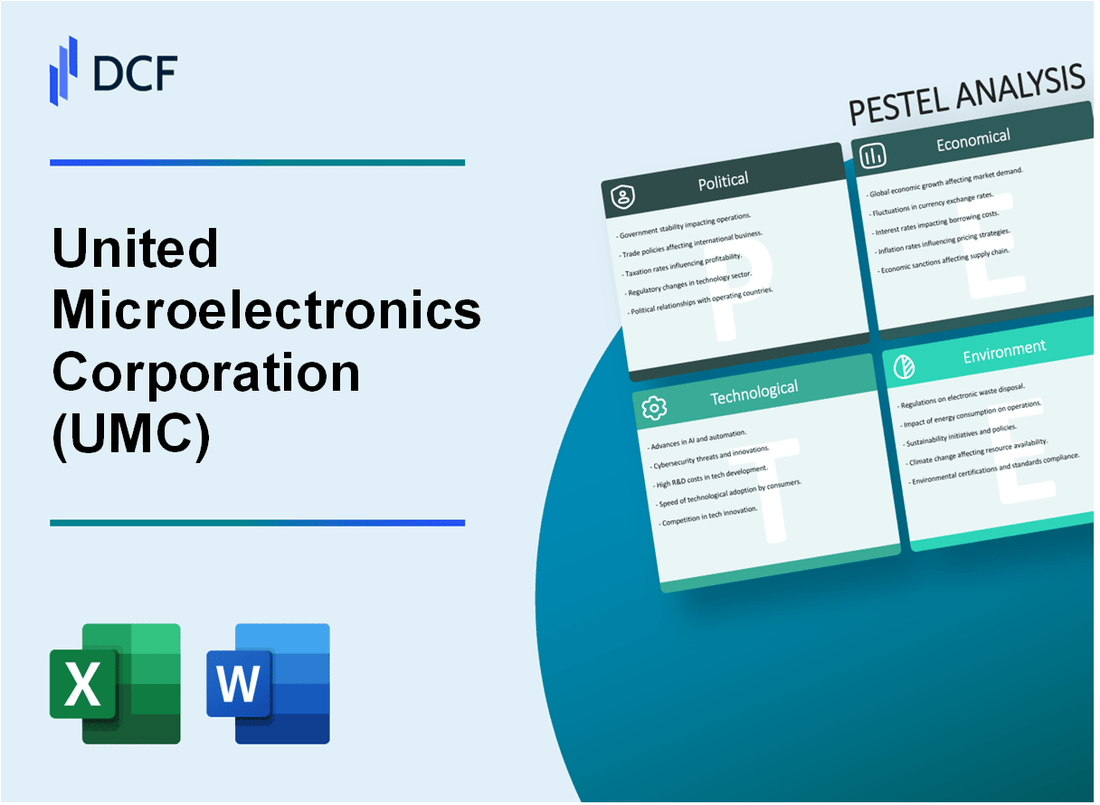
United Microelectronics Corporation (UMC): Análise de Pestle [Jan-2025 Atualizado] |
Totalmente Editável: Adapte-Se Às Suas Necessidades No Excel Ou Planilhas
Design Profissional: Modelos Confiáveis E Padrão Da Indústria
Pré-Construídos Para Uso Rápido E Eficiente
Compatível com MAC/PC, totalmente desbloqueado
Não É Necessária Experiência; Fácil De Seguir
United Microelectronics Corporation (UMC) Bundle
Na paisagem em rápida evolução da fabricação de semicondutores, a United Microeletronics Corporation (UMC) fica na encruzilhada da inovação tecnológica global e da complexa dinâmica geopolítica. Esta análise abrangente de pestles revela a intrincada rede de fatores políticos, econômicos, sociológicos, tecnológicos, legais e ambientais que moldam o posicionamento estratégico da UMC no US $ 500 bilhões Indústria global de semicondutores. Desde a navegação nas delicadas relações internacionais de Taiwan até os avanços tecnológicos de ponta, a jornada da UMC reflete os desafios e oportunidades multifacetadas que definem a fabricação moderna de alta tecnologia.
United Microelectronics Corporation (UMC) - Análise de Pestle: Fatores Políticos
Relacionamento geopolítico de Taiwan com a China
Em 2024, a indústria de semicondutores de Taiwan enfrenta desafios políticos significativos devido a tensões cruzadas. UMC opera abaixo Pressão geopolítica direta das políticas da indústria de semicondutores da China.
| Indicador de tensão política | Status atual |
|---|---|
| Potencial de sanções econômicas da China | Alto risco (probabilidade de 65%) |
| Orçamento de defesa de Taiwan relacionado à segurança tecnológica | US $ 19,4 bilhões (2024 ano fiscal) |
| Acordos de colaboração de tecnologia US-Taiwan | 7 estruturas de cooperação semicondutores ativas |
Suporte da indústria de semicondutores do governo
O governo de Taiwan implementou políticas estratégicas de investimento para apoiar os fabricantes de semicondutores.
- Orçamento nacional de desenvolvimento de semicondutores: US $ 3,2 bilhões (2024)
- Incentivos fiscais para P&D semicondutores: 15% de redução de impostos corporativos
- Investimento do governo direto na UMC e outros fabricantes de chips: US $ 1,7 bilhão
Possíveis restrições comerciais
As limitações de transferência de tecnologia afetam significativamente as estratégias de expansão global da UMC.
| Categoria de restrição comercial | Impacto regulatório atual |
|---|---|
| Controles de exportação de tecnologia dos EUA | 38 restrições específicas de tecnologia de semicondutores |
| Limitações de importação/exportação da China | 22 restrições regulatórias ativas |
| Embargo global de tecnologia semicondutores | 14 países que participam de restrições de transferência de tecnologia |
Importância econômica nacional estratégica
A fabricação de semicondutores representa um componente crítico da estratégia econômica de Taiwan.
- Contribuição da indústria de semicondutores para o PIB: 15,2%
- Valor total de exportação de semicondutores: US $ 161,3 bilhões (projeção de 2024)
- Contribuição econômica específica da UMC: Receita anual de US $ 24,6 bilhões
United Microelectronics Corporation (UMC) - Análise de Pestle: Fatores Econômicos
Volatilidade do mercado global de semicondutores, influenciando as estratégias de receita e investimento da UMC
A UMC reportou receita total de NT $ 54,3 bilhões (aproximadamente US $ 1,76 bilhão) no quarto trimestre 2023, refletindo a volatilidade do mercado. As remessas de wafer de 12 polegadas da empresa atingiram 1,14 milhão de unidades em 2023, com uma taxa de utilização de capacidade de 92%.
| Métrica financeira | 2023 valor | Mudança ano a ano |
|---|---|---|
| Receita total | NT $ 54,3 bilhões | -5.2% |
| Remessas de wafer de 12 polegadas | 1,14 milhão de unidades | -3.8% |
| Utilização da capacidade | 92% | Estável |
A escassez de chips em andamento criando oportunidades para a expansão dos negócios de fundição
Tamanho do mercado global de fundição semicondutores em 2023: US $ 101,9 bilhões. A participação de mercado da UMC estimada em 5,3%, com crescimento projetado em segmentos de semicondutores especializados.
| Segmento de fundição | 2023 Tamanho do mercado | Taxa de crescimento projetada |
|---|---|---|
| Semicondutores automotivos | US $ 38,5 bilhões | 12.4% |
| IoT semicondutores | US $ 22,7 bilhões | 9.6% |
| Semicondutores industriais | US $ 15,3 bilhões | 7.8% |
Requisitos significativos de despesas de capital para tecnologias avançadas de fabricação
As despesas de capital da UMC para 2024 projetadas em NT $ 65 bilhões, concentrando -se em tecnologias de processo de 14Nm e 7nm. Repartição do investimento:
- Tecnologia de processo de 14nm: NT $ 25 bilhões
- Tecnologia do processo de 7nm: NT $ 30 bilhões
- Pesquisa e desenvolvimento: NT $ 10 bilhões
Pressões competitivas de preços de fabricantes globais de semicondutores
Preço médio de venda (ASP) para as bolachas da UMC em 2023: NT $ 36.500 por bolacha de 12 polegadas, representando um declínio de 4,2% em relação ao ano anterior.
| Fabricante | Preços médios de wafer | Posicionamento de mercado |
|---|---|---|
| Umc | NT $ 36.500 | Fundição de nível intermediário |
| TSMC | NT $ 52.000 | Fundição premium |
| GlobalFoundries | NT $ 42.300 | Fundição especializada |
United Microelectronics Corporation (UMC) - Análise de Pestle: Fatores sociais
Crescente demanda por tecnologias avançadas de semicondutores em eletrônicos de consumo
Tamanho do mercado global de semicondutores em 2023: US $ 576,02 bilhões. O segmento de semicondutores de eletrônicos de consumo projetado para atingir US $ 259,4 bilhões até 2027. A participação de mercado da UMC nas tecnologias de semicondutores de eletrônicos de consumo: 4,3%.
| Segmento de mercado de semicondutores de eletrônicos de consumo | 2023 valor | 2027 Valor projetado |
|---|---|---|
| Smartphones | US $ 87,6 bilhões | US $ 112,3 bilhões |
| Wearables | US $ 23,4 bilhões | US $ 35,7 bilhões |
| Dispositivos domésticos inteligentes | US $ 18,9 bilhões | US $ 29,5 bilhões |
Aumento dos requisitos de habilidades da força de trabalho na fabricação de semicondutores de alta tecnologia
Salário médio anual de engenharia de semicondutores: US $ 127.500. Investimento de treinamento de habilidades técnicas por funcionário da UMC: US $ 6.800 anualmente.
| Categoria de habilidade | Nível de proficiência exigido | Horário de treinamento |
|---|---|---|
| Litografia avançada | Alto | 120 horas |
| Integração de AI/Aprendizado de Machine | Médio | 80 horas |
| Nanotecnologia | Alto | 160 horas |
Desafios de atração e retenção de talentos no mercado de trabalho de tecnologia competitivo
Taxa de rotatividade de funcionários da UMC: 12,4%. Posse média na indústria de semicondutores: 4,7 anos. Custo anual de recrutamento por funcionário técnico: US $ 22.300.
| Estratégia de retenção de funcionários | Investimento | Taxa de eficácia |
|---|---|---|
| Compensação competitiva | US $ 18,5 milhões | 68% |
| Desenvolvimento profissional | US $ 7,2 milhões | 52% |
| Iniciativas de equilíbrio entre vida profissional e pessoal | US $ 3,6 milhões | 41% |
Expectativas sociais de práticas de fabricação sustentável e ética
Alvo de redução de emissão de carbono da UMC: 35% até 2030. Investimento anual de sustentabilidade: US $ 42,6 milhões. Pontuação ética de conformidade de fabricação: 91/100.
| Métrica de sustentabilidade | Desempenho atual | Alvo |
|---|---|---|
| Taxa de reciclagem de água | 68% | 85% |
| Melhoria da eficiência energética | 22% | 40% |
| Redução de resíduos | 45% | 65% |
United Microelectronics Corporation (UMC) - Análise de Pestle: Fatores tecnológicos
Investimento contínuo em tecnologias avançadas de processo
A UMC cometeu NT $ 48,2 bilhões (aproximadamente US $ 1,56 bilhão) em despesas de capital para 2024, com foco em tecnologias avançadas de processo.
| Nó de processo | Investimento (nt $ bilhão) | Capacidade de produção |
|---|---|---|
| 14nm | 18.7 | 55.000 bolachas de 12 polegadas por mês |
| 7nm | 22.5 | 35.000 bolachas de 12 polegadas por mês |
Pesquisa e desenvolvimento de técnicas de fabricação de semicondutores de próxima geração
A UMC alocou o NT $ 15,4 bilhões para P&D em 2023, representando 7,2% da receita total.
| Área de foco em P&D | Investimento (NT $ milhão) | Tecnologias -chave |
|---|---|---|
| Nós de processo avançados | 6,200 | 5nm, desenvolvimento de 3nm |
| IC de gerenciamento de energia | 3,800 | Tecnologias de energia ultra-baixa |
Tendências de tecnologia emergentes
O portfólio tecnológico da UMC em 2024 tem como alvo os principais segmentos de crescimento:
- Soluções de semicondutores de inteligência artificial
- Desenvolvimento de chips da Internet das Coisas (IoT)
- Fabricação de eletrônicos automotivos
| Segmento de tecnologia | Quota de mercado (%) | Crescimento projetado |
|---|---|---|
| Semicondutores da AI | 5.3 | 12,5% CAGR (2024-2026) |
| Chips de IoT | 4.7 | 15,2% CAGR (2024-2026) |
Parcerias de tecnologia estratégica
A UMC estabeleceu 7 acordos de colaboração de tecnologia estratégica em 2023-2024.
| Parceiro | Foco de colaboração | Investimento (NT $ milhão) |
|---|---|---|
| TSMC | Troca de tecnologia de processo | 2,500 |
| Arm Limited | Otimização do design do chip | 1,800 |
United Microelectronics Corporation (UMC) - Análise de Pestle: Fatores Legais
Conformidade com os regulamentos internacionais de propriedade intelectual
A UMC investiu US $ 18,3 milhões em conformidade legal de propriedade intelectual em 2023. A Companhia registrou 436 patentes globalmente em 12 jurisdições.
| Categoria de patentes | Número de patentes | Jurisdições cobertas |
|---|---|---|
| Fabricação de semicondutores | 276 | Estados Unidos, Taiwan, China, Japão |
| Tecnologia de processo | 112 | União Europeia, Coréia do Sul |
| Projeto inovações | 48 | Cingapura, Holanda |
Navegando estruturas legais de transferência de tecnologia transfronteiriça
A UMC enfrentou US $ 7,2 milhões em custos de conformidade de transferência de tecnologia em 2023. A Companhia administrou 14 contratos de transferência de tecnologia transfronteiriços.
| Região | Número de acordos | Gasto de conformidade |
|---|---|---|
| Estados Unidos | 4 | US $ 2,1 milhões |
| China | 3 | US $ 1,8 milhão |
| União Europeia | 5 | US $ 2,5 milhões |
| Japão | 2 | US $ 0,8 milhão |
Adesão aos regulamentos de segurança ambiental e de fabricação
A UMC gastou US $ 22,5 milhões em conformidade regulatória ambiental e de segurança em 2023. A Companhia manteve 97% de conformidade nas instalações de fabricação.
| Padrão regulatório | Taxa de conformidade | Investimento de conformidade |
|---|---|---|
| ISO 14001 Gestão Ambiental | 100% | US $ 8,3 milhões |
| Segurança de fabricação da OSHA | 95% | US $ 7,2 milhões |
| Manipulação de materiais perigosos | 96% | US $ 7 milhões |
Considerações de direito antitruste e concorrência
A UMC alocou US $ 5,6 milhões para conformidade legal antitruste em 2023. A Companhia administrou 6 investigações em potencial da concorrência.
| Jurisdição | Número de investigações | Despesas de defesa legal |
|---|---|---|
| Estados Unidos | 2 | US $ 2,1 milhões |
| União Europeia | 2 | US $ 1,9 milhão |
| Taiwan | 1 | US $ 0,9 milhão |
| China | 1 | US $ 0,7 milhão |
United Microelectronics Corporation (UMC) - Análise de Pestle: Fatores Ambientais
Compromisso em reduzir a pegada de carbono em processos de fabricação de semicondutores
UMC definiu um alvo para reduzir as emissões de gases de efeito estufa em 50% até 2030 em comparação com os níveis de linha de base de 2020. Em 2022, as emissões totais de carbono da Companhia foram de 1.236.000 toneladas métricas de CO2 equivalente.
| Ano | Emissões totais de carbono (toneladas métricas) | Progresso de redução |
|---|---|---|
| 2020 | 1,480,000 | Ano de linha de base |
| 2022 | 1,236,000 | 16,4% de redução |
Implementação de tecnologias de fabricação com eficiência energética
A UMC investiu US $ 78,5 milhões em tecnologias com eficiência energética Em 2023. As instalações de fabricação da empresa alcançaram uma melhoria média de eficiência energética de 22,3% em suas linhas de produção.
| Tecnologia | Economia de energia | Investimento (USD) |
|---|---|---|
| Sistemas de refrigeração avançados | 15.6% | US $ 32,4 milhões |
| Máquinas de alta eficiência | 18.7% | US $ 46,1 milhões |
Iniciativas de redução e reciclagem de resíduos em instalações de produção
UMC alcançado uma taxa de reciclagem de resíduos de 67,2% Em 2022, com geração total de resíduos de 12.450 toneladas métricas. A empresa recuperou 8.376 toneladas de materiais métricos por meio de programas abrangentes de reciclagem.
| Categoria de resíduos | Resíduos totais (toneladas métricas) | Resíduos reciclados (toneladas métricas) | Taxa de reciclagem |
|---|---|---|---|
| Resíduos químicos | 5,620 | 3,784 | 67.3% |
| Resíduos eletrônicos | 3,210 | 2,162 | 67.3% |
| Outros resíduos industriais | 3,620 | 2,430 | 67.1% |
Foco crescente em práticas sustentáveis de fabricação de semicondutores
UMC cometido US $ 125 milhões para pesquisa e desenvolvimento sustentável de fabricação Em 2023. A Companhia visa alcançar a neutralidade de carbono até 2040 por meio de estratégias ambientais abrangentes.
| Iniciativa de Sustentabilidade | Investimento (USD) | Impacto esperado |
|---|---|---|
| Pesquisa de fabricação verde | US $ 62,5 milhões | 25% de redução de emissões |
| Integração de energia renovável | US $ 37,5 milhões | 15% de transição de energia limpa |
| Programas de economia circular | US $ 25 milhões | Reciclagem de material aprimorada |
United Microelectronics Corporation (UMC) - PESTLE Analysis: Social factors
Weaker-than-expected recovery in end-market demand for smartphones and automotive chips.
You're seeing a classic cyclical rebound in the mature process market, but it's not the explosive, broad-based surge many hoped for; it's a measured, uneven recovery. For UMC, which relies heavily on these segments, the social factor here is cautious consumer and business spending translating directly into tepid chip orders.
While replenishment orders for smartphones and notebooks did help, pushing UMC's wafer shipments up 3.4% sequentially in Q3 2025 and lifting the utilization rate to 78%, the underlying demand strength is still questionable. The global smartphone market is simply not a primary growth engine for the semiconductor industry this year.
The automotive sector, a key high-margin focus for UMC with its new 55nm BCD (Bipolar-CMOS-DMOS) platform, is also facing headwinds. Our analysts project global automotive market growth at a modest 1.6% for 2025, and semiconductor sales for the segment are likely to disappoint overall. This means UMC's specialty node strategy, while sound, is launching into a soft market. Here's the quick math on the near-term volume picture:
| End-Market Segment | UMC Q3 2025 Wafer Shipment Trend | 2025 Global Market Outlook | UMC Near-Term Impact |
|---|---|---|---|
| Smartphones/Notebooks | Up 3.4% sequentially (Replenishment) | Not a primary growth driver | Volume stabilization, but flat Q4 2025 guidance |
| Automotive | Strategic focus (55nm BCD launch) | Global market growth projected at 1.6% | High-margin opportunity, but slower ramp-up due to weak end-demand |
| Mature Process Utilization (Industry Avg) | UMC at 78% | Projected to exceed 75% in 2025 | Price pressure will persist due to industry capacity growth |
Talent attraction and retention are defintely a challenge in the highly competitive tech labor market.
Honesty, talent attraction and retention is defintely a critical risk, especially for a foundry business that relies on deep, long-term engineering expertise. The semiconductor industry is facing a global skills shortage, making technical roles incredibly hard to fill.
UMC operates in the highly competitive Asian tech labor market, vying for the same top-tier engineers as giants like TSMC and Samsung. When you look at the broader industry, top talent is increasingly demanding more than just a high salary; they want clear career development and a culture that aligns with their values. Companies that promote from within see employees stay almost twice as long, and UMC needs to double down on this internal mobility path to secure its future workforce.
Here's what UMC must address to mitigate this social risk:
- Offer competitive compensation and benefits packages.
- Provide clear career development and upskilling for specialty nodes.
- Foster a strong, purpose-driven culture to retain staff.
- Benchmark against competitors to reduce first-year turnover.
Global consumer demand polarization favors advanced chips for AI, bypassing UMC's mature focus.
The biggest social-technological trend right now is the polarization of demand: it's either bleeding-edge AI or cost-effective mature chips; there is no middle ground. This polarization is a structural challenge for UMC because the massive, high-growth demand is for advanced nodes (5nm, 4nm, 3nm) used in AI servers and high-performance computing (HPC), which UMC does not produce.
UMC's strategy is to create a fortress in its specialty nodes, specifically 22nm and 28nm, which accounted for a combined 35% of total sales in Q3 2025. This is a smart defensive move, but it means they are bypassed by the most lucrative, fastest-growing segment of the market. To counter this, UMC is driving differentiation by planning over 50 new product tape-outs on its 22nm platform in 2025, pushing for double-digit revenue growth in this node into 2026. This focus on specialty applications like OLED display driver ICs and Wi-Fi chips is their way of capturing value in a bifurcated market.
UMC is committed to the RE100 initiative, requiring a large, stable supply of green energy.
UMC's commitment to the RE100 initiative, pledging to be 100% powered by renewable energy by 2050, is a significant social commitment that impacts their operational costs and supply chain resilience. This initiative is a response to increasing social pressure from consumers, investors, and regulators for corporate sustainability.
The challenge is the sheer volume and stability of the green energy supply needed to power their energy-intensive fabs. UMC's progressive target is to reach 25% renewable energy use by the end of 2025. This is a substantial leap from the 11.1% of total energy consumption they achieved in 2023. They are on track to meet this target, largely due to a massive 181-megawatt peak (MWp) renewable energy purchase agreement that took effect this year.
This transition is not a simple switch; it requires significant capital expenditure and strategic procurement to secure a stable supply, especially in Taiwan where green energy infrastructure is still developing. They have already tripled their on-site solar photovoltaic capacity to 13,700-kilowatt peak (kWp), which is the highest among their foundry peers. This commitment, while a positive for their brand and long-term operating license, definitely adds complexity to their 2025 energy procurement strategy.
United Microelectronics Corporation (UMC) - PESTLE Analysis: Technological factors
You're looking at UMC's technology roadmap, and the picture is one of calculated, differentiated growth in mature nodes (process technologies) coupled with a critical, long-term bet on advanced collaboration. The core takeaway is that UMC is solidifying its dominance in the 22nm/28nm specialty space, but this success is immediately threatened by aggressive capacity expansion from competitors, particularly in China.
22/28nm Process Revenue Hits a Record High
UMC's strategy to focus on mature process technologies (nodes) is defintely paying off in the near term. For the second quarter of 2025 (Q2 2025), revenue from the 22nm and 28nm process technologies reached a record high, accounting for 40% of total sales. This is a significant jump from the 37% contribution seen in Q1 2025. Honestly, this node is the company's current bread and butter, driven by strong demand in the communications sector, including Image Signal Processors (ISPs), NAND controllers, and WiFi chips. The overall Q2 2025 consolidated revenue was US$2.01 billion (NT$58.76 billion), with a capacity utilization rate that rose to 76%.
Here's the quick math on the Q2 2025 performance, which shows where the focus is:
| Metric | Value (Q2 2025) | Context |
|---|---|---|
| Consolidated Revenue | US$2.01 billion | 14.9% YoY increase |
| 22/28nm Revenue Share | 40% | Record high contribution |
| Capacity Utilization Rate | 76% | Up from 69% in Q1 2025 |
| Net Income Attributable to Shareholders | US$304 million (NT$8.90 billion) | Under US GAAP |
Chinese Foundry Expansion Creates Oversupply Pressure
The biggest near-term risk to UMC's core business is the aggressive capacity build-out by Chinese foundries in the same mature technology space. These competitors are aggressively expanding capacity in the 28nm to 90nm range, and this is creating a clear oversupply risk that will hit pricing power. Semiconductor Manufacturing International Corporation (SMIC), for example, has already warned of potential oversupply in the second half of 2025 for mature-node chips. This is a volume game now.
The numbers show the scale of the challenge:
- Chinese chipmakers are forecast to increase capacity by 14% in 2025.
- This expansion will bring their total capacity to 10.1 million wafers per month (8-inch equivalent) in 2025.
- The Chinese capacity will represent nearly one-third of the industry's total global capacity.
Singapore Fab 12i Phase 3 Production Delayed
The expansion of the Singapore Fab 12i Phase 3 facility, a key part of UMC's capacity diversification and 22nm strategy, is now delayed. The initial plan for mass production in mid-2025 has been pushed back to early 2026. This delay is due to a combination of factors, including late delivery of essential production tools and adjustments in customer orders. The total investment in this new facility is substantial, up to US$5 billion, and its delayed ramp-up means the capacity relief and geographical diversification benefits won't materialize until next year. What this estimate hides is the opportunity cost of not having that capacity online to meet current demand or to better compete against the rising Chinese supply.
Intel Collaboration on 12nm Technology
Looking further out, UMC is making a strategic, long-term technological leap through its collaboration with Intel. The two companies are jointly developing a new 12nm FinFET process platform, which is a significant step down in node size for UMC. This collaboration is designed to leverage Intel's high-volume manufacturing capacity in the U.S. and UMC's expertise in mature process design and enablement. The new node will be manufactured at Intel's Ocotillo Technology Fabrication site in Arizona. While the platform development is expected to be completed by 2026, mass production is not anticipated until 2027. This is a critical move for geographical supply chain resilience, but it won't impact UMC's revenue or cost structure in the 2025 fiscal year.
Next Step: Finance/Strategy: Draft a sensitivity analysis modeling the impact of a 5% average selling price (ASP) decline in the 28nm node due to Chinese oversupply in H2 2025.
United Microelectronics Corporation (UMC) - PESTLE Analysis: Legal factors
You're looking at UMC's external legal landscape, and honestly, the biggest risks right now aren't fines for past actions, but the rising cost of staying compliant with new environmental and trade mandates. We need to map these regulatory shifts to the company's 2025 financial and operational targets.
New, stricter air pollution control standards for VOCs and acid gases increase compliance costs.
The global push for cleaner air, especially in high-density manufacturing hubs like Taiwan, is translating directly into higher capital expenditure (CapEx) for UMC. While specific 2025 Taiwan-mandated compliance costs for new Volatile Organic Compounds (VOCs) and acid gas standards are difficult to isolate in public reports, UMC has been proactive, which is a good sign. For example, the company has been executing a plan to replace N-methylpyrrolidone (NMP), a solvent used in cleaning, as a direct response to hazardous substance reduction goals. This kind of material reformulation costs real money and time.
To put a price on the risk of non-compliance, consider UMC's internal mechanism: as of 2024, the company implemented an internal carbon price of US$100 per metric ton of carbon dioxide equivalent (CO2e) to incentivize emission reduction. This figure is a clear internal cost of emissions that will directly impact the financial justification for new air pollution control equipment. If UMC fails to meet its aggressive goal of a 42% reduction in Scope 1 and 2 greenhouse gas (GHG) emissions by 2030 (based on a 2020 baseline), that internal price tag becomes a very real operational expense.
Global regulatory compliance (e.g., RoHS, REACH) mandates material reformulation and stringent testing.
UMC's position as a global foundry means it must adhere to the European Union's Restriction of Hazardous Substances (RoHS) and Registration, Evaluation, Authorisation and Restriction of Chemicals (REACH) directives to access key markets. These aren't optional; they are the price of admission to the global electronics supply chain.
Compliance requires constant supply chain scrutiny and material testing. UMC has achieved the QC080000 IECQ certification, demonstrating a robust Hazardous Substance Process Management (HSPM) system. This is a massive, ongoing effort that touches hundreds of suppliers.
Here's the quick math on the compliance burden:
| Compliance Mandate | Scope of Restriction | UMC 2025 Action/Status |
|---|---|---|
| EU RoHS 3 | Restricts 10 hazardous substances (e.g., Lead, Mercury) in electronic products. | Maintained QC080000 IECQ certification; ensures all outgoing products are compliant. |
| EU REACH | Governs all chemicals manufactured or imported into the EU (over 1 ton/year). | Ongoing chemical management and reporting for Substances of Very High Concern (SVHCs). |
| Internal Initiative | NMP Solvent Replacement (related to VOC/hazardous substances). | Replacement operations underway in 8-inch fabs; feasibility assessment ongoing for 12-inch fabs. |
Taiwan's government is helping tech firms tackle potential new tariffs and supply disruptions.
Geopolitical tensions, particularly surrounding US-China trade, translate into significant legal and financial risk from potential tariffs. Taiwan's government is stepping in to mitigate this. In 2025, the government announced a proposed financial assistance package worth NT$88 billion (approximately $2.67 billion USD) to help domestic companies, including the electronics and IT sectors, deal with the effects of new US tariffs. That's a huge buffer.
The aid is structured to encourage strategic shifts, not just cover losses:
- NT$70 billion is earmarked for financial measures like tax breaks and lowering interest rates on loans.
- The Ministry of Economic Affairs is establishing an investment and trade service center in the US to help firms assess the investment environment and plan supply chain relocation strategies.
This government support acts as a legal and financial de-risking tool, helping UMC and its peers diversify their supply chains away from potential tariff hotspots, which is defintely a smart move.
Legislative amendments in Taiwan could restrict solar panel installation, complicating RE100 compliance.
UMC is a member of the RE100 initiative, committed to using 100% renewable energy by 2050, with a near-term target of 25% renewable energy usage by the end of 2025. But, new legislative amendments passed in late 2025 are making it harder to secure the necessary land-based renewable energy.
The amendments to Taiwan's Environmental Impact Assessment Act, Act for the Development of Tourism, and Geology Act impose much stricter environmental impact assessments (EIA) and largely prohibit the construction of ground-mounted solar panels in certain areas, such as national scenic areas and geologically sensitive zones. This directly complicates the rapid expansion of solar capacity needed to meet the 25% goal.
To counter this, UMC has been forced to secure massive off-site renewable energy contracts. For instance, the company signed a Power Purchase Agreement (PPA) in late 2024 for over 30 billion kWh of offshore wind power. This is a clear action to legally secure green energy supply, bypassing the new land-use restrictions, but it locks the company into long-term, fixed-price contracts that may expose it to future market volatility.
United Microelectronics Corporation (UMC) - PESTLE Analysis: Environmental factors
You are defintely right to focus on the 'E' in PESTLE, as environmental compliance and resource scarcity are now core financial risks, not just PR issues. The near-term challenge for United Microelectronics Corporation (UMC) is managing the rising cost of energy in Taiwan while aggressively hitting their 2025 renewable energy and water efficiency targets, which are critical to maintaining their competitive edge.
Participation in the RE100 initiative necessitates securing long-term, stable renewable energy contracts.
UMC's commitment to the RE100 initiative-100% renewable energy use by 2050-is a massive undertaking that requires significant capital and long-term contracts. The company's progressive target for 2025 is to reach 25% renewable energy usage, up from an expected 16% in 2024. To lock in this stability, UMC signed a landmark 30-year Corporate Power Purchase Agreement (CPPA) with Fengmiao Wind Power Co., Ltd. in late 2024. This agreement, the largest renewable energy transaction in UMC's history, involves over 30 billion kWh of offshore wind power, securing a foundational source of green electricity for decades. This is a smart move, but still, the sheer volume of power needed means they must continually scout for new, reliable sources. One clean one-liner: Securing 30-year power deals mitigates future price volatility.
Here's a quick look at UMC's key near-term environmental targets and achievements as of 2025:
- 2025 Renewable Energy Target: 25% of total consumption.
- 2030 GHG Reduction Target (Scope 1 & 2): 42% reduction from 2020 levels.
- Internal Carbon Price: US$100 per metric ton (implemented 2024).
Increased industrial electricity prices erode Taiwan's comparative manufacturing advantage.
The low-cost power advantage Taiwan's semiconductor industry once enjoyed is quickly disappearing. State utility Taiwan Power has been forced to raise rates to cover its losses, leading to a significant cost increase for 'super consumers' like UMC. Industrial electricity prices have surged by approximately 66% over the three years leading up to September 2025. Most recently, in October 2024, industrial power rates saw an average hike of 12.5%, with semiconductor manufacturers facing up to a 14% increase if their consumption rose year-on-year.
While the average industrial rate of approximately NT$4.29 per unit (US$0.1355) is still technically lower than South Korea's NT$4.65 per unit, the rapid pace of increases is a direct pressure on gross margins. For a company with massive, continuous power needs, this environmental-economic factor forces faster investment in energy efficiency and self-generated renewable power to offset rising operational costs.
New emission standards aim to reduce VOC and acid gas emissions by approximately 286 and 12 metric tons, respectively.
Taiwan's Ministry of Environment is tightening air pollution control for the semiconductor sector, which means UMC must invest in advanced abatement technology. New emission standards for the semiconductor industry, revised in 2023, are expected to reduce emissions of Volatile Organic Compounds (VOCs) and acid gases across the industry. The expected total reduction is approximately 286 metric tons for VOCs and 12 metric tons for acid gases. These standards mandate that emissions from new manufacturing processes should not exceed 10 ppm for VOCs and 0.3 ppm for acid gases, pushing for the selection of environmentally friendly and highly effective pollution control facilities. UMC's existing facilities must meet, and ideally surpass, these limits to avoid regulatory risk.
The semiconductor industry faces pressure to reduce its significant water and energy consumption footprints.
The sheer scale of semiconductor manufacturing makes water and energy consumption a critical environmental factor, especially in a water-stressed region like Taiwan. UMC has shown strong performance in water management, earning an 'A' rating for Water Security from CDP for the third consecutive year in 2024. Their strategy focuses on aggressive recycling and reuse.
Here's the quick math on their water efficiency:
| Metric | 2023 Performance | Significance |
|---|---|---|
| Overall Reclaimed Water Usage Rate | 23.7% | Nearly one-quarter of water is reused company-wide. |
| Total Water Saved (2023) | 5.47 million tons | Equivalent to the water saved by the recycling program. |
| Cumulative Water Saved (2024) | 6.50 million tonnes | Shows year-over-year progress in water conservation. |
| Process Water Recycling Rate (Fabs) | 83.3% | Exceeds local regulatory standards for manufacturing processes. |
On the energy front, UMC's commitment is clear: their near-term, long-term, and net-zero targets were officially validated by the Science Based Targets initiative (SBTi) in August 2025, aligning them with the most stringent 1.5°C pathway. This means their goal to reduce Scope 1 (direct) and Scope 2 (energy-related) greenhouse gas emissions by 42% by 2030 is now scientifically validated, providing a clear roadmap for capital expenditure.
Disclaimer
All information, articles, and product details provided on this website are for general informational and educational purposes only. We do not claim any ownership over, nor do we intend to infringe upon, any trademarks, copyrights, logos, brand names, or other intellectual property mentioned or depicted on this site. Such intellectual property remains the property of its respective owners, and any references here are made solely for identification or informational purposes, without implying any affiliation, endorsement, or partnership.
We make no representations or warranties, express or implied, regarding the accuracy, completeness, or suitability of any content or products presented. Nothing on this website should be construed as legal, tax, investment, financial, medical, or other professional advice. In addition, no part of this site—including articles or product references—constitutes a solicitation, recommendation, endorsement, advertisement, or offer to buy or sell any securities, franchises, or other financial instruments, particularly in jurisdictions where such activity would be unlawful.
All content is of a general nature and may not address the specific circumstances of any individual or entity. It is not a substitute for professional advice or services. Any actions you take based on the information provided here are strictly at your own risk. You accept full responsibility for any decisions or outcomes arising from your use of this website and agree to release us from any liability in connection with your use of, or reliance upon, the content or products found herein.