

|
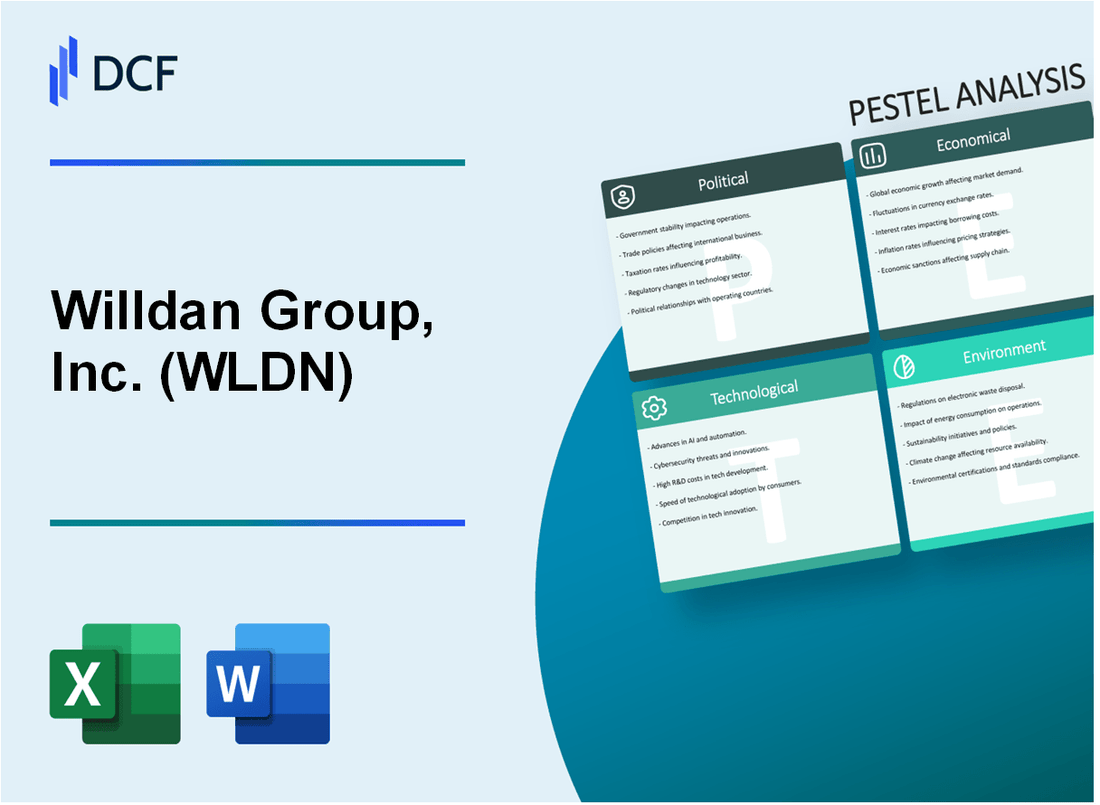
Willdan Group, Inc. (WLDN): Análise de Pestle [Jan-2025 Atualizada] |
Totalmente Editável: Adapte-Se Às Suas Necessidades No Excel Ou Planilhas
Design Profissional: Modelos Confiáveis E Padrão Da Indústria
Pré-Construídos Para Uso Rápido E Eficiente
Compatível com MAC/PC, totalmente desbloqueado
Não É Necessária Experiência; Fácil De Seguir
Willdan Group, Inc. (WLDN) Bundle
No cenário dinâmico da consultoria de infraestrutura e sustentabilidade, o Willdan Group, Inc. (WLDN) surge como uma potência estratégica que navega em desafios complexos de mercado por meio de soluções inovadoras. Ao misturar perfeitamente a experiência tecnológica com insights ambientais e governamentais abrangentes, a empresa se posicionou na interseção crítica do desenvolvimento urbano, eficiência energética e infraestrutura sustentável. Essa análise de pilões revela os fatores externos multifacetados que moldam a trajetória estratégica de Willdan, oferecendo uma exploração convincente de como a dinâmica política, econômica, sociológica, tecnológica, legal e ambiental está desafiadora e impulsionando simultaneamente o potencial de crescimento notável da empresa.
Willdan Group, Inc. (WLDN) - Análise de Pestle: Fatores Políticos
Infraestrutura federal e impactos de financiamento de eficiência energética
A Lei de Investimento de Infraestrutura e Empregos (IIJA) alocada US $ 1,2 trilhão em gastos totais de infraestrutura, com US $ 550 bilhões Em novos investimentos federais diretamente relevantes para os serviços de consultoria governamental de Willdan.
| Categoria de financiamento federal | Quantidade alocada |
|---|---|
| Subsídios de eficiência energética | US $ 84,5 bilhões |
| Infraestrutura de energia limpa | US $ 73,2 bilhões |
| Projetos de resiliência climática | US $ 47,6 bilhões |
Mudanças de política energética renovável
A Lei de Redução de Inflação fornece US $ 369 bilhões Para investimentos climáticos e de energia limpa, criando oportunidades significativas de mercado para as ofertas de consultoria de energia limpa de Willdan.
- Créditos tributários para projetos de energia renovável: US $ 30 bilhões
- Investimentos em fabricação de energia limpa: US $ 60 bilhões
- Modernização da infraestrutura de grade: US $ 27 bilhões
Alocações de orçamento do governo estadual e local
Os orçamentos de energia limpa e infraestrutura em nível estadual para o ano fiscal de 2024 demonstram potencial significativo para os contratos do setor público de Willdan.
| Estado | Orçamento de infraestrutura | Investimento em energia limpa |
|---|---|---|
| Califórnia | US $ 38,2 bilhões | US $ 12,5 bilhões |
| Nova Iorque | US $ 24,7 bilhões | US $ 8,3 bilhões |
| Texas | US $ 32,5 bilhões | US $ 6,9 bilhões |
Oportunidades de política de resiliência e sustentabilidade climáticas
A avaliação climática nacional destaca US $ 50 bilhões Em investimentos anuais de adaptação climática projetados nos governos federais, estaduais e locais.
- Projetos de resiliência urbana: US $ 18,5 bilhões
- Adaptação de infraestrutura: US $ 22,3 bilhões
- Iniciativas de proteção costeira: US $ 9,2 bilhões
Willdan Group, Inc. (WLDN) - Análise de Pestle: Fatores econômicos
Flutuações em gastos municipais de infraestrutura
A partir do quarto trimestre de 2023, o Willdan Group registrou receita total de US $ 182,4 milhões, com projetos de infraestrutura municipal representando 42% do total de fluxos de receita.
| Ano fiscal | Receita de infraestrutura municipal | Porcentagem da receita total |
|---|---|---|
| 2022 | US $ 168,7 milhões | 40.3% |
| 2023 | US $ 182,4 milhões | 42% |
Recuperação econômica e investimento de infraestrutura
A Lei de Investimento de Infraestrutura e Empregos alocados US $ 1,2 trilhão para projetos de infraestrutura, com US $ 550 bilhões Em novos gastos federais, beneficiando diretamente as possíveis oportunidades de projeto de Willdan.
Taxas de juros e condições do mercado de capitais
As taxas atuais de juros do Federal Reserve variam entre 5,25% e 5,50%, impactando os custos de financiamento do projeto de infraestrutura.
| Métrica de financiamento | Valor atual |
|---|---|
| Taxas de títulos municipais | 4.25% - 5.15% |
| Custos de financiamento do projeto de infraestrutura | 6.5% - 7.8% |
Impacto de incerteza econômica
Investimentos do projeto de infraestrutura do governo para 2024 estimados em US $ 98,3 bilhões, representando um aumento de 3,7% em relação a 2023 projeções.
- Orçamento do Projeto Federal de Infraestrutura: US $ 62,5 bilhões
- Investimentos de infraestrutura em nível estadual: US $ 35,8 bilhões
Willdan Group, Inc. (WLDN) - Análise de Pestle: Fatores sociais
A crescente conscientização da sustentabilidade urbana impulsiona a demanda por serviços de consultoria ambiental de Willdan
De acordo com o U.S. Green Building Council, 51% dos projetos globais de construção devem ser verdes até 2025. Os serviços de consultoria ambiental de Willdan se alinham diretamente a essa tendência.
| Segmento de mercado de sustentabilidade urbana | Taxa de crescimento projetada (2024-2030) | Valor de mercado estimado |
|---|---|---|
| Consultoria de infraestrutura verde | 8.3% | US $ 345,6 bilhões |
| Avaliação de impacto ambiental | 6.7% | US $ 214,2 bilhões |
Ênfase crescente na eficiência energética e tecnologias verdes alinham com as principais competências da empresa
O Departamento de Energia dos EUA relata que os investimentos em eficiência energética podem reduzir o consumo nacional de energia em 25% até 2030.
| Tecnologia de eficiência energética | Investimento anual | Economia de energia potencial |
|---|---|---|
| Tecnologias de grade inteligente | US $ 7,8 bilhões | Redução de 17% |
| Construindo sistemas de gerenciamento de energia | US $ 5,3 bilhões | Redução de 22% |
Mudanças demográficas no planejamento urbano criam novas oportunidades de mercado para consultoria de infraestrutura
O Departamento de Censo dos EUA indica que 86,8% da população viverá em áreas urbanas até 2030, criando necessidades significativas de desenvolvimento de infraestrutura.
| Segmento da população urbana | Taxa de crescimento | Investimento de infraestrutura necessário |
|---|---|---|
| Millennial Urban Residentes | 3,4% anualmente | US $ 412 bilhões |
| Infraestrutura da cidade inteligente | 6,2% anualmente | US $ 237,8 bilhões |
As expectativas crescentes da comunidade para soluções de infraestrutura sustentável expandem o potencial de serviço
O Hub Global de Infraestrutura prevê US $ 94 trilhões em necessidades globais de investimento em infraestrutura até 2040, com sustentabilidade como fator -chave.
| Categoria de infraestrutura sustentável | Projeção de investimento global | Participação de mercado potencial |
|---|---|---|
| Infraestrutura de energia renovável | US $ 23,6 trilhões | 25.1% |
| Projetos de resiliência urbana | US $ 15,2 trilhões | 16.2% |
Willdan Group, Inc. (WLDN) - Análise de Pestle: Fatores tecnológicos
As tecnologias avançadas de análise de dados e modelagem aprimoram os recursos de engenharia e consultoria de Willdan
O Willdan Group investiu US $ 7,2 milhões em P&D de tecnologia no ano fiscal de 2023, com foco em plataformas avançadas de análise de dados. A infraestrutura tecnológica da empresa suporta modelagem complexa de engenharia em vários setores.
| Categoria de investimento em tecnologia | 2023 Despesas | Crescimento ano a ano |
|---|---|---|
| Plataformas de análise de dados | US $ 3,5 milhões | 12.4% |
| Software de modelagem preditiva | US $ 2,1 milhões | 8.7% |
| Ferramentas de aprendizado de máquina | US $ 1,6 milhão | 15.2% |
Tecnologias emergentes de energia limpa criam novas oportunidades de desenvolvimento de serviços
Investimentos de tecnologia de energia renovável Representar um segmento de crescimento crítico para Willdan, com expansão projetada de 22,3% nos serviços de consultoria de tecnologia limpa para 2024.
| Segmento de tecnologia de energia limpa | 2023 Receita | 2024 crescimento projetado |
|---|---|---|
| Consultoria de Tecnologia Solar | US $ 18,6 milhões | 24.5% |
| Engenharia de energia eólica | US $ 12,4 milhões | 19.7% |
| Soluções de armazenamento de energia | US $ 8,9 milhões | 26.3% |
A infraestrutura digital e as soluções da cidade inteligente representam mercados crescentes de consultoria tecnológica
O segmento Smart City Technology Consulting, da Smart City Technology, gerou US $ 45,2 milhões em receita durante 2023, com uma expansão prevista de 17,6% em 2024.
Inteligência artificial e integração de aprendizado de máquina no planejamento de infraestrutura melhoram as ofertas de serviços
Os investimentos em tecnologia de IA e aprendizado de máquina totalizaram US $ 5,3 milhões em 2023, representando um aumento de 16,8% em relação ao ano fiscal anterior.
| Domínio do aplicativo AI | 2023 Investimento | Melhoria da eficiência esperada |
|---|---|---|
| Modelagem preditiva de infraestrutura | US $ 2,7 milhões | 22.5% |
| Algoritmos de planejamento urbano | US $ 1,6 milhão | 18.3% |
| Otimização da grade energética | US $ 1,0 milhão | 15.7% |
Willdan Group, Inc. (WLDN) - Análise de Pestle: Fatores Legais
Conformidade com os regulamentos ambientais em evolução
A partir de 2024, Willdan Group Faces 17 Estruturas regulatórias ambientais federais e estaduais distintas. Os custos de conformidade legal da empresa para adaptação ambiental foram estimados em US $ 3,2 milhões no ano fiscal de 2023.
| Estrutura regulatória | Custo de conformidade | Complexidade de adaptação |
|---|---|---|
| Modificações da Lei do Ar Limpo | $875,000 | Alto |
| Regulamentos de qualidade da água | $650,000 | Médio |
| Padrões de eficiência energética | $1,275,000 | Muito alto |
Requisitos de contratação do governo
Grupo Willdan gerencia 42 contratos governamentais ativos com um valor total de US $ 187,6 milhões. Os requisitos de conformidade legal para esses contratos envolvem:
- Regulamentos obrigatórios de compras federais
- Mecanismos detalhados de relatórios
- Padrões estritos de responsabilidade de desempenho
Padrões de infraestrutura e eficiência energética
A empresa investiu US $ 4,7 milhões em recursos legais e técnicos Para se adaptar às mudanças nos padrões de infraestrutura. Impactos regulatórios específicos incluem:
| Categoria padrão | Impacto regulatório | Investimento necessário |
|---|---|---|
| Códigos de energia de construção | Requisitos de adaptação obrigatória | US $ 1,2 milhão |
| Modernização da grade | Certificação de conformidade | US $ 1,5 milhão |
| Integração de energia renovável | Alinhamento padrão técnico | US $ 2 milhões |
Regulamentação de sustentabilidade Conformidade
Willdan Group tem Desenvolvido 23 linhas de serviço de consultoria legal especializadas focado nos regulamentos de sustentabilidade. A oportunidade de mercado para esses serviços é estimada em US $ 45,3 milhões anualmente.
| Linha de serviço de sustentabilidade | Potencial de mercado | Foco regulatório |
|---|---|---|
| Rastreamento de emissões de carbono | US $ 12,6 milhões | Regras de divulgação climática |
| ESG CONSELHA CONSULTA | US $ 18,7 milhões | Relatórios de sustentabilidade corporativa |
| Certificação de energia renovável | US $ 14 milhões | Padrões de energia verde |
Willdan Group, Inc. (WLDN) - Análise de Pestle: Fatores Ambientais
Estratégias de adaptação para mudanças climáticas levam a demanda por serviços de consultoria ambiental de Willdan
De acordo com a Agência de Proteção Ambiental dos EUA, o mercado de consultoria de adaptação climática deve atingir US $ 15,6 bilhões até 2025. Os serviços de consultoria ambiental de Willdan visam diretamente esse segmento de mercado em crescimento.
| Segmento de mercado de adaptação climática | Valor de mercado projetado (2025) | Taxa de crescimento anual |
|---|---|---|
| Planejamento de resiliência municipal | US $ 5,3 bilhões | 7.2% |
| Adaptação de infraestrutura | US $ 4,8 bilhões | 6.9% |
| Avaliação de Risco Ambiental | US $ 5,5 bilhões | 8.1% |
A transição de energia renovável cria oportunidades de mercado significativas para soluções de infraestrutura sustentável
O mercado de energia renovável dos EUA deve atingir US $ 383,3 bilhões até 2025, com uma taxa de crescimento anual composta de 8,4%.
| Segmento de energia renovável | Valor de mercado 2024 | Crescimento projetado |
|---|---|---|
| Infraestrutura solar | US $ 126,7 bilhões | 9.2% |
| Infraestrutura de energia eólica | US $ 94,5 bilhões | 7.6% |
| Soluções de armazenamento de energia | US $ 62,1 bilhões | 10.3% |
Ênfase crescente na redução de carbono e eficiência energética apóia o modelo de negócios principal da empresa
O mercado global de eficiência energética deve atingir US $ 281,7 bilhões até 2026, com um CAGR de 6,3%.
- Investimentos comerciais de eficiência energética: US $ 78,4 bilhões
- Soluções de Gerenciamento de Energia Industrial: US $ 96,2 bilhões
- Otimização de energia municipal: US $ 57,1 bilhões
O planejamento da resiliência ambiental se torna cada vez mais crítica para clientes municipais e governamentais
O governo dos EUA alocou US $ 47,2 bilhões em projetos de infraestrutura de resiliência ao clima em 2024.
| Categoria de planejamento de resiliência | Alocação de financiamento federal | Nível prioritário |
|---|---|---|
| Adaptação costeira | US $ 16,5 bilhões | Alto |
| Mitigação de inundações urbanas | US $ 12,7 bilhões | Alto |
| Redução de risco de incêndio florestal | US $ 8,9 bilhões | Médio |
Willdan Group, Inc. (WLDN) - PESTLE Analysis: Social factors
The social environment for Willdan Group, Inc. (WLDN) in 2025 is a powerful tailwind, directly translating public and corporate values into contract revenue. Your core market-energy efficiency and infrastructure-is now the epicenter of a massive, non-discretionary spending cycle. But this opportunity comes with a clear, near-term risk: the cost and scarcity of the specialized talent you need to deliver. We have to manage that talent crunch defintely.
Growing public demand for climate resilience and sustainable community infrastructure planning.
Public sentiment and corporate strategy are aligned on climate action, which is a significant driver for Willdan's utility and government clients. This isn't just a political trend; it's a fundamental shift in how communities and businesses manage risk. For example, 70% of registered US voters believe corporations should be doing more to address global warming, creating a mandate for utility and municipal action.
This public pressure is forcing a massive investment in climate-tech and resilient infrastructure, which is Willdan's wheelhouse. The US demand for 'climate tech' is projected to be $13.6 billion in 2025, with a compound annual growth rate (CAGR) of 23.4% through 2035. This translates directly into the kind of work Willdan does, such as the $97 million energy and infrastructure project recently secured in Alameda County. The sheer scale of the need is visible in the funding gap: 124 US cities reported needing $40.8 billion in investment for climate projects in 2024, a gap that only external consultants can help close.
- Public demand for climate action is high.
- Climate tech market size in 2025 is $13.6 billion.
- WLDN's Q3 2025 net revenue growth was 26%, reflecting this demand.
Labor shortage of qualified engineers and energy consultants, increasing salary costs and project delays.
This is the primary constraint on your growth. The very demand driving Willdan's revenue-with full-year 2025 net revenue guidance between $360 million and $365 million-is simultaneously tightening the labor market for your key personnel. The scarcity of specialized talent, particularly in engineering and energy consulting, is driving up compensation at a rate higher than the national average. Here's the quick math on the cost pressure:
| Industry Segment | Forecasted Average US Salary Increase (2025) | Relevance to Willdan |
|---|---|---|
| Government | 4.6% | Primary client base, highest increase forecast. |
| Engineering & Science | 4.2% | Core talent pool for WLDN's services. |
| Agencies & Consultancies | 3.8% | Direct competitor for talent. |
| All US Industries (Average) | 3.5% - 3.9% | Benchmark for comparison. |
The fact that Willdan's General and Administrative expenses rose 33% in Q2 2025, partially due to increased wages and incentive compensation, shows this pressure is already impacting your bottom line. You must continue to invest in the Willdan Clean Energy Academy, your workforce training program, to build your own talent pipeline and mitigate this external cost risk.
Increased focus on Environmental, Social, and Governance (ESG) mandates driving corporate and utility spending.
ESG is no longer a corporate public relations exercise; it's a compliance and risk management necessity, especially at the state level. While federal mandates may be uncertain, state-level regulations, like California's new climate disclosure laws, are forcing companies to act. This is great for Willdan because your services are a direct solution to the 'E' (Environmental) component of ESG. 87% of US executives are maintaining or increasing their investments in business sustainability in 2025, regardless of political headwinds.
This spending directly fuels the energy audit and consulting market. The US energy audit services market is estimated at $1.61 billion in 2025, and it is expected to grow at an 8.74% CAGR through 2034, driven by these corporate ESG goals. Furthermore, Willdan has a strong ESG-aligned value proposition: your services to customers resulted in avoiding 100x more greenhouse gas emissions than the company generated itself, a powerful metric for any client's own ESG report. This is a competitive advantage you need to keep marketing hard.
Demographic shifts in utility workforce creating a need for WLDN's outsourced expertise.
The aging utility workforce is creating a knowledge and capacity gap that Willdan is perfectly positioned to fill. As experienced engineers and technicians retire, utilities and municipal governments lose institutional knowledge and the capacity to manage complex, modern projects like grid modernization and climate adaptation. This demographic shift, coupled with the difficulty of recruiting new talent (as evidenced by the 4.2% salary inflation for engineers), forces these clients to outsource.
Willdan's Energy segment, which accounts for about 85% of your contract revenues, is the direct beneficiary of this trend, providing outsourced expertise in energy efficiency, program design, and construction management. The reliance on external consultants is a structural shift, not a temporary fix, as the internal labor shortage is a long-term problem for your clients. Your business model is built on solving this core demographic and labor challenge for utilities and governments.
Willdan Group, Inc. (WLDN) - PESTLE Analysis: Technological factors
Rapid Adoption of AI and Machine Learning for Predictive Energy Modeling
The biggest near-term opportunity for Willdan Group, Inc. is the massive, AI-driven surge in electricity demand, and your technology is the key to managing it. The explosion of new data centers-with companies like Microsoft, Meta, and Alphabet planning to spend tens of billions in 2025 on infrastructure-is pushing the grid to its limits. Willdan is directly capitalizing on this: approximately 15% of your commercial customer work in Q3 2025 was directly centered around electricity usage at these data centers.
You're using advanced analytics to solve the problem. Your E3 subsidiary, for example, is forecasting a significant increase of between 0.7 terawatt hours and 1.2 terawatt hours of U.S. electricity load growth over the next decade, driven by AI, electric vehicles (EVs), and building electrification. This predictive modeling is what utilities need right now to avoid costly infrastructure failures. It's a structural tailwind, and you are positioned perfectly. The AI revolution is energy-intensive, and that's your business.
Increased Integration of Smart Grid Technologies and Distributed Energy Resources (DERs) in Utility Programs
The shift to smart grid technologies and Distributed Energy Resources (DERs)-like solar, battery storage, and microgrids-is a core technological factor that underpins your utility business, which accounts for about 41% of your revenue. Utilities are mandated to integrate these resources, and they need your software and engineering expertise to do it reliably. Your Integral Analytics subsidiary's LoadSEER platform is a crucial tool here; it uses smart meter data to model load profiles and forecast the impact of DERs, helping utilities plan for grid modernization.
This expertise translates directly into large-scale contracts. For instance, in November 2025, Willdan was selected for a $97 million contract with Alameda County, California, to design and implement energy and infrastructure upgrades. This kind of work involves integrating complex, decentralized power systems, and your grid optimization software is what makes those projects feasible and resilient. You're not just consulting; you're building the future grid.
| Technology Segment Focus | 2025 Financial/Contract Data | Strategic Impact on Willdan |
|---|---|---|
| AI-Driven Data Center Demand | Approximately 15% of Q3 2025 commercial work focused on data center electricity usage. | High-growth, high-margin revenue stream; driving organic growth. |
| Grid Modernization/DER Integration | Full-year 2025 Net Revenue guidance raised to $360 million to $365 million. | Securing large, multi-year utility contracts like the $330 million LADWP agreement. |
| Proprietary Software (LoadSEER) | Integral Analytics' LoadSEER licensed for forecasting across nearly ten million electric meters. | Differentiating factor in winning utility planning and forecasting contracts. |
Need to Constantly Update Proprietary Software to Maintain a Competitive Edge
Your competitive moat is built on proprietary software and data analytics, so the pressure to constantly update is immense. While the original outline mentions 'BizCheck' and 'Energy Solutions,' the real 2025 story is about LoadSEER and new tools for the data center boom. For example, in Q2 2025, you introduced a new proprietary software tool specifically for data center siting, which helps clients minimize interconnect times and get to market faster. That's a defintely a significant differentiator.
Your strategic acquisitions, like Alternative Power Generation (APG) in March 2025, also demand rapid technology integration. The plan is to immediately introduce Willdan's proprietary software to APG's suite, which is a key part of cross-selling and fueling growth. This constant investment in research and development (R&D) is a necessary cost of doing business to keep your adjusted EBITDA margin-projected to be between $77 million and $78 million for the full year 2025-at a best-in-class level.
- Invest in R&D to maintain software differentiation.
- Integrate proprietary tools into new acquisitions immediately.
- Develop new software for high-growth markets like data center siting.
Cybersecurity Risks Associated with Managing Sensitive Utility and Government Infrastructure Data
Managing the grid means managing highly sensitive data for utilities and government clients, which presents a non-negotiable cybersecurity risk. As a provider of critical infrastructure solutions, Willdan is a high-value target for state-sponsored actors and other sophisticated threats. You simply cannot afford a breach; the financial and reputational damage would be catastrophic, especially given your reliance on long-term government and utility contracts.
To mitigate this, your cybersecurity program is robust, as detailed in your March 2025 10-K filing. You maintain an internal cybersecurity team, utilize external service professionals, and deploy advanced security technologies like next-generation endpoint security (EDR/XDR) and a SASE framework. Furthermore, you undergo annual external audits to maintain critical industry certifications, including ISO 27001 and SOC2. This demonstrates a commitment that is essential for retaining the trust of your utility and government customer base. Your security posture is a necessary cost of entry to this market.
Willdan Group, Inc. (WLDN) - PESTLE Analysis: Legal factors
You're looking at Willdan Group, Inc. (WLDN) and seeing a company with a strong tailwind from electrification and infrastructure spending, which is true. But honestly, the legal and regulatory environment is the single biggest factor governing their revenue stream. It's not a risk so much as the operating reality: their entire business is built on compliance with complex, state-by-state rules and federal mandates.
The good news is that regulatory complexity is their core competency, as demonstrated by their raised 2025 net revenue forecast of between $360 million and $365 million. The bad news is that a single adverse Public Utility Commission (PUC) decision or a misstep in federal contracting compliance can instantly impact a multi-million-dollar contract. You need to map these risks to their revenue segments.
Complex, state-by-state utility regulatory frameworks
Willdan's Energy segment, which makes up about 85% of their revenue, is fundamentally tied to the decisions of state-level Public Utility Commissions (PUCs) and municipal utility boards. These bodies govern the design, funding, and measurement of energy efficiency and grid modernization programs. The rules are not uniform; they change constantly, and funding is always subject to political and rate-case approval.
For example, the new $330 million five-year contract with the Los Angeles Department of Water and Power (LADWP), a massive win announced in early 2025, is a great opportunity, but it's entirely dependent on the LADWP's own regulatory framework and ratepayer funding approvals. Their subsidiary, Energy and Environmental Economics (E3), is actively involved in this process, such as their 2025 analysis for the Minnesota Department of Commerce, which found that stand-alone energy storage may become cost-effective this year. This kind of policy work is a revenue driver, but it also puts them right in the middle of regulatory risk.
Here's the quick math on regulatory exposure:
| Regulatory Body / Framework | WLDN Revenue Impact (2025) | Core Risk |
|---|---|---|
| State Public Utility Commissions (PUCs) | Governs ~85% of net revenue (Energy Segment) | Adverse rate case decisions can reduce program funding or prematurely terminate a contract. |
| Los Angeles Dept. of Water and Power (LADWP) | New $330 million 5-year contract | Program performance metrics not met, leading to reduced incentives or contract scope changes. |
| Regional Energy Networks (RENs) | New programs like the $15 million Los Angeles County REN program | Lack of consistent, multi-year funding or shifting regional political priorities. |
Strict compliance requirements for federal contracting, including Buy American provisions
Willdan's work for federal agencies and for state/local governments using federal funds exposes them to extremely strict compliance rules. The Engineering and Consulting segment specifically provides federal compliance services, which is a key indicator of the risk involved.
The Buy American Act is a huge compliance headache right now. Federal rules finalized during the prior administration require a domestic content threshold of 75% for components in items purchased by federal agencies by 2029, up from 55%. Willdan must trace the origin of all materials in the infrastructure and energy projects they manage to avoid False Claims Act (FCA) violations, and the Department of Justice is actively pursuing FCA cases. Plus, the Cybersecurity Maturity Model Certification (CMMC) 2.0 is becoming a formal requirement in Department of Defense (DoD) contracts, with CMMC clauses expected to start appearing in solicitations as early as October 1, 2025. They need to ensure their entire supply chain and internal systems are compliant, or they risk being disqualified from major contracts.
Evolving building codes and energy efficiency standards
This is a major opportunity, not just a compliance requirement. New codes and standards are essentially non-optional mandates for Willdan's services. The push for deep decarbonization (reducing greenhouse gas emissions) is driving this. For instance, in California, the state's PATHWAYS model, which Willdan's E3 subsidiary helped evaluate, calls for a 40% reduction in greenhouse gas emissions (GHG) by 2030 and an 80% reduction by 2050. This requires near-term action on building electrification and energy efficiency.
The continuous update cycle for standards like the International Energy Conservation Code (IECC) forces building owners and municipalities to seek Willdan's expertise for compliance and implementation. Their $97 million project in Alameda County, California, announced in late 2025, is a concrete example of this opportunity, as it involves designing and implementing energy and infrastructure upgrades to meet these aggressive standards. The legal requirement for compliance is what creates the demand for the service.
Potential litigation risk from contract disputes or intellectual property claims over proprietary tools
Willdan uses proprietary tools and advanced software for energy forecasting and load relief, which are central to their value proposition. This reliance on intellectual property (IP) creates a specific legal risk: IP infringement claims or trade secret misappropriation.
Separately, the complexity and scale of their contracts with utilities and government entities-which often run for three to five years-raise the risk of contract disputes. A project like the $97 million Alameda County one has a lot of moving parts and subcontractors, and honestly, contract disputes are common in large-scale engineering projects. The general legal environment in 2025 is seeing continued activity in IP litigation, especially concerning license agreements and indemnification clauses. Willdan needs to be defintely vigilant about protecting its proprietary data analytics software and defending against any claims from competitors or partners.
- Protect proprietary software and data analytics tools.
- Manage contract disputes, especially in large, multi-year, multi-party projects.
- Mitigate risk of False Claims Act (FCA) enforcement due to complex federal funding rules.
Willdan Group, Inc. (WLDN) - PESTLE Analysis: Environmental factors
Stricter state-level carbon reduction targets (e.g., California, New York) driving demand for Willdan Group's services.
The regulatory landscape in key markets is defintely the most powerful tailwind for Willdan Group. States like California and New York are setting ambitious, legally-binding carbon reduction targets, which directly translate into multi-million dollar contracts for technical service providers.
California, a core market for Willdan Group, has a statutory goal to cut greenhouse gas emissions to 40% below 1990 levels by 2030, with a further executive order pushing for net-zero by 2045. This commitment was reinforced in September 2025 when the state extended its Cap-and-Invest program through 2045. Meanwhile, in New York, a court ruling in October 2025 mandated the state's Department of Environmental Conservation to implement regulations to comply with the Climate Leadership and Community Protection Act (CLCPA) emissions limits. This legal pressure forces immediate action from utility and government clients, which are the source of approximately 41% and 44% of Willdan Group's forecasted 2025 revenue, respectively. Willdan Group is already capitalizing on this, with its services avoiding 100 times more greenhouse gas emissions than the company itself generated as of May 2025.
Here's the quick math: state policy mandates a reduction, and Willdan Group sells the engineering and program management to achieve it.
Increased frequency of extreme weather events necessitating resilience planning and infrastructure hardening.
The escalating severity and frequency of extreme weather events are shifting utility and municipal spending from simple maintenance to complex resilience planning (making infrastructure able to withstand and recover from shocks). The first half of 2025 alone saw the US experience 14 separate billion-dollar weather events, resulting in a total of $101.4 billion in losses. This is not just a cost problem; it's a grid stability problem.
For Willdan Group, this creates a strong demand for services like microgrids, distributed generation, and infrastructure hardening, which are vital for preventing widespread power outages. Insured losses from US severe convective storms (SCS) reached $42 billion through September 2025, with average per-event costs 31% higher than the previous decade, establishing a 'new normal' for risk. This trend forces utilities to invest heavily in modernizing the grid, and Willdan Group's Energy segment, which accounts for about 85% of its revenue, is positioned to capture this spending.
Focus on decarbonization of the building stock, a major driver for energy audit and retrofit work.
Decarbonization of the existing building stock-switching from fossil fuels to electricity for heating and cooling-is a massive, non-negotiable driver. Buildings are a significant source of emissions, and state and local governments are now mandating deep energy retrofits and electrification. This is a direct pipeline for Willdan Group's energy audit and performance contracting services.
A concrete example: in November 2025, Willdan Group secured a $97 million contract with Alameda County, California, specifically for energy and infrastructure upgrades. This contract includes:
- Electrification of major HVAC systems.
- Solar PV generation and EV charging stations.
- Decarbonization upgrades across 24 sites.
- Reduction of annual carbon emissions by approximately 1.7 metric tons of CO2e.
This type of performance contracting, where the work is paid for by guaranteed energy savings, is a high-margin, repeatable business model fueled by these environmental mandates.
Regulatory mandates for utilities to reduce peak demand, directly fueling Demand-Side Management (DSM) programs.
The explosive growth of data centers and electrification is driving unprecedented electricity load growth, but utilities must manage this without building costly new power plants. This is where Demand-Side Management (DSM) programs, which Willdan Group specializes in, come in. Regulators mandate that utilities meet a portion of their energy needs through efficiency and load reduction, rather than just generation.
The company's CEO highlighted that the 'shift towards electrification coupled with the resurgence in domestic manufacturing and the explosive growth of AI-driven data centers' creates strong tailwinds. Willdan Group's program management segment is performing above plan on utility programs, and their upfront policy and data analytics work-which informs utility DSM strategy-has increased organically at a rate of about 50% this year. The utility business is a bedrock for the company, forecasted to comprise about 41% of 2025 revenue.
The table below summarizes the key environmental drivers and their direct financial impact on Willdan Group's 2025 outlook:
| Environmental Driver | Regulatory/Market Data (2025) | Willdan Group (WLDN) Impact/Action |
|---|---|---|
| State Carbon Reduction Targets | California: 40% below 1990 levels by 2030. New York: Court ordered CLCPA compliance (Oct 2025). | Drives demand for policy advisory and energy efficiency programs. Utility and government clients are 85% of revenue. |
| Extreme Weather & Climate Risk | US saw 14 billion-dollar disasters in H1 2025, totaling $101.4 billion in losses. | Increases need for resilience planning, microgrids, and infrastructure hardening services. |
| Building Decarbonization | Mandates for electrification and deep retrofits in key states. | Secured $97 million Alameda County contract for electrification and decarbonization upgrades (Nov 2025). |
| Utility Peak Demand Reduction (DSM) | AI-driven data center load growth is creating significant electricity demand. | Upfront policy and data analytics work for utilities grew organically by 50% in 2025. Utility revenue is about 41% of total. |
Disclaimer
All information, articles, and product details provided on this website are for general informational and educational purposes only. We do not claim any ownership over, nor do we intend to infringe upon, any trademarks, copyrights, logos, brand names, or other intellectual property mentioned or depicted on this site. Such intellectual property remains the property of its respective owners, and any references here are made solely for identification or informational purposes, without implying any affiliation, endorsement, or partnership.
We make no representations or warranties, express or implied, regarding the accuracy, completeness, or suitability of any content or products presented. Nothing on this website should be construed as legal, tax, investment, financial, medical, or other professional advice. In addition, no part of this site—including articles or product references—constitutes a solicitation, recommendation, endorsement, advertisement, or offer to buy or sell any securities, franchises, or other financial instruments, particularly in jurisdictions where such activity would be unlawful.
All content is of a general nature and may not address the specific circumstances of any individual or entity. It is not a substitute for professional advice or services. Any actions you take based on the information provided here are strictly at your own risk. You accept full responsibility for any decisions or outcomes arising from your use of this website and agree to release us from any liability in connection with your use of, or reliance upon, the content or products found herein.