

|
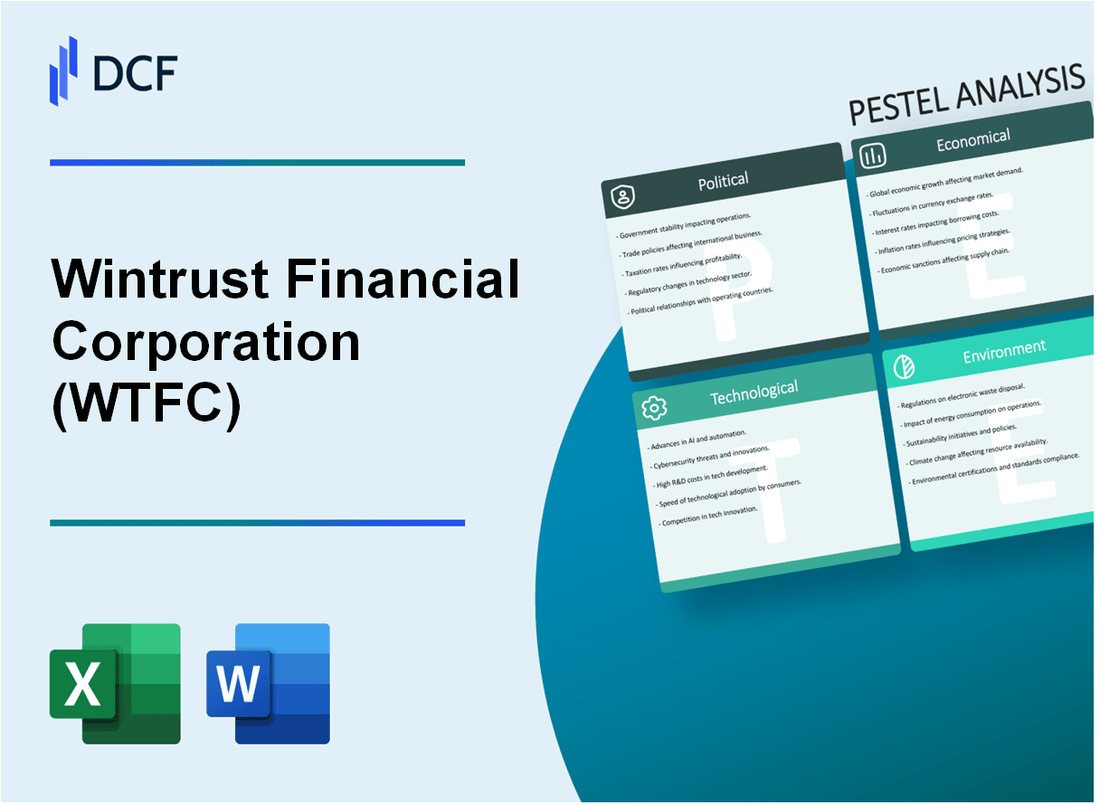
Wintrust Financial Corporation (WTFC): Análise de Pestle [Jan-2025 Atualizado] |
Totalmente Editável: Adapte-Se Às Suas Necessidades No Excel Ou Planilhas
Design Profissional: Modelos Confiáveis E Padrão Da Indústria
Pré-Construídos Para Uso Rápido E Eficiente
Compatível com MAC/PC, totalmente desbloqueado
Não É Necessária Experiência; Fácil De Seguir
Wintrust Financial Corporation (WTFC) Bundle
No cenário dinâmico do setor bancário regional, a Wintrust Financial Corporation (WTFC) navega em um complexo ecossistema de desafios e oportunidades. Desde os efeitos cascata das políticas do Federal Reserve até as interrupções tecnológicas e as expectativas da sociedade em evolução, essa análise abrangente de pilotes revela as forças multifacetadas que moldam a trajetória estratégica do banco. Mergulhe em uma exploração intrincada de como fatores políticos, econômicos, sociológicos, tecnológicos, legais e ambientais se cruzam para definir a resiliência e o potencial de Wrntrust em um mercado financeiro cada vez mais volátil.
Wintrust Financial Corporation (WTFC) - Análise de Pestle: Fatores Políticos
Impacto potencial das mudanças de política monetária do Federal Reserve nos regulamentos bancários
Em janeiro de 2024, o Federal Reserve manteve uma taxa de fundos federais entre 5,25% e 5,50%, o nível mais alto desde 2001. A Wintrust Financial Corporation enfrenta possíveis ajustes regulatórios que poderiam afetar suas estratégias operacionais.
| Federal Reserve Policy Metric | Status atual |
|---|---|
| Taxa de fundos federais | 5.25% - 5.50% |
| Requisitos de capital Basileia III | Requisito de taxa de capital de nível 1: 8% |
| Conformidade no teste de estresse | Requisito regulatório anual |
Scrutinato contínuo do setor bancário regional após 2023 falhas bancárias
Os colapsos do Silicon Valley Bank e Signature Bank em março de 2023 intensificaram a supervisão regulatória das instituições bancárias regionais.
- Requisitos de relatório regulatório aumentados
- Teste de estresse de liquidez aprimorado
- Mandatos mais rígidos de preservação de capital
Potenciais mudanças legislativas que afetam os serviços bancários e financeiros comunitários
A Lei da Comunidade de Reinvestimento (CRA) Regras de Modernização, finalizada em outubro de 2023, introduz novos requisitos de conformidade para bancos regionais como a Wrntrust.
| Aspecto legislativo | Impacto potencial |
|---|---|
| Modernização do CRA | Áreas de avaliação expandida |
| Regulamentos bancários digitais | Mandatos aumentados de segurança cibernética |
| Proteção ao consumidor | Requisitos de divulgação aprimorados |
Tensões geopolíticas que influenciam a estabilidade econômica e estratégias de investimento
As tensões geopolíticas globais, incluindo conflitos em andamento e incertezas comerciais, criam ambientes econômicos complexos para instituições financeiras.
- As sanções potenciais afetam as transações internacionais
- Maior volatilidade nos mercados financeiros globais
- Riscos de interrupção da cadeia de suprimentos
Em dezembro de 2023, os ativos totais da Wintrust Financial Corporation foram de aproximadamente US $ 48,2 bilhões, posicionando o banco para navegar nessas complexas paisagens políticas e regulatórias.
Wintrust Financial Corporation (WTFC) - Análise de Pestle: Fatores Econômicos
Desafios contínuos das flutuações das taxas de juros e incerteza econômica
A partir do quarto trimestre de 2023, a Wintrust Financial Corporation experimentou pressões econômicas significativas. A taxa de juros de referência do Federal Reserve ficou em 5,33%, impactando diretamente a margem de juros líquidos do banco. Para o ano fiscal de 2023, a Wintrust registrou uma receita de juros líquidos de US $ 1,48 bilhão, refletindo o complexo ambiente de taxa de juros.
| Indicador econômico | Valor (2023) | Impacto no WTFC |
|---|---|---|
| Taxa de fundos federais | 5.33% | Aumento dos custos de empréstimos |
| Receita de juros líquidos | US $ 1,48 bilhão | Reflete os desafios do ambiente da taxa |
| Margem de juros líquidos | 3.62% | Pressão moderada sobre a lucratividade |
Desempenho econômico regional em Illinois e nos mercados do meio -oeste circundante
O PIB de Illinois em 2023 foi de US $ 1,04 trilhão, com o mercado primário da Wintrust mostrando estabilidade econômica moderada. A região do Centro -Oeste demonstrou uma taxa de crescimento econômico de 2,1%, apoiando o posicionamento do mercado regional do banco.
| Métrica econômica regional | 2023 valor | Significado |
|---|---|---|
| Illinois PIB | US $ 1,04 trilhão | Tamanho econômico do mercado primário |
| Crescimento econômico do Centro -Oeste | 2.1% | Expansão regional moderada |
| Taxa de desemprego (Illinois) | 4.3% | Mercado de trabalho estável |
Riscos potenciais de recessão que afetam a demanda de empréstimos e serviços financeiros
O portfólio de empréstimos da Wintrust totalizou US $ 47,2 bilhões em 2023, com possíveis riscos de recessão influenciando as estratégias de empréstimos. O banco manteve um Reserva conservadora de perda de empréstimo de US $ 589 milhões, antecipando possíveis crises econômicas.
| Métrica de empréstimo | 2023 valor | Preparação para recessão |
|---|---|---|
| Portfólio total de empréstimos | US $ 47,2 bilhões | Abordagem de empréstimo diversificada |
| Reserva de perda de empréstimo | US $ 589 milhões | Estratégia de mitigação de risco |
| Razão de empréstimos não-desempenho | 1.2% | Indica qualidade de crédito |
Pressões competitivas no setor regional de serviços bancários e financeiros
Wintrust enfrentou intensa competição no setor bancário do Centro -Oeste. O total de ativos do banco atingiu US $ 68,3 bilhões em 2023, com uma participação de mercado de aproximadamente 3,7% em seus mercados regionais primários.
| Métrica competitiva | 2023 valor | Posição de mercado |
|---|---|---|
| Total de ativos | US $ 68,3 bilhões | Presença regional significativa |
| Quota de mercado | 3.7% | Posicionamento regional competitivo |
| Retorno sobre o patrimônio (ROE) | 12.4% | Forte desempenho financeiro |
Wintrust Financial Corporation (WTFC) - Análise de Pestle: Fatores sociais
Mudança de preferências do consumidor para serviços bancários digitais e financeiros móveis
De acordo com o relatório anual de 2022 da Wintrust Financial, as transações bancárias móveis aumentaram 42,3% em comparação com o ano anterior. Os usuários de banco digital cresceram para 68,5% de sua base total de clientes na região do Centro -Oeste.
| Métrica bancária digital | 2022 dados | 2021 dados |
|---|---|---|
| Usuários bancários móveis | 68.5% | 55.2% |
| Volume de transação móvel | Aumento de 42,3% | 28,7% de aumento |
| Aberturas de contas on -line | 37,600 | 24,500 |
Mudanças demográficas nos mercados do Centro -Oeste que afetam a base de clientes bancários
2022 dados demográficos mostram 3,7% de mudança de população, com padrões de migração significativos afetando a demografia dos clientes.
| Segmento demográfico | Variação percentual |
|---|---|
| Clientes bancários milenares | Aumento de 12,4% |
| NOVAS ABERTAS DE CONTA DE GEN Z | 8,6% de crescimento |
| Segmento de clientes sênior | 5,2% de aumento |
Crescente demanda por experiências bancárias personalizadas e focadas na comunidade
Wrntrust Financial relatou US $ 124,5 milhões investidos em programas de desenvolvimento comunitário Em 2022, com 87,3% dos clientes indicando preferência por serviços bancários personalizados locais.
Ênfase crescente na inclusão financeira e serviços bancários acessíveis
Em 2022, a Wintrust lançou 17 novos programas de alfabetização financeira, atendendo a 42.300 indivíduos nas comunidades do Centro -Oeste. As ofertas de contas bancárias de baixo custo aumentaram 22,6%, direcionando as populações carentes.
| Métrica de inclusão financeira | 2022 dados |
|---|---|
| Programas de alfabetização financeira | 17 novos programas |
| Indivíduos servidos | 42,300 |
| Ofertas de contas de baixo custo | 22,6% de aumento |
Wintrust Financial Corporation (WTFC) - Análise de Pestle: Fatores tecnológicos
Investimento contínuo em plataformas bancárias digitais e aplicativos móveis
A partir do quarto trimestre de 2023, a Wrntrust Financial investiu US $ 12,3 milhões em infraestrutura de tecnologia bancária digital. A empresa relatou 487.000 usuários ativos de bancos móveis, representando um aumento de 16,4% em relação ao ano anterior.
| Métrica bancária digital | 2023 valor | Mudança de ano a ano |
|---|---|---|
| Usuários bancários móveis | 487,000 | +16.4% |
| Investimento bancário digital | US $ 12,3 milhões | +9.2% |
| Downloads de aplicativos móveis | 213,000 | +22.7% |
Aprimoramentos de segurança cibernética para proteger as informações financeiras do cliente
Wintrust alocou US $ 8,7 milhões à infraestrutura de segurança cibernética em 2023. A empresa implementou Autenticação multifatorial para 92% de suas plataformas bancárias digitais.
| Métrica de segurança cibernética | 2023 valor |
|---|---|
| Investimento de segurança cibernética | US $ 8,7 milhões |
| Cobertura de autenticação de vários fatores | 92% |
| Tempo de resposta a incidentes de segurança | 24 minutos |
Implementação de IA e aprendizado de máquina em serviços financeiros e gerenciamento de riscos
Os algoritmos de avaliação de risco implantados pela WrTrust implantaram a IA, cobrindo 76% de seus processos de avaliação de empréstimos. Os modelos de aprendizado de máquina reduziram o tempo de avaliação de risco de crédito em 47%.
| Métrica de implementação da IA | 2023 valor |
|---|---|
| Avaliações de empréstimos cobertos de IA | 76% |
| Redução de tempo de avaliação de risco | 47% |
| Investimento em tecnologia da IA | US $ 5,6 milhões |
Adoção de blockchain e tecnologias financeiras emergentes
A Wrntrust iniciou os programas piloto de blockchain em gerenciamento de tesouraria, investindo US $ 3,2 milhões em pesquisa e desenvolvimento de tecnologia financeira emergente.
| Métrica de tecnologia emergente | 2023 valor |
|---|---|
| Blockchain R&D Investment | US $ 3,2 milhões |
| Programas piloto de blockchain | 2 |
| Tamanho emergente da equipe de pesquisa tecnológica | 12 especialistas |
Wintrust Financial Corporation (WTFC) - Análise de Pestle: Fatores Legais
Conformidade com os regulamentos bancários em evolução e requisitos de relatórios financeiros
A partir de 2024, a Wintrust Financial Corporation deve aderir a várias estruturas regulatórias:
| Órgão regulatório | Principais requisitos de conformidade | Frequência de relatório |
|---|---|---|
| Federal Reserve | Relatórios de adequação de capital | Trimestral |
| Fdic | Divulgação de gerenciamento de riscos | Semestral |
| Sec | Transparência de demonstração financeira | Anual |
Desafios legais potenciais relacionados a práticas de empréstimos e proteção ao consumidor
Custo de conformidade: US $ 4,2 milhões anualmente para requisitos legais de proteção ao consumidor
- Monitoramento de conformidade da Lei de Empréstimos Justos
- Supervisão regulatória do Departamento de Proteção Financeira do Consumidor (CFPB)
- ATENÇÃO DE OPORTUNIDADES DE CRÉDITO Igual
Scrutínio regulatório de fusões e aquisições no setor bancário
| Parâmetro de revisão de fusões | Padrão regulatório | Métrica de conformidade |
|---|---|---|
| Concentração de mercado | ÍNDICE HERFINDAHL-HIRSCHMAN | Abaixo de 1.500 limite |
| Avaliação de impacto da comunidade | Conformidade do CRA | Classificação satisfatória necessária |
Adaptação contínua à mudança de cenário legal de serviços financeiros
Orçamento de conformidade legal: US $ 7,5 milhões em 2024
- Atualizações de regulamentação bancária digital
- Modificações da estrutura legal de segurança cibernética
- Alterações regulatórias de lavagem de dinheiro (LBC)
Wintrust Financial Corporation (WTFC) - Análise de Pestle: Fatores Ambientais
Foco crescente em iniciativas bancárias sustentáveis e verdes
A Wintrust Financial Corporation alocou US $ 25,7 milhões em iniciativas de empréstimos verdes em 2023. A carteira de empréstimos de energia renovável do banco aumentou 18,3% em comparação com o ano anterior.
| Categoria de iniciativa verde | Valor do investimento ($) | Porcentagem de portfólio total |
|---|---|---|
| Empréstimos de energia solar | 12,400,000 | 6.2% |
| Projetos de energia eólica | 8,300,000 | 4.1% |
| Empréstimos de eficiência energética | 5,000,000 | 2.5% |
Avaliação de risco ambiental em empréstimos comerciais e residenciais
Métricas de avaliação de riscos ambientais:
- Triagem de risco climático implementado para 92% dos pedidos de empréstimos comerciais
- Avaliação da zona de inundação realizada para 98,5% dos pedidos de hipoteca residencial
- Análise de impacto em emissão de carbono integrada em 75% das grandes decisões de empréstimos corporativos
Relatórios de sustentabilidade corporativa e esforços de redução de pegada de carbono
| Métrica de redução de carbono | 2023 desempenho | Redução de alvo |
|---|---|---|
| Emissões de carbono corporativo | 24.500 toneladas métricas | 15% até 2025 |
| Consumo de energia | 38,2 milhões de kWh | 20% de redução até 2026 |
| Taxa de reciclagem de resíduos | 67.3% | 75% até 2024 |
Integração de considerações ambientais em investimentos e estratégias de empréstimos
Alocação de investimento ambiental, social e de governança (ESG): US $ 412 milhões em 2023, representando 6,7% do portfólio total de investimentos.
| Categoria de investimento ESG | Valor do investimento ($) | Porcentagem de portfólio ESG |
|---|---|---|
| Tecnologia limpa | 156,000,000 | 37.8% |
| Infraestrutura sustentável | 124,500,000 | 30.2% |
| Energia renovável | 131,500,000 | 32.0% |
Wintrust Financial Corporation (WTFC) - PESTLE Analysis: Social factors
Community banking model focuses on local markets in the Midwest and Florida.
Wintrust Financial Corporation's core strategy is built on a decentralized, community-focused banking model, which is a major social factor defining its market acceptance and growth. This model centers on local markets across the Midwest and, to a lesser extent, Florida. The Midwest presence is robust, covering the greater Chicagoland area, northwest Indiana, southern Wisconsin, and west Michigan, where the 2024 acquisition of Macatawa Bank added 26 full-service branches.
The company operates over 175 community bank locations, which allows them to tailor services to the unique needs of each local community. Their footprint in southwest Florida, established to serve existing customers who travel or live there seasonally, confirms the multi-state focus. This hyper-local approach helps them compete effectively against larger national banks by fostering a strong, community-driven brand identity.
42% of new retail branches since 2020 opened in low- to moderate-income areas.
A significant social commitment is Wintrust Financial Corporation's focus on expanding access to financial services in underserved areas. Since 2020, approximately 42% of the new retail banking locations the company has opened are situated in low- to moderate-income (LMI) neighborhoods.
This expansion is a direct, measurable effort to address financial disparities, going beyond the requirements of the Community Reinvestment Act (CRA) of 1977. As of 2024, 12 of their 16 bank charters had received an "outstanding" rating from their regulatory agency for their community development efforts, showing a strong social performance. This is defintely a key differentiator for their franchise value.
Here's the quick math on their community impact investments and outreach:
| Community Investment Metric (2024 Data) | Amount/Value |
|---|---|
| Investment with Community Development Financial Institutions (CDFIs) | Over $72 million |
| Number of CDFIs Supported | 20 |
| Employee Volunteer Hours | Over 27,000 hours |
| Number of Community Partners Supported | More than 2,000 |
Strong emphasis on Diversity, Equity & Inclusion (DE&I) in corporate culture.
Wintrust Financial Corporation actively promotes Diversity, Equity & Inclusion (DE&I) through its corporate culture, which is essential for reflecting the diverse markets it serves. This focus is formalized through the One Wintrust Roadmap, which includes workforce/workplace as a key pillar.
The company's commitment to an inclusive workplace is supported by concrete workforce metrics as of December 31, 2024:
- Women in the workforce: 56%
- Ethnically diverse workforce: 33%
They also invest in programs like the Wintrust Credit Academy and campus recruiting to attract talent from a variety of backgrounds, especially women and people of color, to build a strong internal pipeline. This commitment helps maintain a positive social reputation and attracts top talent in competitive labor markets.
Community-driven spirit is a core part of their brand identity and customer acquisition.
The community-driven spirit is not just a compliance issue; it's a core marketing and customer acquisition tool. The bank's reputation as a local advocate is intentionally woven into its brand identity, translating into tangible marketing spend. For example, in the second quarter of 2025, Advertising and Marketing expenses totaled $18.8 million, an increase of $6.5 million from the prior quarter, partly driven by planned and seasonal community sponsorship events.
This spending supports a strategy where the bank's presence is felt locally, not just through branches but through direct financial and non-financial support, which ultimately drives customer loyalty and deposit growth. They also make banking more accessible by eliminating overdraft and return item fees for all Wintrust Community Bank retail customers, offering a Bank On certified product for safe and affordable accounts.
Wintrust Financial Corporation (WTFC) - PESTLE Analysis: Technological factors
Significant investment in technology and upgrades to mitigate fraud risk.
You can't run a bank with nearly \$70 billion in assets without a serious technology budget, and Wintrust Financial Corporation knows this. The company is constantly upgrading its technology and security infrastructure, a necessity that drove a \$2.7 million increase in Software and equipment expense in the fourth quarter of 2024, specifically for information technology and security upgrades. This isn't a one-off; it's a commitment to staying ahead of increasingly sophisticated financial crime.
This investment is directly aimed at fraud mitigation, especially in high-risk areas like commercial payments. For instance, the bank offers a full suite of Positive Pay solutions (Check, Reverse, and ACH Positive Pay), which are essential, automated tools for commercial clients. The Enterprise Fraud Management Team uses best-in-class fraud analytics and transaction monitoring tools to detect and prevent schemes like Business Email Compromise (BEC) and ACH fraud.
| 2025 Quarterly Non-Interest Expense (Proxy for Operating Scale/Tech Spend) | Amount (Millions) | Notes |
|---|---|---|
| Q1 2025 Non-Interest Expense | $366.1 million | Includes salaries, professional fees, and technology costs. |
| Q2 2025 Non-Interest Expense | $381.5 million | Increased by $15.4 million from Q1 2025, reflecting higher operating costs. |
| Q3 2025 Non-Interest Expense | $380.0 million | Slightly decreased from Q2, but consistent with large-scale operations. |
Cybersecurity planning is a necessity for all financial institutions of Wintrust's size.
Cybersecurity isn't a cost center anymore; it's a core business function and a regulatory mandate. Wintrust's approach is comprehensive, overseen by the Board of Directors' Information Technology & Information Security Committee (IT/IS Committee). They structure their program around global standards, including the National Institute of Standards and Technology Cybersecurity Framework (NIST).
The bank leverages a modern, hybrid IT footprint-spanning cloud-native applications, on-premise systems, Software as a Service (SaaS) platforms, and their branch offices-which makes visibility defintely challenging. To manage this, they use an advanced observability stack, including Cisco ThousandEyes and Splunk, to accelerate threat detection and streamline incident response. This is how a regional bank handles enterprise-level risk.
- Strategy: Devoting necessary resources to monitor, detect, and prevent cyber risk.
- Detection: The Security Operations Center (SOC) constantly monitors systems for threats.
- Compliance: Program closely tracks requirements from various financial regulators.
Uses technology resources of a large bank while maintaining a local service model.
Wintrust's competitive edge is its community-oriented, local service model, but its back-end technology is scaled like a much larger regional player. They run a hybrid IT environment that connects cloud-based enterprise applications with the physical infrastructure of their numerous community bank branches. This allows them to offer sophisticated products-like specialized lending and wealth management platforms-without losing the local, relationship-driven feel their customers expect.
This dual strategy requires a complex technology stack. For example, they utilize enterprise applications like Microsoft Power BI for analytics and SAP Concur for accounts payable automation. This kind of enterprise software is what gives them the efficiency and data-driven capabilities of a large bank, while the branch network maintains the local touchpoint. It's a tricky balance, but it's working.
Digital adoption drives demand for sophisticated online and mobile banking platforms.
The market is clear: digital is the new default. As of 2025, 72% of US adults report using mobile banking apps, and 42% of consumers prefer a mobile app as their go-to method for managing finances. This generational shift is forcing Wintrust to maintain 'ambitious digital transformation goals'.
The company is making continued investment in digital banking platforms and upgraded technology for wealth management. This focus is crucial for strengthening customer acquisition and retention, particularly among younger, tech-savvy segments. The bank also had to transition systems and support for brokerage and certain private client business to a new third party in Q1 2025, a major technology undertaking to keep their wealth management offerings competitive.
- US Mobile Banking Adoption (2025): 72% of US adults use mobile banking apps.
- Consumer Preference (2025): 42% of consumers prefer a mobile app over a website or branch.
- Transaction Shift: Mobile banking transactions surged by 67% in 2025, reinforcing the pivot to digital-first behavior.
Wintrust Financial Corporation (WTFC) - PESTLE Analysis: Legal factors
Compliance with stringent banking regulations for its premium finance business.
Wintrust Financial Corporation's specialty finance segment, which includes insurance premium financing, is a significant part of its business model and is subject to a dual layer of regulatory scrutiny. The commercial and property/casualty premium finance business, which is conducted across all 50 U.S. states, is heavily regulated at the state level, primarily governing notices to borrowers and policy cancellation procedures.
The life insurance premium finance business, which targets high net-worth borrowers, is primarily subject to federal banking regulations and not the additional state-level regimes. This distinction is key, but the sheer volume of this business means compliance is a major operational cost. For the first half of 2025, the total originations within the insurance premium financing receivables portfolios were substantial, with $4.8 billion in Q1 2025 and a seasonally higher $6.1 billion in Q2 2025. This scale requires constant monitoring of state and federal law changes, which directly impacts the legal and compliance budget.
Increased compliance costs due to evolving data privacy and cybersecurity laws.
The legal and compliance burden from evolving data privacy and cybersecurity laws, like the California Consumer Privacy Act (CCPA) and various state-level data breach notification rules, is a growing cost center. While there isn't a single line item for 'cyber-legal compliance,' we see the impact in related expense categories.
For context, Wintrust Financial Corporation's total non-interest expense was $366.1 million in the first quarter of 2025 and $381.5 million in the second quarter of 2025. A portion of this increase is directly tied to technology and legal support for security. Here's the quick math: Professional fees-which cover legal, audit, and consulting services-are a core indicator of this spending. You can defintely expect this cost to rise as new regulations are introduced.
The need to protect customer data is paramount, so you see capital expenditure flowing into IT security infrastructure. This is non-negotiable legal-driven spend.
Subject to oversight by the SEC and FINRA for its wealth management subsidiaries.
The wealth management segment, which includes entities like Wintrust Investments, operates under the strict oversight of the Securities and Exchange Commission (SEC) and the Financial Industry Regulatory Authority (FINRA). Wintrust Investments is regulated as both a registered broker-dealer and a registered investment adviser.
The size of this regulated business is considerable, with approximately $51.1 billion of assets under administration as of March 31, 2025. This scale means any compliance failure could lead to significant fines and reputational damage. The firm must maintain rigorous compliance programs for anti-money laundering (AML), suitability standards for client investments, and accurate disclosures under SEC and FINRA rules. The wealth management revenue, which reached $53.2 million in Q2 2025, is a direct reflection of this highly regulated, fee-based business.
Need to monitor the transition from LIBOR to alternative benchmark rates for transactions.
The legal and operational transition away from the London Interbank Offered Rate (LIBOR) to alternative rates like the Secured Overnight Financing Rate (SOFR) was a massive undertaking for the entire industry, and for Wintrust Financial Corporation, the legal risk is now focused on managing the tail end of legacy contracts.
While the publication of key U.S. dollar LIBOR settings ceased in 2023 and the synthetic LIBOR settings ceased by September 30, 2024, the legal teams in 2025 are still working to ensure all legacy contracts have been successfully transitioned using legally robust fallback language. For perspective on the scale of the legal challenge, the Company had to manage derivative exposure related to this, including interest rate caps with an aggregate notional value of $1.0 billion as of late 2021. The legal team's current action is to monitor any potential litigation arising from the application of fallback rates to those final remaining contracts.
Here is a summary of the key legal and compliance metrics for 2025:
| Legal/Compliance Factor | 2025 Fiscal Year Data (Q1/Q2) | Legal Implication |
|---|---|---|
| Premium Finance Originations (Q1/Q2 2025) | $4.8 billion (Q1) / $6.1 billion (Q2) | Mandates continuous, multi-state compliance monitoring for consumer protection and policy cancellation laws. |
| Assets Under Administration (AUM - Q1 2025) | Approximately $51.1 billion | Requires strict adherence to SEC and FINRA rules, including AML and Know Your Customer (KYC) requirements, to avoid regulatory penalties. |
| Total Non-Interest Expense (Q1/Q2 2025) | $366.1 million (Q1) / $381.5 million (Q2) | Indicates the overall scale of operational costs, a portion of which is dedicated to rising IT security and data privacy compliance. |
| LIBOR Notional Derivative Exposure (Historical Proxy) | $1.0 billion (Interest Rate Caps, as of 12/31/2021) | Highlights the magnitude of contracts requiring legal remediation and the ongoing risk of litigation from legacy contracts transitioning to SOFR. |
Wintrust Financial Corporation (WTFC) - PESTLE Analysis: Environmental factors
Currently introducing practices to manage near-term climate-related risks.
You need to know how Wintrust Financial Corporation is handling climate risk right now, not in ten years, and the good news is that near-term risks are largely manageable for this regional bank. As of May 2025, a credit rating analysis indicated that near-term climate-related risks are believed to be 'well contained' for the firm. Still, the company is actively 'in the process of introducing practices' to integrate climate risk into its existing risk management framework.
This means they are moving past simple disclosure toward embedding climate considerations into core functions. They are working to enhance processes that integrate climate risk into strategies for credit, market, and operational risks, which is defintely the right move. This proactive approach is a necessary step, especially as federal regulators, even with recent political shifts, still expect all supervised institutions to address all material financial risks, including emerging ones like climate change.
Incorporating sustainable practices into operations and products, following ESG principles.
The bank's environmental impact strategy is centered on minimizing its direct operational footprint while maximizing its positive social impact through lending, which is a common and effective ESG (Environmental, Social, and Governance) approach for community-focused financial institutions. The overall sustainability impact, as measured by a net impact ratio, is a positive 39.7%. This positive score is driven primarily by social categories like Societal Infrastructure and Jobs, but the environmental component is addressed through operational efficiency and product offerings.
On the operations side, Wintrust Financial Corporation regularly assesses its corporate offices and operations to find ways to improve sustainability, which includes monitoring consumption and reviewing waste streams. On the product side, the focus is on community-building initiatives that inherently support sustainable communities:
- Supporting Homeownership: Offering products like the Wintrust Down Payment Program and partnering on below-market-rate mortgages with groups like Habitat for Humanity.
- Financial Inclusion: Providing services and financial education in low- and moderate-income (LMI) neighborhoods, with approximately 42% of retail banking locations opened since 2020 situated in these areas.
That is where the real community-level impact is felt.
Committed to ESG reporting, using the SASB Standards framework.
The company is committed to transparent reporting, which is crucial for attracting capital from institutional investors who increasingly screen for ESG performance. Wintrust Financial Corporation aligns its disclosures with both the SASB Standards (Sustainability Accounting Standards Board) and the TCFD framework (Task Force on Climate-related Financial Disclosures).
The SASB Standards provide the detailed, industry-specific metrics for the Commercial Banks and Mortgage Finance sectors, giving investors comparable data. The TCFD framework provides the strategic narrative structure, helping the company disclose how climate-related risks are embedded into its governance and overall strategy. This dual-framework approach is considered best-in-class in 2025 for comprehensive ESG disclosure.
Minimal direct environmental impact, but indirect risk from financing carbon-intensive sectors.
As a bank, Wintrust Financial Corporation's direct environmental footprint (Scope 1 and 2 emissions from its branches and corporate offices) is minimal compared to its indirect impact (Scope 3, or financed emissions). This indirect risk comes from the companies and projects it lends to, and measuring this is a challenge across the entire banking sector.
However, the bank's highly diversified loan portfolio helps mitigate concentration risk in the most carbon-intensive sectors. For instance, a significant portion-about one-third-of the loan portfolio is composed of insurance premium finance loans, which are considered low-loss and less carbon-intensive. As of September 30, 2025, the total loan portfolio stood at $52.1 billion. The low non-performing loan ratio of 0.31% of total loans, or $162.6 million, as of Q3 2025, suggests that credit risk, which includes potential climate-related transition risk, remains well-managed.
Here's the quick math on the portfolio breakdown as of Q3 2025, which helps map the indirect risk exposure:
| Loan Portfolio Segment | % of Total Loans (Q3 2025) | Value (USD, Billions) |
|---|---|---|
| Commercial, Industrial and Other | 31% | $16.15 |
| Commercial Real Estate (C&D) | 8% | $4.17 |
| Commercial Real Estate (Non-Construction) | 6% | $3.13 |
| Residential Real Estate | 6% | $3.13 |
| Premium Finance Receivables (Commercial/Life) | 8% | $4.17 |
| Leasing | 4% | $2.08 |
| Franchise Lending | 3% | $1.56 |
The 31% allocation to Commercial, Industrial and Other loans is where the greatest indirect carbon risk resides, requiring continued scrutiny of client industries for transition risk exposure. Finance: continue to monitor the energy exposure within the Commercial and Industrial portfolio for the 2026 risk review.
Disclaimer
All information, articles, and product details provided on this website are for general informational and educational purposes only. We do not claim any ownership over, nor do we intend to infringe upon, any trademarks, copyrights, logos, brand names, or other intellectual property mentioned or depicted on this site. Such intellectual property remains the property of its respective owners, and any references here are made solely for identification or informational purposes, without implying any affiliation, endorsement, or partnership.
We make no representations or warranties, express or implied, regarding the accuracy, completeness, or suitability of any content or products presented. Nothing on this website should be construed as legal, tax, investment, financial, medical, or other professional advice. In addition, no part of this site—including articles or product references—constitutes a solicitation, recommendation, endorsement, advertisement, or offer to buy or sell any securities, franchises, or other financial instruments, particularly in jurisdictions where such activity would be unlawful.
All content is of a general nature and may not address the specific circumstances of any individual or entity. It is not a substitute for professional advice or services. Any actions you take based on the information provided here are strictly at your own risk. You accept full responsibility for any decisions or outcomes arising from your use of this website and agree to release us from any liability in connection with your use of, or reliance upon, the content or products found herein.