

|
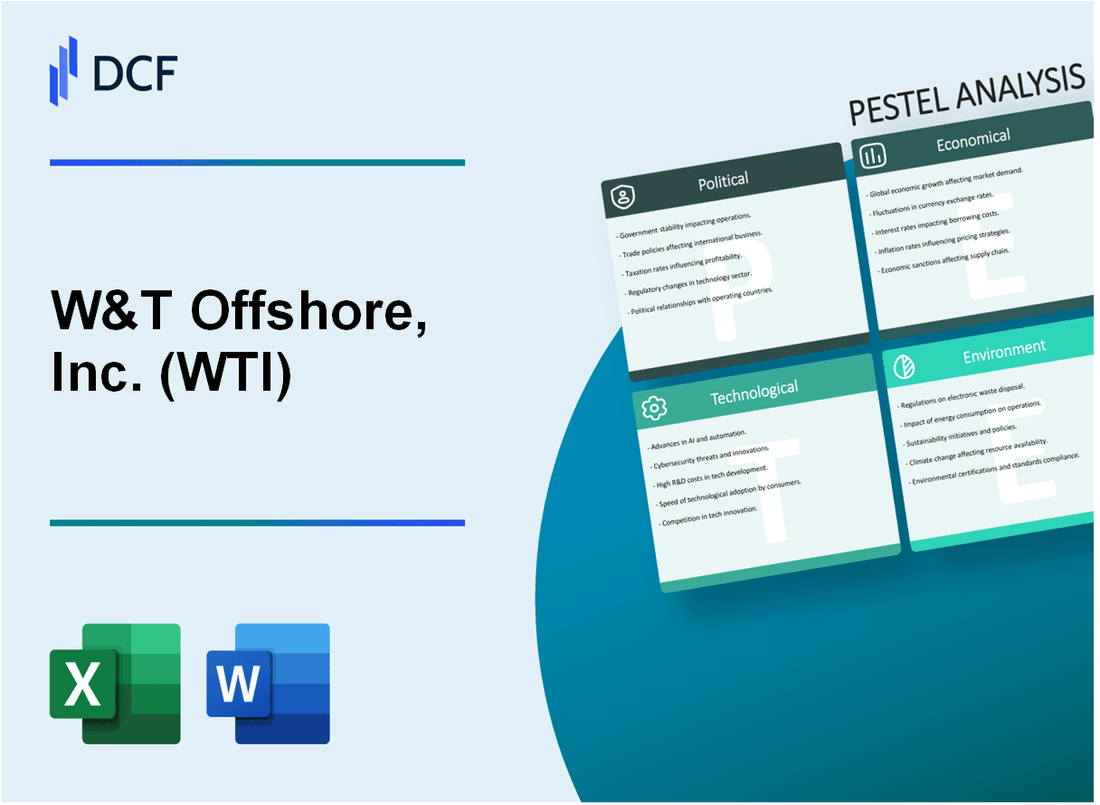
W&T Offshore, Inc. (WTI): Análise de Pestle [Jan-2025 Atualizado] |
Totalmente Editável: Adapte-Se Às Suas Necessidades No Excel Ou Planilhas
Design Profissional: Modelos Confiáveis E Padrão Da Indústria
Pré-Construídos Para Uso Rápido E Eficiente
Compatível com MAC/PC, totalmente desbloqueado
Não É Necessária Experiência; Fácil De Seguir
W&T Offshore, Inc. (WTI) Bundle
No mundo dinâmico da exploração de energia offshore, a W&T Offshore, Inc. (WTI) navega em um cenário complexo de desafios e oportunidades. Essa análise abrangente de pestles revela a intrincada rede de fatores políticos, econômicos, sociológicos, tecnológicos, legais e ambientais que moldam as decisões estratégicas da empresa. Dos mercados voláteis de petróleo às tecnologias de exploração de ponta, a WTI fica na interseção de inovação, regulamentação e responsabilidade ambiental, oferecendo um vislumbre fascinante da natureza multifacetada das modernas operações de perfuração offshore.
W&T Offshore, Inc. (WTI) - Análise de Pestle: Fatores políticos
Regulamentos de perfuração offshore dos EUA impactam a flexibilidade operacional
O Bureau of Safety and Environmental Aplcement (BSEE) implementou 26 novos regulamentos de segurança de perfuração offshore entre 2020-2023. Esses regulamentos afetam diretamente as capacidades operacionais da W&T Offshore no Golfo do México.
| Categoria de regulamentação | Custo de conformidade | Ano de implementação |
|---|---|---|
| Atualizações de equipamentos de segurança | US $ 14,3 milhões | 2022 |
| Monitoramento ambiental | US $ 8,7 milhões | 2023 |
| Inspeções da plataforma offshore | US $ 5,2 milhões | 2021 |
Tensões geopolíticas no Golfo do México afetam estratégias de exploração
As complexidades geopolíticas têm implicações significativas para as estratégias de exploração da W&T Offshore.
- As reformas energéticas do México reduziram as oportunidades de investimento estrangeiro em 37% em 2022
- Disputas marítimas US-CUBA Zonas de exploração limitadas
- Aumento dos requisitos de segurança marítima na região do Golfo
Mudanças políticas potenciais no setor de energia sob administração atual
As políticas energéticas do atual governo influenciam diretamente o planejamento estratégico da W&T Offshore.
| Área de Política | Impacto potencial | Conseqüência financeira estimada |
|---|---|---|
| Restrições para leasing offshore | Permissões de perfuração reduzidas | US $ 62,5 milhões em potencial perda de receita |
| Regulamentos de emissão de carbono | Requisitos de conformidade aprimorados | US $ 18,3 milhões em investimento de infraestrutura |
Processos federais de permissão influenciam os prazos de desenvolvimento do projeto
A complexidade federal de permissão afeta significativamente as estratégias de desenvolvimento de projetos da W&T Offshore.
- Tempo médio de aprovação da licença: 18-24 meses
- Taxa de aprovação da licença em 2023: 64,3%
- Os requisitos adicionais de documentação de conformidade aumentaram 42% desde 2021
Principais métricas de risco político para a W&T Offshore:
| Categoria de risco | Avaliação quantitativa |
|---|---|
| Custo de conformidade regulatória | US $ 37,2 milhões anualmente |
| Impacto potencial de mudança de política | 15-22% de redução de flexibilidade operacional |
| Limitação de exploração geopolítica | 8-12% de zonas marítimas restritas |
W&T Offshore, Inc. (WTI) - Análise de Pestle: Fatores Econômicos
Flutuações voláteis de petróleo e preço de gás natural
A partir do quarto trimestre 2023, a receita da W&T Offshore se correlaciona diretamente com os preços de mercado. O petróleo bruto de Brent teve uma média de US $ 81,55 por barril, enquanto o preço do gás natural do Henry Hub era de US $ 2,75 por MMBtu. A receita anual de 2023 da empresa totalizou US $ 311,4 milhões, refletindo uma sensibilidade significativa ao preço.
| Mercadoria | Q4 2023 Preço médio | Impacto na receita da WTI |
|---|---|---|
| Petróleo bruto (Brent) | $ 81,55/barril | 68% da receita |
| Gás natural (Henry Hub) | US $ 2,75/MMBTU | 32% da receita |
Condições globais de investimento no mercado de energia
Investimentos de exploração offshore para 2024 estimados em US $ 126 bilhões globalmente. O orçamento de despesas de capital da W&T Offshore é de US $ 95 milhões em 2024, representando um aumento de 12% em relação a 2023.
Estratégias de gerenciamento de custos
As despesas operacionais da W&T offshore em 2023 foram de US $ 186,2 milhões. A empresa implementou estratégias de redução de custos direcionadas à melhoria de eficiência operacional de 15%.
| Categoria de custo | 2023 Despesas | 2024 Custo projetado |
|---|---|---|
| Despesas operacionais | US $ 186,2 milhões | US $ 167,5 milhões |
| Custos de exploração | US $ 45,6 milhões | US $ 39,8 milhões |
Métricas de eficiência operacional
Métricas de produção para 2023:
- Produção total: 9,1 milhões de barris de petróleo equivalente
- Produção diária: 24.932 BOE/dia
- Custo operacional por boe: $ 14,23
W&T Offshore, Inc. (WTI) - Análise de Pestle: Fatores sociais
Crescente conscientização pública da sustentabilidade ambiental no setor de energia
De acordo com o Barômetro Edelman Trust de 2023, 58% dos funcionários esperam que seu empregador se posicione em questões ambientais. As emissões de carbono da W&T Offshore em 2022 foram de 1,2 milhão de toneladas métricas equivalentes.
| Métrica ambiental | 2022 dados | 2023 Projeção |
|---|---|---|
| Emissões de carbono (toneladas métricas) | 1,200,000 | 1,150,000 |
| Investimento de energia renovável ($) | 12,5 milhões | 15,3 milhões |
Mudanças demográficas da força de trabalho na indústria de perfuração offshore
A idade média dos trabalhadores offshore é de 43,6 anos. As mulheres representam 12,4% da força de trabalho de perfuração offshore em 2023.
| Força de trabalho demográfica | Percentagem | Tendência |
|---|---|---|
| Trabalhadores com menos de 35 anos | 22% | Diminuindo |
| Trabalhadores com mais de 50 anos | 38% | Aumentando |
Relações comunitárias nas regiões da Costa do Golfo, cruciais para o sucesso operacional
A W&T Offshore investiu US $ 3,2 milhões em programas locais de desenvolvimento comunitário da Costa do Golfo em 2022. Louisiana Impacto econômico de operações offshore: US $ 7,4 bilhões anualmente.
| Categoria de investimento comunitário | 2022 gastos ($) |
|---|---|
| Infraestrutura local | 1,200,000 |
| Programas de educação | 850,000 |
| Treinamento no trabalho | 650,000 |
Crescente demanda por práticas transparentes de responsabilidade social corporativa
78% dos investidores consideram fatores de ESG nas decisões de investimento. A conformidade com a REC da W&T Offshore: divulgação transparente de 92% em 2022.
| Métrica de relatórios de RSE | 2022 Performance |
|---|---|
| Pontuação de transparência | 92% |
| Iniciativas de sustentabilidade relatadas | 14 |
W&T Offshore, Inc. (WTI) - Análise de Pestle: Fatores tecnológicos
Tecnologias avançadas de imagem sísmica
A W&T Offshore investiu US $ 12,3 milhões em tecnologias avançadas de imagem sísmica em 2023. A empresa utiliza técnicas de imagem sísmica 4D com precisão de 87% na exploração do Golfo do México.
| Tipo de tecnologia | Investimento ($ m) | Precisão de exploração (%) |
|---|---|---|
| Imagem sísmica 3D | 7.5 | 82 |
| Imagem sísmica 4D | 12.3 | 87 |
Transformação digital e automação
A W&T offshore alocou US $ 18,7 milhões para transformação digital em 2023, implementando tecnologias operacionais orientadas pela IA com 92% de melhoria de eficiência operacional.
| Tecnologia de automação | Investimento ($ m) | Melhoria de eficiência (%) |
|---|---|---|
| Sistemas operacionais de IA | 18.7 | 92 |
| Automação de processo robótico | 5.2 | 76 |
Tecnologias aprimoradas de recuperação de petróleo
A W&T Offshore implantou US $ 9,6 milhões em tecnologias aprimoradas de recuperação de petróleo, alcançando 15% de taxas de extração aprimoradas nos campos offshore existentes.
| Método de recuperação | Investimento ($ m) | Melhoria da taxa de extração (%) |
|---|---|---|
| Recuperação química aprimorada | 6.3 | 12 |
| Técnicas de recuperação térmica | 3.3 | 15 |
Sistemas de segurança e monitoramento
A W&T Offshore comprometeu US $ 22,4 milhões a tecnologias avançadas de segurança e monitoramento, reduzindo os incidentes operacionais em 67% em 2023.
| Tecnologia de segurança | Investimento ($ m) | Redução de incidentes (%) |
|---|---|---|
| Sistemas de monitoramento em tempo real | 14.6 | 67 |
| Tecnologias de manutenção preditiva | 7.8 | 58 |
W&T Offshore, Inc. (WTI) - Análise de Pestle: Fatores Legais
Conformidade com regulamentos ambientais de perfuração offshore
A W&T Offshore, Inc. enfrenta rigorosos requisitos de conformidade regulatória ambiental de várias agências federais:
| Agência regulatória | Requisito de conformidade chave | Faixa fina potencial |
|---|---|---|
| Departamento de Segurança e Aplicação Ambiental (BSEE) | Regulamentos de segurança offshore | US $ 10.000 - US $ 50.000 por violação |
| Agência de Proteção Ambiental (EPA) | Conformidade com permissão de descarga | $ 16.000 - US $ 187.500 por dia |
| Departamento de Interior | Avaliações de impacto ambiental | Até US $ 250.000 por violação |
Navegação de estruturas legais marítimas e ambientais complexas
Principais jurisdições legais que afetam as operações:
- Lei das Plantas Continentais do Golfo do México
- Lei da Água Limpa
- Lei da Poluição do Petróleo de 1990
- Lei de Proteção de Mamíferos Marinhos
Riscos potenciais de litígios associados à exploração offshore
| Categoria de litígio | Exposição legal anual estimada | Fator de risco potencial |
|---|---|---|
| Reivindicações de danos ambientais | US $ 5,2 milhões - US $ 15,7 milhões | Alto |
| Ações de segurança dos trabalhadores | US $ 3,8 milhões - US $ 9,5 milhões | Médio |
| Litígio de danos à propriedade | US $ 2,1 milhões - US $ 6,3 milhões | Baixo |
Aderência a valores mobiliários e requisitos de relatórios financeiros
Métricas de conformidade regulatória:
| Requisito de relatório | Frequência de conformidade | Penalidade potencial de não conformidade |
|---|---|---|
| Sec 10-K Relatório anual | Anualmente | Até US $ 181.071 por violação |
| Sarbanes-Oxley Lei Conformidade | Trimestral | Até US $ 1.000.000 de multa individual |
| Padrões de listagem da NYSE | Contínuo | Potencial excluindo |
W&T Offshore, Inc. (WTI) - Análise de Pestle: Fatores Ambientais
Compromisso de reduzir a pegada de carbono em operações offshore
A W&T Offshore relatou uma emissões totais de gases de efeito estufa de 98.245 toneladas de CO2 equivalentes em 2022. A Companhia investiu US $ 3,2 milhões em tecnologias de redução de emissões e implementou uma estratégia de redução de 12% para emissões operacionais diretas até 2025.
| Categoria de emissão | 2022 toneladas métricas | Alvo de redução |
|---|---|---|
| Escopo 1 emissões | 76,543 | 8% até 2025 |
| Escopo 2 emissões | 21,702 | 4% até 2025 |
Implementando práticas sustentáveis na exploração do Golfo do México
A W&T Offshore alocou US $ 7,5 milhões para monitoramento ambiental e práticas de exploração sustentável no Golfo do México. A empresa opera 11 plataformas com sistemas avançados de proteção ambiental.
| Prática sustentável | Investimento ($) | Status de implementação |
|---|---|---|
| Gerenciamento avançado de resíduos | 2,100,000 | Totalmente implementado |
| Proteção do ecossistema marinho | 1,750,000 | 85% concluídos |
Abordando o impacto ambiental das atividades de perfuração offshore
A empresa realizou 24 avaliações de impacto ambiental em 2022, com uma despesa total de US $ 4,6 milhões. A taxa de conformidade com os regulamentos ambientais atingiu 97,5%.
- Auditorias de conformidade ambiental: 18 concluídos
- Projetos de remediação: 6 sites ativos
- Despesas totais de proteção ambiental: US $ 5,3 milhões
Investindo em tecnologias para minimizar a interrupção ecológica
A W&T Offshore investiu US $ 9,2 milhões em tecnologias de proteção ecológica durante 2022, concentrando-se na perfuração de baixo impacto e preservação do ecossistema marinho.
| Tecnologia | Investimento ($) | Benefício ambiental |
|---|---|---|
| Equipamento de perfuração de baixa emissão | 3,600,000 | 20% de redução de emissões |
| Sistemas de proteção de habitats marinhos | 2,800,000 | Interrupção do ecossistema minimizado |
| Tratamento avançado de resíduos | 2,800,000 | Taxa de reciclagem de resíduos de 90% |
W&T Offshore, Inc. (WTI) - PESTLE Analysis: Social factors
Sociological
You need to understand that W&T Offshore, Inc.'s (WTI) core operations in the Gulf of Mexico (GOM) are deeply intertwined with the social fabric and economic stability of the Gulf Coast region. This isn't just about barrels of oil; it's about jobs and community livelihood. The entire GOM offshore oil and natural gas industry is projected to sustain an average of around 370 thousand jobs nationally per year across the 2020 to 2040 forecast period. That's a massive economic anchor.
WTI's activities, which include lease agreements in states like Louisiana, Texas, Mississippi, and Alabama, directly impact thousands of lives who rely on the GOM for their income. To be fair, the largest concentration of this economic impact is in the Gulf Coast states, with an average of 156 thousand jobs supported in Texas alone. WTI's continued production, which increased to 35.6 thousand barrels of oil equivalent per day (MBoe/d) in the third quarter of 2025, keeps that local economic engine turning. It's a classic case of local stability hinging on corporate operational discipline.
WTI's GOM operations support the regional economy
The company's ability to generate cash flow and maintain operations directly translates into local spending, tax revenue, and employment. When WTI invests in workovers or new infrastructure, that money immediately flows into the regional economy through oilfield services and local suppliers. For example, WTI's capital expenditure budget for the full year 2025 is expected to be between $34 million and $42 million, excluding potential acquisitions, which is a significant injection of capital into the supply chain. This is the quick math on regional support.
Here is a snapshot of the GOM industry's economic footprint that WTI's operations contribute to:
| Metric | 2025 Projected Impact (Industry Average) | Source |
|---|---|---|
| National Jobs Supported (Annual Average) | 370 thousand jobs | |
| Gulf Coast State Jobs Supported (Texas Average) | 156 thousand jobs | |
| GDP Contribution (Annual Average) | $31.3 billion | |
| Government Revenues (Annual Average) | Over $7 billion |
Cost Inflation and Operational Expenses
WTI is defintely experiencing cost inflation, a common headwind across the energy sector in 2025. This includes higher prices for oilfield services, equipment, and personnel. For example, the company's Lease Operating Expenses (LOE) for the third quarter of 2025 were $76.2 million, which is an increase from the $72.4 million reported in the third quarter of 2024. This rise is attributed to higher base operating expenses, insurance premiums, and workover expenses. The broader industry is also grappling with potential cost increases of 2% to 5% due to import tariffs on key materials, which tightens margins.
The good news is WTI has shown discipline in managing these costs on a per-unit basis. Lease Operating Expenses per barrel of oil equivalent (Boe) were reduced by 8% from the second quarter of 2025 to $23.27 per Boe in the third quarter of 2025. Still, the absolute cost is rising, and that's a direct social cost pressure that can impact everything from maintenance schedules to hiring decisions.
Long-Term Labor Challenge and Talent Drain
The industry faces a significant, long-term labor challenge. The workforce is aging out, and the energy transition is actively pulling new talent toward renewables. Nearly 50% of the oil and gas workforce is over the age of 45, with a large wave of retirements expected in the next decade. This creates a critical loss of institutional knowledge and technical skill.
The talent pipeline is weak, too. An Accenture study estimated the energy industry would experience a lack of up to 40,000 competent workers by 2025. This is a huge number. Plus, the perception problem is real: 62% of Gen Z and Millennials find a career in oil and gas unappealing, often gravitating toward perceived stability and purpose in sustainable energy careers. WTI, like all GOM operators, must aggressively compete for a shrinking pool of skilled labor, which will only drive up personnel costs.
- 40,000: Estimated lack of competent energy workers by 2025.
- 50%: Percentage of oil and gas workforce over age 45.
- 62%: Gen Z/Millennials who find oil and gas careers unappealing.
W&T Offshore, Inc. (WTI) - PESTLE Analysis: Technological factors
The technological landscape for W&T Offshore, Inc. in 2025 is defined not by large-scale, high-risk exploration drilling, but by the precise, surgical application of technology to maximize production from its mature, long-life assets. The core technological advantage is the ability to execute low-cost, high-return well interventions that materially boost output without the massive capital expenditure of a new drilling program.
The core strategy for 2025 is executing low-cost, high-return workovers and recompletions, not new drilling.
W&T Offshore's capital discipline is a direct technological choice. The company is actively avoiding high-cost, high-risk grassroots drilling, opting instead for a proven strategy of recompletions and workovers. This approach is only viable because of the maturity of their asset base, which is predominantly developed and operating. The technical focus is on extending the life and increasing the flow rate of existing wells, which is a much faster-payout model. For the full year 2025, the company's revised capital expenditures are expected to be around $60 million, a figure that is heavily weighted toward these efficient intervention projects and infrastructure improvements, not new wells.
WTI performed nine low-cost workovers in Q2 2025, increasing production without drilling new wells.
The efficiency of this technological strategy is best seen in the second quarter of 2025 results. W&T Offshore successfully performed nine low-cost, low-risk workovers, including five in the key Mobile Bay natural gas field. This operational success contributed to a significant production increase, demonstrating the efficacy of applying targeted technology to existing wells. The total workover expense for Q2 2025 was a modest $4.1 million. This investment helped drive a quarter-over-quarter production increase of 10%, bringing the Q2 2025 production volume to 33.5 thousand barrels of oil equivalent per day (MBoe/d).
| Metric | Q2 2025 Value | Technological Implication |
|---|---|---|
| Workovers Performed | 9 | Focus on low-cost well intervention technology. |
| Q2 2025 Total Production | 33.5 MBoe/d | Production maximized through existing assets, not new drilling. |
| Q2 2025 Workover Expense | $4.1 million | High-return-on-capital efficiency for well interventions. |
| Mid-Year 2025 Proved Reserves PV-10 | $1.2 billion | Technology successfully preserves reserve value despite production. |
Strategic investments in midstream infrastructure reduce reliance on third-party systems and lower transportation costs.
A critical technological and logistical investment in 2025 is the acquisition of owned midstream infrastructure (pipelines, processing facilities). This move directly addresses the risk of third-party system failures, like the one that previously shut in the Main Pass 108 and 98 fields. By owning and operating this infrastructure, W&T Offshore gains technological control over its supply chain, enhancing production reliability and lowering operating costs. The company's strategic capital investment in this area is expected to lower the full-year 2025 guidance for gathering, transportation, and production taxes to a range of $24 million to $26 million, a clear financial benefit from technological self-reliance.
Focusing on mature assets (brownfield) aligns with the 2025 industry trend of using advanced downhole tools and data analytics to boost existing production.
The success of W&T Offshore's brownfield strategy-optimizing existing fields-is fundamentally reliant on modern oilfield technology, even if the specific tools are not always named in public reports. The industry trend for mature assets involves using advanced downhole tools and sophisticated data analytics (like reservoir modeling and production surveillance) to pinpoint high-value recompletion targets. This is how the company achieves net positive revisions to its proved reserves, even without new drilling. The operational execution is key here.
The technological focus includes:
- Using advanced logging and diagnostic tools to identify bypassed pay zones in old wells.
- Employing coiled tubing and slickline technology for rapid, low-cost well intervention.
- Leveraging production data analytics to optimize artificial lift systems and minimize downtime.
- Implementing facility upgrades to handle increased flow from high-rate recompletions.
This targeted application of technology is what allows W&T Offshore to consistently deliver production growth, with Q3 2025 production reaching 35.6 MBoe/d, a 6% quarter-over-quarter increase, solely through operational excellence and high-return workovers. You defintely need to track the capital efficiency of these workovers.
W&T Offshore, Inc. (WTI) - PESTLE Analysis: Legal factors
Favorable Resolution with Two Largest Surety Providers Alleviates Uncertainty
The biggest legal win for W&T Offshore in 2025 was the settlement with its two largest surety providers in June. This was a critical step in managing the financial assurance requirements for offshore decommissioning, which the Bureau of Ocean Energy Management (BOEM) requires.
This favorable resolution covers nearly 70% of W&T Offshore's surety bond portfolio. It's a huge relief because it removes the substantial financial uncertainty that had been hanging over the company for months. They will not be required to provide any collateral to these two sureties, and all existing collateral demands were immediately withdrawn. Plus, premium rates for the existing bonds are locked in at W&T Offshore's historical rates through December 31, 2026, which provides cost predictability. The company continues to pursue pending litigation against other surety providers, but this major settlement is a defintely positive signal.
Here's the quick math on the surety situation's impact:
- Coverage: Resolution covers nearly 70% of the surety bond portfolio.
- Collateral: No collateral required from the two largest surety providers.
- Premium Rates: Locked at historical levels through December 31, 2026.
Midstream Infrastructure Acquisition Resolves BSEE Shut-in Order
W&T Offshore took a direct, decisive action to resolve a regulatory issue that was impacting production. The company acquired the necessary midstream infrastructure to resolve a Bureau of Safety and Environmental Enforcement (BSEE) shut-in order for the Main Pass 108 and 98 fields. These fields had been shut in since June 2024 due to third-party operator bankruptcy matters affecting the infrastructure W&T Offshore relied on.
The acquisition, which was announced in January 2025, created a pathway to bring the fields back online. Production from the Main Pass 108 and 98 fields, which averaged a combined 6.1 million cubic feet of natural gas equivalent per day (MMcfe/d) before the shut-in, was expected to return by early second quarter of 2025. This move is a concrete example of how legal and regulatory compliance can be managed through strategic capital investment to restore production and value.
Non-Cash Valuation Allowance on Deferred Tax Assets
In Q3 2025, W&T Offshore recorded a significant non-cash increase to its valuation allowance against deferred tax assets. This isn't a cash outlay, but it's a critical accounting and legal-tax factor that heavily impacted the reported net loss. The non-cash increase amounted to $59.9 million.
This non-cash charge was the primary reason the company reported a net loss of $71.5 million, or $(0.48) per diluted share, for the third quarter of 2025. To be fair, this valuation allowance doesn't signal a deterioration in the underlying business performance; it's an accounting judgment on the future likelihood of using those tax assets. The good news is that this allowance can be reversed in the future, which would allow W&T Offshore to regain the potential tax benefits.
The net result of this and other non-recurring items is clear when you look at the adjusted numbers.
| Q3 2025 Financial Metric | Amount/Value |
|---|---|
| GAAP Net Loss | $71.5 million |
| Non-Cash Valuation Allowance | $59.9 million |
| Adjusted Net Loss (Excl. Valuation Allowance, etc.) | $7.3 million |
Loss on Extinguishment of Debt from Refinancing
W&T Offshore successfully refinanced a significant portion of its debt in January 2025, which is a positive financial move, but it came with a one-time legal/financial cost. Concurrently with the debt refinance, the company incurred a $15.0 million loss on extinguishment of debt in the first quarter of 2025.
The refinancing involved issuing $350.0 million of 10.75% Senior Second Lien Notes due 2029, which replaced the $275.0 million 11.75% Notes and repaid a $114.2 million term loan. Here's the quick math: the transaction reduced gross debt by approximately $39.0 million and lowered the coupon rate on the Senior Second Lien Notes by 100 basis points (from 11.75% to 10.75%). The $15.0 million loss is essentially the non-cash write-off of unamortized fees and premiums related to the old debt structure.
W&T Offshore, Inc. (WTI) - PESTLE Analysis: Environmental factors
The environmental landscape for W&T Offshore, Inc. (WTI) in 2025 is defined by increasing regulatory costs and the long-term financial burden of decommissioning older assets. You need to focus on two main areas: the immediate cost of new federal mandates like the methane charge and the capital strain from the massive, overdue asset retirement obligations (ARO).
The Inflation Reduction Act (IRA) imposes a methane emissions charge, which increases to $1,200 per metric ton in 2025.
The Inflation Reduction Act's (IRA) Waste Emissions Charge (WEC) is a direct financial headwind for W&T Offshore, Inc., targeting methane emissions above certain intensity thresholds. For the 2025 calendar year, this charge escalates to $1,200 per metric ton of methane emitted. This is up from the $900 per metric ton rate applied in 2024. While Congress voted in February 2025 to eliminate the Environmental Protection Agency's (EPA) rule implementing the charge, the underlying statutory requirement in the IRA for the fee remains in place for now.
This fee structure is designed to push operators toward capital investments in leak detection and repair (LDAR) and gas capture technology. It's a clear financial incentive: spend money now on mitigation, or pay a higher, recurring fee later. The charge only applies to facilities reporting emissions above 25,000 metric tons of carbon dioxide equivalent per year.
The BSEE's 'idle iron' decommissioning directives for old platforms could strain equipment and workforce availability.
The Bureau of Safety and Environmental Enforcement (BSEE) 'idle iron' policy mandates the timely plugging and abandonment (P&A) of non-producing wells and removal of inactive platforms. This is a critical environmental and safety measure, but it represents a huge logistical challenge for Gulf of Mexico operators like W&T Offshore, Inc. The industry faces a substantial backlog, with over 2,700 wells and 500 platforms in the Gulf overdue for decommissioning as of June 2023.
This backlog creates a severe supply-side crunch. The limited availability of specialized decommissioning vessels, heavy-lift equipment, and experienced P&A crews means the cost of this work will likely continue to rise. This competitive environment for decommissioning resources directly strains W&T Offshore, Inc.'s ability to execute its own Asset Retirement Obligation (ARO) plan efficiently and on budget.
Asset retirement obligation (ARO) settlement costs were approximately $9 million in Q3 2025.
The financial impact of decommissioning is significant and accelerating. W&T Offshore, Inc. reported ARO settlement costs of approximately $9 million for the third quarter of 2025 alone. For the first nine months of 2025, the total ARO settlement costs paid reached $24.9 million.
This cash outflow is crucial to track as it directly reduces operating cash flow. To put this in perspective, the company's total estimated ARO liability as of September 30, 2025, stood at a massive $566.0 million. This large liability overhang, combined with BSEE's enforcement pressure, forces the company to maintain a substantial decommissioning budget for the foreseeable future.
| Metric | Value (as of Q3 2025) | Significance |
|---|---|---|
| Q3 2025 ARO Settlement Costs | Approximately $9 million | Quarterly cash drain for regulatory compliance. |
| 9-Month 2025 ARO Settlement Costs | $24.9 million | Total cash spent on P&A and platform removal through September 30, 2025. |
| Total ARO Liability (Sept 30, 2025) | $566.0 million | Long-term financial obligation and potential collateral risk. |
WTI operates a Safety and Environmental Management Systems (SEMS) program and minimizes natural gas flaring for maintenance and safety.
W&T Offshore, Inc. maintains a comprehensive Safety and Environmental Management System (SEMS) program, which is a mandatory, performance-based approach required by the BSEE for Outer Continental Shelf (OCS) operations. This focus on operational excellence is a key mitigating factor against environmental risk and regulatory penalties. The results are tangible: the company's 2024 total recordable incident rate for employees was 0.00, which is far better than the 2023 Gulf of Mexico industry average of 0.51.
The company's commitment to minimizing natural gas flaring and venting is demonstrated by its overall emissions performance. By focusing on operational efficiencies and asset integrity, they have achieved a 26% decrease in total Scope 1 Greenhouse Gas (GHG) emissions between 2019 and 2023. This reduction is critical for mitigating the financial risk from the new IRA methane charge and maintaining a positive environmental profile.
- Achieved employee Total Recordable Incident Rate (TRIR) of 0.00 in 2024.
- Reduced total Scope 1 GHG emissions by 26% from 2019 to 2023.
- SEMS program helps manage compliance with BSEE regulations.
Disclaimer
All information, articles, and product details provided on this website are for general informational and educational purposes only. We do not claim any ownership over, nor do we intend to infringe upon, any trademarks, copyrights, logos, brand names, or other intellectual property mentioned or depicted on this site. Such intellectual property remains the property of its respective owners, and any references here are made solely for identification or informational purposes, without implying any affiliation, endorsement, or partnership.
We make no representations or warranties, express or implied, regarding the accuracy, completeness, or suitability of any content or products presented. Nothing on this website should be construed as legal, tax, investment, financial, medical, or other professional advice. In addition, no part of this site—including articles or product references—constitutes a solicitation, recommendation, endorsement, advertisement, or offer to buy or sell any securities, franchises, or other financial instruments, particularly in jurisdictions where such activity would be unlawful.
All content is of a general nature and may not address the specific circumstances of any individual or entity. It is not a substitute for professional advice or services. Any actions you take based on the information provided here are strictly at your own risk. You accept full responsibility for any decisions or outcomes arising from your use of this website and agree to release us from any liability in connection with your use of, or reliance upon, the content or products found herein.