

|
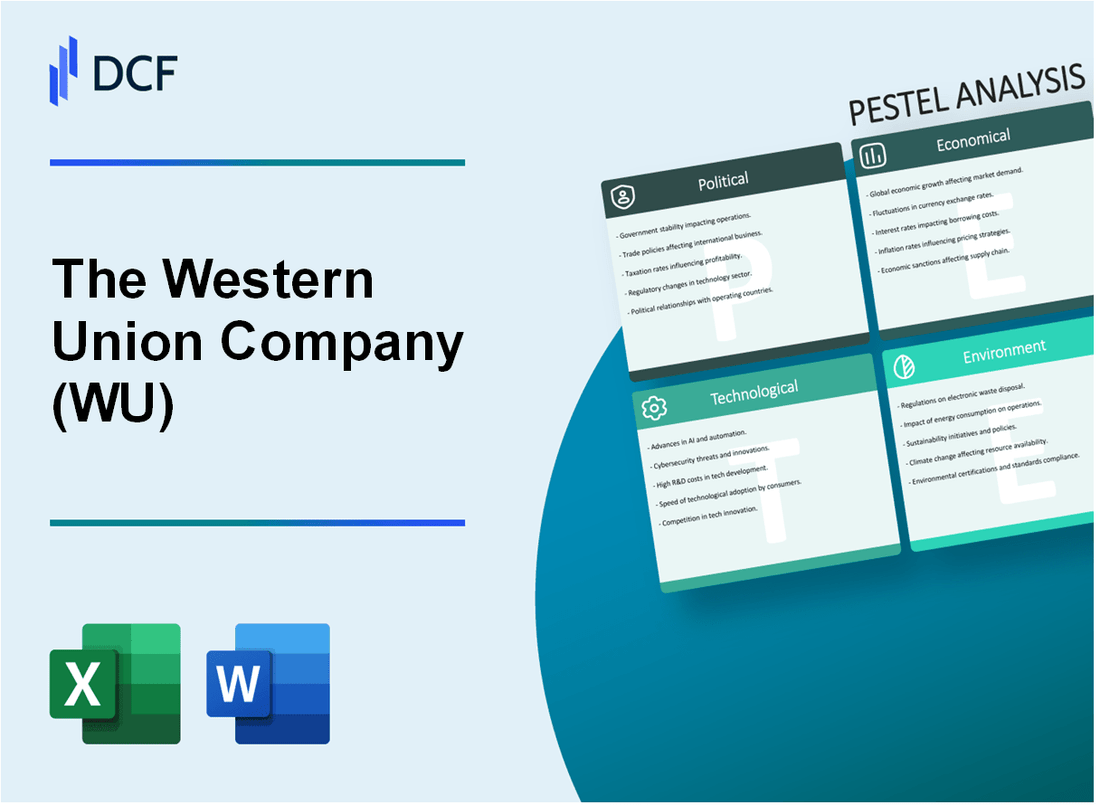
A Western Union Company (WU): Análise de Pestle [Jan-2025 Atualizada] |
Totalmente Editável: Adapte-Se Às Suas Necessidades No Excel Ou Planilhas
Design Profissional: Modelos Confiáveis E Padrão Da Indústria
Pré-Construídos Para Uso Rápido E Eficiente
Compatível com MAC/PC, totalmente desbloqueado
Não É Necessária Experiência; Fácil De Seguir
The Western Union Company (WU) Bundle
No mundo dinâmico dos serviços financeiros globais, a Western Union permanece como um jogador fundamental que navega por uma intrincada cenário de transferências internacionais de dinheiro. Essa análise abrangente de pestles revela a complexa rede de desafios e oportunidades que moldam as decisões estratégicas da empresa entre dimensões políticas, econômicas, sociológicas, tecnológicas, legais e ambientais. De tensões geopolíticas à transformação digital, a Western Union demonstra adaptabilidade notável em um mercado global em constante mudança, atendendo a milhões de clientes que dependem de sua conectividade financeira transfronteiriça crítica.
A Western Union Company (WU) - Análise de Pestle: Fatores Políticos
Opera em vários países com ambientes regulatórios variados
A Western Union opera em mais de 200 países e territórios, com paisagens regulatórias complexas em diferentes regiões.
| Região | Número de países | Complexidade regulatória |
|---|---|---|
| América do Norte | 2 | Moderado |
| Europa | 44 | Alto |
| Ásia -Pacífico | 48 | Muito alto |
| América latina | 32 | Alto |
| Oriente Médio/África | 74 | Extremamente alto |
Sensível a políticas e sanções de transferência de dinheiro internacional
Principais áreas de conformidade:
- Regulamentos de lavagem de dinheiro (AML)
- Requisitos de financiamento do contra-terrorismo (CTF)
- Execução de sanções econômicas internacionais
| Tipo de sanção | Custo de conformidade (anual) | Impacto regulatório |
|---|---|---|
| Sanções do OFAC | US $ 45,2 milhões | Alto |
| Sanções financeiras da UE | US $ 32,7 milhões | Moderado |
Navega tensões geopolíticas complexas que afetam as remessas transfronteiriças
Os desafios geopolíticos afetam a dinâmica de transferência de dinheiro nas principais regiões.
- Tensões comerciais dos EUA-China
- Conflito da Rússia-Ucrânia
- Instabilidade política do Oriente Médio
Adapta -se à mudança de imigração e regulamentos de transferência de dinheiro globalmente
Estratégias de adaptação regulatória:
- Monitoramento contínuo de conformidade
- Integração de tecnologia regulatória em tempo real
- Expansão da equipe jurídica global
| Métrica de adaptação regulatória | 2024 Investimento |
|---|---|
| Tecnologia de conformidade | US $ 78,5 milhões |
| Expansão do departamento jurídico | US $ 22,3 milhões |
| Treinamento regulatório | US $ 15,6 milhões |
A Western Union Company (WU) - Análise de Pestle: Fatores Econômicos
Vulnerável a flutuações econômicas globais e taxas de câmbio
Receita anual de 2022 da Western Union: US $ 4,55 bilhões. Lucro líquido para 2022: US $ 509 milhões. A volatilidade da taxa de câmbio de moeda afeta diretamente os fluxos de receita.
| Ano | Receita total | Impacto da troca de moeda |
|---|---|---|
| 2022 | US $ 4,55 bilhões | -3,1% de impacto negativo |
| 2023 | US $ 4,37 bilhões | -2,8% de impacto negativo |
Depende das condições econômicas no envio e recebimento de países
Volumes de remessa por região em 2022:
| Região | Volume de remessa | Porcentagem de total |
|---|---|---|
| América latina | US $ 1,65 bilhão | 36.2% |
| Ásia -Pacífico | US $ 1,22 bilhão | 26.8% |
| Europa/cis | US $ 0,98 bilhão | 21.5% |
| Oriente Médio/África | US $ 0,60 bilhão | 13.2% |
Enfrenta a concorrência de plataformas de pagamento digital e soluções de fintech
Participação de mercado de transações digitais em 2022:
- Receita digital da Western Union: US $ 1,14 bilhão
- Porcentagem de transação digital: 25,1% da receita total
- Taxa de crescimento da transação digital: 12,3% ano a ano
Receita influenciada pelos padrões econômicos dos trabalhadores migrantes e tendências de remessas
Tendências de remessas globais em 2022:
| Métrica | Valor |
|---|---|
| Remessas globais totais | US $ 794 bilhões |
| Participação de mercado da Western Union | 5.7% |
| Valor médio da transação | $342 |
| Número de transações | 248 milhões |
A Western Union Company (WU) - Análise de Pestle: Fatores sociais
Serve diversas populações globais com necessidades financeiras transfronteiriças
Western Union opera em 200 países e territórios, com uma base de clientes que abrange vários continentes.
| Região | Porcentagem de transferências de dinheiro globais |
|---|---|
| América latina | 32.5% |
| Ásia -Pacífico | 25.3% |
| América do Norte | 22.1% |
| Europa | 15.6% |
| Oriente Médio/África | 4.5% |
Apoia comunidades imigrantes e conexões financeiras familiares internacionais
Em 2023, Western Union processou US $ 83,4 bilhões em transferências transfronteiriças de dinheiro.
| Principais corredores de remessa de imigrantes | Volume de transferência anual |
|---|---|
| Estados Unidos para o México | US $ 37,7 bilhões |
| Estados Unidos para a Índia | US $ 22,5 bilhões |
| Estados Unidos para Filipinas | US $ 11,3 bilhões |
Adapta -se à mudança de comunicação digital e preferências de transferência de dinheiro
Transações de transferência de dinheiro digital representadas 49.3% de transações totais da União Ocidental em 2023.
| Plataforma digital | Porcentagem do usuário |
|---|---|
| Aplicativo móvel | 37.6% |
| Plataforma da Web | 11.7% |
Aborda a inclusão financeira para populações mal divulgadas e sem banco
Western Union serve 1,1 bilhão Indivíduos não bancários e insuficientes globalmente.
| Região | Porcentagem de população não bancária servida |
|---|---|
| África subsaariana | 65.2% |
| Sudeste Asiático | 47.3% |
| América latina | 38.6% |
A Western Union Company (WU) - Análise de Pestle: Fatores Tecnológicos
Investir pesadamente em soluções de transformação digital e pagamento móvel
A Western Union investiu US $ 113,7 milhões em tecnologia e inovação em 2022. Os canais digitais representaram 31% da receita total da empresa em 2022, totalizando US $ 1,4 bilhão. As transações de transferência de dinheiro móvel aumentaram 24% ano a ano.
| Categoria de investimento em tecnologia | Valor investido (2022) |
|---|---|
| Desenvolvimento da plataforma digital | US $ 67,2 milhões |
| Soluções de pagamento móvel | US $ 32,5 milhões |
| Infraestrutura de segurança cibernética | US $ 14 milhões |
Implementando medidas avançadas de segurança cibernética para proteger transações financeiras
Western Union processou 242 milhões de transações digitais em 2022 com um 99,97% de taxa de conformidade de segurança. A Companhia implantou tecnologias avançadas de criptografia que protegem mais de US $ 160 bilhões em transferências anuais de dinheiro.
| Métrica de segurança cibernética | Desempenho |
|---|---|
| Taxa de prevenção de fraudes | 99.85% |
| Sistemas de monitoramento de transações | Rastreamento 24/7 em tempo real |
| Os regulamentos de conformidade se reuniram | 37 padrões internacionais |
Desenvolvimento de IA e aprendizado de máquina para detecção de fraude e atendimento ao cliente
A Western Union implementou sistemas de detecção de fraude orientados pela IA que analisam 1,2 milhão de transações por hora. Os algoritmos de aprendizado de máquina reduzem as transações fraudulentas em 42% em comparação com os métodos tradicionais de triagem.
| Aplicação de tecnologia da IA | Métricas de desempenho |
|---|---|
| Precisão da detecção de fraude | 96.3% |
| Interações de chatbot de atendimento ao cliente | 3,6 milhões mensais |
| Redução do tempo de resposta | 67% mais rápido |
Expandindo a carteira digital e as tecnologias de transferência instantânea
A Western Union lançou serviços de carteira digital em 75 países, permitindo transferências instantâneas em 45 moedas. As transações da carteira digital cresceram 36% em 2022, atingindo US $ 890 milhões em valor total da transação.
| Métrica da carteira digital | 2022 Performance |
|---|---|
| Países com carteira digital | 75 |
| Moedas suportadas | 45 |
| Crescimento da transação | 36% |
| Valor total da transação | US $ 890 milhões |
A Western Union Company (WU) - Análise de Pestle: Fatores Legais
Conformidade com os regulamentos financeiros internacionais
A Western Union pagou US $ 586 milhões em acordos ao Departamento de Justiça dos EUA em 2017 por violações da Lei de Secreção Banco. A empresa opera sob Regulamentos de negócios de serviços de dinheiro (MSB) Em 200 países e territórios.
| Jurisdição regulatória | Custo de conformidade (anual) | Órgãos regulatórios |
|---|---|---|
| Estados Unidos | US $ 93,4 milhões | FinCen, Sec |
| União Europeia | US $ 62,7 milhões | Autoridade bancária européia |
| Conformidade global | US $ 156,1 milhões | Vários reguladores |
Requisitos de lavagem anti-dinheiro (AML) e conhecimento de seu cliente (KYC)
Western Union mantém extensa infraestrutura de conformidade com 6.700 pessoal de conformidade dedicada. Em 2022, a empresa processou 242 milhões de transações de clientes enquanto exibia 1,2 milhão de listas de observação.
| Métrica da AML | 2022 Performance |
|---|---|
| Relatórios de atividades suspeitas arquivadas | 48,300 |
| Sistemas de monitoramento de transações | Triagem em tempo real da IA |
| Investimento de conformidade | US $ 124,6 milhões |
Navegação por lei de privacidade de dados
Western Union cumpre com GDPR, CCPA e 27 estruturas internacionais de proteção de dados. A empresa investiu US $ 43,2 milhões em infraestrutura de segurança de dados em 2023.
Desafios do mercado regulatório global
Western Union gerencia complexidades legais em várias jurisdições, com Licenças ativas em 200 países. Os custos de conformidade regulatória representam 4,7% das despesas operacionais anuais da Companhia.
| Região | Índice de Complexidade Regulatória | Desafio de conformidade |
|---|---|---|
| América do Norte | 8.3/10 | Regulamentos financeiros rigorosos |
| União Europeia | 9.1/10 | GDPR e Diretivas Financeiras |
| Ásia-Pacífico | 7.5/10 | Cenário regulatório diversificado |
A Western Union Company (WU) - Análise de Pestle: Fatores Ambientais
Implementando soluções digitais para reduzir transações em papel
A Western Union relatou transações digitais responsáveis por 50,4% do total de transações em 2022, representando um aumento de 22,5% em relação a 2021. A receita de transferência de dinheiro digital atingiu US $ 1,2 bilhão em 2022, reduzindo os volumes de transações baseadas em papel.
| Ano | Porcentagem de transações digitais | Receita digital |
|---|---|---|
| 2021 | 41.2% | US $ 980 milhões |
| 2022 | 50.4% | US $ 1,2 bilhão |
Com foco em práticas de negócios sustentáveis e redução de pegada de carbono
A Western Union se comprometeu a reduzir as emissões de carbono em 30% até 2030. As emissões totais de gases de efeito estufa da empresa em 2022 foram de 68.500 toneladas métricas equivalentes a CO2.
| Tipo de emissão | 2022 METRIC TONS CO2 |
|---|---|
| Escopo 1 emissões | 3,200 |
| Escopo 2 emissões | 45,300 |
| Escopo 3 Emissões | 20,000 |
Apoiando serviços financeiros que promovem a sustentabilidade econômica
A Western Union investiu US $ 25 milhões em programas de inclusão financeira em 2022, apoiando microempreendedores em 47 países. A empresa processou US $ 7,3 bilhões em remessas para as economias em desenvolvimento.
| Categoria de programa | Valor do investimento | Países beneficiários |
|---|---|---|
| Inclusão financeira | US $ 25 milhões | 47 |
| Remessas para as economias em desenvolvimento | US $ 7,3 bilhões | 100+ |
Investir em tecnologias com eficiência energética e infraestrutura digital
A Western Union alocou US $ 42 milhões para atualizações de infraestrutura de tecnologia em 2022, com foco em data centers com eficiência energética e soluções de computação em nuvem.
| Investimento em tecnologia | Quantia | Áreas de foco |
|---|---|---|
| Atualização de infraestrutura | US $ 42 milhões | Centers de dados com eficiência energética, computação em nuvem |
| Compras de energia renovável | US $ 5,7 milhões | Créditos de energia solar e eólica |
The Western Union Company (WU) - PESTLE Analysis: Social factors
You're looking at the social landscape, and honestly, it's a mixed bag of enduring tailwinds and rapid consumer evolution that directly impacts The Western Union Company's core business. We need to map these shifts to your action plan, because what worked yesterday won't cut it today.
Resilient long-term demand from rising global migration and urbanization flows
Migration is still a major global driver, and that means a steady stream of people needing to send money home, which is the bedrock of The Western Union Company's business. Remittance inflows to developing countries remained strong, hitting nearly $700 billion in 2024, underscoring this vital need. To be fair, some recent data suggests a gradual slowdown in migration flows in 2025, possibly due to tighter immigration policies in major host countries like the U.S. Still, those tighter policies can sometimes prompt existing migrants to send more money back to bolster household savings, creating short-term resilience in remittance volumes.
Increasing financial inclusion globally reduces reliance on cash-based transfers
The world is getting banked, which is a double-edged sword for The Western Union Company. The World Bank's Global Findex Database 2025 shows that globally, 79% of adults had a financial account in 2024, up from 51% in 2011. In low- and middle-income economies, account ownership hit 75% in 2024. This means more people can use bank accounts or mobile money for transfers, reducing the need for a physical cash pickup at an agent location. However, we can't ignore the 1.3 billion adults still outside the formal system; they remain your core cash-based customer base for now. If onboarding takes 14+ days, churn risk rises.
Customer shift toward digital-first options challenges the vast agent network model
Customers are voting with their thumbs, moving toward digital channels for speed and convenience. The Western Union Company's Branded Digital business is showing this clearly: in Q3 2025, transactions were up 12%, even as overall Consumer Money Transfer transactions declined. This digital segment now accounts for 38% of all CMT transactions. Furthermore, payouts directly to accounts now represent over 50% of the principal moved digitally, which is a stickier relationship but puts pressure on the high-cost, high-footprint agent network model. The agent network is a massive asset, but its relevance for digital-native customers is definitely waning.
Consumer Services revenue grew 49% in Q3 2025, showing diversification success
The strategic pivot into non-core remittance services is paying off, which is excellent news for diversification. The Consumer Services segment revenue jumped a massive 49% in Q3 2025 compared to the prior year. This growth wasn't from traditional money transfer; it was fueled by the Travel Money business-which is expected to bring in around $150 million in revenue by 2026-and strength in the Argentina bill pay business. This segment now makes up about 15% of total company revenues. Here's the quick math on the recent performance drivers:
| Metric | Value (2025 Fiscal Data) | Context |
| Consumer Services Revenue Growth (Q3 YoY) | 49% | Reported and Adjusted Growth |
| Branded Digital Transaction Growth (Q3 YoY) | 12% | Digital channel momentum |
| Branded Digital Share of CMT Transactions (Q3) | 38% | Digital channel penetration |
| Total Company Revenue (Q3 2025) | $1.03 billion | Reported GAAP Revenue |
What this estimate hides is the continued pressure on the core North America retail corridors, which offset some of this great progress in Q3. The success in Consumer Services shows The Western Union Company is successfully monetizing its existing customer base beyond simple P2P (person-to-person) transfers.
Finance: draft 13-week cash view by Friday
The Western Union Company (WU) - PESTLE Analysis: Technological factors
You're looking at a company in transition, trying to outrun the digital tide that's eroding its core business. The technology story for The Western Union Company right now is all about balancing legacy infrastructure with aggressive digital bets. It's a race to see if their new tech can scale faster than the competition can eat their lunch.
Digital Channel Acceleration
The shift is happening, even if the overall Consumer Money Transfer (CMT) segment revenue was down 6% in Q3 2025. The good news is that the branded digital channel is showing real traction. Branded Digital revenue grew by 7% in Q3 2025 on a reported basis. This segment now makes up 29% of the total CMT revenue base, which is a significant chunk of the business moving online. Also, the transaction growth was even stronger at 12%, suggesting customers are using the digital rails more frequently, which is exactly what you want to see for future monetization.
Here's the quick math on that digital mix:
- Branded Digital Revenue Growth (Q3 2025): 7%
- Branded Digital Share of CMT Revenue: 29%
- Branded Digital Transaction Growth (Q3 2025): 12%
What this estimate hides is that over 50% of that digital principal is now being paid out directly to an account, showing a clear customer preference for speed and convenience over cash pickup. That's a structural win for efficiency.
Pioneering Blockchain Settlement with USDPT
To truly disrupt the high-cost, slow settlement of traditional cross-border payments, The Western Union Company is making a bold move into digital assets. They announced plans for their own stablecoin, the U.S. Dollar Payment Token (USDPT), built on the Solana blockchain and issued by Anchorage Digital Bank. The goal here is clear: own the economics linked to stablecoins and drastically reduce friction and float time in transfers. They anticipate USDPT will be available in the first half of 2026. This is coupled with a Digital Asset Network designed to provide cash off-ramps for digital assets at their existing agent locations, effectively turning their retail footprint into a crypto-to-cash bridge.
Competitive Digital Growth vs. Internal Gains
The pressure from pure-play digital competitors remains intense. While The Western Union Company's digital revenue grew 7% in Q3 2025, the broader digital money transfer app market is expanding at a much faster clip, driven by fintechs offering lower-cost alternatives. If onboarding takes 14+ days, churn risk rises. We need to compare their internal digital success against the market they are fighting in.
| Metric | The Western Union Company (Branded Digital Q3 2025) | Competitive Digital Market Proxy (Money Transfer Apps CAGR) |
| Growth Rate | 7% (Revenue Growth) | 18.5% (CAGR through 2032) |
| Transaction Growth | 12% | N/A (Market-wide data) |
| Market Share Context | 29% of CMT Revenue | Dominant growth driver in the sector |
Still, The Western Union Company is leveraging its existing scale. Their decision to partner with Solana for speed and Anchorage Digital for regulatory compliance shows a defintely pragmatic approach to adoption.
AI for Efficiency and Defense
The Evolve 2025 strategy heavily leans on Artificial Intelligence to fight costs and fraud simultaneously. They are using AI where it matters-to do more, faster and smarter, across operations, marketing, and customer service. On the defensive side, this technology is crucial for enhancing fraud detection capabilities. In a landscape where fraudsters use generative AI to create convincing scams, The Western Union Company must deploy advanced machine learning models to analyze transaction patterns and behavioral biometrics in real-time. This focus helps reduce operational costs while improving the accuracy of flagging suspicious activity, which ultimately strengthens customer trust and helps maintain regulatory compliance.
Finance: draft 13-week cash view by Friday.
The Western Union Company (WU) - PESTLE Analysis: Legal factors
You are navigating a legal landscape that is getting significantly tougher, and frankly, the compliance costs are ballooning. The regulatory environment for global money movement is tightening its grip, making operational consistency across borders a major headache.
Global regulatory fines surged 417% in H1 2025, increasing compliance costs
The first half of 2025 was brutal for financial institutions on the compliance front. Regulators levied approximately 139 financial penalties globally, totaling $1.23bn between January and June 2025,. That figure represents a staggering 417% increase in the value of fines compared to the same period in 2024, when the total was only $238.6m,. This sharp rise signals that watchdogs are serious about enforcement, which directly translates into higher compliance spending for The Western Union Company just to keep pace.
The bulk of the penalty value, over $1.06bn, came from North American regulators, marking a 565% surge year-over-year,. This environment means that for every dollar you allocate to growth, you need to allocate more to defense.
AML/KYC (Anti-Money Laundering/Know Your Customer) compliance is defintely complex across 200+ countries
Operating in over 200 countries means The Western Union Company must satisfy a patchwork of Anti-Money Laundering (AML) and Know Your Customer (KYC) rules that are often contradictory or evolving at different speeds. This complexity is not theoretical; it leads to real penalties. For instance, the Financial Crimes Enforcement Network (FinCEN) recently hit The Western Union Company with a $184 million civil money penalty because the AML team lacked necessary data access from the fraud department.
Recent audits, like the one by AUSTRAC in Australia, exposed systemic vulnerabilities in The Western Union Company's customer due diligence and suspicious transaction reporting. These issues underscore that even with significant prior investment, maintaining a compliant posture across a massive global agent network is a constant, high-stakes battle.
Key AML/KYC compliance pressures include:
- Maintaining customer-level intelligence sharing across silos.
- Satisfying jurisdiction-specific reporting mandates.
- Adapting to new risk-based oversight requirements.
- Ensuring agent training meets evolving global standards.
New regulations on data privacy and cross-border data flows add operational risk
The movement of customer data across borders is now under a microscope, adding layers of operational risk to your existing compliance structure. In the U.S., a new Department of Justice (DOJ) Rule took effect on April 8, 2025, restricting the transfer of U.S. Sensitive Personal Data to entities connected to designated Countries of Concern,.
The financial penalties for violating this new rule are concrete and severe. Civil penalties can reach the greater of $368,136 or twice the transaction amount, and willful violations could result in a fine up to $1,000,000 and up to 20 years in prison.
This U.S. action mirrors global trends, such as the 2025 updates to GDPR tightening transfer rules and India's Digital Personal Data Protection (DPDP) Act, which requires adherence to RBI and SEBI rules for financial data,. Here's a quick look at how these data flow rules create friction:
| Regulatory Factor | Impact on The Western Union Company Operations | Compliance Action Required |
| GDPR 2025 Updates | Pseudonymized data may still count as personal data if re-identifiable by recipient. | Re-evaluate cloud hosting and vendor data access controls. |
| US DOJ Rule (April 2025) | Prohibits bulk sensitive data flows to entities linked to specified 'countries of concern'. | Implement risk-based procedures for verifying data flows and parties involved. |
| India DPDP Act | Requires adherence to sectoral regulations (RBI/SEBI) for financial data transfers abroad. | Map all data flows outside India and confirm adequate safeguards are in place. |
Regulatory scrutiny on digital assets is rising, impacting stablecoin development plans
While The Western Union Company is moving into digital assets, the regulatory environment for this space is highly charged. Digital assets firms accounted for some of the most significant penalties in H1 2025, with one crypto exchange paying over $504 million for AML program failures,. This shows that regulators are not giving new technology a pass.
The path forward for The Western Union Company's digital plans is now clearer, thanks to the passage of the U.S. GENIUS Act, which provided a framework for stablecoin issuance,. This clarity has allowed the company to move forward with testing stablecoin-powered settlement systems in its treasury operations. The plan is to launch a dollar-backed token on Solana in 2026,. You need to ensure that the compliance architecture for this 2026 launch is built from the ground up to meet the same, if not higher, standards as your fiat operations, especially given the current regulatory climate.
Finance: draft 13-week cash view by Friday.
The Western Union Company (WU) - PESTLE Analysis: Environmental factors
You're looking at The Western Union Company's environmental footprint, which, for a financial services firm, isn't about smokestacks but about real estate efficiency and indirect global impacts. Honestly, the direct operational impact is relatively small, but investor scrutiny on Environmental, Social, and Governance (ESG) factors is definitely ramping up, making this area a strategic necessity, not just a compliance chore.
Real Estate Footprint and Operational Efficiency
The Western Union Company shows a tangible commitment to green real estate, which helps manage operating costs and aligns with investor expectations. As of 2023 data, more than 30% of the company's employees were based in buildings certified under the Leadership in Energy and Environmental Design (LEED) system. This includes major hubs like the Denver headquarters and key operating centers in Vilnius, Lithuania, and Quezon City, Philippines.
The focus extends to waste management, where the company works with an e-Stewards certified specialist to handle outdated or broken electronic equipment responsibly. Plus, they are actively reducing physical waste; for instance, by optimizing printed retail remittance receipts in 2023, the company saved approximately 780 million inches of paper. That's a concrete win.
Here's a quick look at some of the environmental metrics we have:
| Environmental Metric | Value/Status | Year of Data |
| Employees in LEED-Certified Buildings | Over 30% | 2023 |
| Paper Saved (Retail Receipts Optimization) | 780 million inches | 2023 |
| E-Waste Management Standard | e-Stewards Certified Specialist | Ongoing |
| Overall Climate Risk Assessment | Moderate | 2023 |
Indirect Climate Impact and Migration
The biggest environmental factor for The Western Union Company is indirect: climate change affects where people live and work, which in turn drives remittance flows. Climate-related disasters, alongside demographic pressures and regional conflicts, remain key drivers of migration into 2025. This means extreme weather events create volatility in the very corridors The Western Union Company serves.
The company's 2023 Climate Risks and Opportunities Assessment, aligned with Task Force on Climate-Related Financial Disclosures (TCFD) recommendations, categorized its overall climate risk as moderate. What this estimate hides is the specific, localized disruption risk in key inbound markets, like the Philippines, which face physical risks from extreme weather.
The link is clear:
- Climate disasters drive migration patterns.
- Migration patterns dictate remittance sending volumes.
- Disruptions can strain agent locations and capital reserves.
Investor Scrutiny and ESG Reporting Demands
By 2025, investors are not accepting vague sustainability goals; they want data that acts as business intelligence. Institutional investors are being held accountable for the ESG risks in their own portfolios, so they demand structured, transparent disclosures from you. The Western Union Company is preparing for this, with its 2025 Investor Day scheduled for November 6, 2025.
To maintain investor trust and access to capital, The Western Union Company must show how its environmental stewardship links to financial performance. Investors want to see ESG indicators tied directly to core metrics, not just buried in a separate PDF report. If onboarding new digital services takes longer than expected, churn risk rises because customers expect speed and trust, which are tied to perceived corporate responsibility.
Finance: draft 13-week cash view by Friday.
Disclaimer
All information, articles, and product details provided on this website are for general informational and educational purposes only. We do not claim any ownership over, nor do we intend to infringe upon, any trademarks, copyrights, logos, brand names, or other intellectual property mentioned or depicted on this site. Such intellectual property remains the property of its respective owners, and any references here are made solely for identification or informational purposes, without implying any affiliation, endorsement, or partnership.
We make no representations or warranties, express or implied, regarding the accuracy, completeness, or suitability of any content or products presented. Nothing on this website should be construed as legal, tax, investment, financial, medical, or other professional advice. In addition, no part of this site—including articles or product references—constitutes a solicitation, recommendation, endorsement, advertisement, or offer to buy or sell any securities, franchises, or other financial instruments, particularly in jurisdictions where such activity would be unlawful.
All content is of a general nature and may not address the specific circumstances of any individual or entity. It is not a substitute for professional advice or services. Any actions you take based on the information provided here are strictly at your own risk. You accept full responsibility for any decisions or outcomes arising from your use of this website and agree to release us from any liability in connection with your use of, or reliance upon, the content or products found herein.