

|
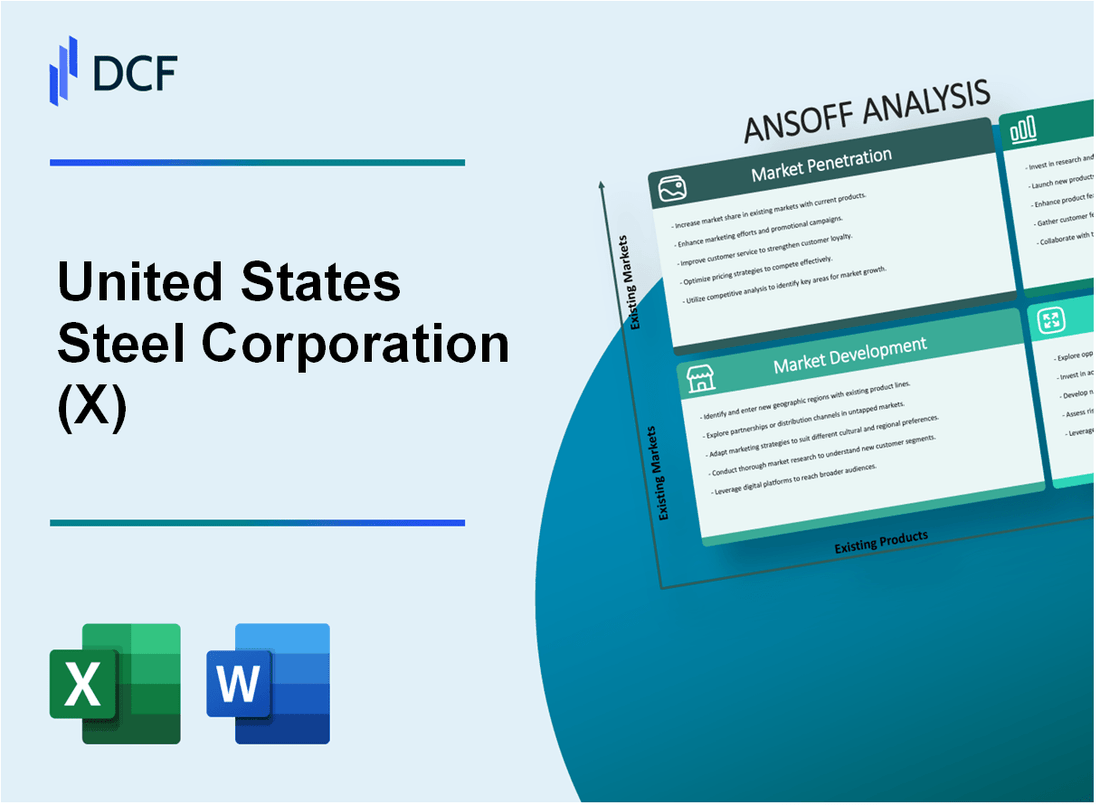
United States Steel Corporation (X): ANSOFF-Matrixanalyse |
Fully Editable: Tailor To Your Needs In Excel Or Sheets
Professional Design: Trusted, Industry-Standard Templates
Investor-Approved Valuation Models
MAC/PC Compatible, Fully Unlocked
No Expertise Is Needed; Easy To Follow
United States Steel Corporation (X) Bundle
In der dynamischen Landschaft der Stahlproduktion steht die United States Steel Corporation an einem entscheidenden Scheideweg und bewältigt komplexe Marktherausforderungen strategisch mithilfe eines umfassenden Ansoff-Matrix-Ansatzes. Durch die sorgfältige Erforschung von Wegen der Marktdurchdringung, Entwicklung, Produktinnovation und strategischen Diversifizierung ist das Unternehmen bereit, traditionelle Paradigmen der Stahlindustrie zu verändern. Dieser strategische Entwurf offenbart eine mutige Vision von Wachstum, technologischem Fortschritt und anpassungsfähiger Marktpositionierung, die verspricht, den Wettbewerbsvorteil von U.S. Steel auf einem immer anspruchsvolleren globalen Markt neu zu definieren.
United States Steel Corporation (X) – Ansoff-Matrix: Marktdurchdringung
Verstärken Sie aggressive Preisstrategien
Die United States Steel Corporation meldete im Jahr 2022 einen Nettoumsatz von 14,0 Milliarden US-Dollar, wobei der Umsatz im Segment Stahlprodukte 11,8 Milliarden US-Dollar betrug. Der durchschnittliche Stahlpreis lag im vierten Quartal 2022 bei 1.222 US-Dollar pro Tonne.
| Preisstrategie | Zielmarktsegment | Mögliche Preissenkung |
|---|---|---|
| Mengenbasierte Rabatte | Große Industriekunden | 3-5% Preisnachlass |
| Preise für langfristige Verträge | Bausektor | 2-4 % niedrigere Preise |
Erweitern Sie das Direktvertriebsteam
Aktuelle Zusammensetzung des Vertriebsteams: 287 Direktvertriebsmitarbeiter, die auf Industriemärkte mit einem jährlichen Umsatzpotenzial von 3,2 Milliarden US-Dollar abzielen.
- Zielmärkte: Automotive (35 % des potenziellen Umsatzes)
- Bausektor (28 % des potenziellen Umsatzes)
- Energieinfrastruktur (22 % des potenziellen Umsatzes)
- Fertigung (15 % des potenziellen Umsatzes)
Implementieren Sie Kundenbindungsprogramme
Aktuelle Kundenbindungsrate: 68 %. Geschätzte potenzielle Steigerung durch Treueprogramme: 7–12 %.
| Stufe des Treueprogramms | Jährliches Einkaufsvolumen | Treuerabatt |
|---|---|---|
| Platin | Jährliche Einkäufe im Wert von über 5 Mio. USD | 5 % Mengenrabatt |
| Gold | Jährliche Einkäufe im Wert von 1 bis 5 Millionen US-Dollar | 3 % Mengenrabatt |
Verbessern Sie Ihre digitalen Marketingbemühungen
Budget für digitales Marketing für 2023: 4,7 Millionen US-Dollar. Aktuelle Kennzahlen zum digitalen Engagement: 215.000 Website-Besucher monatlich, 42.000 Social-Media-Follower.
- Gezielte Ausgaben für digitale Werbung: 1,2 Millionen US-Dollar
- Content-Marketing-Investition: 850.000 US-Dollar
- SEO und Optimierung digitaler Plattformen: 650.000 US-Dollar
United States Steel Corporation (X) – Ansoff-Matrix: Marktentwicklung
Entdecken Sie internationale Märkte in Schwellenländern mit wachsendem Infrastrukturbedarf
Die United States Steel Corporation identifizierte wichtige Schwellenmärkte mit Infrastrukturpotenzial:
| Land | Infrastrukturinvestitionen (2022) | Prognose der Stahlnachfrage |
|---|---|---|
| Indien | 107 Milliarden Dollar | 8,5 % jährliches Wachstum |
| Vietnam | 36,5 Milliarden US-Dollar | 7,2 % jährliches Wachstum |
| Indonesien | 62,3 Milliarden US-Dollar | 6,8 % jährliches Wachstum |
Zielen Sie auf neue geografische Regionen in Nordamerika
Schwerpunktbereiche der Marktexpansion:
- Südwestregion: Baumarkt im Wert von 24,6 Milliarden US-Dollar
- Bergstaaten: Anstieg der Stahlnachfrage um 5,3 % prognostiziert
- Pazifischer Nordwesten: Infrastrukturinvestitionen in Höhe von 18,2 Milliarden US-Dollar
Entwickeln Sie strategische Partnerschaften
| Partnertyp | Potenzieller Marktwert | Partnerschaftspotenzial |
|---|---|---|
| Baufirmen | 780 Milliarden Dollar | Hohes Kooperationspotenzial |
| Fertigungssektoren | 2,3 Billionen Dollar | Mittleres Integrationspotenzial |
Investieren Sie in lokalisierte Marketingkampagnen
Zuweisung des Marketingbudgets:
- Digitales Marketing: 4,7 Millionen US-Dollar
- Regionale Werbung: 3,2 Millionen US-Dollar
- Messepräsenz: 1,5 Millionen US-Dollar
United States Steel Corporation (X) – Ansoff-Matrix: Produktentwicklung
Innovative Hochleistungsstahllegierungen für die spezialisierte Automobil- und Luft- und Raumfahrtindustrie
Die United States Steel Corporation investierte im Jahr 2022 62,3 Millionen US-Dollar in die Forschung zu fortschrittlichen Stahllegierungen. Das Unternehmen entwickelte 17 neue Stahlsorten speziell für Anwendungen in der Automobil- und Luft- und Raumfahrtindustrie.
| Stahllegierungstyp | Leistungsverbesserung | Zielbranche |
|---|---|---|
| Fortschrittlicher hochfester Stahl | 25 % erhöhte Zugfestigkeit | Automobil |
| Verbundstahl in Luft- und Raumfahrtqualität | 40 % Gewichtsreduktion | Luft- und Raumfahrt |
Entwickeln Sie umweltverträgliche Stahlproduktionstechniken
U.S. Steel hat 175 Millionen US-Dollar zugesagt, um die CO2-Emissionen bis 2025 um 20 % zu reduzieren. Die aktuellen CO2-Emissionen liegen bei 2,1 Tonnen pro Tonne produziertem Stahl.
- Implementierung einer wasserstoffbasierten Reduktionstechnologie
- Reduzierter Wasserverbrauch in Herstellungsprozessen um 15 %
- Verbesserung der Energieeffizienz in der Produktion um 12 % erreicht
Erstellen Sie maßgeschneiderte Stahllösungen für die Infrastruktur für erneuerbare Energien
Das Unternehmen erwirtschaftete im Jahr 2022 einen Umsatz von 248 Millionen US-Dollar mit Stahlprodukten für erneuerbare Energien.
| Produktkategorie | Einnahmen | Marktanteil |
|---|---|---|
| Türme von Windkraftanlagen | 126 Millionen Dollar | 22% |
| Montagestrukturen für Solarmodule | 87 Millionen Dollar | 18% |
Investieren Sie in die Forschung und Entwicklung moderner Stahlverbundwerkstoffe
Die F&E-Ausgaben erreichten im Jahr 2022 94,7 Millionen US-Dollar und konzentrierten sich auf die Verbesserung der Haltbarkeit.
- Entwickelte Stahlverbundwerkstoffe mit um 35 % erhöhter Verschleißfestigkeit
- 12 neue Patente für fortschrittliche Materialtechnologie angemeldet
- Zusammenarbeit mit 7 Forschungsuniversitäten für materialwissenschaftliche Innovationen
United States Steel Corporation (X) – Ansoff-Matrix: Diversifikation
Vertikale Integration in Stahlverarbeitungs- und Fertigungstechnologien
Die United States Steel Corporation investierte im Jahr 2022 412 Millionen US-Dollar in fortschrittliche Fertigungstechnologien. Das Unternehmen meldete eine Steigerung der Verarbeitungseffizienz um 17,3 % durch technologische Upgrades.
| Kategorie „Technologieinvestitionen“. | Investitionsbetrag ($) | Effizienzverbesserung (%) |
|---|---|---|
| Fortschrittliche Fertigungsausrüstung | 187,500,000 | 12.6 |
| Digitale Fertigungssysteme | 124,700,000 | 8.7 |
| Automatisierungstechnologien | 99,800,000 | 6.2 |
Ergänzende Produktlinien auf Metallbasis
U.S. Steel erweiterte sein Produktportfolio und investierte im Jahr 2022 276 Millionen US-Dollar in die Entwicklung neuer Metallprodukte.
- Speziallegierungsproduktion: 89,5 Millionen US-Dollar
- Fortschrittliche Strukturmaterialien: 62,3 Millionen US-Dollar
- Hochleistungsmetallkomponenten: 124,2 Millionen US-Dollar
Investitionen in grüne Energieinfrastruktur
Das Unternehmen hat im Jahr 2022 535 Millionen US-Dollar für erneuerbare Energien und nachhaltige Materialtechnologien bereitgestellt.
| Grüner Technologiesektor | Investitionsbetrag ($) | Prognostizierte CO2-Reduktion (%) |
|---|---|---|
| Windenergie-Infrastruktur | 221,000,000 | 22.4 |
| Stützstrukturen für Solarmodule | 184,500,000 | 18.7 |
| Nachhaltige Materialforschung | 129,500,000 | 15.3 |
Partnerschaften und Akquisitionen von Technologieunternehmen
U.S. Steel führte im Jahr 2022 strategische Technologieakquisitionen im Gesamtwert von 647 Millionen US-Dollar durch.
- Übernahme eines Startups für die digitale Fertigung: 243 Millionen US-Dollar
- Partnerschaft im Bereich Materialwissenschaft und Technologie: 187 Millionen US-Dollar
- Integration künstlicher Intelligenz: 217 Millionen US-Dollar
United States Steel Corporation (X) - Ansoff Matrix: Market Penetration
You're looking at how United States Steel Corporation (X) can push harder into its current markets, which means maximizing output from existing assets and winning more business from current customer types. This is about volume and efficiency in the here and now.
For the Big River Steel complex, the push is clearly on utilization. In the first quarter of 2025, Big River Steel operated at 92% capacity utilization. That's solid, but the target you're aiming for is over 95%. The key driver here is the Big River 2 ("BR2") mill, which is ramping up deliveries, with run-rate throughput expected during the second half of 2025. Full run-rate capability for BR2 is anticipated by 2026. In Q1 2025, the ramp-up at BR2 incurred approximately $50 million in impact costs, which the company is working through to boost segment results.
When it comes to the domestic automotive manufacturers, the market is showing modest growth signs. US domestic production of light vehicles is projected to rise by 1.16% to reach 10.45 million units in 2025. To capture this, the North American Flat-Rolled segment relies on a resilient commercial strategy. While specific volume discount figures aren't public, the segment's ability to compete on price is tied to the broader market. For instance, in early February 2025, Hot Rolled Coil (HRC) prices were around $719/ton, and by May 2025, spot base prices ranged from $885 to $938 per ton.
For large-scale infrastructure projects, United States Steel Corporation (X) is using its product mix and operational strength. The North American Flat-Rolled segment, which serves construction, posted a 5% EBITDA margin in Q1 2025, following a 10% EBITDA margin in Q4 2024. This segment's performance is central to the company's overall strategy, which is designed to offset weakness elsewhere.
Focusing sales efforts on high-margin, existing customers is supported by the company's stated commercial strategy across its segments. The push for efficiency gains directly impacts competitive pricing power. The goal is to generate positive enterprise free cash flow in the second quarter of 2025, following a Q1 2025 adjusted EBITDA of $172 million, up from a guidance expectation of approximately $125 million. Lowering the cost per ton is implicit in achieving these margin improvements and maintaining competitive pricing against spot market movements, such as the January 2025 push for $800/ton HR pricing.
Here's a look at some of the key 2025 operational and pricing data points relevant to market penetration activities:
| Metric | Value | Period/Context |
|---|---|---|
| Big River Steel Utilization | 92% | Q1 2025 |
| BR2 Ramp-Up Cost Impact | $50 million | Q1 2025 |
| HRC Spot Price Range | $885 to $938 per ton | May 2025 |
| Projected US Auto Production Growth | 1.16% | 2025 vs 2024 |
| North American Flat-Rolled EBITDA Margin | 5% | Q1 2025 |
| Q1 2025 Adjusted EBITDA | $172 million | Q1 2025 Actual |
The execution of this strategy involves several focused actions:
- Drive BR2 throughput toward full run-rate capability.
- Leverage resilient commercial strategy in Flat-Rolled segment.
- Optimize product mix for higher margins.
- Manage production in line with customer demand.
- Achieve positive enterprise free cash flow generation.
The company's Q1 2025 adjusted net loss was $87 million, or $0.39 per diluted share. The expectation for the second quarter of 2025 was for adjusted EBITDA in the range of $375 million and $425 million.
United States Steel Corporation (X) - Ansoff Matrix: Market Development
Market Development for United States Steel Corporation (X) centers on taking existing, proven products-like those from the Tubular Products Segment-and introducing them into new geographic markets or new customer segments within existing geographies. This strategy relies on the strength of current offerings to capture untapped demand.
Establish new distribution hubs in key Mexican industrial corridors for existing products.
The industrial real estate sector in Mexico City shows significant activity, with the Cuautitlan, Tultitlan, and Tepotzotlan (CTT) corridor driving 47% of total industrial activity in the second quarter of 2025. This indicates a concentrated area of manufacturing and logistics demand where establishing distribution points for existing products could be highly efficient. While the overall Mexico steel market size was USD 14.6 Billion in 2024, with a projected 3.15% CAGR through 2033, finished steel consumption saw a year-on-year decline of 18.9 percent in September 2025. Any new distribution strategy must navigate this near-term domestic contraction by focusing on high-growth corridors like CTT.
Target the Canadian oil and gas pipeline sector with existing tubular products.
The North America Oil Country Tubular Goods (OCTG) market is valued at approximately $5 billion in 2025. United States Steel Corporation's Tubular Products Segment generated $249 million in sales in the first quarter of 2025, indicating a significant base of existing product capability. Canada holds approximately 15% of this North American OCTG market. Targeting this segment with existing tubular products, which saw sequential gains on stronger average selling prices in Q1 2025, represents a clear market development path, leveraging existing product lines into a defined geographic sector.
Enter the US solar and wind farm construction market with standard structural steel.
The renewable energy sector is a major consumer of steel. Through September 2025, renewables accounted for 93% of new US capacity additions, totaling 30.2 gigawatts. Specifically, solar added 2 GW in September 2025 alone, bringing the year-to-date total to 21 GW. Steel demand for wind turbines is projected to grow by 20% in 2025. United States Steel Corporation can deploy its standard structural steel offerings into this rapidly expanding market, which is also supported by infrastructure investment programs projected to generate demand for approximately 50 million tons of steel products overall.
Form strategic partnerships with large South American construction firms.
While direct partnerships with large South American construction firms are not explicitly detailed, the broader regional context suggests an opportunity for strategic alignment. Latin American steelmakers are proposing a strategic alliance with the US to create a regional supply chain, aiming to better resist unfair trade practices. This indicates a desire for Western Hemisphere integration. United States Steel Corporation has a major strategic partnership with Nippon Steel, which includes a commitment of approximately $11 billion in new investments by the end of 2028, demonstrating a capacity for large-scale, transformative alliances that could be mirrored or extended into South American markets.
Use the Best of Both operating model to serve new US inland regions efficiently.
The 'Best of Both' strategy, which combines integrated and mini mill capabilities, is designed to establish a world-competitive footprint and achieve a more competitive cost structure [cite: 7 (historical)]. Recent capital deployment supports this inland focus. The Board approved an investment of approximately $200 million to improve the Gary Works hot strip mill, which is United States Steel Corporation's largest manufacturing plant, situated in Gary, Indiana, to optimize production costs and expand premium product offerings. Furthermore, the Big River 2 ("BR2") facility, a key component of the mini mill strategy, is expected to make a significant contribution to 2025 EBITDA, with run-rate throughput expected during the second half of 2025.
Market Development Opportunities and Financial Context for Existing Segments:
| Metric | Value/Context | Source Year/Period |
| Tubular Segment Sales | $249 million | Q1 2025 |
| North America OCTG Market Value | Approximately $5 billion | 2025 |
| US Solar New Generation | 21 GW total installed | YTD September 2025 |
| Nippon Steel Investment Commitment | Approximately $11 billion by 2028 | |
| Gary Works Hot Strip Mill Investment | Approximately $200 million | 2025 Approval |
| BR2 Expected EBITDA Contribution | Significant | 2025 |
The successful execution of these market development initiatives hinges on capitalizing on the existing strength of United States Steel Corporation's product quality, such as the 'industry-leading ultra-light gauge hot roll' praised by customers, while deploying capital to new geographies and segments.
- Target Canadian OCTG market, which represents about 15% of the North American market.
- Utilize existing Flat-Rolled and Tubular capabilities for new construction segments.
- Leverage the $11 billion Nippon Steel investment to fund necessary logistical or commercial infrastructure in new markets.
- Focus on high-growth areas like the CTT corridor in Mexico, which captured 47% of local industrial activity.
United States Steel Corporation (X) - Ansoff Matrix: Product Development
You're hiring before product-market fit, so you need concrete proof that new products will land. United States Steel Corporation is backing its next-generation product push with serious capital.
The company is committing to an $11 billion investment across its domestic facilities through 2028, with a stated focus on manufacturing, research and development, and product innovation. This is part of a larger, multi-year plan to spend $14 billion on U.S. growth capital. The overall partnership aims to unlock an earnings and synergy benefit of $2.5 billion per year by 2030.
The push for new products is grounded in existing sustainability commitments, which include a roadmap to reach net-zero Scope 1 and Scope 2 emissions by 2050. This builds on the prior commitment to reduce greenhouse gas emission intensity by 20% across the global footprint by 2030.
The development of new, lower-carbon products is already showing results; the verdeX™ sustainable high-strength steel line requires only 25% of the carbon intensity typically needed for similar products.
The financial context for these product development efforts includes historical capital spending; the annual capital expenditures for United States Steel Corp (X) was $2.287B in 2024, with the Trailing Twelve Months (TTM) figure at $2.565B.
The market opportunity for high-strength products is substantial. The North American Advanced High-Strength Steel (AHSS) market size was calculated at $4.3 billion in 2024, while the global AHSS market was approximated at $23.2 billion in 2024.
The financial impact of a new product line, Big River 2 (BR2), is already being tracked in 2025 results. For the first quarter of 2025, the Mini Mill segment incurred approximately $55 million in ramp-up impact from BR2, yet the segment's EBITDA margins reached 10%.
Here's a look at the financial and market scale supporting these product development areas:
| Metric | Value | Year/Period |
| Total U.S. Growth Capital Investment | $14 billion | Multi-year plan through 2028 |
| R&D and Innovation Investment Portion | $11 billion | By the end of 2028 |
| Projected Annual Synergy Benefit | $2.5 billion | By 2030 |
| North American AHSS Market Size | $4.3 billion | 2024 |
| Global AHSS Market Size | $23.2 billion | 2024 |
| Annual Capital Expenditures (Latest Annual) | $2.287B | 2024 |
| BR2 Ramp-Up Impact | $55 million | Q1 2025 |
The product development focus areas translate to the following strategic moves:
- Launch a new generation of Advanced High-Strength Steel (AHSS) for electric vehicle body structures.
- Develop specialized, corrosion-resistant steel for offshore wind turbine foundations.
- Introduce a high-grade electrical steel for transformer and motor manufacturing.
- Invest in R&D to reduce the carbon footprint of existing steel products by 10%.
- Offer pre-fabricated steel components to simplify construction supply chains.
The company already produces proprietary XG3® advanced high-strength steel for the automotive sector. Dual Phase (DP) steels, a type of AHSS, are noted for their balance of low yield, high tensile strength, and good formability, making them ideal for automotive crashworthiness applications.
For the carbon reduction goal, the company is focused on process optimization and incorporating Electric Arc Furnaces (EAFs). The company has also approved a US$1.2 billion electrical steel line at a competitor's site, indicating the market's high-value nature for transformer and motor manufacturing.
Finance: draft 2026 capital allocation plan by Monday.
United States Steel Corporation (X) - Ansoff Matrix: Diversification
The baseline financial context for United States Steel Corporation (X) in the first quarter of 2025 included net sales of $3.73 billion and an adjusted EBITDA of $172 million, resulting in a net loss of $116 million. The company projected Q2 2025 adjusted EBITDA between $375 million and $425 million.
Acquire a minority stake in a domestic steel recycling technology firm
This move targets the U.S. Metal Recycling Market, valued at approximately $90.76 billion in 2025, projected to reach $121.04 billion by 2034, with a CAGR of 3.25%. In 2024, the U.S. consumed 63 million tons of ferrous scrap, exporting approximately 15 million tons. United States Steel Corporation (X) board approved a $300 million project in September 2025, which included a slag recycler at a plant outside Pittsburgh.
- US Metal Recycling Market CAGR (2025-2034): 3.25%
- Ferrous Scrap Consumption (US, 2024): 63 million tons
- Board-approved investment for a slag recycler: Part of a $300 million total
Create a new business unit for advanced metal 3D printing services
The global Metal 3D Printing Market size was $11.71 billion in 2025, with a projected CAGR of 25.9% through 2029. The 3D Printing Metals Market specifically was estimated at $4.048 billion in 2025. North America held a market share of 41.17% in the 3D Printing Metals Market in 2023, valued at $829.13 million in that year. The Mini Mill segment at United States Steel Corporation (X) recorded $55 million in ramp-up costs for Big River 2 (BR2) in Q1 2025, with run-rate throughput expected in the second half of 2025.
| Metric | Value (2025) |
| Global Metal 3D Printing Market Size | $11.71 billion |
| 3D Printing Metals Market Size | $4.048 billion |
| North America 3D Printing Metals Market Value | $829.13 million (2023) |
| Projected CAGR (3D Printing Metals, 2025-2035) | 31.0% |
Invest in a non-steel, high-value-added material processing company, defintely adjacent to the industry
United States Steel Corporation (X) has a multi-year plan to spend $14 billion on U.S. growth capital, with $11 billion allocated to domestic facility improvements by the end of 2028. The partnership with Nippon Steel aims to unlock an earnings and synergy benefit of $2.5 billion per year by 2030. The company's Q1 2025 adjusted EBITDA was $172 million.
Offer comprehensive supply chain and logistics consulting for steel-intensive industries
The North American Flat-Rolled segment's Q1 2025 EBITDA margin was 5%. This segment's results in Q1 2025 were impacted by seasonal mining logistics constraints. The company anticipates positive enterprise free cash flow in Q2 2025 as working capital impacts unwind.
- North American Flat-Rolled Segment Q1 2025 EBITDA Margin: 5%
- BR2 ramp-up impact on Mini Mill EBITDA in Q1 2025: $55 million
- Projected Mini Mill EBITDA improvement in Q2 2025: Sequential improvement expected
Develop and commercialize proprietary steel slag aggregate for road construction
The global Steel Slag Market was projected to grow from $26.01 billion in 2025 to $36.14 billion by 2032, at a CAGR of 4.8%. The North America market was estimated to reach $1.49 billion in 2025, with the U.S. market specifically estimated at $1.12 billion in 2025. Globally, the steel sectors generate roughly 50 million tons of steel slag each year. Approximately one ton of steel slag is produced for every three tons of stainless steel manufactured. United States Steel Corporation (X) approved a slag recycler project in September 2025 as part of a $300 million capital outlay.
| Metric | Value |
| US Steel Slag Market Value (2025 Estimate) | $1.12 billion |
| Global Annual Steel Slag Generation | Roughly 50 million tons |
| Slag to Steel Production Ratio | Approximately 1:3 |
| Global Steel Slag Market CAGR (2025-2032) | 4.8% |
Disclaimer
All information, articles, and product details provided on this website are for general informational and educational purposes only. We do not claim any ownership over, nor do we intend to infringe upon, any trademarks, copyrights, logos, brand names, or other intellectual property mentioned or depicted on this site. Such intellectual property remains the property of its respective owners, and any references here are made solely for identification or informational purposes, without implying any affiliation, endorsement, or partnership.
We make no representations or warranties, express or implied, regarding the accuracy, completeness, or suitability of any content or products presented. Nothing on this website should be construed as legal, tax, investment, financial, medical, or other professional advice. In addition, no part of this site—including articles or product references—constitutes a solicitation, recommendation, endorsement, advertisement, or offer to buy or sell any securities, franchises, or other financial instruments, particularly in jurisdictions where such activity would be unlawful.
All content is of a general nature and may not address the specific circumstances of any individual or entity. It is not a substitute for professional advice or services. Any actions you take based on the information provided here are strictly at your own risk. You accept full responsibility for any decisions or outcomes arising from your use of this website and agree to release us from any liability in connection with your use of, or reliance upon, the content or products found herein.