

|
Análisis FODA de Barclays PLC (BCS) [Actualizado en enero de 2025] |
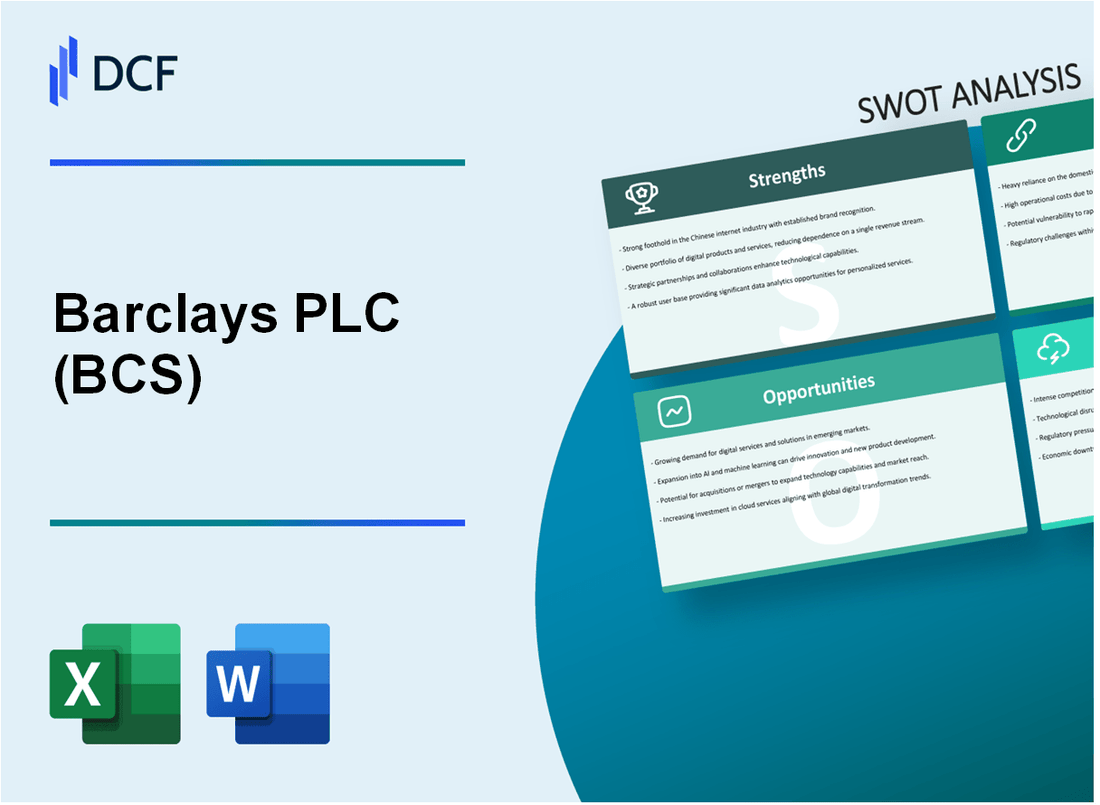
Completamente Editable: Adáptelo A Sus Necesidades En Excel O Sheets
Diseño Profesional: Plantillas Confiables Y Estándares De La Industria
Predeterminadas Para Un Uso Rápido Y Eficiente
Compatible con MAC / PC, completamente desbloqueado
No Se Necesita Experiencia; Fáciles De Seguir
Barclays PLC (BCS) Bundle
En el panorama dinámico de la banca global, Barclays PLC es una potencia financiera con un 300 años Legado, navegación de desafíos del mercado complejos a través de la innovación estratégica y la resiliencia. Este análisis FODA completo revela el intrincado posicionamiento del banco en 2024, ofreciendo una exploración perspicaz de sus fortalezas competitivas, vulnerabilidades potenciales, oportunidades emergentes y amenazas críticas en un ecosistema financiero cada vez más digital e interconectado. Descubra cómo Barclays está maniobrando estratégicamente para mantener su prominencia bancaria global en medio de una rápida transformación tecnológica e incertidumbres económicas.
Barclays PLC (BCS) - Análisis FODA: fortalezas
Presencia global con fuertes operaciones bancarias
Barclays opera en 35 países En múltiples continentes, con una importante presencia del mercado en el Reino Unido y los mercados internacionales. A partir de 2023, el banco mantuvo 1.465 ramas a nivel mundial.
| Región | Número de países | Total de ramas |
|---|---|---|
| Reino Unido | 1 | 823 |
| África | 12 | 261 |
| Otros mercados internacionales | 22 | 381 |
Cartera de servicios financieros diversos
Barclays ofrece servicios financieros integrales en múltiples segmentos:
- Banca minorista
- Banca comercial
- Banca de inversión
- Gestión de patrimonio
| Segmento de negocios | Ingresos (2023) | Cuota de mercado |
|---|---|---|
| Banca minorista | £ 7.2 mil millones | 15.3% |
| Corporativo & Banca de inversión | £ 9.6 mil millones | 12.7% |
Infraestructura bancaria digital
Barclays ha invertido £ 1.2 mil millones en transformación digital, con 8.4 millones de usuarios de banca digital activos a partir de 2023.
Reservas de capital y estabilidad financiera
Barclays mantiene relaciones de adecuación de capital robustas:
| Métrico de capital | Valor 2023 |
|---|---|
| Relación de nivel de equidad común | 14.2% |
| Relación de capital total | 19.5% |
Reputación de marca establecida
Fundado en 1690, Barclays ha Más de 333 años de historia bancaria continua. El banco sirve aproximadamente 48 millones de clientes mundial.
Barclays PLC (BCS) - Análisis FODA: debilidades
Desafíos legales y de cumplimiento continuos que resultan en importantes multas regulatorias
Barclays ha enfrentado sanciones regulatorias sustanciales en los últimos años. En 2023, el banco incurrió en £ 280 millones en gastos legales y relacionados con el cumplimiento. Los desafíos regulatorios clave incluyen:
- Investigaciones de mala conducta financiera
- Problemas de cumplimiento contra el lavado de dinero
- Venta incorrecta histórica de productos financieros
| Año | Multas regulatorias (£ millones) |
|---|---|
| 2022 | 215 |
| 2023 | 280 |
Rentabilidad relativamente menor en comparación con los competidores bancarios globales
Las métricas de rentabilidad revelan desafíos en el posicionamiento competitivo:
| Métrico | Barclays | Promedio de la competencia |
|---|---|---|
| Regreso sobre la equidad (ROE) | 5.8% | 7.3% |
| Margen de beneficio neto | 12.4% | 15.2% |
Exposición a la volatilidad económica en el Reino Unido y los mercados europeos
Indicadores de vulnerabilidad económica:
- Tasa de crecimiento del PIB del Reino Unido: 0.1% en 2023
- Índice de incertidumbre económica europea: 16.5
- Las interrupciones del mercado relacionadas con el Brexit continúan afectando el desempeño financiero
Vulnerabilidades potenciales de ciberseguridad en plataformas de banca digital
Evaluación del riesgo de ciberseguridad:
| Métrico | 2022 | 2023 |
|---|---|---|
| Incidentes cibernéticos informados | 127 | 164 |
| Impacto financiero potencial (£) | 45 millones | 62 millones |
Estructura organizacional compleja que obstaculiza la eficiencia operativa
Métricas de complejidad organizacional:
- Número de divisiones operativas globales: 7
- Ratio de costos generales: 62.3%
- Tiempo promedio para implementar cambios estratégicos: 18 meses
Barclays PLC (BCS) - Análisis FODA: oportunidades
Expandir la banca digital y la innovación de fintech
El segmento de banca digital de Barclays reportó £ 2.1 mil millones en ingresos por transacciones digitales en 2023. Los usuarios de la banca móvil aumentaron en un 18.7% a 11.3 millones de usuarios activos. Las transacciones de pago digital crecieron un 22.4% año tras año.
| Métrica de banca digital | 2023 rendimiento |
|---|---|
| Ingresos de transacciones digitales | £ 2.1 mil millones |
| Usuarios de banca móvil | 11.3 millones |
| Crecimiento de la transacción de pago digital | 22.4% |
Potencial del mercado en crecimiento en los mercados emergentes
Barclays identificó importantes oportunidades de crecimiento en los mercados africanos y asiáticos.
- El potencial de mercado de África se estima en £ 47.3 mil millones en ingresos bancarios
- El crecimiento de la banca digital del mercado asiático proyectado en 15.6% anual
- Ingresos actuales del mercado emergente: £ 6.2 mil millones
Productos financieros sostenibles y ESG
Barclays cometió £ 175 mil millones para las finanzas sostenibles para 2025. Las emisiones de bonos verdes alcanzaron £ 4.3 mil millones en 2023.
| Métrica Financiera de ESG | Cantidad |
|---|---|
| Compromiso financiero sostenible | £ 175 mil millones |
| Emisiones de bonos verdes (2023) | £ 4.3 mil millones |
Adquisiciones de tecnología estratégica
Presupuesto de adquisición de tecnología asignado a £ 1.2 mil millones para el período 2024-2026. Concéntrese en las plataformas de inteligencia fintech y artificial.
Desarrollo de inteligencia artificial y aprendizaje automático
La inversión de IA alcanzó £ 387 millones en 2023. La implementación de aprendizaje automático se espera que reduzca los costos operativos en un 14,5%.
- Inversión de IA: £ 387 millones
- Reducción de costos operativos proyectados: 14.5%
- Plataformas de servicio al cliente con IA implementadas en 23 mercados globales
Barclays PLC (BCS) - Análisis FODA: amenazas
Aumento de la competencia de las plataformas bancarias nativas digitales y las nuevas empresas de fintech
Barclays enfrenta una presión competitiva significativa de las plataformas de banca digital. A partir de 2024, las nuevas empresas de FinTech han capturado aproximadamente el 13.2% de la participación en el mercado bancario mundial. Los bancos solo digitales como Revolut y Monzo continúan desafiando los modelos bancarios tradicionales.
| Competidor | Penetración del mercado | Base de usuarios digitales |
|---|---|---|
| Revolutivo | 28.5 millones de usuarios | £ 636 millones de ingresos (2023) |
| Monzo | 8.1 millones de usuarios | £ 218 millones de ingresos (2023) |
Posibles recesión económica y presiones recesionales
Los indicadores económicos sugieren riesgos potenciales de recesión en los mercados clave. El Fondo Monetario Internacional proyecta un crecimiento económico global en 3.1% para 2024, con posibles riesgos a la baja.
- Previsión de crecimiento del PIB del Reino Unido: 0.6% para 2024
- Proyección de crecimiento económico de la eurozona: 0.9%
- Posibles tasas de incumplimiento del préstamo estimadas en 3.7%
Entorno regulatorio estricto
Los costos de cumplimiento continúan aumentando. Los gastos regulatorios para Barclays alcanzaron £ 742 millones en 2023, lo que representa un aumento del 12.5% respecto al año anterior.
| Área reguladora | Costo de cumplimiento | Aumento interanual |
|---|---|---|
| Informes financieros | £ 276 millones | 8.3% |
| Anti-lavado de dinero | £ 198 millones | 15.6% |
Incertidumbres geopolíticas
Las operaciones bancarias internacionales enfrentan desafíos geopolíticos significativos. Las tensiones globales actuales afectan las actividades bancarias transfronterizas y las estrategias de inversión.
- Restricciones comerciales que afectan a 17 mercados globales
- Impacto potencial de sanciones: riesgo potencial de ingresos potenciales de £ 1.2 mil millones
- Mayor complejidad operativa en 6 regiones internacionales clave
Riesgos de ciberseguridad
Los desafíos de seguridad digital representan una amenaza crítica. Los incidentes de ciberseguridad en el sector financiero cuestan un promedio de £ 4.5 millones por violación en 2023.
| Métrica de ciberseguridad | Impacto financiero | Frecuencia de incidentes |
|---|---|---|
| Costo de violación promedio | £ 4.5 millones | Aumentando el 12.7% anual |
| Inversiones de protección de datos | £ 328 millones | Aumento del 18,3% de 2022 |
Barclays PLC (BCS) - SWOT Analysis: Opportunities
The opportunities for Barclays PLC in 2025 are clearly aligned with its strategic plan to deliver structurally higher returns, with the main levers being targeted growth in the US Investment Bank and the benefit of a higher-for-longer interest rate environment on its core UK retail franchise. The focus is on driving the Return on Tangible Equity (RoTE) to greater than 11% in 2025 and a progressive increase in capital returns compared to 2024.
Further expansion of US Investment Bank to capture market share.
The Investment Bank (IB) remains a key area for profitable growth, particularly in the US, which is a core market for the division. The strategy is not just about size, but about driving greater Risk-Weighted Asset (RWA) productivity and returns. The IB's RoTE saw a significant improvement, reaching 12.2% in Q2 2025, which is a substantial 2.6 percentage point increase year-on-year.
This momentum is supported by strong underlying activity, as seen in the 22% rise in Investment Banking Fees in Q4 2024 and the circa 90% year-on-year growth in US Deposit Balances (Q4 2024), indicating deepening client relationships in the critical US market. The opportunity lies in continuing to take market share from competitors in high-margin areas like financing and advisory, while keeping the IB's RWAs tightly managed at around 50% of the Group total.
Higher interest rates boosting Net Interest Margin (NIM) in UK retail.
The UK retail and corporate franchises are high-returning engines for the Group, and the opportunity from a stable to higher interest rate environment is significant. This macroeconomic tailwind directly boosts Net Interest Income (NII). The bank has already upgraded its 2025 NII guidance, reflecting favourable deposit volumes and mix.
The updated guidance for 2025 projects Group NII (excluding the Investment Bank and Head Office) to be greater than £12.6 billion, an upgrade from the previous guidance of greater than £12.5 billion. Specifically, the Barclays UK NII is forecast to surpass £7.6 billion for 2025, up from the FY24 NII of £6.5 billion (excluding Tesco Bank NII). This NII growth is a direct proxy for a strong Net Interest Margin (NIM) and is supported by the stability of customer deposits, which feeds into the structural hedge income.
Here's the quick math on the UK NII momentum:
| Metric | FY24 Actual (Excl. Tesco Bank NII) | 2025 Guidance | Implied Growth Opportunity |
|---|---|---|---|
| Barclays UK NII | £6.5 billion | Greater than £7.6 billion | At least 16.9% |
| Group NII (Excl. IB & HO) | £11.2 billion | Greater than £12.6 billion | At least 12.5% |
Strategic simplification via divestment of non-core assets.
The opportunity here is to continue the simplification of the business model, which 'unshackles' the high-returning core businesses from non-strategic, lower-return assets. This is a continuous process of portfolio optimization, designed to improve the overall Group RoTE.
The bank's focus on structural actions is evidenced by past inorganic activity, such as the divestment of the performing Italian retail mortgage portfolio, which resulted in a £220 million loss in FY24, and the German consumer finance business, a £9 million loss. The key is that these actions, while sometimes incurring a short-term loss on sale, free up capital and management focus, driving the core business performance. The ultimate goal is to hit a RoTE of greater than 12% by 2026.
The strategic simplification allows for disciplined capital allocation to the highest-returning divisions. That's how you get to a double-digit RoTE.
Increased digital adoption reducing branch operating costs.
Digital transformation is a direct route to improving the cost-to-income ratio, which is a core 2025 target. Barclays is targeting a cost-to-income ratio of around 61% for 2025, with a further reduction to the high 50s % targeted for 2026.
The financial opportunity from efficiency is clear: the bank is targeting gross efficiency savings of approximately £500 million for the full year 2025. Impressively, £350 million of these gross savings were already achieved in the first half of 2025. This is defintely a strong operational performance.
The savings are driven by increased investment in technology, automation, and the adoption of Generative AI (GenAI), which two-thirds of surveyed fintechs believe is significant to their 2025 growth plan. The opportunity is to translate this technology investment into lower operating costs and a better customer experience, which supports the Group's financial targets:
- Target gross efficiency savings of c.£500 million in 2025.
- Achieve a 2025 cost-to-income ratio of c.61%.
- Leverage AI for better business processes, including payments, fraud detection, and customer onboarding.
Finance: Monitor the run-rate of efficiency savings against the £500 million target quarterly.
Barclays PLC (BCS) - SWOT Analysis: Threats
Global economic slowdown increasing credit impairment charges
You're watching the global economy, especially the US consumer, and you know a downturn translates directly into higher loan losses for Barclays. The bank's business model, particularly its US Consumer Bank (USCB) and UK retail lending, makes it sensitive to rising unemployment and debt stress. This is a clear, near-term threat.
The risk is already materializing. For the nine months ended September 30, 2025, Barclays reported credit impairment charges of £643 million, which is a jump from £513 million a year prior. Importantly, this included a specific £74 million adjustment due to 'elevated US macroeconomic uncertainty.'
Here's the quick math: Barclays' own internal target for its Loan Loss Rate (LLR) is expected to range between 50 to 60 basis points throughout the economic cycle. For the first half of 2025 (H1 2025), the reported LLR was already 52 basis points, sitting squarely in that target range, which suggests management is pricing in a sustained level of elevated risk. If unemployment spikes, that LLR could easily breach the top end of the range, directly hitting profits.
Intense competition from US bulge bracket banks in investment banking
Barclays Investment Bank (IB) is a core profit driver, but it is constantly battling the sheer scale and capital power of the US bulge bracket banks-JPMorgan Chase, Goldman Sachs, and Morgan Stanley. To be fair, Barclays is the only non-US bank with scale access to the US client base, but the competition is defintely intense.
While Barclays has shown strength in specific areas, it's not consistent across the board. For example, in Q1 2025, the bank's Fixed Income, Currencies, and Commodities (FICC) trading income rose by a strong 21%, actually outpacing the 6% average gain seen across the top five Wall Street banks. But, look at the other side of the coin: the bank's Equities income growth was a modest 9%, which lagged significantly behind the 32% average achieved by top American players.
This uneven performance highlights a key threat: the US banks can deploy more capital and attract top talent globally, making it harder for Barclays to gain sustainable market share in lucrative areas like M&A advisory and Equity Capital Markets (ECM). The difference in market capitalization alone speaks volumes about the scale disparity:
| Bank | Market Capitalization (Jan 2025) |
| Bank of America | $353.06 billion |
| Barclays PLC | $53.56 billion |
New regulatory fines or capital requirements (e.g., Basel IV implementation)
The threat of new regulation, particularly the finalization of the Basel III framework (often called Basel IV or Basel 3.1), is a perpetual risk for any global bank. While UK banks are generally considered better capitalized than some European peers, the new rules still force a capital rethink.
The UK's implementation of Basel 3.1 is currently expected to begin in July 2026. The biggest change is the new 'output floor,' which constrains how much banks can reduce their Risk-Weighted Assets (RWAs) using their internal models. This floor will be phased in, eventually preventing a bank's internal RWA calculation from falling below 72.5% of the standardized approach by 2030.
This means Barclays must hold more capital against certain assets, which ties up funds that could otherwise be used for lending or shareholder returns. The bank currently maintains a robust Common Equity Tier 1 (CET1) ratio of 14.0% as of June 30, 2025, which is at the high end of its own target range of 13% to 14%. Still, any unexpected hike in regulatory capital requirements could force a reduction in capital returns or a shift in business mix to less capital-intensive areas.
Political or economic uncertainty in the core UK market
Barclays remains deeply exposed to the health of the UK economy, which is its core market. The combination of political drama and economic uncertainty directly impacts consumer and business confidence, which in turn slows down lending and investment-the lifeblood of a bank.
Despite a forecast for UK GDP growth to improve in 2025, with inflation stabilizing around 2.3%, policy uncertainty is crippling business investment. A recent Barclays survey (November 2025) showed that:
- 55% of all firms polled are pausing investment decisions until after the Chancellor's Budget.
- 45% of small company bosses believe policy uncertainty is negatively impacting their firms.
- The proportion of SMEs feeling positive about the current climate dropped from 48% to 36% between Q3 2024 and Q2 2025.
This reluctance to invest means lower demand for corporate loans and advisory services in the UK, limiting growth in the bank's UK Corporate Bank and Investment Bank segments. The lack of 'consistent policy direction' is a major headwind for the UK economy, and therefore for a bank with such deep roots in the market.
Disclaimer
All information, articles, and product details provided on this website are for general informational and educational purposes only. We do not claim any ownership over, nor do we intend to infringe upon, any trademarks, copyrights, logos, brand names, or other intellectual property mentioned or depicted on this site. Such intellectual property remains the property of its respective owners, and any references here are made solely for identification or informational purposes, without implying any affiliation, endorsement, or partnership.
We make no representations or warranties, express or implied, regarding the accuracy, completeness, or suitability of any content or products presented. Nothing on this website should be construed as legal, tax, investment, financial, medical, or other professional advice. In addition, no part of this site—including articles or product references—constitutes a solicitation, recommendation, endorsement, advertisement, or offer to buy or sell any securities, franchises, or other financial instruments, particularly in jurisdictions where such activity would be unlawful.
All content is of a general nature and may not address the specific circumstances of any individual or entity. It is not a substitute for professional advice or services. Any actions you take based on the information provided here are strictly at your own risk. You accept full responsibility for any decisions or outcomes arising from your use of this website and agree to release us from any liability in connection with your use of, or reliance upon, the content or products found herein.