
|
Análisis de las 5 Fuerzas de The Vita Coco Company, Inc. (COCO) [Actualizado en Ene-2025] |
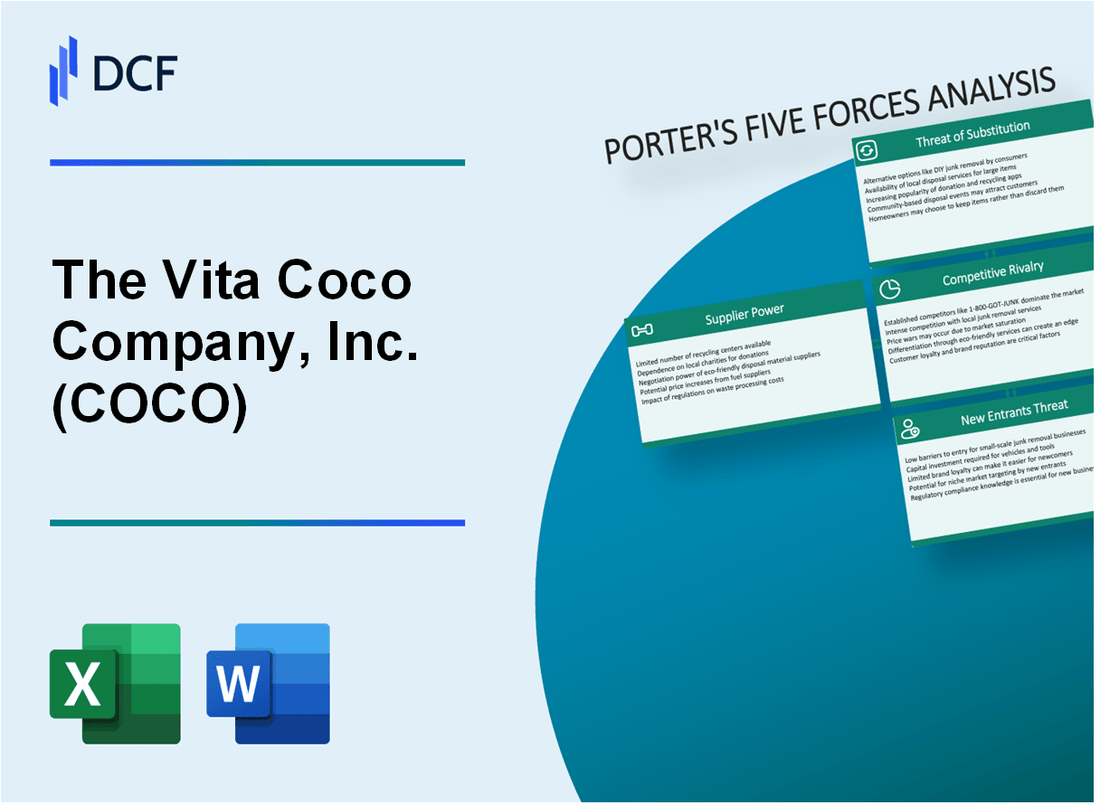
Completamente Editable: Adáptelo A Sus Necesidades En Excel O Sheets
Diseño Profesional: Plantillas Confiables Y Estándares De La Industria
Predeterminadas Para Un Uso Rápido Y Eficiente
Compatible con MAC / PC, completamente desbloqueado
No Se Necesita Experiencia; Fáciles De Seguir
The Vita Coco Company, Inc. (COCO) Bundle
En el mundo dinámico del agua de coco, la Compañía Vita Coco navega por un complejo panorama competitivo donde cada decisión estratégica puede tomar o romper el éxito del mercado. A medida que los consumidores buscan cada vez más opciones de bebidas más saludables y más saludables, Vita Coco enfrenta un desafío multifacético de equilibrar las relaciones con los proveedores, las preferencias de los clientes y las presiones competitivas. Al diseccionar el marco de las cinco fuerzas de Michael Porter, presentaremos la intrincada dinámica que da forma al posicionamiento estratégico de Vita Coco en el $ 1.4 mil millones Mercado de bebidas funcionales, revelando los factores críticos que determinarán su crecimiento futuro y sostenibilidad.
The Vita Coco Company, Inc. (Coco) - Las cinco fuerzas de Porter: poder de negociación de los proveedores
Paisaje de proveedores de coco
A partir de 2024, Vita Coco obtiene cocos principalmente de Brasil, Indonesia y Filipinas. La producción global de coco en 2023 fue de aproximadamente 62.5 millones de toneladas métricas.
| País | Producción de coco (2023) | Cuota de mercado |
|---|---|---|
| Indonesia | 18.5 millones de toneladas métricas | 29.6% |
| Filipinas | 14.7 millones de toneladas métricas | 23.5% |
| Brasil | 8.2 millones de toneladas métricas | 13.1% |
Dinámica de concentración y negociación de proveedores
Los 5 principales proveedores de coco controlan aproximadamente el 67% del mercado mundial de coco, lo que indica una concentración moderada de proveedores.
- Tamaño promedio de la granja de coco: 1.2 hectáreas
- Ingresos promedio de los agricultores de coco: $ 3,200 por año
- Rango de volatilidad del precio de coco: 15-22% anual
Factores de riesgo de la cadena de suministro
El cambio climático impacta la producción de coco con posibles reducciones de rendimiento del 10-15% en las regiones clave en crecimiento.
| Factor de riesgo | Impacto potencial |
|---|---|
| Frecuencia de tormenta tropical | Aumentó en un 22% desde 2010 |
| Sequía | Reducción del rendimiento del cultivo potencial del 12-18% |
| Infestación de plagas | Puede reducir los rendimientos hasta en un 25% |
Inversión de la cadena de suministro
Vita Coco invirtió $ 4.2 millones en programas de abastecimiento sostenible en 2023 para mitigar los riesgos de proveedores.
- Relaciones directas de proveedores: 87 cooperativas de cultivo de coco
- Duración promedio del contrato del proveedor: 3-5 años
- Cumplimiento de la certificación del proveedor: 94% que cumple con los estándares de sostenibilidad
The Vita Coco Company, Inc. (Coco) - Las cinco fuerzas de Porter: poder de negociación de los clientes
Bajos costos de cambio para los consumidores en el mercado de bebidas
Según los datos de Nielsen, el consumidor promedio puede cambiar entre las marcas de agua de coco con un impacto financiero mínimo, con diferencias de precios que van desde $ 2.49 a $ 3.99 por contenedor de 16 oz.
| Categoría de bebida | Costo de cambio promedio | Flexibilidad del consumidor |
|---|---|---|
| Agua de coco | $0.50 - $1.50 | Alto |
| Bebidas deportivas | $1.99 - $3.49 | Medio |
Preferencias del consumidor conscientes de la salud
La investigación de mercado reciente indica que el 67% de los consumidores de entre 18 y 45 años priorizan las bebidas funcionales con los beneficios para la salud.
- Crecimiento del mercado orgánico de agua de coco: 12.3% anual
- Demanda del consumidor de alternativas bajas en azúcar: 54%
- Preferencia por los ingredientes naturales: 73%
Múltiples canales minoristas
La distribución de Vita Coco alcanza 85,000 ubicaciones minoristas en comestibles, conveniencia y plataformas en línea.
| Canal minorista | Penetración del mercado | Volumen de ventas |
|---|---|---|
| Tiendas de comestibles | 58% | $ 124 millones |
| Tiendas de conveniencia | 22% | $ 45 millones |
| Plataformas en línea | 20% | $ 41 millones |
Sensibilidad al precio en el segmento de bebidas funcionales
El mercado de bebidas funcionales muestra la elasticidad de precios de 1.2, lo que indica que los consumidores son moderadamente sensibles a los cambios de precios.
- Voluntad promedio del consumidor para pagar la prima: 15-20%
- Rango de tolerancia al precio: $ 2.49 - $ 4.29
- Punto de precio competitivo de la marca: $ 3.19 promedio
The Vita Coco Company, Inc. (Coco) - Las cinco fuerzas de Porter: rivalidad competitiva
Panorama de la competencia del mercado
A partir de 2024, el mercado de agua de coco listo para beber demuestra una intensa dinámica competitiva con los siguientes competidores clave:
| Competidor | Cuota de mercado | Ingresos anuales |
|---|---|---|
| Vita Coco | 35.2% | $ 385.6 millones |
| Zico | 18.7% | $ 203.4 millones |
| Cosecha inofensiva | 12.5% | $ 145.9 millones |
| Etiquetas privadas | 22.6% | $ 247.3 millones |
Dinámica competitiva
El mercado del agua de coco exhibe las siguientes características competitivas:
- Tasa de innovación de productos: 4-6 lanzamientos de nuevos productos por marca anualmente
- Inversión promedio de I + D: 7-9% de los ingresos
- Tasa de crecimiento del mercado: 8.3% año tras año
- Intensidad de competencia de precios: medio a alto
Estrategias de posicionamiento de marca
Las estrategias de posicionamiento competitivos incluyen:
- Certificación orgánica
- Abastecimiento sostenible
- Perfiles de sabor únicos
- Innovación de envasado
Indicadores de fragmentación del mercado
| Métrico | Valor |
|---|---|
| Número de competidores | 17 |
| Ratio de concentración de mercado (CR4) | 68.4% |
| Herfindahl-Hirschman Índice (HHI) | 1,245 |
The Vita Coco Company, Inc. (Coco) - Las cinco fuerzas de Porter: amenaza de sustitutos
Cultivo de opciones de bebidas alternativas
Según Statista, el mercado mundial de bebidas deportivas se valoró en $ 25.5 mil millones en 2022 y se proyecta que alcanzará los $ 36.9 mil millones para 2027. El tamaño del mercado de agua con sabor se estimó en $ 9.7 mil millones en 2022.
| Categoría de bebida | Tamaño del mercado 2022 | Tamaño del mercado proyectado 2027 |
|---|---|---|
| Bebidas deportivas | $ 25.5 mil millones | $ 36.9 mil millones |
| Agua con sabor | $ 9.7 mil millones | $ 14.3 mil millones |
Creciente popularidad de las alternativas de bebidas funcionales
El mercado de bebidas funcionales se valoró en $ 151.7 mil millones en 2021, con una tasa compuesta anual del 9.7% que se espera de 2022 a 2030.
- Tamaño del mercado de Kombucha: $ 2.64 mil millones en 2022
- Tamaño del mercado del agua de coco: $ 2.7 mil millones en 2022
- Mercado de bebidas energéticas: $ 57.9 mil millones en 2022
Aumento de la tendencia de salud y bienestar del consumidor
El mercado de bebidas de salud y bienestar alcanzó los $ 191.7 mil millones en 2022, con un crecimiento proyectado a $ 303.3 mil millones para 2030.
| Segmento de bebidas de salud | Valor de mercado 2022 | Tocón |
|---|---|---|
| Bebidas funcionales | $ 151.7 mil millones | 9.7% |
| Bebidas de salud y bienestar | $ 191.7 mil millones | 6.2% |
Competidores emergentes de bebidas basadas en plantas y de plantas
El tamaño del mercado de bebidas a base de plantas fue de $ 18.4 mil millones en 2021, que se espera que alcance los $ 40.5 mil millones para 2030.
- Mercado de leche de avena: $ 3.9 mil millones en 2022
- Mercado de leche de almendras: $ 5.2 mil millones en 2022
- Mercado de bebidas basado en plantas CAGR: 11.2%
The Vita Coco Company, Inc. (Coco) - Las cinco fuerzas de Porter: amenaza de nuevos participantes
Barreras de entrada a la industria de bebidas
A partir de 2024, la industria de las bebidas demuestra barreras de entrada relativamente bajas con características financieras específicas:
| Categoría de costos de entrada | Rango de inversión estimado |
|---|---|
| Equipo de producción inicial | $250,000 - $750,000 |
| Configuración de distribución inicial | $100,000 - $350,000 |
| Presupuesto de lanzamiento de marketing | $75,000 - $250,000 |
Análisis de requisitos de capital
La entrada al mercado de agua de coco requiere inversiones de capital moderadas:
- Capital de inicio mínimo: $ 500,000
- Capital de trabajo recomendado: $ 1.2 millones
- Inversión inicial de la instalación de producción: $ 350,000 - $ 600,000
Factores de reconocimiento de marca
La posición del mercado de Vita Coco incluye:
- Cuota de mercado en el segmento de agua de coco: 44.7%
- Puntuación de reconocimiento de marca: 8.2/10
- Gastos anuales de marketing: $ 22.3 millones
Desafíos de red de distribución
| Canal de distribución | Porcentaje de penetración |
|---|---|
| Tiendas de comestibles minoristas | 82% |
| Tiendas de conveniencia | 67% |
| Plataformas en línea | 41% |
The Vita Coco Company, Inc. (COCO) - Porter's Five Forces: Competitive rivalry
You're looking at a market where The Vita Coco Company, Inc. has established a commanding position, but the rivalry is definitely heating up from both the giants and the niche players. Honestly, the sheer momentum The Vita Coco Company is showing suggests they are managing this competitive landscape well for now.
The Vita Coco Company is the clear U.S. market leader with a 42% share. This leadership position is the foundation of its current strength, but it also makes it a prime target for everyone else trying to chip away at that dominance. The core business, Vita Coco Coconut Water, is the engine driving this, showing net sales growth of 42% in the third quarter of 2025 alone. That kind of growth in a mature segment is impressive.
Rivalry includes large beverage players like PepsiCo and smaller premium brands. You see the big guys, like PepsiCo, and the other major incumbent, The Coca-Cola Company (which owns ZICO), constantly looking for ways to gain share. Then you have smaller, often premium-focused brands like C2O and Taste Nirvana, who compete on quality or unique sourcing. It's a multi-front battle.
The Vita Coco Company's recent financial results underscore its ability to gain ground despite this pressure. For Q3 2025, net sales grew 37% to $182 million. That's not just growth; that's a statement that their brand equity is translating directly to the bottom line, even with headwinds like tariff costs.
Here's a quick look at the key financial results that reflect this competitive strength in Q3 2025:
| Metric | Q3 2025 Value | Year-over-Year Change |
| Net Sales | $182 million | 37% increase |
| Vita Coco Coconut Water Net Sales | N/A | 42% growth |
| Net Income | $24 million | Increase of $5 million |
| Non-GAAP Adjusted EBITDA | $32 million | Increase of $9 million |
| Gross Margin | 38% | Slight decrease from 39% |
Competition is shifting to new product segments like the Vita Coco Treats rollout. This move into coconut-milk-based beverages shows The Vita Coco Company is not just defending its core but actively expanding the total addressable market, which is smart. This new category growth is contributing to the performance of the Other category, which is key to diversifying revenue away from just the core water.
The overall market context is massive, which gives room for multiple players to succeed, though The Vita Coco Company is clearly leading the charge. The total global coconut beverage market is estimated at $15 billion in 2025. Still, The Vita Coco Company's strong balance sheet, with $204 million in cash and cash equivalents and no debt as of September 30, 2025, gives it the firepower to invest in marketing and product development to maintain its edge.
The competitive dynamics are also shaped by The Vita Coco Company's strategic focus areas:
- Driving increased household penetration in the U.S.
- Expanding new consumption occasions for coconut water.
- Leveraging the launch of Vita Coco Treats.
- Managing the impact of tariff costs on gross margin.
- Executing a share repurchase program with $42 million remaining on the authorization limit.
Management's confidence is reflected in the raised full-year 2025 guidance, projecting net sales between $580 million and $595 million, and Adjusted EBITDA in the range of $90 million to $95 million. Finance: draft 13-week cash view by Friday.
The Vita Coco Company, Inc. (COCO) - Porter's Five Forces: Threat of substitutes
You're analyzing The Vita Coco Company, Inc. (COCO) and need to see just how much competition comes from drinks that aren't coconut water. Honestly, the threat of substitutes is substantial, driven by the sheer size and growth of adjacent beverage categories that promise similar hydration or functional benefits. We see this pressure from established giants and fast-growing niche players alike.
The market for direct and indirect substitutes is massive, as evidenced by the 2025 estimated market sizes for enhanced waters and the established sports drink segment. For instance, the global enhanced water market is estimated to account for USD 7.6 billion in 2025, though another projection places the global market size at $9.77 billion in 2025. North America, a key market for The Vita Coco Company, Inc. (COCO), held the largest revenue share in the enhanced water market at 48.5% in 2024.
The established sports drink category, while showing some signs of stagnation in certain areas, represents a huge volume of consumer spending on hydration. The global sports drink market size was valued at USD 34.89 billion in 2024. In the U.S. specifically, non-aseptic sports drink sales were above $11.5 billion in the 52 weeks ending April 20, with Gatorade sales alone surpassing $7.5 billion during that period. To be fair, that same non-aseptic category experienced a decline of 0.5% in sales over the same 52-week period, which might signal an opening for natural alternatives like The Vita Coco Company, Inc. (COCO)'s offerings.
Here's a quick look at the scale of the competition from these substitute categories based on recent estimates:
| Substitute Category | Estimated Market Size (2025) | North America Revenue Share (2024) | Key Growth Driver/Trend |
|---|---|---|---|
| Enhanced Water | USD 7.6 Billion to USD 9.77 Billion | 48.5% (Largest Region) | Growing demand for functional beverages |
| Sports Drinks (Global) | USD 34.89 Billion (2024 Base) | 34.31% (Largest Region) | Continued fitness culture |
| Electrolyte Powder (Global) | Implied growth from USD 8.74 Billion (2024) | 48.2% (Dominant Region) | Surge in fitness and wellness awareness |
Electrolyte powders and functional formulations offer similar hydration benefits, often directly competing on electrolyte content, which is a key selling point for coconut water. The global electrolyte powder market size was estimated at USD 8.74 billion in 2024 and is expected to grow at a Compound Annual Growth Rate (CAGR) of 8.8% from 2025 to 2030. In the U.S., the electrolyte powder market generated revenue of USD 2,775.2 million in 2024, with a projected CAGR of 8.9% from 2025 to 2030. The sports application segment drives 64.1% of the demand for electrolyte powders.
The consumer shift toward better-for-you products definitely helps The Vita Coco Company, Inc. (COCO) by pulling consumers away from high-sugar options, but it also fuels the growth of other natural alternatives. Coconut water itself, which is often marketed as a healthy replacement for water due to its potassium content, is experiencing rapid growth, suggesting a broader consumer migration to natural hydration. The Coconut Water Market accounted for USD 5.7 Billion in 2024 and is expected to reach USD 31.46 Billion by 2035, growing at a CAGR of around 16.8% between 2025 and 2035. Another estimate puts the 2024 market size at USD 4.43 billion, projecting growth to USD 11.43 billion by 2030 at a 17.3% CAGR from 2025.
The competitive pressure from these substitutes manifests in several ways:
- Sports drinks face sharper criticism for ingredients, potentially pushing marketers toward natural formulations.
- The flavored segment dominates the enhanced water market, holding a 68.8% revenue share in 2024.
- The conventional segment dominated the coconut water industry with an 81.7% revenue share in 2024.
- The electrolyte powder market is seeing growth in bulk packaging, which offers cost efficiency.
Finance: draft 13-week cash view by Friday
The Vita Coco Company, Inc. (COCO) - Porter's Five Forces: Threat of new entrants
You're looking at the barriers to entry for a new player trying to crack the coconut water space right now, late 2025. It's not as simple as mixing some liquid and slapping a label on it; the hurdles are quite high, honestly.
Significant capital is required to build a global, diversified supply chain network. The Vita Coco Company, Inc. operates an asset-light model, but that still means managing complex sourcing, utilizing 17 factories across seven countries to maintain flexibility. A new entrant would need substantial upfront investment to replicate this global footprint or risk severe supply volatility. For context, The Vita Coco Company, Inc. maintained a strong liquidity position with $167 million in cash as of June 30, 2025, which is the kind of war chest needed to secure sourcing and distribution agreements. Furthermore, securing ethical and stable supply involves relationship building, evidenced by their investment of $4.2 million in sustainable sourcing programs since 2023 across 87 farming cooperatives.
Long lead time of 5-7 years for new coconut palms is a natural barrier to entry. This biological reality creates a massive lag between investment and first harvestable product for any new competitor looking to establish captive supply. Tall varieties of coconut palms, crucial for commercial cultivation, take six to ten years to yield their first fruit. Even dwarf varieties, which fruit faster, still require three to four years to become productive. This long gestation period means a new entrant cannot quickly scale up raw material supply to meet market demand.
Strong first-mover brand advantage requires massive marketing spend to challenge. The Vita Coco Company, Inc. has cemented its position, holding a commanding 41.7% market share in the coconut water segment as of Q1 2025. To even attempt to gain traction against that level of consumer recognition, a newcomer faces a steep promotional cost curve. Looking at historical spend, The Vita Coco Company, Inc.'s digital marketing spend in 2023 was $4.2 million, with $1.7 million allocated just to influencer partnerships. You'd need to match or exceed that level of spend just to get noticed.
Large existing beverage companies can enter the segment easily through acquisition or private label. This is perhaps the most immediate threat. Established giants have the capital and distribution muscle to enter overnight, often by buying existing infrastructure or capacity. For instance, PepsiCo revealed its acquisition of Amacoco, which holds dominant brands in Brazil, in August 2024. This shows a clear path for large players to bypass the supply chain and brand-building phases. The global coconut water market size was valued at USD 5.7 Billion in 2024, making it an attractive target for these established entities.
Here's a quick look at the scale of the barriers:
| Barrier Component | The Vita Coco Company, Inc. Metric | New Entrant Implication |
|---|---|---|
| Supply Chain Footprint | Sourcing from 17 factories across 7 countries | Requires massive capital outlay and time to establish equivalent global reach. |
| Natural Lag Time | 5-7 years for new palms to mature | Guarantees a multi-year delay before a new entrant can achieve self-sufficient raw material supply. |
| Market Share Dominance | 41.7% share of coconut water segment (Q1 2025) | Requires sustained, high-level marketing investment to displace established consumer preference. |
| Historical Marketing Spend (2023) | $4.2 million in digital marketing | Sets a high baseline for necessary promotional expenditure to achieve brand awareness. |
| Acquisition Activity | PepsiCo acquired Amacoco in August 2024 | Large players can bypass organic build-up through immediate, strategic M&A. |
The threat is mitigated by the following structural elements:
- Coconut palm maturity takes 6 to 10 years for tall varieties.
- The Vita Coco Company, Inc. ended 2024 with $164.7 million in cash.
- The company has a strong liquidity position with $167 million in cash as of June 30, 2025.
- The Vita Coco brand holds 82% market share in the U.K..
- The global market size was $5.7 Billion in 2024.
Still, the threat from deep-pocketed incumbents like PepsiCo, which is actively acquiring, remains the most potent channel for new competition.
Disclaimer
All information, articles, and product details provided on this website are for general informational and educational purposes only. We do not claim any ownership over, nor do we intend to infringe upon, any trademarks, copyrights, logos, brand names, or other intellectual property mentioned or depicted on this site. Such intellectual property remains the property of its respective owners, and any references here are made solely for identification or informational purposes, without implying any affiliation, endorsement, or partnership.
We make no representations or warranties, express or implied, regarding the accuracy, completeness, or suitability of any content or products presented. Nothing on this website should be construed as legal, tax, investment, financial, medical, or other professional advice. In addition, no part of this site—including articles or product references—constitutes a solicitation, recommendation, endorsement, advertisement, or offer to buy or sell any securities, franchises, or other financial instruments, particularly in jurisdictions where such activity would be unlawful.
All content is of a general nature and may not address the specific circumstances of any individual or entity. It is not a substitute for professional advice or services. Any actions you take based on the information provided here are strictly at your own risk. You accept full responsibility for any decisions or outcomes arising from your use of this website and agree to release us from any liability in connection with your use of, or reliance upon, the content or products found herein.