

|
Coursera, Inc. (COUR): Análisis de la Matriz ANSOFF [Actualizado en Ene-2025] |
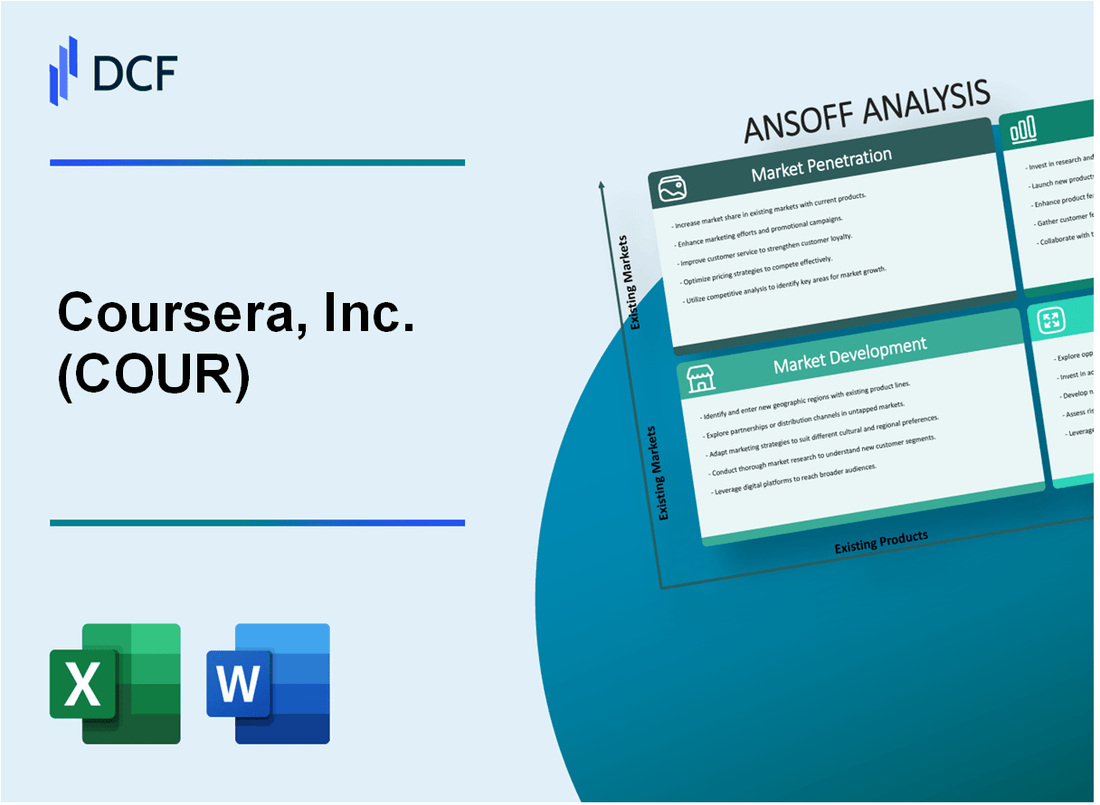
Completamente Editable: Adáptelo A Sus Necesidades En Excel O Sheets
Diseño Profesional: Plantillas Confiables Y Estándares De La Industria
Predeterminadas Para Un Uso Rápido Y Eficiente
Compatible con MAC / PC, completamente desbloqueado
No Se Necesita Experiencia; Fáciles De Seguir
Coursera, Inc. (COUR) Bundle
En el panorama de aprendizaje digital en rápida evolución, Coursera se encuentra en la encrucijada de la innovación y el crecimiento estratégico. Al mapear meticulosamente una matriz Ansoff integral, la plataforma presenta una visión audaz para transformar la educación en línea a través de estrategias específicas que abarcan la penetración del mercado, el desarrollo, la innovación de productos y la diversificación estratégica. Desde la expansión del alcance global hasta las experiencias de aprendizaje pioneras con IA, Coursera no se adapta solo a la revolución de la tecnología educativa, está reformando activamente cómo los profesionales en todo el mundo adquieren conocimientos, desarrollan habilidades y aceleran sus trayectorias profesionales.
Coursera, Inc. (Cour) - Ansoff Matrix: Penetración del mercado
Aumentar el gasto de marketing para atraer más estudiantes individuales
Coursera invirtió $ 96.5 millones en ventas y marketing en el cuarto trimestre de 2022, lo que representa el 35.9% de los ingresos totales. La compañía tiene como objetivo expandir su base de alumnos individuales a través de esfuerzos de marketing específicos.
| Métrico de marketing | Valor 2022 |
|---|---|
| Gasto de marketing | $ 96.5 millones |
| Mercado porcentaje de ingresos | 35.9% |
| Total de alumnos individuales | 77 millones |
Expandir las asociaciones empresariales
Coursera reportó 890 clientes empresariales en el cuarto trimestre de 2022, con un valor de contrato promedio de $ 49,000.
| Métrica de asociación empresarial | Valor 2022 |
|---|---|
| Total de clientes empresariales | 890 |
| Valor de contrato empresarial promedio | $49,000 |
| Ingresos empresariales | $ 102.4 millones |
Mejorar la participación del usuario
La plataforma de Coursera presenta recomendaciones personalizadas con una tasa de aceptación de recomendaciones del curso del 62%.
- Usuarios de la plataforma: 77 millones
- Tasa de aceptación de recomendación del curso: 62%
- Cursos promedio completados por usuario: 3.7
Reducir los precios del curso
Coursera ofrece cursos que van desde $ 39 a $ 79 por mes, con suscripciones anuales que proporcionan hasta un 50% de ahorro de costos.
| Modelo de precios | Gama de precios |
|---|---|
| Suscripción individual mensual | $39 - $79 |
| Descuento de suscripción anual | Hasta el 50% |
Mejorar la experiencia del usuario de la plataforma
La tasa de finalización del curso de Coursera mejoró al 52% en 2022, frente al 46% en 2021.
- Tasa de finalización del curso 2021: 46%
- Tasa de finalización del curso 2022: 52%
- Tasa de satisfacción del usuario: 4.5/5
Coursera, Inc. (Cour) - Ansoff Matrix: Desarrollo del mercado
Expandir el alcance geográfico a los mercados emergentes
A partir del cuarto trimestre de 2022, Coursera reportó 77 millones de alumnos registrados a nivel mundial. La expansión internacional dirigida a los mercados emergentes clave:
| Mercado | Usuarios registrados | Índice de crecimiento |
|---|---|---|
| India | 18.5 millones | 42% año tras año |
| Sudeste de Asia | 12.3 millones | 37% año tras año |
| América Latina | 8.7 millones | 33% año tras año |
Dirija nuevos segmentos profesionales
Inscripciones del curso de segmento profesional en 2022:
- Atención médica: 3.2 millones de inscripciones
- Gobierno: 1.8 millones de inscripciones
- Sin fines de lucro: 1.5 millones de inscripciones
Estrategia de contenido de cursos localizados
Métricas de adaptación del lenguaje:
| Idioma | Cursos totales | Aprendedores únicos |
|---|---|---|
| Español | 4.200 cursos | 6.5 millones |
| portugués | 2.800 cursos | 4.3 millones |
| mandarín | 3.600 cursos | 5.7 millones |
Asociaciones estratégicas
Asociaciones internacionales de la institución educativa en 2022:
- Total de asociaciones: 275
- Nuevas asociaciones en mercados emergentes: 87
- Instituciones asociadas en 50 países
Campañas de marketing global
Inversión y alcance de marketing:
| Región | Gasto de marketing | Nueva adquisición de usuarios |
|---|---|---|
| Asia-Pacífico | $ 12.3 millones | 2.6 millones de usuarios |
| América Latina | $ 8.7 millones | 1.9 millones de usuarios |
| Medio Oriente/África | $ 5.4 millones | 1.2 millones de usuarios |
Coursera, Inc. (Cour) - Ansoff Matrix: Desarrollo de productos
Lanzar programas de certificado profesional más avanzados en campos tecnológicos de alta demanda
A partir del cuarto trimestre de 2022, Coursera tenía 5.025 certificados profesionales totales disponibles. La plataforma agregó 2.250 nuevos certificados profesionales en campos relacionados con la tecnología durante 2022.
| Categoría de certificado de tecnología | Número de certificados | Tiempo de finalización promedio |
|---|---|---|
| Ciencia de datos | 875 | 4-6 meses |
| Ciberseguridad | 412 | 3-5 meses |
| Computación en la nube | 623 | 4-7 meses |
Desarrollar microcredenciales y cursos cortos basados en habilidades
En 2022, Coursera lanzó 1.340 nuevos microcréditos con una duración promedio del curso de 12-15 horas.
- Micro-acreditaciones totales a diciembre de 2022: 3,675
- Tasa promedio de finalización del curso: 62%
- Precios promedio del curso: $ 49- $ 79
Crear herramientas de aprendizaje adaptativas con IA
Coursera invirtió $ 47.3 millones en IA y desarrollo de tecnología de aprendizaje automático en 2022.
| Herramienta de aprendizaje de IA | Compromiso de usuario | Tasa de personalización |
|---|---|---|
| Evaluación adaptativa | 1.2 millones de usuarios | 78% |
| Motor de recomendación | 2.4 millones de interacciones | 65% |
Introducir formatos de aprendizaje interactivos e inmersivos
Coursera asignó $ 22.6 millones para desarrollar tecnologías de aprendizaje inmersivo en 2022.
- Ofertas de cursos VR: 87 cursos
- Módulos de aprendizaje basados en simulación: 142
- Participación del usuario en cursos inmersivos: 43%
Desarrollar soluciones de capacitación corporativa personalizada
Los ingresos por capacitación corporativa alcanzaron los $ 156.4 millones en 2022, con 412 clientes empresariales.
| Sector industrial | Número de programas de capacitación personalizados | Valor de contrato promedio |
|---|---|---|
| Tecnología | 127 | $375,000 |
| Servicios financieros | 98 | $265,000 |
| Cuidado de la salud | 76 | $210,000 |
Coursera, Inc. (Cour) - Ansoff Matrix: Diversificación
Adquirir o desarrollar una plataforma de bootcamp de codificación
Coursera reportó ingresos de $ 571.1 millones en 2022. El mercado de codificación de bootcamp proyectado para alcanzar los $ 1.9 mil millones para 2025.
| Segmento de mercado de Bootcamp de codificación | Valor proyectado |
|---|---|
| Tamaño del mercado global | $ 1.9 mil millones para 2025 |
| Codificación de bootcamp de codificación en línea | 17.4% CAGR |
Crear un servicio de coincidencia de talentos
Coursera tiene 77 millones de alumnos registrados a partir del cuarto trimestre de 2022.
| Métricas de talento a juego | Datos actuales |
|---|---|
| Usuarios registrados | 77 millones |
| Clientes empresariales | 3,850+ |
Desarrollar un ecosistema de aprendizaje basado en suscripción
Coursera generó ingresos de $ 571.1 millones en 2022, con un crecimiento de 41% año tras año.
- Ingresos de suscripción: $ 214.3 millones en el cuarto trimestre de 2022
- ALICIRES PAGADOS: 900,000 en el cuarto trimestre 2022
Iniciar sistema de gestión de aprendizaje empresarial
Los ingresos del segmento empresarial alcanzaron los $ 236.5 millones en 2022.
| Métricas de aprendizaje empresarial | Datos 2022 |
|---|---|
| Ingresos empresariales | $ 236.5 millones |
| Crecimiento de clientes empresariales | 29% año tras año |
Explore la credenciales basadas en blockchain
Se espera que el mercado de credenciales digitales alcance los $ 16.8 mil millones para 2026.
- Tamaño del mercado de credenciales digitales: $ 16.8 mil millones para 2026
- Tasa de crecimiento de acreditación de blockchain: 22.5% CAGR
Coursera, Inc. (COUR) - Ansoff Matrix: Market Penetration
You're looking at how Coursera, Inc. can drive more revenue from its existing user base and customer contracts. This is the Market Penetration quadrant, focusing on getting current users to buy more or existing customers to spend more.
Boost Coursera Plus conversion, which already drives over half of Consumer revenue. In the third quarter of 2025, Consumer segment revenue hit $130.3 million, showing a strong 13% year-over-year growth, largely fueled by this subscription model. The goal is to push more of the Consumer base onto the annual plan, which offers a better value proposition than the monthly rate of $59/month or individual course purchases.
Increase Enterprise segment's Net Retention Rate (NRR) above the recent 89% figure. This metric, which measures revenue retention from existing paid enterprise customers over 12 months, saw a dip to 89% as of September 30, 2025, down from 93% in Q2 2025. Pushing for higher seat utilization and cross-selling new Professional Certificates within existing accounts is key to moving this number back up.
Run targeted promotions to convert more of the 191 million registered learners to paid users. As of September 30, 2025, the total registered learner base reached 191 million, an 18% increase year-over-year. Converting even a small percentage of this massive free/audit pool into Coursera Plus subscribers or certificate purchasers represents significant near-term revenue potential.
Deepen AI-driven personalization to increase course completion and subscription renewal rates. This investment directly impacts the lifetime value of a paid user. Learners using the Coursera Coach AI-powered tutor are reported to be 10% more likely to pass a quiz on their first attempt. Furthermore, generative AI course enrollments hit a pace of 14 per minute in the third quarter of 2025, showing high engagement with new, relevant content.
Leverage the 8.0% Adjusted EBITDA margin goal to fund aggressive digital marketing campaigns. Management raised the full-year 2025 Adjusted EBITDA margin target to 8.0%, up from a prior 7.0% target. This improved profitability, with Q2 2025 Adjusted EBITDA margin at 9.6% of revenue, provides the capital to aggressively acquire the next cohort of paying learners through targeted digital spend.
Here's a quick look at the segment performance driving this market penetration effort as of the third quarter of 2025:
| Metric | Consumer Segment (Q3 2025) | Enterprise Segment (Q3 2025) |
| Revenue (millions) | $130.3 | $63.9 |
| Year-over-Year Revenue Growth | 13% | 6% |
| Gross Profit Margin | 61.2% | 69.6% |
| Net Retention Rate (NRR) | N/A (Included in Consumer) | 89% |
To drive that conversion, you need to focus on the value proposition across the funnel:
- Boost Coursera Plus adoption for unlimited access to over 7,000 courses.
- Promote Professional Certificates, which start around $39.99 USD a month for the commitment period.
- Target the 191 million registered learners with time-sensitive offers.
- Increase the number of Paid Enterprise Customers from 1,724 (as of Q3 2025) through existing account expansion.
The platform's expansion of AI features is a key lever for retention, which is critical for hitting that 8.0% margin target.
Coursera, Inc. (COUR) - Ansoff Matrix: Market Development
Aggressively expand the 'Coursera for Campus' offering in high-growth international universities.
Coursera for Campus (C4C) is the expected highest growth driver within the Enterprise offerings for 2025, despite the Degrees segment revenue being projected to decline in 2025. As of September 2025, Coursera announced 6 new university partners, bringing the total partner count to over 350 institutions. Total learners accessing content across campuses, businesses, and governments now exceeds 183 million at over 6,500 campuses. India leads total enrollments with 24.6 million learners.
- Total registered learners reached 191 million as of the third quarter of 2025.
- The Philippines shows the highest female participation at 51% among its learners.
- Malaysia reports the highest STEM engagement at 34% among its learners.
Target new government contracts globally, especially in regions focused on national workforce reskilling.
While Coursera for Government is trailing C4C and Coursera for Business in expected growth for 2025, historical data shows traction. In 2020, over 380 governments used Coursera. Specific US Federal contract activity provides concrete financial anchors. One contract with the Department of Health and Human Services (HHS) National Institutes of Health had a running total obligation of $957,034 as of September 10, 2024, with an end date of September 10, 2025. Another contract with the Department of Defense (DOD) Department of the Air Force showed an award amount of $333,500. A separate DOD contract had a total award obligation of $207,753 ending September 29, 2025.
| Government/Agency Example | Contract Obligation/Award Amount | Date Reference |
| HHS National Institutes of Health | Total award obligation of $1,191,343 | As of September 10, 2025 |
| DOD Department of the Air Force | Award Amount: $333,500 | Reported on USAspending |
| DOD Department of the Air Force (DFAS) | Running total obligation of $207,753 | As of October 31, 2024 |
Localize top Professional Certificates with AI-powered translations for non-English speaking markets.
Coursera has expanded its content accessibility significantly using AI. The platform now offers over 5,500 courses and 65 Professional Certificates in 26 languages. 1.3 million learners have logged 3.8 million enrollments in AI-translated courses. AI dubbing, launched in April 2025, has seen over 120,000 learners use it for more than 425,000 hours of learning across 300 courses in five languages. The most engaged dubbing learners come from Colombia, Brazil, Mexico, Spain, and Chile.
- AI-translated content covers 65 Professional Certificates.
- AI dubbing is available in five languages.
- Enrollments in Generative AI courses reached 14 per minute in 2025.
Focus B2B sales efforts on the 1,724 existing paid enterprise customers' international subsidiaries.
The paid enterprise customer count reached 1,724 in the third quarter of 2025, representing a 10% year-over-year growth. The net retention rate (NRR) for these customers was 89% in Q3 2025. The Enterprise segment revenue for Q3 2025 was $63.9 million, marking 6% year-over-year growth. The overall full-year 2025 revenue guidance was raised to a range of $750 million to $754 million.
| Metric | Value (Q3 2025 or Latest) | Context |
| Paid Enterprise Customers | 1,724 | Q3 2025 Count |
| Enterprise Segment Revenue | $63.9 million | Q3 2025 YoY Growth: 6% |
| Enterprise Customer NRR | 89% | Q3 2025 Figure |
| Total Courses Available | More than 12,000 | As of Q3 2025 |
Enter the K-12 teacher professional development market with existing foundational courses.
The global K-12 online learning market is projected to reach $5.66 trillion by 2030, growing at an annual rate of 12.5% from 2024. Coursera offers foundational content relevant to K-12 educators, such as the 'Computational Thinking for K-12 Educators' series, which takes 9 hours to complete. Another relevant offering is the 'Advanced Instructional Strategies in the Virtual Classroom' series, which takes 2 months at 10 hours a week. In 2023, U.S. K-12 schools accessed an average of over 2,500 edtech tools per district.
- K-12 Online Learning Market Projection (2030): $5.66 trillion.
- U.S. K-12 EdTech Tools Accessed Per District (2023): Over 2,500.
- Teacher reported edtech enhances self-paced learning: Over 50% in 2023.
Coursera, Inc. (COUR) - Ansoff Matrix: Product Development
You're looking at the hard numbers behind Coursera, Inc.'s push for new offerings. This is where the platform builds out its existing product lines to capture more value from its current customer base.
Here's a quick look at the financial backdrop as of the third quarter of 2025:
| Metric | Value | Context/Period |
| Full Year 2025 Revenue Outlook | $750 to $754 million | Raised Outlook (Q3 2025) |
| Q3 2025 Revenue | $194 million | Up 10% Year-over-Year |
| Q3 2025 Consumer Segment Revenue | $130 million | Up 13% Year-over-Year |
| Q3 2025 Enterprise Segment Revenue | $64 million | Up 6% Year-over-Year |
| Full Year 2025 Adjusted EBITDA Margin Target | 8.0% | 200 basis points improvement |
| Year-to-Date Free Cash Flow (as of Q3 2025) | Exceeded $80 million | Q3 2025 |
| Unrestricted Cash and Cash Equivalents (as of Sep 30, 2025) | Approximately $798 million | No debt |
The strategy here centers on deepening the product catalog and enhancing existing features with new technology.
Scale the new 'Skills Tracks' Enterprise solution across the Software, Data, and GenAI verticals.
- Skill Tracks launched with four initial role-based paths: Software and Product, IT, Data, and GenAI.
- The World Economic Forum's Future of Jobs Report 2025 finds 63% of employers cite skill gaps as the primary barrier to business transformation.
- GenAI course enrollments among enterprise learners surged by 866% year-over-year.
- The total catalog now exceeds 12,000 courses.
Integrate the new 'Coursera Coach' and 'Role Play' generative AI features into all high-demand courses.
- Coursera Coach has seen 6 million engagements for job skill practice.
- 94 percent of learners using Coursera Coach report an improved learning experience.
- Role Play is positioned as an AI-driven activity for practicing skills in workplace simulations.
- GenAI courses averaged 12 enrollments per minute in 2025, up from 8 in 2024.
Launch more entry-level Professional Certificates, like the new AAPC Medical Biller, for career switchers.
- Coursera has nearly 100 professional certificates available.
- There have been over 15.4 million enrollments recorded in the portfolio of Entry-Level Professional Certificates.
- Enrollments in Entry-Level Professional Certificates saw 37% growth in North America over the past year.
- The AAPC Medical Biller is a four-course series.
Partner with Anthropic and OpenAI to create new, exclusive AI-native learning experiences.
- New content partnerships were announced with Anthropic and OpenAI.
- Coursera partners with 200 universities and 150 industry leaders.
- GenAI enrollments surged by 195% year-over-year, surpassing 8 million in total.
Introduce more stackable credentials that bridge Professional Certificates to full Degrees.
- The Degree segment revenue grew 13% Year-over-Year, reaching $57.7 million (as reported in a March 2025 context).
- Coursera offers 50+ online degrees, including bachelor's and master's programs.
- New courses from the University of Illinois Urbana-Champaign focus on AI and stack into their online iMBA and iMSA degree programs.
Coursera, Inc. (COUR) - Ansoff Matrix: Diversification
You're looking at where Coursera, Inc. can make its next big leap beyond the current growth trajectory, which saw Consumer revenue hit $130.3 million in the third quarter of 2025, growing 13% year-over-year, while the Enterprise segment grew a more modest 6% to $63.9 million in the same period. The total registered learner base reached 191 million as of September 30, 2025.
Consider launching a new, non-degree, accredited Applied MasterTrack for regulated fields like finance or law. This targets a new product type within the existing Enterprise and high-value Consumer markets. The current Enterprise segment has 1,724 paid customers, but the Net Retention Rate (NRR) slipped to 89%, suggesting a need for higher-value, stickier offerings that command premium pricing beyond standard Professional Certificates, of which Coursera, Inc. currently offers nearly 100.
Next, roll out a B2B Skills Consulting service. This leverages the massive data set from 7.7 million new learners added in the third quarter of 2025 alone. The consulting arm would use platform data to advise companies on closing skill gaps, directly addressing the Enterprise segment's growth rate of 6%, which management noted was muted. The company ended Q3 2025 with $798 million in unrestricted cash and cash equivalents, providing capital for this service build-out.
For a true diversification move, you could acquire a small, specialized platform focused on vocational or trade skills. This is a completely new market for Coursera, Inc. The company is already investing heavily in content, having spent $17.3 million on content production in 2024, up from $5.3 million the year before. An acquisition would immediately place Coursera, Inc. in a new vertical, potentially diversifying revenue away from the current reliance where the Consumer segment accounted for $130.3 million of the $194.2 million Q3 2025 revenue.
Develop a subscription-based Content Creation Suite for university partners. This is a product enhancement aimed at existing partners. Coursera, Inc. is already pushing AI integration, with generative AI enrollments hitting 14 per minute in Q3 2025, up from 8 per minute the prior year. Making it easier for partners to build AI-powered courses could accelerate content expansion beyond the current catalog of over 12,000 courses.
Finally, offer a verifiable Digital Portfolio product. This is a new product layer for all learners, regardless of whether they are using Coursera, Inc. for a degree or certificate. The platform is clearly seeing strong consumer engagement, evidenced by the 13% year-over-year growth in the Consumer segment for Q3 2025. This new product could be monetized via a one-time fee or an add-on to the Coursera Plus subscription, which already accounts for more than half of Consumer segment revenue.
Here's a snapshot of the current financial context for these potential moves:
| Metric | Value (Latest Reported) | Period/Context |
| Full Year 2025 Revenue Guidance (Midpoint) | $752 million | Full Year 2025 Outlook |
| Q3 2025 Total Revenue | $194.2 million | Three Months Ended September 30, 2025 |
| Q3 2025 Free Cash Flow | $27 million | Three Months Ended September 30, 2025 |
| Year-to-Date Free Cash Flow | More than $80 million | Through Q3 2025 |
| Total Registered Learners | 191 million | As of September 30, 2025 |
| Paid Enterprise Customers | 1,724 | As of September 30, 2025 |
The company is generating cash, with year-to-date Free Cash Flow up 55% year-over-year through Q3 2025. Finance: draft a capital allocation plan for a potential acquisition target by next Tuesday.
Disclaimer
All information, articles, and product details provided on this website are for general informational and educational purposes only. We do not claim any ownership over, nor do we intend to infringe upon, any trademarks, copyrights, logos, brand names, or other intellectual property mentioned or depicted on this site. Such intellectual property remains the property of its respective owners, and any references here are made solely for identification or informational purposes, without implying any affiliation, endorsement, or partnership.
We make no representations or warranties, express or implied, regarding the accuracy, completeness, or suitability of any content or products presented. Nothing on this website should be construed as legal, tax, investment, financial, medical, or other professional advice. In addition, no part of this site—including articles or product references—constitutes a solicitation, recommendation, endorsement, advertisement, or offer to buy or sell any securities, franchises, or other financial instruments, particularly in jurisdictions where such activity would be unlawful.
All content is of a general nature and may not address the specific circumstances of any individual or entity. It is not a substitute for professional advice or services. Any actions you take based on the information provided here are strictly at your own risk. You accept full responsibility for any decisions or outcomes arising from your use of this website and agree to release us from any liability in connection with your use of, or reliance upon, the content or products found herein.