

|
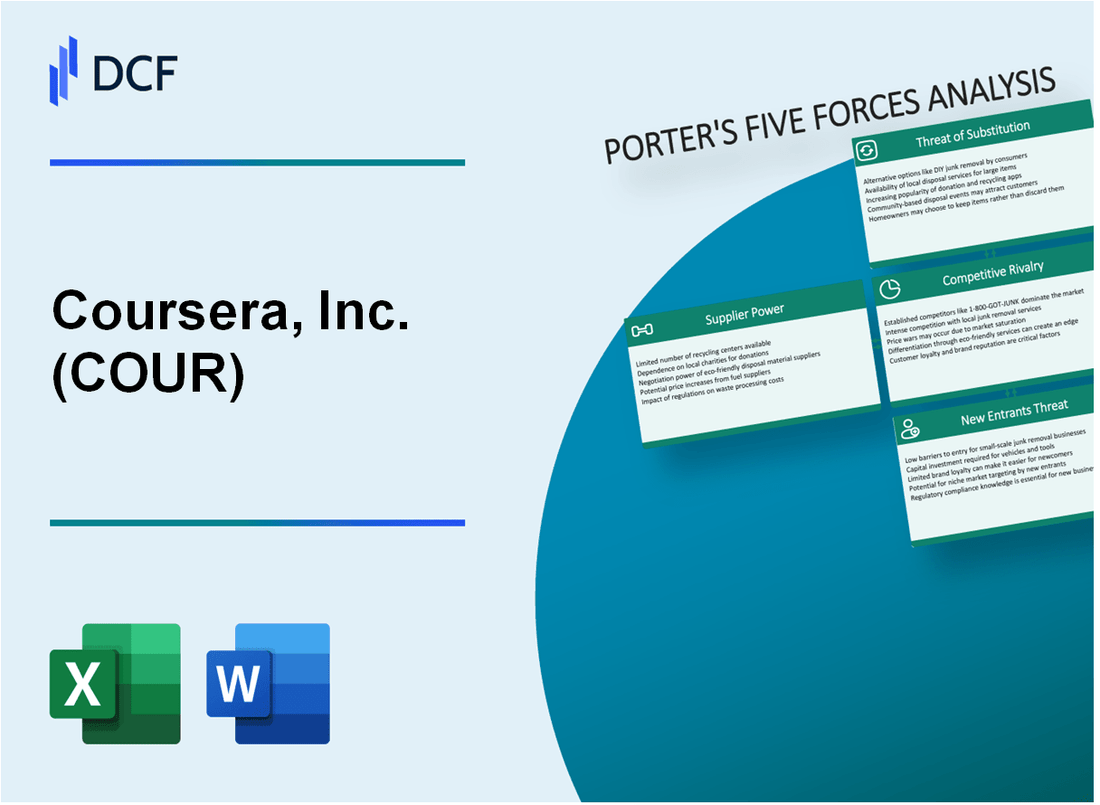
Coursera, Inc. (COUR): Análisis de 5 Fuerzas [Actualizado en Ene-2025] |
Completamente Editable: Adáptelo A Sus Necesidades En Excel O Sheets
Diseño Profesional: Plantillas Confiables Y Estándares De La Industria
Predeterminadas Para Un Uso Rápido Y Eficiente
Compatible con MAC / PC, completamente desbloqueado
No Se Necesita Experiencia; Fáciles De Seguir
Coursera, Inc. (COUR) Bundle
En el panorama en rápida evolución de la educación en línea, Coursera, Inc. se encuentra en una intersección crítica de la innovación tecnológica, las asociaciones académicas y la dinámica del mercado. Al diseccionar el posicionamiento estratégico de la compañía a través del marco Five Forces de Michael Porter, revelamos el complejo ecosistema de desafíos y oportunidades que dan forma a la estrategia competitiva de Coursera en 2024. Desde navegando las negociaciones de proveedores hasta comprender las preferencias de los clientes y defenderse de los posibles disruptores del mercado, este análisis proporciona un completo lente en cómo Coursera mantiene su ventaja en el mercado de aprendizaje digital cada vez más lleno de gente.
Coursera, Inc. (Cour) - Las cinco fuerzas de Porter: poder de negociación de los proveedores
Número limitado de creadores de contenido de alta calidad e instituciones académicas
A partir de 2024, Coursera se asocia con 275 universidades e instituciones a nivel mundial. Los principales socios incluyen:
| Institución | Número de cursos |
|---|---|
| Universidad de Stanford | 397 cursos |
| Universidad de Pensilvania | 276 cursos |
| 215 certificados profesionales | |
| Universidad de Yale | 189 cursos |
Dependencia significativa de universidades e instructores expertos
La creación de contenido de Coursera se basa en métricas clave:
- 97% de los cursos desarrollados por instituciones académicas acreditadas
- El 62% de los instructores tienen Ph.D. grados
- Experiencia de instructor promedio: 14.3 años en los respectivos campos
Palente de apalancamiento de precios de los proveedores de contenido educativo de primer nivel
Estructura de precios del proveedor de contenido:
| Categoría de proveedor | Precio promedio del curso | Participación de ingresos |
|---|---|---|
| Universidades de primer nivel | $79 - $299 | 60-70% |
| Organizaciones profesionales | $49 - $199 | 50-60% |
| Expertos de la industria | $39 - $149 | 40-50% |
Poder de negociación variable basado en la singularidad del curso
Métricas de singularidad del curso:
- El 85% de los precios de comando de cursos técnicos especializados premium
- El 67% de los instructores tienen acuerdos de contenido exclusivos
- 42 dominios más demandados con alto poder de negociación de proveedores
Coursera, Inc. (Cour) - Las cinco fuerzas de Porter: poder de negociación de los clientes
Bajos costos de cambio para plataformas de aprendizaje en línea
A partir de 2024, Coursera ofrece múltiples opciones de suscripción con barreras de entrada mínima:
| Tipo de suscripción | Costo mensual | Dificultad de cambio |
|---|---|---|
| Curso individual | $39-$79 | Bajo |
| Coursera Plus | $ 59/mes | Bajo |
| Certificados profesionales | $ 39- $ 89/mes | Bajo |
Alumnos sensibles a los precios
La investigación de mercado indica sensibilidades clave en los precios:
- El 75% de los alumnos en línea priorizan las opciones educativas asequibles
- Presupuesto promedio de aprendizaje en línea: $ 150- $ 250 por curso
- 62% comparar los precios en múltiples plataformas antes de la inscripción
Expectativas de calidad del curso
Expectativas de calidad del alumno basadas en datos 2024:
| Métrica de calidad | Porcentaje |
|---|---|
| Espere credenciales del instructor | 89% |
| Demanda de habilidades prácticas | 83% |
| Requerir certificados reconocidos de la industria | 76% |
Capacidades de comparación de plataforma
Métricas de comparación de plataforma de aprendizaje en línea:
- Número promedio de plataformas comparadas por alumno: 3.4
- Factores de comparación primarios:
- Precio
- Duración del curso
- Reputación del instructor
- Valor certificado
- Tiempo dedicado a comparar plataformas: 2.7 horas promedio
Coursera, Inc. (Cour) - Las cinco fuerzas de Porter: rivalidad competitiva
Panorama competitivo Overview
A partir de 2024, Coursera enfrenta una intensa competencia en el mercado educativo en línea con múltiples jugadores clave:
| Competidor | Cuota de mercado | Ingresos anuales |
|---|---|---|
| Idacacidad | 4.2% | $ 87.3 millones |
| edx | 5.7% | $ 112.6 millones |
| LinkedIn Learning | 7.9% | $ 215.4 millones |
| Cursera | 12.5% | $ 541.8 millones |
Capacidades competitivas
Las capacidades competitivas incluyen:
- Ofertas totales de cursos en línea en todas las plataformas
- Número de asociaciones universitarias
- Penetración del mercado geográfico
| Plataforma | Cursos totales | Socios universitarios | Alcance global |
|---|---|---|---|
| Cursera | 7,500 | 275 | 214 países |
| edx | 4,300 | 160 | 186 países |
| Idacacidad | 2,100 | 35 | 98 países |
Métricas de innovación
Innovación de inversión y métricas de investigación:
- Gastos de I + D de Coursera: $ 87.4 millones
- Nueva tasa de desarrollo del curso: 18% anual
- Crecimiento del curso de aprendizaje automático: 42% año tras año
Factores de diferenciación del mercado
Métricas de diferenciación clave:
- Asociaciones de aprendizaje de Enterprise B2B: 1.200
- Programas de certificados profesionales: 94
- Programas de grado: 32
Coursera, Inc. (Cour) - Las cinco fuerzas de Porter: amenaza de sustitutos
Educación universitaria tradicional
Tamaño del mercado global de educación superior en 2023: $ 117.95 mil millones. Costos de matrícula anual promedio en los Estados Unidos: $ 39,723 para universidades privadas, $ 10,940 para instituciones públicas en el estado.
| Tipo de educación | Costo anual | Duración promedio |
|---|---|---|
| Universidad tradicional | $39,723 | 4 años |
| Grado en línea de Coursera | $9,000-$25,000 | 2-3 años |
Recursos de aprendizaje en línea gratuitos
Estadísticas de contenido educativo de YouTube: más de 500,000 canales educativos, 2 mil millones de usuarios activos mensuales que miran contenido educativo.
- Los tutoriales de YouTube alcanzan 2.100 millones de usuarios globales mensualmente
- Tiempo de vigilancia promedio para contenido educativo: 15-20 minutos por sesión
- Más del 65% del contenido de aprendizaje de YouTube es gratuito
Plataformas de aprendizaje con IA
El mercado global de IA en educación proyectado para alcanzar los $ 25.7 mil millones para 2030, con una tasa de crecimiento anual del 45%.
| Plataforma de aprendizaje de IA | Usuarios activos mensuales | Fijación de precios |
|---|---|---|
| Cursera | 77 millones | $ 39- $ 79/mes |
| Idacacidad | 10 millones | $ 99- $ 199/mes |
| edx | 35 millones | $ 50- $ 300/curso |
Programas de capacitación corporativa
Tamaño del mercado global de capacitación corporativa en 2023: $ 370.6 mil millones. Gastos promedio de capacitación corporativa por empleado: $ 1,286 anualmente.
- El 96% de las empresas ofrecen opciones de aprendizaje digital
- Mercado corporativo de aprendizaje electrónico que crece al 11% anualmente
- El 70% de los empleados prefieren los métodos de capacitación en línea
Coursera, Inc. (Cour) - Las cinco fuerzas de Porter: amenaza de nuevos participantes
Requisitos de capital iniciales bajos para plataformas de aprendizaje en línea
A partir de 2024, el mercado de la plataforma de aprendizaje en línea requiere una inversión de capital inicial mínima. Los costos de alojamiento en la nube para plataformas educativas van desde $ 500 a $ 5,000 mensuales. Los gastos de desarrollo de contenido promedian $ 50,000 a $ 250,000 para la creación inicial del curso.
| Categoría de costos | Rango estimado |
|---|---|
| Infraestructura en la nube | $ 500 - $ 5,000/mes |
| Desarrollo inicial del curso | $50,000 - $250,000 |
| Configuración de la plataforma de tecnología | $25,000 - $100,000 |
Accesibilidad tecnológica para la creación de contenido educativo
Las barreras tecnológicas para la creación de contenido han disminuido significativamente. Las herramientas de creación de contenido cuestan entre $ 50 y $ 500 mensuales. El desarrollo del sistema de gestión de aprendizaje requiere $ 75,000 a $ 300,000 en inversión inicial.
- Equipo de grabación de video: $ 500 - $ 5,000
- Micrófonos profesionales: $ 100 - $ 1,000
- Software de edición: $ 20 - $ 300/mes
Entrada potencial de gigantes tecnológicos en el mercado de educación en línea
Las principales compañías tecnológicas como Google, Microsoft y Amazon ya han invertido en educación en línea. La plataforma de aprendizaje de Google generó $ 350 millones en 2023. Microsoft LinkedIn Learning reportó ingresos de $ 780 millones en el mismo año.
| Compañía | Ingresos de educación en línea 2023 |
|---|---|
| Aprendizaje de Google | $ 350 millones |
| Microsoft LinkedIn Learning | $ 780 millones |
| Educación Amazonas | $ 245 millones |
Desafíos en la construcción de asociaciones académicas y calidad de contenido
El establecimiento de la asociación académica requiere recursos significativos. Los costos de colaboración universitaria varían de $ 100,000 a $ 500,000 anuales. Los gastos de verificación de calidad de contenido promedian $ 75,000 a $ 250,000 por programa.
- Negociación de la asociación universitaria: $ 50,000 - $ 200,000
- Revisión de contenido de expertos: $ 25,000 - $ 100,000
- Procesos de acreditación: $ 75,000 - $ 250,000
Coursera, Inc. (COUR) - Porter's Five Forces: Competitive rivalry
The competitive rivalry within the online education technology space for Coursera, Inc. remains fierce. You see this intensity reflected in the battle for market share against established, well-funded players like edX, Udemy, and LinkedIn Learning. This rivalry is set against a backdrop of a rapidly expanding market, which naturally attracts and intensifies competition as everyone fights for a bigger slice of the pie.
The overall market growth is evident in Coursera, Inc.'s own revised full-year 2025 revenue guidance, which now sits in the range of $750 million to $754 million. This projected revenue, up from previous expectations, fuels the drive to capture more learners and enterprise contracts, directly escalating the competitive pressure across all segments.
A significant battleground for this rivalry is shifting toward AI-powered learning and the verification of those new skills. Coursera, Inc. is actively investing here, partnering with firms like Anthropic to bring real-world AI learning experiences to its platform. Generative AI is cited as the most in-demand skill on Coursera, indicating where competitors are also focusing their content development efforts.
Coursera, Inc. attempts to maintain strong differentiation through its deep roots in academia. The platform boasts an ecosystem of over 375 leading university and industry partners, offering more than 12,000 courses and nearly 100 professional certificates as of late 2025. However, the strategy around its own degree programs is undergoing a pivot. Despite the Degrees segment showing strong enrollment growth in 2024-with enrollments up 20%-revenue growth lagged at only 13%, leading to a planned reduction in investment for 2025 and the segment's absorption into the Consumer reporting unit in Q1 2025.
Here's a quick look at Coursera, Inc.'s scale, which is a key factor in its competitive standing:
| Metric | Value as of Late 2025 | Context |
| Full-Year 2025 Revenue Guidance | $750 million to $754 million | Reflects market expansion and competition |
| Total Registered Learners | 191 million | As of September 30, 2025 |
| University & Industry Partners | Over 375 | Key for content differentiation |
| Enterprise Paid Customers | 1,724 | Grew 10% YoY in Q3 2025 |
| Enterprise Net Retention Rate (NRR) | 89% | Slipped from 94% a year prior |
The competitive dynamics in the Enterprise space are also telling. While Coursera, Inc. continues to grow its paid customer base, the net retention rate for these customers slipped to 89% in Q3 2025, suggesting that retaining and expanding existing contracts is becoming harder against rivals offering competing upskilling solutions. The Enterprise segment generated $63.9 million in revenue in Q3 2025.
You should watch these specific competitive indicators:
- Sustaining Consumer segment growth, which saw 13% YoY growth in Q3 2025.
- Effectiveness of new AI-focused content launches.
- The success of new Enterprise sales motions like Skills Tracks.
- The ability to reverse the declining revenue trend in the former Degrees business.
Finance: draft 13-week cash view by Friday.
Coursera, Inc. (COUR) - Porter's Five Forces: Threat of substitutes
The threat of substitutes for Coursera, Inc. (COUR) remains a significant structural pressure, as learners have numerous, often lower-cost or free, alternatives for acquiring skills and credentials. This force is multifaceted, ranging from informal content to established academic pathways.
Free, high-quality educational content (e.g., YouTube tutorials, open-source documentation) is a strong substitute for basic courses. The sheer scale of this substitute is immense; as of February 2025, YouTube had over 2.74 billion monthly active users, with creators uploading approximately 360 hours of video content every minute in 2025. The high engagement in this space is evidenced by the premium advertising rates for educational content, which can command an RPM (Revenue Per Mille) of $10-$15, suggesting that viewers are actively seeking and consuming in-depth learning material outside of structured platforms. This accessibility directly competes with Coursera's lower-tier, non-credentialed offerings.
Internal corporate training and direct university-run online programs bypass the platform entirely. The broader corporate e-learning market, which represents direct internal competition for Coursera's Enterprise segment, was valued between $10.20 billion and $102.55 billion in 2025, depending on the scope of the market definition. One estimate projects this market to grow at a CAGR of 17.7% from 2024 to 2025, indicating significant, dedicated spending by companies to upskill their workforce internally, potentially bypassing third-party platforms like Coursera's Enterprise offering, which reported $63.9 million in revenue in Q3 2025.
Generative AI tools are becoming a direct substitute for basic knowledge acquisition and problem-solving. While Coursera, Inc. (COUR) is integrating AI, the underlying technology itself is a substitute. The market's appetite for this technology is clear from Coursera's internal metrics: Generative AI enrollments on the platform reached 14 per minute in Q3 2025, a substantial increase from 8 per minute in the prior year. This rapid adoption suggests learners are increasingly turning to AI for immediate answers and basic skill development, which may cannibalize demand for foundational courses.
Traditional, full-time university degrees remain the gold standard substitute for Coursera's Degrees segment. Globally, the number of students enrolled in higher education reached a record 264 million by 2023. Despite this massive existing market, Coursera's own Degrees segment revenue was only $15.5 million in Q1 2025, and management signaled an expectation for this revenue to decline in 2025 as the company shifted focus. This dynamic shows that while the traditional degree market is vast, Coursera, Inc. (COUR) is strategically de-emphasizing this segment, perhaps acknowledging the high barrier to entry and the slow pace of capturing market share from established institutions.
Here is a comparison of Coursera's key financial metrics against the scale of some substitute markets:
| Metric Category | Coursera, Inc. (COUR) Value (Late 2025) | Substitute Market Scale/Rate |
| Total Registered Learners | 191 million (as of Q3 2025) | Global Higher Education Enrollment (2023): 264 million |
| Q3 2025 Revenue | $194.2 million | Corporate E-learning Market Size (2025 Estimate): $10.20B to $102.55B |
| Consumer Segment Revenue (Q3 2025) | $130.3 million | YouTube Monthly Active Users (Feb 2025): Over 2.74 billion |
| Degrees Segment Revenue (Q1 2025) | $15.5 million | Degrees Revenue Expected 2025 Trend |
| AI-Related Enrollments (Q3 2025) | 14 per minute | AI-Related Enrollments YoY Growth: From 8 per minute (2024) |
The threat is not just about cost; it's about perceived value and immediacy. You see the Consumer segment growing at 13% year-over-year in Q3 2025, which is strong, but the existence of free content with massive reach suggests that any price increase on Coursera Plus could immediately push more users toward YouTube or open-source documentation.
The key takeaways on substitutes are:
- Free content platforms like YouTube boast over 2.74 billion monthly users as of February 2025.
- Internal corporate training budgets are substantial, with the global market valued up to $102.55 billion in 2025.
- The traditional degree market is massive, with 264 million global students in 2023, dwarfing Coursera's degrees revenue of $15.5 million in Q1 2025.
- Generative AI adoption is accelerating rapidly, evidenced by Coursera's own AI enrollment metric jumping from 8 to 14 per minute year-over-year.
Coursera, Inc. (COUR) - Porter's Five Forces: Threat of new entrants
The threat of new entrants for Coursera, Inc. remains moderated by significant structural barriers that require immense scale and established relationships to overcome. A new competitor cannot simply launch a basic learning site; they must replicate the network effects Coursera has built over years.
High capital is required to build a platform with the current scale Coursera, Inc. commands. To compete on reach, a new entrant would need to match the platform's existing user base, which stood at 191 million registered learners as of September 30, 2025. Furthermore, the annual revenue run-rate, guided to be between $750 million to $754 million for the full year 2025, suggests the necessary investment in technology, marketing, and operations to achieve similar financial footing.
Barriers are high for aggregating content from top-tier, brand-name partners. Coursera, Inc. partners with over 375 leading university and industry partners. Securing these relationships requires significant upfront investment, demonstrated value proposition, and often, exclusivity agreements, which is a major hurdle for any startup. The content aggregation barrier is tied directly to the platform's perceived quality and breadth.
New entrants must overcome the established brand trust and verified credential recognition Coursera, Inc. holds. This trust is what converts casual learners into paying customers, particularly within the Consumer segment, which saw revenue growth of 13% year-over-year in Q3 2025. The credibility of a certificate or degree from a Coursera partner carries weight in the job market, a factor built over time, not purchased overnight.
The main threat comes from large tech companies who could leverage their existing user bases and data to enter the space quickly. The overall online learning platforms market is substantial, projected to generate US$60.25 billion in revenue by 2025. This prize attracts deep-pocketed players who could rapidly deploy capital to acquire content or build competing infrastructure, potentially bypassing some of the initial capital barriers faced by smaller firms. The competition from these giants is less about building from zero and more about a rapid, well-funded market entry.
Here's a quick look at the scale Coursera, Inc. has achieved, which acts as a barrier:
| Metric | Value (as of Late 2025) |
| Total Registered Learners | 191 million |
| Total University & Industry Partners | Over 375 |
| Q3 2025 Quarterly Revenue | $194.2 million |
| Estimated Online Learning Market Volume (2025) | US$60.25 billion |
Still, the barrier isn't just size; it's the specific nature of the partnerships and the technology stack required to support features like AI-powered tools, which Coursera, Inc. is actively deploying.
- Platform scale requires billions in sustained investment.
- Partner aggregation demands established institutional trust.
- Verified credentials are a moat against unproven entrants.
- Large tech firms pose the most significant, albeit latent, risk.
If a major tech player integrates a high-quality learning module directly into their existing ecosystem, the customer acquisition cost for that competitor could be near zero. Finance: model the cost of a major tech firm launching a direct competitor using a $500 million initial R&D budget by next Tuesday.
Disclaimer
All information, articles, and product details provided on this website are for general informational and educational purposes only. We do not claim any ownership over, nor do we intend to infringe upon, any trademarks, copyrights, logos, brand names, or other intellectual property mentioned or depicted on this site. Such intellectual property remains the property of its respective owners, and any references here are made solely for identification or informational purposes, without implying any affiliation, endorsement, or partnership.
We make no representations or warranties, express or implied, regarding the accuracy, completeness, or suitability of any content or products presented. Nothing on this website should be construed as legal, tax, investment, financial, medical, or other professional advice. In addition, no part of this site—including articles or product references—constitutes a solicitation, recommendation, endorsement, advertisement, or offer to buy or sell any securities, franchises, or other financial instruments, particularly in jurisdictions where such activity would be unlawful.
All content is of a general nature and may not address the specific circumstances of any individual or entity. It is not a substitute for professional advice or services. Any actions you take based on the information provided here are strictly at your own risk. You accept full responsibility for any decisions or outcomes arising from your use of this website and agree to release us from any liability in connection with your use of, or reliance upon, the content or products found herein.