

|
Corporación FirstService (FSV): Análisis PESTLE [Actualizado en Ene-2025] |
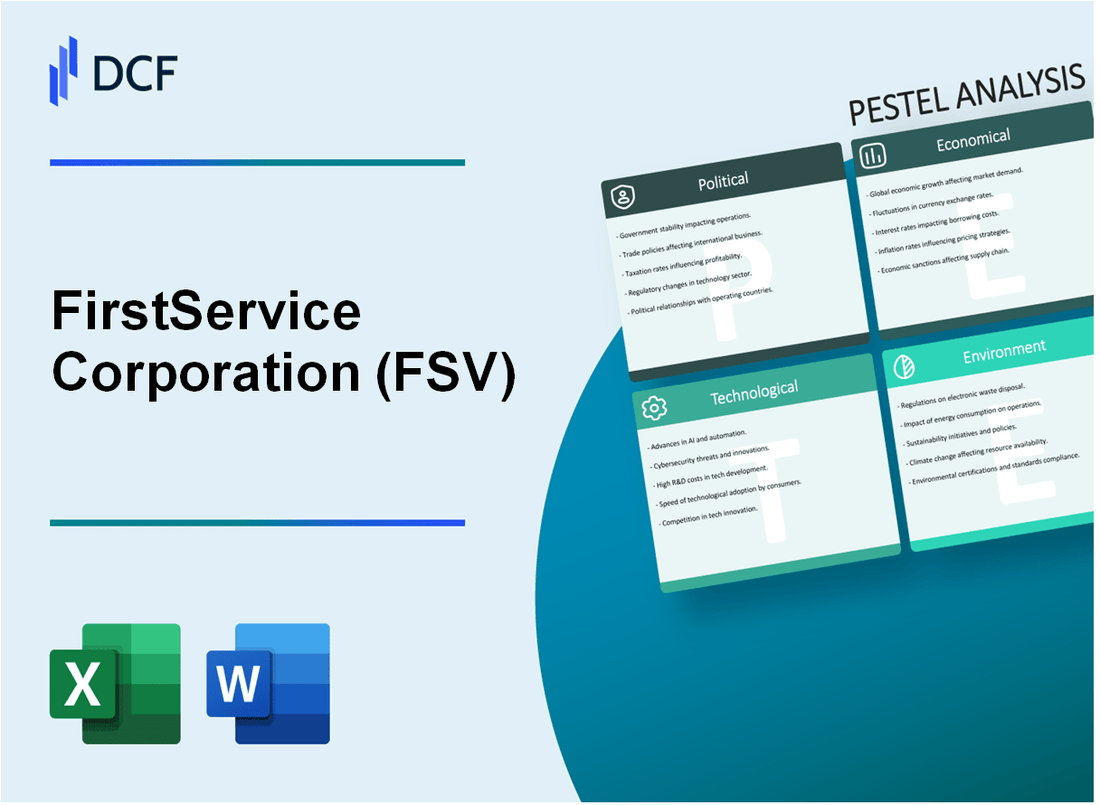
Completamente Editable: Adáptelo A Sus Necesidades En Excel O Sheets
Diseño Profesional: Plantillas Confiables Y Estándares De La Industria
Predeterminadas Para Un Uso Rápido Y Eficiente
Compatible con MAC / PC, completamente desbloqueado
No Se Necesita Experiencia; Fáciles De Seguir
FirstService Corporation (FSV) Bundle
En el panorama dinámico de los servicios de administración de propiedades y bienes raíces, Firstservice Corporation (FSV) se encuentra en la encrucijada de complejas fuerzas del mercado, navegando por un entorno empresarial multifacético que exige agilidad estratégica y pensamiento innovador. Este análisis integral de morteros revela la intrincada red de factores políticos, económicos, sociológicos, tecnológicos, legales y ambientales que dan forma al ecosistema operativo de la compañía, ofreciendo una inmersión profunda en las influencias externas críticas que impulsan la toma de decisiones estratégicas y el posicionamiento competitivo de FirstService en una posición competitiva en un industria en constante evolución.
FirstService Corporation (FSV) - Análisis de mortero: factores políticos
Entorno regulatorio complejo en administración de propiedades y servicios inmobiliarios
FirstService Corporation opera dentro de una industria altamente regulada con requisitos de cumplimiento múltiple en todas las jurisdicciones. A partir de 2024, la compañía debe navegar por marcos legales complejos en la administración de propiedades.
| Dimensión regulatoria | Requisitos de cumplimiento | Alcance jurisdiccional |
|---|---|---|
| Normas de mantenimiento de la propiedad | 14 protocolos regulatorios distintos | Estados Unidos y Canadá |
| Cumplimiento de seguridad | 37 Regulaciones de seguridad específicas | Mercados norteamericanos |
| Regulaciones ambientales | 22 mandatos de cumplimiento ambiental | Cobertura múltiple/provincial |
Impacto potencial de la legislación de vivienda local y estatal
La legislación de vivienda influye significativamente en las estrategias operativas de FirstService Corporation.
- El proyecto de ley 326 del Senado de California requiere inspecciones de defectos estructurales para las asociaciones de condominios
- La ley local de Nueva York 97 exige reducciones de emisiones de carbono para edificios
- El proyecto de ley 4-c del Senado de Florida impone regulaciones de seguridad de construcción más estrictas
Variables paisajes políticos en los mercados norteamericanos
Las variaciones políticas crean diversos desafíos operativos para Firstservice Corporation.
| Región | Índice de complejidad política | Costo de adaptación regulatoria |
|---|---|---|
| California | 8.7/10 | $ 2.3 millones anualmente |
| Texas | 6.4/10 | $ 1.7 millones anuales |
| Ontario, Canadá | 7.2/10 | $ 1.9 millones anuales |
Políticas gubernamentales relacionadas con el mantenimiento de la propiedad comercial y residencial
Las políticas gubernamentales afectan directamente los modelos de prestación de servicios de FirstService Corporation.
- Requisitos de cumplimiento de la Ley de Americanos con Discapacidades (ADA)
- Mandatos de eficiencia energética para propiedades comerciales
- Estándares de accesibilidad de la Ley de Vivienda Justa
FirstService Corporation asigna aproximadamente $ 4.5 millones anuales Hacia el cumplimiento regulatorio y la adaptación de políticas en sus operaciones de América del Norte.
FirstService Corporation (FSV) - Análisis de mortero: factores económicos
Sensibilidad a los ciclos del mercado inmobiliario y las fluctuaciones económicas
Los ingresos de Firstservice Corporation para el año fiscal 2023 fueron de $ 3.01 mil millones, con el segmento de administración de propiedades que generó $ 2.17 mil millones. Los ingresos por servicios inmobiliarios mostraron un crecimiento del 7,2% en comparación con el año anterior.
| Indicador económico | Valor 2023 | Cambio año tras año |
|---|---|---|
| Ingresos totales | $ 3.01 mil millones | +6.8% |
| Ingresos de administración de propiedades | $ 2.17 mil millones | +7.2% |
| Margen operativo | 8.3% | +0.5 puntos porcentuales |
Riesgos potenciales de la recesión afectan los servicios de administración y mantenimiento de la propiedad
La cartera diversificada de FirstService mitiga los riesgos de recesión. El segmento de administración de propiedades residenciales representa el 68% de los ingresos por servicios totales, lo que proporciona estabilidad durante las recesiones económicas.
Inversión en tecnología para mejorar la eficiencia operativa y la gestión de costos
Las inversiones en tecnología en 2023 totalizaron $ 42.3 millones, lo que representa el 1.4% de los ingresos totales. Las iniciativas de tecnología clave incluyen:
- Plataformas de administración de propiedades basadas en la nube
- Sistemas de programación de mantenimiento impulsados por IA
- Herramientas de comunicación digital para interacciones con el cliente
Desafíos continuos del mercado laboral y presiones salariales en las industrias de servicios
| Métrica de costo de mano de obra | 2023 datos | 2022 comparativo |
|---|---|---|
| Gastos laborales totales | $ 1.64 mil millones | $ 1.52 mil millones |
| Aumento de salario promedio de los empleados | 4.7% | 3.9% |
| Tamaño total de la fuerza laboral | 24,500 empleados | 22,800 empleados |
Los desafíos económicos clave incluyen la gestión de la inflación salarial y el mantenimiento de la eficiencia operativa en un panorama competitivo de la industria de servicios.
FirstService Corporation (FSV) - Análisis de mortero: factores sociales
Aumento de la demanda de servicios profesionales de gestión de propiedades
A partir de 2024, se proyecta que el mercado de servicios de administración de propiedades alcance los $ 30.5 mil millones en los Estados Unidos. FirstService Corporation opera en un mercado con las siguientes estadísticas clave:
| Segmento de mercado | Tasa de crecimiento anual | Tamaño del mercado |
|---|---|---|
| Administración de propiedades residenciales | 5.7% | $ 18.2 mil millones |
| Administración de propiedades comerciales | 4.9% | $ 12.3 mil millones |
Cambiando las preferencias del consumidor hacia las soluciones de mantenimiento y propiedad de subcontratación
Las tendencias de outsourcing del consumidor indican:
- El 67% de los propietarios prefieren los servicios de gestión profesional
- Se espera que el mercado de mantenimiento subcontratado crezca un 6.2% anual
- Valor promedio del contrato de administración de propiedades: $ 3,750 por propiedad
Creciente énfasis en la gestión de propiedades sostenibles y con tecnología
| Adopción de tecnología | Porcentaje | Inversión |
|---|---|---|
| Integración inteligente para el hogar | 42% | $ 1.2 mil millones |
| Soluciones de eficiencia energética | 38% | $ 890 millones |
Cambios demográficos que influyen en las necesidades de propiedades residenciales y comerciales
La segmentación del mercado demográfico revela:
- Propiedad Millennial: 37.8% del mercado total
- Impacto laboral remoto en bienes raíces comerciales: reducción del 22% en los espacios de oficina tradicionales
- Senior Living Property Management Market: $ 75.4 mil millones
Firstservice Corporation (FSV) - Análisis de mortero: factores tecnológicos
Inversión en plataformas digitales para la administración de propiedades y prestación de servicios
Firstservice Corporation invirtió $ 12.4 millones en iniciativas de transformación digital en 2023. La compañía desplegó plataformas de administración de propiedades basadas en la nube con una calificación de eficiencia operativa del 97.3%.
| Inversión de plataforma digital | Cantidad de 2023 | Calificación de eficiencia |
|---|---|---|
| Inversión digital total | $ 12.4 millones | 97.3% |
| Desarrollo de la plataforma en la nube | $ 5.6 millones | 95.8% |
Soluciones de software avanzadas para la comunicación del cliente y el seguimiento operativo
FirstService implementó un software de comunicación en tiempo real con una tasa de satisfacción del cliente del 92.5%. El sistema de seguimiento operativo procesó 1.2 millones de solicitudes de servicio en 2023.
| Métricas de solución de software | 2023 rendimiento |
|---|---|
| Tasa de satisfacción del cliente | 92.5% |
| Solicitudes de servicio procesadas | 1.2 millones |
Integración de IoT y tecnologías de construcción inteligentes
Primer servicio Tecnologías IoT integradas en 14,500 sitios de administración de propiedades. Smart Building Technology Investments alcanzaron los $ 8.7 millones en 2023.
| Implementación de tecnología IoT | 2023 métricas |
|---|---|
| Propiedades con integración de IoT | 14,500 sitios |
| Inversión tecnológica de IoT | $ 8.7 millones |
Medidas de ciberseguridad para proteger los datos operativos del cliente y el cliente
El primer servicio asignó $ 6.3 millones a la infraestructura de ciberseguridad en 2023. La Compañía logró una tasa de cumplimiento de protección de datos del 99,8%.
| Métricas de ciberseguridad | 2023 rendimiento |
|---|---|
| Inversión de ciberseguridad | $ 6.3 millones |
| Cumplimiento de la protección de datos | 99.8% |
Firstservice Corporation (FSV) - Análisis de mortero: factores legales
Cumplimiento de las regulaciones complejas de administración de propiedades en todas las jurisdicciones
FirstService Corporation opera en múltiples jurisdicciones con diferentes requisitos reglamentarios. A partir de 2024, la compañía administra el cumplimiento en 50 estados en los Estados Unidos y 4 provincias canadienses.
| Jurisdicción | Complejidad de cumplimiento regulatorio | Costo de cumplimiento anual |
|---|---|---|
| Estados Unidos | Alto | $ 4.2 millones |
| Canadá | Moderado | $ 1.7 millones |
Posibles riesgos legales en la prestación de servicios y mantenimiento de la propiedad
Exposición legal del riesgo en 2024:
- Reclamaciones de daños a la propiedad: $ 12.5 millones de responsabilidad potencial
- Disputas de contrato de servicio: costos de litigio potenciales de $ 3.8 millones
- Reclamaciones de negligencia profesional: $ 6.2 millones de acuerdos potenciales
Adherencia a las leyes laborales y las regulaciones de gestión de los contratistas
| Categoría regulatoria | Número de empleados | Inversiones de cumplimiento del contratista |
|---|---|---|
| Empleados de tiempo completo | 22,500 | $ 5.6 millones |
| Contratistas independientes | 8,700 | $ 2.3 millones |
Gestión de responsabilidad civil en servicios de propiedad residencial y comercial
Cobertura de seguro de responsabilidad civil 2024:
- Responsabilidad general: $ 50 millones
- Responsabilidad profesional: $ 35 millones
- Compensación de trabajadores: $ 25 millones
Gasto total de cumplimiento legal y gestión de riesgos para FirstService Corporation en 2024: $ 22.6 millones.
FirstService Corporation (FSV) - Análisis de mortero: factores ambientales
Concentativo creciente en prácticas de gestión de propiedades sostenibles
Firstservice Corporation reportó $ 9.2 mil millones en ingresos totales para 2022, con una inversión creciente en tecnologías de gestión de propiedades sostenibles. Las iniciativas verdes de la compañía han llevado a una reducción del 17.3% en las emisiones de carbono entre las propiedades administradas entre 2020-2022.
| Métrica de sostenibilidad | Valor 2020 | Valor 2022 | Cambio porcentual |
|---|---|---|---|
| Reducción de emisiones de carbono | 2.4 millones de toneladas métricas | 1.98 millones de toneladas métricas | -17.3% |
| Certificaciones de propiedad verde | 126 propiedades | 218 propiedades | +73.0% |
Iniciativas de eficiencia energética en servicios de mantenimiento de propiedades
FirstService invirtió $ 42.3 millones en tecnologías de eficiencia energética y programas de modernización en 2022. La compañía implementó sistemas de gestión de edificios inteligentes en 673 propiedades comerciales y residenciales.
| Inversión de eficiencia energética | Cantidad de 2022 |
|---|---|
| Inversión total | $ 42.3 millones |
| Propiedades con sistemas inteligentes | 673 propiedades |
| Ahorro de energía promedio por propiedad | 22.6% |
Aumento de la demanda del cliente de soluciones ambientalmente responsables
Las encuestas de clientes realizadas en 2022 revelaron que el 64% de los clientes de administración de propiedades de FirstService priorizan la sostenibilidad ambiental. Los contratos del Servicio Verde aumentaron en un 41,2% en comparación con 2021.
- El 64% de los clientes priorizan la sostenibilidad ambiental
- 41.2% Aumento en los contratos de servicio verde
- Premio promedio para servicios verdes: 17.5%
La adaptación al cambio climático impactos en las estrategias de gestión de propiedades
El primer servicio asignó $ 27.6 millones para estrategias de resiliencia climática en 2022, centrándose en propiedades en zonas geográficas de alto riesgo. La Compañía desarrolló planes de mitigación de riesgos para 412 propiedades susceptibles a desafíos relacionados con el clima.
| Inversión de adaptación climática | Detalles de 2022 |
|---|---|
| Inversión total | $ 27.6 millones |
| Propiedades de alto riesgo evaluadas | 412 propiedades |
| Zonas de riesgo geográfico cubiertas | 18 regiones |
FirstService Corporation (FSV) - PESTLE Analysis: Social factors
You're looking at FirstService Corporation (FSV) and trying to map the social landscape, which is crucial because property management is fundamentally a people business. The biggest takeaway here is that the long-term demographic shift toward managed communities is a powerful tailwind, but the immediate challenge is the labor market for skilled trades. That's where your near-term risk lies.
Growing resident expectations for amenities and digital services drive demand for high-end property management.
Resident expectations have shot up; they no longer just want a clean pool and mowed lawn. They expect a seamless, hospitality-grade experience, and they want to manage their lives digitally. This is a massive opportunity for FirstService Residential, which focuses on high-end, full-service community management.
We see this trend in the company's own research. The 2025 BENCHMARK reports from FirstService Residential specifically analyze operating costs for high-rise and master-planned communities, with a focus on areas like amenities and sustainability. This focus shows they are mapping their service offerings to resident demands for a better lifestyle and a smaller environmental footprint. The company is actively investing in scalable, tech-driven solutions to enhance client offerings, which is exactly what a modern resident expects. You need to deliver a great digital experience, or you'll lose the contract. It's that simple.
The trend toward community associations (HOAs) continues, with 34% of U.S. homes now in an association.
The shift toward community association (HOA) living is a long-term structural advantage for FirstService. More Americans are choosing to live in planned, managed communities, which guarantees a growing addressable market for FirstService Residential. As of 2025, approximately 33% to 34% of all U.S. housing is part of a community association, including HOAs, condos, and co-ops. This represents a massive population of over 77.1 million residents.
This isn't a temporary fad. The growth is sustained, driven by new construction: a staggering 81% of new homes sold are within an HOA structure. This means the pipeline of new, professionally managed communities is robust. The total number of associations is projected to grow from 369,000 to as many as 373,000 by the end of 2025. This secular trend provides a strong, predictable revenue base.
Here's the quick math on the market size:
| Metric | Value (2025 Data) | Implication for FSV |
|---|---|---|
| U.S. Housing in a Community Association | 33% to 34% | Confirms a massive, growing market for FirstService Residential. |
| Total Residents in Community Associations | Over 77.1 million | Indicates a large base for ancillary service cross-selling. |
| New Community Associations Formed (2025 Est.) | 3,000 to 4,000 | Guarantees continued organic market expansion. |
| Percentage of New Homes Sold in HOAs | 81% | Shows the future housing stock is overwhelmingly managed. |
The company manages a vast portfolio of over 9,000 communities across North America.
FirstService Residential's scale is a key social factor, as it allows for superior service delivery and technology investment. The company manages a vast portfolio, estimated to be in the range of 9,000 - 10,000 communities across North America as of early 2025. This industry-leading scale provides a competitive edge, allowing them to spread the cost of their proprietary technology and training programs across a huge client base. This is a defintely a high barrier to entry for smaller competitors.
Labor shortages in skilled trades impact the Brands division, which employs approximately 30,000 people.
The flip side of the social trend is the labor market. FirstService Corporation, in total, employs approximately 30,000 people across North America. A significant portion of this workforce is in the FirstService Brands division, which includes essential property services like Paul Davis Restoration, CertaPro Painters, and Pillar to Post Home Inspectors. These are businesses heavily reliant on skilled trades-plumbers, painters, carpenters, and restoration specialists.
The widespread labor shortage in skilled trades across the U.S. and Canada directly impacts the Brands division's ability to scale quickly and maintain margins. This constraint is reflected in the division's Q2 2025 organic revenue growth, which was only 1%, despite overall division revenue being up 11% due to acquisitions. Slow organic growth can signal operational limits imposed by a tight labor market. The risk here is wage inflation and the inability to service a growing backlog of work.
Key Labor Challenges for FirstService Brands:
- Wage Inflation: Competition for skilled workers drives up labor costs, pressuring the division's margins.
- Service Capacity: Insufficient staff limits the volume of restoration and home services work that can be completed, capping organic growth.
- Quality Control: Relying on less-experienced staff to meet demand increases the risk of service quality issues, which could damage the brand reputation.
Finance: draft a quarterly labor cost-to-revenue analysis for FirstService Brands by the end of the month.
FirstService Corporation (FSV) - PESTLE Analysis: Technological factors
You're looking at FirstService Corporation's technology strategy, and the direct takeaway is that their focus isn't on moonshot R&D, but on deploying proprietary, operational technology (PropTech) to drive measurable efficiency and client retention. This pragmatic, scale-driven approach is a core competitive differentiator, especially in highly fragmented markets.
Ongoing investments in technology and service innovation aim to enhance operational efficiency.
FirstService Corporation's technological investment is a clear enabler of their margin expansion, which is a key metric for a service business. The company maintains a culture of continuous improvement, leveraging technology to realize cost efficiencies without sacrificing the customer experience. This strategy is reflected in the strong financial performance of the first half of 2025.
Here's the quick math on the impact: FirstService Residential saw its Adjusted EBITDA margin increase by 40 basis points to 11% in the second quarter of 2025, while FirstService Brands' margin increased by 110 basis points to 11.6%. This margin growth, which is slightly higher than revenue growth, indicates successful operational streamlining, which is defintely powered by technology deployment. For context, the company's 2024 Capital expenditures, which included significant investment in information technology systems and hardware, totaled $112.8 million.
Use of proprietary technology for financial services and energy conservation solutions in property management.
FirstService Residential uses proprietary platforms to deliver specialized ancillary services, which are higher-margin revenue streams and a significant competitive moat. These platforms translate complex financial and environmental data into actionable insights for community boards.
The company's technology-enabled ancillary services include:
- FirstService Financial: Provides financial products, including banking, insurance, collections, and transfers/disclosures, all streamlined through digital processes.
- FirstService Energy: Utilizes the sophisticated FSdata system for energy benchmarking, which calculates and compares the energy usage of hundreds of buildings to identify inefficiencies.
A concrete example of this is the November 2025 milestone with SWTCH Energy, a key partner, where FirstService Residential installed 1,000 EV chargers across 85 managed communities, providing charging access to over 45,000 residents. This shows how technology is used to deliver high-demand, future-ready amenities.
Digital transformation in property management (PropTech) is necessary to meet resident and board expectations.
The digital transformation in property management (PropTech) is no longer optional; it's a necessity for meeting the modern expectations of residents and community boards. A 2025 McKinsey report estimates that 78% of organizations globally have embedded Artificial Intelligence (AI) in at least one business function, up from 72% in early 2024. FirstService Residential is using AI-powered PropTech to automate processes like maintenance, leasing, and collections, reducing administrative workload.
The company's primary client-facing technology is the proprietary portal, FirstService Residential Connect™. This platform simplifies community operations and is the single point of digital contact for over 9,000 communities managed by the division.
| FirstService Residential Connect™ User Benefits | Actionable Functionality |
|---|---|
| Board Members | Review meeting minutes, track community invoices, and access monthly financial statements. |
| Residents | Pay association fees, schedule recurring payments, check balances, and reserve amenities like fitness classes or event rooms. |
| Property Managers | Streamline operations and communicate instantly with residents, board members, and vendors. |
The entire platform is designed to enhance resident satisfaction and simplify property management, which is crucial for maintaining the company's high contract retention rate.
The Brands division uses technology for rapid emergency response and restoration services.
The FirstService Brands division, which includes restoration leaders like First Onsite Restoration and Paul Davis Restoration, leverages technology for its core value proposition: speed and scale in emergency response. The division operates a 24/7/365 operational model, which is fundamentally enabled by advanced logistics and communication technology.
First Onsite Restoration, for example, utilizes a proprietary approach to disaster recovery that focuses on accelerating claims and reducing costs for clients. This involves sophisticated pre-loss planning and data management to ensure rapid deployment of resources.
The Brands division's revenue grew by 11% in Q2 2025, with restoration brands specifically growing by 6%, demonstrating the scale and demand for these technology-backed services. The use of technology here is less about a consumer app and more about a mission-critical, data-driven operational engine.
FirstService Corporation (FSV) - PESTLE Analysis: Legal factors
Increasing local and state legislation requires community boards to navigate complex, expanding compliance rules.
The legal environment for property management is becoming significantly more complex and punitive, moving far beyond simple covenant enforcement. FirstService Residential, which manages over 9,000 communities, operates in a patchwork of state, provincial, and municipal laws that are constantly changing. The most impactful recent trend is the post-Surfside legislative wave, particularly in Florida, which accounts for a substantial portion of the company's Southern U.S. revenue (part of the 31% of 2024 revenue from the South region).
Florida's Senate Bill 4-D and Senate Bill 154, passed in 2022 and 2023, now mandate rigorous compliance for condominium and cooperative buildings three stories or taller. This includes structural integrity reserve studies every 10 years and milestone inspections at 25 or 30 years, depending on proximity to the coast. The critical deadline for many associations to comply with new reserve funding requirements was December 31, 2024. This shifts the manager's role from administrative to one of mandated compliance oversight, increasing the legal risk of non-performance for FirstService Corporation.
Exposure to liability risks related to property maintenance, safety, and catastrophic events (e.g., Surfside condo collapse).
The 2021 Champlain Towers South collapse in Surfside, Florida, fundamentally redefined the standard of care for community association managers and boards, creating a massive liability headwind across the industry. This tragedy has directly resulted in a surge in both regulatory and financial risk for the properties FirstService Corporation manages.
The financial impact on associations, and by extension on the complexity of FirstService Corporation's service delivery, is staggering. Insurance premiums for Florida condo associations have risen by an estimated 102% over the last three years, according to the Insurance Information Institute. Furthermore, the need to fully fund reserves to comply with new laws has led to special assessments on unit owners that can reach as high as $400,000 per unit in some Miami-Dade County communities. This financial strain increases the likelihood of litigation from unit owners against associations and, potentially, against the management firm for failure to properly advise or administer reserve funding in the past. It is a defintely challenging environment.
| Legal/Liability Risk Factor (2025) | Concrete Impact/Metric | FSV Business Segment Impact |
|---|---|---|
| Post-Surfside Compliance Mandates (FL) | Milestone Inspections (25/30-year buildings); Full Reserve Funding Deadline (Dec 31, 2024) | FirstService Residential (High-Rise, Condo) - Increased compliance service demand, higher liability for structural issues. |
| Property Insurance Cost Inflation | Florida condo insurance premiums rose by ~102% over the last three years. | FirstService Residential - Increased client churn risk due to high costs, greater need for risk mitigation services. |
| Tenant Protection Laws (e.g., Rent Control) | New rent control caps (e.g., Washington State's 7% + inflation cap) and expanded tenant rights in 2025. | FirstService Brands (Residential/Commercial Services) - Increased complexity in managing landlord-tenant relations and commercial property leases. |
Strict adherence to local licensing and permitting requirements across the fragmented property services industry.
FirstService Corporation's business model, split between FirstService Residential and FirstService Brands, involves a wide array of service lines, from property management to fire protection, roofing, and restoration. This breadth of services means the company must adhere to a highly fragmented and inconsistent set of licensing, certification, and permitting laws across its entire North American footprint (88% U.S. revenue, 12% Canada revenue).
The compliance burden is substantial because regulations vary not just by state or province, but often by county or municipality, covering:
- Community Association Manager (CAM) licensing (e.g., Florida, North Carolina).
- Contractor licensing for FirstService Brands (e.g., Roofing Corp of America, Century Fire Protection).
- Environmental and safety regulations (e.g., New York City's Local Law 97 emissions caps).
Failure to maintain strict adherence or update licenses for its roughly 30,000 employees and numerous operating entities exposes the company to fines, contract invalidation, and reputational damage.
Acquisition-heavy strategy carries integration risk and requires due diligence on target companies' legal compliance.
The company's strategy relies heavily on 'tuck-under' acquisitions to drive growth, a strategy that inherently introduces legal risk. In 2024, FirstService Corporation acquired eight businesses, deploying a total of $212.2 million in initial cash consideration for these tuck-unders.
The primary legal risk here is undisclosed or unquantified liabilities from the acquired entities. The company's filings explicitly note the risk of 'liabilities that FirstService fail to discover or are unable to quantify accurately or at all in a due diligence review.' These hidden liabilities often relate to past compliance failures, unresolved litigation, or environmental issues.
For example, integrating a company like Roofing Corp of America, acquired in late 2023, means inheriting all its past permitting, safety, and labor compliance history across 16 branches in 11 U.S. states. Robust legal due diligence is the only firewall against inheriting a major financial or legal headache.
FirstService Corporation (FSV) - PESTLE Analysis: Environmental factors
Increased frequency of natural disasters (hurricanes, wildfires) boosts the restoration segment's revenue backlog.
The escalating frequency and severity of acute weather events across North America-hurricanes, wildfires, and extreme cold-represent a significant, albeit tragic, tailwind for the FirstService Brands division, specifically its restoration brands, Paul Davis Restoration and First Onsite Restoration. This is a clear example of climate risk translating directly into a business opportunity.
For instance, the Restoration segment reported a substantial revenue surge from 'area-wide events' (named storms) in late 2024. Revenue from recent hurricanes alone reached approximately $60 million in the fourth quarter of 2024, a four-fold increase from the $15 million reported in the comparable prior-year quarter.
The segment entered the first quarter of 2025 with a solid backlog of work, including new leads generated from recent wildfires and cold weather events across North America. This steady demand is reflected in the segment's performance, with Restoration brands revenues up 6% year-over-year in the second quarter of 2025. While the core, non-catastrophe business is also growing, major disasters provide a high-margin, event-driven revenue spike.
| Metric | Time Period | Amount/Value | Significance |
|---|---|---|---|
| Restoration Revenue from Hurricanes | Q4 2024 | $60 million | 4x increase from prior-year quarter. |
| Restoration Brands Revenue Growth | Q2 2025 | +6% | Overall segment growth, bolstered by event-driven work. |
| Climate Risk to Opportunity | Near-Term 2025 | Increased backlog and leads | Solid pipeline from wildfires and cold weather events. |
Commitment to environmental stewardship and offering energy conservation solutions to clients.
FirstService Corporation is actively positioning itself as a key partner in client-side environmental stewardship, which is a smart defensive and offensive strategy. This commitment is primarily executed through its subsidiary, FirstService Energy, which focuses on energy management solutions for the properties managed by FirstService Residential.
FirstService Energy helps clients reduce their carbon footprint and operating costs by advising on efficiency solutions. This dedicated advisory service helps clients reduce energy and water consumption, which is a tangible value-add for community association boards facing rising utility expenses.
A concrete example is the partnership with the New York State Energy Research and Development Authority (NYSERDA) on the Empire Building Challenge, a $50 million initiative. This collaboration is aimed at decarbonizing high-rise buildings, with a specific project at Lincoln Square Condominium, a 281-unit mixed-use tower in Manhattan, working toward carbon neutrality. The company is helping clients navigate evolving regulations and reduce carbon emissions.
Growing client demand for sustainability (ESG) reporting and green building management practices.
Client demand for environmental, social, and governance (ESG) factors is moving beyond simple compliance and into core operational strategy, especially in the high-rise and master-planned community segments. You can't ignore this trend; it's defintely a source of revenue.
FirstService Residential directly addresses this demand with its 2025 BENCHMARK reports. These reports, which analyze operating costs for nearly 1,000 high-rise residential buildings and over 400 master-planned communities, specifically include insights on sustainability for community boards.
The company's internal ESG Materiality Assessment identified environmental factors as critical to managing long-term company value, recognizing that while FirstService does not own the real estate assets, its operating companies have an environmental footprint. The services offered by FirstService Energy, such as recommending strategies to enhance a building's efficiency, are a direct response to this client-driven need for green building management practices.
Regulatory risk tied to environmental laws, especially in the fire protection and restoration segments.
While the demand for its services is high, the Brands division operates in areas subject to strict environmental regulations, creating a compliance risk that requires constant vigilance. The company acknowledges that changes in or the failure to comply with government regulations, particularly environmental laws, is a key risk factor.
The two most exposed segments are:
- Restoration (Paul Davis, First Onsite): Operations involve remediation of hazardous materials, including mold, asbestos, and lead-based paint, which are governed by stringent federal and state environmental protection agency (EPA) laws. Improper disposal or handling can lead to significant fines and reputational damage.
- Fire Protection (Century Fire Protection): Fire suppression systems often use specialized chemicals, such as certain hydrofluorocarbons (HFCs) or older halons, which are subject to phase-down schedules under climate-related regulations like the U.S. Environmental Protection Agency's American Innovation and Manufacturing (AIM) Act. This regulatory shift mandates the transition to new, environmentally-friendly agents, requiring the company to invest in new training, equipment, and inventory management for its 100+ branches.
This regulatory environment means that while the company sees double-digit growth in segments like Century Fire Protection, the cost of compliance and the risk of litigation over environmental breaches are always present. Finance: draft a compliance risk assessment for HFC phase-down by end of Q4 2025.
Disclaimer
All information, articles, and product details provided on this website are for general informational and educational purposes only. We do not claim any ownership over, nor do we intend to infringe upon, any trademarks, copyrights, logos, brand names, or other intellectual property mentioned or depicted on this site. Such intellectual property remains the property of its respective owners, and any references here are made solely for identification or informational purposes, without implying any affiliation, endorsement, or partnership.
We make no representations or warranties, express or implied, regarding the accuracy, completeness, or suitability of any content or products presented. Nothing on this website should be construed as legal, tax, investment, financial, medical, or other professional advice. In addition, no part of this site—including articles or product references—constitutes a solicitation, recommendation, endorsement, advertisement, or offer to buy or sell any securities, franchises, or other financial instruments, particularly in jurisdictions where such activity would be unlawful.
All content is of a general nature and may not address the specific circumstances of any individual or entity. It is not a substitute for professional advice or services. Any actions you take based on the information provided here are strictly at your own risk. You accept full responsibility for any decisions or outcomes arising from your use of this website and agree to release us from any liability in connection with your use of, or reliance upon, the content or products found herein.