

|
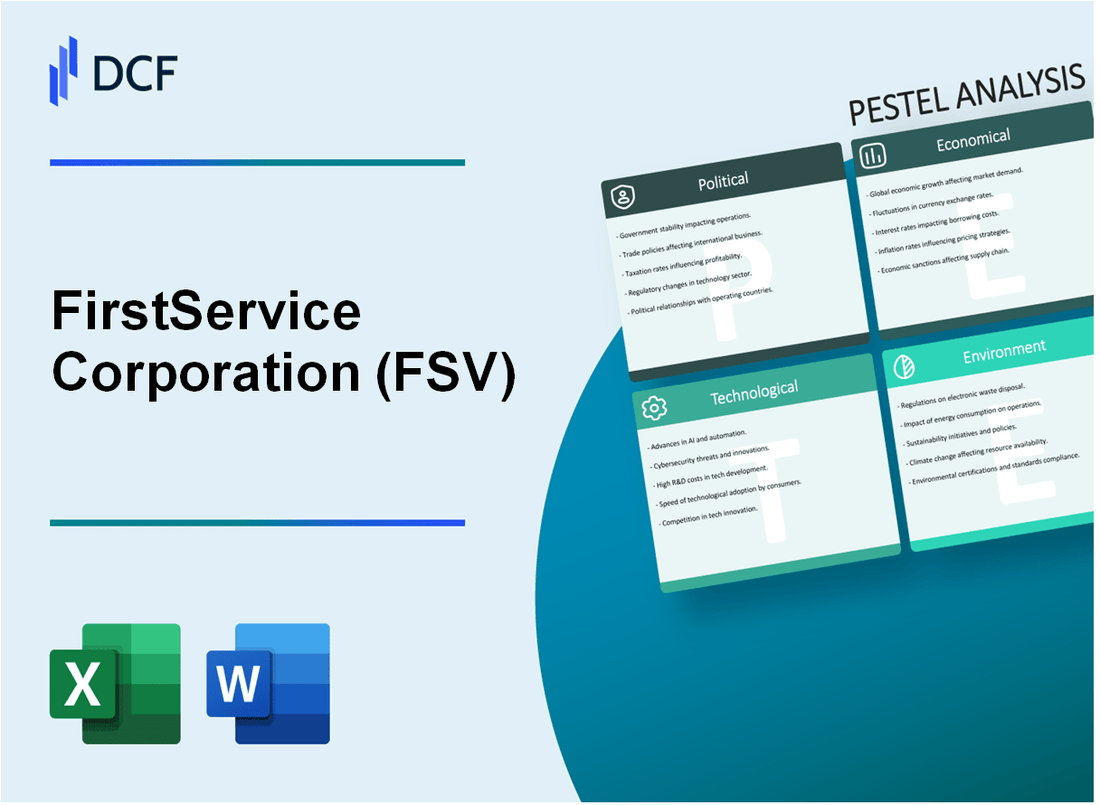
FirstService Corporation (FSV): Analyse de Pestle [Jan-2025 MISE À JOUR] |
Entièrement Modifiable: Adapté À Vos Besoins Dans Excel Ou Sheets
Conception Professionnelle: Modèles Fiables Et Conformes Aux Normes Du Secteur
Pré-Construits Pour Une Utilisation Rapide Et Efficace
Compatible MAC/PC, entièrement débloqué
Aucune Expertise N'Est Requise; Facile À Suivre
FirstService Corporation (FSV) Bundle
Dans le paysage dynamique de la gestion immobilière et des services immobiliers, FirstService Corporation (FSV) se dresse au carrefour des forces du marché complexes, naviguant dans un environnement commercial à multiples facettes qui exige une agilité stratégique et une pensée innovante. This comprehensive PESTLE analysis unveils the intricate web of political, economic, sociological, technological, legal, and environmental factors that shape the company's operational ecosystem, offering a deep dive into the critical external influences that drive FirstService's strategic decision-making and competitive positioning in an industrie en constante évolution.
FirstService Corporation (FSV) - Analyse du pilon: facteurs politiques
Environnement réglementaire complexe dans la gestion immobilière et les services immobiliers
FirstService Corporation opère dans une industrie hautement réglementée avec de multiples exigences de conformité dans les juridictions. Depuis 2024, la société doit naviguer dans des cadres juridiques complexes dans la gestion immobilière.
| Dimension réglementaire | Exigences de conformité | Portée juridictionnelle |
|---|---|---|
| Normes d'entretien des biens | 14 protocoles de régulation distincts | États-Unis et Canada |
| Conformité à la sécurité | 37 Règlements de sécurité spécifiques | Marchés nord-américains |
| Règlements environnementaux | 22 mandats de conformité environnementale | Couverture multi-États / provinciale |
Impact potentiel de la législation sur le logement local et étatique
La législation sur le logement influence considérablement les stratégies opérationnelles de FirstService Corporation.
- Le projet de loi du Sénat californien 326 nécessite des inspections de défauts structurels pour les associations de copropriété
- La loi locale de New York 97 oblige les réductions des émissions de carbone pour les bâtiments
- Le projet de loi du Sénat de Floride 4-C impose des réglementations de sécurité des bâtiments plus strictes
Paysages politiques variables sur les marchés nord-américains
Les variations politiques créent divers défis opérationnels pour FirstService Corporation.
| Région | Indice de complexité politique | Coût d'adaptation réglementaire |
|---|---|---|
| Californie | 8.7/10 | 2,3 millions de dollars par an |
| Texas | 6.4/10 | 1,7 million de dollars par an |
| Ontario, Canada | 7.2/10 | 1,9 million de dollars par an |
Politiques gouvernementales liées à l'entretien des biens commerciaux et résidentiels
Les politiques gouvernementales ont un impact direct sur les modèles de prestation de services de FirstService Corporation.
- Exigences de conformité des Américains avec les handicaps (ADA)
- Mandats d'efficacité énergétique pour les propriétés commerciales
- Normes d'accessibilité de la Loi sur le logement équitable
Firstservice Corporation alloue approximativement 4,5 millions de dollars par an vers la conformité réglementaire et l'adaptation des politiques à travers ses opérations nord-américaines.
FirstService Corporation (FSV) - Analyse du pilon: facteurs économiques
Sensibilité aux cycles du marché immobilier et aux fluctuations économiques
Le chiffre d'affaires de FirstService Corporation pour l'exercice 2023 était de 3,01 milliards de dollars, le segment de gestion immobilière générant 2,17 milliards de dollars. Les revenus des services immobiliers ont montré une croissance de 7,2% par rapport à l'année précédente.
| Indicateur économique | Valeur 2023 | Changement d'une année à l'autre |
|---|---|---|
| Revenus totaux | 3,01 milliards de dollars | +6.8% |
| Revenus de gestion immobilière | 2,17 milliards de dollars | +7.2% |
| Marge opérationnelle | 8.3% | +0,5 points de pourcentage |
Les risques de récession potentiels ont un impact sur les services de gestion et de maintenance immobilières
Le portefeuille diversifié de FirstService atténue les risques de récession. Le segment de la gestion des biens résidentiels représente 68% du total des revenus de service, assurant la stabilité pendant les ralentissements économiques.
Investissement dans la technologie pour améliorer l'efficacité opérationnelle et la gestion des coûts
Les investissements technologiques en 2023 ont totalisé 42,3 millions de dollars, ce qui représente 1,4% des revenus totaux. Les principales initiatives technologiques comprennent:
- Plates-formes de gestion immobilière basées sur le cloud
- Systèmes de planification de maintenance dirigés AI
- Outils de communication numérique pour les interactions du client
Défis en cours du marché du travail et pressions sur les salaires dans les industries des services
| Métrique du coût de la main-d'œuvre | 2023 données | 2022 Comparatif |
|---|---|---|
| Total des dépenses de main-d'œuvre | 1,64 milliard de dollars | 1,52 milliard de dollars |
| Augmentation moyenne des salaires des employés | 4.7% | 3.9% |
| Taille totale de la main-d'œuvre | 24 500 employés | 22 800 employés |
Les principaux défis économiques comprennent la gestion de l'inflation des salaires et le maintien de l'efficacité opérationnelle dans un paysage de l'industrie des services compétitifs.
FirstService Corporation (FSV) - Analyse du pilon: facteurs sociaux
Demande croissante de services professionnels de gestion immobilière
En 2024, le marché des services de gestion immobilière devrait atteindre 30,5 milliards de dollars aux États-Unis. FirstService Corporation opère sur un marché avec les statistiques clés suivantes:
| Segment de marché | Taux de croissance annuel | Taille du marché |
|---|---|---|
| Gestion des propriétés résidentielles | 5.7% | 18,2 milliards de dollars |
| Gestion immobilière commerciale | 4.9% | 12,3 milliards de dollars |
Déplacer les préférences des consommateurs vers des solutions de maintenance et de propriété externalisées
Les tendances de l'externalisation des consommateurs indiquent:
- 67% des propriétaires préfèrent les services de gestion professionnelle
- Le marché de l'entretien externalisé devrait augmenter de 6,2% par an
- Valeur du contrat de gestion immobilière moyenne: 3 750 $ par propriété
Accent croissant sur la gestion immobilière durable et compatible avec la technologie
| Adoption de la technologie | Pourcentage | Investissement |
|---|---|---|
| Intégration de maison intelligente | 42% | 1,2 milliard de dollars |
| Solutions d'efficacité énergétique | 38% | 890 millions de dollars |
Changements démographiques influençant les besoins de propriété résidentielle et commerciale
La segmentation du marché démographique révèle:
- Propriété des biens du millénaire: 37,8% du marché total
- Impact du travail à distance sur l'immobilier commercial: réduction de 22% des espaces de bureaux traditionnels
- Marché de la gestion immobilière de la vie senior: 75,4 milliards de dollars
FirstService Corporation (FSV) - Analyse du pilon: facteurs technologiques
Investissement dans des plateformes numériques pour la gestion immobilière et la prestation de services
FirstService Corporation a investi 12,4 millions de dollars dans des initiatives de transformation numérique en 2023. La société a déployé des plateformes de gestion immobilière basées sur le cloud avec une cote d'efficacité opérationnelle de 97,3%.
| Investissement de plate-forme numérique | 2023 Montant | Cote d'efficacité |
|---|---|---|
| Investissement numérique total | 12,4 millions de dollars | 97.3% |
| Développement de plate-forme cloud | 5,6 millions de dollars | 95.8% |
Solutions logicielles avancées pour la communication client et le suivi opérationnel
FirstService a mis en œuvre un logiciel de communication en temps réel avec un taux de satisfaction du client de 92,5%. Le système de suivi opérationnel a traité 1,2 million de demandes de service en 2023.
| Métriques de la solution logicielle | Performance de 2023 |
|---|---|
| Taux de satisfaction du client | 92.5% |
| Demandes de service traitées | 1,2 million |
Intégration des technologies IoT et Smart Building
FirstService a intégré les technologies IoT sur 14 500 sites de gestion immobilière. Les investissements en technologie de construction intelligente ont atteint 8,7 millions de dollars en 2023.
| Déploiement de la technologie IoT | 2023 métriques |
|---|---|
| Propriétés avec intégration IoT | 14 500 sites |
| Investissement technologique IoT | 8,7 millions de dollars |
Mesures de cybersécurité pour protéger les données des clients et opérationnels
FirstService a alloué 6,3 millions de dollars aux infrastructures de cybersécurité en 2023. La société a atteint un taux de conformité de la protection des données de 99,8%.
| Métriques de cybersécurité | Performance de 2023 |
|---|---|
| Investissement en cybersécurité | 6,3 millions de dollars |
| Conformité à la protection des données | 99.8% |
Firstservice Corporation (FSV) - Analyse du pilon: facteurs juridiques
Conformité aux réglementations complexes de gestion des propriétés à travers les juridictions
Firstservice Corporation opère dans plusieurs juridictions avec des exigences réglementaires variables. En 2024, la société gère la conformité dans 50 États aux États-Unis et 4 provinces canadiennes.
| Juridiction | Complexité de conformité réglementaire | Coût annuel de conformité |
|---|---|---|
| États-Unis | Haut | 4,2 millions de dollars |
| Canada | Modéré | 1,7 million de dollars |
Risques juridiques potentiels dans la prestation de services et l'entretien des biens
Exposition aux risques juridiques en 2024:
- Réclamations sur les dommages matériels: 12,5 millions de dollars de responsabilité potentielle
- Distigues du contrat de service: 3,8 millions de dollars en frais de litige potentiels
- Réclamations de négligence professionnelle: 6,2 millions de dollars de règlements potentiels
Adhésion aux lois sur l'emploi et aux réglementations de gestion des entrepreneurs
| Catégorie de réglementation | Nombre d'employés | Investissements de la conformité des entrepreneurs |
|---|---|---|
| Employés à temps plein | 22,500 | 5,6 millions de dollars |
| Entrepreneurs indépendants | 8,700 | 2,3 millions de dollars |
Gestion de la responsabilité dans les services de propriété résidentielle et commerciale
Couverture d'assurance responsabilité civile 2024:
- Responsabilité générale: 50 millions de dollars
- Responsabilité professionnelle: 35 millions de dollars
- Compensation des travailleurs: 25 millions de dollars
Dépenses totales de conformité juridique et de gestion des risques pour FirstService Corporation en 2024: 22,6 millions de dollars.
Firstservice Corporation (FSV) - Analyse du pilon: facteurs environnementaux
Accent croissant sur les pratiques de gestion des propriétés durables
FirstService Corporation a déclaré 9,2 milliards de dollars de revenus totaux pour 2022, avec une augmentation des investissements dans les technologies de gestion immobilière durable. Les initiatives vertes de l'entreprise ont entraîné une réduction de 17,3% des émissions de carbone entre les propriétés gérées entre 2020 et 2022.
| Métrique de la durabilité | Valeur 2020 | Valeur 2022 | Pourcentage de variation |
|---|---|---|---|
| Réduction des émissions de carbone | 2,4 millions de tonnes métriques | 1,98 million de tonnes métriques | -17.3% |
| Certifications de propriété verte | 126 propriétés | 218 propriétés | +73.0% |
Initiatives d'efficacité énergétique dans les services de maintenance immobilière
FirstService a investi 42,3 millions de dollars dans des technologies économes en énergie et des programmes de modernisation en 2022. La société a mis en œuvre des systèmes de gestion des bâtiments intelligents dans 673 propriétés commerciales et résidentielles.
| Investissement d'efficacité énergétique | 2022 Montant |
|---|---|
| Investissement total | 42,3 millions de dollars |
| Propriétés avec des systèmes intelligents | 673 propriétés |
| Économies d'énergie moyenes par propriété | 22.6% |
Augmentation de la demande des clients pour des solutions respectueuses de l'environnement
Les enquêtes sur les clients menées en 2022 ont révélé que 64% des clients de la gestion immobilière de FirstService hiérarchirent la durabilité environnementale. Les contrats de service vert ont augmenté de 41,2% par rapport à 2021.
- 64% des clients priorisent la durabilité environnementale
- Augmentation de 41,2% des contrats de service vert
- Prime moyenne pour les services verts: 17,5%
L'adaptation aux impacts du changement climatique sur les stratégies de gestion des propriétés
FirstService a alloué 27,6 millions de dollars aux stratégies de résilience climatique en 2022, en se concentrant sur les propriétés des zones géographiques à haut risque. La société a élaboré des plans d'atténuation des risques pour 412 propriétés sensibles aux défis liés au climat.
| Investissement d'adaptation climatique | 2022 Détails |
|---|---|
| Investissement total | 27,6 millions de dollars |
| Propriétés à haut risque évaluées | 412 propriétés |
| Zones de risque géographique couvertes | 18 régions |
FirstService Corporation (FSV) - PESTLE Analysis: Social factors
You're looking at FirstService Corporation (FSV) and trying to map the social landscape, which is crucial because property management is fundamentally a people business. The biggest takeaway here is that the long-term demographic shift toward managed communities is a powerful tailwind, but the immediate challenge is the labor market for skilled trades. That's where your near-term risk lies.
Growing resident expectations for amenities and digital services drive demand for high-end property management.
Resident expectations have shot up; they no longer just want a clean pool and mowed lawn. They expect a seamless, hospitality-grade experience, and they want to manage their lives digitally. This is a massive opportunity for FirstService Residential, which focuses on high-end, full-service community management.
We see this trend in the company's own research. The 2025 BENCHMARK reports from FirstService Residential specifically analyze operating costs for high-rise and master-planned communities, with a focus on areas like amenities and sustainability. This focus shows they are mapping their service offerings to resident demands for a better lifestyle and a smaller environmental footprint. The company is actively investing in scalable, tech-driven solutions to enhance client offerings, which is exactly what a modern resident expects. You need to deliver a great digital experience, or you'll lose the contract. It's that simple.
The trend toward community associations (HOAs) continues, with 34% of U.S. homes now in an association.
The shift toward community association (HOA) living is a long-term structural advantage for FirstService. More Americans are choosing to live in planned, managed communities, which guarantees a growing addressable market for FirstService Residential. As of 2025, approximately 33% to 34% of all U.S. housing is part of a community association, including HOAs, condos, and co-ops. This represents a massive population of over 77.1 million residents.
This isn't a temporary fad. The growth is sustained, driven by new construction: a staggering 81% of new homes sold are within an HOA structure. This means the pipeline of new, professionally managed communities is robust. The total number of associations is projected to grow from 369,000 to as many as 373,000 by the end of 2025. This secular trend provides a strong, predictable revenue base.
Here's the quick math on the market size:
| Metric | Value (2025 Data) | Implication for FSV |
|---|---|---|
| U.S. Housing in a Community Association | 33% to 34% | Confirms a massive, growing market for FirstService Residential. |
| Total Residents in Community Associations | Over 77.1 million | Indicates a large base for ancillary service cross-selling. |
| New Community Associations Formed (2025 Est.) | 3,000 to 4,000 | Guarantees continued organic market expansion. |
| Percentage of New Homes Sold in HOAs | 81% | Shows the future housing stock is overwhelmingly managed. |
The company manages a vast portfolio of over 9,000 communities across North America.
FirstService Residential's scale is a key social factor, as it allows for superior service delivery and technology investment. The company manages a vast portfolio, estimated to be in the range of 9,000 - 10,000 communities across North America as of early 2025. This industry-leading scale provides a competitive edge, allowing them to spread the cost of their proprietary technology and training programs across a huge client base. This is a defintely a high barrier to entry for smaller competitors.
Labor shortages in skilled trades impact the Brands division, which employs approximately 30,000 people.
The flip side of the social trend is the labor market. FirstService Corporation, in total, employs approximately 30,000 people across North America. A significant portion of this workforce is in the FirstService Brands division, which includes essential property services like Paul Davis Restoration, CertaPro Painters, and Pillar to Post Home Inspectors. These are businesses heavily reliant on skilled trades-plumbers, painters, carpenters, and restoration specialists.
The widespread labor shortage in skilled trades across the U.S. and Canada directly impacts the Brands division's ability to scale quickly and maintain margins. This constraint is reflected in the division's Q2 2025 organic revenue growth, which was only 1%, despite overall division revenue being up 11% due to acquisitions. Slow organic growth can signal operational limits imposed by a tight labor market. The risk here is wage inflation and the inability to service a growing backlog of work.
Key Labor Challenges for FirstService Brands:
- Wage Inflation: Competition for skilled workers drives up labor costs, pressuring the division's margins.
- Service Capacity: Insufficient staff limits the volume of restoration and home services work that can be completed, capping organic growth.
- Quality Control: Relying on less-experienced staff to meet demand increases the risk of service quality issues, which could damage the brand reputation.
Finance: draft a quarterly labor cost-to-revenue analysis for FirstService Brands by the end of the month.
FirstService Corporation (FSV) - PESTLE Analysis: Technological factors
You're looking at FirstService Corporation's technology strategy, and the direct takeaway is that their focus isn't on moonshot R&D, but on deploying proprietary, operational technology (PropTech) to drive measurable efficiency and client retention. This pragmatic, scale-driven approach is a core competitive differentiator, especially in highly fragmented markets.
Ongoing investments in technology and service innovation aim to enhance operational efficiency.
FirstService Corporation's technological investment is a clear enabler of their margin expansion, which is a key metric for a service business. The company maintains a culture of continuous improvement, leveraging technology to realize cost efficiencies without sacrificing the customer experience. This strategy is reflected in the strong financial performance of the first half of 2025.
Here's the quick math on the impact: FirstService Residential saw its Adjusted EBITDA margin increase by 40 basis points to 11% in the second quarter of 2025, while FirstService Brands' margin increased by 110 basis points to 11.6%. This margin growth, which is slightly higher than revenue growth, indicates successful operational streamlining, which is defintely powered by technology deployment. For context, the company's 2024 Capital expenditures, which included significant investment in information technology systems and hardware, totaled $112.8 million.
Use of proprietary technology for financial services and energy conservation solutions in property management.
FirstService Residential uses proprietary platforms to deliver specialized ancillary services, which are higher-margin revenue streams and a significant competitive moat. These platforms translate complex financial and environmental data into actionable insights for community boards.
The company's technology-enabled ancillary services include:
- FirstService Financial: Provides financial products, including banking, insurance, collections, and transfers/disclosures, all streamlined through digital processes.
- FirstService Energy: Utilizes the sophisticated FSdata system for energy benchmarking, which calculates and compares the energy usage of hundreds of buildings to identify inefficiencies.
A concrete example of this is the November 2025 milestone with SWTCH Energy, a key partner, where FirstService Residential installed 1,000 EV chargers across 85 managed communities, providing charging access to over 45,000 residents. This shows how technology is used to deliver high-demand, future-ready amenities.
Digital transformation in property management (PropTech) is necessary to meet resident and board expectations.
The digital transformation in property management (PropTech) is no longer optional; it's a necessity for meeting the modern expectations of residents and community boards. A 2025 McKinsey report estimates that 78% of organizations globally have embedded Artificial Intelligence (AI) in at least one business function, up from 72% in early 2024. FirstService Residential is using AI-powered PropTech to automate processes like maintenance, leasing, and collections, reducing administrative workload.
The company's primary client-facing technology is the proprietary portal, FirstService Residential Connect™. This platform simplifies community operations and is the single point of digital contact for over 9,000 communities managed by the division.
| FirstService Residential Connect™ User Benefits | Actionable Functionality |
|---|---|
| Board Members | Review meeting minutes, track community invoices, and access monthly financial statements. |
| Residents | Pay association fees, schedule recurring payments, check balances, and reserve amenities like fitness classes or event rooms. |
| Property Managers | Streamline operations and communicate instantly with residents, board members, and vendors. |
The entire platform is designed to enhance resident satisfaction and simplify property management, which is crucial for maintaining the company's high contract retention rate.
The Brands division uses technology for rapid emergency response and restoration services.
The FirstService Brands division, which includes restoration leaders like First Onsite Restoration and Paul Davis Restoration, leverages technology for its core value proposition: speed and scale in emergency response. The division operates a 24/7/365 operational model, which is fundamentally enabled by advanced logistics and communication technology.
First Onsite Restoration, for example, utilizes a proprietary approach to disaster recovery that focuses on accelerating claims and reducing costs for clients. This involves sophisticated pre-loss planning and data management to ensure rapid deployment of resources.
The Brands division's revenue grew by 11% in Q2 2025, with restoration brands specifically growing by 6%, demonstrating the scale and demand for these technology-backed services. The use of technology here is less about a consumer app and more about a mission-critical, data-driven operational engine.
FirstService Corporation (FSV) - PESTLE Analysis: Legal factors
Increasing local and state legislation requires community boards to navigate complex, expanding compliance rules.
The legal environment for property management is becoming significantly more complex and punitive, moving far beyond simple covenant enforcement. FirstService Residential, which manages over 9,000 communities, operates in a patchwork of state, provincial, and municipal laws that are constantly changing. The most impactful recent trend is the post-Surfside legislative wave, particularly in Florida, which accounts for a substantial portion of the company's Southern U.S. revenue (part of the 31% of 2024 revenue from the South region).
Florida's Senate Bill 4-D and Senate Bill 154, passed in 2022 and 2023, now mandate rigorous compliance for condominium and cooperative buildings three stories or taller. This includes structural integrity reserve studies every 10 years and milestone inspections at 25 or 30 years, depending on proximity to the coast. The critical deadline for many associations to comply with new reserve funding requirements was December 31, 2024. This shifts the manager's role from administrative to one of mandated compliance oversight, increasing the legal risk of non-performance for FirstService Corporation.
Exposure to liability risks related to property maintenance, safety, and catastrophic events (e.g., Surfside condo collapse).
The 2021 Champlain Towers South collapse in Surfside, Florida, fundamentally redefined the standard of care for community association managers and boards, creating a massive liability headwind across the industry. This tragedy has directly resulted in a surge in both regulatory and financial risk for the properties FirstService Corporation manages.
The financial impact on associations, and by extension on the complexity of FirstService Corporation's service delivery, is staggering. Insurance premiums for Florida condo associations have risen by an estimated 102% over the last three years, according to the Insurance Information Institute. Furthermore, the need to fully fund reserves to comply with new laws has led to special assessments on unit owners that can reach as high as $400,000 per unit in some Miami-Dade County communities. This financial strain increases the likelihood of litigation from unit owners against associations and, potentially, against the management firm for failure to properly advise or administer reserve funding in the past. It is a defintely challenging environment.
| Legal/Liability Risk Factor (2025) | Concrete Impact/Metric | FSV Business Segment Impact |
|---|---|---|
| Post-Surfside Compliance Mandates (FL) | Milestone Inspections (25/30-year buildings); Full Reserve Funding Deadline (Dec 31, 2024) | FirstService Residential (High-Rise, Condo) - Increased compliance service demand, higher liability for structural issues. |
| Property Insurance Cost Inflation | Florida condo insurance premiums rose by ~102% over the last three years. | FirstService Residential - Increased client churn risk due to high costs, greater need for risk mitigation services. |
| Tenant Protection Laws (e.g., Rent Control) | New rent control caps (e.g., Washington State's 7% + inflation cap) and expanded tenant rights in 2025. | FirstService Brands (Residential/Commercial Services) - Increased complexity in managing landlord-tenant relations and commercial property leases. |
Strict adherence to local licensing and permitting requirements across the fragmented property services industry.
FirstService Corporation's business model, split between FirstService Residential and FirstService Brands, involves a wide array of service lines, from property management to fire protection, roofing, and restoration. This breadth of services means the company must adhere to a highly fragmented and inconsistent set of licensing, certification, and permitting laws across its entire North American footprint (88% U.S. revenue, 12% Canada revenue).
The compliance burden is substantial because regulations vary not just by state or province, but often by county or municipality, covering:
- Community Association Manager (CAM) licensing (e.g., Florida, North Carolina).
- Contractor licensing for FirstService Brands (e.g., Roofing Corp of America, Century Fire Protection).
- Environmental and safety regulations (e.g., New York City's Local Law 97 emissions caps).
Failure to maintain strict adherence or update licenses for its roughly 30,000 employees and numerous operating entities exposes the company to fines, contract invalidation, and reputational damage.
Acquisition-heavy strategy carries integration risk and requires due diligence on target companies' legal compliance.
The company's strategy relies heavily on 'tuck-under' acquisitions to drive growth, a strategy that inherently introduces legal risk. In 2024, FirstService Corporation acquired eight businesses, deploying a total of $212.2 million in initial cash consideration for these tuck-unders.
The primary legal risk here is undisclosed or unquantified liabilities from the acquired entities. The company's filings explicitly note the risk of 'liabilities that FirstService fail to discover or are unable to quantify accurately or at all in a due diligence review.' These hidden liabilities often relate to past compliance failures, unresolved litigation, or environmental issues.
For example, integrating a company like Roofing Corp of America, acquired in late 2023, means inheriting all its past permitting, safety, and labor compliance history across 16 branches in 11 U.S. states. Robust legal due diligence is the only firewall against inheriting a major financial or legal headache.
FirstService Corporation (FSV) - PESTLE Analysis: Environmental factors
Increased frequency of natural disasters (hurricanes, wildfires) boosts the restoration segment's revenue backlog.
The escalating frequency and severity of acute weather events across North America-hurricanes, wildfires, and extreme cold-represent a significant, albeit tragic, tailwind for the FirstService Brands division, specifically its restoration brands, Paul Davis Restoration and First Onsite Restoration. This is a clear example of climate risk translating directly into a business opportunity.
For instance, the Restoration segment reported a substantial revenue surge from 'area-wide events' (named storms) in late 2024. Revenue from recent hurricanes alone reached approximately $60 million in the fourth quarter of 2024, a four-fold increase from the $15 million reported in the comparable prior-year quarter.
The segment entered the first quarter of 2025 with a solid backlog of work, including new leads generated from recent wildfires and cold weather events across North America. This steady demand is reflected in the segment's performance, with Restoration brands revenues up 6% year-over-year in the second quarter of 2025. While the core, non-catastrophe business is also growing, major disasters provide a high-margin, event-driven revenue spike.
| Metric | Time Period | Amount/Value | Significance |
|---|---|---|---|
| Restoration Revenue from Hurricanes | Q4 2024 | $60 million | 4x increase from prior-year quarter. |
| Restoration Brands Revenue Growth | Q2 2025 | +6% | Overall segment growth, bolstered by event-driven work. |
| Climate Risk to Opportunity | Near-Term 2025 | Increased backlog and leads | Solid pipeline from wildfires and cold weather events. |
Commitment to environmental stewardship and offering energy conservation solutions to clients.
FirstService Corporation is actively positioning itself as a key partner in client-side environmental stewardship, which is a smart defensive and offensive strategy. This commitment is primarily executed through its subsidiary, FirstService Energy, which focuses on energy management solutions for the properties managed by FirstService Residential.
FirstService Energy helps clients reduce their carbon footprint and operating costs by advising on efficiency solutions. This dedicated advisory service helps clients reduce energy and water consumption, which is a tangible value-add for community association boards facing rising utility expenses.
A concrete example is the partnership with the New York State Energy Research and Development Authority (NYSERDA) on the Empire Building Challenge, a $50 million initiative. This collaboration is aimed at decarbonizing high-rise buildings, with a specific project at Lincoln Square Condominium, a 281-unit mixed-use tower in Manhattan, working toward carbon neutrality. The company is helping clients navigate evolving regulations and reduce carbon emissions.
Growing client demand for sustainability (ESG) reporting and green building management practices.
Client demand for environmental, social, and governance (ESG) factors is moving beyond simple compliance and into core operational strategy, especially in the high-rise and master-planned community segments. You can't ignore this trend; it's defintely a source of revenue.
FirstService Residential directly addresses this demand with its 2025 BENCHMARK reports. These reports, which analyze operating costs for nearly 1,000 high-rise residential buildings and over 400 master-planned communities, specifically include insights on sustainability for community boards.
The company's internal ESG Materiality Assessment identified environmental factors as critical to managing long-term company value, recognizing that while FirstService does not own the real estate assets, its operating companies have an environmental footprint. The services offered by FirstService Energy, such as recommending strategies to enhance a building's efficiency, are a direct response to this client-driven need for green building management practices.
Regulatory risk tied to environmental laws, especially in the fire protection and restoration segments.
While the demand for its services is high, the Brands division operates in areas subject to strict environmental regulations, creating a compliance risk that requires constant vigilance. The company acknowledges that changes in or the failure to comply with government regulations, particularly environmental laws, is a key risk factor.
The two most exposed segments are:
- Restoration (Paul Davis, First Onsite): Operations involve remediation of hazardous materials, including mold, asbestos, and lead-based paint, which are governed by stringent federal and state environmental protection agency (EPA) laws. Improper disposal or handling can lead to significant fines and reputational damage.
- Fire Protection (Century Fire Protection): Fire suppression systems often use specialized chemicals, such as certain hydrofluorocarbons (HFCs) or older halons, which are subject to phase-down schedules under climate-related regulations like the U.S. Environmental Protection Agency's American Innovation and Manufacturing (AIM) Act. This regulatory shift mandates the transition to new, environmentally-friendly agents, requiring the company to invest in new training, equipment, and inventory management for its 100+ branches.
This regulatory environment means that while the company sees double-digit growth in segments like Century Fire Protection, the cost of compliance and the risk of litigation over environmental breaches are always present. Finance: draft a compliance risk assessment for HFC phase-down by end of Q4 2025.
Disclaimer
All information, articles, and product details provided on this website are for general informational and educational purposes only. We do not claim any ownership over, nor do we intend to infringe upon, any trademarks, copyrights, logos, brand names, or other intellectual property mentioned or depicted on this site. Such intellectual property remains the property of its respective owners, and any references here are made solely for identification or informational purposes, without implying any affiliation, endorsement, or partnership.
We make no representations or warranties, express or implied, regarding the accuracy, completeness, or suitability of any content or products presented. Nothing on this website should be construed as legal, tax, investment, financial, medical, or other professional advice. In addition, no part of this site—including articles or product references—constitutes a solicitation, recommendation, endorsement, advertisement, or offer to buy or sell any securities, franchises, or other financial instruments, particularly in jurisdictions where such activity would be unlawful.
All content is of a general nature and may not address the specific circumstances of any individual or entity. It is not a substitute for professional advice or services. Any actions you take based on the information provided here are strictly at your own risk. You accept full responsibility for any decisions or outcomes arising from your use of this website and agree to release us from any liability in connection with your use of, or reliance upon, the content or products found herein.