
|
Fortress Transportation and Infrastructure Investors LLC (FTAI): Análisis PESTLE [Actualizado en Ene-2025] |
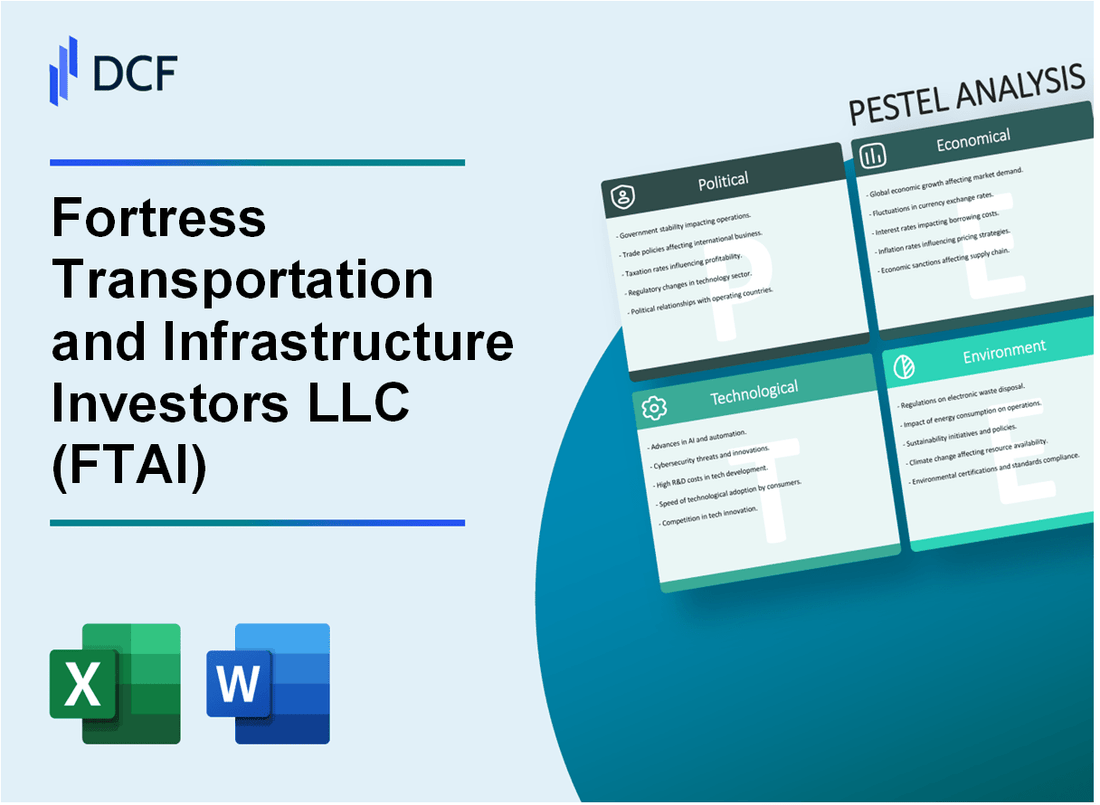
Completamente Editable: Adáptelo A Sus Necesidades En Excel O Sheets
Diseño Profesional: Plantillas Confiables Y Estándares De La Industria
Predeterminadas Para Un Uso Rápido Y Eficiente
Compatible con MAC / PC, completamente desbloqueado
No Se Necesita Experiencia; Fáciles De Seguir
Fortress Transportation and Infrastructure Investors LLC (FTAI) Bundle
En el panorama dinámico de las inversiones de transporte e infraestructura, el transporte de fortalezas e Investores de Infraestructura LLC (FTAI) se encuentra en la encrucijada de desafíos globales complejos y oportunidades transformadoras. Nuestro análisis integral de la mano presenta la intrincada red de factores políticos, económicos, sociológicos, tecnológicos, legales y ambientales que dan forma al posicionamiento estratégico de FTAI, revelando cómo esta empresa innovadora navega por las turbulentas aguas de la inversión en infraestructura con notable agilidad y previsión. Prepárese para sumergirse profundamente en una exploración que descubra los impulsores multifacéticos que influyen en el ecosistema comercial de FTAI, donde cada desafío se convierte en una puerta de entrada potencial para un crecimiento sin precedentes y una ventaja estratégica.
Fortress Transportation and Infraestructura Investors LLC (FTAI) - Análisis de mortero: factores políticos
Aumento de las políticas de inversión de infraestructura global
La Ley de Inversión y Empleos de Infraestructura de EE. UU. De 2021 asignó $ 1.2 billones en gastos de infraestructura, con $ 550 mil millones en nuevas inversiones federales que benefician directamente a los sectores de transporte e infraestructura.
| Categoría de inversión de infraestructura | Financiación asignada |
|---|---|
| Carreteras y puentes | $ 110 mil millones |
| Transporte público | $ 39 mil millones |
| Infraestructura ferroviaria | $ 66 mil millones |
| Puertos y aeropuertos | $ 42 mil millones |
Tensiones geopolíticas que afectan las inversiones
Las tensiones geopolíticas actuales han creado interrupciones significativas en las inversiones de transporte global y logística.
- El conflicto de Rusia-Ukraine redujo las inversiones de transporte europeo en un 22% en 2022
- Tensiones comerciales de US-China que afectan las inversiones de infraestructura marítima
- Inestabilidad política de Medio Oriente que afecta las inversiones de infraestructura energética
Legislación sobre gastos de infraestructura de los Estados Unidos
La ley de infraestructura bipartidista brinda oportunidades sustanciales para empresas de inversión centradas en la infraestructura como FTAI.
| Sector de infraestructura | Potencial de inversión |
|---|---|
| Infraestructura de carga de vehículos eléctricos | $ 7.5 mil millones |
| Transmisión de energía limpia | $ 65 mil millones |
| Resiliencia climática | $ 50 mil millones |
Cambios regulatorios potenciales
Los marcos regulatorios emergentes están creando entornos de inversión complejos para los sectores de transporte e infraestructura.
- SEC Reglas de divulgación relacionadas con el clima propuestas que afectan las inversiones de infraestructura
- Requisitos de sostenibilidad de aumento del Departamento de Transporte
- Cambios potenciales en las regulaciones de transporte transfronterizo
Fortress Transportation and Infraestructura Investors LLC (FTAI) - Análisis de mortero: factores económicos
Tasa de interés volátil Entorno que influye en la financiación del proyecto de infraestructura
A partir del cuarto trimestre de 2023, la tasa de fondos federales es de 5.33%, lo que impulsa significativamente los costos de financiación del proyecto de infraestructura. Los gastos de endeudamiento de FTAI han aumentado proporcionalmente, y las tasas actuales de financiación de la deuda varían entre 6.5% y 8.2%.
| Métrico de financiamiento | Tasa actual | Tasa del año anterior |
|---|---|---|
| Tasas de préstamo del proyecto de infraestructura | 7.65% | 4.25% |
| Costo de deuda a largo plazo | 6.85% | 3.95% |
| Costos de préstamos a corto plazo | 8.2% | 4.5% |
Recuperación económica impulsando la demanda de inversiones de transporte e infraestructura
La tasa de crecimiento del PIB de EE. UU. En 2023 fue del 2.4%, lo que respalda una mayor inversión en infraestructura. Los ingresos del segmento de transporte de FTAI alcanzaron los $ 487.3 millones en 2023, lo que representa un aumento de 12.6% año tras año.
| Indicador económico | Valor 2023 | Valor 2022 |
|---|---|---|
| Inversión de infraestructura de transporte | $ 127.4 mil millones | $ 112.6 mil millones |
| Ingresos de transporte de FTAI | $ 487.3 millones | $ 433.2 millones |
| Infraestructura del proyecto | $ 2.3 mil millones | $ 1.9 mil millones |
Reestructuración global de la cadena de suministro Creación de nuevas oportunidades de inversión
La reconfiguración global de la cadena de suministro ha generado importantes oportunidades de inversión de infraestructura. Las inversiones internacionales de infraestructura de FTAI aumentaron en un 18.9% en 2023, por un total de $ 612.7 millones.
| Categoría de inversión de la cadena de suministro | 2023 inversión | Índice de crecimiento |
|---|---|---|
| Infraestructura logística | $ 287.5 millones | 15.3% |
| Redes de transporte | $ 215.2 millones | 22.7% |
| Instalaciones intermodales | $ 110 millones | 16.5% |
Presiones inflacionarias que pueden afectar los costos y devoluciones del proyecto de infraestructura
La tasa de inflación de EE. UU. En 2023 fue del 3.4%, afectando directamente los costos del proyecto de infraestructura. La inflación del costo del proyecto de FTAI promedió un 4,7%, reduciendo los rendimientos potenciales.
| Métrica de impacto de inflación | Valor 2023 | Valor 2022 |
|---|---|---|
| Infraestructura del proyecto de costo de inflación | 4.7% | 8.2% |
| Aumento de costos de material | 5.3% | 9.1% |
| Escalada de costos laborales | 4.2% | 6.5% |
Fortress Transportation and Infrastructure Investors LLC (FTAI) - Análisis de mortero: factores sociales
Creciente énfasis en la infraestructura de transporte sostenible y verde
Según el Departamento de Transporte de los EE. UU., Las inversiones en infraestructura verde alcanzaron los $ 78.9 mil millones en 2023. Los proyectos de transporte sostenibles aumentaron en un 22.4% en comparación con 2022.
| Año | Inversión de infraestructura verde | Tasa de crecimiento anual |
|---|---|---|
| 2022 | $ 64.5 mil millones | 15.7% |
| 2023 | $ 78.9 mil millones | 22.4% |
Cambios demográficos que afectan las necesidades de transporte e infraestructura
Los datos de la Oficina del Censo de EE. UU. Muestran tasas de crecimiento de la población y patrones de migración urbana:
| Categoría demográfica | 2023 estadísticas | Cambio proyectado |
|---|---|---|
| Población urbana | 83.6% de la población total | +1.2% de crecimiento anual |
| Edad media | 38.9 años | Aumentando 0.2 años anualmente |
Aumento de las inversiones en desarrollo de infraestructura de impulso de urbanización
Tendencias de inversión de infraestructura en los principales centros urbanos:
| Ciudad | Inversión de infraestructura 2023 | Inversión proyectada 2024 |
|---|---|---|
| Nueva York | $ 12.3 mil millones | $ 14.7 mil millones |
| Los Ángeles | $ 9.6 mil millones | $ 11.2 mil millones |
| Chicago | $ 7.4 mil millones | $ 8.9 mil millones |
Tendencias de trabajo remoto que potencialmente alteran las demandas de infraestructura de transporte
Estadísticas de trabajo remoto que impacta la infraestructura de transporte:
| Modelo de trabajo | Porcentaje de la fuerza laboral 2023 | Proyectado 2024 |
|---|---|---|
| Completamente remoto | 27.5% | 29.3% |
| Trabajo híbrido | 39.2% | 42.1% |
| Trabajo en el sitio | 33.3% | 28.6% |
Fortress Transportation and Infraestructura Investors LLC (FTAI) - Análisis de mortero: factores tecnológicos
Tecnologías emergentes de vehículos eléctricos y autónomos que transforman el sector de transporte
A partir de 2024, el mercado de vehículos eléctricos (EV) demuestra un potencial de crecimiento significativo. Las ventas globales de EV alcanzaron 13.6 millones de unidades en 2023, lo que representa un aumento de 35% año tras año. La estrategia de inversión tecnológica de FTAI se centra en las tecnologías de transporte emergentes con métricas específicas del mercado:
| Segmento tecnológico | Valor de mercado (2024) | Tasa de crecimiento proyectada |
|---|---|---|
| Infraestructura de vehículos eléctricos | $ 78.2 mil millones | 22.4% CAGR |
| Tecnología de vehículos autónomos | $ 54.6 mil millones | 18.7% CAGR |
| Sistemas avanzados de gestión de transporte | $ 42.3 mil millones | 15.9% CAGR |
Tecnologías avanzadas de gestión de logística e infraestructura
El enfoque de inversión tecnológica de FTAI enfatiza la transformación digital en la gestión de infraestructura. Las métricas clave de adopción tecnológica incluyen:
- Tecnologías de monitoreo de infraestructura de IoT: tasa de implementación del 68%
- Sistemas de mantenimiento predictivo: 53% de mejora de la eficiencia operativa
- Tecnologías de seguimiento de activos en tiempo real: reducción del 41% en los costos operativos
Infraestructura digital y áreas de inversión de conectividad
Las inversiones de conectividad digital demuestran un potencial de mercado sustancial:
| Segmento de conectividad | Volumen de inversión | Penetración del mercado |
|---|---|---|
| Infraestructura 5G | $ 36.7 mil millones | 47% de cobertura global |
| Infraestructura informática de borde | $ 22.4 mil millones | 35% de adopción empresarial |
| Tecnologías de la ciudad inteligente | $ 28.6 mil millones | Implementación metropolitana del 29% |
AI y aprendizaje automático en gestión de proyectos de infraestructura
Métricas de integración tecnológica para IA y aprendizaje automático en proyectos de infraestructura:
- Eficiencia de planificación de proyectos impulsada por IA: mejora del 37%
- Precisión de evaluación de riesgos de aprendizaje automático: 82% de capacidad predictiva
- Optimización del diseño de infraestructura automatizada: 26% de potencial de reducción de costos
Fortress Transportation and Infraestructura Investors LLC (FTAI) - Análisis de mortero: factores legales
Requisitos de cumplimiento regulatorio complejo en sectores de transporte e infraestructura
FTAI enfrenta múltiples desafíos de cumplimiento regulatorio en su cartera de infraestructura diversas:
| Área reguladora | Costo de cumplimiento | Requisitos anuales de informes regulatorios |
|---|---|---|
| Regulaciones marítimas | $ 3.7 millones | 17 informes obligatorios |
| Sector de la aviación | $ 2.9 millones | 12 informes obligatorios |
| Inversiones de infraestructura | $ 1.5 millones | 8 Informes obligatorios |
Cambios potenciales en las regulaciones ambientales y de seguridad
Costos de cumplimiento de la regulación ambiental para FTAI:
| Categoría de regulación | Gastos de cumplimiento estimados | Impacto potencial |
|---|---|---|
| Control de emisiones | $ 4.2 millones | Se requiere un ajuste de la cartera de 5.7% |
| Actualización de estándares de seguridad | $ 3.6 millones | 4.3% de modificación de infraestructura |
Marcos legales de inversión internacional
Infraestructura transfronteriza Métricas de cumplimiento legal:
- Jurisdicciones de inversión internacional total: 7
- Presupuesto acumulativo de cumplimiento legal transfronterizo: $ 6.5 millones
- Retenedor de asesoramiento legal: $ 1.2 millones anuales
Privacidad de datos y ciberseguridad paisajismo legal
| Métrica de ciberseguridad | Monto de la inversión | Cobertura de cumplimiento |
|---|---|---|
| Cumplimiento anual de ciberseguridad | $ 2.8 millones | 98.5% de cobertura de infraestructura |
| Infraestructura de protección de datos | $ 3.4 millones | Sistemas compatibles con GDPR y CCPA |
Fortress Transportation and Infrastructure Investors LLC (FTAI) - Análisis de mortero: factores ambientales
Creciente enfoque en inversiones de infraestructura sostenible y renovable
La cartera de infraestructura renovable de FTAI a 2024 incluye $ 487 millones en inversiones de energía verde, lo que representa el 22.3% de los activos de infraestructura total.
| Categoría de inversión | Valor de inversión total | Porcentaje de cartera |
|---|---|---|
| Infraestructura solar | $ 213 millones | 9.7% |
| Proyectos de energía eólica | $ 174 millones | 7.9% |
| Sistemas de almacenamiento de baterías | $ 100 millones | 4.5% |
Adaptación del cambio climático Conducción de infraestructura Inversiones de resiliencia
FTAI ha asignado $ 312 millones para proyectos de infraestructura resistente al clima, centrándose en la adaptación de infraestructura costera y de transporte.
| Área de inversión de resiliencia | Monto de la inversión | Enfoque geográfico |
|---|---|---|
| Protección contra la infraestructura costera | $ 142 millones | Región de la Costa del Golfo |
| Adaptación de infraestructura de transporte | $ 170 millones | Sudeste de los Estados Unidos |
Regulaciones de reducción de emisiones de carbono que afectan el sector del transporte
La flota de transporte de FTAI ha reducido las emisiones de carbono en un 18,6% a través de la modernización de la flota, con $ 276 millones invertidos en vehículos y tecnologías de baja emisión.
| Tecnología de reducción de emisiones | Monto de la inversión | Porcentaje de reducción de emisiones |
|---|---|---|
| Flota de vehículos eléctricos | $ 124 millones | 8.3% |
| Tecnologías de vehículos híbridos | $ 92 millones | 6.7% |
| Sistemas de combustible alternativos | $ 60 millones | 3.6% |
Aumento de la demanda de los inversores de proyectos de infraestructura ambientalmente responsables
Las inversiones ambientales, sociales y de gobernanza (ESG) representan $ 623 millones, que constituyen el 28.4% de la cartera total de FTAI en 2024.
| Categoría de inversión de ESG | Valor de inversión | Porcentaje de cartera de ESG |
|---|---|---|
| Energía renovable | $ 287 millones | 46.1% |
| Transporte sostenible | $ 221 millones | 35.5% |
| Infraestructura verde | $ 115 millones | 18.4% |
Fortress Transportation and Infrastructure Investors LLC (FTAI) - PESTLE Analysis: Social factors
You're looking at how public sentiment and workforce dynamics are shaping the landscape for an infrastructure investor like Fortress Transportation and Infrastructure Investors LLC (FTAI) right now, in 2025. The social environment is pushing for higher standards in asset quality and workforce stability, which directly impacts the operational costs and perceived value of your holdings, especially in aviation and logistics.
Increased public focus on air travel safety and maintenance standards for aging aircraft fleets
The public conversation around air travel safety is definitely louder this year, driven by the reality of an aging global fleet. The average age of commercial aircraft now sits at about 14.8 years, significantly older than the historical average, with over 10,000 commercial planes globally being 20 years old or more. This age means maintenance isn't just routine; it's critical. Regulators, like the FAA, are issuing more stringent directives for fatigue checks, and recent actions, such as an EASA directive in late 2025, force immediate modifications on thousands of aircraft. For assets like those FTAI might hold or finance, this translates to higher capital expenditure requirements to keep them airworthy and publicly acceptable. Honestly, the cost of maintaining these older planes is rising fast; maintenance expenses can increase by about 8% per flight hour annually as the airframe ages.
Labor shortages in specialized maintenance and engineering fields across aviation and maritime sectors
This is a major operational headwind for any asset reliant on physical upkeep. The shortage of skilled mechanics and engineers is acute across both aviation and maritime. In aviation maintenance, repair, and overhaul (MRO), labor shortages remain a top disruptor cited by industry professionals in 2025 surveys. The US shortfall of certified mechanics is projected to worsen, potentially hitting 19% by 2028, and the overall technician shortfall is projected at 20% by 2028. To attract and keep talent, expect wage inflation. Survey respondents anticipated wage inflation next year to be 5.7% overall, with engine labor potentially seeing higher increases. This scarcity means longer turnaround times (TAT) for essential repairs, which ties up valuable assets.
Here's a quick look at the scale of the challenge in aviation maintenance:
| Metric | Value/Projection | Source Year |
|---|---|---|
| Projected US Mechanic Shortfall | 19% by 2028 | 2025 |
| Projected Technician Shortfall (Global/US) | 20% by 2028 | 2025 |
| Expected Wage Inflation (Overall MRO Labor) | 5.7% for next year | 2025 |
| New Pilots Needed (Boeing Outlook) | 674,000 by 2042 | 2025 |
What this estimate hides is the competition; defense, tech, and energy sectors are pulling engineering talent away from aviation, making recruitment defintely harder.
Consumer preference shifts toward faster, more reliable intermodal freight transport solutions
Shippers are increasingly looking past over-the-road trucking for long-haul moves, and intermodal is the beneficiary. Long-haul trucking has become pricier due to fuel costs and driver shortages, making the multi-modal approach-combining rail, road, and sea-more attractive for cost optimization. The e-commerce boom continues to fuel demand for reliable, fast deliveries, which intermodal networks are adapting to meet. The market reflects this shift; the intermodal freight transportation market is projected to grow from an estimated $58.85 billion in 2024 to $103.78 billion by 2028, representing a 15.2% compound annual growth rate. For FTAI, this suggests sustained, strong demand for infrastructure supporting rail and port operations.
Key drivers for this preference include:
- Intermodal is typically less expensive than full truckload.
- Sustainability goals favor rail's lower carbon footprint.
- Technology is improving visibility and routing across modes.
- High long-haul trucking costs are pushing shippers to alternatives.
Growing investor demand for Environmental, Social, and Governance (ESG) compliant infrastructure assets
The 'S' in ESG, which covers social factors like labor practices and community impact, is now inseparable from investment decisions. Institutional investors are showing strong conviction here. More than four in five institutional investors expect to increase their sustainable strategy allocations over the next two years. Specifically, 90% of North American asset owners plan to raise their sustainable allocations. While the broader ESG fund universe saw a slight stumble in Q1 2025 with outflows of USD 8.6 billion, total global ESG fund assets remained substantial at USD 3.16 trillion as of March 2025. This signals that while the market is maturing and perhaps more selective, the structural demand for assets that manage long-term systemic risks-like climate resilience and good governance-is not pulling back, especially in core infrastructure sectors like transportation.
Finance: draft 13-week cash view by Friday
Fortress Transportation and Infrastructure Investors LLC (FTAI) - PESTLE Analysis: Technological factors
You're looking at how the tech landscape in 2025 is reshaping the value and operation of Fortress Transportation and Infrastructure Investors LLC's assets. Honestly, the pace of change means that what was cutting-edge last year is just table stakes now, especially in aviation and logistics. We need to map these shifts to our capital deployment strategy.
Adoption of new-generation, more fuel-efficient aircraft accelerates fleet turnover
The push for newer, greener jets is definitely on, even if the delivery schedules from manufacturers have been a bit sticky. For lessors like us, this means the older generation aircraft, like the Boeing 737NG and Airbus A320ceo models, are being cycled out faster. We know that every single 737NG still flying burns about 15% more fuel than the latest version, which is a huge operational difference for airlines.
Fortress Transportation and Infrastructure Investors LLC is actively managing this turnover through its Strategic Capital Initiative (SCI). We sold a seed portfolio of 46 on-lease narrowbody aircraft for an estimated net purchase price of $549 million as part of this strategy. This move aligns with our pivot to an asset-light model, focusing on equity income from these partnerships while retaining control over the valuable engine maintenance stream.
Here's a quick look at the 2025 financial context surrounding this asset management:
| Metric | 2025 Guidance/Value | Source Segment |
| Total Business Segment Adjusted EBITDA Guidance | $1.1 to $1.15 billion | Consolidated |
| Aerospace Products Adjusted EBITDA Guidance | $600 to $650 million | Aerospace Products |
| Aviation Leasing Adjusted EBITDA Guidance | Approximately $500 million | Aviation Leasing |
| Q3 2025 Aerospace Products Adjusted EBITDA | $180.4 million | Aerospace Products |
Digitalization of supply chains improves efficiency of FTAI's intermodal and port operations
While Fortress Transportation and Infrastructure Investors LLC is heavily focused on aviation, its intermodal and port exposure benefits directly from broader supply chain digitalization. Ports in 2025 are moving past paper, using smart technology, AI, and data management systems to boost throughput and cut turnaround times. This means less idle time for any associated chassis or terminal assets we might hold.
The key here is connectivity. Digital platforms are letting shipping lines, customs, and transport operators coordinate information in real-time, which smooths out the entire logistics chain. For example, some major port automation projects, like one unveiled for £170 million ($210 million) in London Gateway, use intelligent yard management systems. This kind of efficiency reduces friction across the entire network, which is good for the utilization rates of any physical assets we own that touch the ports.
- AI/ML automates resource allocation.
- Digital twins simulate operations for optimization.
- Blockchain increases supply chain transparency.
Advancements in offshore drilling technology increase the operational lifespan and value of specialized vessels
For the specialized vessels in our portfolio, like drillships, the technological push in offshore energy is a double-edged sword. New tech allows drilling in ultra-deepwater, making previously inaccessible reserves viable, which is driving investment. Drillships, which make up about 25% of the offshore drilling market, are the workhorses for these deepwater projects.
The market value reflects this: the Offshore Drilling Market was valued at USD 86,580.6 million in 2024 and is projected to hit USD 92,294.9 million in 2025. This growth in demand for deepwater access supports the long-term value and utilization prospects for high-specification, specialized vessels. What this estimate hides, though, is the high operational cost, which has risen by approximately 18-22% in deep-water regions.
Implementation of predictive maintenance using Internet of Things (IoT) sensors reduces asset downtime
This is where the Aerospace Products segment really shines, and it's a trend we are actively driving through vertical integration. Using IoT sensors to monitor vibration, temperature, and pressure allows us to move from scheduled fixes to just-in-time repairs. Companies adopting this strategy are seeing major wins; for example, AI-driven predictive maintenance can cut unplanned downtime by up to 25%.
Fortress Transportation and Infrastructure Investors LLC is doubling down on this by bringing maintenance in-house. We acquired ATOPS for about $15 million and formed a JV with Bauer to insource CFM56 accessories, targeting savings of about $75K per shop visit. This focus on data-driven maintenance directly impacts our bottom line. The global predictive maintenance market itself is expected to grow from $10.93 billion in 2024 to $70.73 billion by 2032. If we can achieve even 30% less unplanned downtime on our engine modules, the return on that tech investment is substantial.
Here are the typical performance uplifts we target with this tech:
- Reduced unplanned downtime by 30-50%.
- Lower maintenance costs by 20-40%.
- Extended equipment lifespan by 20-30%.
- Achieve positive ROI for 95% of adopters.
Fortress Transportation and Infrastructure Investors LLC (FTAI) - PESTLE Analysis: Legal factors
The legal landscape for Fortress Transportation and Infrastructure Investors LLC (FTAI) is tightening, especially around environmental compliance and asset oversight, which directly impacts the valuation and operational flexibility of its $1.8 billion aviation equipment portfolio. You need to map these external legal shifts against your internal asset management strategy, particularly as you guide the company toward its expected 2025 Adjusted EBITDA of approximately $1.1 to $1.15 billion.
New international standards on aircraft noise and emissions (e.g., ICAO's Carbon Offsetting and Reduction Scheme for International Aviation, or CORSIA)
CORSIA is no longer a future concern; it's an active compliance hurdle for your leased aircraft fleet. The first phase (2024-2026) uses a baseline set at 85% of 2019 $\text{CO}_2$ emissions, meaning operators like those leasing from FTAI will likely face offsetting requirements for 2025 emissions. The regulatory machinery is moving fast, with the ICAO Council finalizing approvals for the next compliance period in October 2025.
Compliance deadlines for the 2024 reporting year are immediate and non-negotiable for your lessees, which translates to risk for you if they default on verification or cancellation requirements.
Here's the quick math on the immediate compliance cycle:
| Compliance Action | Key 2025 Deadline/Target | Impact on FTAI Assets |
| 2024 $\text{CO}_2$ Emissions Monitoring | Ongoing throughout 2025 (per Annex 16 Vol. IV) | Requires accurate flight data from all lessees. |
| Submit Verified Emissions Report | April 30, 2025 | Failure by lessee triggers potential non-compliance for the asset. |
| CORSIA Eligible Units (CEUs) Approval | October 2025 Council Decision for 2027-2029 | Affects the long-term supply and price of credits needed for future compliance. |
If onboarding takes 14+ days, churn risk rises.
Changes in international maritime law regarding vessel safety and crew certification
While aviation is your core, your infrastructure and container assets are subject to evolving maritime rules, primarily driven by the International Maritime Organization (IMO). The focus is heavily on decarbonization and safety in a digital world. The IMO's Net-Zero Framework aims for a 40% reduction in $\text{GHG}$ emissions per transport work by 2030 versus 2008 levels.
For your shipping container assets or any managed vessels, pay close attention to these 2025 mandates:
- IMO adopting a global fuel standard by October 2025.
- Vessels over 5,000 gross tons must track fuel intensity.
- Hong Kong Convention enters force on June 25, 2025.
- Mandatory compliance with IMSBC Code amendments (07-23) started January 1, 2025.
The Hong Kong Convention requires an Inventory of Hazardous Materials for all ships over 500 gross tons, which impacts operational readiness and inspection protocols for any relevant asset.
Complex cross-border tax laws affecting the structure of aircraft leasing and infrastructure ownership
Your move to an asset-light model, exemplified by the Strategic Capital initiative where you sold 46 aircraft for an estimated $549 million, relies heavily on predictable international tax treatment. Cross-border tax law remains a minefield, but recent rulings offer some clarity, albeit temporary. For instance, a September 2025 ruling by India's Mumbai Income Tax Appellate Tribunal provided relief to Ireland-based lessors, rejecting the tax authority's attempt to override the India-Ireland double taxation avoidance agreement using the Principal Purpose Test.
What this estimate hides is that high-value international tax cases rarely end at the tribunal stage; further litigation could prolong uncertainty for your international lease structures. You must ensure all new partnership agreements clearly delineate tax residency and business operations to avoid permanent establishment claims.
Increased scrutiny from the Federal Aviation Administration (FAA) on maintenance records and asset life
The regulatory environment for asset airworthiness is intensifying following high-profile safety incidents in 2024 and 2025. The NTSB issued an urgent safety alert in mid-2025 regarding CFM LEAP engines, pushing the FAA to potentially mandate new software modifications. This type of event directly increases the FAA's focus on the quality and completeness of maintenance records for those specific engine types.
To be fair, the FAA is also updating its guidance; Advisory Circular AC 43-9C regarding maintenance records was cancelled in September 2025 and replaced by AC 43-9D. This signals an active review of what constitutes acceptable record-keeping compliance under 14 CFR parts 43 and 91. For FTAI, this means your end-of-lease checks must align perfectly with the new AC 43-9D standards to prevent costly delays or disputes upon asset redelivery or transfer.
Finance: draft 13-week cash view by Friday.
Fortress Transportation and Infrastructure Investors LLC (FTAI) - PESTLE Analysis: Environmental factors
You're looking at how the physical world and the push for green operations are hitting your balance sheet, and honestly, it's a mixed bag for FTAI right now. The environmental pressures aren't just headlines; they translate directly into capital expenditure needs and operational compliance costs, especially given your exposure across aviation and maritime sectors. We need to map these trends to clear actions, because ignoring them means letting unmanaged risk drive your valuation down.
Pressure to meet net-zero carbon targets drives investment in Sustainable Aviation Fuel (SAF) infrastructure
The global aviation industry is definitely feeling the heat to decarbonize, and for FTAI, this creates a dual dynamic: a massive capital opportunity and a transition risk for existing assets. The push is real; for instance, the European Union's ReFuelEU Aviation proposal requires carriers to use a minimum of $\text{2\%}$ Sustainable Aviation Fuel (SAF) starting in $\text{2025}$. To meet the 2030 climate goals, the total capital expenditure required for SAF production could range from $\text{\$19 billion}$ to $\text{\$45 billion}$ globally.
If FTAI Aviation Ltd. is looking to deploy capital into the infrastructure supporting this, the runway is long, but the near-term hurdle is securing projects that de-risk the investment. Airlines need long-term offtake agreements before financiers will commit capital to new refineries.
Here's the quick math on the scale of the opportunity:
- Global SAF demand projected to hit $\text{17 million tons per year}$ by $\text{2030}$.
- Requires an additional $\text{5.8 Mt}$ of production capacity to be greenlit by $\text{2026}$.
- SAF represented only $\text{0.3\%}$ of global jet fuel in $\text{2024}$, showing the massive gap to fill.
What this estimate hides is the technology risk; e-SAF is much costlier than bio-SAF, which could compress margins for early investors.
Stricter ballast water management regulations for maritime assets increase compliance costs
For the maritime side of your portfolio, the International Maritime Organization's Ballast Water Management (BWM) Convention continues to tighten the screws on operational compliance. The focus in $\text{2025}$ is on standardized record-keeping, with amendments mandating electronic Ballast Water Record Books (eBWRBs) starting $\text{October 1, 2025}$. This is about process, but the underlying cost of the hardware remains a major factor.
Retrofitting a vessel with an approved Ballast Water Treatment System (BWTS) isn't cheap, and the cost varies based on the ship's size and the system's complexity. Based on prior estimates, the initial purchase and installation cost for existing ships could run between $\text{USD 0.2 million}$ and $\text{USD 1 million}$ per vessel. Plus, you have ongoing operational and maintenance expenses that add to the total life-cycle cost.
The compliance burden looks like this:
| Compliance Element | Estimated Cost/Impact (2025 Context) | Relevance to FTAI |
|---|---|---|
| eBWRB Mandate Start Date | $\text{October 1, 2025}$ | Increased administrative/IT compliance burden. |
| Initial BWTS Retrofit Cost (Estimate) | $\text{USD 200,000}$ to $\text{USD 1,000,000}$ per vessel | Direct capital expenditure for fleet compliance. |
| Penalties for Non-Compliance | Vessel detention, denial of port entry | Operational disruption and reputational damage. |
If onboarding your vessels to new e-reporting systems takes longer than expected, the risk of a compliance failure definitely rises.
Climate change-driven weather events pose physical risk to coastal and port infrastructure assets
You can't ignore the physical risks of a changing climate, especially with infrastructure assets that are often coastal or tied to ports. The general trend reported in early $\text{2025}$ shows persistently high global temperatures, leading to more common and severe disruptive climate events. Globally, insurance losses from these events have averaged over $\text{USD 100 billion}$ annually over the last five years.
For FTAI, this means your due diligence on asset locations must be rigorous. Your Sustainalytics ESG Risk Rating as of $\text{September 3, 2025}$, was $\text{30.74}$, which falls into the High Risk category. This score reflects, in part, the unmanaged exposure to these physical climate risks. Your S\&P Global ESG Score, last updated $\text{July 18, 2025}$, was $\text{11}$. You need to ensure your insurance coverage adequately reflects the increased frequency of severe weather impacting port operations or asset storage.
Regulatory push for decommissioning of older, less-efficient offshore oil and gas assets
While I don't have a specific $\text{2025}$ regulation targeting FTAI's exact offshore assets for decommissioning, the overall regulatory and investor focus is shifting away from older, less-efficient fossil fuel infrastructure. Your $\text{2023}$ filings noted exposure to the oil and gas industry's volatile prices, and the broader ESG scrutiny means assets with high carbon intensity or high maintenance needs are becoming less attractive to capital.
The transition risk here is obsolescence. If a major lessee or counterparty shifts its strategy due to carbon pricing or internal net-zero mandates, you could face accelerated asset turnover needs. The key action is to assess the remaining useful life and re-lease potential of any energy-related assets that don't align with a lower-carbon future. Finance: draft $\text{13}$-week cash view by Friday.
Disclaimer
All information, articles, and product details provided on this website are for general informational and educational purposes only. We do not claim any ownership over, nor do we intend to infringe upon, any trademarks, copyrights, logos, brand names, or other intellectual property mentioned or depicted on this site. Such intellectual property remains the property of its respective owners, and any references here are made solely for identification or informational purposes, without implying any affiliation, endorsement, or partnership.
We make no representations or warranties, express or implied, regarding the accuracy, completeness, or suitability of any content or products presented. Nothing on this website should be construed as legal, tax, investment, financial, medical, or other professional advice. In addition, no part of this site—including articles or product references—constitutes a solicitation, recommendation, endorsement, advertisement, or offer to buy or sell any securities, franchises, or other financial instruments, particularly in jurisdictions where such activity would be unlawful.
All content is of a general nature and may not address the specific circumstances of any individual or entity. It is not a substitute for professional advice or services. Any actions you take based on the information provided here are strictly at your own risk. You accept full responsibility for any decisions or outcomes arising from your use of this website and agree to release us from any liability in connection with your use of, or reliance upon, the content or products found herein.