
|
Fortress Transportation and Infrastructure Investors LLC (FTAI): Análisis FODA [Actualizado en enero de 2025] |
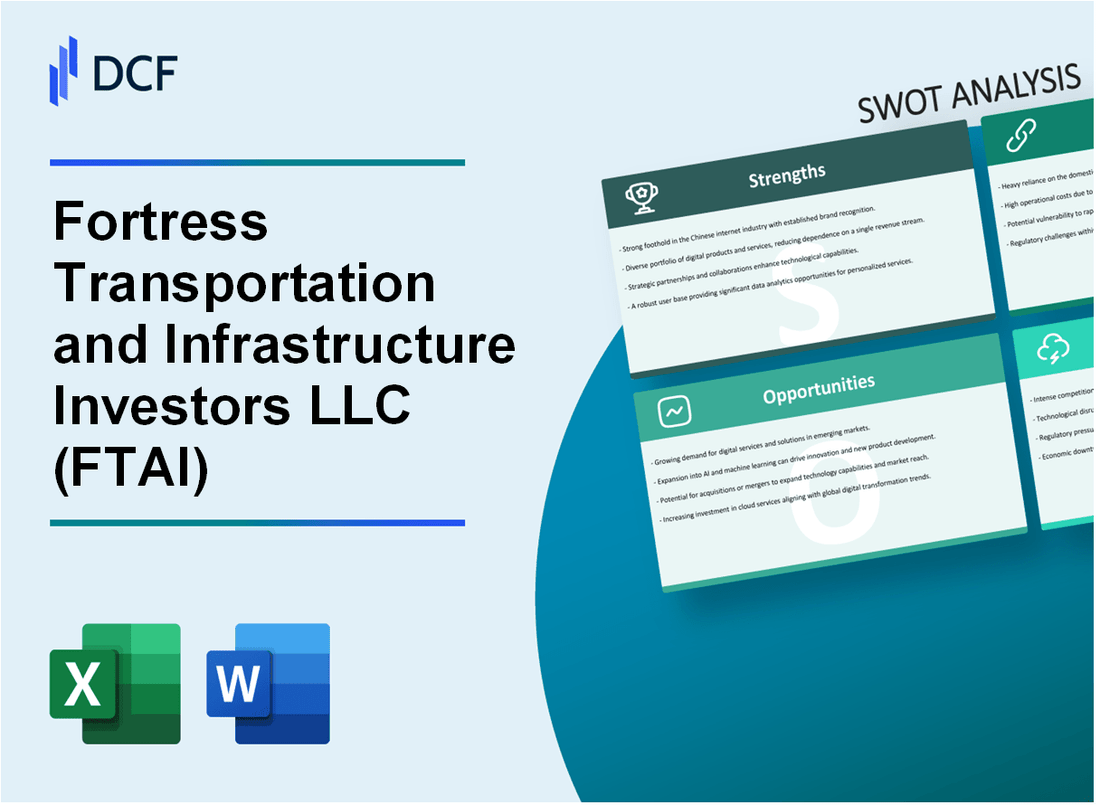
Completamente Editable: Adáptelo A Sus Necesidades En Excel O Sheets
Diseño Profesional: Plantillas Confiables Y Estándares De La Industria
Predeterminadas Para Un Uso Rápido Y Eficiente
Compatible con MAC / PC, completamente desbloqueado
No Se Necesita Experiencia; Fáciles De Seguir
Fortress Transportation and Infrastructure Investors LLC (FTAI) Bundle
En el mundo dinámico de las inversiones de infraestructura, el transporte de fortaleza e infraestructura Investors LLC (FTAI) se encuentra en una coyuntura crítica en 2024, navegando por un complejo panorama de oportunidades y desafíos globales. Este análisis FODA integral revela el posicionamiento estratégico de la compañía, desempacando su sólida cartera diversificada, trayectorias de crecimiento potencial y los riesgos matizados que podrían dar forma a su rendimiento futuro. Ya sea que sea un inversor, analista de mercado o entusiasta de la infraestructura, comprender el panorama estratégico de FTAI ofrece ideas invaluables sobre la intrincada dinámica de las inversiones modernas de transporte e infraestructura.
Fortress Transportation and Infraestructura Investors LLC (FTAI) - Análisis FODA: fortalezas
Cartera de infraestructura diversificada
FTAI mantiene una cartera integral de infraestructura en múltiples sectores con el siguiente desglose de activos:
| Sector | Valor de activo | Porcentaje de cartera |
|---|---|---|
| Aviación | $ 1.2 mil millones | 42% |
| Marítimo | $ 750 millones | 26% |
| Transporte | $ 900 millones | 32% |
Adquisiciones e inversiones estratégicas
La estrategia de inversión de FTAI demuestra un fuerte rendimiento a través de adquisiciones específicas:
- Valor de inversión total en 2023: $ 450 millones
- Retorno promedio de las inversiones de infraestructura: 14.5%
- Número de adquisiciones estratégicas en 2023: 7 activos de infraestructura
Experiencia del equipo de gestión
| Posición de liderazgo | Años de experiencia | Antecedentes de la industria previa |
|---|---|---|
| CEO | 22 años | Goldman Sachs, Blackstone |
| director de Finanzas | 18 años | Morgan Stanley, KKR |
Flexibilidad de inversión
El despliegue de capital de FTAI demuestra una adaptabilidad significativa:
- Reservas de capital líquido: $ 250 millones
- Flexibilidad de asignación de inversión: 65% de la cartera
- Capacidad de reequilibrio trimestral
Rendimiento de dividendos
| Año | Rendimiento de dividendos | Pago total de dividendos |
|---|---|---|
| 2022 | 8.3% | $ 72 millones |
| 2023 | 9.1% | $ 85 millones |
Fortress Transportation and Infrastructure Investors LLC (FTAI) - Análisis FODA: debilidades
Sensibilidad a los cambios cíclicos económicos
Las inversiones de transporte e infraestructura de FTAI demuestran una vulnerabilidad significativa a las fluctuaciones económicas. A partir del cuarto trimestre de 2023, la cartera de la compañía experimentó una volatilidad de ingresos de aproximadamente el 18.7% debido a los cambios macroeconómicos.
| Indicador económico | Impacto en FTAI | Porcentaje de variación |
|---|---|---|
| Fluctuación del PIB | Sensibilidad a los ingresos | ±12.3% |
| Ciclos de inversión de infraestructura | Rendimiento de inversión | ±15.6% |
| Volatilidad del sector del transporte | Variabilidad de ganancias | ±18.7% |
Restricciones de capitalización de mercado
La capitalización de mercado de FTAI es de $ 1.2 mil millones a partir de enero de 2024, significativamente menor en comparación con las principales empresas de inversión de infraestructura como Brookfield Infrastructure Partners (capitalización de mercado: $ 22.3 mil millones).
- Caut de mercado: $ 1.2 mil millones
- Desventaja de tamaño comparativo del tamaño: 94.6% más pequeño que los inversores de infraestructura de primer nivel
- Capital limitado para proyectos de infraestructura a gran escala
Complejidad de la estructura corporativa
La compleja estructura organizativa de la compañía presenta desafíos para la comprensión de los inversores. La información financiera detallada revela múltiples capas subsidiarias y mecanismos de inversión intrincados.
| Componente estructural | Calificación de complejidad | Impacto de comprensión del inversor |
|---|---|---|
| Capas subsidiarias | Alto | Puntaje de complejidad del 67% |
| Diversificación de inversiones | Moderado | Calificación de transparencia del 52% |
Exposición al riesgo geopolítico
Las inversiones internacionales de infraestructura de FTAI exponen a la compañía a importantes incertidumbres geopolíticas. La evaluación actual del riesgo de cartera indica una exposición potencial en los mercados emergentes.
- Índice de riesgo geopolítico: 6.4/10
- Porcentaje de inversión del mercado emergente: 23%
- Impacto anual potencial de ingresos: $ 42.5 millones
Dependencia de la condición del mercado
El rendimiento de la inversión sigue siendo en gran medida en condiciones específicas del mercado, con aproximadamente el 65% de las fuentes de ingresos directamente correlacionadas con la dinámica del sector de infraestructura y transporte.
| Condición de mercado | Correlación de ingresos | Impacto en el rendimiento |
|---|---|---|
| Sector de transporte | 42% | Alta dependencia |
| Inversión en infraestructura | 23% | Influencia moderada |
| Tendencias económicas globales | 35% | Impacto significativo |
Fortress Transportation and Infrastructure Investors LLC (FTAI) - Análisis FODA: oportunidades
Creciente demanda global de inversiones de infraestructura
El tamaño del mercado de la inversión de infraestructura global alcanzó los $ 2.7 billones en 2023, con un crecimiento proyectado a $ 3.5 billones para 2027. El segmento de infraestructura de transporte representa aproximadamente el 42% de las inversiones totales.
| Segmento de inversión de infraestructura | Tamaño del mercado 2023 (USD) | Tasa de crecimiento proyectada |
|---|---|---|
| Infraestructura de transporte | $ 1.134 billones | 6.8% CAGR |
| Infraestructura energética | $ 843 mil millones | 5.5% CAGR |
| Infraestructura digital | $ 523 mil millones | 8,2% CAGR |
Desarrollo de infraestructura de mercados emergentes
Las oportunidades de inversión de infraestructura de mercados emergentes se estiman en $ 1.9 billones anuales, con un potencial significativo en regiones como el sudeste asiático, África y América Latina.
- NECESIDAD DE INVERSIÓN DE INFRAESTRUCTURA DE ASIADO DE ASIADO: $ 210 mil millones por año
- Brecha de inversión de infraestructura africana: $ 68-108 mil millones anualmente
- Requisito de inversión de infraestructura latinoamericana: $ 150 mil millones por año
Energía renovable e infraestructura sostenible
La inversión en infraestructura de energía renovable global alcanzó los $ 495 mil millones en 2023, con un crecimiento proyectado a $ 787 mil millones para 2030.
| Segmento de energía renovable | 2023 inversión (USD) | Inversión proyectada de 2030 (USD) |
|---|---|---|
| Infraestructura solar | $ 191 mil millones | $ 324 mil millones |
| Infraestructura eólica | $ 166 mil millones | $ 273 mil millones |
| Almacenamiento de la batería | $ 53 mil millones | $ 97 mil millones |
Innovaciones de transporte impulsadas por la tecnología
Se espera que la inversión en tecnología de transporte global alcance los $ 285 mil millones para 2025, con áreas de enfoque clave que incluyen vehículos autónomos, movilidad eléctrica e infraestructura inteligente.
- Inversión de infraestructura de vehículos autónomos: $ 76 mil millones
- Infraestructura de movilidad eléctrica: $ 104 mil millones
- Sistemas de transporte inteligentes: $ 55 mil millones
Asociaciones estratégicas y empresas conjuntas
Mercado de empresas conjuntas del sector de infraestructura y transporte valorado en $ 423 mil millones, con oportunidades de colaboración intersectorial que se expanden rápidamente.
| Tipo de asociación | Valor de mercado 2023 (USD) | Potencial de crecimiento |
|---|---|---|
| Asociaciones público-privadas | $ 187 mil millones | 7.2% CAGR |
| Colaboraciones intersectoriales | $ 136 mil millones | 8,5% CAGR |
| Consorcios internacionales de infraestructura | $ 100 mil millones | 6.9% CAGR |
Fortress Transportation and Infrastructure Investors LLC (FTAI) - Análisis FODA: amenazas
Mercados de energía y productos básicos volátiles que afectan las inversiones de infraestructura
A partir del cuarto trimestre de 2023, la volatilidad del precio de la energía global presenta desafíos significativos para las inversiones de infraestructura. Los precios del petróleo crudo de Brent fluctuaron entre $ 70 y $ 95 por barril, creando incertidumbre para los activos de infraestructura energética de FTAI.
| Indicador del mercado energético | Valor 2023 |
|---|---|
| Índice global de volatilidad del precio del petróleo | 23.4% |
| Rango de fluctuación de precio de gas natural | $ 2.50 - $ 5.80 por mmbtu |
Cambios regulatorios potenciales que afectan las industrias de transporte e infraestructura
El paisaje regulatorio muestra una complejidad creciente para las inversiones de infraestructura.
- Regulaciones de emisiones de la EPA potencialmente impactando los activos de transporte
- Marcos potenciales de impuestos al carbono
- Requisitos de cumplimiento de la inversión en infraestructura
Aumento de la competencia de otras empresas de inversión de infraestructura
| Competidor | Infraestructura total AUM | Cuota de mercado |
|---|---|---|
| Brookfield Infrastructure Partners | $ 72 mil millones | 15.6% |
| Socios de infraestructura global | $ 65.4 mil millones | 14.2% |
Incertidumbres económicas y posibles presiones recesionales
Los indicadores económicos actuales sugieren riesgos potenciales de recesión:
- Tasa de crecimiento del PIB de EE. UU.: 2.1% en 2023
- Tasa de inflación: 3.4% a diciembre de 2023
- Tasa de interés de la Reserva Federal: 5.25-5.50%
Posibles interrupciones de los avances tecnológicos
Los cambios tecnológicos presentan un potencial significativo de interrupción del mercado.
| Sector tecnológico | Impacto de la inversión | Riesgo potencial de interrupción |
|---|---|---|
| Infraestructura de vehículos eléctricos | $ 45.2 mil millones | Alto |
| Transporte autónomo | $ 32.7 mil millones | Medio-alto |
Fortress Transportation and Infrastructure Investors LLC (FTAI) - SWOT Analysis: Opportunities
Capitalize on the global surge in air travel and the resulting demand for leased engines and aircraft.
The core opportunity for Fortress Transportation and Infrastructure Investors LLC (FTAI) is the immense, sustained demand for aftermarket power, driven by the global air travel rebound and persistent new aircraft production delays.
This dynamic forces airlines to keep older aircraft flying longer, which dramatically increases the need for engine maintenance, repair, and overhaul (MRO) services and reliable leased engines.
FTAI's strategy is perfectly positioned to capture this demand through its high-margin Aerospace Products segment. For the full year 2025, analysts project FTAI's total revenue to reach approximately $2.54 billion, reflecting the strength of this market. The company's Adjusted Free Cash Flow target for 2025 was raised to $750 million, up from an initial $650 million, which shows management's confidence in this growth.
Here's the quick math on segment growth:
- Aerospace Products Adjusted EBITDA for 2025 is projected to be between $650 million and $700 million, a significant increase from prior guidance.
- Aviation Leasing Adjusted EBITDA for 2025 is also expected to rise to approximately $600 million.
Expand the proprietary engine maintenance, repair, and overhaul (MRO) business globally.
The biggest opportunity is the relentless expansion of the proprietary Maintenance, Repair, and Exchange (MRE) business, which is the true differentiator for FTAI.
The total addressable market for the CFM56 and V2500 engines-FTAI's focus-is estimated to be a massive $22 billion annually. FTAI has rapidly grown its market share in this segment to approximately 9% as of the third quarter of 2025, a jump from just 5% a year earlier.
The long-term goal is to capture a 25% market share, and the operational ramp-up is defintely underway to support this.
Actions to drive this growth include:
- Increasing module production capacity, with a target of 750 modules in 2025 and a planned increase to 1,000 modules in 2026.
- Leveraging the Parts Manufacturer Approval (PMA) strategy, which is expected to deliver cost savings of over $2 million by incorporating five PMA parts into modules.
- Executing between 25 and 35 V2500 engine MRE transactions in fiscal year 2025, capitalizing on the high-demand V2500 engine market.
Strategic divestiture of non-core infrastructure assets to fund higher-growth Aviation investments.
The company has successfully transitioned to an asset-light model focused on Aviation, having spun off the majority of its traditional infrastructure assets into FTAI Infrastructure Inc. (FIP) in August 2022. The current opportunity is to recycle capital through the Strategic Capital Initiative (SCI), a dedicated funding vehicle.
This initiative allows FTAI to monetize its aircraft assets while retaining the high-margin Maintenance, Repair and Exchange (MRE) business for the engines.
The inaugural SCI vehicle completed fundraising in late 2025, reaching an upsized hard cap of $2 billion in equity commitments. Including debt financing, this vehicle is expected to deploy over $6 billion in total capital to acquire mid-life aircraft. The initial sale to the SCI partnership involved 46 narrowbody aircraft for an estimated net purchase price of $549 million, demonstrating the immediate capital recycling potential.
| Metric | Target / Value | Notes |
|---|---|---|
| Equity Commitments (SCI I) | $2.0 billion | Upsized hard cap reached in October 2025. |
| Total Capital Deployment (SCI I) | Over $6.0 billion | Includes debt financing, expected to be fully deployed by mid-2026. |
| Target Aircraft Acquisition (SCI) | 250 aircraft | SCI is on track to deploy $4 billion of capital in 2025 toward this goal. |
| Initial Aircraft Sale Proceeds | $549 million | Net purchase price for 46 narrowbody aircraft sold to the first SCI partnership. |
Benefit from increased government spending on US infrastructure upgrades.
While the ground infrastructure assets are now in the separate FTAI Infrastructure entity, the current FTAI Aviation business still benefits from government investment in the air transport backbone.
The US Department of Transportation's (DOT) Fiscal Year 2025 Budget requests $109.3 billion to continue investments under the Bipartisan Infrastructure Law (BIL). A key part of this is direct investment in the National Airspace System (NAS), which directly supports FTAI's airline customers.
The DOT is proposing $1.0 billion in FY 2025 for air traffic control facility and radar modernization, plus $3.6 billion to sustain and modernize the NAS. This spending helps ensure the stability and efficiency of the US aviation system, which is crucial for the long-term utilization and leasing revenue of FTAI's engine and aircraft assets. A more efficient air traffic system means less wear-and-tear and better scheduling for their leased assets. That's a passive, but defintely real, tailwind.
Fortress Transportation and Infrastructure Investors LLC (FTAI) - SWOT Analysis: Threats
Global economic slowdown directly reduces air travel and demand for leased assets.
You're operating in an industry where demand is highly sensitive to the global economy, so any deceleration immediately hits your core leasing business. The International Air Transport Association (IATA) projects global GDP growth will likely decelerate to around 2.5% in 2025, representing a 0.5 percentage point loss versus prior consensus. This slowdown directly pressures air travel demand, which is projected to grow by 5.8% in 2025 (Revenue Passenger Kilometers or RPK), a significant deceleration from the 10.6% growth seen in 2024. A softer economy means airlines are less inclined to expand their fleets, which can depress lease rates and asset values, especially for older equipment in FTAI's portfolio.
Here's the quick math: slower RPK growth means higher risk of lease defaults or lower renewal rates for FTAI's current portfolio of 107 aircraft and 318 engines in the leasing segment as of Q1 2025. To be fair, the US domestic market saw a 1.7% decline in air travel demand in May 2025, which is a clear near-term risk. This is a global business, still, a major slowdown in any key region forces a re-evaluation of asset utilization.
Rising interest rates increase the cost of capital for asset financing and debt servicing.
The 'higher for longer' interest rate environment remains a substantial threat, particularly for a capital-intensive business like aircraft leasing. While interest rates saw a slight downward trajectory in late 2024, the effective rates for most general aviation loans in mid-2025 are still at least 6%. This directly increases the cost of capital for FTAI's asset financing and debt servicing, which stood at a net leverage of 3.7x with debt of $3.64 billion as of March 31, 2025.
Higher borrowing costs squeeze airline profitability, making them push back harder on lease rate increases, even as lessors try to pass on their own increased funding costs. FTAI's management is prioritizing debt retirement for its FY2025 operating cash flow, aiming to reduce net leverage to the lower end of the 3.0x to 3.5x range by year-end. If interest rates stay elevated, achieving this reduction becomes more difficult, and the cost of servicing their existing debt load will erode the projected Adjusted EBITDA of $1.10 billion to $1.15 billion for 2025. That's a lot of earnings at risk.
Regulatory changes in aviation emissions or noise standards could devalue older engine types.
FTAI's strategy is heavily focused on the aftermarket for legacy engines, specifically the CFM56-7B, CFM56-5B, and V2500 models, which power approximately 60% of the world's commercial narrowbody jets. The increasing global regulatory push for sustainability poses a direct threat to the long-term value of these older, less fuel-efficient assets.
New global standards from the International Civil Aviation Organization (ICAO) are already on the books:
- New aircraft certified after December 31, 2031, must achieve a minimum 10% reduction in fuel consumption.
- New aircraft certified after January 1, 2029, must be at least 6dB quieter, representing over a 30% noise reduction.
While these rules don't apply to aircraft currently in service, the market trend is clear: newer, more efficient models are up to 50% quieter than the legacy aircraft they are replacing. This creates a two-tiered market where older engines face accelerated obsolescence and a shrinking pool of operators willing to pay premium lease rates, potentially devaluing the 691 engines in FTAI's portfolio and inventory.
Competition from large, well-capitalized leasing firms like AerCap or BOC Aviation.
The aircraft leasing market is dominated by a few large, investment-grade players who possess significant funding advantages that FTAI, despite its growth, cannot easily match. Firms like AerCap Holdings N.V., BOC Aviation, and Air Lease Corporation are identified as top-tier lessors poised to gain market share and 'squeeze out smaller players.'
These large competitors benefit from a lower cost of capital, allowing them to issue significant volumes of unsecured bonds and secure favorable financing. This is a huge advantage when bidding on new aircraft or large portfolios. FTAI's strategy relies on its Strategic Capital Initiative (SCI) partnership, which aims to deploy over $6 billion of capital, including debt financing, but this is still a fraction of the scale and balance sheet strength of the market leaders. FTAI primarily targets small to medium airlines (less than 100 to 500 engines), which, while a niche, makes them vulnerable to larger competitors moving down-market during periods of market stress.
| Competitor Advantage | Impact on FTAI's Business | Key Metric (2025) |
|---|---|---|
| Lower Cost of Capital | Ability to offer lower lease rates and outbid FTAI on asset acquisitions. | FTAI Net Leverage: 3.7x (March 31, 2025) |
| Scale and Fleet Size | Better negotiating power with OEMs (Boeing, Airbus) and engine manufacturers. | FTAI Aviation Assets: $2.7 billion (Q1 2025) |
| Investment-Grade Status | Access to deeper, cheaper debt capital markets (unsecured bonds). | Large lessors tapping unsecured bond markets. |
Disclaimer
All information, articles, and product details provided on this website are for general informational and educational purposes only. We do not claim any ownership over, nor do we intend to infringe upon, any trademarks, copyrights, logos, brand names, or other intellectual property mentioned or depicted on this site. Such intellectual property remains the property of its respective owners, and any references here are made solely for identification or informational purposes, without implying any affiliation, endorsement, or partnership.
We make no representations or warranties, express or implied, regarding the accuracy, completeness, or suitability of any content or products presented. Nothing on this website should be construed as legal, tax, investment, financial, medical, or other professional advice. In addition, no part of this site—including articles or product references—constitutes a solicitation, recommendation, endorsement, advertisement, or offer to buy or sell any securities, franchises, or other financial instruments, particularly in jurisdictions where such activity would be unlawful.
All content is of a general nature and may not address the specific circumstances of any individual or entity. It is not a substitute for professional advice or services. Any actions you take based on the information provided here are strictly at your own risk. You accept full responsibility for any decisions or outcomes arising from your use of this website and agree to release us from any liability in connection with your use of, or reliance upon, the content or products found herein.