
|
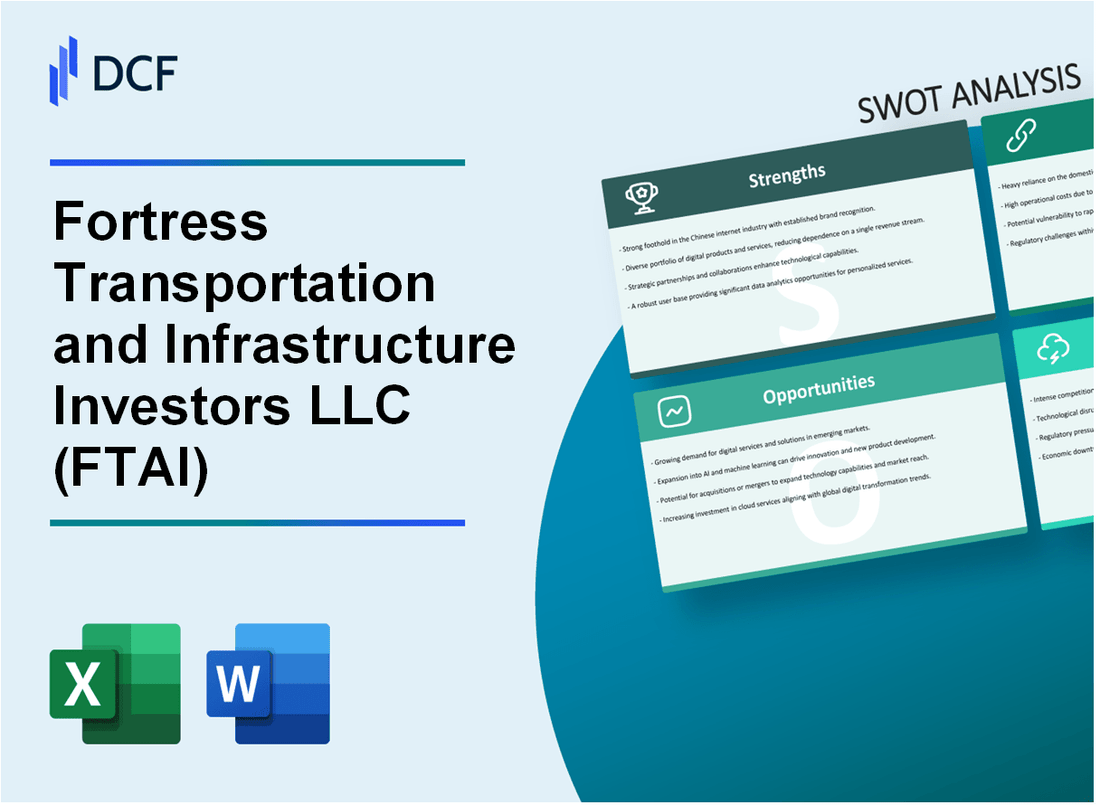
Fortress Transportation and Infrastructure Investors LLC (FTAI): SWOT Analysis [Nov-2025 Updated] |
Fully Editable: Tailor To Your Needs In Excel Or Sheets
Professional Design: Trusted, Industry-Standard Templates
Investor-Approved Valuation Models
MAC/PC Compatible, Fully Unlocked
No Expertise Is Needed; Easy To Follow
Fortress Transportation and Infrastructure Investors LLC (FTAI) Bundle
You're trying to cut through the noise on Fortress Transportation and Infrastructure Investors LLC (FTAI), and the clear takeaway is that this is defintely an aerospace growth story, not a diversified infrastructure play. The strategic shift is paying off, with the company raising its 2025 Adjusted EBITDA guidance to a range of $1.25 billion to $1.3 billion, powered almost entirely by the Aviation segment. But, this aggressive pivot still carries a heavy anchor: a long-term debt load of around $3.4 billion as of mid-2025, which is the core tension you need to understand.
Fortress Transportation and Infrastructure Investors LLC (FTAI) - SWOT Analysis: Strengths
Aviation Segment Dominance Drives Revenue
You can't talk about Fortress Transportation and Infrastructure Investors LLC (FTAI), now FTAI Aviation Ltd., without acknowledging that the business is now laser-focused on aviation, and that's where the money is. The old infrastructure assets were spun off, leaving a pure-play aerospace company with a dominant revenue stream.
For the 2025 fiscal year, the company projects its total Adjusted EBITDA will be approximately $1.1 to $1.15 billion. Here's the quick math on how the two aviation segments-Aerospace Products and Aviation Leasing-split that dominance, making the entire aviation ecosystem the core strength.
- Aerospace Products (MRE): Expected Adjusted EBITDA of $600 million to $650 million.
- Aviation Leasing: Expected Adjusted EBITDA of approximately $500 million.
The Aerospace Products segment alone is expected to account for more than half of EBITDA in 2025, and analysts project this to grow to about 70% in 2026. That's a powerful concentration of earnings.
Proprietary Engine Technology Provides a High-Margin Niche
The real defensible strength isn't just leasing aircraft; it's controlling the maintenance, repair, and exchange (MRE) market for the most popular engines. FTAI Aviation has carved out a proprietary niche, primarily around the CFM56 and V2500 engines, which power the world's most widely used commercial aircraft.
The company's proprietary products, like The Module Factory and a joint venture for engine Parts Manufacturer Approval (PMA), allow it to offer cost-effective, faster maintenance. This MRE focus translates directly to high-growth, high-margin revenue. The Aerospace Products segment saw its Adjusted EBITDA swell by 77% year-over-year in Q3 2025 to $180.4 million, maintaining a healthy margin of 35%.
This is a huge market, honestly. The total addressable aftermarket for CFM56 and V2500 is estimated at $22 billion, and FTAI currently commands an annualized market share of $2 billion. They are defintely scaling, too, with production ramping up to 184 CFM56 Modules in Q2 2025-a 33% increase over the prior quarter.
Highly Diversified, Long-Life Asset Base in Aviation
While the original company held diverse transportation and infrastructure assets, the current strength of FTAI Aviation is its diversified, long-life asset base within the aviation sector itself. Total assets for FTAI Aviation were reported at $4.240 billion for the quarter ending September 30, 2025.
The asset base is strategically diversified across the leasing and MRE segments, covering aircraft, engines, and engine parts. This is a smart way to mitigate risk. The company is aggressively expanding this base through its Strategic Capital Initiative (SCI), which completed fundraising in October 2025 with an upsized hard cap of $2.0 billion in equity commitments.
This initiative, FTAI SCI I, is designed to acquire on-lease 737NG and A320ceo aircraft and will ultimately deploy over $6 billion of total capital, including debt financing, to acquire 190 aircraft. This asset-light model, where they manage and co-invest, keeps the balance sheet clean while driving fee income and MRE business to their core engine segment.
Strong Liquidity Position Allows for Opportunistic Asset Acquisitions
A strong balance sheet is crucial for an asset-heavy business, and FTAI Aviation is well-positioned with significant liquidity. As of September 30, 2025, the company held $510 million in cash. Plus, they have full availability under their $400 million corporate revolving credit facility.
This financial flexibility is a major strength, allowing them to jump on opportunistic acquisitions, like the agreement to acquire ATOPS to expand product capacity from 450 modules to 600 modules. Here's the key cash flow picture:
| Metric | Value (FY 2025 Guidance/Projection) | Source |
| Adjusted Free Cash Flow (FCF) | $750 million | |
| Cash from Operations (Next 12 Months) | $600 million - $650 million | |
| Asset Divestitures (Projected FY 2025) | Approximately $770 million |
The projected 2025 Adjusted Free Cash Flow of $750 million gives them ample dry powder to pursue growth. This capital structure is what lets them execute large-scale initiatives, like the $6 billion SCI vehicle, without stressing the core business. You need that kind of liquidity to be a trend-aware realist in the aviation market.
Fortress Transportation and Infrastructure Investors LLC (FTAI) - SWOT Analysis: Weaknesses
High concentration risk in the Aviation segment, tying performance to a single cyclical industry.
The most immediate weakness for the current FTAI Aviation Ltd. is its near-total reliance on the aviation sector, specifically the commercial jet engine aftermarket. The 2022 spin-off, while simplifying the legal structure, created a pure-play aviation company, which means all performance is now tied to a single, highly cyclical industry. This is a deliberate strategic choice, but it removes the diversification benefit the original Fortress Transportation and Infrastructure Investors LLC had from its infrastructure assets.
For the 2025 fiscal year, management is guiding to an Adjusted EBITDA of approximately $1.1 to $1.15 billion from its reportable segments, with all of that coming from Aviation Leasing and Aerospace Products. This concentration means any major, unforeseen global event-like a future pandemic or a prolonged economic downturn-that impacts air travel demand or maintenance schedules will defintely hit the company's financials hard. You are essentially betting on the sustained health of the global airline industry.
- All 2025 EBITDA is aviation-dependent.
- Cyclical downturns immediately impact engine leasing and maintenance demand.
Significant debt load, increasing sensitivity to interest rate fluctuations and refinancing risk.
FTAI Aviation Ltd. operates with a substantial debt load, which is a major financial risk, especially in the current higher interest rate environment. The company's financial leverage is significant. As of September 30, 2025, the Long-Term Debt and Capital Lease Obligation stood at approximately $3.447 billion.
Here's the quick math on the leverage: The Debt-to-Equity ratio as of September 29, 2025, was extremely high at approximately 1365.2%. That is a massive amount of debt relative to shareholder equity. The interest expense alone for the fiscal year ended December 2024 was about $222 million. This debt burden makes the company highly sensitive to any further increases in benchmark interest rates, which directly increases the cost of servicing existing floating-rate debt and the cost of refinancing maturing obligations.
The Interest Coverage Ratio, which measures how easily a company can pay its interest expenses, was relatively low at 3.42x as of September 2025. To be fair, a higher ratio is always better, and anything below 2.0x is typically seen as burdened by debt. Still, a ratio of 3.42x does not leave a large buffer if operating income were to decline unexpectedly.
| Metric (as of Sep. 2025) | Amount/Ratio | Implication |
|---|---|---|
| Long-Term Debt & Capital Lease Obligation | $3.447 Billion | High principal repayment and refinancing risk. |
| Debt-to-Equity Ratio | 1365.2% | Extreme financial leverage; high risk for equity holders. |
| Interest Expense (Q3 2025) | $61 Million | Significant recurring cash outflow. |
| Interest Coverage Ratio | 3.42x | Limited buffer if operating income declines. |
Infrastructure assets (e.g., ports, rail) often require substantial, long-term capital expenditure.
While the infrastructure assets were spun off into FTAI Infrastructure Inc. (FIP) in 2022, the original FTAI (Fortress Transportation and Infrastructure Investors LLC) was historically burdened by the long-term, capital-intensive nature of those assets-like the Jefferson Terminal and Repauno Port. This legacy is what necessitated the spin-off to create a more focused, and theoretically less capital-intensive, aviation entity.
However, the new FTAI Aviation Ltd. still has significant capital expenditure (CapEx) needs to fuel its growth. The company's projected CapEx for the 2025 fiscal year is estimated at a substantial $2,594 million, according to some valuation models. This high CapEx is largely driven by the Strategic Capital Initiative (SCI), which aims to deploy over $3.0 billion of capital annually to acquire aircraft and engines. While this new model is designed to be 'asset-light' by involving third-party capital, the sheer scale of the capital deployment required to execute the strategy still represents a massive investment commitment and a drain on free cash flow in the near term.
Complex corporate structure, making valuation and financial analysis defintely more challenging.
Even after the 2022 spin-off and the conversion from an LLC (which generated complex K-1 tax forms) to a C-Corp, the corporate structure of FTAI Aviation Ltd. remains intricate, complicating financial analysis and valuation. The core issue is the external management structure, where the company is managed by an affiliate of Fortress Investment Group LLC.
This external management arrangement means you have to constantly monitor potential conflicts of interest and the fee structure, which includes management fees and incentive allocations. Plus, the new growth strategy relies heavily on complex joint ventures, specifically the Strategic Capital Initiative (SCI). The SCI involves the creation of a '2025 Partnership' with third-party institutional investors to acquire aircraft. Analyzing the financials requires understanding how the economics of these partnerships flow back to FTAI Aviation Ltd., which co-invests and acts as the exclusive service provider. This layered structure makes it harder to get a clean read on the true, unencumbered earnings of the core business.
- External management by Fortress Investment Group LLC.
- Incentive allocation and fee structure introduce complexity.
- Strategic Capital Initiative (SCI) relies on complex, non-wholly-owned partnerships.
Fortress Transportation and Infrastructure Investors LLC (FTAI) - SWOT Analysis: Opportunities
Capitalize on the global surge in air travel and the resulting demand for leased engines and aircraft.
The core opportunity for Fortress Transportation and Infrastructure Investors LLC (FTAI) is the immense, sustained demand for aftermarket power, driven by the global air travel rebound and persistent new aircraft production delays.
This dynamic forces airlines to keep older aircraft flying longer, which dramatically increases the need for engine maintenance, repair, and overhaul (MRO) services and reliable leased engines.
FTAI's strategy is perfectly positioned to capture this demand through its high-margin Aerospace Products segment. For the full year 2025, analysts project FTAI's total revenue to reach approximately $2.54 billion, reflecting the strength of this market. The company's Adjusted Free Cash Flow target for 2025 was raised to $750 million, up from an initial $650 million, which shows management's confidence in this growth.
Here's the quick math on segment growth:
- Aerospace Products Adjusted EBITDA for 2025 is projected to be between $650 million and $700 million, a significant increase from prior guidance.
- Aviation Leasing Adjusted EBITDA for 2025 is also expected to rise to approximately $600 million.
Expand the proprietary engine maintenance, repair, and overhaul (MRO) business globally.
The biggest opportunity is the relentless expansion of the proprietary Maintenance, Repair, and Exchange (MRE) business, which is the true differentiator for FTAI.
The total addressable market for the CFM56 and V2500 engines-FTAI's focus-is estimated to be a massive $22 billion annually. FTAI has rapidly grown its market share in this segment to approximately 9% as of the third quarter of 2025, a jump from just 5% a year earlier.
The long-term goal is to capture a 25% market share, and the operational ramp-up is defintely underway to support this.
Actions to drive this growth include:
- Increasing module production capacity, with a target of 750 modules in 2025 and a planned increase to 1,000 modules in 2026.
- Leveraging the Parts Manufacturer Approval (PMA) strategy, which is expected to deliver cost savings of over $2 million by incorporating five PMA parts into modules.
- Executing between 25 and 35 V2500 engine MRE transactions in fiscal year 2025, capitalizing on the high-demand V2500 engine market.
Strategic divestiture of non-core infrastructure assets to fund higher-growth Aviation investments.
The company has successfully transitioned to an asset-light model focused on Aviation, having spun off the majority of its traditional infrastructure assets into FTAI Infrastructure Inc. (FIP) in August 2022. The current opportunity is to recycle capital through the Strategic Capital Initiative (SCI), a dedicated funding vehicle.
This initiative allows FTAI to monetize its aircraft assets while retaining the high-margin Maintenance, Repair and Exchange (MRE) business for the engines.
The inaugural SCI vehicle completed fundraising in late 2025, reaching an upsized hard cap of $2 billion in equity commitments. Including debt financing, this vehicle is expected to deploy over $6 billion in total capital to acquire mid-life aircraft. The initial sale to the SCI partnership involved 46 narrowbody aircraft for an estimated net purchase price of $549 million, demonstrating the immediate capital recycling potential.
| Metric | Target / Value | Notes |
|---|---|---|
| Equity Commitments (SCI I) | $2.0 billion | Upsized hard cap reached in October 2025. |
| Total Capital Deployment (SCI I) | Over $6.0 billion | Includes debt financing, expected to be fully deployed by mid-2026. |
| Target Aircraft Acquisition (SCI) | 250 aircraft | SCI is on track to deploy $4 billion of capital in 2025 toward this goal. |
| Initial Aircraft Sale Proceeds | $549 million | Net purchase price for 46 narrowbody aircraft sold to the first SCI partnership. |
Benefit from increased government spending on US infrastructure upgrades.
While the ground infrastructure assets are now in the separate FTAI Infrastructure entity, the current FTAI Aviation business still benefits from government investment in the air transport backbone.
The US Department of Transportation's (DOT) Fiscal Year 2025 Budget requests $109.3 billion to continue investments under the Bipartisan Infrastructure Law (BIL). A key part of this is direct investment in the National Airspace System (NAS), which directly supports FTAI's airline customers.
The DOT is proposing $1.0 billion in FY 2025 for air traffic control facility and radar modernization, plus $3.6 billion to sustain and modernize the NAS. This spending helps ensure the stability and efficiency of the US aviation system, which is crucial for the long-term utilization and leasing revenue of FTAI's engine and aircraft assets. A more efficient air traffic system means less wear-and-tear and better scheduling for their leased assets. That's a passive, but defintely real, tailwind.
Fortress Transportation and Infrastructure Investors LLC (FTAI) - SWOT Analysis: Threats
Global economic slowdown directly reduces air travel and demand for leased assets.
You're operating in an industry where demand is highly sensitive to the global economy, so any deceleration immediately hits your core leasing business. The International Air Transport Association (IATA) projects global GDP growth will likely decelerate to around 2.5% in 2025, representing a 0.5 percentage point loss versus prior consensus. This slowdown directly pressures air travel demand, which is projected to grow by 5.8% in 2025 (Revenue Passenger Kilometers or RPK), a significant deceleration from the 10.6% growth seen in 2024. A softer economy means airlines are less inclined to expand their fleets, which can depress lease rates and asset values, especially for older equipment in FTAI's portfolio.
Here's the quick math: slower RPK growth means higher risk of lease defaults or lower renewal rates for FTAI's current portfolio of 107 aircraft and 318 engines in the leasing segment as of Q1 2025. To be fair, the US domestic market saw a 1.7% decline in air travel demand in May 2025, which is a clear near-term risk. This is a global business, still, a major slowdown in any key region forces a re-evaluation of asset utilization.
Rising interest rates increase the cost of capital for asset financing and debt servicing.
The 'higher for longer' interest rate environment remains a substantial threat, particularly for a capital-intensive business like aircraft leasing. While interest rates saw a slight downward trajectory in late 2024, the effective rates for most general aviation loans in mid-2025 are still at least 6%. This directly increases the cost of capital for FTAI's asset financing and debt servicing, which stood at a net leverage of 3.7x with debt of $3.64 billion as of March 31, 2025.
Higher borrowing costs squeeze airline profitability, making them push back harder on lease rate increases, even as lessors try to pass on their own increased funding costs. FTAI's management is prioritizing debt retirement for its FY2025 operating cash flow, aiming to reduce net leverage to the lower end of the 3.0x to 3.5x range by year-end. If interest rates stay elevated, achieving this reduction becomes more difficult, and the cost of servicing their existing debt load will erode the projected Adjusted EBITDA of $1.10 billion to $1.15 billion for 2025. That's a lot of earnings at risk.
Regulatory changes in aviation emissions or noise standards could devalue older engine types.
FTAI's strategy is heavily focused on the aftermarket for legacy engines, specifically the CFM56-7B, CFM56-5B, and V2500 models, which power approximately 60% of the world's commercial narrowbody jets. The increasing global regulatory push for sustainability poses a direct threat to the long-term value of these older, less fuel-efficient assets.
New global standards from the International Civil Aviation Organization (ICAO) are already on the books:
- New aircraft certified after December 31, 2031, must achieve a minimum 10% reduction in fuel consumption.
- New aircraft certified after January 1, 2029, must be at least 6dB quieter, representing over a 30% noise reduction.
While these rules don't apply to aircraft currently in service, the market trend is clear: newer, more efficient models are up to 50% quieter than the legacy aircraft they are replacing. This creates a two-tiered market where older engines face accelerated obsolescence and a shrinking pool of operators willing to pay premium lease rates, potentially devaluing the 691 engines in FTAI's portfolio and inventory.
Competition from large, well-capitalized leasing firms like AerCap or BOC Aviation.
The aircraft leasing market is dominated by a few large, investment-grade players who possess significant funding advantages that FTAI, despite its growth, cannot easily match. Firms like AerCap Holdings N.V., BOC Aviation, and Air Lease Corporation are identified as top-tier lessors poised to gain market share and 'squeeze out smaller players.'
These large competitors benefit from a lower cost of capital, allowing them to issue significant volumes of unsecured bonds and secure favorable financing. This is a huge advantage when bidding on new aircraft or large portfolios. FTAI's strategy relies on its Strategic Capital Initiative (SCI) partnership, which aims to deploy over $6 billion of capital, including debt financing, but this is still a fraction of the scale and balance sheet strength of the market leaders. FTAI primarily targets small to medium airlines (less than 100 to 500 engines), which, while a niche, makes them vulnerable to larger competitors moving down-market during periods of market stress.
| Competitor Advantage | Impact on FTAI's Business | Key Metric (2025) |
|---|---|---|
| Lower Cost of Capital | Ability to offer lower lease rates and outbid FTAI on asset acquisitions. | FTAI Net Leverage: 3.7x (March 31, 2025) |
| Scale and Fleet Size | Better negotiating power with OEMs (Boeing, Airbus) and engine manufacturers. | FTAI Aviation Assets: $2.7 billion (Q1 2025) |
| Investment-Grade Status | Access to deeper, cheaper debt capital markets (unsecured bonds). | Large lessors tapping unsecured bond markets. |
Disclaimer
All information, articles, and product details provided on this website are for general informational and educational purposes only. We do not claim any ownership over, nor do we intend to infringe upon, any trademarks, copyrights, logos, brand names, or other intellectual property mentioned or depicted on this site. Such intellectual property remains the property of its respective owners, and any references here are made solely for identification or informational purposes, without implying any affiliation, endorsement, or partnership.
We make no representations or warranties, express or implied, regarding the accuracy, completeness, or suitability of any content or products presented. Nothing on this website should be construed as legal, tax, investment, financial, medical, or other professional advice. In addition, no part of this site—including articles or product references—constitutes a solicitation, recommendation, endorsement, advertisement, or offer to buy or sell any securities, franchises, or other financial instruments, particularly in jurisdictions where such activity would be unlawful.
All content is of a general nature and may not address the specific circumstances of any individual or entity. It is not a substitute for professional advice or services. Any actions you take based on the information provided here are strictly at your own risk. You accept full responsibility for any decisions or outcomes arising from your use of this website and agree to release us from any liability in connection with your use of, or reliance upon, the content or products found herein.