

|
Halliburton Company (HAL): Análisis PESTLE [Actualizado en Ene-2025] |
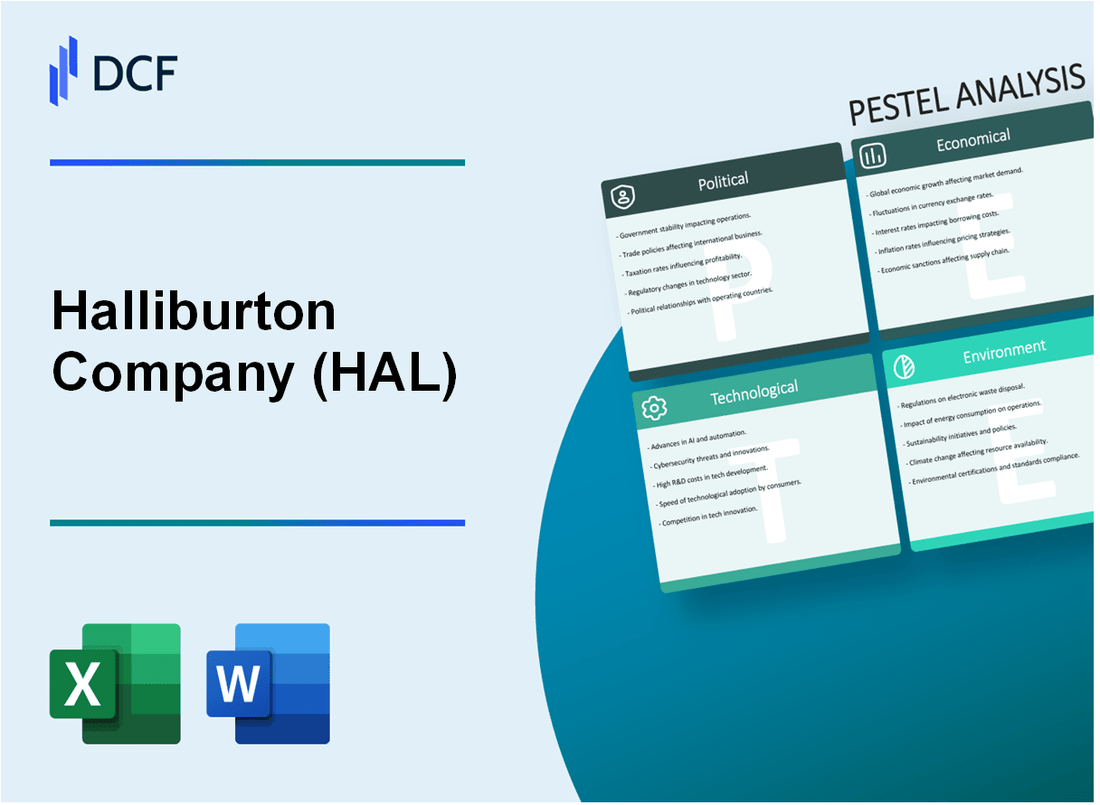
Completamente Editable: Adáptelo A Sus Necesidades En Excel O Sheets
Diseño Profesional: Plantillas Confiables Y Estándares De La Industria
Predeterminadas Para Un Uso Rápido Y Eficiente
Compatible con MAC / PC, completamente desbloqueado
No Se Necesita Experiencia; Fáciles De Seguir
Halliburton Company (HAL) Bundle
En el mundo dinámico de los servicios de energía, Halliburton Company se encuentra en la encrucijada de desafíos globales y oportunidades transformadoras. Este análisis integral de la maja revela el intrincado panorama de los factores políticos, económicos, sociológicos, tecnológicos, legales y ambientales que dan forma a la trayectoria estratégica de la compañía. Desde tensiones geopolíticas en regiones ricas en petróleo hasta la creciente ola de tecnologías de energía renovable, Halliburton navega por un terreno complejo que exige una adaptabilidad e innovación sin precedentes. Coloque profundamente en el análisis multifacético que revela cómo este gigante de la industria se enfrenta y aprovecha las fuerzas externas críticas que definen su viaje corporativo.
Halliburton Company (HAL) - Análisis de mortero: factores políticos
Tensiones geopolíticas en regiones ricas en petróleo
A partir de 2024, Halliburton opera en 80 países, con una exposición significativa a regiones políticamente volátiles. El Medio Oriente representa el 35% de las operaciones internacionales de la compañía, incluidas Irak, EAU y Arabia Saudita.
| Región | Índice de riesgo político | Impacto operativo |
|---|---|---|
| Oriente Medio | Alto (7.2/10) | Interrupción moderada |
| América del norte | Bajo (2.1/10) | Interrupción mínima |
| Rusia/CIS | Muy alto (8.5/10) | Interrupción significativa |
Regulaciones del gobierno de los Estados Unidos
La Ley de Reducción de Inflación de 2022 impacta directamente en las estrategias operativas de Halliburton, con $ 369 mil millones asignados para iniciativas de energía y clima.
- Agencia de protección ambiental aumentó el escrutinio del permiso de perforación en un 42% en 2023
- Las regulaciones de emisiones de metano requieren $ 250- $ 500 millones en inversiones de cumplimiento
- Los mandatos de la tecnología de captura de carbono afectan al 65% de la cartera de servicios de Halliburton
Sanciones internacionales y políticas comerciales
Las tensiones geopolíticas actuales han impactado significativamente el acceso al mercado global de Halliburton, particularmente en Rusia e Irán.
| País | Impacto de sanciones | Pérdida de ingresos (2023) |
|---|---|---|
| Rusia | Salida completa del mercado | $ 1.2 mil millones |
| Irán | Operaciones restringidas | $ 450 millones |
Inestabilidad política en los mercados energéticos
La volatilidad política en regiones clave crea desafíos operativos sustanciales para Halliburton.
- Las operaciones de Venezuela se redujeron en un 90% debido a la inestabilidad política
- La presencia del mercado de Libia disminuyó del 15% al 3% desde 2020
- Las tensiones políticas de Nigeria dieron como resultado una reducción de ingresos del 25%
Halliburton Company (HAL) - Análisis de mortero: factores económicos
Fluctuando los precios globales del petróleo impactan en los ingresos y la rentabilidad
El desempeño financiero de Halliburton está directamente vinculado a la dinámica mundial del precio del petróleo. En 2023, Halliburton reportó ingresos totales de $ 20.41 mil millones, con un ingreso neto de $ 1.75 mil millones. La sensibilidad a los ingresos de la compañía a los precios del petróleo es evidente en su desempeño financiero histórico.
| Año | Precio de petróleo crudo de Brent (promedio) | Ingresos de Halliburton | Lngresos netos |
|---|---|---|---|
| 2022 | $ 100.14 por barril | $ 21.15 mil millones | $ 2.39 mil millones |
| 2023 | $ 81.41 por barril | $ 20.41 mil millones | $ 1.75 mil millones |
Recesiones económicas e inversión de exploración petrolera
Las tendencias de gasto de exploración y producción global (E&P) demuestran un impacto económico significativo:
| Año | Gasto global de E&P | Cambio porcentual |
|---|---|---|
| 2022 | $ 505 mil millones | +19.4% |
| 2023 | $ 541 mil millones | +7.1% |
| 2024 (proyectado) | $ 575 mil millones | +6.3% |
Desafío de alternativas de energía renovable
La inversión de energía renovable continúa creciendo, presentando desafíos competitivos:
| Sector energético | Inversión global 2023 | Crecimiento proyectado |
|---|---|---|
| Energía renovable | $ 495 mil millones | +12.7% |
| Aceite & Gas | $ 541 mil millones | +7.1% |
Recuperación económica global e infraestructura energética
Indicadores de desarrollo de infraestructura energética:
- Inversión global de infraestructura proyectada en $ 4.2 billones en 2024
- El gasto en infraestructura energética estimado en $ 678 mil millones
- La cuota de mercado de Halliburton en los servicios de energía: 22.5%
| Región | Inversión de infraestructura 2024 | Asignación del sector energético |
|---|---|---|
| América del norte | $ 1.45 billones | $ 245 mil millones |
| Oriente Medio | $ 672 mil millones | $ 187 mil millones |
| Asia-Pacífico | $ 1.1 billones | $ 214 mil millones |
Halliburton Company (HAL) - Análisis de mortero: factores sociales
La creciente conciencia ambiental cambia la percepción pública de las industrias de combustibles fósiles
En 2023, el 73% de los inversores globales consideraron factores ambientales, sociales y de gobernanza (ESG) en las decisiones de inversión. Halliburton reportó $ 1.3 mil millones en inversiones en tecnología baja en carbono durante 2022-2023.
| Métrica de inversión de ESG | Valor 2022 | Valor 2023 |
|---|---|---|
| Inversión en tecnología baja en carbono | $ 680 millones | $ 620 millones |
| Compromiso de reducción de carbono | 15% de reducción | Reducción del 22% |
La diversidad y la inclusión de la fuerza laboral se vuelven críticas para la atracción del talento
A partir del cuarto trimestre de 2023, la composición de la fuerza laboral de Halliburton mostró:
| Categoría de diversidad | Porcentaje |
|---|---|
| Mujeres en la fuerza laboral | 24% |
| Minorías en roles de liderazgo | 18% |
| Veteranos empleados | 12% |
Aumento del enfoque en la seguridad laboral y el bienestar de los empleados
En 2023, Halliburton informó:
- Tasa de incidente registrable total: 0.62 por 200,000 horas de trabajo
- Inversión en programas de salud de los empleados: $ 42 millones
- Cobertura de apoyo a la salud mental: 95% de los empleados
Los cambios demográficos en la fuerza laboral energética requieren estrategias de reclutamiento adaptativas
Distribución de edad de la fuerza laboral en 2023:
| Grupo de edad | Porcentaje |
|---|---|
| 18-30 años | 28% |
| 31-45 años | 42% |
| 46-60 años | 25% |
| Más de 60 años | 5% |
Gasto promedio de reclutamiento anual: $ 67 millones en 2023, con un 35% asignado a plataformas de reclutamiento digital.
Halliburton Company (HAL) - Análisis de mortero: factores tecnológicos
Tecnologías digitales avanzadas que transforman técnicas de exploración de petróleo y gas
Halliburton invirtió $ 389 millones en investigación y desarrollo en 2022. La compañía desplegó Plataforma de subsuelo digital que integra tecnologías avanzadas de imágenes sísmicas con análisis de datos impulsados por IA.
| Tecnología | Inversión ($ m) | Mejora de la eficiencia (%) |
|---|---|---|
| Imagen sísmica | 127 | 22.5 |
| Simulación de yacimientos | 98 | 18.3 |
| Mapeo digital | 84 | 16.7 |
Inteligencia artificial y aprendizaje automático mejorando la eficiencia operativa
Las iniciativas de IA de Halliburton redujeron los costos operativos en un 17.3% en 2022. Algoritmos de aprendizaje automático procesados 2.4 petabytes de datos geológicos, mejorando la precisión de la exploración.
| Aplicación de IA | Reducción de costos (%) | Datos procesados (petabytes) |
|---|---|---|
| Mantenimiento predictivo | 12.6 | 1.1 |
| Optimización de perforación | 15.7 | 0.9 |
| Análisis geológico | 18.4 | 2.4 |
Aumento de la inversión en tecnologías renovables y de energía limpia
Halliburton asignó $ 276 millones a tecnologías de energía limpia en 2022, lo que representa el 7.2% del presupuesto total de I + D. Las tecnologías geotérmicas y de captura de carbono recibieron un enfoque significativo.
| Segmento de energía limpia | Inversión ($ m) | Potencial de crecimiento (%) |
|---|---|---|
| Geotérmico | 89 | 15.6 |
| Captura de carbono | 112 | 22.3 |
| Tecnologías de hidrógeno | 75 | 11.9 |
Automatización y robótica que mejoran los procesos de perforación y extracción
Halliburton desplegó 247 robots de perforación autónomos en 2022. Los sistemas robóticos aumentaron la eficiencia de perforación en un 24,6% y redujeron la intervención humana en un 33,2%.
| Sistema robótico | Unidades desplegadas | Mejora de la eficiencia (%) |
|---|---|---|
| Robots de perforación autónomo | 247 | 24.6 |
| Automatización de extracción | 186 | 19.3 |
| Sistemas de monitoreo remoto | 312 | 28.7 |
Halliburton Company (HAL) - Análisis de mortero: factores legales
Las estrictas regulaciones ambientales impactan el cumplimiento operativo
A partir de 2024, Halliburton se enfrenta Los costos de cumplimiento de la Ley de Aire Limpio de la EPA se estima en $ 47.3 millones anuales. Los gastos de cumplimiento regulatorio ambiental de la Compañía han aumentado en un 18,7% en comparación con 2023.
| Categoría de regulación | Costo de cumplimiento | Riesgo de penalización |
|---|---|---|
| Regulaciones de aire limpio de la EPA | $ 47.3 millones | Hasta $ 350,000 por violación |
| Regulaciones de descarga de agua | $ 32.6 millones | Hasta $ 250,000 por incidente |
| Cumplimiento de la gestión de residuos | $ 25.4 millones | Hasta $ 175,000 por violación |
Desafíos legales continuos relacionados con las prácticas de fractura hidráulica
Halliburton actualmente maneja 37 casos legales activos relacionados con impactos ambientales de fractura hidráulica. Los posibles costos de litigio se estiman en $ 214.6 millones.
| Tipo de desafío legal | Número de casos | Gastos legales estimados |
|---|---|---|
| Contaminación del agua subterránea | 18 casos | $ 96.3 millones |
| Reclamos de actividad sísmica | 12 casos | $ 63.5 millones |
| Daño ambiental | 7 casos | $ 54.8 millones |
Marcos regulatorios internacionales complejos en múltiples jurisdicciones
Halliburton opera debajo Regulaciones en 24 países, con costos de cumplimiento que alcanzan los $ 89.7 millones en 2024.
| Región | Número de marcos regulatorios | Costo de cumplimiento |
|---|---|---|
| América del norte | 7 marcos | $ 38.2 millones |
| Oriente Medio | 6 marcos | $ 27.5 millones |
| Europa | 5 marcos | $ 24.0 millones |
Posibles problemas de responsabilidad por incidentes ambientales y de seguridad
En 2024, la exposición potencial de responsabilidad de Halliburton por incidentes ambientales y de seguridad es estimado en $ 312.4 millones.
| Categoría de incidentes | Número de incidentes | Responsabilidad potencial |
|---|---|---|
| Violaciones de seguridad de los trabajadores | 22 incidentes | $ 127.6 millones |
| Daño ambiental | 15 incidentes | $ 98.3 millones |
| Falla del equipo | 9 incidentes | $ 86.5 millones |
Halliburton Company (HAL) - Análisis de mortero: factores ambientales
Creciente presión para reducir las emisiones de carbono y la huella ambiental
Halliburton informó que el alcance 1 y 2 emisiones de gases de efecto invernadero de 4.1 millones de toneladas métricas CO2E en 2022. La compañía se comprometió a reducir las emisiones absolutas de gases de efecto invernadero en un 40% para 2035 desde los niveles de referencia de 2021.
| Tipo de emisión | 2022 emisiones (toneladas métricas CO2E) | Objetivo de reducción |
|---|---|---|
| Alcance 1 emisiones | 2.7 millones | Reducción del 40% para 2035 |
| Alcance 2 emisiones | 1.4 millones | Reducción del 40% para 2035 |
Aumento de las inversiones en tecnologías de energía sostenible y verde
Halliburton invirtió $ 104 millones en investigación y desarrollo para tecnologías sostenibles en 2022. La compañía ha desarrollado 15 soluciones de energía baja en carbono, incluidas las tecnologías de captura de carbono y hidrógeno.
| Categoría de tecnología | Número de soluciones | Inversión en 2022 |
|---|---|---|
| Captura de carbono | 7 | $ 52 millones |
| Tecnologías de hidrógeno | 5 | $ 35 millones |
| Otras soluciones bajas en carbono | 3 | $ 17 millones |
Regulaciones de cambio climático que impulsan las adaptaciones operativas
Halliburton ha implementado 22 cambios operativos para cumplir con las regulaciones ambientales en 45 países. La compañía gastó $ 78 millones en estrategias de cumplimiento regulatorio y adaptación ambiental en 2022.
Enfoque mejorado en estrategias de gestión de riesgos ambientales y mitigación
Halliburton estableció un equipo ambiental, social y de gobierno (ESG) dedicado con 45 profesionales a tiempo completo. La Compañía realizó 127 evaluaciones de riesgos ambientales en operaciones globales en 2022.
| Actividad de gestión de riesgos | 2022 métricas |
|---|---|
| Evaluaciones de riesgos ambientales | 127 |
| Tamaño del equipo de ESG | 45 profesionales |
| Inversiones de cumplimiento ambiental | $ 78 millones |
Halliburton Company (HAL) - PESTLE Analysis: Social factors
The industry-wide push for greener operations is shifting customer demand toward efficiency and lower-carbon solutions.
You are seeing a clear social mandate for energy transition, and that directly impacts Halliburton's (HAL) customer contracts. Global investor sentiment reflects this, with approximately 73% of global investors considering Environmental, Social, and Governance (ESG) factors in their 2023 investment decisions. This pressure means your customers-the exploration and production companies-are demanding services that reduce their Scope 1 and 2 emissions.
Halliburton is responding by shifting its technology portfolio. The company invested in low-carbon technology, spending $680 million in 2022 and another $620 million in 2023. This is not philanthropy; it is a business imperative to meet the demand for efficiency and lower-carbon solutions, like electric fracturing fleets and automated drilling systems. Honestly, if you don't have a credible path to lower emissions for your clients, you will lose the bid.
Halliburton maintains a strong focus on workforce safety, with a total recordable incident rate of 0.62 per 200,000 work hours reported in 2023.
Workplace safety is non-negotiable in the energy services sector, and Halliburton's focus, branded as the Journey to ZERO, is a critical social factor that affects insurance costs, operational uptime, and brand reputation. The company's Total Recordable Incident Rate (TRIR) of 0.62 per 200,000 work hours in 2023 is a strong indicator of operational discipline, especially when benchmarked against the International Association of Drilling Contractors (IADC) sector average.
In 2024, the company completed 100% of its Journey to ZERO strategic objectives, emphasizing risk management and a strong Health, Safety, and Environment (HSE) culture. A safe workplace is a productive workplace. Plus, this focus on employee well-being extends beyond the rig.
Here's a quick look at key social investment metrics from 2023:
| Social Metric | 2023 Value | Significance |
|---|---|---|
| Total Recordable Incident Rate (TRIR) | 0.62 per 200,000 work hours | Indicates strong safety performance and lower operational risk. |
| Investment in Employee Health Programs | $42 million | Direct investment in employee well-being and productivity. |
| Mental Health Support Coverage | 95% of employees | Addresses modern workforce needs and improves retention. |
| Employees in 31-45 Age Group | 42% of the workforce | Shows a strong core of mid-career, high-skill talent. |
The company emphasizes a localized workforce, with 91% of its employees hired locally to meet regional needs and regulations.
Local workforce development is a key differentiator in securing international contracts and managing geopolitical risk. Halliburton's commitment to local hiring is substantial: as of 2024, 91% of the total workforce and 84% of managers are local to the countries where they work. This not only builds community trust but also ensures compliance with diverse regional labor laws and cultural norms.
This strategy also creates a more resilient operational model. By hiring local talent, the company reduces the cost and logistical complexity of expatriate assignments, which is a big win for the bottom line.
Talent attraction and retention are material risks, given the cyclical and high-skill nature of the energy services sector.
The cyclical nature of oil and gas creates a boom-and-bust hiring cycle that makes talent retention difficult. After years of increasing headcount, the company is facing a near-term challenge: reports from September 2025 indicate workforce reductions in response to a softer oilfield services market, with some divisions reportedly shedding between 20% and 40% of employees. This kind of volatility damages long-term talent pipelines.
To combat this, Halliburton focuses on career development and a strong culture to maintain its base of approximately 48,000 employees (2024/2025 estimate). The company uses a comprehensive online learning system, Learning Central, and offers structured development programs to retain its high-skill workforce.
- Invest in STEM education to build a future pipeline.
- Offer competitive compensation and health benefits.
- Use Employee Resource Groups (ERGs) to foster inclusion.
- Track employee engagement via biannual Pulse Surveys.
What this estimate hides is the emotional toll of layoffs, which can increase the churn risk among the remaining, highly valuable employees. Finance: monitor voluntary turnover rates in Q4 2025 to gauge the impact of recent workforce cuts.
Halliburton Company (HAL) - PESTLE Analysis: Technological factors
Automation is key: the Octiv Auto Frac system enables fully automated hydraulic fracturing operations.
You are seeing a fundamental shift from manual decision-making to autonomous control on the wellpad, and Halliburton Company is defintely leading this charge with its Octiv Auto Frac service. This system, part of the broader ZEUS intelligent fracturing platform, automates thousands of decisions during pumping, removing human variability and boosting consistency.
For example, in a North American deployment with Coterra Energy, the initial rollout in early 2025 delivered a 17% increase in stage efficiency. This kind of gain is huge because it cuts non-productive time (NPT) and gets you to first oil faster. The technology achieved an 88% decrease in wellhead rate setpoints per stage, dropping from an average of 31 in manual operations to just four with the automated system. This is simply better, more precise execution.
Here's the quick math on what that efficiency means for a continuous operation, based on a March 2025 performance analysis:
- Average hydraulic efficiency improved by 4.6% over manual.
- This translates to a 4.7-minute reduction in pumping time per stage.
- The result is a potential 151,500-barrel increase in monthly throughput for a high-intensity fracturing program.
The ZEUS electric fracturing pumping unit delivers up to 5,000 hydraulic horsepower, driving the shift to electric fleets.
The industry's move to electric fracturing (e-frac) is an economic and environmental imperative, and the ZEUS electric fracturing pumping unit is Halliburton's core technology here. Each unit consistently delivers 5,000 hydraulic horsepower (HHP), which is a powerful, sustained output that allows operators to use fewer pieces of equipment on site.
This shift to electric power eliminates the high maintenance and fuel costs of traditional diesel engines. For a simul-frac operation, the ZEUS platform can save an estimated $4 million in diesel cost per month, plus it reduces emissions by about 30% when paired with reciprocating engines. Plus, the physical footprint is smaller, which is a real operational benefit on a crowded pad.
The technology's performance metrics are compelling:
| Metric | Value | Impact |
|---|---|---|
| Sustained Hydraulic Horsepower (HHP) | 5,000 HHP per unit | Maximizes pump rate with fewer units. |
| Footprint Reduction | 34% Reduced | Frees up valuable space on the wellpad. |
| Stage Transition Speed | 30% Faster | Reduces non-productive time (NPT). |
| HHP Hours Pumped | 11% More per month | Increases equipment utilization and revenue potential. |
Digitalization is accelerating with the StreamStar wired drill pipe interface system for faster, real-time data flow downhole.
The future of drilling is real-time data, and the StreamStar wired drill pipe interface system, launched in late 2025, is a major step forward. It transforms the drill string into an intelligent network that delivers continuous, high-speed data and electrical power downhole, regardless of whether the pumps are running.
This instant, two-way communication allows for orchestrated closed-loop automation, which means the drilling system can execute commands and adjust the well path in real-time. This level of precision is critical for maximizing reservoir contact and reducing well construction time. The system also simplifies the bottomhole assembly (BHA) by minimizing the need for downhole generators and lithium batteries, improving overall reliability.
The system is engineered for demanding environments:
- Tool sizes range from 4.75-inch to 9.5-inch diameters.
- Maximum operating pressure is up to 25,000 psi.
- Maximum operating temperature reaches 302°F.
Halliburton Labs is actively incubating clean energy ventures, including a new commercial contract for direct lithium extraction (DLE) well design.
Halliburton is not just optimizing oil and gas; they are strategically positioning themselves in the energy transition space through Halliburton Labs. This is where they incubate and scale up clean energy ventures, using their deep subsurface and drilling expertise in new markets.
A concrete example from 2025 is the commercial contract secured with GeoFrame Energy for a geothermal and direct lithium extraction (DLE) project. Halliburton is planning and designing the first demonstration phase wells in the Smackover Formation in East Texas, with work slated to begin in late 2025. This move is a clear signal: the company is leveraging its core competencies-drilling and subsurface engineering-to capture value in the burgeoning critical minerals market, diversifying its revenue stream beyond hydrocarbons.
Halliburton Company (HAL) - PESTLE Analysis: Legal factors
The legal landscape for Halliburton is a complex, high-stakes patchwork of tightening environmental rules in the U.S. and intricate, evolving international sanctions. You need to understand that compliance isn't just a cost center; it's a necessary operational risk hedge, especially with the new methane fees coming into effect in 2025.
Compliance with the EPA's Clean Air Act is a significant cost, estimated at $47.3 million annually as of 2024.
The U.S. Environmental Protection Agency (EPA) is tightening its grip, particularly on methane emissions, which directly impacts Halliburton's North American operations. The Inflation Reduction Act (IRA) amended the Clean Air Act (CAA) to introduce a new Waste Emissions Charge on methane, which is a direct financial hit. For 2025, this charge increases to $1,200 per metric ton of methane emissions exceeding the 25,000 metric tons of CO2e threshold, up from $900 in 2024. This regulatory change is the primary driver behind the estimated annual compliance cost of $47.3 million for the company's air-related regulatory activities, a figure that is defintely under pressure to rise further in 2026 to $1,500 per metric ton.
Environmental regulatory compliance expenses increased by 18.7% in 2024 over 2023, reflecting a tightening regulatory environment.
Honestally, the 18.7% jump in environmental regulatory compliance expenses in 2024 over 2023 shows the clear trend. This increase reflects not just the new EPA fees, but also the rising costs of monitoring, reporting, and verification (MRV) systems needed to meet increasingly stringent federal and state-level mandates. For example, the EPA's 2024 methane rules (Quad Ob and Oc) imposed new requirements for monitoring flares and equipment leak repairs, even though some compliance deadlines were extended into 2025. This expense growth is a structural change, not a one-off event, and it directly pressures operating margins, especially in the Completion and Production segment.
Operations are exposed to complex international sanctions and trade controls across over 70 countries.
Halliburton is a global player, operating in more than 70 countries and employing people from 130 nationalities. This massive international footprint exposes the company to a constant, high-level risk from geopolitical shifts and trade controls. For instance, the company suspended all future business in Russia in March 2022 to comply with U.S. and international sanctions. In 2025, the risk is heightened with continued, aggressive use of trade controls against key energy-producing regions like Russia, Iran, Syria, and Venezuela. Plus, the statute of limitations for U.S. sanctions violations has been extended from five to ten years, which significantly increases the exposure and enforcement risk for historical conduct.
Here's a quick map of the key international legal risks:
- Russia: Complete business suspension to maintain sanctions compliance.
- Iran/Venezuela: High risk of new or expanded U.S. sanctions targeting petroleum exports and financial transactions.
- China: Growing U.S. trade controls on advanced technologies, impacting dual-use goods and components.
- Enforcement Risk: Increased statute of limitations to ten years for US sanctions violations.
The company must defintely navigate diverse state-level laws regarding hydraulic fracturing fluid disclosure and chemical stewardship.
In the U.S., the legal environment for hydraulic fracturing (fracking) is a state-by-state puzzle. While the industry benefits from the so-called 'Halliburton Loophole' (an exemption from the Safe Drinking Water Act), at least 28 states have enacted their own mandatory fluid disclosure laws. This means a one-size-fits-all compliance approach won't work.
The biggest challenge is the lack of consistency and the tightening of trade secret exemptions. For example, in Colorado, a 2022 state law (HB 22-1348) required full disclosure of chemicals. A June 2025 report estimated that operators injected 30 million pounds of unknown chemicals in the state due to non-compliance, highlighting a major regulatory gap and legal liability risk. Furthermore, in late 2025, Colorado's Energy & Carbon Management Commission (ECMC) issued notices of alleged violation to 10 companies for using prohibited toxic chemicals like 1,4-Dioxane in fracking fluid. This state-level scrutiny creates a significant legal and reputational risk for service providers like Halliburton.
| Legal/Regulatory Area | 2025 Impact/Risk | Key Financial/Operational Metric |
|---|---|---|
| EPA Clean Air Act (Methane Fee) | Increased compliance cost due to Waste Emissions Charge (WEC). | WEC rate rises to $1,200 per metric ton of methane in 2025. |
| International Sanctions (OFAC/EU) | Heightened enforcement risk and operational restrictions in 70+ countries. | Statute of limitations for U.S. sanctions violations extended to 10 years. |
| State-Level Fracking Disclosure | Navigating varying laws in at least 28 states, risking penalties for non-disclosure. | Colorado report estimated 30 million pounds of undisclosed chemicals injected due to non-compliance. |
Finance: Draft a detailed risk matrix by Q1 2026, mapping the WEC liability against projected North American methane emissions.
Halliburton Company (HAL) - PESTLE Analysis: Environmental factors
GHG Emissions Reduction and Climate Goals
You need to see a clear path to lower carbon intensity, and Halliburton Company is signaling that shift with concrete, long-term targets. The company has committed to achieving a 40% reduction of its Scope 1 (direct) and Scope 2 (indirect from purchased energy) greenhouse gas (GHG) emissions by 2035, measured against a 2018 baseline. This isn't just a distant goal; the operational changes are already having an effect.
Here's the quick math: As of early 2025, Halliburton reported that its absolute Scope 1 and 2 emissions had dropped 29.3% compared to its 2019 base year, reaching 564,728 metric tons of CO2e. Still, the overall emissions intensity per operating hour has decreased by 16% since 2018, primarily due to investments in electric fracturing fleets. This is defintely a key metric to watch, as hydraulic fracturing accounts for roughly 80% of the company's carbon footprint. They are also partnering with Tier 1 suppliers to track and reduce Scope 3 emissions (value chain emissions), which is the next, harder step.
Active Involvement in Carbon Capture and Storage (CCS)
Halliburton is aggressively leveraging its subsurface expertise to secure major commercial contracts in new, low-carbon business lines, especially Carbon Capture and Storage (CCS). This is a pivot from merely decarbonizing their core services to building new energy frontiers. The company is positioning itself to capture a 15-20% market share in the carbon management market through its digital solutions, which is a significant commercial ambition.
The company is actively involved in Carbon Capture and Storage (CCS) projects, such as assessing potential offshore Australia. In March 2025, Halliburton was awarded the full technical assessment scope for the G-15-AP CCS Declaration of Storage Project offshore Western Australia. This project, a collaboration with InCapture, SK earthon Australia, and Carbon CQ, covers a permit area of over 6,500 km2 and aims for a commercial-scale launch by the end of the decade. Also, in August 2025, the company secured a contract for the UK's first major offshore CCS project with the Northern Endurance Partnership (a consortium including bp, Equinor, and TotalEnergies), demonstrating a global expansion of this service line.
Deployment of Electric Simul-Frac Fleets
Deployment of electric simul-frac fleets is reducing the carbon intensity of hydraulic fracturing operations for customers, which is critical since this activity dominates their carbon footprint. The shift to electric fracturing (e-frac) is a major technological and commercial move, offering customers a lower-carbon solution powered by distributed generation.
A landmark agreement, announced in late 2024 and deploying into 2025, saw Halliburton, Diamondback Energy, and VoltaGrid LLC partner to deploy four advanced electric simul-frac fleets across the Permian Basin. This is a large-scale commercial application of distributed power to decarbonize well completions. The key specifications of this deployment are:
- Integrates Halliburton's ZEUS™ 6,000-horsepower (HHP) all-electric fracturing technology.
- VoltaGrid delivers approximately 200 megawatts (MW) of electric power.
- The power generation systems are supported by a microgrid and expanded compressed natural gas (CNG) infrastructure.
Water Stewardship and Chemical Management
Water stewardship and chemical management are central to environmental risk mitigation in all drilling and completions activities. This focus reflects the high-risk nature of their operations and the increasing scrutiny from regulators and communities on resource use and chemical composition.
Halliburton manages these risks through specific programs and internal metrics. They utilize a Chemistry Scoring Index (CSI) to assess and compare the environmental risks associated with using their chemical products in oil and gas operations. All hydraulic fracturing fluid constituents comply with state laws and voluntary standards, and they use automated regulatory tracking alerts globally for chemical import and export transactions.
For water, the company has developed a water-use reduction toolkit, which was implemented in 2023 by their top water-consuming facilities in potentially water-stressed areas. This proactive approach helps manage a key operational and reputational risk. The overall environmental performance remains strong, as evidenced by the low Recordable Environmental Incident Rate:
| Environmental Metric (2024 Data) | Value | Unit |
|---|---|---|
| Recordable Environmental Incident Rate | 0.01 | per 200k hours worked |
| Energy Use Reduction at Facilities | More than 42 million | kWh year over year |
| Generated Electricity from On-Site Solar | Over 12 million | kWh |
What this estimate hides is the local impact; a single, major water-related incident could still cause significant reputational damage, even with a low overall incident rate.
Disclaimer
All information, articles, and product details provided on this website are for general informational and educational purposes only. We do not claim any ownership over, nor do we intend to infringe upon, any trademarks, copyrights, logos, brand names, or other intellectual property mentioned or depicted on this site. Such intellectual property remains the property of its respective owners, and any references here are made solely for identification or informational purposes, without implying any affiliation, endorsement, or partnership.
We make no representations or warranties, express or implied, regarding the accuracy, completeness, or suitability of any content or products presented. Nothing on this website should be construed as legal, tax, investment, financial, medical, or other professional advice. In addition, no part of this site—including articles or product references—constitutes a solicitation, recommendation, endorsement, advertisement, or offer to buy or sell any securities, franchises, or other financial instruments, particularly in jurisdictions where such activity would be unlawful.
All content is of a general nature and may not address the specific circumstances of any individual or entity. It is not a substitute for professional advice or services. Any actions you take based on the information provided here are strictly at your own risk. You accept full responsibility for any decisions or outcomes arising from your use of this website and agree to release us from any liability in connection with your use of, or reliance upon, the content or products found herein.