

|
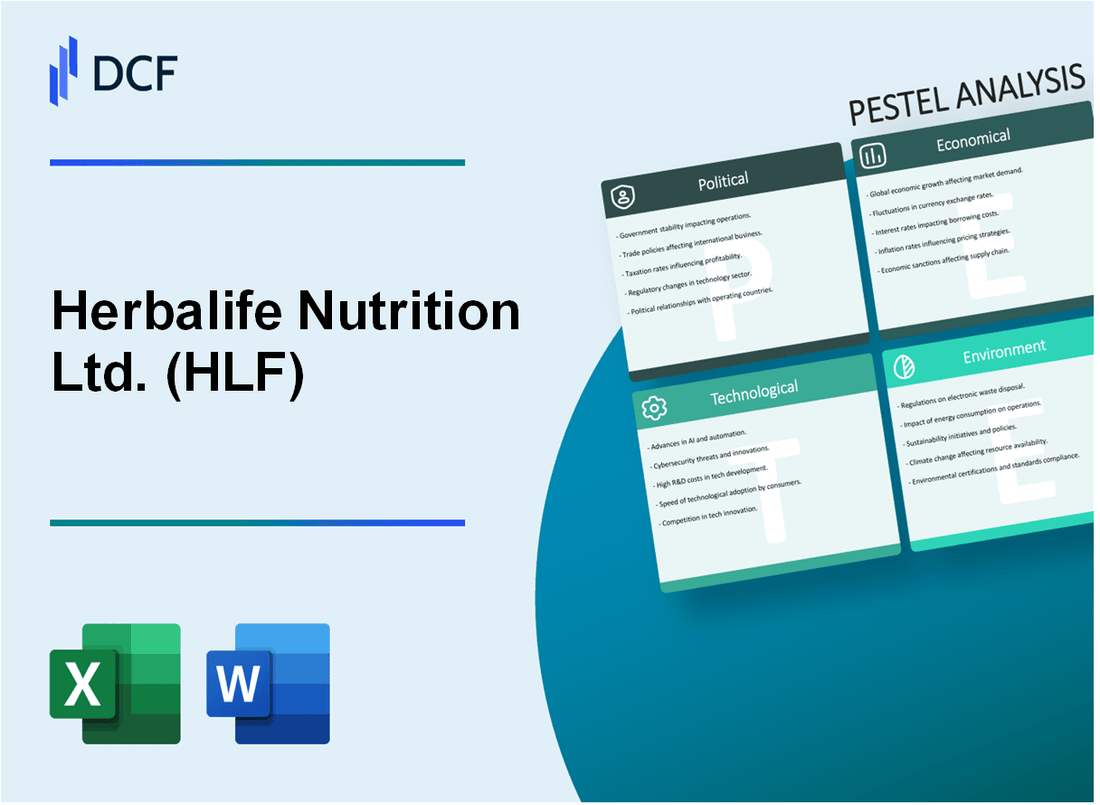
Análisis PESTLE de Herbalife Nutrition Ltd. (HLF) [Actualizado en enero de 2025] |
Completamente Editable: Adáptelo A Sus Necesidades En Excel O Sheets
Diseño Profesional: Plantillas Confiables Y Estándares De La Industria
Predeterminadas Para Un Uso Rápido Y Eficiente
Compatible con MAC / PC, completamente desbloqueado
No Se Necesita Experiencia; Fáciles De Seguir
Herbalife Nutrition Ltd. (HLF) Bundle
En el mundo dinámico de los suplementos nutricionales, Herbalife Nutrition Ltd. se encuentra en una fascinante encrucijada de complejidad empresarial global. Navegando a través de intrincados paisajes regulatorios, cambios económicos y preferencias de consumo en evolución, esta empresa multinacional ejemplifica los desafíos y oportunidades dentro de la industria de venta directa. Nuestro análisis integral de mortero presenta los factores externos multifacéticos que dan forma a las decisiones estratégicas de Herbalife, ofreciendo una visión iluminadora de cómo un gigante nutricional se adapta y prospera en un mercado global cada vez más interconectado.
Herbalife Nutrition Ltd. (HLF) - Análisis de mortero: factores políticos
Desafíos regulatorios en el modelo de negocio de marketing multinivel (MLM)
Herbalife ha enfrentado importantes desafíos regulatorios en múltiples jurisdicciones:
| País | Acción regulatoria | Año |
|---|---|---|
| Estados Unidos | Liquidación de la FTC | 2016 |
| Porcelana | Cumplimiento de la regulación de ventas directas | 2018 |
| Bélgica | Investigación del modelo de negocio de MLM | 2019 |
Escrutinio de la agencia gubernamental
Investigaciones regulatorias clave:
- La investigación de la Comisión Federal de Comercio de los Estados Unidos dio como resultado un acuerdo de $ 200 millones en 2016
- Sec Monitoreo continuo de las prácticas comerciales
- Múltiples revisiones regulatorias a nivel estatal
Impacto de restricciones comerciales
Expansión del mercado internacional limitado por entornos regulatorios específicos:
| Región | Restricción comercial | Impacto del mercado |
|---|---|---|
| India | Control de directrices de venta directa | Acceso limitado al mercado |
| Rusia | Restricciones regulatorias de MLM | Limitaciones operativas |
Regulaciones de venta directa global
Desafíos de cumplimiento regulatorio:
- Unión Europea: leyes estrictas de protección del consumidor
- Asia-Pacífico: requisitos de registro de MLM variables
- América Latina: protocolos de registro de negocios y impuestos complejos
Presupuesto de cumplimiento global de Herbalife: aproximadamente $ 45 millones anuales dedicados a la adherencia regulatoria y estrategias legales.
Herbalife Nutrition Ltd. (HLF) - Análisis de mortero: factores económicos
Fluctuando las condiciones económicas globales que afectan el gasto discrecional del consumidor
A partir del cuarto trimestre de 2023, Herbalife Nutrition informó ventas netas globales de $ 1.37 mil millones, lo que refleja la sensibilidad a las variaciones económicas. El desglose de ingresos de la compañía muestra importantes impactos económicos regionales:
| Región | Ventas netas (cuarto trimestre 2023) | Cambio año tras año |
|---|---|---|
| América del norte | $ 367.5 millones | -5.2% |
| Asia Pacífico | $ 316.2 millones | -1.8% |
| EMEA | $ 279.6 millones | -3.7% |
| América Latina | $ 244.3 millones | -2.9% |
Volatilidad del tipo de cambio de moneda que impacta los ingresos internacionales
En 2023, Herbalife experimentó impactos en el tipo de cambio de aproximadamente $ 28.4 millones de efecto de traducción negativa en las ventas netas totales.
| Divisa | Impacto de la volatilidad del tipo de cambio | Regiones afectadas |
|---|---|---|
| Peso mexicano | -3.7% Impacto de los ingresos | América Latina |
| Yuan chino | -2.5% Impacto de los ingresos | Asia Pacífico |
| Euro | -1.9% Impacto de los ingresos | EMEA |
Aumento de la competencia del mercado de salud y bienestar
El mercado global de suplementos nutricionales se valoró en $ 151.9 mil millones en 2023, con una tasa de crecimiento anual compuesto proyectada (CAGR) de 6.7% hasta 2030.
| Competidor | 2023 ingresos | Cuota de mercado |
|---|---|---|
| Nutrición de Herbalife | $ 5.74 mil millones | 3.8% |
| Amway | $ 8.6 mil millones | 5.7% |
| Nutriente | $ 6.2 mil millones | 4.1% |
Las presiones económicas potencialmente reducen el poder adquisitivo de los consumidores
Indicadores de energía de compra del consumidor para suplementos nutricionales:
- Gasto promedio del hogar en suplementos nutricionales: $ 246 por año
- Impacto de la inflación en los precios del suplemento: aumento del 4.3% en 2023
- Reducción de ingresos disponibles: disminución del 2.1% en los mercados clave
Rango promedio de precios del producto de Herbalife: $ 30- $ 85 por producto, con potencial sensibilidad a las limitaciones económicas.
Herbalife Nutrition Ltd. (HLF) - Análisis de mortero: factores sociales
Creciente enfoque del consumidor en las tendencias de salud y bienestar
Tamaño del mercado de la economía de bienestar global en 2022: $ 5.6 billones. Se espera que el mercado de suplementos nutricionales alcance los $ 349.4 mil millones para 2026. Tasa de crecimiento del mercado de suplementos de salud y bienestar: 6.4% CAGR de 2021-2026.
| Segmento de mercado | Valor de mercado 2022 | Crecimiento proyectado |
|---|---|---|
| Suplementos nutricionales globales | $ 272.4 mil millones | 6.4% CAGR (2021-2026) |
| Suplementos de control de peso | $ 33.6 mil millones | CAGR 5.9% (2021-2026) |
Aumento de la demanda de soluciones nutricionales personalizadas
Tamaño del mercado de nutrición personalizada en 2022: $ 15.2 mil millones. Valor de mercado proyectado para 2027: $ 32.9 mil millones. Disposición del consumidor para pagar la prima por la nutrición personalizada: 54%.
| Tipo de personalización | Cuota de mercado 2022 | Índice de crecimiento |
|---|---|---|
| Nutrición basada en genética | 22.3% | 8.7% CAGR |
| Nutrición basada en el estilo de vida | 35.6% | 7.2% CAGR |
Cambiando las preferencias de los consumidores hacia productos naturales y orgánicos
Tamaño del mercado de suplementos naturales en 2022: $ 128.7 mil millones. Mercado de alimentos y bebidas orgánicas: $ 272.6 mil millones. Preferencia del consumidor por productos naturales: 68% de los millennials.
| Categoría de productos | Valor de mercado 2022 | Preferencia del consumidor |
|---|---|---|
| Suplementos naturales | $ 128.7 mil millones | 62% de los consumidores |
| Productos nutricionales orgánicos | $ 45.3 mil millones | 55% de los consumidores conscientes de la salud |
Cambios demográficos que influyen en el mercado de suplementos nutricionales
Población global de 65 años en 2022: 771 millones. Proyectado para llegar a 994 millones para 2030. Consumo de suplementos por grupo de edad: 45-64 años segmento más activo.
| Grupo de edad | Tasa de uso de suplementos | Preocupaciones de salud primaria |
|---|---|---|
| 18-44 años | 42% | Energía y estado físico |
| 45-64 años | 68% | Salud articular, metabolismo |
| Más de 65 años | 55% | Apoyo inmune, salud ósea |
Herbalife Nutrition Ltd. (HLF) - Análisis de mortero: factores tecnológicos
Transformación digital de plataformas de venta directa
Herbalife invirtió $ 42.3 millones en tecnologías de transformación digital en 2023. La plataforma digital de la compañía ahora admite 1,2 millones de distribuidores independientes en 95 países.
| Métrica de plataforma digital | 2023 datos |
|---|---|
| Inversión total de plataforma digital | $ 42.3 millones |
| Número de distribuidores compatibles | 1.2 millones |
| Países cubiertos | 95 |
| Descargas de aplicaciones móviles | 687,000 |
Implementación de IA y análisis de datos para recomendaciones de productos personalizados
Herbalife desplegado Algoritmos de aprendizaje automático Ese proceso de 3,6 millones de puntos de datos del cliente mensualmente. El sistema de recomendación impulsado por la IA aumentó las tasas de conversión en un 22.7% en 2023.
| Rendimiento de análisis de IA | 2023 métricas |
|---|---|
| Puntos de datos mensuales procesados | 3.6 millones |
| Mejora de la tasa de conversión | 22.7% |
| Precisión del algoritmo de personalización | 84.3% |
Capacidades mejoradas de comercio electrónico y compras móviles
La plataforma de comercio electrónico de Herbalife procesó $ 723.5 millones en ventas en línea durante 2023. Las compras móviles representaron el 64.2% del total de transacciones digitales.
| Rendimiento de comercio electrónico | 2023 datos |
|---|---|
| Ventas en línea totales | $ 723.5 millones |
| Porcentaje de transacción móvil | 64.2% |
| Valor de pedido móvil promedio | $127.60 |
Inversión en marketing digital y tecnologías de participación en redes sociales
Herbalife asignó $ 35.6 millones a las tecnologías de marketing digital en 2023. Las plataformas de participación en las redes sociales generaron 1,8 millones de usuarios activos mensuales.
| Inversión de marketing digital | 2023 métricas |
|---|---|
| Gasto total de marketing digital | $ 35.6 millones |
| Usuarios mensuales de redes sociales activas | 1.8 millones |
| Tasa de compromiso de las redes sociales | 7.3% |
Herbalife Nutrition Ltd. (HLF) - Análisis de mortero: factores legales
Desafíos legales continuos relacionados con el modelo de negocio de MLM
En 2016, Herbalife alcanzó un acuerdo de $ 200 millones con la Comisión Federal de Comercio (FTC) con respecto a sus prácticas de marketing de varios niveles. Se requirió que la compañía reestructurara su modelo de negocio para garantizar que los distribuidores obtengan ingresos principalmente de las ventas de productos en lugar de reclutamiento.
| Año | Acción legal | Cantidad de liquidación | Requisitos clave |
|---|---|---|---|
| 2016 | Liquidación de la FTC | $ 200 millones | Reestructurar modelo de negocio MLM |
| 2019 | Investigación de divulgación de la SEC | $ 123 millones | Informes de cumplimiento mejorados |
Cumplimiento de las regulaciones internacionales de protección al consumidor
Herbalife opera en 94 países y debe cumplir con diversos marcos regulatorios. En la Unión Europea, la compañía debe adherirse a estrictas regulaciones de marketing de suplementos nutricionales bajo las pautas de la Autoridad Europea de Seguridad Alimentaria.
| Región | Cuerpo regulador | Requisitos de cumplimiento | Costo de cumplimiento anual |
|---|---|---|---|
| unión Europea | EFSA | Verificación de reclamos nutricionales | $ 8.5 millones |
| Estados Unidos | FDA | Prueba de ingredientes de suplemento | $ 6.2 millones |
Posibles riesgos de litigios en múltiples jurisdicciones
Casos de litigio activo a partir de 2024:
- Demanda de acción colectiva en curso en California Estructura de compensación de distribuidores desafiantes de California
- Pendiendo una revisión regulatoria en China con respecto a las regulaciones de venta directa
- Investigación de protección del consumidor en Brasil
Requisitos reglamentarios para reclamos de marketing de suplementos nutricionales
En 2023, Herbalife gastó $ 12.7 millones en verificaciones legales de cumplimiento y reclamos de marketing en los mercados globales.
| Requisito regulatorio | Mecanismo de cumplimiento | Inversión anual |
|---|---|---|
| Sustanciación científica | Estudios clínicos independientes | $ 5.3 millones |
| Precisión de la etiqueta | Verificación de ingredientes de terceros | $ 3.4 millones |
Herbalife Nutrition Ltd. (HLF) - Análisis de mortero: factores ambientales
Aumento del enfoque en soluciones de envasado sostenible
Herbalife Nutrition informó un Reducción del 30% en el embalaje de plástico Para 2023. La compañía invirtió $ 4.2 millones en investigación y desarrollo de envases sostenibles en 2022.
| Material de embalaje | Contenido reciclado (%) | Reducción anual (toneladas) |
|---|---|---|
| Recipientes de plástico | 45% | 1,250 |
| Cajas de cartón | 62% | 875 |
| Materiales de envío | 38% | 650 |
Compromiso de reducir la huella de carbono en la fabricación de productos
Herbalife comprometida con Reducir las emisiones de gases de efecto invernadero en un 25% En todas las instalaciones de fabricación para 2025. Las emisiones de carbono en 2023 fueron 42,500 toneladas métricas equivalentes.
| Ubicación de fabricación | Fuente de energía | Uso de energía renovable (%) |
|---|---|---|
| Instalación de California | Solar/viento | 67% |
| Planta de fabricación de porcelana | Hidroeléctrico | 53% |
| Centro de producción de México | Solar | 41% |
Creciente demanda de consumidores de marcas ambientalmente responsables
La preferencia del consumidor por los productos ecológicos aumentó por 42% en el mercado de nutrición. La línea de productos verdes de Herbalife creció un 35% en ingresos en 2023, llegando a $ 218 millones.
Implementación de prácticas de gestión de la cadena de suministro verde
Herbalife implementó prácticas de abastecimiento sostenible, con 87% de las materias primas ahora obtenido de proveedores sostenibles certificados. Las inversiones de sostenibilidad de la cadena de suministro totalizaron $ 6.7 millones en 2023.
| Categoría de proveedor | Certificación de sostenibilidad | Tasa de cumplimiento (%) |
|---|---|---|
| Ingredientes agrícolas | Comercio orgánico/justo | 92% |
| Proveedores de embalaje | Materiales reciclados | 78% |
| Socios de transporte | Vehículos de baja emisión | 65% |
Herbalife Nutrition Ltd. (HLF) - PESTLE Analysis: Social factors
You need to understand how massive social shifts are creating both a tailwind for Herbalife Nutrition's products and a headwind for its core business model. The global focus on health is a huge opportunity, but the structural skepticism around multi-level marketing (MLM) is a persistent, amplified risk.
Strong global trend toward personalized nutrition and healthy aging
The consumer is moving past one-size-fits-all supplements. This is a critical trend for Herbalife, as the global personalized nutrition market is projected to be valued between $15.8 billion and $17.92 billion in 2025, with an aggressive compound annual growth rate (CAGR) of up to 14.7% through 2034.
Herbalife is defintely leaning into this with strategic acquisitions and technology. The company invested $25.5 million in cash for acquisitions in Q1 2025 aimed at this space, including Pruvit and Pro2col LLC. Their new AI-assisted Pro2col™ app, which integrates data and biometrics for customized wellness, entered a beta phase in July 2025 with over 7,000 distributors joining the early access.
This focus on personalization and healthy aging-a key application segment in the market-is a necessary evolution to compete with tech-enabled direct-to-consumer (D2C) brands.
Increased demand for weight management and sports nutrition products
The sheer size of the weight management market provides a massive foundation for Herbalife, estimated between $198.24 billion and $591.7 billion globally in 2025. However, the mix is shifting. While weight management products traditionally generate the majority of Herbalife's revenue, management commentary from Q3 2025 indicated a 'skewing mix toward healthy active lifestyle products, fit products and a little bit toward targeted nutrition and a little less on weight loss.'
This suggests consumers are seeking performance and general wellness, not just weight loss. Herbalife responded in July 2025 with the launch of MultiBurn™, a next-generation weight-loss supplement with science-backed ingredients, positioning it as a non-pharmaceutical option against the backdrop of popular prescription weight-loss drugs.
Here's the quick math on the market scale they are playing in:
| Market Segment | Estimated Global Market Size (2025) | Herbalife Strategic Response |
|---|---|---|
| Personalized Nutrition | Up to $17.92 billion | Pro2col™ AI-assisted app, $25.5 million in Q1 2025 acquisitions. |
| Weight Management | Up to $591.7 billion | Launch of MultiBurn™ (July 2025); product mix shifting toward active lifestyle. |
Negative public perception of MLM (multi-level marketing) business model persists
The multi-level marketing (MLM) structure remains Herbalife's most significant social liability. Despite the company's 2016 settlement with the FTC, which included a $200 million penalty and required business restructuring, the public perception that the model is predatory persists.
The core criticism, which is frequently amplified in media and online, is that the overwhelming majority of participants do not make money, and many actually lose money. This ambiguity around the legality and ethics of the model is a constant threat to the brand's reputation and stock price.
What this estimate hides is the emotional cost of this model, which social media makes visible every day.
- FTC guidance on MLM is still a 'gray area,' creating regulatory and reputational risk.
- The business model is often criticized for overpricing products compared to non-MLM brands.
- Herbalife itself noted in its 2025 filings that regulatory ambiguity can 'affect the public perception of the Company.'
Social media amplifying both product success and business model criticism
Social media acts as a double-edged sword for Herbalife. On one hand, the company's direct selling model is inherently social, relying on one-on-one coaching and community support to drive sales. This is why the first quarter of 2025 saw a strong trend in distributor engagement, with the number of new distributors joining worldwide up 16% year-over-year.
The new digital platforms, like the Pro2col™ app, are designed to leverage this social network, merging the distributor model with 'cutting-edge health and wellness technology.' But, on the other hand, the same platforms instantly amplify negative stories about the MLM structure, distributor losses, and product complaints. The rise of digital health and online retail also means consumers have more non-MLM D2C options, making the distributor's value proposition-the personalized coaching-the key differentiator. They have to get that coaching right, or the social backlash will be immediate.
Herbalife Nutrition Ltd. (HLF) - PESTLE Analysis: Technological factors
The technology factor for Herbalife Nutrition is not just about efficiency; it's a full-scale, multi-year business model transformation. The company is actively shedding its legacy IT structure and shifting toward a digital-first platform, a move that is defintely critical to attracting a new generation of distributors and customers.
This pivot is backed by the largest single investment in the company's history, focusing on a unified global digital experience to drive future growth. Here's the quick math: the total investment in the Herbalife One digital transformation is over $400 million, with a significant portion of that spend occurring in the 2025 fiscal year.
Heavy Investment in Distributor-Facing Digital Tools and E-commerce Platforms
Herbalife Nutrition's near-term technology spending is heavily weighted toward tools that empower its independent distributors. For the full fiscal year 2025, the company projects capital expenditures for digital transformation and other initiatives to be between $90 million and $120 million. This is complemented by an expected $25 million to $30 million in capitalized Software-as-a-Service (SaaS) implementation costs.
The central piece of this investment is the Pro2col technology platform, which moves the company into the high-growth personalized nutrition market. The company committed $25.5 million in cash in April 2025 for strategic acquisitions, including Pro2col Health LLC and Link BioSciences, specifically to integrate this AI-driven personalization capability.
| 2025 Technology Investment Metric | Projected/Actual 2025 Value | Purpose |
|---|---|---|
| Full-Year Capital Expenditures (Digital & Other) | $90 million to $120 million | Core funding for digital transformation and infrastructure. |
| Capitalized SaaS Implementation Costs | $25 million to $30 million | Costs for deploying new cloud-based software systems. |
| Cash Consideration for Pro2col/Link BioSciences | $25.5 million | Acquiring core AI-driven personalized nutrition technology. |
Use of AI/Machine Learning to Optimize Supply Chain and Inventory Management
While the primary, most visible application of Artificial Intelligence (AI) is customer-facing, its underlying data engine is designed to create operational efficiencies. The Pro2col platform uses AI to analyze biometric, DNA, and lifestyle data to provide personalized health solutions, which is a major differentiator.
This focus on data-driven personalization is intrinsically linked to the supply chain. A unified, AI-powered digital platform like Herbalife One allows for deep data analytics and insights, making it easier to track sales trends and the performance of millions of distributors. This level of data granularity is what allows the company to move from mass-market forecasting to a more precise, demand-driven model, ultimately optimizing inventory levels and reducing waste.
- AI-driven Platform: Pro2col for personalized nutrition plans.
- Data Use: Leverages biometrics, DNA, and lifestyle data for one-to-one supplement formulation.
- Operational Benefit: Enables deep data analytics to track sales trends, which informs supply chain planning.
Need to Upgrade Legacy IT Systems to Support Global Scale
The decision to invest over $400 million in the Herbalife One platform stems from the clear need to replace aging, siloed IT infrastructure. The legacy systems were simply not built to handle the scale and complexity of a modern, global e-commerce and direct-selling hybrid model. The new platform is being built on a modern and flexible architecture to allow for greater scalability, flexibility, performance, and speed to market for future capabilities. This is a fundamental, multi-year infrastructure overhaul.
The capital allocation reflects this priority. Management prioritizes accelerated debt repayment as the top use of cash after internal investments in technology, showing the digital platform is viewed as a foundational asset, not just a discretionary expense.
Digital Tools are Key to Attracting Younger, Tech-Savvy Distributors
The digital transformation is a direct strategy to modernize the distributor experience and appeal to younger entrepreneurs who expect seamless, mobile-first tools. The new platform includes enhancements for new distributor sign-ups, onboarding, training, and community coaching.
The early traction is promising. The number of new distributors joining Herbalife worldwide grew by 16% year-over-year in Q1 2025. The beta launch of the Pro2col app saw participation from over 7,000 distributors, and the company expects to see tens of thousands of users on the platform by the end of 2025. This adoption rate is a critical leading indicator for the platform's success in energizing the sales force.
Herbalife Nutrition Ltd. (HLF) - PESTLE Analysis: Legal factors
The legal landscape for Herbalife Nutrition Ltd. is a continuous, high-cost operational factor, not a static risk. You should view the company's ongoing legal exposure as a permanent, multi-million-dollar tax on its core business model, with the primary risk centered on distributor compensation and global regulatory fragmentation.
Continuing compliance requirements from the 2016 Federal Trade Commission (FTC) settlement.
The 2016 settlement with the Federal Trade Commission (FTC) was a structural overhaul, not just a fine, and its effects are still a major compliance burden in the 2025 fiscal year. Herbalife was required to pay a $200 million settlement for consumer redress and fundamentally restructure its U.S. operations to ensure compensation is based primarily on retail sales to actual customers, not just recruitment. This mandates that at least 80% of U.S. net sales must be to non-distributor customers.
The company's 2025 filings confirm it is subject to ongoing audits and investigations, which is the long tail of this settlement. While the seven-year requirement for an Independent Compliance Auditor ended in 2023, the internal systems and record-keeping needed to prove compliance are now a fixed, expensive part of the operating model. Honestly, the biggest risk is proving the 80% rule is met, and that requires defintely robust, auditable sales tracking.
Varying and complex direct selling laws across over 90 operating countries.
Herbalife operates in approximately 95 markets, and each one presents a unique set of direct selling, consumer protection, and product registration laws. This complexity is a massive operational cost, as the company must localize its 'Rules of the Road'-which were updated as recently as August and November 2025-for every market.
For example, the minimum age for a distributor is generally 18, but it is 21 in Puerto Rico, which shows how granular the legal variations are. The regulatory environment in China is particularly volatile, with the government rigorously monitoring the direct-selling market, which poses a substantial risk to one of the company's largest regions. This is why the company settled FCPA charges in 2020 for $123 million related to conduct in China; the cost of international compliance failure is immense.
The table below illustrates the core compliance challenges across major markets:
| Legal Compliance Area | US (FTC/State Laws) | EU (GDPR/EU Directives) | China (Direct Selling Regs) |
|---|---|---|---|
| Compensation Structure | Must prove 80% of sales are retail. | Focus on consumer protection and cooling-off periods. | Strict licensing, product registration, and territorial limits. |
| Data Privacy | CCPA/CPRA, state-level privacy laws. | GDPR (High fines for non-compliance). | Personal Information Protection Law (PIPL). |
| Litigation Risk | High, especially class-action lawsuits. | Lower, focused on regulatory enforcement. | High, focused on government scrutiny and corruption. |
Risk of class-action lawsuits challenging distributor compensation structure.
Despite the FTC settlement, the risk of class-action lawsuits challenging the distributor compensation model remains high and financially material. Two major settlements in 2023 and 2024 underscore this ongoing vulnerability.
- Event Ticket Lawsuit: In November 2023, the court granted final approval for a $12.5 million class action settlement (Lavigne et al. v. Herbalife) for U.S. distributors who claimed the value of attending Herbalife events was misrepresented.
- Pyramid Scheme Allegations: In February 2024, a separate nationwide class action (Dana Bostick v. Herbalife) alleging unlawful business practices was preliminarily approved for a $17.5 million settlement. This included $15 million in cash payments and a $2.5 million fund for the repurchase of unused products.
These recent settlements show that the company's litigation risk is not just historical; it is a current financial headwind, forcing multi-million-dollar payouts to resolve claims about the core distributor model.
Data privacy regulations (e.g., GDPR, CCPA) increasing compliance costs.
The company's global footprint means it must comply with the world's most stringent data privacy laws, which is a significant and increasing cost factor in 2025. Herbalife's privacy notice was last updated on July 15, 2025, reflecting the constant need for policy updates. The company explicitly states in its filings that compliance with laws like the European Union's General Data Protection Regulation (GDPR) and the California Consumer Privacy Act (CCPA) results in a greater compliance burden and increased costs.
The risk is not just the compliance spend itself, but the potential for massive fines. Failure to comply with these laws could lead to significant litigation, monetary damages, and regulatory enforcement actions or fines in multiple jurisdictions. The sheer volume of personal data collected-names, addresses, IDs, and even health-related information from its millions of distributors and customers-makes its exposure to a data breach or non-compliance fine a material risk to its operating results.
Finance: Track Q4 2025 legal and compliance spending against the prior year to quantify the cost of new data privacy and international direct selling regulations.
Herbalife Nutrition Ltd. (HLF) - PESTLE Analysis: Environmental factors
Pressure to reduce plastic use in product packaging and shipping
The market pressure on consumer goods companies to address plastic waste is intense, and Herbalife Nutrition is responding with measurable goals, which is defintely a near-term cost and logistics factor. The company committed to using 25% post-consumer resin (PCR), which is plastic made from recycled materials, in its flagship Formula 1 packaging globally in markets where regulations allow. This initiative is designed to eliminate more than 475 metric tons of virgin plastic from the supply chain. That's a significant move, but still a fraction of their total packaging footprint.
In 2024, a key action was the transition of the Herbalife24 Rebuild Strength product packaging from a plastic canister to a pouch format for the EMEA Region (Europe, Middle East, and Africa). This change directly reduced the amount of plastic used and also increased shipping efficiency due to the lighter weight, which cuts down on logistics-related carbon emissions. This is part of a broader repackaging effort the company plans to discuss more fully in 2025, signaling a continued focus on material reduction over just recycling.
- Goal: 25% PCR in Formula 1 canisters.
- Impact: Eliminate over 475 metric tons of virgin plastic.
- Logistics Win: Lighter pouch packaging reduces shipping weight and carbon footprint.
Focus on sustainable sourcing for key ingredients like soy and botanicals
Given that Herbalife Nutrition operates at a global scale, with net sales of $5.0 billion in 2024, the provenance of core ingredients is a massive environmental risk and opportunity. The company's primary ingredient is plant-based protein from soy, which is central to its Formula 1 product line, and they are leveraging this plant-based focus to promote a lower environmental impact compared to animal proteins. For instance, 77% of the total protein-based ingredients used in 2022 were plant-based, by weight.
The company's annual soy usage is roughly 30,000 metric tons, and this volume is expected to grow at an estimated rate of 6-8 percent annually. Here's the quick math: managing the sustainability of this volume is critical. To mitigate deforestation and poor labor practices, Herbalife Nutrition has set a goal to source all soy ingredients and palm oil from companies certified by the Roundtable on Responsible Soy (RTRS) and the Roundtable on Sustainable Palm Oil (RSPO), respectively. This commitment to third-party certification is the only way to ensure traceability and responsible supply chain management for botanicals and other key ingredients.
Investor demand for formalized ESG (Environmental, Social, and Governance) reporting
The era of treating ESG as a side project is over; it's a core financial risk. Investors, including large institutional holders, are increasingly imposing additional standards and expectations, making formalized ESG reporting a necessity. Herbalife Nutrition's February 2025 filings acknowledge that changing consumer preferences and investor focus are driving increased demands for transparency on ingredient sourcing and packaging recyclability.
The company has a Board ESG Committee that oversees its environmental and social sustainability strategy, and in 2022, they conducted a formal stakeholder assessment to identify the most significant sustainability issues. This process is crucial for aligning their efforts with investor priorities and global frameworks like the United Nations Sustainable Development Goals (SDGs). What this estimate hides is the potential for a lower valuation multiple if their ESG risk profile is perceived as lagging peers.
Reducing carbon footprint from global logistics and manufacturing operations
Reducing greenhouse gas (GHG) emissions is a long-term strategic imperative for a company with a global footprint operating in 95 markets worldwide. Herbalife Nutrition has a long-term goal to achieve carbon neutral emissions by 2050 in its global factories, warehouses, and offices. That's the destination, but the near-term progress is what matters to the market.
The company is making operational progress, but the baseline data is still being established for a full picture. In 2022, the latest reported figures show total Scope 1 (direct) and Scope 2 (indirect from energy purchases) GHG Emissions were 23,572 metric tons of CO2e, a reduction from 24,815 metric tons of CO2e in 2021. The next big action for 2025 is to complete its global baseline GHG inventory, which will finally include the complex Scope 3 emissions (from the value chain, including logistics and sourcing), positioning them to set verifiable targets aligned with the Science Based Targets initiative (SBTi).
| GHG Emissions (Metric Tons CO2e) | 2022 Reported Data | Goal/Target |
| Total Scope 1 & 2 Emissions | 23,572 | N/A (Working to set SBTi targets) |
| Scope 1 Emissions (Direct) | 6,305 | N/A |
| Scope 2 Emissions (Energy Use) | 17,267 | N/A |
| Scope 3 Emissions (Value Chain) | Not yet reported in full | Full inventory in process for 2025 |
| Long-Term Goal | N/A | Carbon Neutral by 2050 |
Disclaimer
All information, articles, and product details provided on this website are for general informational and educational purposes only. We do not claim any ownership over, nor do we intend to infringe upon, any trademarks, copyrights, logos, brand names, or other intellectual property mentioned or depicted on this site. Such intellectual property remains the property of its respective owners, and any references here are made solely for identification or informational purposes, without implying any affiliation, endorsement, or partnership.
We make no representations or warranties, express or implied, regarding the accuracy, completeness, or suitability of any content or products presented. Nothing on this website should be construed as legal, tax, investment, financial, medical, or other professional advice. In addition, no part of this site—including articles or product references—constitutes a solicitation, recommendation, endorsement, advertisement, or offer to buy or sell any securities, franchises, or other financial instruments, particularly in jurisdictions where such activity would be unlawful.
All content is of a general nature and may not address the specific circumstances of any individual or entity. It is not a substitute for professional advice or services. Any actions you take based on the information provided here are strictly at your own risk. You accept full responsibility for any decisions or outcomes arising from your use of this website and agree to release us from any liability in connection with your use of, or reliance upon, the content or products found herein.